Charter Schools and 2020: The Huge Elephant in the Classroom

It’s not just about the unions. As we gear up to hear leading Democratic 2020 candidates at the National Education Association forum this afternoon in Houston, pundits keep missing the point about charter schools and our new political landscape.

nea forum

I, too, …erm…would just like to say that I have always advocated the position I recently adopted…

One thing is hard not to notice: Leading Democrats have flipped on charter schools. Until very recently, leaders like Elizabeth Warren, Cory Booker, and Beto O’Rourke were positively rosy about the prospects of improving education with charters. No longer. Even Senator Booker, the candidate most thoroughly associated with charter reform, has backpedaled.

For some reason, pundits keep missing the obvious explanation for this important partisan realignment. Writers assume that the only reason Democratic hopefuls bash charters is to please the NEA and other teachers’ unions. As Bloomburg put it,

On charter schools, the top Democrats seem intent on placating teachers’ unions at the expense of low-income families.

Another pro-charter activist warned Democrats like Beto O’Rourke that “pandering” to union interests won’t pay off in the end. “The Presidential campaign trail,” she writes,

is littered with candidates who have won the union endorsements and never made it to the White House or even the nomination. They should remind themselves that our north star in education must be what’s best for children.

Will we see candidates pandering to the NEA this afternoon? Probably. I can’t imagine many of them pushing for more charters and voucher programs in front of this crowd. But there is a bigger, more obvious reason for this; candidates aren’t simply telling the audience what it wants to hear.

Here’s the scoop: Like most education-reform ideas, charter schools could never possibly deliver on the inflated promises of advocates. As historians know—and as I’m finding more and more as I complete the research for my book about America’s first urban school-reform movement—school reform ideas tend to follow a predictable pattern. Confronted with intractable social problems, reformers and politicians glom on to a “silver-bullet” idea that promises to save education in one fell swoop.

Charter schools were never the solution to America’s social and educational problems. They are also not the problem. Some charter schools do a great job of educating children. Some don’t. Since the 1990s, however, charter schools have been unfairly touted as the Next Big Thing, the cure-all for structural problems such as poverty, inequality, racial segregation, and underfunding.
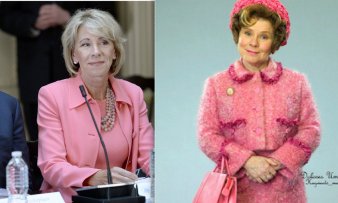
betsy devos dolores umbridge

All Hufflepuffed up.

Until 2016, leaders from both parties embraced this convenient political fiction. It wasn’t the rise of union-backed teacher protests that killed it. Rather, it was the rise of Queen Betsy, the stumbling elephant in the ed-reform china shoppe. By associating charter schools with only the Trumpist wing of the GOP, Queen Betsy has forced Democratic hopefuls to swing the other way.

Do Democratic candidates hope to secure NEA votes? Sure. Will they bash charters to do so? Most likely. But the real elephant in the classroom is Queen Betsy. By making charter schools her signature issue, she has forced a widespread political realignment on the issue.
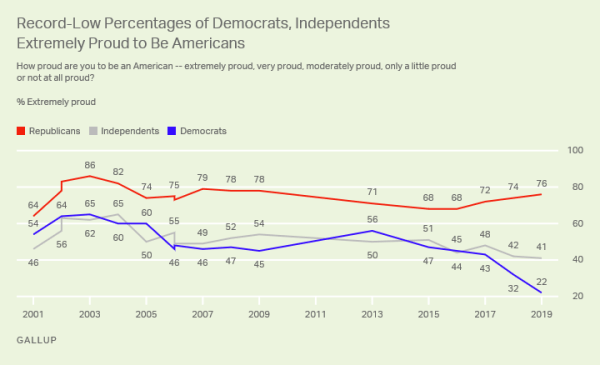
Stupid Question: Are You “Extremely Proud” to Be an American?

Just in time for the Fourth: New poll results prove that Democrats are a bunch of anti-American no-goodniks. But anyone who knows culture-war history will see that Gallup goofed in the wording of this patriotic question.gallup pride

The poll results won’t really surprise anyone. When asked how proud they are to be Americans—“extremely proud, very proud, moderately proud, only a little proud or not at all proud”—fewer and fewer respondents are saying they are “extremely proud.” Among Democrats, the number has slid to a mere 22%, from a post-9/11 high of 65%.

As SAGLRROILYBYGTH know, asking someone if they are “extremely proud” to be an American doesn’t tell us much. For almost a full century now, this kind of phrase has not been a true measure of one’s love of country, but rather a marker of which side you were on. As I argued in The Other School Reformers, following World War I a certain sort of knee-jerk patriotism became a hallmark of cultural conservatism.

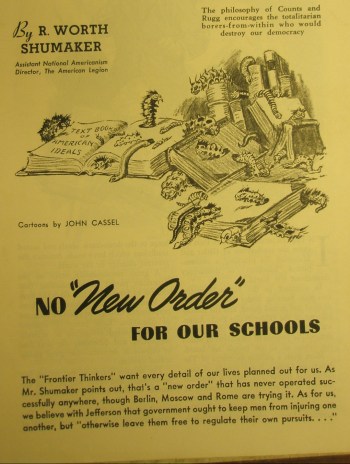
Consider the case of Harold Rugg. Rugg’s textbooks were used by millions of American students. Starting in the late 1930s, however, conservatives in the American Legion and other “patriotic” groups attacked Rugg as sneakily socialist. The books, conservatives argued, were un-American because they questioned America’s role as an unqualifiedly positive force in world history.

As have lefties ever since, Rugg fought back. He insisted that he DID love America, but that children should learn about its faults as well as its virtues. As he put it in 1941, he felt

profound admiration and deep loyalty to the historic American version of the democratic way of life.

He also believed that real American virtues were under attack, not by lefties like him, but by

a few false patriots in our midst who, while mouthing the slogans of Americanism, stamp on the Bill of Rights, destroy tolerant discussion of issues, bear false witness and defame the characters and reputations of other Americans who are sincerely striving to honor and protect the democratic process.

These days, too, asking people if they are “extremely proud” to be American seems to be the wrong question to ask. Consider the flip side: With a few exceptions—such as conservative isolationism in the early 1940s—generally the Left has been the side of “peace.” Since the Vietnam War in particular, saying that you are in favor of “peace” has lined you up with hippies and vegetarianism and Jane Fonda.

OLYMPUS DIGITAL CAMERA

Boring…boring…boring from within.

Of course conservatives are also in favor of “peace.” Who isn’t? But any poll that asked Americans if they were on the side of “peace” would get skewed results. It would find that Democrats apparently favored “peace” more than Republicans.

For this Fourth of July holiday, too, with T-diddy promising “brand-new Sherman tanks” in a Stalin-esque military display, it seems perverse to ask people if they are “extremely proud” to be Americans. Ask us if we love this country. Ask us if we are willing to make sacrifices for the common good. Ask us a million different questions and you’ll get a better answer.

I Love You but You Didn’t Do the Reading

Summer’s here and the culture wars are bloomin. Here are some of the top stories from the interwebs this week. Thanks to everyone who sent in tips.

White supremacists keep leafleting college campuses, at IHE.

What’s going on in Indianapolis’s Catholic schools?

Was Anita Bryant really the first Christian martyr to LGBTQ rights in the 1970s? Not really, at WaPo.anita bryant protest

The latest from Taylor University: President suddenly retires, at CT.

Working at Liberty University…not so great, from WT.

Liberty University as a whole was as shifty, dishonorable, unprincipled, and hypocritical a work environment as could be offered.

What Would Howard Zinn Say?

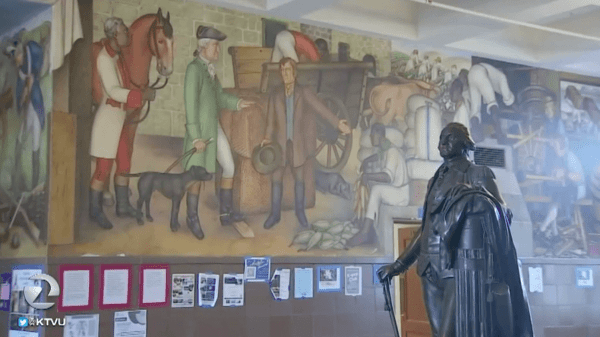
I admit it—I was confused. I had to read the news from San Francisco two more times before I realized that I had read it right. The school board had voted to destroy a communist-painted mural that depicted US history as the story of slavery and genocide because…it was racist. They didn’t want students to have to see Washington depicted as a slave-purchasing Indian-killer.washington mural 1

First, the historical background: As I described in The Other School Reformers, in the 20th century conservatives fought long and hard to keep what they called “communist” histories out of America’s schools. Books that told the stories of genocide and slavery were repeatedly attacked by groups such as the American Legion and Daughters of the American Revolution as anti-American and subversive.washington mural 2

This week in San Francisco, though, the 1930s-era murals by communism-friendly artist Victor Arnautoff will be destroyed. It’s not that people don’t understand the point of the murals. The school board seems to understand that these murals were meant to criticize Washington’s participation in genocide and slavery. However, the school board decided that these particular anti-slavery, anti-genocide murals were not the best way to teach kids. In the words of the school board’s working group,

We come to these recommendations due to the continued historical and current trauma of Native Americans and African Americans with these depictions in the mural that glorifies slavery, genocide, colonization, manifest destiny, white supremacy, oppression, etc. This mural doesn’t represent SFUSD values of social justice, diversity, united, student-centered. It’s not student-centered if it’s focused on the legacy of artists, rather than the experience of the students. If we consider the SFUSD equity definition, the “low” mural glorifies oppression instead of eliminating it. It also perpetuates bias through stereotypes rather than ending bias. It has nothing to do with equity or inclusion at all. The impact of this mural is greater than its intent ever was. It’s not a counter-narrative if [the mural] traumatizes students and community members.

Indeed, the activists who opposed this mural came from the left, not the right. It was not the honest depictions of slavery and genocide against which they protested, but rather the depictions of African Americans and Native Americans solely as victims, slaves, and corpses. As one anti-mural activist told the LA Times,

Our students deserve better. We don’t need to see ourselves portrayed as dead Indians every single time we see ourselves portrayed in any type of art or in any books. We don’t need that. . . . We know our history already — our students don’t need to see it every single time they walk into a public school.

washington mural 3As another anti-muralist told the Washington Post,

It is time to erase the dominant narrative of the dead and defeated Native American. . . . It is important that our public schools are a place for all students to learn and be educated in a safe environment.

After reading these arguments, I felt like I understood the objections better. Perhaps the school board is not merely echoing the sentiments of right-wingers and trying to block any depiction of the ugly side of US history. Rather, the goal is to give students a deeper “counter-narrative.”

Still, as a history teacher, I’m feeling nonplussed. It is difficult enough to talk about racial violence and imperialism in class. Literally whitewashing an attempt to show those histories doesn’t seem like the best way to get those important conversations going.

…Could This Possibly Work?

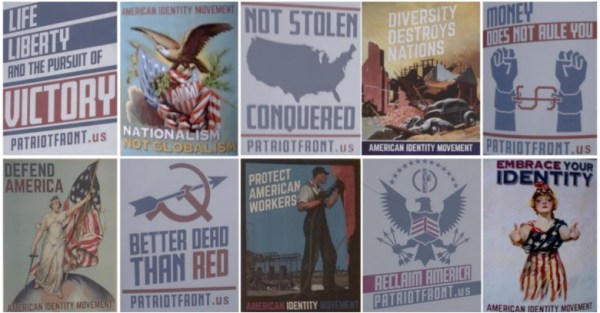
I’m really asking: Does anyone think that white supremacist organizations will  have much luck recruiting on college campuses? According to Inside Higher Education, that’s the reason groups such as the American Identity Movement put up leaflets.

White supremacy posters IHE REAL

…do these things actually work?

Why would they spend time putting up these posters on campuses? According to the Anti-Defamation League, the goal of these white supremacists is to

inject their views into spaces they view as bastions of liberal thinking and left-wing indoctrination.

So here’s my naive question: Is there any possibility some college student will see these posters and think, ‘hmmm, you know that makes a lot of sense”…?

I can’t imagine it, but I know I’m not normal. According to last year’s ADL report, most of the campus “recruiting” was done far away from sunny Binghamton, in Texas and California, Washington state and Florida.

I just can’t imagine this sort of thing getting any traction on our campus. Are other colleges different?

Indianapolis: Catholic LGBTQ Battle Ground

Who knew Indianapolis would emerge as the field on which Catholics would do culture-war battle? This week has seen an incredible back-and-forth in that city’s Catholic schools. One school has broken with the archdiocese in order to retain a gay teacher. Two others have fired gay teachers. I’m sorry for the folks in Indianapolis. Whenever there is a school battle like this, everyone loses. However, I can’t help but notice that this back-and-forth highlights the difficult questions of orthodoxy that we have been discussing lately here at ILYBYGTH.

bryan and darrow

What’s wrong with the “orthodoxy” defense? Ask William Jennings Bryan…

Here’s what we know: According to the New York Times, Cathedral High School fired a teacher in a same-sex marriage after receiving instructions to do from the archdiocese. At Roncalli High last year, two gay teachers were fired. Meanwhile, Brebeuf Jesuit Preparatory School refused to do so, and cut ties with the archdiocese.

[For SAGLRROILYBYGTH who are not savvy about Catholic stuff, Jesuit schools are often not under the direct control of the archdiocese, unlike most parish schools. It is a little easier for Brebeuf to contradict an archdiocesan directive, but it is still very unusual.]

My heart goes out to all the people involved. This must be a wrenching and difficult time for all of them, no matter which side they are on. FWIW, I’m guessing that most people at these schools are not on one side or another, but rather simply want the best education for the kids.

For those of us watching from the sidelines, this story highlights some of the thorniest issues of culture-war school battles. Just as they did when defending Karen Pence’s job at a conservative evangelical school with an anti-LGBTQ policy, some conservatives will surely insist that Indianapolis conservatives are merely defending Catholic orthodoxy.

As the New York Times explained,

A statement from the archdiocese said its approach to teachers in same-sex marriages was “not about sexual orientation,” but rather its belief that Catholic school employees “are ministers of the faith” who must “abide by all Church teachings, including the nature of marriage.”

“If and when a minister of the faith is publicly not doing so, the Church calls us to help the individual strive to live a life in accordance with Catholic teaching,” the statement said.

Over the years, the archdiocese has “walked with individuals and schools” on other issues that went against the teachings of the church, it said.

When an individual has not “chosen this accompaniment,” the archdiocese said, “it is very difficult to part ways, but we readily honor the person’s dignity and decision.”

From the conservative perspective within the church, then, this is a simple question of orthodoxy. School teachers are expected to uphold the faith, not undermine it.

But it’s not really that simple. The question of “orthodoxy” is never so easy. As progressive Catholic pundit Fr. James Martin told the New York Times, the Indianapolis archdiocese is guilty of very selective enforcement. As he put it, if the archdiocese really wanted to defend Catholic orthodoxy among teachers,

the “categories of people you would need to fire” would amount to “a huge list,” including faculty members who used birth control, skipped Sunday Mass or did not give to the poor.

“Why are those virtues any less important than the church’s teaching on same-sex marriage?” Father Martin said. “It is completely discriminatory.”

This is why I’m always surprised when some conservative pundits bring out the “orthodoxy” defense so unthinkingly. It is a two-edged sword. Just ask William Jennings Bryan.

Why Is There a Racial Divide about Charter Schools?

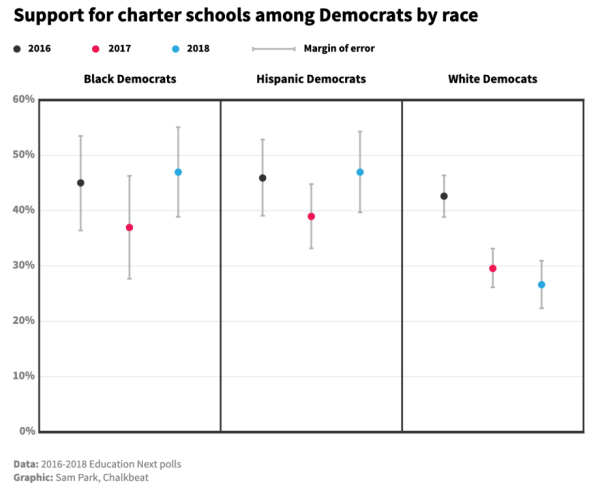
It is an uncomfortable issue for progressive white people to talk about. As the Democratic Party swings hard against charter schools, the racial divide is becoming painfully obvious. Black and Latinx Democrats support charter schools at much higher rates than white ones do. So what gives? Are suburban whites being insensitive to urban concerns? Probably. But there is another obvious point that needs to be included in the discussion.support-for-charter-scools by raceIf you haven’t heard it already, you will soon. White Democrats who oppose charter schools will be accused of racial insensitivity, at best. As the Washington Post’s editors put it,

It’s easy to oppose charters if you are well-off and live in a suburb with good schools.

The racial divide in the Democratic Party on the issue of charter schools has been and will be painted as a simple urban/suburban divide. And there’s some important truth to that. However, we’d be silly if we didn’t also recognize the context.

Namely, for the past thirty years, on certain issues, Black Democrats have often been far more conservative than white ones. As just one example, take the issue of abortion rights. In 2018, just over three quarters (76%) of all Democrats supported legal abortion rights “in all or most cases.” Just under one quarter (21%) wanted abortion illegal “in all or most cases.”

party and abortion 2018

No surprise here…

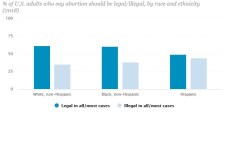
African American voters, however, tended to be much more conservative about abortion rights. Only 60% of African Americans supported legal abortion rights, compared to 38% who opposed them.

What does this mean? Not all that much, of course. Not all African-American voters are Democrats, though many are. And on plenty of other issues African-American Democrats do not skew more conservative than white Democrats.race and abortion 2018

When it comes to charter schools, however, we should remember that racial divisions within the Democratic Party are the norm, not an anomaly. If the issue of charter schools is shifting—AND IT IS—from one with bipartisan support to one with solely conservative support, we should not be surprised to find more conservative Democrats sticking with it. On many issues, including LGBTQ rights and abortion rights, non-white Democrats have always been more conservative than whites.

The racial divide about charter schools is just joining a party divide already in progress.

From the Archives: School a la Carte

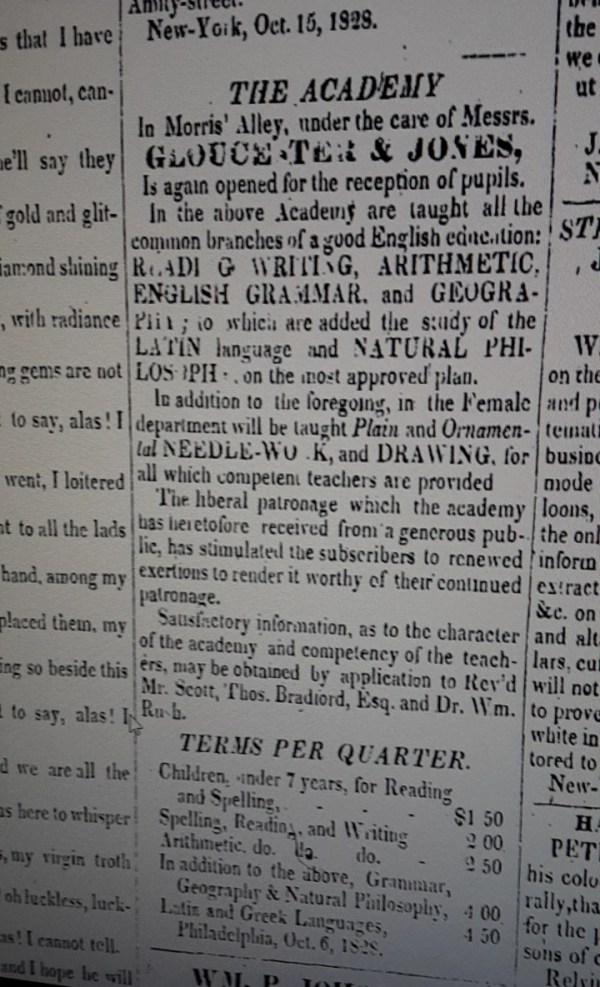
In newspapers from the early 1800s, they are everywhere. Individual proprietors advertised their services to the population of cities. Parents and children could slap together as much education as they could afford, with rates published up front. It might sound like a purely private, market-driven system, but the fine print shows it wasn’t that simple.

a la carte education

From Freedom’s Journal (New York), October 17, 1828

In this case the school was for African-American kids in Philadelphia, c. 1828. As I’ve argued recently in the Washington Post, I think conservatives who dream of injecting more market forces into public education don’t really understand how things worked back when the market WAS in control. As I dig through the newspapers and records of African-American schools in the early 1800s, it is obvious that tuition payments alone could not provide the schools kids needed.

Sure, some families likely thrived with schools like these, but even these “private” academies relied on public funding. As you can see in this advertisement, Philadelphia’s Academy didn’t survive on tuition alone. It also received

liberal patronage from a generous public.

Over time, that patronage evolved into reliable, secure tax funding. Then and only then were schools able to flourish, for both white and black students. When people these days yearn for public schools that don’t rely entirely on tax funding, they don’t seem to realize what they are asking for.

In the bad old days of early public schooling, schools like the Morris’ Alley Academy were forced to cobble together funding from all over the place. I think if Gloucester and Jones could sit down with DeVos and Friedman, they would set them straight.

From the Archives: Who Are Schools REALLY For?

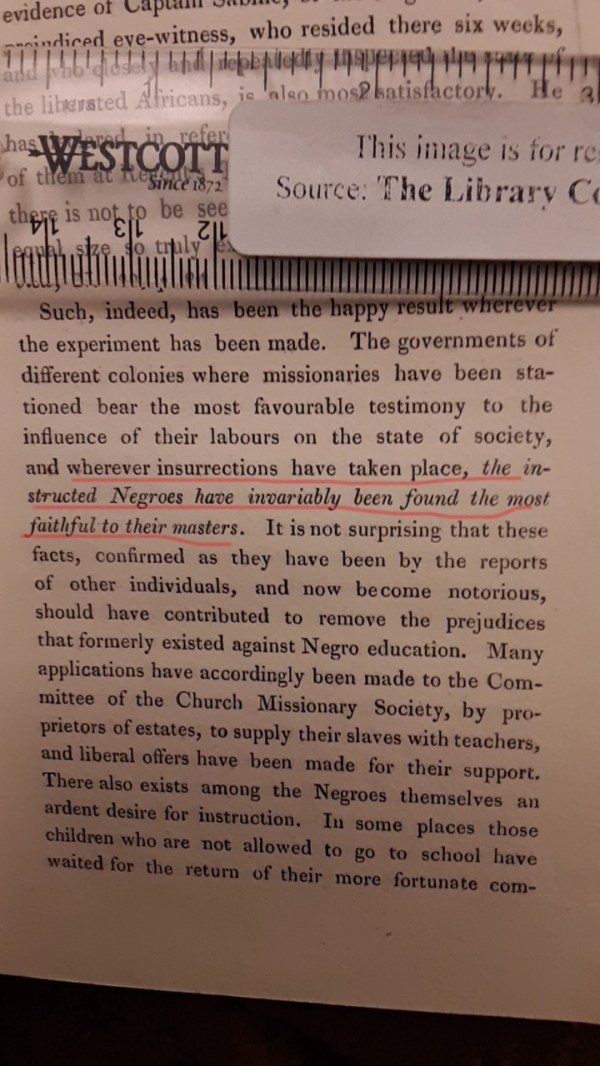
In theory, it’s not surprising. But it’s still always weird to see people talking so blatantly about it. InkedInsurrection 1826_LI

The latest came from my work at the Library Company in Philadelphia. A group of English “Ladies” were raising money in 1826 to educate enslaved people in the West Indies. Their pitch? Educated slaves are the most loyal. As they put it,

wherever insurrections have taken place, the instructed Negroes have invariably been found the most faithful to their masters. It is not surprising that these facts, confirmed as they have been by the reports of other individuals, and now become notorious, should have contributed to remove the prejudices that formerly existed against Negro education.

I Love You but You Didn’t Do the Reading

The view from 1804 is still pretty bleak, but things in 2019 don’t look all that cheery, either. Here are some of the news stories we found when we crawled up out of the archives this week:

Will the real conservative please stand up? Prof. Patrick Deneen reviews George Will’s new book at WaPo.

Animated by a conservative skepticism of the belief in sufficient human knowledge to control circumstance, and a pessimism about the capacity of human beings to consistently act from noble intentions (or that such noble intentions are likely to lead to noble ends), Will calls for a minimalist state allowing for maximal expression of “spontaneous order.” . . . Nowhere to be found in the 538 pages of text is a discussion of conservative commitments to the unborn, the threats posed by the advance of the sexual liberation movement, and commitments to religious liberty. It is as if the book was written in 1944…

A billionaire offers a new way to give teachers a raise, at Forbes.

An interview with historian Darren Dochuk about his new book, Anointed with Oil: How Christianity and Crude Made Modern America, at R&P.

Amid jungles of derricks and refining fires, risk-filled labor and violent swings of fortune, oil-patch Christians embrace a cataclysmic view of the here and now and of life beyond, as well as a dependency on an all-powerful being who gives and takes and tests his people but is always there.

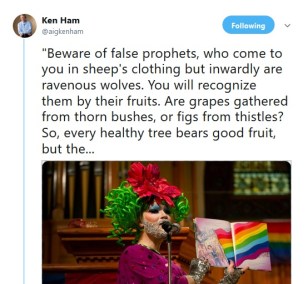
Why are radical creationists so upset about men in heels? Here at ILYBYGTH.

Ken Ham drag school

It’s not Darwin they’re worried about, it’s “Sparkle Leigh.”

Can a professor teach a class about conservative thought? Portland State says no, at IHE.

How did Teach For America get tied up with charter schools? An expose at Propublica. HT: MM

Liberty U. cuts divinity program, at IHE.

Did anyone think we were done with all this? Trump, Falwell, Cohen, and the “Pool Boy,” at NYT.

That backstory, in true Trump-tabloid fashion, features the friendship between Mr. Falwell, his wife and a former pool attendant at the Fontainebleau hotel in Miami Beach; the family’s investment in a gay-friendly youth hostel; purported sexually revealing photographs involving the Falwells; and an attempted hush-money arrangement engineered by the president’s former fixer, Michael Cohen.

…and boom goes the dynamite. At MH.

Three photographs have been seen by the Herald, however. They are images not of Falwell, of but his wife in various stages of undress. It is not known who took the photographs or when they were taken, and the Herald was not given the photographs and therefore, has not been able to authenticate them independently. Two of the photographs appear to have been taken at the Falwells’ farm in Virginia, and a third at the Cheeca Lodge.

Curmudgucrat Peter Greene tells arrogant ed-reformers what they’ve always needed to hear:

We told you so. . . . Before you launch your next bright idea to reform education, talk to actual professional educators first. You don’t have to talk just to teachers. But talk to teachers (and not just ones that have been carefully vetted to be sure they’re aligned with your values). Every dollar and hour wasted, every fruitless crappy reform idea of the last twenty-some years could have been avoided if people had listened to actual teachers. There’s the lesson that everyone, even exceptionally smart and respectable former Presidents, needs to learn.