Gordon with a Twist

These are tough times for colleges. Dropping enrollments and increasing costs have led many schools to shut their doors or slash programs. The latest in the evangelical world has been Gordon College. As I shared recently with a reporter for Inside Higher Ed, I think we need to understand the peculiar pinched politics of evangelicalism if we hope to make sense of Gordon’s recent changes. I hope the changes work out well for the Gordon community, but I can’t help but notice that they don’t seem to match Gordon’s history or tradition.
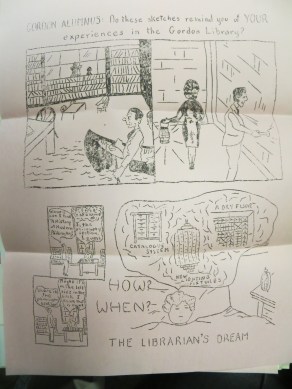
plea to alumnus funds for library cartoon

At Gordon, money has always been tight. This alumni appeal came from the 1940s.

Like all evangelical colleges, Gordon has always had to walk a tightrope. It has always had to promise parents and families a top-notch academic education, including preparation for professional careers. At the same time, it has had to guard its evangelical reputation vigilantly. Like all evangelical colleges, Gordon has had to worry that the college-going evangelical public will see it as too liberal or too conservative.

Back in the day, Gordon was a leader in the evangelical evolution from “missionary-training school” to “Bible college.” What began as the Gordon Missionary Training School in 1895 became the Gordon Bible Institute in 1914, then Gordon Bible College in 1916, then Gordon College of Theology and Missions in 1921.

Back then, the changes were not driven by financial pressures but rather by the changing nature of American higher education. As then-president Nathan Wood explained, the school changed its name in 1921 to accommodate the desires of students and alumni for a college degree, not merely a missionary certificate. As Wood explained in his autobiography, a group of current and former class presidents came to him to request the 1921 name change. They wanted, in Wood’s words,

a change of name . . .  which would express the collegiate and theological work of the school. . . . It meant much to them as future Alumni.

Culture-war politics have also always driven decisions at Gordon. In the 1960s, for example, Gordon’s faculty rejected a move to the political right. In 1964, then-president James Forrester hoped to import a free-market conservative focus to Gordon. With help from politically conservative administrators of The King’s College, Forrester planned a big free-market conference at Gordon, including conservative luminaries such as Congressman Walter Judd and Leonard Read of the Foundation for Economic Education. They wanted to bring Gordon on board, to focus on teaching students

a pervading high regard for Freedom in its spiritual, economic and political dimensions.

When Forrester ran his plan by Gordon’s faculty, however, they nixed the idea. They didn’t want Gordon to be associated with what one faculty leader called the “extreme right.” The faculty had higher academic ambitions for Gordon, not merely to indoctrinate students in what faculty called “a program of education in conservative thinking.”

Today’s changes seem worlds removed from these Gordon precedents. As Elizabeth Redden described, today’s students are not driving today’s changes. Rather, many students seemed surprised and saddened by the reduction in major programs and the reduction of faculty positions.
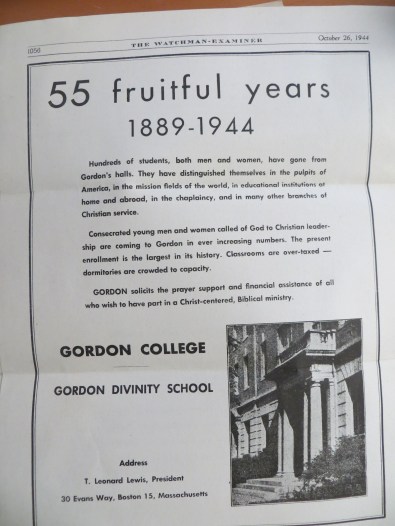
Gordon 1944 ad for donations in Watchman Examiner

A different plea for money, to the evangelical community, c. 1944.

Plus, the current administration of Gordon does not seem cowed by faculty pressure. Rather, Redden found herself unable to find a single faculty member willing to comment. The changes in Gordon were decided upon by top administrators, not faculty. Moreover, the administration seems willing to move Gordon’s reputation more to the conservative side of the evangelical world, with reminders in recent years that Gordon has never approved of LGBTQ “practice.”

I don’t doubt that Gordon’s administrators are feeling pinched. Like college administrators everywhere, they have had to make some difficult decisions. In this case, though, speaking as a fly on the wall, I can’t help but notice how different today’s decisions are from the ones Gordon College has made in the past.

Why Progressives Should Cheer for Creationism

Good news for science, but bad news for progressive culture warriors: We’ve got a smart conservative voice preaching to the creationist choir. In National Review this week, geneticist Razib Khan makes the obvious case that conservatives should not paint themselves into a science-denial corner.  If conservatives were to listen to Dr. Khan, progressives would be in trouble, but there’s no need for my fellow progressives to fret.

jindal

Why won’t Dr. Khan’s argument get anywhere? Exhibit A:

As I’m arguing in my new book about creationism (more news on that front soon), there is no logical reason for evolutionary theory to be so scary to American conservatives. As Dr. Khan sensibly explains,

evolutionary biology is nothing for conservatives to fear, because it is one of the crowning achievements of modern Western civilization. It should be viewed not as an acid gnawing at the bones of civilization, but as a jewel. The science built upon the rock of Charles Darwin’s ideas is a reflection of Western modernity’s commitment to truth as a fundamental value. And many Christians well-versed in evolutionary science find it entirely compatible with their religious beliefs.

Absolutely true. Moreover, Dr. Khan points out a strategic truth that should leave progressives trembling. Namely, if conservatives ever got over their evo-phobia, they would have a powerful new weapon with which to fight culture-war battles. As Khan puts it,

the political implications of evolutionary biology do not favor the Left. Today many on the Left reject the very idea of human nature, to the point of effectively being evolution deniers themselves. They assert that society and values can be restructured at will. That male and female are categories of the mind, rather than of nature. In rejecting evolution, a conservative gives up the most powerful rejoinder to these claims.

Khan hopes to turn the culture-war tables. For example, if conservatives could put together credible arguments against same-sex marriage based on science rather than the Bible, they would have a far stronger political case. After all, almost all American voters revere the idea of science (even if they sometimes define ‘science’ in odd ways), but only a minority care about the Bible.

Moreover, Dr. Khan has history on his side. Historically, evolutionary theory has been used politically to fight for a wide range of political ideologies. Back in the 1920s, for example, it was the politically progressive pro-evolution side that used evolutionary theory to fight for eugenics and “scientific racism.” There is no logical reason–theological or otherwise–why today’s conservatives could not use evolutionary theory to fight for their conservative political beliefs.

However, there is one enormous flaw in Dr. Khan’s argument. Yes, conservatives should embrace evolutionary science. They should turn the idea of ‘evolution’ into a battle field instead of merely retreating from it. But they won’t.

Consider the case of former Louisiana Governor Bobby Jindal. Jindal is a smart cookie—Ivy League degree, biology major, Oxford graduate degree…the works. There is no doubt that Governor Jindal understands the scientific power of evolutionary theory. Yet when he was asked about his policy on creationism, Jindal hedged. He hemmed and he hawed and he finally agreed that he wouldn’t want to tell anyone that they should learn about evolutionary theory.

What does any of that have to do with Dr. Khan’s argument? Plenty. Evolutionary theory is a simple no-go for American conservatives. It’s a third rail. Conservative politicians will have no more luck embracing Dr. Khan’s suggestion than progressive ones would have with Larry Summers’ ideas about gender.

So for that reason, progressives should celebrate the political power of creationism. In many ways, the conservative coalition’s addiction to fighting evolutionary theory is one of its greatest weaknesses. Progressives’ only hope is that smart conservatives like Dr. Khan remain lonely voices shouting into the anti-science conservative wind.

If You’re Having a Bad Day, Don’t Read This:

It was funny when Jonah Ryan said it. Turns out, though, it’s not funny at all, because it’s true.

https://www.youtube.com/watch?v=sWgdM9Gdk3k

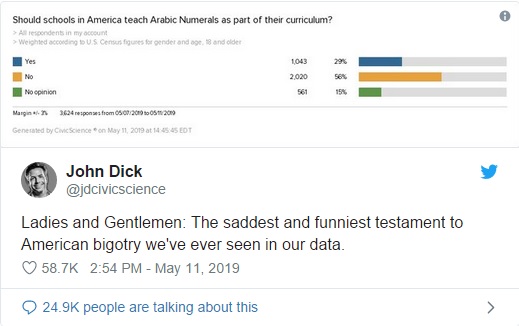
If you’re not a Veep fan, I’m sorry. It is hilarious. In the seventh season, all-around chucklehead Jonah Ryan wins surprising support for taking a staunch anti-math position. Yes, that’s right, anti-math. He does it because he found out that modern mathematics derived from medieval Muslim scholars.

Funny, right? Well, not so much, because real-life recent poll results indicate that truth is scarier than fiction. A recent poll of some 3,600+ American adults find that a slim majority (56%) oppose–wait for it–oppose the teaching of Arabic numerals in schools. arabic numerals pollI’m flabbergasted. I can’t believe that so many people mix their stupid with their ugly.

Kids: Be Afraid. Be Very Afraid

If you have kids in public schools these days, you are likely hearing about lockdown drills and run-hide-fight training. What are we supposed to think about them? On one hand, we all want our kids to be safe. On the other, watching six-year-olds cower and tremble about a threat that they will (statistically) likely never encounter seems kooky. In the Atlantic last week, Joe Pinsker asked historian Paula Fass for some context of scaring kids straight. Prof. Fass offered two good examples, but we can come up with a lot more. And that fact points us to a central, odd truth about the nature of American schooling.

Pinsker ran through some of the central dilemmas of lockdown training. In actual fact, students are extremely unlikely to experience a school shooting. Yet the training for them can be deeply upsetting. As Pinsker wrote,

These lockdowns can be scarring, causing some kids to cry and wet themselves. Others have written letters bidding their family goodbye or drafted wills that specify what to do with their belongings. . . . children are being trained to anticipate an outcome that is both terrifying and extremely unlikely to happen to them.

Pinsker wondered if there had been similar scare tactics employed in schools in the twentieth century. Paula Fass pointed out two big ones: duck-and-cover drills and kidnapping scares. Like school shootings, both threats were terrifying, but statistically speaking, both were also extremely unlikely.

Like me, SAGLRROILYBYGTH are probably now thinking the obvious: We could extend this list of unlikely-but-scary scenarios forever. Schools have always sought to terrify students into feeling an exaggerated anxiety.

Consider just a few examples:

1.) Sex. If you’ve experienced any sex-education curriculum lately, you know that they rely on a fear of STIs and unplanned pregnancies to get their points across.

2.) Drugs. It wasn’t only in the 1930s that school leaders warned students of “Reefer Madness.”

3.) Health. You might not be old enough to remember polio, but for those who lived through it, children were told not to go swimming for fear of contracting the disease. In the 1980s, too, children were warned that they could catch HIV merely from being near a positive person.

It seems to me we need to reverse Pinsker’s question. He asked,

In postwar America, have kids ever been so afraid and so regularly prompted to imagine their own suffering?

But we need to ask instead: Has there ever been a time when students were NOT regularly shocked and scared? When students were NOT shown clips of dope-smoking creeps or atomic devastation in an attempt to scare them into proper behavior?

And the big question: Why have schools always felt a need for such scare tactics?

I’ve got a couple of ideas. First, I think school leaders and parents tend to see scare tactics as developmentally appropriate. Like drivers-ed crash videos, scare tactics are thought to be necessary to pierce the adolescent fog surrounding students’ brains, to make them understand the real dangers of certain things. Also, I think school administrators and politicians understand that exaggerated fears are politically required, even if they are not practically relevant. No school leader could survive an election if she told parents she was doing nothing to prevent a threat because the actual threat was so miniscule.

Is there more? Are there other reasons you can think of why schools have always hoped to terrify children about highly unlikely dangers?

I Love You but You Didn’t Do the Reading

Have you ever wondered how conservative Christians think about porn? I haven’t really, but I read about it this week with a lot of interest. That story and more made our weekly review of ILYBYGTH-themed news ‘n’ views:

Porn and the evangelical community: Samuel Perry talks about his new book Addicted to Lust, at NY.

What I found is that, whatever we think pornography is doing, those effects tend to be amplified when we’re talking about conservative Protestants. It seems to be uniquely harmful to conservative Protestants’ mental health, their sense of self, their own identities—certainly their intimate relationships—in ways that don’t tend to be as harmful for people who don’t have that kind of moral problem with it. . . .

But for women, if they are lusting over things visually—if they are looking at things like pornography and masturbating to them or getting turned on—they really feel like an extreme pervert. They experience what I would call a double shame. They are violating their own sexuality in a way that God doesn’t want. So they’re sinning, but they’re also sinning like a man. And so they feel trapped.

In my neighborhood, a group of kids just attacked an elderly man, at BJS.

The end of an era: Moody Bible Institute shuts down its student newspaper, at RNS.

Ew: looks like Trump’s “fixer” fixed some photos for Jerry Falwell Jr., Reuters reports.

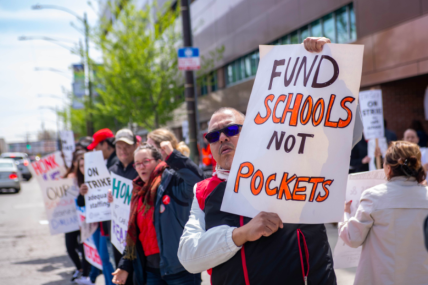
Strikes at Chicago charters win big concessions, at Chalkbeat.

chicago charter protestTraining kids as first responders: Should we have ‘active-shooter’ drills in schools? This mom says no.

Losing our ability to feel shame, at FPR.

It doesn’t take a great act of the imagination to apply the rebuke to those of us today who enjoy watching the train-wreck conversations that often accompany the comments sections of various online media outlets—for, as Dante well knew, there is an immense and indecent pleasure in watching other people, especially people whom we instinctively feel ourselves better than, hate one another.

More from Senator Warren on college-debt forgiveness—will a racial angle win more votes? At IHE.

And (a little) more about Senator Harris’s edu-funding plan at The Atlantic.

“It is completely upside down that we currently have a system where the funding of a school district is based on the tax base of that community,” the Democratic hopeful vying to run against President Donald Trump in 2020 said. The line met with approving head nods and a chorus of agreement. “It’s just basic math,” she continued, on a roll. “The community that has the lowest tax base is going to receive the fewest resources, and by the way probably [has] the highest need.”

Moody Student RIP

It’s difficult to believe that it’s really only a budget thing. After all, as SAGLRROILYBYGTH are well aware, student newspapers at evangelical colleges have always been a thorn in the sides of conservative administrators. Whatever the real reason, I’m sorry to hear that Moody Bible Institute in Chicago will cease publication of its student paper. In my research for Fundamentalist U I spent many hours reading through back issues. As with other student papers, the old Moody Student gave me a sense of the ways evangelical colleges really operate.

The news from Chicago is somber. One faculty member pleaded to keep the paper going. Administrators, meanwhile, insist the decision to close down the Moody Standard was about budgets, not bibles. As one administrator put it,

The decision to no longer fund The Moody Standard was not an isolated one, but prayerfully considered as a part of our ongoing strategic desire to steward resources in a way that achieves strategic balance in our education department and better serves students.

Whatever the reason for its demise, I’m sorry for future historians of MBI. After all, the old copies of the Moody Student helped me wrap my mind around the ways evangelicalism played out at MBI across the twentieth century.

For example, consider the back-and-forth on the editorial page of the Moody Student in January, 1942. One student complained that he had asked for coffee in the dining room and been snarkily informed by another student, “Real Christians don’t drink coffee.”

It wasn’t a huge issue roiling the world of American evangelicalism. It didn’t involve big labels like “fundamentalists” vs. “new-evangelicals.” There were no celebrities involved. And that’s precisely why the story was so helpful to this historian—it helped me see the everyday gripes and disagreements that defined the world of college evangelicalism.

I found similar examples all over my notes. For example, what did MBI students think of courtship and dating? One series from 1945 was a big help to me, as student reporters interviewed their peers about “What I Look for in a Christian Young Woman” and “What I Look for in a Christian Young Man.” My favorite line: the perfect Christian man, one woman explained, will help even with home décor. He won’t think “it’s sissy to regard neatness and color-harmony.”

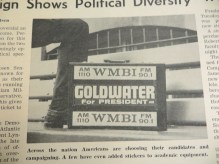
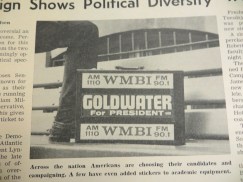
Jumping to the 1960s, the Moody Student provided an insight into the upside-down student politics of a conservative institution.

1964 WMBI and Goldwater

Capturing the evangelical vote, c. 1964.

As one student editor wrote in 1969, the job of MBI students should be to prove that a “silent majority” of students weren’t like “SDS.” Those fake radicals, the MBI editor explained,

try to give the impression that they are planting the seeds of freedom.  In truth, they are plowing furrows of division among Americans.

The student paper also helped me understand the divisions that developed over white racism at MBI. In 1970, for example, the Moody Student reported on anti-racism protests among MBI alums. As the anti-racist alums wrote,

The hypocrisy, frustration and profound spiritual damage suffered by us, both consciously and unconsciously, lead us to tear up our degrees and a diploma.

Last but not least, the Moody Student provided a public forum for the MBI community to debate changing ideas about student rules. As one editor opined in 1970,

Rules are necessary to develop discipline in the individual student, but equally important, the student must have freedom to make decisions on his own.  There must be a balance.  A person will not mature nor be able to face today’s world if he is not free to make choices. . . . I personally don’t think Moody has provided its students with that freedom to decide.

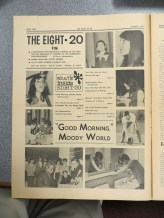
8 20 student paper pictures

What did the “Moody World” look like in 1971?

Reading the student paper, too, gave me a chance to see the non-written clues about changing norms and values at MBI. Student styles in the summer of 1971 were worlds removed from those of the buttoned-down 1940s.

In the end, I wholeheartedly agree with the MBI faculty member who argued that the student paper plays a vital role on campus. But even if I didn’t, I would feel sorry for those future historians who won’t have this resource to help understand the world of college evangelicalism in the twenty-first century.

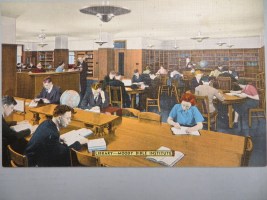
1940s postcard library

…what did it look like c. 1941?

Wait…Did Charter Schools Just Die?

They might not know it. They might keep going for a while, oblivious to the fact of their own death. But recent news from Chicago makes me wonder if charter schools are effectively dead.

chicago charter protest

Should any school be allowed to skimp on students?

Here’s what we know: According to Chalkbeat, a series of walkouts and threats of walkouts in Chicago has compelled charter networks to change their tunes. They will pay teachers the same salaries as public-school teachers. They will cap class sizes. They will add better services for special-ed students and English Language Learners. And they will add counselors to their staffs.

All this is good news for students and families, but it seems like very bad news for the idea of charter schools. When charter schools are subject to the same oversight as public schools, they no longer can claim the same freedom from red tape that has been the hallmark of charter schools.

Some charter-school enthusiasts are accusing teachers’ unions of killing charter schools. As Curmudgucrat Peter Greene explains, lobbyists like Jeanne Allen are pointing the finger at unions for effectively ending the thirty-year run of charter school experimentation.

That’s true in one sense, and false in another. Yes, by organizing teachers and insisting on better conditions for students in charter schools, unions are preventing charter-school administrators from cutting corners and offering shoddy schools.

But teacher protests would not be effective if they didn’t articulate real problems. No one would support teachers who threatened to strike over quibbles. The problems in Chicago’s charters—like the problems in public AND charter schools nationwide—are real and desperate.

So here’s the question for this morning: Did Chicago’s teachers just drive a stake through the heart of the charter-school dream?  And good riddance? Will the corpse wiggle around for a while, but without the freedom to impose sub-standard conditions on students? Or will these stories just drive charter-supporters to build bigger legislative walls around their schools?

Youth Gone Wild

It was a fluke, you might say. A rare event. You’d be right, but that won’t stop people from being terrified of packs of young people going on the rampage, as a group apparently did in my neighborhood this week. And, in fact, the history of schools has always been, in part, a history of adults trying to control the potential violent threat of youth going wild.

Here’s what we know: Here in sunny Binghamton, New York, a 76-year-old man was beaten into the hospital by a group of kids. Apparently, he said “hello” to them and they started a confrontation that escalated rapidly.  The group of four to seven children ages twelve to fifteen began shouting at the man, then punching, kicking, and biting him. The man ended up with bite wounds, cuts, and, according to his granddaughter, a neck injury.

On one hand, it’s a story that gets attention precisely because it’s so unusual. On the other hand, America’s fear of young people runs deep. And that fear has influenced America’s schools for centuries.

Consider comedian John Mulaney’s take. As Mulaney puts it,

Thirteen-year-olds are the meanest people in the world. They terrify me to this day.

For the founders of America’s public school systems, there was nothing funny about it.

As I’m discovering in the research for my new book, the dawn of the 1800s brought renewed fears of what wild children might do. Joseph Lancaster, founder of a new type of urban school for poor children, warned in 1807, left out of school, kids

will become the burden and pests of Society. . . .  It is in vain that laws are made for the punishment of crimes, or that good men attempt to stem the torrent of irreligion and vice, if the evil is not checked at its source; and the means of prevention, by the salutary discipline of early education, seasonably applied.

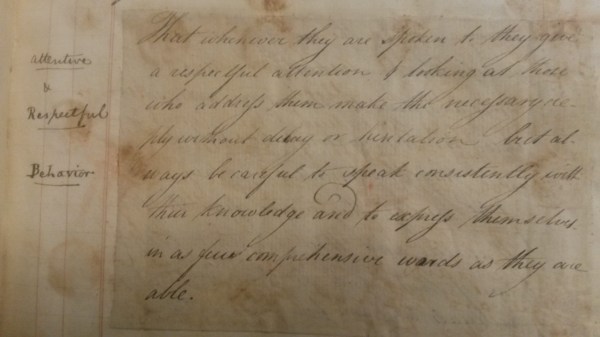
LOOK AT ME

Notes from 1804…or is it 2019?

The kind of school Lancaster had in mind was all about teaching children to obey, obey, obey. Like students in today’s ‘no-excuses’ charter schools, Lancaster insisted that his students learn to behave in a submissive, docile way. As he put it in 1804,

That whenever they are spoken to they give a respectful attention by looking at those who address them make the necessary reply without delay or hesitation but always be careful to speak consistently with their knowledge and to express themselves in as few comprehensive words as they are able.

Did it help? Back in 1804, when Lancaster promised to corral and control wild urban youth, did it work? Not really. Then and now, the promises of urban school reformers can’t keep up with the harsher realities of urban life.

I don’t think young people are really any more violent or explosive than adults, but for centuries Americans have been terrified of what might happen if more youth go wild. I can’t help but think that my 76-year-old neighbor will think twice before he says “hello” to any more kids on his block.

I Love You but You Didn’t Do the Reading

Dive in to the latest collection of stories from the interwebs of interest to SAGLRROILYBYGTH:

Pat Robertson mocks young-earth creationism on his 700 Club, at CN.

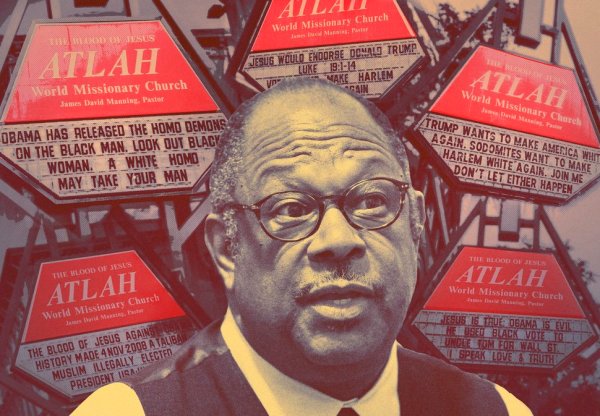
manning atlah

Westboro, NYC.

Westboro, NYC: Stories of child abuse from religious school leader, at HP.

People who attended the school describe its leaders as being rabidly homophobic. Manning would often talk about evil “faggots.” Teachers would echo those sentiments, describing gay people as demons who were doomed to go to hell. A message from Manning on the school’s website directs parents to “Stop the homosexual brainwashing of your children!”

Christians under attack, at AC.

Such ideological efforts have spawned not only attempted social ostracism, but a culture ripe for anti-Christian violence by the mentally unhinged.

Methodist colleges face LGBTQ dilemma: Should they stay or should they go? At CD.

Will Senator Warren’s college-debt plan lift her chances in 2020? Large majorities support the plan, even if they don’t support Warren. At TH.

Why are evangelical megachurches adopting Catholic traditions? At America.

old school Catholic practices are in. Yes, that celebrity Protestant pastor is wearing a stole with Our Lady of Guadalupe on it.

Synagogue shooting: Is the Orthodox Presbyterian Church to blame?

Did Common Core work? Not really, at Chalkbeat.

Creationists Lovin Trump

I admit it: I don’t get out much. And when I do, I mostly hang out with people a lot like me. And people like me don’t understand how anyone could like President Trump. So I’m always curious about the people who are lovin Trump.

Creationists lovin trump

Young-earthers agree: GOAT!

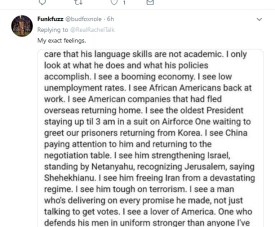
I got a clue this afternoon–turns out at least one young-earth creation aficionado agrees with Rachel. I couldn’t help myself and I scanned through some of the other comments. Why do Americans love Trump? people lovin trump

For some of them, at least, Trump is a real hero, not just someone who will stack SCOTUS with anti-abortion justices. As “Funkfuzz” contributed, some see Trump as the hardest-working, toughest-talking “lover of America” we’ve ever had in the White House.

I don’t see it, but I do understand why some radical creationists love Trump so much. After all, as I’m arguing in my new book about American creationism, radical young-earth creationists don’t really disagree with other creationists about theology. That is, young-earth creationists are usually not more conservative in their theology than are other types of creationists.

The thing that distinguishes young-earth creationists most sharply from other evangelical creationists is not their theology. Rather, it is a deep cultural conservatism, a nostalgic yearning for a Christian America that never was. It’s no surprise, then, that radical young-earth creationists would hop on board the Trump train, hoping to Make America Great Again.