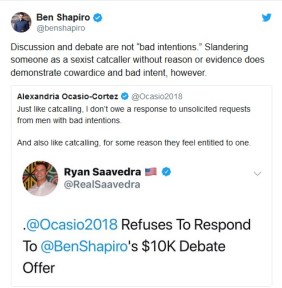
What would YOU call it? Conservative pundit Ben Shapiro says it’s nothing but civil debate. Leftist darling Alexandria Ocasio-Cortez dismisses it as a mere catcall. SAGLRROILYBYGTH might be reminded of something else: a long-standing creationist plea for attention.
I’m curious to hear what you think: is it legitimate for Shapiro to offer $10,000 for a debate? Or is that merely an extension of rude, aggressive unsolicited male attention?
And finally, how about this: is Shapiro’s debate offer a remix of an old creationist tactic? For years now, radical creationists such as Joseph Mastropaolo have offered $10,000 to any mainstream scientist willing to debate the facts of evolutionary science. In the opinion of one mainstream scientist, such tactics are obviously a “scam designed to lure the unsuspecting” into a shoddy creationist publicity stunt.
Is that what’s going on here? Is Shapiro merely hoping to attract attention? Or does he really want to engage in a civil debate? Or, as Ocasio-Cortez accuses, is this the equivalent of verbal street thuggery?
[UPDATE: thanks for letting me know about the bad link. It’s fixed now.]
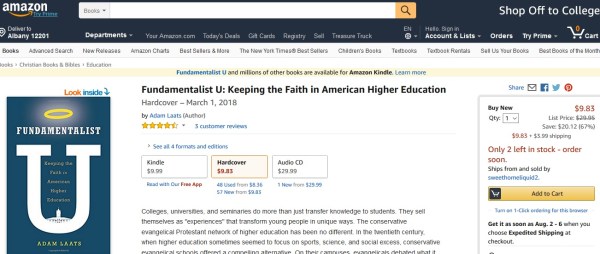
Want to kill uber-conservative evangelical Protestant colleges and universities? The recipe is simple: Have a lot more news stories like this one from Milwaukee.
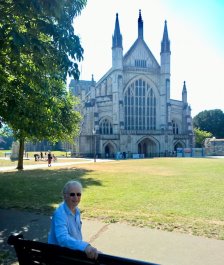
Schmidt preaches the young-earth gospel…
Outsiders like me might not get it at first. We might think that fundamentalist colleges are happy to live in a little bubble, utterly protected from trends in the wider world. And, to some degree, they are. But when it comes right down to the hard facts, even the most conservative evangelical institutions care what people think about them. They have to. If colleges want to attract students and their tuition dollars, they have to prove that students’ college experiences will help them professionally. Colleges have to be able to assert that they are more than an educational punchline.
Even though they traditionally eschewed accreditation, fundamentalist universities and colleges promised that their educations were not only theologically and culturally pure, but also good preparation for professional careers. Bob Jones University liked to assert that its students’ GRE scores were higher than similar schools. Founder Bob Jones Sr. often claimed that his school would do more than protect students’ faith—it would prepare them to be faith-filled doctors, engineers, lawyers, and teachers.
His decision to avoid accreditation, Senior often noted, was not due to lack of campus resources. Rather, it was only a measure of BJU’s spiritual superiority. As founder Bob Jones Sr. bragged in 1950,
Bob Jones University is probably the only one in America that could join an association that does not join, and we refuse to join. We believe . . . that a Christian institution should make its own policies in line with the purposes it has in view and that no association of any kind should dictate the administrative policies of the institution.
For most institutions of higher education, though, accreditation has always represented a crucial mark of respectability. Schools that could not afford to earn accreditation have always risked losing students to accredited schools.
It makes sense. Why would a student spend tuition dollars at a university when those classes would not be recognized by other institutions? Why would students attend an undergraduate college when their degree wouldn’t qualify them to enter any graduate schools?
As a recent story from my adopted hometown of Milwaukee demonstrates, evangelical colleges risk losing credibility if they aren’t accredited. Here’s what happened: The current acting sheriff, Richard Schmidt, often brags about his advanced degrees. He has one PhD, he likes to say, and he is working on a second. His election signs tout him as “Dr.” Smith.
Sorry, I can’t go out tonight. I’ve got my big final in Crock-Pot tomorrow…
This embarrassingly shoddy college poses a career risk for Acting Sheriff Schmidt. For our purposes, the bigger threat is to fundamentalist higher education itself. If conservative evangelical students and families see that unaccredited colleges are the butt of jokes, they just won’t attend. And if degrees from these schools prove a hindrance to professional success—as they are for Sheriff Schmidt—students will take their tuition dollars elsewhere.
In the end, if you want to kill off fundamentalist higher education, all you have to do is laugh at it.
It can be a tough pill to swallow. If we want to be brutally honest, however, we need to acknowledge that religion is about something besides religion. New survey data confirm our hunch that a religious identity isn’t necessarily about religion itself, but about something more complicated.
In my recent book about evangelical higher education, I argued that we can only understand fundamentalism and conservative evangelicalism if we abandon our tendency to define these things theologically. After all, there wasn’t really an orthodoxy involved in fundamentalism. There couldn’t be. Although fundamentalism and conservative evangelicalism were certainly religious movements, their institutions were not driven solely by theological considerations. Instead, as with every human endeavor, evangelical colleges jumbled together religion, culture, politics, and other factors to come up with a mish-mash of beliefs, beliefs that “felt right” to students, professors, alumni, and parents.
The Bible is the highest authority for what I believe.
It is very important for me personally to encourage non-Christians to trust Jesus Christ as their Savior.
Jesus Christ’s death on the cross is the only sacrifice that could remove the penalty of my sin.
Only those who trust in Jesus Christ alone as their Savior receive God’s free gift of eternal salvation.
Being an “evangelical,” then, is not a theological position. It might INCLUDE theological tendencies, but it is something more than a religious identity. And, of course, it’s different for different people. Plenty of evangelicals ARE defined by their theological beliefs. Just not a majority.
Today we see more survey evidence that evangelicals and other Protestants don’t restrict their beliefs to evangelical or Protestant theology. A large majority think that God wants them to prosper financially. Among evangelicals, a solid 75% majority think so.
We might think that these prosperty-gospellers simply don’t know because they don’t really go to church. But prosperity beliefs are STRONGER among those who attend church more frequently.
What’s the takeaway? Like all of us, evangelical Protestants are complicated. For those of us trying to understand evangelical history, the vital message is clear: “Evangelical” identity is about much more than simple theology.
Wong looks at the changing face of private education. With the dwindling enrollment in low-tuition Catholic schools, she notes, more expensive private schools are gobbling up a larger and larger share of the private-school market. The average tuition at private schools in the latest available data approached $11,000 annually. For most parents, that’s simply unaffordable.
So far, so good. If we really want to get a sense of the staggering inequalities built into America’s educational landscape, IMHO, the bigger story is the startling disparities between public schools. Even in the same city, some public schools resemble upscale educational hotels while others feel like seedy fleabags. But Wong makes a good point that private schools are becoming the province of a shrinking economic elite.
However, I can’t figure out why she left out the most obvious explanation for the shrinking of America’s Catholic school network. Here’s how she puts it,
A number of factors are contributing to the phasing-out of Catholic schools. One is a drop in the number of clergy members, who historically taught for relatively low wages. Another is the Church’s sex-abuse scandals, whose financial ramifications have undermined its ability to operate schools. In addition, demographic shifts such as falling birth rates, the growing concentration of black and Hispanic families in the bottom tier of the country’s income distribution, and a decline in religiosity among Americans, combined with the rise of charter schools, have led to lower enrollment in parochial education.
All true and important. But Wong doesn’t mention the impact of Vatican II. The public perception of the Church’s 1965 statement, Gravissimum Educationis, was that Catholic parents had been released from the requirement to send their children to Catholic schools. As the 1965 statement said,
Parents who have the primary and inalienable right and duty to educate their children must enjoy true liberty in their choice of schools.
Of course, at least as I read it, that statement is more about helping Catholic parents get a tax break to send their children to Catholic schools, but in the public eye the Vatican II agreement was often seen as freedom to attend public schools. Not surprisingly, given the choice between free-tuition public schools and low-tuition Catholic schools, huge numbers of Catholic parents began sending their children to local public schools instead.
Vatican II is not the only reason for shrinking enrollments in Catholic schools, for sure. At least in the popular understanding of American Catholic history, though, it played a huge role.
…so why wouldn’t Wong mention this epochal shift in American Catholic education? If we’re trying to understand the changing enrollment in private Catholic schools, it seems like an odd thing to leave out.
Who owns your history? Who gets to decide, that is, what is “real” history and what is politically motivated claptrap? For too long, academic historians like me have had it easy. We have glibly assumed our ability to define the boundaries of authentic historical thinking. A smart recent essay made that case once again. But as all of us should, the author needs to study the lessons of a different sort of history. After all, we have been down this road before.
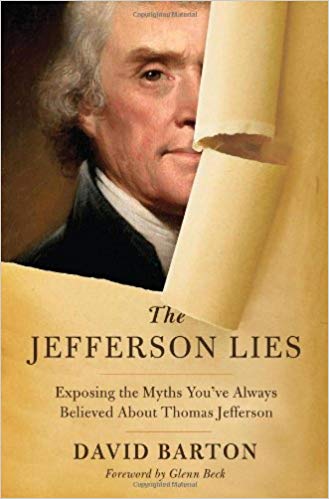
If you’re not familiar with the history wars, a quick look at the bumptious career of David Barton might help. Barton touts himself as a historian, tirelessly exposing the lies of left-wing academic historians. In short, he wants to prove that the United States was founded to be an evangelical nation.
What are we to think of this episode? Barton’s book was terrible history, by the standards of mainstream academic history. But it was enormously popular and no amount of expose could deflate its appeal among certain readers.
To SAGLRROILYBYGTH, this might sound hauntingly familiar. Since the 1960s, mainstream scientists—including conservative evangelical scientists—have pulled their hair and gnashed their teeth at the claims made by young-earth creationists. Time and time again, in the face of repeated scientific refutations and debunkings, young-earthers have staked their claim to represent the cause of true “science.”
For an earlier generation, gallopers like Duane Gish steadfastly refused to give up their claim to be the real scientists in the room. These days, Ken Ham does the same thing.
As my friend and co-author Harvey Siegel argued in our book about evolution education, it makes no sense—logically or strategically—to try to prove them wrong. That is, it will always be impossible to prove that Gish and Ham are “pseudo” scientists. There is a better way to talk about the differences between mainstream science and radical young-earth creationism.
It has been difficult enough for mainstream scientists and science pundits to accept this awkward and uncomfortable fact. It seems even more challenging for academic types in other fields. In the field of academic history, for example, mainstream professors have grown accustomed to being unchallenged in their ability to define real historical thinking from the fake kind. When challengers like David Barton raise their head, too many of us are only able to sputter. Too many of us are too confident that Barton’s blather will be rejected as low-quality scholarship.
Is there anything that can be done to prevent basic historical facts from going the way of climate science, seen essentially as politically motivated rather than the result of serious professional study?
Unfortunately, the short answer is no. Indeed, even asking the question shows how far behind the times we academic historians are. Mainstream scientists and science activists have been struggling with these sorts of challenges for a long time. Creationism and climate-change-denialism have long forced mainstream scientists to examine their claims and their public image. Academic historians have tended to be able to ignore such things.
No longer. As Iber puts it,
there is a market for pseudo-historical grift.
Definitely. And to be as clear as possible, I agree entirely with Professor Iber’s anti-crappy-history position. However, we historians need to learn the tough lessons that mainstream academic scientists learned long ago. Namely, we can’t de-fang bad history simply by calling it “pseudo” history. We can’t assume that our credentials and mainstream institutional affiliations will make America listen to our pleas to reject crappy history.
In short, we can’t rest easy that our definition of good historical thinking will win the day based solely on its persuasive power. It won’t. We don’t have the luxury to conclude, as Professor Iber does, that exposing people to historical thinking will tend to make people agree with our vision. As Iber optimistically insists,
Seeing oneself as a part of history tends to be equalizing: It exposes the radical contingency of your own existence, which usually results in taking the humanity of others as seriously as your own.
I wish that were true. But as the career of David Barton proves, seeing oneself as a part of history can result in very different conclusions. Historical thinking is not a wholly owned subsidiary of left-leaning academic types like Professor Iber or me.
If academic historians aren’t more savvy, we risk getting run over by the vastly more popular sorts of history that are out there.
Throughout American history, earnest reformers have hoped to use schools to level out the playing field. It has never worked—at least never as well as we would hope. Why not? A recent piece in the New York Times helps explains a key fact about schools and inequality that is glaringly obvious yet surprisingly hard to see.
For most of us, the logic of schools and social reforms feels pretty straightforward. When we see inequality in our society, we think that school reform can help fix it. After all, it makes sense that better education will allow students from lower-income homes to move up the economic ladder.
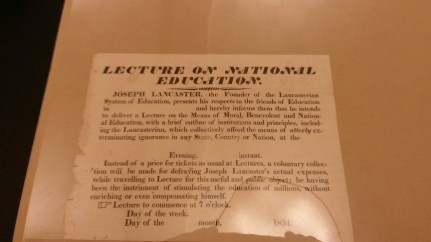
How to save everyone, c. 1834
As I’m arguing in my new book, this logic has always dominated educational and social thinking. Two hundred years ago, Joseph Lancaster swept out of London to New York, Baltimore, Philadelphia, and Boston. He promised a new type of school that would—in the words of this lecture advertisement—
Collectively afford the means of utterly exterminating ignorance in any State, Country, or Nation.
It didn’t work. Lancaster’s schools hoped to “uplift” the poorest children of every city. They couldn’t. Today’s piece in the New York Times helps explain why they couldn’t back then and they can’t now.
These days, as Asian-American applicants sue Harvard about racist admissions policies and New York elite high schools scramble to make their student bodies more representative of their city, there are still strong factors standing in the way.
That question is being debated in Massachusetts, where court papers argue over Harvard’s use of race in its “holistic” admissions process, and in New York City, where politicians are trying to increase the number of black and Latino students at top public high schools.
But the answer has always been obvious: only the elite.
How does it work? In the case of Harvard admissions,
Harvard applicants who are recruited athletes or children of alumni enjoy significant advantages, and these candidates are disproportionately white and well-off.
As the authors put it succinctly,
In our highly unequal society, education systems have consistently found ways to favor elite, white applicants, whether it’s through slippery definitions of “merit,” giving added weight to athletes or children of alumni, or fighting to change admissions policies to schools in which Asians are more overrepresented rather than those where whites are.
Or, as we at ILYBYGTH like to say, schools can’t reform society; schools ARE society. In other words, schools are not external levers with which reformers can lift people up. Schools are all intensely bound up within the unequal mechanisms of society itself. If society is biased against poor children, or non-white children, or any sort of children, then schools will be too.








 I Love You but You're Going to Hell