Close your eyes and it might be difficult to guess the decade, much less the century. Fears of a brash, vulgar populist President, a traumatic sense of rapid decline in our public institutions, and a desperate dream that stability might be right around the corner. Sound familiar?
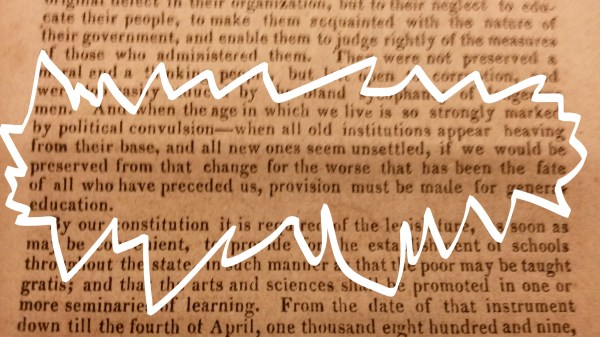
As SAGLRROILYBYGTH are sick of hearing, I’m down in the Philadelphia archives these days researching my new book. I keep stumbling across head-scratchers that are too good not to share. This bit is from an 1831 report on education from the Pennsylvania house of representatives. They were worried that politics had gotten out of hand. They hoped that high-quality public schools could offer some hope for the future. As they put it,
when the age in which we live is so strongly marked by political convulsion—when all old institutions appear heaving from their base, and all new ones seem unsettled, if we would be preserved from that change for the worse that has been the fate of all who have preceded us, provision must be made for general education.
Clearly, the sorts of political upheaval we’re living through now have a long history.
Laats attempts to identify the distinct nature of non-denominational, fundamentalist-evangelical higher education in the 20th century. And he succeeds admirably. . . .
In explaining how this struggle [between fundamentalism and neo-evangelicalism] played out, Laats helps us better understand both Christian higher education and the historic relationship between fundamentalism and evangelicalism.
My favorite bit of all?
With fundamentalism subject to such a fluid range of definitions, controversies often centered on the question of authority. In other words, who gets to define fundamentalism for the college? Is it the board, the president, the faculty, or the students (certainly not, unless you ask them)? This was not shared governance but something akin to WrestleMania.
Professor Hankins explores the book’s treatment of issues such as creationism and racism in evangelical higher education and sends us off with a heartening conclusion:
Overall, Fundamentalist U is an exhaustively researched and well-written book, even when it dwells on episodes we might prefer to forget.
In 1828, the education committee of the state senate of Pennsylvania issued a report. There was no disagreement, they said, about the immense value of public education. As they put it,
The diffusion of education among the great body of the people, is an object very near the hearts of the benevolent and humane. It is conceded to be the most powerful means of furthering the cause of morality and religion; and its importance to a country possessing a republican form of government, is universally admitted.
Moreover, schools funded by the public should serve to unite the public. At Pennsylvania’s public schools, the committee promised (with emphasis added):
All the rising generation of a great community are instructed in the rudiments of learning. The doors of the common school houses are open to all without distinction, and the children of the rich and the poor meet there in the participation of a common benefit, upon terms of the most perfect equality. Such a system is above all praise, and deserves imitation every where.
At least, that was the dream. So far, it hasn’t happened. The children of the rich tend to go to schools with other children of the rich. Likewise for the children of the poor. But then again, it has only been 190 years. Maybe we’ll get there soon.
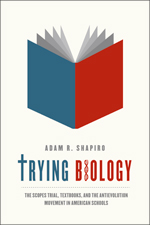
As Professor Shapiro noted, back in the 1920s publishers made big promises about cutting evolution out of their textbooks. In many cases, though, they left the content the same and merely took the word “evolution” out of their indexes. Sometimes they changed the word “evolution” to “development” in the text itself.
Usually, this wasn’t due to any ardent love or hate for science or creationism. Rather, publishers just wanted to sell books. If buyers wanted evolution out, so be it. But changing text was expensive, so publishers tended to make the smallest changes they could get away with.
We see today similar edits in Arizona. This time around, though, it looks as if standard-makers really do want to water down the teaching of evolution.
4 The theory of evolution seeks to make clear the unity and diversity of organisms, living and extinct, is the result of evolutionorganisms.
43 Life Sciences: Students develop an understanding of patterns and how genetic information is passed from generation to generation. They also develop the understanding of adaptations contribute to the process of biological evolutionhow traits within populations change over time. [sic]
69 Gather, evaluate, and communicate multiple lines of empirical evidence to explain the mechanisms of biological evolution change in genetic composition of a population over successive generations.
Will this sort of editing make any difference? Will science teachers in Arizona change what they are doing based on these cosmetic changes? Does it matter if creationists believe in “change in genetic composition of a population over successive generations,” but refuse to accept the evidence for “biological evolution”?
History might not be destiny, but it can be depressing. As I’ve worked in the Philadelphia archives for my new book, I’ve found some reminders that teachers have always had to shell out their own money just to do their jobs.
Working without pay has always been considered part of the job…
Teachers shouldn’t have to pay for everything, but they’ve always had to…
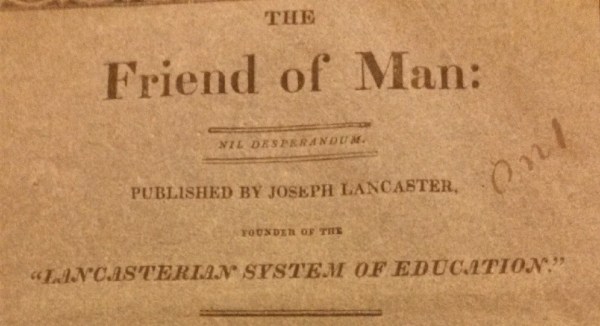
As I read Joseph Lancaster’s 1821 newsletter I couldn’t help but notice a disturbing parallel. When Lancaster started his career as an educator, he wrote, he visited the nearby town of Stockport, near Manchester. The schools had been terrible until teachers stepped up. They needed better supplies. They needed an expensive new school building. As Lancaster described, the teachers
as a body, offered to work extra hours at their trades, and from their own earnings, to save and devote the sum of five hundred pounds sterling to the proposed building—within twelve months.
Joseph Lancaster told this as a happy tale, showing the possibilities of education if we all pulled together. Almost two hundred years later, though, I can’t help but be a little bummed out that teachers are still expected to donate their scanty mite in order to keep the school lights on.
How does Christian nationalism tie in to young-earth creationism?
Bailey tagged along on a Christian-nationalist tour of Washington DC for a group of middle-schoolers. The tour was specifically designed to explain to children that the United States had a special role in Christian history. This tour was led by one Stephen McDowell, of the Providence Foundation. As Bailey explains,
McDowell, who has been organizing the trips for about 30 years, describes them as a kind of calling. God, he says, has been ignored in the schools, in the government, in the media, and in official tours of our nation’s historic sites. But if tourists can peel back the secular layers of government and media, they will behold a nation birthed by God, he maintains, and thus be compelled to conclude that without Christianity, there would be no United States.
The kids all dressed in red, white, and blue and learned that DC was designed as a Christian capital. They learned to be skeptical of senators like mine, who sound, as one student put it, “like he was from somewhere in the North.” Bailey’s description offers a rare glimpse of fundamentalist pedagogy in action and I encourage you to read the whole article.
This morning, though, we are more interested in the ways this sort of Christian-nationalist education looks and feels a lot like young-earth creationist pedagogy. The “truths” taught by McDowell are far removed from the actual historical record. As with young-earth creationists, it’s difficult not to wonder how anyone can believe something so radically divorced from mainstream academic understandings.
Just as with young-earth creationism, Christian nationalist historians like McDowell tell a tale of hidden truths. As McDowell explains,
I wasn’t taught this in school because God was ignored as he is today in most of our state school public school textbooks.
In other words, the true fact of a Christian America has been obscured by generations of benighted secularists. The goal, McDowell explains, must be to
Awaken the American people and teach them truth . . . See our nation turn back to God and other nations as well.
With enough tours and textbooks and schools and websites, McDowell apparently believes, there is hope that the true nature of America’s Christian history and destiny will be revealed and embraced.
Compare McDowell’s language to that of the founding text of modern American young-earth creationism. In The Genesis Flood (I’m pulling from the 1966 edition), Henry Morris and John Whitcomb Jr. made very similar claims for the truth and power of young-earth creationism. If YEC is true, they wonder, why do so many Americans believe in evolution? As they explain,
Historical geology, with its evolutionary implications, has had profound influence on nearly every aspect of modern life, especially in its fostering of an almost universal rejection of the historicity of Genesis and of Biblical Christianity generally.
The true story of our species and planet, in other words, has been obscured by the pernicious secular rejection of the Truth. What did Morris and Whitcomb hope to do? They were after
restoring His people everywhere to full reliance on the truth of the Biblical doctrine of origins.
Like Morris and Whitcomb, McDowell is telling a story of a powerful truth, hidden by scheming (or possibly simply mistaken) secularists. Of course, this truth might seem outlandish or even ridiculous to those raised on the lies of false history or science. But by revealing those truths, missionary educators think they have the ability to transform both souls and society.
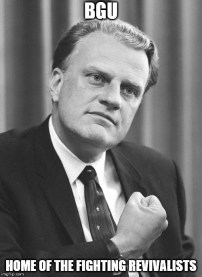
I’m back in Philadelphia to get back into the archives for my new book. And the trip has reminded me of a great question that never got an answer: Why isn’t there a Billy Graham University?
Last time I was down here, I got to sit in on Jon Zimmerman’s history of higher-ed seminar. They had read Fundamentalist U and I was happy to talk with the students about it. One of the students raised the question and it has bothered me ever since.
After all, it did seem to be a pretty standard part of the revivalists’ resume. Moody had Moody Bible Institute. Billy Sunday had Winona Lake. William Bell Riley started Northwestern. Bob Jones had, well, Bob Jones. The list goes on and on. Falwell-Liberty; Oral Roberts-Oral Roberts; Robertson-Regent.
So why is there no Billy Graham University?
Wheaton’s Billy Graham Center
One possibility is that Wheaton has functioned as the de facto BGU. The Billy Graham Center is there, and the connection is pretty tight.
Maybe we’ll see a repeat of the Bryan University story. Back in 1925, after the sudden death of William Jennings Bryan in the immediate aftermath of the Scopes trial, fundamentalists rallied to open a college in Bryan’s memory. Some wanted it in Chicago; some wanted it to be a junior college. In the end, Bryan’s widow won the day with her plea to open the new school in Dayton, Tennessee. The junior-college idea was rejected in favor of a traditional liberal-arts university.
Is it possible that we’ll see a similar push for a memorial BGU?
After all, neither Hillsdale nor Pence seemed reticent about the conservative particulars of the school. Pence called Hillsdale a “beacon of liberty and American ideals.” He praised the college’s aggressive leader, Larry Arnn, for grounding students “in the traditions and teachings that are our greatest inheritance in America.”
So why don’t the locals seem to care? On the local news about Pence’s address, absolutely no mention was made of the conservative nature of the college. Pence’s speech was stripped of any ideological meaning. Graduates talked about their jobs and their hopes for the future, a future pointedly stripped of any mention of taking over Washington DC with a new, Hillsdale-inspired conservative vision.
Is this simply Midwestern politeness? Local-news inoffensiveness? Or do they just not care about the central mission of their local university?
As SAGLRROILYBYGTH know, we’ve been obsessed these days about white evangelicals’ love affair with Trump. In talks and article after article after article, we’ve wondered why white evangelicals support a seemingly amoral leader.
I’m 100% on board with Ehrenreich’s central theme. As he puts it,
behind the apparent disparity, there exists a psychological kinship between Trumpism and evangelical thought—at least, for white evangelicals. . . . The similarities in their approaches to the world run so deep that I believe that white evangelicals would continue to support Trump even if Roe v. Wade weren’t in the picture.
Right.
It seems obvious: there is an intense and powerful tradition of Make-America-Great-Again thinking among white evangelicals, a tradition to which Trump makes an intense and powerful (if surprising) appeal. If we really want to understand white evangelicalism in America, it does not help to start and finish with theological notions, IMHO. We need to include the mish-mash of history, memory, nostalgia, and politics that leads many white Americans—including white evangelicals—to yearn for the good old days.
It didn’t start with Reagan. Bibb Graves was the Governor of Alabama and close political friend of Bob Jones College in the 1920s…
Trump appeals to something deep, something beyond tax policy or even abortion policy. Now, I don’t buy Prof. Ehrenreich’s explanation of this evangelical-Trump affinity. He wants to tie the Trump connection to white-evangelical psychology, which seems a little simplistic.
But that’s not my main beef. This morning I’m objecting to Prof. Ehrenreich’s quick sketch of twentieth-century evangelical history. He repeats the tired myth that white evangelicals only really became political and conservative in the 1970s. He argues that white evangelicals had been split, politically, between progressive and conservative wings. Only in the late 1970s, he thinks, did the bulk of white evangelicalism embrace political conservatism. As he puts it,
by the end of the ’70s, things began to change. The percent of the American population adhering to evangelical beliefs grew rapidly. Right-wing fundamentalist preachers took over organizations such as the Southern Baptist Convention. There was a rapid rise of separatist Baptist churches, proclaiming a fundamentalist theology, denouncing the moral ills of society and communism, and often promoting segregationist views. In 1979, Jerry Falwell joined hard-line conservative activists such as Heritage Foundation and American Legislative Exchange Council co-founder Paul Weyrich to form the Moral Majority, a political action group focused on mobilizing Christians against “secular humanism” and moral decay. Evangelical pastors threw themselves into the political arena and worked for 1980s conservative electoral victories. Simultaneously, largely evangelical white voters in the South shifted rapidly from the Democratic Party to the Republican Party, and American politics as a whole moved sharply to the right.
I thought we were beyond this. The facts of Ehrenreich’s historical sketch are basically correct, but taken together they don’t prove that conservative evangelicals got political only in the 1970s.
As our leading historians such Daniel K. Williams and Matthew Avery Sutton have demonstrated, white evangelicals ALWAYS were political. Yes, there were progressive and conservative wings, but there was never a “retreat” from politics. As Williams showed, something big really did happen in the 1970s, but it was not that white evangelicals got into politics. They had always been into politics. Instead, what happened was that white conservative evangelicals embraced the GOP as their single political vehicle.
Maybe I shouldn’t be surprised. It’s easy to think that white evangelicals retreated from mainstream politics in the 1930s, only to reemerge with a flourish in the Reagan years. After all, it is a story that white evangelicals have told themselves and the rest of us for many years. As I point out in my recent book about evangelical higher ed, fundamentalist college leaders often insisted that they and their schools were above politics.
Consider the example of Bob Jones Jr. and Bob Jones University in the era of the so-called “New Christian Right.” In 1969, Junior told a friend that he was “opposed to party politics . . . on principle.” In the very same 1969 letter, though, he gave a glimpse of what he meant by that. Was BJU above political activism? Not at all. As Junior explained, BJU was always “urging our students to remember how their senators voted when the next election comes up in their state.”
In other words, white conservative evangelical leaders such as Bob Jones Jr. SAID they were above politics, but what they meant was that they were not wedded to one major party or the other. By 1976, Jones had begun to change his tune. As he put it in 1976, evangelical leaders
should denounce what’s spiritually and morally wrong, and if that means getting into politics, so be it.
When Jones said he was “getting into politics,” what he meant was that he was embracing the GOP alone. He might have sincerely thought that he and his school were above politics before that, but it just wasn’t true. Way back to the 1950s and into the 1980s, Junior continued to talk about getting “into” or “out of” politics, but he never meant that he wouldn’t be throwing his political weight around.
And he certainly never meant that he was somehow split between progressive and conservative political ideas. For fundamentalists like Jones, going all the way back to the 1910s, Christian politics were always conservative politics.
When the Reagan administration angered Jones Jr., for example, Junior threatened in 1982 to take his followers “out” of politics. As he put it, he might just urge BJU voters to
stay away from the polls and let their ship sink.
Now, clearly, withholding votes from the GOP is just as political an act as giving votes is. When white evangelicals in the twentieth century talked about staying out of politics, they didn’t really mean it. They didn’t really mean they wouldn’t vote for conservative candidates or mobilize for conservative issues.
All they meant was that they weren’t married to one party or the other.
When will we stop reading the misleading myth that white evangelicals retreated from politics until Falwell and Reagan?










 I Love You but You're Going to Hell