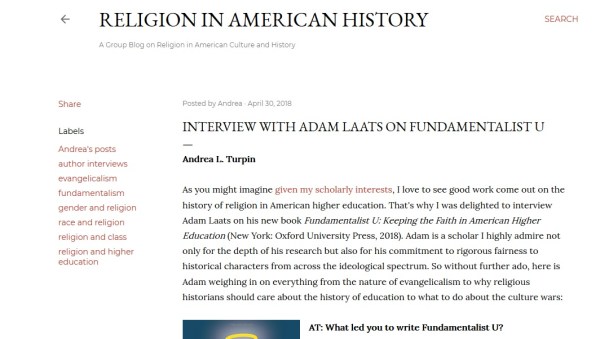
Why should historians of religion care about schools? How can our study of history help us heal our culture-war ulcers? This week, I had the chance to talk with Professor Andrea Turpin of Baylor University about these questions and more.
In our interview, she asked terrific questions that got right to the heart of the matter. What does the history of evangelical higher education tell us about the relationship between “fundamentalists” and “evangelicals?” How does political conservatism line up with theological conservatism? …and more!
From fajita robbery to lynching memorials to teacher strikes, this past week had a little bitta everything. Here are some stories that came across our desk…
I sat down curious. I got up stumped. Why didn’t the usual conservative and progressive websites and magazines have anything to say about this momentous event? I’m wondering if the topic is too touchy even for the most brazen of cultural commentators.
Remembering…
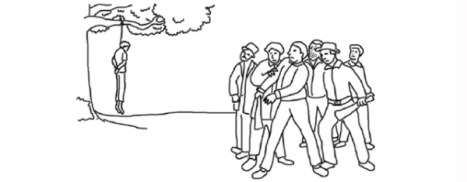
Here’s what we know: A new lynching memorial opened this week in Montgomery, Alabama. The mainstream press covered it in detail: NPR, New York Times, The Conversation, Los Angeles Times, Washington Post…newspapers and news outlets rushed to describe the wrenching attempt to remember the brutal legacy of racial violence in America.
Most of the coverage mixed outraged descriptions of the ugly history with hopeful intimations that this memorial might help open ancient festering sores to the bracing effects of sunlight. For me, as both a history teacher and a human being, I’m optimistic that the memorial might fulfill its goal of helping Americans recognize and deal with the fundamental historical facts of slavery, lynching, and their legacy.
As a teacher, I have always had a difficult time helping students understand why people would send postcards to friends with cheerful mementoes of the lynchings they’d witnessed. It seemed like serial-killer behavior, yet it was fairly commonplace. (I won’t include the images here, because they are truly horrifying. With preparation, though, I’ve introduced students to the grim collection at Without Sanctuary. In particular, I challenged students to try to make sense of image #28.)
As I was flying home recently, I sat next to a very friendly woman. Once she found out I was a history nerd, she mentioned that she had recently seen news of the lynching memorial in Montgomery. And she was shocked. She was in her mid-fifties, she said, and she knew vaguely about racial violence and lynching, but the memorial opened her eyes to the numbers of victims and the peculiarly brutal nature of racial lynchings.
If more and more Americans can have similar experiences with the Montgomery memorial, I think we will have made significant but insufficient progress.
But here’s what I don’t understand: Why don’t the usual pundits have anything to say about it? This morning, I conducted a very unscientific survey of both left and right. I found almost no mention of the Montgomery memorial. Why not?
Why don’t other progressive or conservative commentators have anything to say? Are they waiting for someone to say something provocative about the museum for them to react to? Did I just look in the wrong places?
I’d think this intensely provocative topic would attract a lot of culture-war commentary. Why hasn’t it?
They’re out there. In twenty-plus years of teaching and hanging around schools, I can say from experience that some of my friends and colleagues match the stereotype of the ardent, left-wing teacher, seeing their mission as introducing students to the disgusting excesses of capitalism. And maybe wearing scarves. And just as certainly, some teachers embody the tough-talking stereotype of the conservative teacher, pooh-poohing fads and frills and hoping to reach kids with the glories of self-sacrifice and flag waving. As the recent rash of teachers’ strikes has shown us, though, trite stereotypes of left and right don’t really help if we want to understand the cultural politics of teaching.
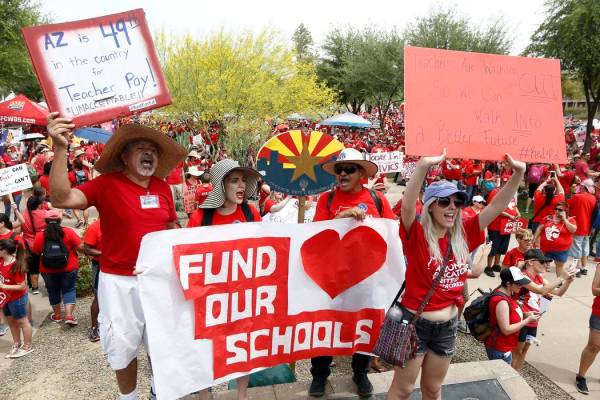
There shouldn’t be any doubt about the real reasons for these teacher strikes. In Oklahoma, West Virginia, Kentucky, and now Arizona and Colorado, teachers and public schools have faced crummy salaries and crummy conditions. Oklahoma’s teachers have shared pictures of their classrooms, textbooks, and paychecks. It’s not pretty.
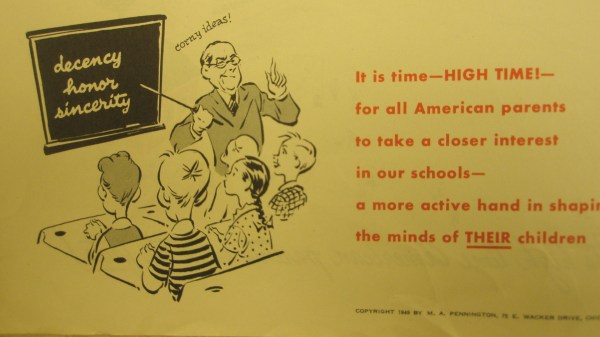
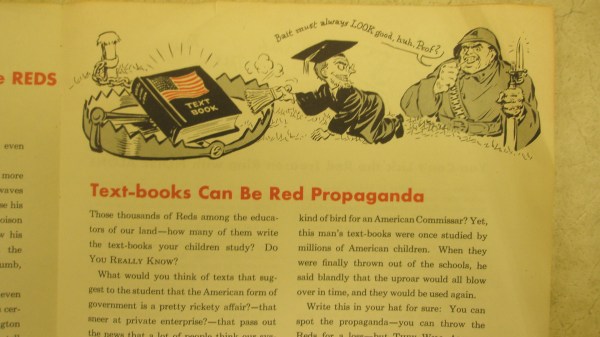
I’m not so sure. But I can’t help but notice that pundits from both left and right have always assumed too quickly that teachers are somehow naturally politically progressive. In my research into the twentieth-century history of educational conservatism, for instance, I found that conservative activists assumed without even thinking about it that teachers tended to be soft on socialism.
The problem with schools and textbooks, many conservatives believed, was that too many teachers wanted to use their platform to push their students to the left. As one editorialist wrote in my local paper in 1940,
we don’t think it is fair to use taxpayer money in a democracy to teach the glory of collectivism to the budding citizens of a democracy.
Similarly, an American Legion activist at the time warned that too many teachers
will flavor their teaching with a bias in favor of the new collectivism which will subtly determine the content and method of their teaching.
We all know, of course, that some teachers really are politically progressive. Just dip a toe into the blogosphere and you’ll find plenty of examples. Some teachers really do hope to shake children free of the cruel thinking that undergirds capitalist society.
Watch out for socialist teachers, c. 1949…
With all the attention to teachers in the recent spate of strikes, though, it’s more and more clear that political stereotypes and labels just don’t help much if we want to understand the way schools and teachers really work. Are today’s striking teachers really hoping to lead a comeback of organized labor? Maybe some are. Most of them are probably trying to pay their mortgages and teach their students.
As reporters in Arizona found out when they interviewed non-striking teachers, there is no simple way to categorize teachers’ politics. Are the teachers who voted against the walkout “conservative?” Maybe. Sort of. Kinda. But that label doesn’t begin to capture the mix of reasons teachers gave for opposing the walkout.
More socialists in the schoolhouse, c. 1949…
One teacher and football coach, for example, seems like he was sent straight from culture-war central casting to fulfill the stereotype of the “conservative” teacher. He told reporters he felt he needed to show his students that he honored his contract. As he put it,
Life is about not getting what you want and finding a way to get it while you continue to fulfill your obligations and for me, my obligation is my contract.
As I argued in my book about the history of educational conservatism, this notion of teaching students tough lessons about traditional morality has always been central to conservative thinking about schools and education. And of course he’s the football coach.
Other strike-opposing teachers don’t seem quite so easy to put in one box or another. As one explained, she voted against the walkout for a mix of reasons. Primarily, she couldn’t stand to leave her students in the lurch. She told reporters,
The kids that I work with are at-risk kids … (the walkout) also puts them behind. A lot of them come from homes where it’s safer for them to be at school. A lot of kids I work with have severe and profound learning disabilities and their parents both have to work to provide for them. Now they can’t.
Plus, at age 57, she can’t afford not to work. Does she want to be paid more? Sure. She currently works three jobs to make ends meet. A walkout, though, puts her finances and her students’ well-being at risk.
Is that “conservative?” To this reporter, these walkouts help show once again that teachers are just as complicated as regular people.
If you didn’t know much about Liberty University or conservative evangelical higher education, you might be surprised to hear that President Jimmy Carter will be giving the commencement address at Liberty this year.
Do I have a problem? For sure. Am I embarrassed about it? Not at all. But I do want to make my case for the importance of old grudges and festering scars in understanding the world of evangelical higher education.
Even better, Compton has nice things to say about my book. As he puts it, Fundamentalist U
offers an invaluable introduction to the esoteric world of Christian higher education. Few existing studies offer this level of insight into the inner workings of schools like BJU and Liberty.
Compton captures the central dilemmas I emphasized, such as the tension between keeping students safe and keeping up with changing academic trends. He notes the important divisions that emerge between new “evangelical” colleges and stalwart “fundamentalist” ones.
I can’t help but comment, though, on one of Compton’s points. He is doubtless absolutely correct when he states,
some readers may be turned off by Laats’s fascination with long-forgotten rivalries involving long-dead university administrators[.]
I am certainly fascinated by such things. And I don’t doubt that sensible people have better things to do with their time than ponder the administrative squabbles in Cleveland, Tennessee or Wheaton, Illinois in 1937. This is why I don’t get invited out very often. Most people are, in fact, turned off by my fascination with these questions.
For those of us who hope to understand American evangelicalism, though, there’s no way we can consider such rivalries “long-forgotten.” As in any family feud, time may have obscured the details, but it has not tempered the animosity. If anything, bitter feelings caused in 1937 may have earned angry compound emotional interest over the decades, giving original squabbles a power and fury they didn’t originally possess.
To give just one example from the book, I can certainly see how many readers might not immediately care about the firing of President J. Oliver Buswell from Wheaton College in the 1930s. President Buswell wanted Wheaton to pursue a more theologically pure separatist approach. He wanted Wheaton to encourage its faculty and students to withdraw from mainline Protestant denominations and focus instead on creating a consistently conservative evangelical institution.
Wheaton’s trustees disagreed. They insisted that Wheaton maintain its efforts to attract conservative students who remained within mainline denominations as well as those that joined breakaway fundamentalist churches.
As Professor Compton notes, all the players in this 1930s drama are long-dead. But their squabble is anything but long-forgotten. Throughout its history, Wheaton struggled to figure out how to handle the tension between conservative purity and (relatively) big-tent inclusiveness. Time after time, whenever faculty members challenged the vagaries of Wheaton’s assumptions about orthodoxy, they were given the boot.
If you think these patterns are no longer in effect, just ask Professor Hawkins. Perhaps no one in that recent Wheaton battle invoked the specter of President Buswell’s 1930s ouster, but the college as a whole still deals with the echoes of every long-ago conflict.
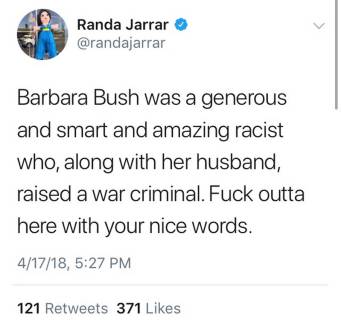
The topic came up when a journalist called me yesterday to talk over the case. Among her questions, she wondered if Professor Jarrar’s hateful tweets represented a new low in academic discourse. I invite SAGLRROILYBYGTH to disagree, but I think Jarrar’s comments, as nasty as they were, are nothing new in academic life.
Here’s what we know: Professor Jarrar teaches English at Fresno State University. When former First Lady Barbara Bush passed away, Professor Jarrar seized the opportunity to tweet her outrage about President Bush’s policies. As Jarrar put it,
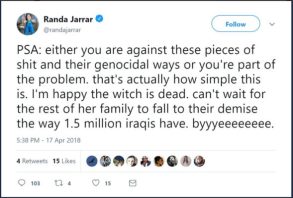
Barbara Bush was a generous and smart and amazing racist who . . . raised a war criminal. . . . I’m happy the witch is dead.
As Jarrar attracted attention from friends and foes for her comments, she bragged that she made a six-figure salary and couldn’t be fired. Trolls dug up video clips of Jarrar’s public talks, in which she seemed to call for violence against white-supremacist Richard Spencer, among other things.
Loud. Brash. Unpleasant. But a new low? I don’t think so. I think Professor Jarrar, like so many other academics these days, was scrambling to build her brand. She was looking for attention—as all humanities academics these days feel pressed to do—and she did so in a particularly nasty way.
I don’t like it, but I don’t think it’s worse than other provocations from pundits of both the left and the right. Am I missing something?
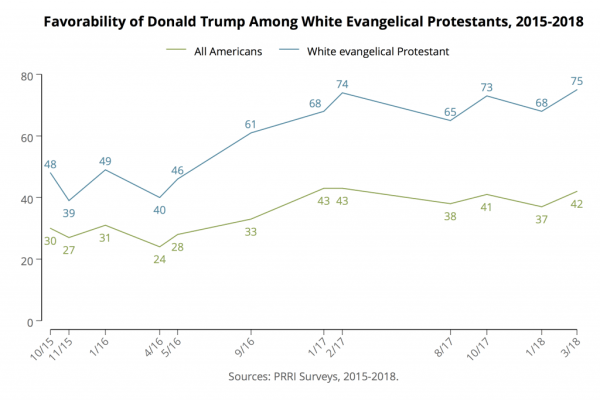
The contradiction that seems so obvious to me is apparently a false one. To me, it would make sense if white evangelicals became disaffected with Trump’s in-your-face leadership style, with his reputed sexual dalliances, and with his hazy patriotism.
Among white evangelical respondents, there is no problem. A whopping seventy-one percent of white evangelical women like Trump. An even higher eighty-one percent of men do.
Could this be a division between “faculty-lounge” evangelicalism and the popular sort? The numbers suggest otherwise. True, college-educated white evangelicals support Trump in lower numbers, but still at a very high sixty-eight percent. Among those who have not been to college, seventy-eight percent of white evangelicals are pro-Trump.
Why so much Trumpism? One of my conservative evangelical friends offered his two cents. As he put it,
Adam, it is very simple why Trump has such wide-spread support among conservatives, we finally have a president on our side in the culture wars.
I get it, I really do. I think arming teachers is a terrible idea, but I understand that lots of people disagree with me. When it comes to ideas like the ones we’re seeing this morning, though, we can’t possibly disagree. Does anyone really think this is a good idea? More important, the kerfuffle might tell us something about how schools work in the real world.
The superintendent explains his plan…
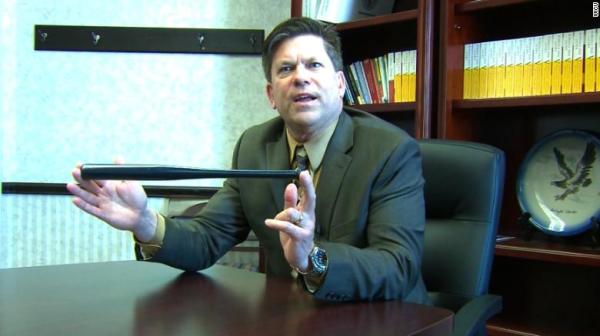
Here’s what we know: Some school districts in Pennsylvania have approved plans to arm their teachers…with miniature baseball bats. You know, the kind you got as a kid when you went to a Brewers game, then left on your desk in your bedroom until finally someone threw it out or something.
The head of the local teachers’ union defended the move. As he put it,
This is a tool to have in the event we have nothing else. . . . Part of the formula now is to fight back. . . . The theory behind the attack option is to create noise, distract, or defend against an active shooter. For a classroom or office setting, this translates to books, staplers, chairs, fire extinguishers, etc. being used as defensible tools.
We didn’t want our students to be helpless victims. . . . River stones were my idea. I thought they would be more effective than throwing books or book bags or staplers.
Can they be serious? Is there any support out there for these sorts of preposterous plans?
It seems merely wacky, but this story tells us something about the way public schools often work in practice. There will be a controversial idea—evolution, sex ed, or, as in this case, arming teachers. District leaders will want to be seen taking action, but they also want to avoid controversy at all costs. The result? Half measures that veer sharply into the ridiculous.







 I Love You but You're Going to Hell