I Love You but You Didn’t Do the Reading

Spring still feels pretty far away up here in the woods. Here are some stories that kept us occupied this past week:

Trumpism and the authoritarian personality, at NYT. HT: HD.

Speak no revival: Liberty bans talk of RedLetterRevival, at RNS.

FBI, MLK, and the first televangelist, at R&P.

ok teacher march

Teachers march in OK.

  • “History does not repeat itself, but often, it does rhyme. Today, the White House has an evangelical advisory board and a coterie of televangelists to march alongside the executive branch. Are the African American members of President Trump’s evangelical advisory council the modern day Michauxs?”

How do radical creationists change their mind? Not by argument, at RD.

  • “However well-intentioned you are, bludgeoning people with fact after argument after fact will only entrench them in their position and reinforce a perception of being persecuted by the world.”
  • How can creationists refuse to acknowledge scientific evidence? Easy, at ILYBYGTH.

Arizona’s up-and-coming Betsy Devos clone, at NR.

Why don’t Americans care more about World War I? At The Guardian.

Shocking: Mother uses stun gun to wake her teenager for Easter services. At RNS.

LGBTQ at evangelical colleges: Author interview at IHE.

Hullabaloo at Taylor, too.

Oh my: New flat-earth poll finds only 2/3 of young people “confident” that the earth is a sphere, at LS.

Too far for the Atlantic: Kevin Williamson fired for advocating hanging women who had abortions.

Sweepin Down the Plains: Oklahoma teachers march 110 miles, at NBC.

Are college history classes teaching students to be critical thinkers? Erm…not really, says Stanford’s Sam Wineburg at IHE.

Censorship at Christian Colleges

Want to get fired? Try this: Run a controversial story in a newspaper at an evangelical college. This week, Liberty University’s Erin Covey complains that her reporting is being blocked. She’s not the first student reporter to have this experience. On the contrary, student editors have always worked under constant threat.

At issue today is an anti-Trump/anti-Falwell revival going on near Liberty University. Shane Claiborne and his progressive evangelical allies are hosting a Red Letter Revival service, challenging Liberty’s president to join them or change his “toxic” Trump-loving ways.

When student reporter Erin Covey shared her coverage of the revival with Liberty’s leaders, she was told to squelch the story. As she tells it, Liberty’s administration told her,

No let’s not run any articles about the event. That’s all these folks are here for — publicity. Best to ignore them.

Covey plaintively wondered,

We often wonder: Do other private schools deal with this? What are the levels of freedom that other school papers have? Do we have the same freedoms — is this common?

When it comes to school newspapers—including student newspapers–censorship and content control have been universal practices in the history of evangelical higher education. As I describe in my recent book, this has been true at all evangelical schools, no matter how liberal or how conservative.

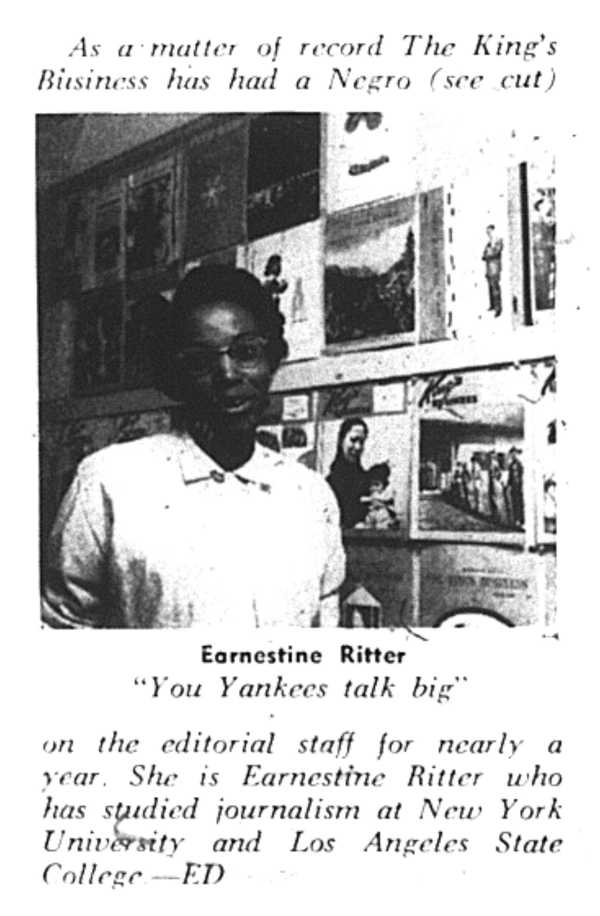
Earnestine Ritter

How to get fired at Biola, c. 1957.

Why? Let me share one example from Biola that exemplifies this tradition. In 1957, editor Lloyd Hamill took a strong anti-segregation position. He excoriated white evangelicals who opposed racial integration. As he put it,

No Spirit-controlled Christian can escape the solid fact that all men are equal in God’s sight.  Integration is not only the law of our nation, it is also the plain teaching of the Bible.

Biola, Hamill wrote, didn’t only endorse integration. It practiced it, employing an African American journalist on staff. A deluge of letters flooded Biola. More than 90% of them attacked Hamill’s position, though a few supported him. What did Biola’s administration do? As Biola’s president explained privately to Billy Graham. Hamill was sacked immediately. Biola did not want to endorse

the very foolish letters he wrote and statements which he made.

Granted, the situation is somewhat different. Hamill worked at the college’s magazine, not a student publication. But I think the rule still holds.

Why do evangelical colleges censor their publications so rigorously? Why can’t Erin Covey cover an anti-Falwell revival?

It’s not an accident and it’s not only Liberty. All evangelical colleges live under constant scrutiny. The evangelical public is always wondering if school X or Y has gone soft. The publications coming out of schools—including student newspapers—have always received endless scrutiny from interested members of the evangelical public.

Whatever appears in a student newspaper is often taken to represent more than one student’s opinion. It is taken, at heart, to represent the current moral climate of the school. For students like Erin Covey and editors like Lloyd Hamill, the result is clear: Don’t rock the boat.

The Most Important Part of Radical Creationism

What is the most important thing secular people need to know in order to make sense of young-earth creationism? It’s nothing specifically scientific. It’s not even anything directly theological. The vital key to understanding radical creationism is something different. As a recent commentary reminds us, creationism thrives because it has a powerful intellectual defense mechanism.

let-there-be-truth

From Answers In Genesis: Creationist defense mechanisms.

As I finish up my new book about American creationism, I’m struggling with a lot of difficult questions. Perhaps the hardest of all is the durability of radical ideas about science and nature. For those of us who aren’t creationists, it can be difficult to understand how anyone can be educated, aware, and intelligent while still thinking the earth is only about 6,000 years old.

Why don’t they abandon those ideas as soon as they hear how scientifically impossible they are?

As Nelle Smith pointed out recently, radical creationism has a powerful defense mechanism: Satan. Creationists don’t only believe in dissident science. They also are told—over and over again—that their scientific ideas are under attack. The attack has many sources—Bill Nye, Richard Dawkins, local science teachers, etc.—but the true source of the attack is always more nefarious.

As Smith puts it,

growing up in many evangelical churches means to be told, repeatedly, that the devil will always seek a foothold, and once you give him one you’re well on the road to hell, to losing your faith, to destroying your witness. That’s scary stuff. To begin to doubt evangelicalism is not simply a mental exercise. For many like me, it’s to feel a void opening, the earth dropping out from beneath you. It’s to face the prospect of invalidating your entire existence.

As I’ve argued elsewhere, naïve anti-creationists have often failed to understand this key part of radical creationism. Like the affable Bill Nye, anti-creationists have assumed that they can convince and convert creationists simply by explaining the outlines of mainstream evolutionary theory. Anti-creationists have assumed that the evidence will be enough to change people’s minds.

What we non-creationists have failed to understand is that creationists are expecting to hear arguments that seem to make sense. They are ready to see evidence that looks convincing. They know what to do when they are presented with so-called facts that purport to poke holes in their worldview.

The central story of radical young-earth creationism isn’t one of science and religion. Rather, it’s a story of faith and doubt, of steadfastness and wavering, of obedience and sin. When arguments for evolution seem convincing, creationists can dismiss them as yet another alluring trick of Satan to fool the unwary.

To be sure, every once in a while, creationists raised to watch for the devil’s scientific snares change their minds. They embrace evolutionary science and abandon their old creationist mindset. But as Nelle Smith writes, to do so requires a wholesale revolution in their ways of thinking about good and evil, right and wrong. It’s not a simple matter of accepting evidence or mulling competing arguments.

For many creationists, the arguments of mainstream evolutionary scientists aren’t attractively modern. They are as ancient and as seductive as the serpent’s whisper to Eve.

Who Cares about Fundamentalist U?

It’s not just a topic for evangelical intellectuals. Recently, journalist Lauren Gilger asked me some great questions about my new book. Among the most pressing is this one: Why should the rest of us care about evangelical higher ed?

KJZZ_Gen_BlackBlue

Why care about evangelical colleges?

You can listen to the whole interview at Phoenix’s KJZZ: The Show.

I Love You but You Didn’t Do the Reading

The holiday week didn’t seem to slow down the culture-war rhetoric. Here are a couple of ILYBYGTH-themed stories that came across our desk this week. Thanks to everyone who sent in stories and tips.

Historian Sean Wilentz on the difference between “liberals” and “progressives.”

  • “there is a rumor abroad in the land that only progressives care about the powerless and the poor, whereas liberals are just vaguely left-of-center fig leaves for plutocrats and globalizers. . . . This was edifying and improbable pandering.”

    wheaton rainbow bench

    ARE the times a-changin?

LGBTQ issues at evangelical colleges, at NPR. HT: EC.

Yes: Why do white evangelicals love Trump?

Double standards, elite liberal hypocrisy, and Trump-shaming, at FPR.

It’s tough to be a teacher, by Andrew Heller.

What do Hungarian school children read in their textbooks? “It can be problematic. . . . for different cultures to coexist.” At NYT. HT: HD.

The David defense: Trump’s relationship with Stormy Daniels in biblical language, at Vox.

Life after polygamy in Short Creek, at R&P.

Schools are getting safer these days, in spite of how it feels. From NCES.

The coming collapse of Christian colleges, by Rod Dreher at AC.

More teachers’ strikes: Kentucky teachers stay home, at CNN.

Should history be patriotic? At The Atlantic.

Want to save the humanities?

Which of These People Will Save the Humanities?

At many colleges, humanities enrollments are down. So far down that schools such as one University of Wisconsin campus are scrapping entire humanities departments. What can academics do? Two pundits this week have suggested different solutions. We have a different proposal to make.

savior 1

…is it students reading Beowulf?

At the Chronicle of Higher Education, Mark Bauerlein makes a counterintuitive proposal. If humanities programs want to survive and thrive, Professor Bauerlein argues, they need to woo freshmen and wow their parents. As he puts it, “right now, nothing is more crucial than the preferences of 19-year-olds.”

You might think the way to do that would be to lighten up on grades and assignments. Offer an easy A and students will line up…right? Professor Bauerlein describes a program that does the opposite. Teachers at the University of Oklahoma have revived W.H. Auden’s 1940s-era syllabus. It forces students to do a ton of reading and reflection. And the students seem to like it.

Bauerlein’s conclusion? Make humanities courses unapologetically difficult. Stop apologizing for Western Civilization:

Design your Western-civ or Great Books course and ramp it up to Auden levels. Be frank about the reading challenge. Boast of the aged, uncontemporary nature of the materials. Highlight the old-fashioned themes of greatness, heroism and villainy, love and betrayal, God and Truth, and say nothing against intersectionality and other currencies. Your antagonists are mediocrity, youth culture, presentism, and the disengagement of professors and students. You occupy a competitive terrain, and your brand is Achilles, Narcissus, the Wyf of Bath, Isolde, and Bigger. Let’s see what happens. Let the undergrads decide.

Could it work? Maybe. I’ve stopped being surprised by the numbers of students who want to be challenged. Yes, many—maybe most—students approach their classes as mere hurdles to be overcome to get to the next goal. But a reliable stream of students want something else.
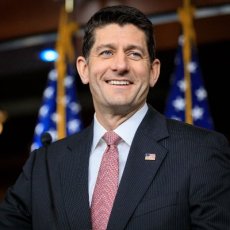
savior 2

…is it budget-controlling conservative hawks?

From across the pond, we get a very different prescription for saving the humanities. At Times Higher Education, Musa al-Gharbi gives us another idea. If we want to save classes in philosophy, sociology, history, literature, etc., al-Gharbi says, academics should court conservative politicians. After all, when conservatives think humanities departments have been taken over by leftists, they will not hesitate to close them down. And then progressives themselves suffer. As al-Gharbi puts it,

It is generally women and people of colour – usually progressives – who pay the cost when administrators are encouraged to weigh into political disputes. These same groups will also bear the brunt of continued erosion of public trust in institutions of higher learning.

The value of scientific fields is widely appreciated, but social research is a different matter entirely. Given that women, people of colour, LGBTQ scholars and leftists are better represented in the humanities and social sciences than in most other disciplines, they will disproportionately suffer when social research is devalued and defunded.

In other words, if we want to save the humanities, we need to help influential conservative politicians see that courses in history, literature, and so on are not merely training grounds for leftist radicals.

Could that work? In Wisconsin, at least, the shutdown of Stevens Point humanities courses was a direct result of long-simmering conservative outrage. Cultivating conservative political support for humanities classes might help maintain budgets.

I’ve got a different suggestion, though. As I argue in my new book about evangelical higher education, there is one constant truth about higher education in these United States. Whether students choose a fundamentalist college, an Ivy League redoubt, or a community-college approach, a driving factor in student decisions has always been professional credentials.

Heather Gerken

…or is it someone different?

That is, whatever college students choose, most of them (or at least, their parents) insist that their work must lead to a better career. Like all institutions, evangelical colleges fail when they can’t deliver on that promise. The same is true for humanities programs. Some humanities courses are thriving. At Yale, for example, history is back as the most popular major.

Why are students flocking to history courses at Yale? As Professor Bauerlein argues, many of them are likely attracted by the intellectual rigor and challenge of the major. And, as Prof. al-Gharbi explains, some of them are probably intrigued by the ideological diversity of academic history. The bulk, though, are hoping that the history major will situate them well to apply to law school. That’s been the tradition for long years.

So who should academics be trying to convince of the value of humanities courses? Is it freshmen looking for old-fashioned intellectual challenge? Or is it conservative politicians looking askance at faculty politics? I think both ideas have merit.

But if humanities programs really want to survive, they need to convince students, parents, and law-school deans that their programs are the best way to fulfill the most important purpose of American higher education: preparation to move up the career ladder.


R-E-L-A-X…

Is the sky falling for evangelical colleges? Rod Dreher says yes. I say no.

Dreher is responding to a recent NPR piece describing the tensions at evangelical colleges over student sexuality and gender identity.

As the article describes, colleges aren’t sure what to do. For many conservative evangelicals, homosexual practice is unacceptable. But so is rejecting and harassing Christians. To Dreher, the conundrum is proof that evangelical colleges—like all evangelical institutions—need to take drastic Benedictine steps. As Dreher puts it,

the environment in which traditional Christian colleges and educational institutions work is rapidly changing: politically, legally, and culturally. We cannot count on anything anymore. . . . Somehow, faithful small-o orthodox Christians have to figure out how to educate within this hostile new heterodoxy. We will have to form new institutions, ones built to be resilient in the face of anti-Christian modernity.

Sounds scary. But as I argue in my new book about the history of evangelical higher education, this predicament is nothing new. To the contrary, this dilemma has been the driving force behind evangelical higher education for a hundred years now. Consider this plea from Dean Lowell Coate of Marion College, c. August, 1923. Mainstream higher ed, Dean Coate fretted, had been taken over by “evolution, destructive criticism, and liberalism.” What evangelicals needed, Coate insisted, was to

ignore the whole worldly system, and organize courses independent of the world’s stereotyped curricula, engage the strongest conservative scholarship in America, raise the educational standard above the present unchristian philosophy, stablish [sic] it upon ‘the faith once for all delivered to the saints,’ and then challenge the world to meet the new scholarship.

Guess what? It worked. The fundamentalist movement of the 1920s set up a startlingly successful network of colleges, universities, seminaries, and institutes. Evangelical colleges have faced the challenge of rapid change for almost a century and they have always found a way to remain true to both their religious mission and their academic aspirations.

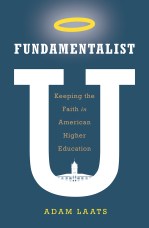
Cover art final

Is the sky falling? Yes, but it has been falling for over a century now…

Now, as SAGLRROILYBGTH are tired of hearing, I don’t have a dog in this fight. I’m not evangelical, nor am I personally invested in evangelical higher ed. If I were, though, I would listen to Aaron Rodgers and not Rod Dreher. The challenges faced by schools today are serious and dire—but they are not more serious and dire than the challenges that have always confronted evangelical academics.

The School Headline We Won’t See

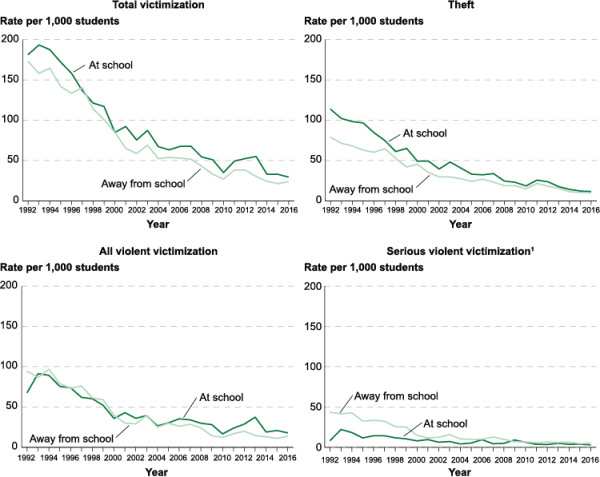
Don’t get me wrong: I’m all for the brave Parkland students who have done so much in the past few weeks to push for change. I’m as distressed as my friends when I hear conservative politicians belittling their activism. But whatever our political views on student activism, we’re likely to believe something about schools that just isn’t true. In spite of what all of us might think if we just read the papers, America’s schools are safe and getting safer. Why don’t we hear more about it?

school safety

Where are the cheers?

Here’s what we know: The National Center for Education released its new report today about school safety. By any measure, schools today are much safer places than they’ve been since 1992. Crime reports from schools are down, security measures are improved, staffs are better trained in safety measures, and students report less crime.

Why won’t we hear more culture-war blather about this news? Here’s my guess: Whether you’re a conservative, a progressive, or other, you want people to think that schools are dangerous places.

Let’s look at the conservative side first. Throughout the twentieth century, as I argued in my book about the history of educational conservatism, conservatives told one another that schools—especially public schools—had gone to the dogs. For example, as Reagan’s second Ed Secretary memorably lamented, by any “index of cultural indicators,” schools had failed catastrophically.

It wasn’t only Bill Bennett who worried. Religious conservatives also warned that public schools had

grown into jungles where, of no surprise to Christian educators, the old Satanic nature ‘as a roaring lion, walketh about, seeking whom he may devour’ (I Peter 5:8).  Students do well to stay alive, much less learn. . .

In most cases, if conservatives hate something, progressives will love it. But that hasn’t been the case with public schools. From the left, critics charge that public schools are abusive places, especially to students from minority backgrounds. In one recent case from Maryland, for example, activists note that African American students

are subject to daily abuse and humiliation. . . . [from] a decades-long pattern of resistance to change and the creation of a hostile environment for children of color.

Conservatives don’t agree with progressives about much. When it comes to school safety, however, both sides agree that public schools are dangerous and getting worse. Both sides, it seems, won’t allow themselves to be troubled by inconvenient truths.

Is “Gay” the New “Black” at Evangelical Colleges?

It’s not a simple question, but there is a simple answer. A recent story from NPR about LGBTQ+ issues at evangelical colleges has people asking: Are today’s official anti-gay policies at most evangelical colleges the 21st century equivalent of their 1950s racist policies? Short answer: No.

wheaton rainbow bench

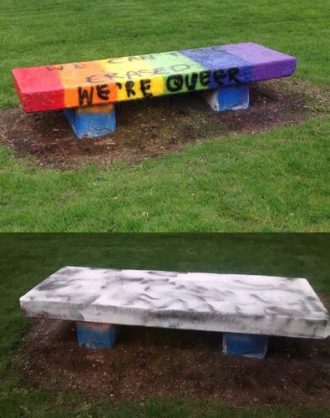
It’s not easy. The rainbow bench at Wheaton was covered over…

As the article describes, many campuses such as Calvin and Multnomah send profoundly mixed messages about non-heterosexual identities among students. On one hand, students are carving out for themselves friendly spaces on evangelical campuses. They are finding emotional support among sympathetic faculty and fellow students.

This matches other reports, such as one from Liberty University a few years back. It is different at different schools, of course, but students have already introduced LGBTQ+ rights on most evangelical campuses.

On the other hand, most schools still have official rules banning non-married, non-heterosexual sexual expression. As the NPR article describes, people at evangelical colleges are often confused. The chaplain at Calvin, for example, put her position this way,

You’ve got those two values. . . . We love our LGBT people. We love our church of Jesus Christ. We love Scripture. So those of us who do this work are right in the middle of that space. We are living in the tension.

It’s hard not to ask: Is this just an updated version of the struggle over segregation and racism at evangelical colleges? As I argue in my recent book, evangelical and fundamentalist schools had a shameful racial legacy in the twentieth century. (For the record, so did non-evangelical schools.) Though many evangelical colleges had been founded as explicitly anti-racist or cross-racial missionary institutions, by the early twentieth century they had imposed rules and policies against interracial dating. They discouraged non-white applications.

Are today’s battles over sexual and gender identity just new versions of this old conflict? In at least one important way, the answer is a clear no. When evangelical activists fought against their schools’ racism in the twentieth century, they were able to pull from their own evangelical history to make their cases. At Wheaton College, for example, faculty activists such as James Murk and John Alexander were able to point to the incontrovertible fact that the school had been founded by Jonathan Blanchard, an ardent cross-racial Christian activist.

There is no similar history for LGBTQ+ activists to pull from. They can say—and they do—that loving all people is an essential part of their religion. But they are not able to pull from their own evangelical history to make their cases.

To be clear, I’m all for LGBTQ+ rights. I’m proud to work at a school where there can be no institutional discrimination based on sexual identity or gender identity. Speaking as an historian, though, I have to make the obvious point: It will be harder for LGBTQ+ Christians to stake their claims than it was for anti-racist white students.

HT: EC

Can Jesus Make a Profit?

It’s true—there are lots of topics that I had to leave out of my new book about evangelical higher education. Among the most difficult choices was the decision to focus tightly on one group of interdenominational evangelical schools that had its roots in the 1920s fundamentalist movement. Lots of important and interesting evangelical colleges got (mostly) left out of the story: Oral Roberts University, Regent University (VA), and Patrick Henry College, to name a few.

grand-canyon-university_2015-03-23_14-34-58.004

Cactus, cross…and ka-ching?

A recent call from a journalist has me yearning to have been able to include one of the most unusual and idiosyncratic stories in the history of evangelical higher education—the tangled tale of Grand Canyon University.

Like a lot of evangelical schools, Grand Canyon University started out as humbler Grand Canyon College, an institution catering to local Southern Baptists. With such a small draw, the school had trouble keeping the lights on. In an effort to attract more students, it adopted an interdenominational evangelical posture. So far, so ho hum. All evangelical colleges—well, almost all—could tell similar tales in the 1960s, 1970s, and 1980s—tales of dwindling enrollments and desperate attempts to lure more students.

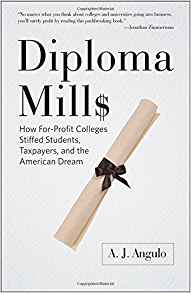
What makes GCU so interesting is its radical 21st-century attempt to rewrite the Christian college playbook. In order to stay afloat, in 2004 GCU converted into a for-profit institution. There’s nothing new about for-profit higher education. As my friend and colleague A.J. Angulo has argued so powerfully, the for-profit sector has a long and often shameful history.

What IS unusual is an evangelical college hoping to join the for-profit club. To be sure, plenty of evangelical colleges make money. Most famously, Liberty University made gagillions of dollars in online education in the past dozen years. But that money isn’t a profit for shareholders; it is plowed back into campus resources, including the newly respectable Liberty football team.

diploma mills

Tsk, tsk. Not a club I’d think Christian colleges would want to join…

If recent news is any indication, there are good reasons why evangelical colleges don’t try to make a profit. In Phoenix, GCU has recently agreed to buy back its right to be a non-profit school. It won’t be cheap. The school plans to spend almost a billion dollars (yes, that’s B-illion with a B) to buy back its stock.

Some of the benefits are concrete. As a non-profit institution, GCU will once again be eligible to accept tax-deductible donations. It will be able to participate in NCAA sports and compete for research grants. As all colleges must do to survive, these trappings will allow GCU to look like a “real” college.

The quest to maintain status as a “real” college has always animated evangelical schools. They have fretted that their doctrinal peculiarities and severe campus rules would cause higher-ed outsiders to look down their noses at them as mere “church colleges.”

So GCU’s desire to reclaim its non-profit status makes perfect sense in the longer story of evangelical higher education. This morning I’ve got a different question. All evangelical colleges want to have sports, research, and the other trappings of “real” colleges. But they’ve also insisted on their status as “real” Christian institutions, though they have never been able to agree on a precise definition of that term.

So here’s the question: How could GCU have ever moved into the for-profit world? Could an evangelical college ever hope for respect if it made a profit off of its students? Wouldn’t that undermine its claims to being a truly Christian institution?