These Twelve Teachers Terrify Me

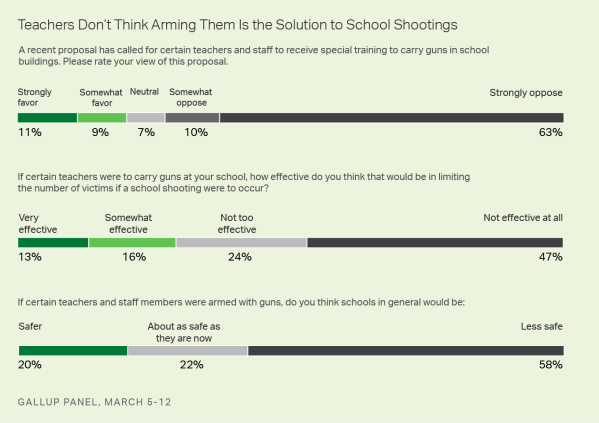
Me, I don’t think more guns in school are a good idea. But if we were to go ahead with such a plan, we have to find a better way to figure out who our gun-toters will be. A recent Gallup poll offers a frightening scenario.

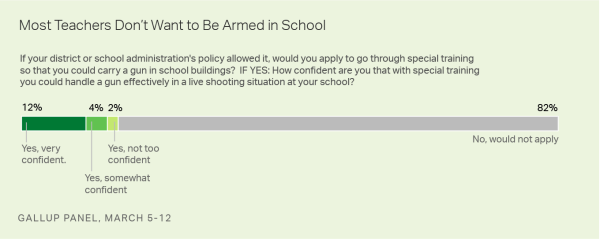
The poll finds that teachers overall don’t want guns. Nearly three-quarters (73%) of polled teachers oppose the idea. A significant majority (58%) think it will make schools less safe.gallup on teachers with guns

The scary result is different. Some teachers (18%) said they’d be willing to carry guns at work. Of those, two-thirds told pollsters they were “very confident” that “with special training [they] could handle a gun effectively in a live shooting situation at [their] school.”gallup on teachers with guns 2

Am I crazy? Or are these twelve-out-of-a-hundred teachers who think they know just what to do with a deadly weapon the LAST people who should be packing heat in school? Have we forgotten the lessons of Farva?

The Dilemma of the Fundamentalist Intellectual

It’s tough to be a conservative evangelical intellectual these days. As a recent exposé at Religion & Politics makes clear, they are still addicted to mainstream academic credentials, even when those credentials can be nearly impossible for them to achieve.

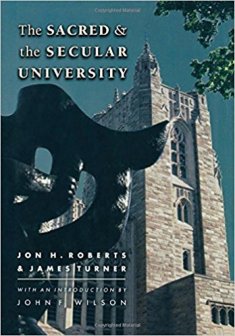
Why is it so difficult for conservative evangelicals to earn mainstream academic credentials? In part, it’s due to the stark and growing divide between mainstream institutions and evangelical intellectual assumptions. As I’m arguing in my new book about evangelical higher education, in the late nineteenth century conservative evangelicalism lost its place as the presumed intellectual backbone of America’s colleges and universities. I think historian Jon H. Roberts said it best. In the late 1800s,

Truth claims based on alternative epistemologies—tradition, divine inspiration, and subjective forms of religious experience—increasingly lost credibility within the academy.  In addition, the recognition that knowledge itself was fallible and progressive cast doubt on the legitimacy of venerable doctrines.  Claims that ongoing inquiry would eliminate error and establish truth fostered an iconoclasm toward orthodoxies.

In response, conservative evangelicals—calling themselves “fundamentalists”—built a dissenting network of higher-educational institutions. It wasn’t only brick-and-mortar schools. Fundamentalists created their own accrediting agencies, athletic leagues, alumni organizations, and more. These independent evangelical institutions allowed academics to rack up titles and honors without participating in mainstream thinking. As we’ve noted recently, the fetish for credentials has always included a frenzy of cross-institutional honorary doctorates.

sacred secular university

The empire really was in ruins.

But it’s still not enough. Throughout the twentieth century and continuing today, conservative evangelicals have yearned for more than just their own credentials. They have oohed and aahed at their colleagues who have earned mainstream academic respectability.

One notable case occurred during the mid-century creationism wars. Back in the 1940s and 1950s, evangelical intellectuals squared off (again) over the question of a young earth. Did belief in the Bible require belief in a literal six-day recent creation? In a literal world-wide flood?

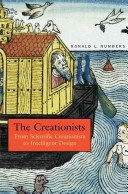
At the 1948 meeting of the creationist American Scientific Affiliation at Calvin College, for example, geochemist J. Laurence Kulp battled with Calvin botanist Edwin Y. Monsma. Monsma defended the young-earth position. Kulp trashed it as mere “foolishness.” With his PhD from Princeton and his faculty berth at Columbia, Kulp’s mainstream credentials helped carry the day. As historian Ronald L. Numbers described, many ASA members were “ready to follow Kulp in boldly shedding the trite fundamentalist apologetics of the past.” Creationism, yes. Young earth, no.

At least in part, Kulp’s bona fides from outside the charmed circle of fundamentalist institutions helped convince many conservative evangelical intellectuals that Kulp’s ideas had oomph.

The_Creationists_by_Ronald_Numbers

Creationists love credentials…

Today, we see a sad case of inflated credentials from another evangelical intellectual. As Professor Jill Hicks-Keeton of the University of Oklahoma points out, a recent publicity appearance to promote the new Museum of the Bible highlighted conservatives’ desperate drive for mainstream academic credentials.

Professor Hicks-Keeton describes the spiel of Jeremiah Johnston of Houston Baptist University. Professor Johnston hopes, in his organization’s words, to “teach Christians to be Thinkers and Thinkers to be Christians.”

But in his quest to wow evangelical audiences, according to Hicks-Keeton, Dr. Johnston played fast and loose with his resume. Hicks-Keeton sleuthed a little deeper. As she puts it,

Johnston’s academic credentials sound impressive: “He has studied at Oxford,” the pastor said. The CTS [Christian Thinkers Society] website’s bio for Johnston includes a list of presses with whom he has published, led by one of the most prestigious in the guild: Oxford University Press. During his talk to the congregation, Johnston repeatedly performed such credentials for church members by dropping academic words the average churchgoer would not have encountered (shema, protois, verisimilitude) and by flagging his own academic work. . . . A closer look at his curriculum vitae reveals that his educational pedigree is unrelated to Oxford University, a premiere institution of scholarship. The “Oxford” mentioned by Pastor Daniel is actually the Oxford Centre for Mission Studies—identified by its website as “an independent Christian charity.” Johnston’s publications with OUP amount to four brief, co-authored contributions to encyclopedias and edited volumes, which are not subjected to the rigors of peer review.

Ouch. For any academic—evangelical or not–these charges sting.

Why would Professor Johnston puff up his credentials, when they are so easy to deflate? I don’t know Johnston, but my hunch is that he shares the century-old dilemma of all fundamentalist intellectuals. In spite of their long efforts to free their minds from the shackles of mainstream academic thinking, they are still wed to the same hierarchy of prestige as everyone else.

Word Up.

Woo–here’s another doozy. I’m doing background reading for my new research project and I came across this phrase from the mid-1800s.Gilfoyle word up

“Noctivagous strumpetocracy”?!??!??

I think I get it, but it’s hard to be sure. Props to historian Timothy Gilfoyle, City of Eros (1992). Great book, great glossary.

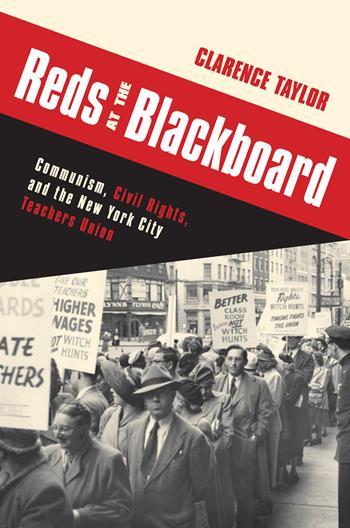
Clarence Taylor on Purging Racist Teachers

[Editor’s Note: We are delighted to welcome comments today from eminent historian Clarence Taylor. Taylor is the author, among other things, of Reds at the Blackboard. As SAGLRROILYBYGTH recall, last week we wondered if Florida’s firing of a racist teacher was similar to Cold-war-era firings of socialist teachers. Instead of flapping our gums more, we asked the expert. Here is Professor Taylor’s perspective:]

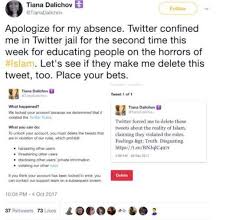
The decision to remove Dayanna Volitich, a 25 year old social studies teacher at a middle school in Florida, from the classroom, after it was discovered that she hosted a white nationalist podcast raised the question of the right to free speech. Was Volitich denied freedom of speech?  She expressed horrendous beliefs on her podcast, including agreeing with a guest who maintained that an African child has a lower IQ than a child born in Sweden.  On her February 26, 2018 podcast, Volitich, who went by the pseudonym Tiana Dalichov, maintained that there is scientific evidence that some races are more intelligent than others.  But should she have been removed from the classroom because she expressed racist views on a podcast?

voliltich tweet

Grounds for dismissal?

There is a long history of targeting teachers for their political beliefs.   By the First World War teachers were forced to sign loyalty oaths to assure that they would not take part in what those in power deemed as unpatriotic activities.  As scholars Charles Howlett and Audrey Cohan note, “there was a time in United States history when loyalty oaths struck fear in the hearts and minds of those who encouraged free inquiry and open discussion on controversial issues.”

During the Cold War teachers, college professors and others were targeted for their political beliefs.   Hundreds of New York City public school teachers were forced to resign, retire, or were fired because they were members of the Communist Party.  Not one of the teachers fired, forced to retire or forced to resign because of their political affiliation were ever found to be derelict in the classroom.  None were found guilty of spreading Communist propaganda to their students.  They simply lost their positions because of their membership in the Communist Party.

No matter how appalling Volitich’s views are she has the constitutional right to express those views.  I am sure that a vast majority of Americans think that Volitich’s ideas are distasteful.  But the views of Communist teachers were distasteful to many.  Because views are seen as repugnant to a large number of people does not mean that those expressing those views should have their constitutional rights revoked.

taylor reds at the blackboard

A different world? Or just a different context?

One may argue that unlike the victims of the Cold War, where they were purged for just Communist Party membership and taking part in communist led activities outside of the classroom, it is claimed that Volitich eagerly touted her white supremacist views to her students.  She even confessed on her podcast, that she shared her white supremacist ideas in the classroom.  According to Volitich when parents complained to the principal that she was espousing her racial ideology to her students, she admitted that she lied to the principal by denying she was attempting to spread her racist views.

But even with her claim on her podcast and a few parents complaining that she advocated her Nazi doctrine in class, at this point there is no hard evidence that Volitich was advocating white supremacy in the classroom.  Nowhere is it mentioned that school officials, including those who must observe her in the classroom, ever complained that she was spreading white supremacist doctrine to her students.    Moreover none of her colleagues ever complained of her views.  Is what someone claimed on a podcast grounds for dismissing her from her position as a teacher? Shouldn’t a teacher be judged for what she does in her classroom and for service to her school?

One may argue that the ideas Volitich expressed are dangerous to the larger society therefore she should be fired. But that was the same argument that was used to purge teachers and professors from their position.  Those who were responsible for the dismissal of teachers during the Cold War maintained that their membership in the Communist Party deemed them as dangerous to the country.  There was no need to prove that they were indoctrinating students.  Cold War crusaders argued that the mere fact that they were communists and communist sympathizers disqualified them from the classroom.

Today many recognize that the New York City teachers were simply victims of overzealous anti-Communist warriors.  Let’s not make the same mistake with those on the extreme right.

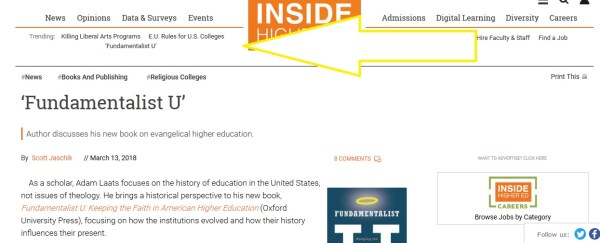
We’re Trending!

You might have trended before. I don’t think I have. I’m a little dizzy…

IHE FU story

Does this mean I’ll need new outfits?

How Did Christian Colleges Become Racist?

People keep asking: Why are white evangelicals so racist? This week we see it in The Atlantic and at Forbes. At leading evangelical colleges—in the North anyway—there’s a big, obvious answer that this week’s pundits don’t mention.

Here’s what they’re saying:

  • Michael Gerson wondered what happened. At his alma mater Wheaton College in Illinois, a strident anti-racism among white evangelical leaders slipped away.
  • Chris Ladd places the blame on slavery and the lingering dominance of Southern Baptists. As Ladd writes,

Southern pastors adapted their theology to thrive under a terrorist state. Principled critics were exiled or murdered, leaving voices of dissent few and scattered. Southern Christianity evolved in strange directions under ever-increasing isolation.

The question should bother all of us, white or not, evangelical or not. Why do so many white evangelicals seem comfortable or even enthusiastic about Trump’s Charlottesville-friendly MAGA message?

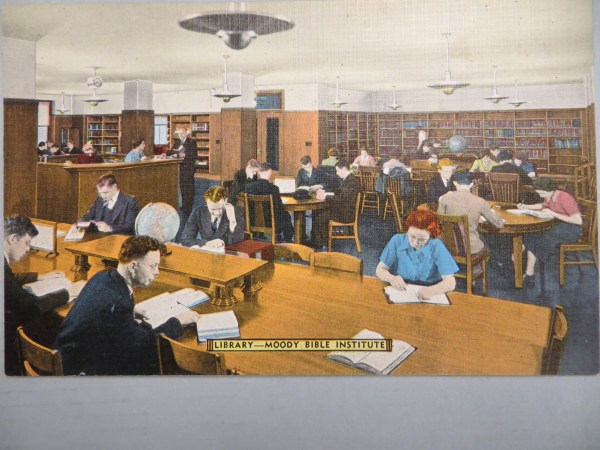
1940s postcard library

Not a lot of diversity, c. 1940s

Since neither Gerson nor Ladd bring it up, I will. At some of the leading institutions among white evangelicals, there is an obvious culprit. It’s not the political power of the slave state. It’s not craven lust for political influence. As I’m arguing in my new book about evangelical higher education, Christian colleges have always been desperate to keep up with trends in mainstream higher education. And those trends pushed white evangelicals to mimic the white supremacy of mainstream higher education.

Of course, evangelical colleges were happy to stick out in some ways. In the classroom, for example. Evangelical institutions of higher education have always prided themselves on teaching dissident ideas about science, morality, and knowledge. In social trends, too, evangelical colleges didn’t mind having stricter rules for their students about drinking, sex, and dress codes.

When it came to academic luster, however, fundamentalist academics in the first half of the twentieth century were desperate for the respect of outsiders.

At Gerson’s alma mater, for example, President J. Oliver Buswell quietly discouraged African American attendance in the 1930s. Why? There’s no archival smoking gun, but Buswell explicitly discouraged one African American applicant, suggesting that her admission would lead to “social problems.”

When we remember the rest of Buswell’s tenure, his reasons for discouraging non-white applicants become more clear. Against the wishes of other Wheaton leaders at the period, Buswell fought hard for academic respectability. He tried to decrease teaching loads, increase faculty salaries, and improve faculty credentials. As Wheaton’s best historian put it, Buswell

passionately believed that one of the best ways to earn intellectual respect for fundamentalist Christianity would be to make certain that Wheaton achieved the highest standing possible in the eyes of secular educators.

In the 1930s, that respect came from a host of factors, including faculty publications and student success. It also came, though, from limiting the number of African American students and the perceived “social problems” interracialism would impose.

Buswell and Wheaton weren’t the only northerners to impose segregation on their anti-racist institutions. Cross-town at Moody Bible Institute, leaders similarly pushed segregation in order to keep their institution respectable in the eyes of white mainstream academics.

Like other white evangelical institutions, in the late 1800s Moody Bible Institute was committed to cross-racial evangelical outreach. On paper, in any case. And MBI always remained so on paper, but by the 1950s the dean of students broke up an interracial couple. The dean was not willing to say that there was anything theologically wrong with interracial dating, but he separated the couple anyways, worried that public interracialism would “give rise to criticism” of MBI and its evangelical mission.

Why do so many of today’s white evangelicals seem comfortable with Trump and his white-nationalist claptrap? Why didn’t they hold on to the anti-racism that had animated white evangelicals in the past? Both Ladd and Gerson make arguments worth reading.

On the campuses of northern evangelical colleges, though, there was another powerful impulse. For evangelical college leaders, being a real college meant earning the respect of white non-evangelical school leaders. Between the 1930s and the 1950s, uncomfortable as it may be to acknowledge, mainstream white college leaders expected racial segregation. White evangelical college leaders weren’t more racist than non-evangelicals. They were just more desperate to seem like “real” colleges.

HT: DL, EC

Required Reading: Our American Dilemma

Is America a racist place? Like, fundamentally and deeply racist? When historians look around, they tend to say yes. But as a terrific new book about the 1920s Ku Klux Klan makes clear, saying that white racism has always been a central part of American culture is only the beginning. If we really want to understand white racism in America, we need to be prepared to wrestle with some complicated and uncomfortable facts.
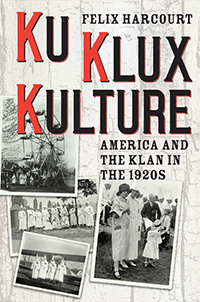
harcourt ku klux kulture

Required reading…

We can see the dilemma everywhere we look these days. White nationalism seems to be thriving, as we saw in the 2016 presidential elections. We also see it all over today’s college campuses. And—as I argued recently in Religion Dispatches—we find it in places we might not expect, such as evangelical colleges and universities.

But white nationalism is only part of the story. These days, every triumph of Trumpishness is also a catalyst for anti-Trump activism.

This paradox at the heart of American identity is made disturbingly clear in a wonderful new book by Felix Harcourt. Harcourt examines the impact of the 1920s Ku Klux Klan on the wider American culture of the 1920s. I’ve spent my share of time studying the 1920s Klan—it was a big part of my book about the history of educational conservatism.

Harcourt’s book raises new and intriguing ways to understand the everyday bigotry associated with the Klan of the 1920s. When most of us imagine the Ku Klux Klan, we think of the much smaller, much different Civil-Rights-era group. In the 1950s and 1960s, the Klan had been reduced to small clusters of southern hillbillies lashing together dynamite bombs and informing for the FBI.

The 1920s Klan wasn’t like that. Some of the symbols were the same, such as the fiery cross, the infamous hood, and the night-rider imagery. In the 1920s, though, membership in the Klan boomed into the millions. Instead of hunkering down in barns and basements, the 1920s Klan seized Main Street with lavish parades and open celebrations of “100% Americanism.” The organizations briefly ran the government of states such as Indiana and Oregon. Its main bugbear was not voting rights for African Americans, but rather infiltration by Catholics and other sorts of immigrants.

Not that the 1920s Klan wasn’t fiercely controversial. It was. Even as it attracted endless criticism, however, it also attracted millions of members, each coughing up ten dollars for required accoutrements and registration forms.

Professor Harcourt does the best job any historian has done yet of capturing this American paradox. He examines the way the Klan presented itself in newspapers, books, and other media. He also looks at the ways outsiders unwittingly helped drive membership by attacking the Klan. As Harcourt makes abundantly clear, the real lesson of the 1920s Klan lies in its everyday radicalism, in the way its members thought of the Klan as a muscle-bound Rotary Club, another expression of their Main-Street claim to white Protestant supremacy.

For example, journalists in Columbus, Georgia took great personal and professional risks to confront their local Klan. They went undercover to expose their governor as a Klan stooge. The upshot? Their newspaper won a Pulitzer Prize for brave investigative journalism but the outed governor won a landslide re-election.

Beyond electoral politics, the 1920s Klan made a huge impact on popular culture. As Harcourt recounts, publishers generally were more interested in exploiting the Klan’s controversial reputation than in supporting or denouncing it. Maybe the best example of this was the June, 1923 special edition of the pulp magazine Black Mask.
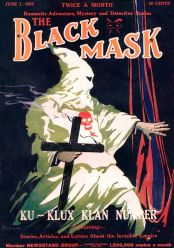
black mask kkk june 1 1923

“Rip-snorting” racism.

In a masterpiece of blather, the editor told readers of the Klan issue that the hooded empire was

the most picturesque element that has appeared in American life since the war, regardless of whether or not we condemn its aims—whatever they may be—or not.

This same editor told one author to provide a “rip-snorting dramatic tale” about the Klan, but to leave out any sort of controversy. In the story, “Call Out the Klan,” a WWI veteran investigates the Virginia Klan who has kidnaped his love interest. Turns out it was fake news—a non-Klansman put on robes and hood and kidnaped the southern belle in order to discredit the Klan. In the end, the true Klan saved the day, in particularly dramatic fashion. The story includes no mention of racism, anti-Semitism, or anti-Catholicism.

The 1920s Klan was at once frightening and fascinating; lauded as a tough answer for tough times and excoriated for anti-democratic thuggery; hailed as America’s salvation and cursed as its damnation.

In our popular memory, the Klan is usually conveniently dismissed as a nutty group of thugs and crazies. In fact, as Harcourt reminds us, “the men and women of the Klan were far from aberrant and far from marginal.”

Those of us who were shocked by President Trump’s surprise electoral victory in 2016 should heed these historical lessons. White nationalism has always been able to mobilize Americans. Many of us get off the couch to fight against it, but equally large numbers will fight in favor.

And though no one says President Trump is a latter-day Clifford Walker, it’s difficult not to get spooked by some of the parallels. As one Klansman told reporters, the Klan’s strategy was always to attract attention, no matter what. As he put it, “the Klan organization dealt very deliberately in provocative statements, knowing they would garner front-page headlines.”

I Love You but You Didn’t Do the Reading

From Scott Pruitt to Thing T. Thing, this week has been another doozy. Thanks to everyone who sent in stories for the weekly roundup.

Want to understand educational culture wars? Start with the Addams Family Goes to School. HT: JN.

Teacher strikes sweeping down the plains?

Head of EPA warns about Islam and evolution, at Politico.

What real school reform looks like, at TLFM.

American Stalinism is back, says Andrew Bacevich at AC.

Loving power, tolerating Trump: Concerned Women for America’s “Esther Moment,” at R&P.

Creationism and “hate speech” in Oklahoma: Ken Ham talks at university after all, at RNS.

  • Was this Christian love? Or something else? At ILYBYGTH.

White nationalism in the teachers’ lounge:

Life as a closeted conservative academic, at AC.

Campus Christian group wins reinstatement in Detroit, at CT.

Town government quits after losing the mayor’s office in polygamous town, at RNS.

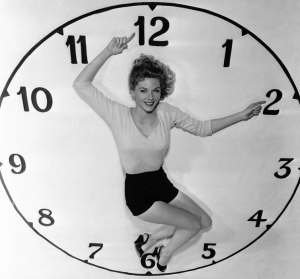
Set your clocks to stupid: Why 100 years of Daylight Savings Time have been a flop, at RCS.

Remember those clocks! C. 1956.

Is your top cardiologist out of town? Good—your chances of survival just went up, at CHE.

Why did white evangelicals jump for Trump? Michael Gerson says they “lost their interest in decency, [they] . . . became defined by resentment.” At Atlantic. HT: DL.

  • Sounds just about right, but it’s missing one important thing, at ILYBYGTH.

When Did Conservatives Demand Local Control?

I’m no conservative, but I respect several conservative thinkers and writers. We may disagree—sometimes fiercely—but folks such as Rod Dreher, Patrick Deneen, and Mark Bauerlein are always worth reading, IMHO. In education, I put Rick Hess in this category. In a recent piece about localism, though, Hess makes some mistaken claims about the history of educational conservatism. I can’t figure out why.

OLYMPUS DIGITAL CAMERA

The first worry wasn’t desegregation, but communist subversion.

He’s not alone. Back when my book about the history of educational conservatism came out, I did a brief interview with conservative journalist John Miller. He wanted to know about the long history of conservative desire for charter schools. As I told him, there wasn’t one. The charter movement only became a darling of most conservative thinkers at the very tail end of the twentieth century. Before that, only a few lonely free-marketeers embraced Milton Friedman’s charter plan. (I have described this history in a different academic article, if you’re interested.)

Conservatives aren’t the only ones who don’t like to look their history square in the face, of course. Progressives don’t like to be reminded that WE were the racist ones back in the 1920s, as I also describe in The Other School Reformers.

Hess is too smart and too ethical to distort conservative school history in the usual ways. He frankly acknowledges that conservatives turned to localism in order to protect their right to racial segregation. As he and his co-author put it,

After Brown v. Board in 1954, demands for more “rational” and “less political” oversight were joined by a compelling moral claim—that many communities (and even states) could not be trusted to do right by all their students. Thus, the post-Brown era was marked by school reform agendas—in the states and in Washington—that frequently sought to reduce or even eliminate local control. These strategies came from both the right and left, from both legislatures and the courts, and included new directives regarding desegregation, standards, testing, discipline, funding, teacher quality, school interventions, magnet schools, school choice, and more.

In this telling, federal influence after 1954 pushed states and towns to desegregate. Conservatives pushed back, demanding local control in order to preserve segregated schools. In one sense, he’s not wrong. Brown v. Board marked a milestone in conservative thinking about schools and education. But 1954 was not the watershed year. For American conservatives, the big switch came earlier, in the New Deal era.

OLYMPUS DIGITAL CAMERA

A later effort (1963), but wow.

Through the 1920s, leading conservative public figures tended to call for increased federal involvement in local schools. By the 1940s, conservatives recoiled in horror at the notion of federal control.

What happened?

It wasn’t Brown v. Board. Brown v. Board strengthened conservative animosity toward the idea of federal educational leadership a thousandfold. But it did not create that animosity. Starting in the 1920s, conservative thinkers and activists became convinced that the academic leaders of educational thinking had gone to the socialist dogs.

In the 1930s, conservatives mobilized against the “experts” at places such as Teachers College, Columbia University. As one business leader warned an ally in the American Legion in 1939, professors such as Harold Rugg and George Counts

have been weaning [sic] over to their side a large and increasing population of educational authorities. This ties in with the whole progressive-education movement, which is another thing which some of old-fashioned believers in mental discipline believe is helping to weaken the moral strength and self-reliance of our youth.  That may not come under the heading of Americanism or un-Americanism, but it is a closely related consideration because the progressive educators and the spreaders of radical un-American doctrines are to a large degree the same people and they mix their two products together and wrap them up in one package.

For this patriotic conservative, the leading educational experts could no longer be trusted.

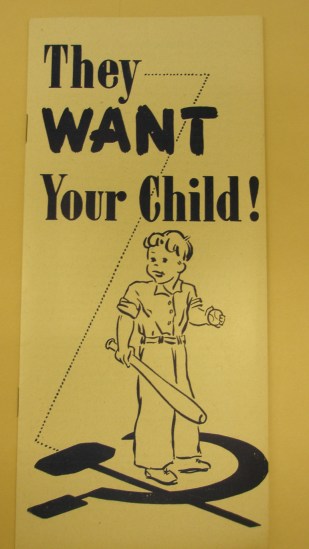
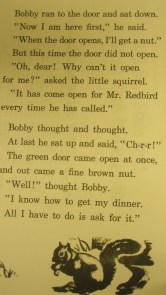
By the 1940s, it had become standard thinking among conservatives—all sorts of conservatives—that federal control meant leftist control. They warned one another that “they” were after your children. For decades, they investigated textbooks for subversive squirrels and other communist rats.

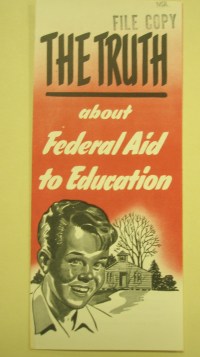
The trend was so powerful that organizations such as the National Association for Education tried to fight back. Federal aid to education, they told anyone who would listen, was nothing but a better way to fund local schools.

OLYMPUS DIGITAL CAMERA

NAE: Don’t hate me cuz I’m federal… (c. 1950)

Conservatives didn’t buy it.

By the time SCOTUS ruled in favor of school desegregation, conservative thinkers and activists had long distrusted the influence of the federal government. They had long since turned to the idea of local control as the only way to protect decent education.

To this reporter, it seems today’s conservatives would want to trumpet this version of conservative educational history, not ignore it. I can’t help but wonder: Why don’t they?

Attention Cheapskates!

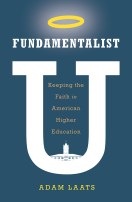
Good news. Oxford has donated ten copies of Fundamentalist U to Goodreads for a giveaway. If you’d like to save your ten bucks, you can put your name in the hat for a free copy.

Cover art finalGood luck!