Whites at the Blackboard

I get it. I wouldn’t want a middle-school social-studies teacher who hosts a white-supremacist podcast teaching my kid. I wouldn’t want her in my local school at all. But does everyone–even a teacher–have a right to free speech? Does our history of teacher purges have a lesson to teach us here?

voliltich tweet

Grounds for dismissal?

You’ve probably heard the story by now. Florida’s Dayanna Volitich has admitted she hosted a white supremacist podcast and twitter account. As her alter ego “Tiana Dalichov” Volitich noted that preferring one’s own race was not a bad thing. She wondered about the “Jewish Question.” She noted that some “races . . . have higher IQs than others.”

Does all this make her unfit for service as a public-school teacher? How about the fact that she bragged about disguising her views when her supervisor came around, but did her best to secretly promote them among her students?

In her own defense, Volitich has insisted that her online persona was nothing more than “political satire and exaggeration.”

Should she be fired? IMHO, if Volitich really did engage in this sort of racist diatribe, she’s not worthy of the role of social-studies teacher. Moreover, if she knowingly and intentionally taught her ideas to her students subversively, she should be out on her ear.

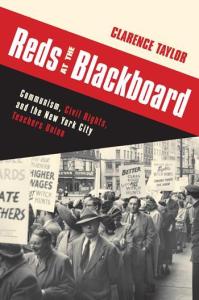
taylor reds at the blackboard

A different world? Or just a different context?

But the historian in me can’t help but ask: Is this situation different from Local 5? As Clarence Taylor has demonstrated, socialist teachers in New York City were purged for their political views. Between the 1930s and the 1950s, left-wing teachers were fired for their socialist ideas. They weren’t accused of bad teaching, but only of bad politics.

It can be difficult to remember the heat and fury of America’s anti-socialism movement. For long decades, though, as I argue in my book about educational conservatism, socialism was viewed as nothing less than intellectual poison. Teaching it to students–or even harboring a teacher who harbored socialist ideals–was seen by many Americans as an outrageous abdication of educational justice.

I feel the same way about this case. I can’t imagine allowing a white-supremacist teacher to sneakily insert her horrible views into a middle-school classroom. But when I call for her dismissal, am I repeating the travesties of the twentieth century, only from the other side?

What do you think?

Genesis, Free Speech, and Hate Speech

What would arch-creationist Ken Ham say if someone accused him of hate speech? We don’t have to guess. At his recent talk at the University of Central Oklahoma, Ham defended his vision of proper Christian morality. Did he capture ancient Christian wisdom? Or spout off twenty-first century bigotry?

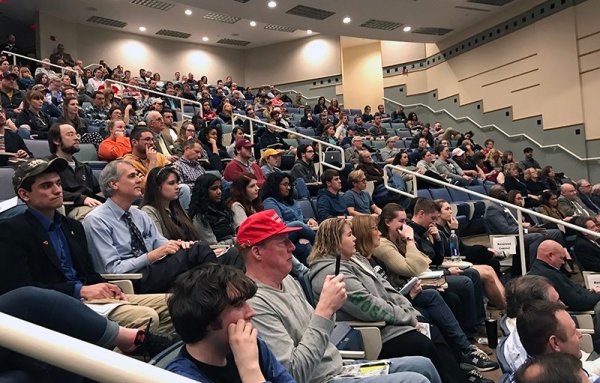
ham speech audience UCO

Part of the 500-person audience at UCO.

As SAGLRROILYBYGTH recall, we’ve tussled over this issue recently. When UCO rescinded Ham’s original invitation, we wondered if free speech was still alive. I argued at the time that free speech was something of a red herring in this case–and many similar college cases. The real issue is sponsorship. The student organization at UCO did not want to pay Ham to speak, due to Ham’s views on sexuality and marriage.

In the end, UCO President Don Betz squared the circle by using money from a separate slush fund to pay for Ham’s visit. And the talk went off without a hitch. During the Q&A, one audience member asked Ham directly about gay rights. Here’s how the interchange went, according to Religion News Service:

One questioner — a self-described “spirit-filled Christian” and member of the LGBTQ community — said: “I sought the Lord and churches for why I feel attracted to the same sex. I found the church nor churches’ traditional view on (LGBTQ) fit my experience of hearing the Lord speak directly to me. Science, not the church, gave me peace. How can you say my experience of still being a child of God isn’t valid?”

Ham said he would start by asking how the person heard from God: “My way of dealing with that would be to say, ‘Let’s judge what the actual written word of God says. Let’s judge what you’re saying against what it says.’

“Because I have a different worldview in relation to marriage and gender doesn’t mean I hate that person,” Ham added. “Sometimes, people accuse us of hate speech because we disagree with them. It’s a clash of worldviews. That doesn’t mean we hate someone. In fact, the Bible commands us to love everyone, and that’s what we do.”

What do you think?

From my perspective, Ham’s answer sidesteps the central point. I don’t want to put words in anyone’s mouth, but my hunch is that anti-Ham protesters at UCO didn’t care if Ham personally hated or loved them. The real question is whether or not he wanted to take away their civic rights to marriage equality.

Extremely Mainstream

It’s uncomfortable. Listening to a high government official denounce evolutionary theory and Islam makes me nervous for the future of the USA. More important, though, it brings us back to a tough question: When is an idea “extreme?” Our answers matter, because extremism can be kicked to the curb, but strong disagreement can’t.

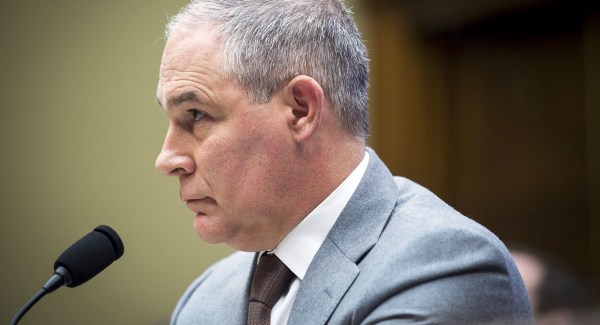
pruitt

Terrible? Yes. Outside the mainstream? No.

To SAGLRROILYBYGTH, this discussion will feel familiar. In recent weeks, we’ve been wondering if young-earth creationism really counts as “hate speech.” We’ve debated whether tax-funded student groups should be free to discriminate. We’ve examined the decisions of conservative Californians to shun a speaker they considered “extreme.

The details of the story this week are different, but the issue is the same. Scott Pruitt, former state senator and current head of the Environmental Protection Agency, has had some of his old laundry aired in public. In thirteen-year-old radio interviews, Director Pruitt talks about a range of issues, from science to the Second Amendment.

Is evolution really the best explanation for the diversity of species? Quoth Pruitt,

There aren’t sufficient scientific facts to establish the theory of evolution, and it deals with the origins of man, which is more from a philosophical standpoint than a scientific standpoint.

Should some kinds of guns be banned? Not according to Pruitt:

If you can tell me what gun, type of gun, I can possess, then I didn’t really get that right to keep and bear arms from God. . . . It was not bequeathed to me, it was not unalienable, right?

Is Islam a religion that deserves constitutional protection? Pruitt thinks so, but he didn’t object when one of the interviewers called Islam

not so much a religion as it is a terrorist organization in many instances.

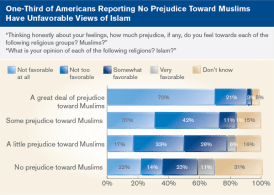
To a person like me, those ideas are both ridiculous and frightening. Ridiculous because they articulate a vast ignorance of the history of our Constitution, of evolutionary science, and basic knowledge about Islam. Frightening, because they articulate a vision of proper government that could include radical violations of Constitutional rights and dangerous inaction concerning gun control.gallup islam

But here’s the rub. The author of a Politico article about Pruitt’s 2005 interviews denounces Pruitt’s

stances that at times are at odds with the broader American mainstream, and in some cases with accepted scientific findings. [Emphasis added.]

For starters, I won’t call attention to the goof in the article about the Supreme Court’s 1947 Everson decision. The author thinks SCOTUS ruled against tax-funded bussing for Catholic schools in that landmark case, but in fact the decision went the other way.

The real issue here is not SCOTUS history, but rather the difficult definition of “mainstream.” I’ll admit it: I’m angry about Pruitt’s views. I’m angry that someone with such opinions would be posted to the head of a scientific government agency. But that doesn’t mean that Pruitt’s ideas are out of the mainstream. When an idea is shared by a plurality of Americans, how can it possibly be out of the mainstream?gallup guns

Gallup polls, for example, indicate that more than a third of American respondents who say they are not prejudiced against Muslims still have an unfavorable view of Islam. Yes, you read that right. Of the people who say they are NOT prejudiced against Islam, 36% still say they don’t like it. Of the people who say they ARE prejudiced against Muslims, that number jumps to 91%.

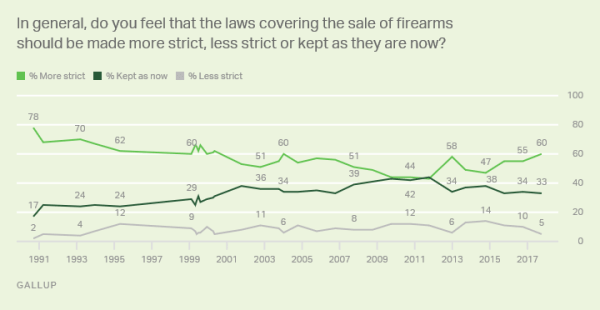
Similarly, the number of Gallup’s respondents who think America needs stricter gun laws has dropped in the last three decades. In 1991, 78% of respondents wanted stricter gun laws. In 2017, that number was only 60%.

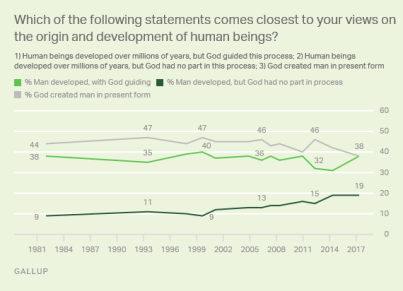
The same is true with evolution. Large majorities of Gallup respondents agree that humanity was either created recently or created by God over time. At best, mainstream evolutionary theory has captured the hearts of a small minority of Americans. It’s only “mainstream” among a small coterie of scientists.gallup creationism poll may 2017

If Director Pruitt agrees with large segments of the American population—sometimes a majority—how can his views be called “at odds with the broader American mainstream”?

The distinctions matter. If an idea is extreme, or discriminatory, or illegitimate, or non-mainstream, it seems fair to push that idea outside the boundaries of polite political or cultural discussion. If not, we have to talk about it.

Like it or not, Director Pruitt’s terrible ideas are as American as apple pie.

I Love You but You Didn’t Do the Reading

In like a lion–we’re reeling from an early March blizzard. It left your humble editor plenty of time to scour the interwebs for stories you might like:

Arizona lawmakers push “conservative thought” onto campus, at NYT. HT: HD.

Guns and boys: A pictorial history of Americans’ gun fetish, at HNN.

guns and boys

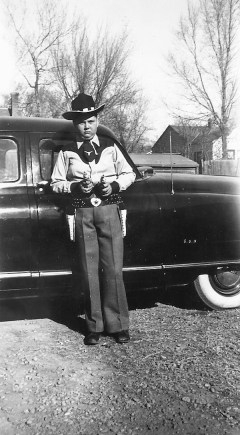
How long have Americans been in love with guns?

Praying at school—the story from McKinney, Texas, at RNS.

How segregated are public schools? A new survey at Brookings.

Did the Nazis really burn the Reichstag in 1933? New proof, at Telegraph.

Notes from the fundamentalist underground: Campus strife at evangelical Taylor University, at IHE.

West Virginia teachers head back to the salt mines, at CNN.

…or DO they? Strike continues after all.

Lehigh University rescinds Trump’s honorary degree from 1988, at TMC.

Charter schools worldwide—what do they look like with fewer rules? Hechinger Report describes Sweden, New Zealand, and France.

LDS scientist: Mormons have nothing to fear from evolutionary theory, at SLT.

Why did China ban Winnie the Pooh? At BBC.

Is religion for suckers? Mark Bauerlein on Steven Pinker, at FT.

Shipping conservatives to the gulag: Rod Dreher’s latest at AC.

Fundamentalists Forget their Furious Family Feud

Maybe there’s hope for every family feud. The death of Billy Graham last week inspired an outpouring of love and respect from people whose fundamentalist forefathers loathed Graham’s revivals. Creationist impresario Ken Ham, for example, never one to water down his fundamentalist faith, had nothing but praise for Graham’s ministry. The archives tell a much different story.

Some of today’s no-compromise conservatives seem to have forgotten the legacy of their fundamentalist forefathers. Ken Ham, for example, praised Graham’s evangelistic outreach. As a child he listened to a Graham rally in Australia. As Ham recalled,

I remember people going forward in this church after listening to him and committing their lives to Christ.

Of course, it’s never kosher to speak evil of the dead. Ken Ham, however, lauded the whole body of Graham’s evangelistic outreach, from the 1950s through today. Ham included no whisper of accusation about Graham’s work.

Does he not know the backstory? Or have fundamentalists given up their ferocious feelings about Graham’s revivals in the 1950s?

Cover art final

Yes, there is a place to read the full story…

To be sure, Graham’s passing has attracted some criticism from intellectuals. Historian Matthew Avery Sutton blasted Graham’s reactionary politics. D.G. Hart recalls the fact that many conservative Protestants were “not exactly wild about Graham’s ministry.”

The epochal anger and denunciations sparked by Graham’s outreach, however, seem to have been forgotten by some latter-day fundamentalists themselves.

I look into this history in my new book about evangelical higher education. In a nutshell, Graham’s revivals split the conservative evangelical community. The sticking point was follow-up. At Graham’s hugely popular services, audience members who felt Jesus’s call were put in touch with a sponsoring church. Those churches included more liberal Protestant churches as well as more conservative ones.

Fundamentalists worried that Graham’s preaching was leading souls directly into the pit of hell, by sending them to false churches to learn poisoned theology. These fears weren’t limited to a few right-wing wackos; they were a prominent part of conservative evangelical thinking in the 1950s, 1960s, and 1970s.

In 1963, for example, Samuel Sutherland of Biola University denounced Billy Graham. To a correspondent who accused Sutherland of cooperating with Billy Graham, Sutherland wrote,

I do appreciate the truth found in the Word of God which Billy Graham proclaims.  We appreciate also the souls that are saved and who find their way to Bible-believing churches and thus are nurtured in our most holy faith.  We deplore quite definitely, and have said so publicly, that there are so many doctrinally questionable individuals who are identified in prominent ways with the campaign and we are disappointed beyond words in the knowledge that so many of those who profess faith in the Lord Jesus Christ at the crusades will doubtless find their way into churches where the Word of God is not proclaimed and where they will not have a chance to know what the Gospel is all about or what it means, actually, to be born-again.  I am with you.

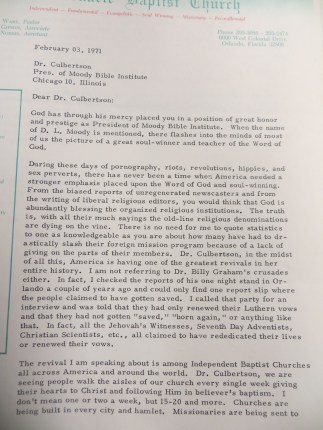
In 1971, one outraged fundamentalist wrote to Moody Bible Institute President William Culbertson to express his disgust at the Graham crusades. As he put it, the Graham crusades only sent people into false churches, such as “Luthern” [sic], “Jehovah’s Witnesses, Seventh Day Adventists, Christian Scientists, etc.”

anti culbertson anti graham letter 1

Fundamentalists didn’t like Billy Graham…

For a fundamentalist, that was a serious accusation.

Such accusations flew fast and furious around the world of fundamentalist higher education. The magazine of Biola University ran one typical reader letter in 1958. Reader Dorothy Rose condemned Graham as a false Christian and a servant of world communism. Rose warned (falsely) that Graham had been expelled from two “outstanding, sound Bible colleges.” As Rose wrote direly,

It is easy to be popular with the high-ups and with the press if we are willing to compromise.  But what is the cost spiritually?

No one denounced Graham more fiercely than Graham’s former mentor Bob Jones Sr. In 1958, for example, Jones wrote to a fundamentalist ally,

No real, true, loyal, Bible friend of Bob Jones University can be for the Billy Graham sponsorship . . . . [Billy Graham is] doing more spiritual harm than any living man.

Fundamentalists have come a long way. When it comes to the legacy of Billy Graham at least, no-compromise conservatives seem to have forgiven, or more likely, forgotten the divisive nature of Graham’s ministry.

Poison Pens at Evangelical Colleges

What’s going on at Taylor University in Indiana? According to a recent anonymous newsletter, the evangelical campus is seething with

gossip, slander, backbiting, profanity, vulgarity, crude language, sexual immorality (including adultery, homosexual behavior, premarital sex and involvement with pornography in any form), drunkenness, immodesty of dress and occult practice.

Zoiks!

Taylor’s administration struggles to respond to this conservative carping. For those in the know about the history of evangelical higher education, this sort of anonymous poison-pen assault has always been part of life at Christian colleges.

As I found in the research for my new book, critics from both the evangelical left and the fundamentalist right have often resorted to anonymous open letters in their attempts to influence policy at their schools. The archival files bulge with letters and newsletters of this type.

At Biola University, for example, a self-identified group of disgruntled fundamentalists buttonholed President Samuel Sutherland with a list of concerns in 1969. As they wrote anxiously,

we are deeply concerned about danger signs showing themselves among some of our conference speakers and members of the student body! Indications now present seem to point to a trend that the school is moving from its Biblical foundation.  May God prevent such a tragedy!

The students were concerned with the slackening of the student dress code, particularly for women. The rules stated that skirts and dresses must not be shorter than one and a half inches above the knee. As the conservative students complained, though,

the failure of a number of Biola girls to adhere to the dress rule is altogether too evident.  Excessive bodily exposure of Biola girls has even been seen in the seminary section of the library and has proven a hindrance to study. . . . We urge the administration to be rigorous in enforcing the rules and regulations of Biola Schools.  IN particular, the dress length rule should be observed because of its obvious Biblical basis.

Rock and roll, too, had snuck onto campus. As the protesters warned,

Unfortunately, many students here are experiencing a diet of music consisting primarily of the popular beat of the day.  Our group does not advocate avoidance of popular tunes!  However we do oppose the trend toward an exclusive diet of rock and roll even to the extent that our religious music is to be constructed around the beat.

All in all, the fundamentalist protesters in 1969 worried about the very continuation of Biola as a safe evangelical school. As they concluded,

Many great schools of the past today are under the sway of heresy.  We do not believe that loss happened within a few months.  We believe the erosion was gradual.  May God help all of the administration and faculty at Biola Schools to become more alert in detecting danger signs and in taking action to prevent the deterioration that has begun here.

These sorts of anonymous pleas for reform and renewal haven’t only come from nose-out-of-joint fundamentalists. Liberal students, too, have penned their share of open letters. The archives are full of em, but my personal favorite comes from Moody Bible Institute.
anti john rice demonstration warning letter

From the MBI Archives: BEWARE!

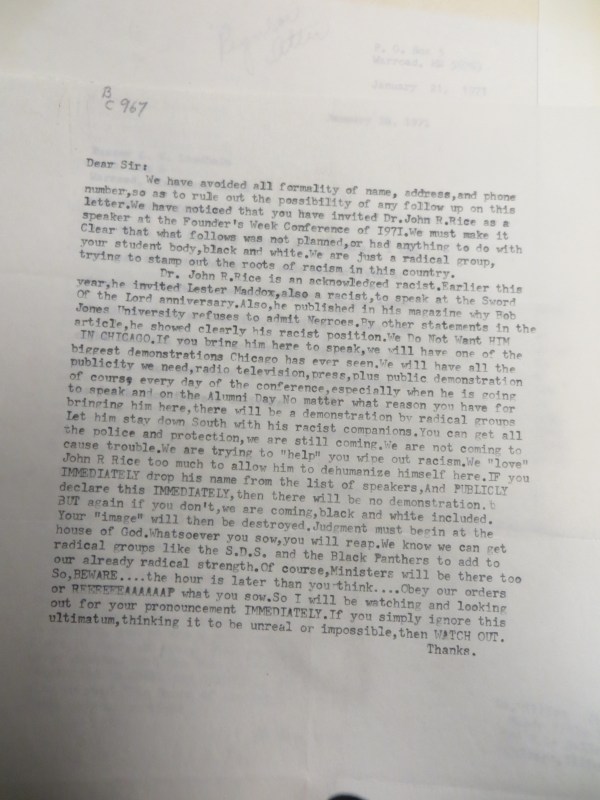
In 1971, MBI invited John R. Rice to speak at its annual Founder’s Day event. Before he could make the trip to Chicago, Rice came out in favor of the racial segregation at Bob Jones University. What was MBI to do? The leadership didn’t want to endorse Rice’s brand of Southern-fried racism. But they also didn’t want to anger his considerable fundamentalist following. As they dithered, they received an anonymous letter warning them to cancel Rice’s appearance.

The letter claimed to be written by non-students. To this reporter, however, the tone sounds awfully similar to the phrasing used by evangelical students everywhere and the letter-writers seem to know a lot more about Rice and MBI than any outsider would. For example, they had read Rice’s publication, Sword of the Lord. They knew about Rice’s recent support for racial segregation at Bob Jones U.

What should MBI do? The letter writers made threats:

We Do Not Want HIM [Rice] IN CHICAGO. If you bring him here to speak, we will have one of the biggest demonstrations Chicago has ever seen.

It would get ugly. As the letter concluded,

BEWARE . . . . the hour is later than you think. . . . Obey our orders or REEEEEEAAAAAP what you sow.

In the end, MBI canceled Rice’s speech. Perhaps the administration shared the letter-writers’ concern that their “ ‘image’ will . . . be destroyed.”

What will happen at Taylor? The conservative newsletter complains that the current campus is going to the dogs, according to Inside Higher Education. In classes, the newsletter exclaims, students learn

permissive views of human sexuality, hostility toward creationist perspectives, rejection of the rule of law (especially on the immigration issue) and uncritical endorsement of liberal-progressive ideas[.]

Such poison-pen missives have had a big impact in the past. Perhaps Taylor’s administration will take the path of least resistance and make some move to mollify the “conservative underground.”

Dress for Success!

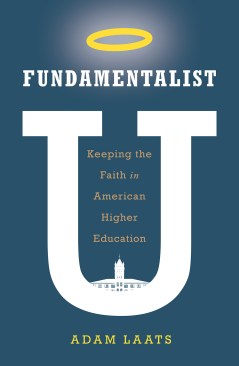
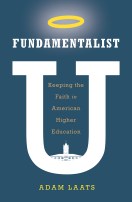
Well, friends, March 1st is just around the corner. And that means the official release of my new book, Fundamentalist U: Keeping the Faith in American Higher Education. Cover art final

I’ve heard from none of you that you plan to “Harry-Potter” this release. That is, that you plan to camp out all night at the bookstore on Wednesday, February 28th, dressed as your favorite personage from Fundamentalist U. For those of you who will be doing so, I’ll share here a few images of the people you might choose to dress up as.

I’m not sure how many of them were in Hufflepuff…

All of these people play important roles in the history of conservative evangelical higher education. For bonus points, can you match the pix to the names? Or the names to the relevant institutions?

Here they are, in no particular order:

  1. Mark Noll
  2. Elisabeth Howard Elliot
  3. Russell Mixter
  4. Henry Morris
  5. James M. Gray
  6. Clifton Fowler
  7. Hudson Armerding
  8. Charles Blanchard
  9. Larycia Hawkins
  10. J. Oliver Buswell

Have fun, and see you at the bookstore!

Winning the Culture Wars—Arizona Style

Forget a long march through the institutions. Conservatives in Arizona are trying a new tactic to win the campus culture wars. Will this new style of legislative campus coup achieve what generations of conservative intellectuals haven’t been able to pull off?

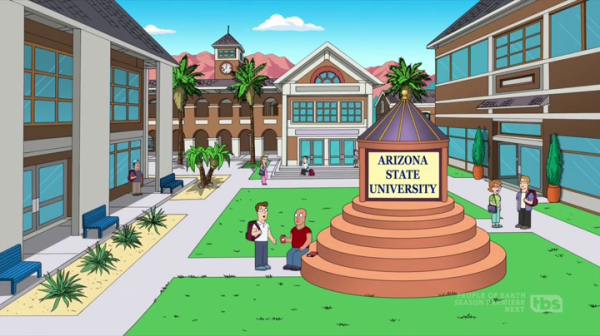
According to the New York Times, conservative lawmakers in Arizona—fueled by bags of cash—have foisted two “Freedom School” programs onto the party campus of Arizona State. Students study the traditional Western canon–Aristotle, Madison, Adam Smith—unfiltered by recent trends in academic thinking.

ArizonaState

Home to Freedom Schools and beer bongs…

The goal, as one lawmaker told the NYT, was to fix the warped intellectual culture of college life. Students are supposed to hear the powerful arguments for free markets and the superiority of Western culture. As Representative Jay Lawrence put it,

There is too much revisionism being taught in universities today. . . . It’s a big deal to those of us who feel very strongly about a more conservative education.

The NYT article doesn’t go into it, but this style of legislative curriculum-making has been popular lately among conservative politicians. In Colorado, SAGLRROILYBYGTH will recall, pressure from the Capitol forced a new chair of conservative thought onto Boulder’s campus. In Wisconsin, lawmakers foisted a campus rule giving conservative students the right to appeal any slight to their conservative ideals.

To this reporter, these attempts to legislate conservative ideas onto left-leaning campuses represent a new strategy.

For about a century now, of course, conservative intellectuals and academics have fretted about the state of higher education. One particular group of religious conservatives—as I recount in my new book about evangelical higher education—threw in the towel and opened their own wildly successful conservative colleges.

More secular conservatives have tried a variety of tactics. Beginning in the 1940s, conservative intellectuals have founded alternative student groups, journals, and newspapers, as George Nash described so powerfully in his history of conservative intellectual life.

Yet in spite of generations of dedicated conservative academic activism, mainstream college campuses still skew left. As Neil Gross has argued, this is more due to self-selecting than to any vast left-wing conspiracy.

Yet it still rankles conservatives. Will the new strategy make mainstream secular campuses more conservative?

William Jennings Bryan dreamed it in 1922.

Frank Chodorov salivated about it in 1953.

Until now, though, conservative intellectuals haven’t had the big-budget clout that they’ve needed to set up campus programs. Will Arizona State’s new “Freedom Schools” herald a new era in secular conservative higher education?

I doubt it. The programs need to offer the kinds of things that colleges have always had to offer—professional certifications, career opportunities, and so on. My guess is that the funding will peter out and students will return to traditional majors and academic programs.

HT: HD

I Love You but You Didn’t Do the Reading

Another busy week: Here are some ILYBYGTH-themed stories that came across our desk recently:

Can a creationist parent successfully sue a school district for teaching evolution? Not in PA, at NCSE.

READING

Words, words, words…

Are international students a higher-ed security threat? FBI director says yes, at IHE.

Conservative college professor to conservative UCLA students: Don’t invite Milo, at WS.

“Any reasonable person will agree…” At HXA, Musa Al-Gharbi points out that reasonable people are actually better at disagreeing, with three suggestions for better cross-culture-war communication.

How Protestantism shaped the modern world: An interview with Alec Ryrie at R&P.

Was this the most gruesome battle in human history?

RIP Billy Graham, at CNN.

What’s wrong with Black History Month? At The Progressive.

School shootings:

Ted Cruz: The Democrats are the party of Lisa Simpson. GOP is for Homer, Marge, Bart, and Maggie. At USA Today, HT: BM.

What’s wrong with standardizing student assessment at colleges? Molly Worthen tees off at NYT.Bart reading bible

West Virginia teachers go on strike, at CNN.

How Liberalism Failed: Albert Mohler interviews Patrick Deneen.

Conservatives need to confront campus radicalism, by Noah Rothman at Commentary.

When Conservative College Students Cancel Campus Speeches

Should they or shouldn’t they? At UCLA, conservative students invited Milo Yiannopoulos to campus. A conservative professor advised them against it. His reasons for doing so highlight another fundamental question buried beneath our campus-free-speech shouting match.

milo yiannopolous

A “legitimate” conservative? Or just a “despicable asshole”?

Like everyone else, we at ILYBYGTH have been pondering questions of campus free speech lately. As SAGLRROILYBYGTH will recall, last week we wondered if arch-creationist Ken Ham could legitimately be disinvited from an Oklahoma university. Then we wondered if conservative student groups could be forced to accept leaders who don’t agree with them.

The issues from UCLA might seem vastly different at first. The College Republicans had issued a speaking invitation to right-wing bomb-thrower Milo. He planned to talk on the topic, “Ten Things I Hate About Mexico.” In an open letter published at Weekly Standard, one of their few conservative faculty mentors, Gabriel Rossman, advised them to cancel the invitation, for conservative reasons. And they did.

Why?

Professor Rossman condemned Milo as nothing but—using the words of Charles Murray—“a despicable asshole.” If UCLA conservatives were really dedicated to promoting conservative ideas and principles, inviting Milo was a bad idea. As Rossman put it,

You need to ask yourselves, what is your goal as an organization? If you’re in it for the lulz and just want to see the world burn, then I guess go ahead and bring in a vapid provocateur.

But if your mission is to spread conservative ideas, you should recognize that hosting Yiannopoulos will only render your organization and our ideas toxic.

Prof. Rossman’s advice—which the students heeded—raises another central underlying question in our debates over campus free speech. Last week in these pages, Agellius noted that the real question was not just creationism or homosexuality or nationalism. The real question, he wrote, was this:

It’s all about who gets to define “discrimination” isn’t it?

If Ken Ham’s version of Christianity is considered ipso facto discriminatory, then it makes some sense that he wouldn’t be invited to speak at a school dedicated to fighting against anti-homosexual discrimination. But if it isn’t, then it doesn’t.

Prof. Rossman’s advice raises a related question. He encourages UCLA’s conservative students to invite provocative conservative speakers. He lauded the decision to bring “War on Cops” author Heather MacDonald to campus. As he explained,

I can understand why some people were offended by Heather Mac Donald’s ideas when she spoke on campus last year. But reasonable people can disagree about whether all Americans, and especially African Americans, on net benefit from aggressive policing. More to the point, Mac Donald expresses her pro-police position without animus, so sponsoring her talk was an entirely legitimate and honorable thing to do.

Milo is different, Rossman thinks. His goal is only to push leftist students into vulgar displays of coercive thuggery. Rossman’s against it; against the entire “epater les SJWs performance art model” that Milo represents. [Editor’s note: SJW = “Social Justice Warrior.”]

We might say that Professor Rossman considered some so-called conservative speakers beyond the pale of legitimacy. Did College Republicans have the right to invite him? Rossman says yes. But was it good conservative strategy to do so? Rossman says no.

The central question, though, is not about Milo or Ken Ham or any single speaking invitation. The central question, it seems to me—following Agellius—is this: Who decides what “extremism” and “legitimacy” are?

Is it “illegitimate” to oppose same-sex marriage? The Oklahoma student protesters said yes. Ken Ham says no.

Is it “extreme” to deride Mexico? To try to provoke UCLA students into wilder and wilder displays of speech-blocking ferocity? Professor Rossman says yes. The College Republicans, apparently, agreed.