Mumbling Toward Gomorrah

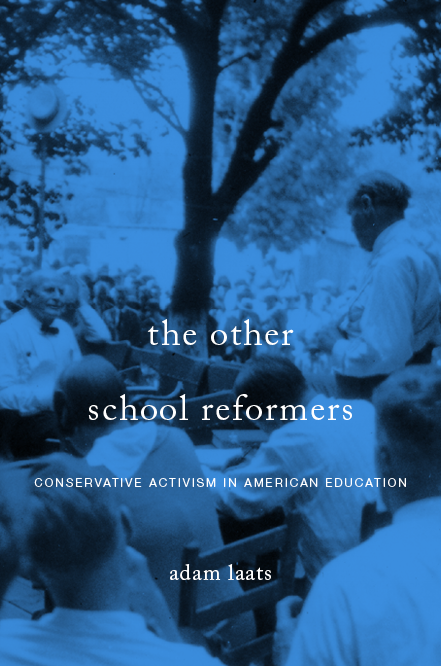
Which side are you on? That’s the question college administrators hate to answer. A few recent headlines make it clear that conservative evangelical college leaders continue to prefer mumbling through some of the touchiest issues they face. As I found in the research for my new book about evangelical higher education, it has always been thus.
baylor-header

What’s their position on homosexuality? …how much time do you have?

I was reminded of this dilemma when I came across a conservative lament about Baylor University in Texas. One outraged correspondent wrote to Benedictophile Rod Dreher to complain that Baylor had ditched its Baptist tradition. Officially, according to this American conservative, Baylor’s code of student conduct prohibits homosexual relationships. But as he or she described, it can be very difficult to actually find that rule spelled out. As s/he told Dreher, in order to find out that Baylor officially bans homosexuality,

You must start here Student Misconduct Defined https://www.baylor.edu/student_policies/index.php?id=32401 only to be redirected here for Sexual Conduct Policy https://www.baylor.edu/student_policies/index.php?id=32294 which says literally nothing, but directs you here: https://www.baylor.edu/content/services/document.php?id=39247. This tells you almost nothing but at least tells you sex is only allowed in marriage–but these days, who knows that means? The Baylor website basically says they understand marriage according to the 1963 Baptist Faith and Message but tough shit, we aren’t going to give you a link; you’re are on your own. I found it: http://www.baptiststart.com/print/1963_baptist_faith_message.html And it turns out that according to the Baptist Faith and Message, marriage is defined as being between a man and a woman. Whew! I’m tired already! Lots of link-chasing and more than a few logical inferences from different webpages are necessary to conclude that in fact, homosexual contact is prohibited by Baylor policy.

Baylor isn’t the only evangelical school to founder in the face of sex policy. SAGLRROILYGYTH may remember a recent case from Boston. Gordon College’s President D. Michael Lindsay set off a firestorm a couple of years ago when he reminded the Gordon community of Gordon’s long-standing policy against homosexual relationships among students. The Gordon community remains painfully divided over the question, with entire faculty committees resigning their leadership roles in protest over leadership decisions.

Now, I’m no evangelical. I’m not conservative. I wouldn’t send my child to a school that banned homosexual relationships, even if that school buried those rules deep in ivy. But as an outside observer, I can’t help but notice what so many school leaders have always known: Sometimes the best policy is mumbles. Anything else can blow up in your face.

After all, Lindsay at Gordon wasn’t changing any rules. He was not imposing a new, draconian policy. Rather, he was simply stating established Gordon rules. And that was enough to create an uproar. It would be difficult for other school leaders not to get the message. Time and time again, cautious school administrators and others can see the enormous benefits of mumbling. Of studied silences. Of intentional ambiguity.

Baylor considers itself a mainstream school, a powerhouse in both faculty lounges and football fields. The fact that its policy officially prohibits homosexual sex isn’t something it likes to promote.

Similarly, President Lindsay’s statement about student sex did nothing more than openly state the school’s longstanding policy, yet his statement has led to prolonged anguish for the Gordon community.

With stakes so high, it certainly seems to be in colleges’ best interest to maintain some flexibility in their official policies. This strategy is nothing new.

To describe just one example from my new book, in the 1960s Wheaton’s administrators faced a similar upsurge from the Wheaton community. Students wanted to revise the forty-year-old student pledge. The old rules against movies, alcohol, and card-playing—rebels insisted—reflected the college’s sad fundamentalist past. They insisted on more flexible rules in order to give them more moral responsibility.

In 1967, President Hudson Armerding agreed, sort of. He approved and announced a new set of guidelines for student behavior. From then on, instead of the old list of banned activities, students were expected to abide by the following rules:

                1.) Cooperate constructively in the achievement of the aims and objectives of Wheaton College and the responsibilities of citizenship in the community and nation.

2.) Exhibit Christian conduct, based on principles taught in the Scriptures, which will result in the glorification of God, the edification of the Church and his own growth in grace

3.) Observe, while under the jurisdiction of the college, Wheaton College’s ‘Standards of Conduct.’

4.) Take maximum advantage of the educational opportunities available to him by ordering his life so that he can live in harmony with both the academic and non-academic goals.

5.) Make full use of his God-given abilities so as to achieve maximum personal development.

6.) Continually evaluate his commitment to Christ and to the purposes of Wheaton College.

Armerding was a past master at mumbling through these questions. He could tell students with a straight face that he had heard their complaints. He really did approve a new approach.

Yet at the same time, President Armerding could tell conservative alumni and trustees that the new rules left the old ones in place. Students still had to abide by the old standards of conduct while on campus. He could look parents in the face, as he did in a 1971 chapel talk, and tell them that nothing had changed. As Armerding put it, Wheaton would never approve

a shallow permissiveness [that] conveys a distorted view of God who deals far differently with His children. . . . We believe that students should be disciplined and corrected and that this should be consistent with the teachings of the Word of God.

The questions in the 1960s and 1970s weren’t about homosexuality. But the strategies were the same. As do administrators at all types of colleges, many evangelical school leaders cherish the value of fuzzy, possibly two-sided rules.
Required Reading: Public vs. Private

[Editor’s Note: We are happy to include an interview with Robert Gross about his new book Public vs. Private. In his book, Dr. Gross explores questions near and dear to the hearts of SAGLRROILYBYGTH: Private schools, public schools, religion, government, and the politics of education. His new book examines the early history of these questions and we’re delighted Dr. Gross has agreed to share some of his thoughts with us.]

1.) In the introduction to Public vs Private, you write,

American conceptions of public and private . . . are impossible to fully understand without placing education at the center of the regulatory state.

Could you please expand on that idea a little? Why is it so important to understand educational history in this area if we want to understand American concepts of “public” and “private?”

There are three main reasons that I think education needs to be placed at the center of our understanding of the history of the regulatory state. The first is simply that, by the early twentieth century, there was perhaps no other sphere of American life that was more heavily regulated. When focusing exclusively on private schools you see the scope of American market regulation in a way that is more hidden in other areas. States regulated almost the entirety of the private school sector: what classes they could teach, what credentials their teachers needed, what language they could speak in the classroom, and so forth. Private schools had to open their doors to inspectors and turn over their attendance rosters. And of course the state reached into the homes of private school parents—paying visits to them if their child was truant or not assigned to a schools.

public v private

Get your copy today.

The second way that education matters to understanding American government power is that court cases about public regulation of private schools have served as major precedents to define the broader scope of market regulation over business. I discuss a range of major supreme court cases in the book—from Dartmouth College v. Woodward to Berea College v. Kentucky to Pierce v. Society of Sisters—that centered on state regulation of private schools, but that also had a tremendous impact on how state governments could regulate to private enterprise more generally. Private schools have thus frequently been the sites over our most important legal contestations over the role of state power.

Finally, I was struck when researching and writing the book how much state officials relied on private schools to accomplish a crucial public goal: of providing mass education at no cost to taxpayers. I don’t think we can understand American government without seeing how it often uses private corporations to achieve public ends—we see that in health care, of course, but it was very much there in the 19th century with schooling.

2.) In the era you focus on in Public vs. Private, religion and religious arguments played a huge role in debates about funding for schools. How were those earlier debates different from today’s fights about religion in public schools? How were they similar?

Religious arguments were indeed used to prevent the vast majority of (religious) private schools from receiving direct state funding. But we have to remember that Catholic school systems, in particular, benefited immensely from a range of financial subsidies, especially property tax exemptions. While this is not something I explicitly write about in the book, my sense is that religious arguments historically have been less successful in obtaining funds than broader, more secular claims from religious schools about the “quasi-public” nature of their work. For example, in the 19th century legislatures and courts allowed Catholic parochial schools to have property-tax exemptions not solely (or even chiefly) because they were religious institutions, but rather because they served an important “public” purpose of educating masses of children. You see a somewhat similar dynamic in the middle of the 20th century over whether private schools that engage in various forms of discrimination can maintain their tax-exempt status. Courts ruled that private schools excluding African Americans, for example, were violating an important area of public policy, and so had no constitutional protections, nor claims to a tax deduction, in doing so. In the Hobby Lobby era we may see a shift in this general trend, of course.

3.) At the heart of the story you tell is an idea that seems foreign to a lot of people today. Can you explain the ways some leading 19th-century school reformers considered all private education to be a threat? Why did they think private schools were dangerous to American liberty?

Horace Mann and other public school reformers wrote extensively in the middle of the nineteenth century about how public school systems not only would eliminate private schooling but should do so. Public schools, they argued, were created precisely to destroy the balkanized provision of education that had existed beforehand—where Americans attended schools on the basis of their religious denomination, their class, or their ethnic heritage. Private schools thus represented an inherent challenge to the public school’s ability to be the assimilationist institution their founders envisioned. And because the vast majority of private schools by the late nineteenth century were run by Catholic organizations and, often, immigrant Catholics, they became enmeshed in deeper American traditions of anti-Catholicism and nativism.

There were a variety of other arguments for why private schools were seen as threatening that I think are worth mentioning as well. Many state public school leaders used economic arguments to suggest that private schools were inefficient, that schooling itself was a “natural monopoly” best operated by the government, without private competition—similar to how the government was increasingly providing other public utilities like water, gas, rail transportation, and so forth.

4.) What do you wish Betsy Devos knew about the history of the line between public and private schools?

I cannot speak to what Secretary Devos knows or does not know, but there is an important lesson in this book that I would want any public official to understand. The first is that we spend too much time in our debates about educational policy over whether one “supports” charter schools, voucher programs, school choice, or doesn’t support these initiatives. I think we would be better off if we talked about school choice in less Manichean terms, and instead posed the question that the communities in Public vs. Private had to contend with: “If we have school choice, how do we want to regulate it?” To what standards should we hold schools that receive public subsidies but are privately governed? How should we hold them accountable? Public regulation, as I argue in the book, is what allowed us to have robust school choice in the first place a century ago, and yet too often we ignore it in our contemporary debates.

Author bio: Robert N. Gross is a history teacher and assistant academic dean at Sidwell Friends School. He holds a PhD from the University of Wisconsin-Madison and writes about the social and educational history of the United States.

Why Don’t We Tell Children the Truth about Slavery?

A sad new report offers proof of something history teachers have long lamented: Most students don’t learn much about slavery in their history classes. This terrible failure of our school network isn’t just about slavery; it’s a profound and depressing fact about our schools: We don’t dare to tell kids the truth.

life-of-george-washington-junius-brutus-stearns

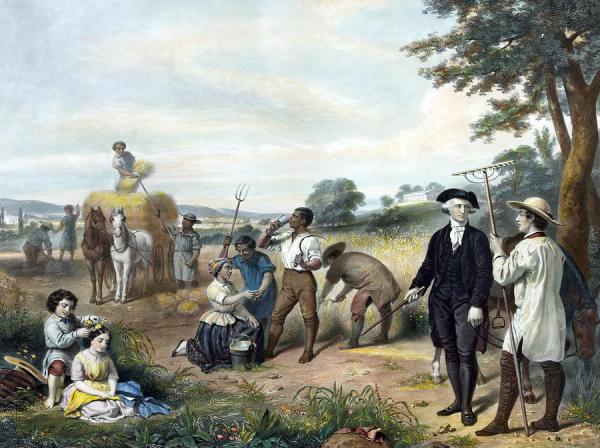
George Washington doing what George Washington did. Why is it considered unpatriotic to tell the children about it?

Why not?

The report on students’ knowledge about slavery comes from the Southern Poverty Law Center. The numbers are sadly predictable. Under a quarter of the students surveyed could identify the ways the Constitution gave advantages to slaveholders. Most teachers (over 90%) claimed to want to teach more and better information about slavery, but they reported feeling unsupported by textbooks and state standards.

Our national reticence to teach children the undeniable and important historical truth about slavery has long roots. Time and time again, history classes focus on a feel-good national story. As Yale’s David Blight puts it in the report’s preface:

In America, our preferred, deep national narratives tend to teach our young that despite our problems in the past, we have been a nation of freedom-loving, inclusive people, accepting the immigrant into the country of multi-ethnic diversity. Our diversity has made us strong; that cannot be denied.

And, as the reports’ authors note,

We teach about slavery without context, preferring to present the good news before the bad. In elementary school, students learn about the Underground Railroad, about Harriet Tubman or other “feel good” stories, often before they learn about slavery. In high school, there’s over-emphasis on Frederick Douglass, abolitionists and the Emancipation Proclamation and little understanding of how slave labor built the nation.

This fear of telling students ugly truths has a long history. As I noted in my book about educational conservatism, many of our culture-war battles about teaching US History pitted the bashers against the boasters. Conservatives wanted kids only to hear about America’s glories. Progressives wanted to teach that the US has always had plenty of moral flaws.

In the 1930s, for example, journalist and patriot Bertie Forbes attacked the popular textbooks written by Harold Rugg. Rugg hoped to introduce students to the real complexity of international relations. In Forbes’s opinion, such efforts would rob students of their patriotic fervor. As Forbes wrote in 1940,

If I were a youth, I would be converted by reading these Rugg books to the belief that our whole American system, our whole American form of government, is wrong, that the framers of our Constitution were mostly a bunch of selfish mercenaries, that private enterprise should be abolished, and that we should set up Communistic Russia as our model.

By and large, historically speaking, the Forbeses of the world have always won these fights. Schools primarily teach (and taught) students that America was a place they could love. Teaching too much or too frankly about slavery has always been seen as a dangerous and controversial effort.

It’s not only slavery that is ignored or misrepresented. As SAGLRROILYBYGTH are keenly aware, schools shy away from all types of controversial topics, even when the controversy is contrived.

berkman plutzer chart 2 better text color

From Berkman & Plutzer: Can we please not talk about it?

As Penn State political scientists Michael Berkman and Eric Plutzer found, only a minority of high-school biology teachers teach mainstream evolutionary theory and only mainstream evolutionary theory in their classes. The rest tend to mash together a mix of mainstream science and dissenting creationist ideas. Why? Because most teachers share the ideas of their local communities. If people want their kids to learn a variety of ideas about science, that’s what most teachers will deliver.

This has always been the case. In the 1940s, an enterprising scholar set out to discern how many teachers taught evolution. One teacher from California explained why he avoided the topic of evolution in class. As he put it,

Controversial subjects are dynamite to teachers.

And there’s the rub. Teachers will tend to avoid controversy. There’s no controversy among historians about whether or not slavery was a vital and decisive element in US history. There’s no controversy among mainstream scientists about whether or not mainstream evolutionary theory is a vital and decisive element in biology.

But broad segments of the population disagree. They don’t want their children to learn that America has historical flaws. They don’t want their children to learn that our species developed by a long series of minor changes.

Unless and until those things change, classrooms won’t improve. I heartily concur with the four-point action plan put forth by the recent SPLC report. It recommends the four following steps:

  1. Improve Instruction About American Slavery and Fully Integrate It Into U.S. History.
  2. Use Original Historical Documents.
  3. Make Textbooks Better.
  4. Strengthen Curriculum.

All good ideas. But they won’t be enough. Just like evolutionary theory, the history of slavery won’t be included in our classrooms until it is included in our day-to-day conversations. Until the country as a whole recognizes the importance of America’s ugly past, classrooms will continue to ignore it.

As we’ve seen time and again, we can’t use curriculum to change society. We need to change society and watch curriculum follow along.

The Tortuous Triumph of Progressive Education

It’s hard to know whether to cheer or cry. For people like me who want progressive schools and progressive politics, it hurts to see progressive classrooms converted into tools of the rich. But see it we do: More evidence today from Wichita that progressive education has triumphed over its conservative bête noirs, only to be turned into a tool of traditionalism.

wichita wonder koch school

The progressive vision for Wichita. Rich people only, please.

Here’s what we know: The conservative bajillionaire Koch brothers have long been interested in educational issues. Now they have funded a fancy-pants progressive school in Wichita. Second-generation Chase and Annie Koch are opening the Wonder school in Wichita. Their plans could have come straight out of a 1930s progressive-ed playbook.

Their vision? No age-graded classrooms, no report cards, no judgment. Focus on student-directed activity, guided by adult “coaches,” not teachers. As one planner put it,

We think that children are not challenged to the fullest extent that they could be right now. . . . We want to challenge them to take on new tasks and greater ownership over what they’re doing.

So far, so good. Such dreams have been around for a century now, pushed by progressive-ed leaders such as George Counts, William Heard Kilpatrick, and of course, John Dewey.

In the middle of the twentieth century, as I recount in my book about educational conservatism, traditionalists pushed back hard against such notions. These days, at least in Kansas, some of the hardest-core educational conservatives have embraced the obvious superiority of progressive classroom methods.

So we should celebrate, right? Not so fast. Those same progressive-ed-loving conservatives tend to take a very different approach when it comes to schools for the rest of us.

Yes, the Koch’s own kids get to go to schools with fabulously progressive pedagogy. But Koch money pushes a very different sort of classroom elsewhere. In Tennessee, for example, Koch funding promoted charter schools for low-income families. At some of those schools, most famously the KIPP network, students are rigidly controlled. KIPP’s “no excuses” model and “SLANT” rules (Sit up, Listen, Ask and Answer questions, Nod and Track the teacher) can feel oppressive.

At some charter schools—especially urban schools with high proportions of low-income non-white students—students are compelled to sit silently at lunch, march silently and exactly through hallways, respond rapidly and exactly to teacher prompts, and hold their heads rigidly at all times.

What a contrast to the free-wheeling, mind-expanding Koch-funded school soon to be offered to affluent kids in Wichita. Of course, for only $10,000 per year, anyone is welcome at the Wichita Wonder school. Unless, of course, a student has any sort of disability.

What are we supposed to think? I’m no conspiracy theorist, but it’s hard not to see the obvious: Some conservatives have recognized the huge benefits of progressive classroom practices, but they only want them for their own children. Or, to be more charitable, conservatives are only willing to foot the bill for progressive classrooms for their own kids.

Where’s the Beef?

I didn’t think it was all that complicated, but at least two smart people have misunderstood my complaint, so I’ll try to clarify. If SAGLRROILYBYGTH think I’m splitting hairs or being overly persnickety, I’ll shut my yap. But I don’t think I am and I don’t think the point is all that abstruse.duty_calls

Here’s what we’re talking about this morning: Last week, I wondered if evolution maven Jerry Coyne had a glitch in his code. He didn’t think protesters against Steve Bannon had a legitimate right to block Bannon’s appearance at UChicago. Coyne pooh-poohed protesters’ claims that the issue wasn’t really about free speech.

But I assumed—correctly it appears—that Prof. Coyne does reject some claims to free-speech protections. Prof. Coyne and I agree: Just because someone claims free-speech protection doesn’t mean they should get it. Some claims are bogus. Some are even harmful, at least potentially. The most obvious case is the perennial free-speech claim of America’s creationists. In state legislatures, bill after bill purports to protect the free-speech rights of creationist students and teachers.

Especially since we agree on everything, Prof. Coyne wondered what my beef was. As he put it,

Laats’s beef seems to be this: if I, Professor Ceiling Cat Emeritus, favor free speech on college campuses, why don’t I favor free speech in the classroom?

Coyne goes on to explain—and I agree with him as far as he goes—that creationist teaching in classrooms is not the same as controversial invited speakers on university campuses. However, he didn’t identify my beef correctly. Here it is: If Prof. Coyne doesn’t recognize the legitimacy of creationists’ claims to free-speech protections, why doesn’t he grant other people similar rights to un-recognize free-speech claims?

After all, Professor Coyne makes it clear. He says,

I do not recognize creationists’ desire to teach goddy stuff in the classroom as a “free speech” claim. [His emphasis.]

Coyne means, I think, that creationists can’t claim protection for their speech if it establishes a government religion unfairly, contra the First Amendment. By doing so, creationists give up any right to free-speech protection for their creationist teaching. The important point, IMHO, is that Prof. Coyne recognizes that some free-speech claims are faulty. Those claims are not legitimate and they do not deserve the protection they demand. Creationists insist on their right to free speech; they insist that their rights to be heard are often dismissed unfairly. In general, I think Prof. Coyne and I agree—we don’t lose any sleep over such creationist complaints, because we do not recognize them as legitimate claims to the protection of free-speech rights.

Which leads us to the main question again: If Prof. Coyne is willing to dismiss some claims to free-speech protection as illegitimate, why doesn’t he at least respect the anti-Bannon argument, even if he disagrees with it?

In other words, though I agree with Professor Coyne both that Bannon should be allowed to speak and that creationists should not be allowed to teach creationism in public-school science classes, I disagree with his glib dismissal of the arguments of the anti-Bannon protesters.

I think we need to acknowledge that there are real and important reasons why some intelligent, informed, well-meaning people refuse to recognize Bannon’s claims to free-speech protections. Further, there are good arguments to be made that a private (or public) institution has a responsibility to consider the implications of its speaking invitations. By inviting Bannon to speak, an elite university like Chicago is conferring on Bannon and Bannon’s ideas more than a touch of mainstream legitimacy. Blocking someone from speaking at the University of Chicago is not the same as blocking his or her right to holler on a street corner. I don’t think the Chicago protesters are hoping to shut down Breitbart; they are merely hoping to deny Bannon the enormous prestige of a Chicago speaking appearance.

Now, in this particular case I think the decision should swing in Bannon’s favor. But that does not mean that the anti-Bannon protesters don’t have a decent case to make. It does not mean that the UChicago protesters are “discarding one of the fundamental principles of American democracy because they don’t like its results,” as Prof. Coyne accused.

Some free-speech claims are bogus and don’t deserve to be recognized. The Chicago protesters and I merely disagree about the proper decision in this one particular case. They are not necessarily against free speech; they are disputing Bannon’s claim to free-speech protections; they are against their university recognizing Bannon’s legitimate status.

I Love You but You Didn’t Do the Reading

It may come as a surprise, but even during superbowl week, other stuff happened, too. Here are some ILYBYGTH-themed stories you might have missed:

Charters and choice: Yohuru Williams argues it’s not a choice at all, at The Progressive.

State of Trump’s Union analysis:

The mess in DC schools:

No surprise: gifted programs skewed, at Fordham Institute.Bart reading bible

How charter schools resegregate in Charlotte, from UCLA’s Civil Rights Project.

Trump-fueled goons and white supremacist flyers on Texas campuses, at Texas Observer.

Was Bob Dylan best when he was a fundamentalist? A review at American Conservative.

Students and faculty protest Steve Bannon appearance at UChicago, at Why Evolution Is True.

Sex abuse and evangelical religion: Larry Nassar victim Rachel Denhollander talks about “institutional protectionism,” at CT.

The Ugly Truth: Sex Abuse at Evangelical Colleges

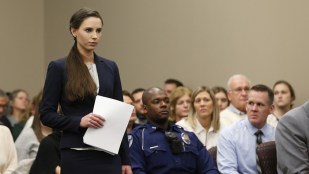
I wish it were a shock or a surprise. Instead, the terrible stories coming out of the Larry Nassar case are all too familiar: young people threatened and abused, an abuser tolerated for the sake of victory, the whole story hushed up. Why did so many responsible adults look the other way? One phrase from gymnast and whistleblower Rachel Denhollander struck me: “not simple institutional protectionism.” Denhollander sees it as a theological problem, but in the research for my new book about evangelical colleges, I found a more complicated truth.

rachel denhollander

Denholland testifies…

Of course, the demon of sexual abuse and institutional cover-up is not a problem for evangelical churches and colleges alone. The Catholic Church, big football schools like Penn State, and in the Nassar case, Michigan State all have an atrocious record of institutional protectionism.

However, I argue in my book that evangelical colleges faced a peculiar double-pronged problem. First, in the early years of the fundamentalist movement, leaders were keen to protect the reputation of their controversial movement. Second, without an outside arbiter—a denominational convention or presbytery or Vatican—fundamentalist institutions tended to turn into self-contained fiefdoms. The thoughts and plans of charismatic leaders tended to become authoritative, if not authoritarian.

A couple of examples will illustrate the trend. In the 1930s, Denver Bible Institute was wracked with a gruesome sex-abuse scandal. The accused leader and perpetrator, Clifton Fowler, turned to a blue-ribbon panel of Bible-institute worthies to clear his name. The panelists tried hard, in the words of the chair, to keep their investigation a “strictly private matter among Christian brethren.” They wanted to find out the truth about Fowler, but they didn’t want to publicize it. They were worried about the reputation of fundamentalism as a whole and Bible institutes in particular. It wasn’t a cover-up, exactly, but it was a form of discouraging complaint and public outcry.

This sort of “institutional protectionism” isn’t exactly theological, but it has been a tradition written deep into the bones of conservative evangelical and fundamentalist institutions since the 1920s. The movement has always had a sense of beleaguered outsider status, of being ripped off and usurped, kicked out of its rightful role as leaders of denominations and higher education. Certainly, this sense of hyper-defensive circle-the-wagons clubbishness is related to the theology of fundamentalism, but it is not itself a theological notion.

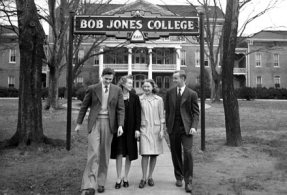
Maybe one more example will help illustrate the tradition. At Bob Jones College during its Tennessee years (1933-1947), founder and president Bob Jones Sr. established the patterns that guided the school for decades. Unfortunately, those patterns also fostered and abetted sexual abuse. During the 1930s, Jones established his rule against “dirty gripers.” Anyone who complained—faculty and students alike—about conditions at the school, Jones insisted, was not welcome. As Jones put it in a chapel talk:

we are not going to pay anybody to ‘cuss’ us. We can get ‘cussin’’ free from the outside. . . . We have never been a divided college. . . . Gripers are not welcome here. If you are a dirty griper, you are not one of us.

It is not difficult to see how this rule discouraged student victims from coming forward. With no other authority to turn to, evangelical colleges like Bob Jones College sometimes deteriorated into authoritarian echo chambers. For years, students and faculty at institutions like this had no chance to condemn their abusers.1940circa-cl000198-bjcsign-4students

This sort of authoritarian structure isn’t strictly a theological thing, but it is also a central part of the fundamentalist tradition. As in the Denver case, Bob Jones College leaders had to create some sort of self-supporting authority. They couldn’t turn to denominational boards or conventions. Instead, they vested authority in other ways, including in overweening charismatic leaders like the Bob Joneses.

Again, these sorts of institutional protection are not at all unique to evangelical colleges. But there are historical patterns that are specific to the fundamentalist movement. Those patterns can make abuse worse. At times, they are linked to theology, as Denholland pointed out. Far more common, though, they are a result of the unique history of evangelical institutions as a self-consciously defensive group that had no higher bureaucracy to help figure out disputes.

Does Jerry Coyne Support Creationism?

Okay, maybe I’m just mad because he poked fun at “humanities” types like me. But I can’t help wondering if Jerry Coyne’s love for free speech is really as consistent as he implies. Does Professor Coyne support creationist “free speech” laws for K-12 schools? Colleges?

Here’s what we know: Right-wing eminence gross Steve Bannon is planning to speak at the University of Chicago. Students and some faculty are protesting. Professor Coyne criticizes the protesters, calling their “tiresome” ideas “reprehensible.”

UChicago sit in

Protesting against unfettered free speech at Chicago…

I tend to agree with Prof. Coyne that almost all speakers should be allowed to speak on university campuses. We need a high bar to prohibit speech, especially for guest lectures at universities. There are exceptions. If someone is likely to directly incite violence, they shouldn’t be allowed to speak. Universities, moreover, are under no obligation to financially support disruptive tactics—the kind of intentional provocation used by the likes of Richard Spencer. That is, when speakers plan to cause riots in order to draw attention to themselves, universities are not obligated to pay for the show. That’s not about free speech, but simple administrative common sense.

White supremacists and Trumpy trolls aren’t the only ones pleading for their right to free speech. As SAGLRROILYBYGTH know, creationists these days demand free speech in schools. Many current school bills insist that they will give teachers “academic freedom” to teach ideas critical of mainstream evolutionary theory. Missouri’s 2015 bill, for example, promises the following:

Neither the state board of education, nor any public elementary or secondary school governing authority, superintendent of schools, school system administrator, or public elementary or secondary school principal or administrator shall prohibit any teacher in a public school system of this state from helping students understand, analyze, critique, and review in an objective manner the scientific strengths and scientific weaknesses of biological or chemical evolution whenever these subjects are taught within the course curriculum schedule.

I’ll say it: I don’t think this kind of “freedom” is good policy. Sponsors of bills like these, IMHO, are mainly trying to cram a wedge into public-school science classes. I’m suspicious of the “scientific weaknesses” that such bills hope to teach about. If they really wanted to teach the various disagreements about the details of evolutionary science, fine. Great, even. But in fact, teaching those “scientific weaknesses” usually means teaching creationist critiques of mainstream evolutionary science as a whole. Teachers in public schools should not consider themselves free to tell students that worse creationist science is just as good as better mainstream academic science.

“Academic freedom” creationist gambits are not limited to K-12 schools. A few years back, for example, Professor Eric Hedin won tenure at Ball State despite accusations that he taught creationism-friendly ideas.

Does Professor Coyne support free speech in cases like these? In the case of Eric Hedin, we don’t have to wonder. Coyne outed Hedin early and often. Coyne protested that no professor at a publicly funded university had the freedom to teach creationism-friendly ideas as if they were science.

In creationist cases, then, Professor Coyne agrees to strict limits on free speech. How does he choose which free speech to prohibit?

A few possibilities:

  • Professor Coyne might say that he only objects to tax-funded religious preaching, as when a public university pays Hedin’s salary.

But tax money supports lots of religious talk on public college campuses. At many schools, religious groups use tax-funded facilities as meeting rooms. They use tax-funded student lists to recruit possible converts and members. Moreover, nearly every decent public university teaches lots of classes about all sorts of religious ideas. Why single out this particular instance?

  • Professor Coyne might object that Hedin taught religious ideas as science.

Surely Prof. Coyne knows better than me how difficult it is to articulate a simple definition of “science.” Shouldn’t scholars have the freedom to explore those boundaries?

  • Professor Coyne might say that he is against schools paying salaries for the promulgation of bad ideas; he doesn’t want intelligent design afforded the prestige of appearing in a college class.

If so, he would be repeating the ideas of the anti-Bannon UChicago protesters and their ilk. They do not want to legitimize hateful trolls such as Steve Bannon by paying him to speak at Chicago. They do not want to afford Bannon the prestige of such an affiliation.

  • Professor Coyne might say that teachers should stick with the curriculum.

But I don’t think he would. The heart and soul of academic free speech is the freedom to explore ideas not dictated from above.

Or, even if Professor Coyne could convince people that Professor Hedin was a special case, a case in which a teacher falsely claimed the freedom to preach religion on the public dime, what would he say about other free-speech schemes out there, like the one in Wisconsin?

Lawmakers in Madison have proposed a law to protect free speech on campus. If a creationist student were told that his “speech” about a 6000-year-old earth was incorrect on an exam, he could complain to an ominously named Council on Free Expression.

I just can’t imagine that Professor Coyne would protect creationists’ freedom to equal status for their ideas. In fact, I’m hopeful he would join me in strident opposition to this sort of thing.

The point, in the end, is not that students, faculty, and outside speakers are all engaging in the same sorts of speech. When a professor teaches a class or a student writes an exam, they are obviously engaged in different sorts of speech than when an outsider comes for a one-off lecture. They’re not all the same, but that’s not the point. Rather, the central point is that some assertions of free speech are strategic manipulations. In the case of most creationist “free speech” bills, the true goal is to make creationism seem legitimate.

When I (and maybe Prof. Coyne would join me) argue against such creationist free speech laws, our motives and goals are not “reprehensible.” We are trying to protect a vital idea—that mainstream science and creationist alternatives are not merely equally valuable scientific understandings. Academic freedom for instructors and free speech for students doesn’t include the right to teach and preach worse science as if it were equal science. People are certainly free to speak their minds about creationism, but schools do not have to pay people to engage in that kind of speech.

Given all that, I don’t understand why Coyne is so quick to bash his Chicago colleagues. Sure, he may disagree with them, but he should recognize his own objections to some purported “free speech” claims. If he did, he would likely have a different take on the “reprehensible” actions of his Bannon-busting colleagues.

News Again: The Oldest Scandal in Public Schools

Don’t act surprised. The depressingly predictable scandal in DC schools serves as yet another reminder of a centuries-old truth about public education. When people tell you they have figured out how to fix urban schools on the cheap, they’re either lying or fooling themselves. When they show you proof, they’re faking it.

ballou HS DC

Where magic didn’t happen….

Here’s what we know: NPR investigated Ballou High School in Washington DC. The school showed remarkable sudden improvements. Graduation rates suddenly jumped to 100% and all the grads were accepted to college.

A triumph, right? Not really. Turns out about a third of the students hadn’t been to school enough to meet minimum requirements. Many of them couldn’t read or write well. Teachers felt enormous pressure to move kids along, whether or not they had met any of their educational goals. Some teachers reported a “culture of fear;” they felt forced to do things they knew weren’t right.

Now wunderkind chancellor Antwan Wilson is in the spotlight. What did he know and when did he know it? Not only Wilson, but informed school folks are all keenly aware of the sobering truth: We all knew this would happen and we’ve known it for centuries. Even for those few folks who don’t read ILYBYGTH to find out the centuries-old story of urban school reform, there are so many recent examples that no one can claim ignorance.

Consider Rod Paige and the overstuffed “Houston Miracle.” Or the ugly cheating scandal in Atlanta. Time and time again, when reformers and administrators build sparkling careers on their sudden, dramatic improvements, they have simply cut corners, cheated, and fudged numbers.

For SAGLRROILYBYGTH in the know, these sorts of educational con jobs are the oldest story in urban public education. As I’m researching these days, in the early 1800s Joseph Lancaster set the pattern that Paige, Wilson, and many others would follow. Lancaster was an earnest young Quaker who opened a school for urban urchins in London. He copied a system that allowed him to educate hundreds of students with only one adult teacher.

Soon, a group of wealthy philanthropists hyped Lancaster’s “Borough Road Miracle.” Lancaster thought he had figured out something radically new. He promised he could establish similar schools for America’s cities. He promised he could turn illiterate “Street Arabs” into upstanding literate Christian citizens.

lancaster schools

The promise: Everyone learns, no one pays…

He couldn’t.

In a few years, Lancaster’s over-hyped schools had flopped and failed. Parents and students complained that they were abused and under-educated. Teachers warned that Lancaster’s methods didn’t work. Lancaster himself was in debt up to his ears and fled to Caracas.

The lesson? It’s not that school reform isn’t possible or desirable. Rather, we need to remember that charismatic, ambitious reformers will always promise more than they can deliver. Politicians will tend to glom on to silver-bullet solutions that don’t cost any extra. School reports that sound too good to be true usually are.

School reform IS possible, but it isn’t easy and it isn’t cheap. If we really want to fix our public schools, we need to stop looking for magic solutions and rather do the difficult and expensive job of improving every school.

From the Archives: I Know Who Will Win the Super Bowl

[Editor’s Note: It’s that time of year again, so I dusted off this oldie from the ILYBYGTH vaults. The survey data is a couple of years old, but I bet it’s still fresh.]

Call Vegas.  Bet the farm.  We know for sure who will win the Super Bowl.

First a note for readers outside the United States or for those ensconced in thick protective layers of nerd: The “Super Bowl” is a contest between football teams.  It is typically a hugely popular TV and social event.

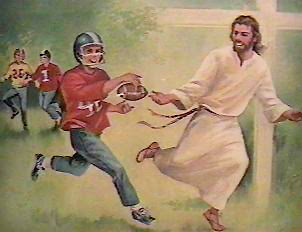
The winner this year has been proclaimed in advance.  No matter what happens on the  field, the winner will be… Jesus!

jesus_football

Did Tommy Brady grow a beard?

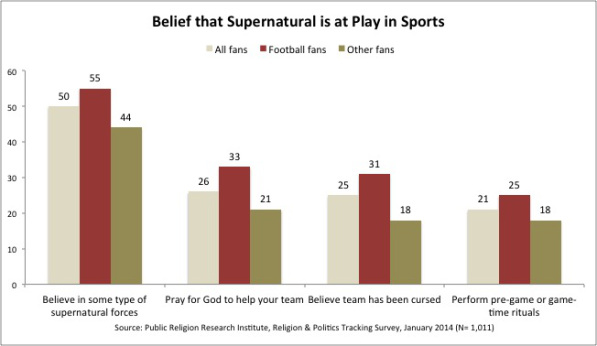
That’s right: no matter how the game goes, Americans tell pollsters they believe that Jesus will determine the outcome.  At least according to a recent report from the Public Religion Research Institute, a majority of Americans think that “some type of supernatural forces” will decide who wins the big game on Sunday.  More than a quarter of fans say they pray to God to help their team win.  And roughly a quarter of fans think their team has been cursed at one time or another. Weirdly, this tendency seems to be stronger among football fans than fans of other sports. No matter what the sport, though, plenty of Americans live in a world of magic and supernatural forces.

Shocking?  Not really.  It seems to be just another piece of evidence that Americans are enormously religious.  And another warning to out-of-touch academics that their understanding of a liberal, secular society is woefully out of step with social realities. supernaturalforces_in_sports