Read This Before You Freak Out…

Conservatives might be shooting their guns in the air to celebrate. Progressives might be shedding a tear in their IPAs. Whether it’s a triumph or an apocalypse, it’s not a surprise: The Ed Department is filling its ranks with more and more conservative, creationist leaders. Before we freak out, though, let’s take stock of the real situation.

zais

He’s coming for your public school…

First, the creationism part. The new pick for the education department’s undersecretary has made no bones about his creationist sympathies. As head of South Carolina’s schools, Dr. Mick Zais supported the removal of the idea of natural selection from the state’s science standards. As Zais told a local newspaper, “We ought to teach both sides and let students draw their own conclusions.”

It’s not only creationism. Queen Betsy’s pick for undersecretary of education will make conservatives happy for a lot of other reasons as well. Zais comes to the nomination fresh off his post as South Carolina school superintendent. As Politico reports, Dr. Zais became a conservative ed hero for refusing to truckle to the Obama administration’s carrots and sticks.

In South Carolina, Zais pushed hard for vouchers. Time and time again, vouchers are embraced by conservatives who hope to shift public-school money to private schools, often religious schools.

When Zais’s zeal is added to DeVos’s enthusiasm, it might seem to progressives and conservatives alike that conservatives have finally triumphed in the world of educational politics. If ILYBYGTH cared about clickbait, we would certainly write something that exploited that sort of attitude. But we don’t and we won’t. Because, in historical perspective, this moment of conservative triumph looks much less triumphant than it might seem at first.

First, let me repeat the caveats SAGLRROILYBYGTH are sick of hearing: My own politics skew progressive. I think creationism has no place in public-school science classes. I am horrified by Queen Betsy and I think President Trump’s leadership is a blight on our nation that won’t be easy to recover from.

Having said all that, I’m not interested this morning in fighting Trumpism but rather in understanding it. And when we see Queen Betsy’s reign from the perspective of the long history of conservative activism in education, we see just how wobbly her throne really is.

First, as I noted in my book about twentieth-century educational conservatism, today’s conservative push for charters and vouchers is both a novelty and a concession. Milton Friedman promoted the idea of charter schools way back in the 1950s, and nobody listened. Even the free-marketiest of Reaganites didn’t care much about promoting alternatives to traditional public-school funding.

Take, for example, Reagan’s second ed secretary, William J. Bennett. He was far more interested in pushing traditional moral values and classroom rules in public schools than in gutting public-school funding.

What happened? Only in the 1990s did conservative education pundits embrace the notion of charters and vouchers. They did so not as a triumph, but as a grim concession to the obvious fact that they had been stumped and stymied by their lack of influence in public schools.

So when conservative heroes like Queen Betsy and Superintendent Zais push for alternatives to traditional public schools, progressives should fight back. But we should also recognize that the conservative drive to fund alternatives results from conservatives’ ultimate failure to maintain cultural control of public schools.

Plus, the language used by conservatives these days represents another long-term progressive victory. In his public argument for voucher schools, for example, Superintendent Zais voiced his agreement with progressive ideas about the purposes of schooling and public policy. Why should we have more vouchers? Quoth Zais, vouchers will provide “more options for poor kids stuck in failing schools.”

I understand Zais may be less than 110% sincere in his zeal to promote social equity through public school funding. Nevertheless, the fact that he felt obliged to use that sort of progressive reasoning shows how dominant those progressive ideals have become.

In other words, if even South Carolina’s conservatives adopt the language—if not the authentic thought processes—of progressive thinking about the goals of public education, it shows that progressive ideas have come to dominate our shared beliefs about public education.

On the creationist front, too, Zais’s conservatism shows the long-term decline of conservatism. It wasn’t too long ago, after all, that creationists fought and often won the battle to have evolution utterly banned from public schools. These days, all Zais can dream of is maybe wedging some worse creationism-friendly science into public schools alongside real science.

Science educators won’t like it. I don’t like it. But once again, before we freak out, we need to recognize the long-term implications of our current situation. The dreams of creationists are so far reduced they no longer preach the abolition of evolution. If you ask creationist leaders these days what they want in public schools, they’ll tell you they want children to learn evolution, “warts and all.”

We don’t agree about that. And we don’t agree about the value of vouchers. I’m not even ready to concede that Dr. Zais and I agree on the best ways to use public schools to help alleviate poverty and improve the economic life chances of kids in lower-income families.

And I’m perturbed. I’m frightened by Queen Betsy. If he’s confirmed, I’m guessing I’ll be alarmed by Dr. Zais’s work.

I also know, though, that the seeming strength of conservative thinking these days is an illusion.


How Roy Moore Put Jesus on a Dinosaur

It’s ugly. And weird. The accusations against Roy Moore in the Washington Post are hard to read without shuddering. It got even uglier and weirder when some evangelical leaders actually supported Moore’s alleged actions. Yet those familiar with the history of American fundamentalist institutions see a familiar pattern in this depressing story. And maybe I’m too deep in my new book about American creationism to think clearly, but it seems to me these sorts of attitudes help explain radical young-earth creationism.

If you haven’t seen the story, it’s grim. The Washington Post shared allegations by women that Roy Moore had groped and kissed them back in the 1970s, when they were young teenagers and he was a thirty-something lawyer. To complicate things, Judge Moore has always been a controversial figure, insisting on keeping a 10-commandments monument in his courtroom even when ordered to remove it. Moreover, Moore just won a contentious GOP primary election in the US Senate race. He’s facing a tough battle with his Democratic opponent.

That history helps explain the continuing support for Moore among conservatives. Almost 40 percent of Alabama evangelicals say they are MORE likely to support Moore after these accusations. Only 28 percent say they’re less likely to do so.

We might be understandably tempted to see the whole thing as just another episode in today’s bare-knuckled political free-for-all. Judge Moore defended himself in those terms, after all. He claimed the whole story was just a cynical smear campaign against him. Real conservatives, he tweeted, needed to see through the fake news. In his words,

The forces of evil will lie, cheat, steal — even inflict physical harm — if they believe it will silence and shut up Christian conservatives like you and me. I believe you and I have a duty to stand up and fight back against the forces of evil waging an all-out war on our conservative values!

From Liberty University, President Jerry Falwell Jr. took Moore at his word. The accuser, Falwell intoned, was not as “credible” as Moore. The same thing happened to President Trump, Falwell noted, yet Trump heroically triumphed.

The story, according to Moore and Falwell, is one of brave conservatives fighting false accusations. In today’s climate, it makes some sense to me that people on both sides would rally around someone who they thought was falsely accused by the “forces of evil.”

But nitty-gritty politics don’t really explain the way some evangelical leaders seem to actually condone Moore’s alleged actions. They don’t just deny the allegations. They deny that there’s anything wrong with them. Alabama State Auditor Jim Ziegler noted that Joseph and Mary had a similar age difference when they married.

Jesus on a dinosaur

If mainstream science says it couldn’t have happened, it must be true.

“Mary was a teenager and Joseph was an adult carpenter,” Ziegler told the Washington Examiner. “They became parents of Jesus. There’s just nothing immoral or illegal here. Maybe just a little bit unusual.”

Other evangelical leaders rushed to disagree. At Christianity Today, for instance, Ed Stetzer emphasized that evangelicals are not okay with Moore’s alleged actions. As Stetzer put it,

Christians don’t believe the message that is coming from some of Moore’s supporters. Actually, most of us find it really creepy.

Those of us who live outside of the charmed circle of American evangelicalism might have a difficult time understanding why Stetzer even needs to make such a statement. Of course it’s creepy!

As I finish up my book manuscript about American creationism, I can’t help but see enormous parallels between Ziegler-style rationalizations and radical young-earth creationism. As I detail in the book, by the late 1950s America’s conservative evangelicals faced a difficult situation. Unlike their fundamentalist parents in the Scopes generation, by 1960 evangelicals had to cope with the fact that mainstream scientists had generally agreed on the outlines of modern evolutionary theory. They had a few options: Reject creationism altogether along with their evangelical beliefs; accept the scientific strength of mainstream evolutionary thinking but claim that it didn’t change their evangelical religion; or reject mainstream science utterly.

Following the lead of theologian John Whitcomb Jr. and engineering professor Henry Morris, thousands of earnest evangelicals chose the third option. They believed Whitcomb and Morris that mainstream scientists had followed Satan’s red herring and abandoned true science. As Whitcomb and Morris put it in their 1964 preface,

extrapolation of present processes into the prehistoric past or into the eschatological future is not really science.

In order to have true biblical faith, Whitcomb and Morris argued, Christians needed to reject radically the claims of mainstream science. There was a better science out there, a biblical science, that insisted on a young-earth and a literal interpretation of the “days” in the Bible’s six-day creation story.

genesis flood 1961 ed

Why would (false) scientists lie?

Before the 1960s, not many evangelical Christians believed those things. After that, however, young-earth creationism became a mainstream belief among conservative evangelicals.

What does any of this have to do with Alabama’s Senate race? Then and now, conservative evangelicals have nurtured a unique sense of persecution, of their role as a beleaguered minority, unfairly ejected from their rightful role as America’s conscience and moral guardians, usurped and despised. A mainstream society that can treat good Christians that way, the thinking goes, must be following a false trail. When challenged or threatened, then, it is not very difficult for some evangelicals to reject huge swathes of mainstream thinking. Such mainstream thought, after all, had been led astray by the “forces of evil.”

In Moore’s case, we see how quickly some supporters wrapped Moore’s alleged actions in a sheaf of pages from Scripture. And in the case of rejecting mainstream science, it was relatively easy for thousands of evangelicals to believe outrageously radical scientific ideas.

When you assume that mainstream thinking is from the devil, it becomes very easy to accept ideas that the rest of us find bizarre. It becomes easy to think that sexual predation has Gospel roots, or that Jesus could have cavorted happily with Brontosaurus.

HT: MM

I Love You but You Didn’t Do the Reading

Happy Monday the 13th! I hope you have good luck today. Here are a few of the stories and trends that passed across our desk this week:

Scales and schools: How do well-meaning reformers keep goofing? Why do they insist on “scaling up” good schools when it never works?

Red Dynamite: At Righting America at the Creation Museum, Carl Weinberg untangles the connections between creationism and anti-communism.Bart reading bible

Education culture-war news from the midterm elections: School board vote in Colorado dings vouchers.

Ahhh…Thanksgiving. The holiday to gather around a table and yell culture-war insults at our friends and family. At 3 Quarks Daily, Scott Aikin and Robert Talisse reflect on “familial angst” on Turkey Day.

Why are college students so touchy about free speech? As reported by IHE, a new survey says it’s because they’re Americans.

Arica Coleman looks at the career of neo-confederacy in American textbooks, at Time.

What’s wrong with charter schools? The Progressive examines the debates in North Carolina.

…and what’s wrong with “personalized learning?” EdWeek listens to three critics.

John Oliver takes on Ken Ham. Should Kentucky’s Ark Encounter receive tax incentives?

Creating Jobs

Is it worth it? Ken Ham says heavens yes. John Oliver says hell no. This week on Last Week Tonight (5:42-8:12) Oliver rips into tax incentive schemes in general, and the Kentucky uber-creationist Ark Encounter project in particular.


Oliver’s accusations aren’t new. Critics such as Americans United for the Separation of Church and State have long criticized Kentucky’s willingness to forego sales tax revenue as part of an incentive program for the huge Ark project.

After all, as AU points out, Kentucky’s goal is the creation of “jobs, jobs, jobs.” To work at Ark Encounter, though, potential employees must be conservative evangelical Christians. And not just any sort of evangelical. They have to embrace Answers In Genesis’s specific vision of true creationism. They are encouraged to love non-fundamentalist Christians, but they must agree that all non-fundamentalists are going to hell forever. Ark employees can’t be gay. And if they’re single, they must agree to a chastity clause in their contracts. AU thinks such beliefs should never be supported with tax incentives.

John Oliver, as always, is more interested in zingers. As he points out, Ark Encounter includes some stuff that is just pure wackiness, such as a section devoted to the question of manure. Where did all the poop go?

Moreover, Oliver skewers the notion of signing a chastity pledge when the entire purpose of the Ark was to encourage sex, sex, sex, among the animals. As Oliver puts it, they didn’t get on the Ark two-by-two so that every animal would have a “swim buddy.” I’m too embarrassed to repeat Oliver’s most hilarious name for the Ark (it rhymes with “duck boat”), but if you watch to the end of his clip you’ll see how he ties together the Ark Encounter, the Entourage movie, zebras drowning in feces, and masturbation.

It’s hilarious, but it raises important questions. Should religious groups enjoy tax privileges? Ken Ham’s answer is that saying no would be pure discrimination. He points out that his group is not receiving any money from the state, but is rather simply not paying some taxes that would never have been paid in the first place if he didn’t bring hordes of creationist tourists to the area.

Oliver says no. He thinks ALL tax-incentive programs need to be held to higher standards.

Americans United says no, too, but for different reasons. They argue that tax money and tax incentives should not be allowed to fuel divisive, sectarian religious programs.

What do you think? Should creationists be allowed to profit from tax programs that other groups use? Or should tax incentives be restricted to less-controversial organizations?

Two Simple Rules for Textbook Conspiracies

It doesn’t matter if you’re a neo-confederate or a creationist, a Texas stalwart or a West Virginia hiller. If you want your textbook conspiracy to succeed, you only need to remember two simple rules.

This week the kerfuffle over John Kelly’s Lost-Cause-flavored Civil War comments brought the textbook question back into the news. As historian Arica Coleman reminds us, a for-real conspiracy of neo-confederates plotted and schemed to make sure neo-confederate ideas dominated history textbooks. How did they do it?

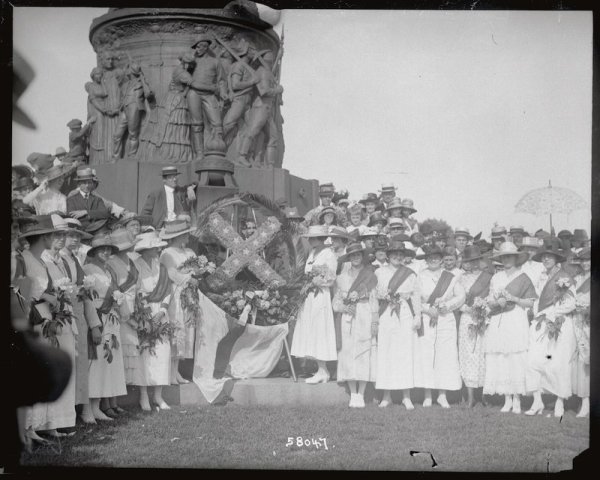
Confederacy Daughters Unveil Monument

Whitewashing the past, UDC style.

The neo-confederate textbook plot is something historians have known about for a long while. In Race & Reunion, David Blight detailed the battle over public memory of the Civil War, a battle largely won by neo-confederates. In Whose America?, Jon Zimmerman looked at the struggle over textbooks and the battle to teach children a culture-war flavored vision of American history.

As Professor Coleman retells the tale, schemers like Mildred Rutherford of the United Daughters of the Confederacy worried that schoolchildren were learning to blame the confederacy for the Civil War. They were learning that the war was caused by a ruthless determination to maintain the slave system in the South. They were learning that Confederate heroes were not always heroes after all. In other words, they were learning a reasonably accurate story about the war.

Rutherford and her allies wanted to put a stop to it.

To a large degree, Rutherford’s tireless activism worked. She applied pressure on textbook publishers to whitewash the story of secession and the connection between confederacy and slavery. And textbook publishers often complied.

The lingering influence of Rutherford’s ideas about history—what I’ve called the “eulogy” approach to understanding the Civil War and Reconstruction—tells us something about the way culture-war groups can and can’t police the intellectual goings-on in America’s schools.mildred rutherford 2

Textbook conspiracies succeed when they remember two simple rules. As Adam Shapiro demonstrated so brilliantly in his book Trying Biology, textbook publishers aren’t culture warriors. They recoil from controversy and they lust for sales. It’s a pretty simple formula:

  • If conspirators can promise sales, they’ll win.
  • If they can’t avoid controversy, they’ll lose.

As I recount in my history of educational conservatism, this pattern repeated itself over and over again in the twentieth century. When activists went against those two simple rules, their schemes failed. When they remembered them, the conspiracies worked.

Consider the example of Harold Rugg. Rugg was a progressive scholar who hoped to reshape American ideas about capitalism and democracy. He hoped his popular textbook series would cause kids to rethink the simplistic, jingoistic patriotism that they might have imbibed from their families and communities. With his allies and colleagues at Teachers College, Columbia University, Rugg really did scheme and conspire to use his textbooks to push America in a leftward direction. The books were extremely popular, until the American Legion accused them of subversion in the WWII years. At the first whiff of controversy, school districts yanked the books. Sales plummeted. Rugg was flummoxed.

Or take the example of James Moffett and the Communicating and Interactions series in the 1970s. Moffett worked hard on these books—he hoped they would “rid[e] the crest of progressive energy that had wrought so many changes in the 1960s and seemed to mandate further innovations in schooling.” As Moffett later explained, he and his fellow editors

took a strong stand for pluralism and multicultural expression that went far beyond wooing of minorities; we found that a feeling for folklore, a savoring of different styles, a respect for the whole human range made up want to set forth like a feast the varieties of reading matter.

Reading these multicultural tales, Moffett hoped, would transform classrooms and lives. Moffett’s dreams were shattered when conservative protesters in West Virginia labeled the new books controversial. In Kanawha County, administrators dithered and ultimately put the eight most controversial volumes under lock and key.

kanawha-textbook-image

How to scare a publisher.

Last but not least, don’t forget the culture-war successes of Mel and Norma Gabler. To a degree that surprised textbook bigwigs, this Texas couple managed to influence book purchases by telling politicians that certain titles were politically and religiously offensive. It didn’t take much. In the 1960s, Norma began attending public hearings of the state textbook committee. She and Mel prepared lists of criticisms for books they considered leftist. The committee listened and so did textbook publishers. Publishers soon asked the Gablers for approval for new titles. A tiny amount of pressure, judiciously applied, allowed the Gablers to move textbooks in conservative directions.

Why was their influence so profound? Simple. Textbook publishers follow two rules. Any whiff of controversy is anathema. They don’t care about evolution, or General Lee, or socialism. All they want is sales.

Why Do We Want our Schools to Fail?

The numbers are in, and they are good. So why aren’t we celebrating?

Here’s the story: For the past two years, graduation rates have continued to climb for Washington DC schools. And here’s the dilemma: Why don’t we hear more about our continuing love for and satisfaction with our public schools?

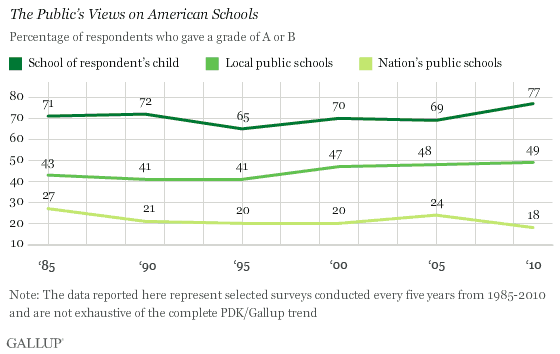
Most of us like our local public schools. As Gallup polls have showed over and over again, public perception of public schools is hugely skewed. Large majorities of respondents with kids in public schools are very happy with those schools. But majorities also say that public schools in general are in terrible shape.

gallup people like their local schools

We love our schools…except we don’t.

In our nation’s capital, the news has been good for the last couple of years. In 2016, new programs and policies led to increased graduation rates. That trend has continued this year.

So why don’t we see more headlines about the improving state of public education? Why don’t we hear more about the fact that most parents like their local public schools?

I have a hunch that won’t surprise SAGLRROILYBYGTH. When it comes to our bitter educational culture wars, both sides have an interest in promoting bad news.

Progressive types like me worry that schools for low-income and minority students have always suffered from a lack of funding and attention. When we look at the headlines from DC, it’s easy to a huge lurking BUT. Yes, graduation rates are improving and hitting all-time highs, but they still reflect the cruel inequities of our schools and society. As WaPo notes,

In D.C. Public Schools, black and Latino students also saw a boost in graduation rates — to 72 percent and 71 percent, respectively — but they still lag behind their white classmates by more than 10 points.

Plus, the improvements in graduation rates still vary tremendously by school. At selective high schools—schools that non-coincidentally educate a richer, whiter population—more students graduate on time. The numbers are much worse for neighborhood schools.

DC schools are good

Good news travels slow.

The takeaway? For progressive pundits, saying the news is good feels like a betrayal of all the students and families who still aren’t getting a fair shake.

Conservative education pundits don’t agree with that progressive argument, but they also tend to pooh-pooh any sorts of optimism. For many conservatives, the news from DC is still bleak. Public school systems, some conservatives think, are still throttled by sclerotic union-dominated bureaucracies. They don’t really teach kids. For proof, they can point to other parts of WaPo’s reporting:

At H.D. Woodson High School, for example, 76 percent of its students graduated on time, yet just 1 percent met math standards on national standardized tests linked to the Common Core academic standards. Just 4 percent met reading standards.

Shuttling a bunch of under-educated students across the graduation stage, conservatives might argue, doesn’t mean the schools are really doing a decent job of training students for jobs and passing along the big ideas of our culture. All it means is that union-ruled pencil-pushers are inflating their numbers. What public schools really need, conservatives might say, is an authentic shake up, a thorough-going privatization with charters and vouchers.

In every case, pundits tend to prefer bad news. It’s hard to fundraise when you tell people things are fine and getting better.

How Do You Keep an Iceberg Fresh?

The pattern is as old as school reform itself. When we find a school that works, how can we transport those successes to schools everywhere? Two recent stories underline the perennial misunderstandings about school and school reform that have always bedeviled well-meaning reformers. A good school is not something we can package, market, and ship. It’s as difficult as trying to tow an iceberg.

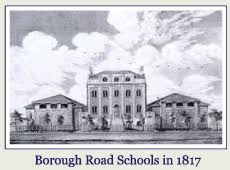
As I’m finding in the research for my next book, good people have always made this same goof. When Joseph Lancaster’s Borough Road School in London began showing decent results educating kids from low-income homes, he became an instant celebrity. Fabulously wealthy dilettantes visited the school and gushed. Back then, those folks were actual royalty.

borough road school 1817Soon, the young Lancaster started believing his own fundraising spiel. He promised the leaders of New York, Boston, and Philadelphia that his master plan could work in any school, anywhere. It couldn’t and it didn’t. The mistake Lancaster made—one of them, at least—was to assume that his limited successes were due to the specific methods he was using, rather than to his endlessly deep royal pockets and his authentic love and enthusiasm for his school and students.

These days, progressive teachers fume about well-meaning celebrities making these same sorts of centuries-old mistakes. In The Nation recently, Megan Erickson offered a scathing review of Eva Moskowitz’s self-promotional memoir. Moskowitz is hard to like. Among her many face-palm-worthy notions is the idea that she could package her program at Success Academy and use it to “fix” schools everywhere.

When Moskowitz connected with some wealthy backers, they hoped to help her do just that. As Erickson put it,

They wanted to figure out how to set up a school that cost no more to run than district schools but achieved far better results, and then replicate that model throughout the country.

As Lancaster’s story showed, it has never worked that way. School is an intensely local enterprise. Trying to package and replicate it will always be a losing proposition.

Don’t believe it?

Consider the story told this week by curmudgucrat Peter Greene. Greene looks at the deterioration of the AltSchool program. This intensely personalized school program for wealthy families has run into some problems, as Greene describes here and here.

The problem?…you guessed it: AltSchool is hoping to take an expensive program and cut it down to fit a replicable mass-market budget. As Greene laments,

Now that Ventilla has some things that sort of work, it’s time to sell a version of them to other schools and make some real bank.

Those schemes have never worked and they never will, just like wacky schemes to tow icebergs from Antarctica to hot deserts. Since at least the 1970s, attention-hungry politicians from hot places have always flirted with such plans. After all, they say, the icebergs are just floating around. With a little funding and pluck, icebergs could provide nice cool water for hot dry deserts.

Could it really work? No! I’m embarrassed to even spell it out, but I will. When you tow icebergs to the equator, the icebergs don’t like it. They break up. They melt.

What does any of this have to do with school reform? Like good schools, icebergs are intensely LOCAL things. They come about because of local conditions. So do good schools. Good schools are fueled by families who feel included. They are good because of the enthusiasm, energy, and dedication of teachers and staff. Good schools work because leaders make smart decisions that focus on supporting those good things and getting obstacles out of the way.

Trying to package those things up, slap a marketing label on them and ship them to other schools is not a smart way to create good schools, just like towing icebergs is not a good way to get ice. Of course, with enough money and energy, it might be possible to pull an iceberg around. You might even make it to the desert. But what you’ll be left with won’t be worth all the hassle; all you’ll get is a handful of lukewarm disappointment.

I Love You but You Didn’t Do the Reading

From “creationist” neo-confederates to whiskey-drinkin tooth-pullers, this week had it all. Here are some of the articles that riled us:

Is there an intellectual wing to Trumpism? Daniel McCarthy reviews some conservative contenders at American Conservative.

Should college students have to PAY for speakers they disagree with? Hechinger looks at the fight over mandatory student fees.

Wow! Whatta week for in-depth profiles of ILYBYGTH personalities:

John Kelly’s comments generated a lot of culture-war heat.Bart reading bible

Does THIS count as school segregation? Or is it just a reasonable attempt to reward good behavior?

Ouch. The Nation profiles the painful lengths people go to in Tennessee when they lack dental insurance. Spoiler: It includes “pliers, chisels, and whiskey.”

I Get the “Racist” Part…but Why Is It “Creationist”?

We history nerds are a-flutter. Trump’s Chief of Staff John Kelly got us riled up by stating that General Lee was an “honorable man” and that more “compromise” could have avoided the Civil War. To many of us, such arguments are a cruel attempt to whitewash the deep racism that fueled the war and today’s culture war over Confederate monuments. I’ve been putting in my two cents and following the debate closely. In general, I feel like I understand the various positions involved, but recent comments by one of my favorite pundits have me stumped.

Some of my friends and family generally agree with General Kelly. They don’t see why academic historians are so determined that support for heroes back then implies support for racism now. The common charge is that progressives and historians are trying to “whitewash” history by disrespecting monuments to our shared past.

To academic historians like me, it seems obvious: Most of the General Lee monuments didn’t go up right after the Civil War. They went up much later, in a blatant attempt to assert a heroic history for the slave regime of the Confederacy. They were an attempt by later white-supremacist state governments and organizations to whitewash history, to prove that the Confederates were the good guys, not really traitors after all.

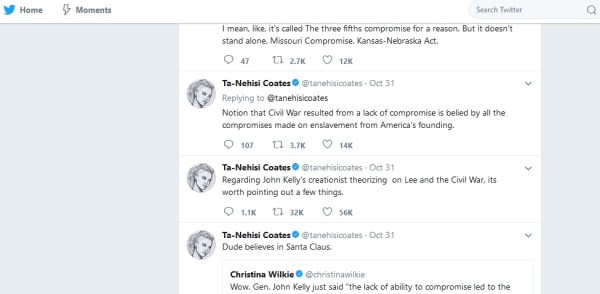
The back and forth can be exhausting, but at least I feel like I (sort of) understand both positions. When Ta-Nehisi Coates offered a recent condemnation of General Kelly’s remarks, though, he flummoxed me. As Coates put it, “Regarding John Kelly’s creationist theorizing on Lee and the Civil War, its worth pointing out a few things.”

ta nahesi coates general kelly creationist tweet

…am I missing something???

As you can imagine, this is the line that stumps me. Why is Kelly’s defense of General Lee “creationist”? I agree that it’s bad history. I agree that at root it supports a white-supremacist-derived vision of American history, even if I understand that many people who agree with Kelly don’t think of themselves as racist.

But why, oh why, did Coates call this “creationist” thinking? As SAGLRROILYBYGTH know, I’m fascinated with all things creationist. And I could imagine some reasons why someone would lump together Christian-history activists like David Barton with creationist activists like Ken Ham.

Is that what Coates is doing? Or do people in general just use “creationist” as an all-purpose adjective meaning “wacky” or “incorrect?” I looked over his twitter feed and I couldn’t find any explanation. Can you?

Why Are So Many People Angry about History?

Have you seen the clip yet?

As SAGLRROILYBYGTH are well aware, General Kelly’s pontifications about General Lee and slavery are the kinds of thing that drive academic historians bonkers.

These battles over history have a history all their own. In my book about educational conservatism, for example, I looked at the furious fight over Harold Rugg’s textbooks. Were they doing what history books were supposed to do?

In a recent piece published on History News Network, I argue for a different vocabulary to help make better sense of the deep anger that roils all around our culture-war battles over history.

Head on over to HNN to check it out.

OLYMPUS DIGITAL CAMERA

An earlier generation’s history wars…