Schools on a Mission

Why go to college? For most Americans, “college” is about a bunch of things all bundled together. People want to prepare for white-collar jobs. They want to watch football and engage in hijinks. They want to have an “experience” that they hear will shape the rest of their lives. In my new book about evangelical higher education, I’m arguing that fundamentalist and evangelical schools generally offered students all those things and more. In addition to training students to be lawyers, doctors, engineers, and teachers, “Fundamentalist U” prepared students for a unique sort of career that secular universities didn’t. And that focus changed things at evangelical schools in major ways.

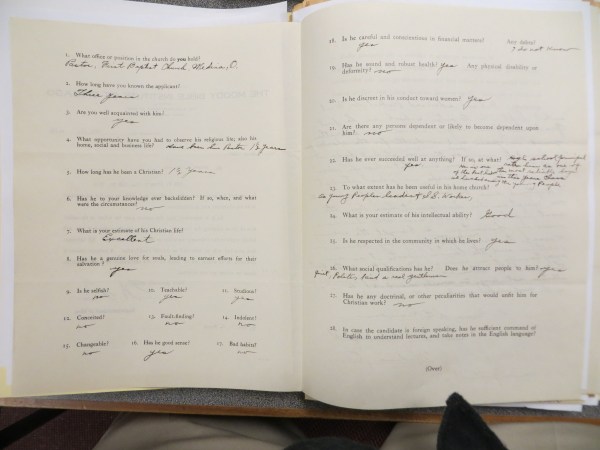
1930s application ref form

MBI reference form, c. 1930s. Note question number 8.

For many evangelical Christians in the twentieth century, the main point of going to college was to prepare for a career (or at least an experience) as a missionary. As one Biola student reported in 1940, she wasn’t sure what to do with her life. She had grown up as a missionary kid in China, but she hadn’t planned to go into missionary work herself. However, one day she felt a “call” to become a missionary after all.

How did she go about it? She knew she needed some training, so after diligent prayer and consultation with “the fundamental Church groups” in her area, she decided to enroll at Biola. For her, the entire point of a college education was to become a better missionary. College, in her way of thinking, was the place to learn how to “more perfectly tell [the millions of lost and dying souls in the world] of the matchless wonders of His grace.”

The focus on missionary work didn’t just change the way students decided to go to college and which college to apply to. Schools, too, put formal mechanisms in place to encourage missionary careers. On admissions forms, for example, schools asked about more than just grades and activities. As did the Moody Bible Institute, most schools wanted to know if an applicant “has . . . a genuine love for souls.” Wheaton, too, added extra admissions points if a student had a “demonstrated ability as an outstanding soulwinner.”

The focus on missionary preparation shaped schools in other ways, too. ALL colleges and universities tended to expand their bureaucracies after World War II. They formalized and systematized their admissions departments and alumni outreach bureaus.  In addition to these sorts of new departments, evangelical colleges also formalized their missionary training, by adding departments to help students pick the right missionary career path.

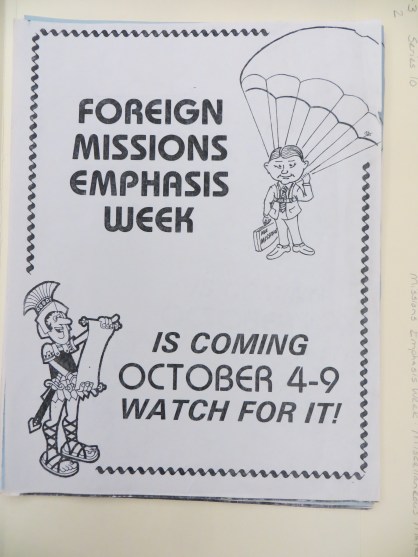
missions flier

Attention Liberty Students–your school will help you get to your mission field. C. early 1980s

One of the central themes of my book is that evangelical higher education experienced its own sort of evangelical existence—IN the world of American higher ed, but not OF it. In some ways, that is, evangelical institutions were shaped by the same sorts of forces that transformed the world of American higher education as a whole. In other ways—as in the focus on training missionaries—evangelical schools shaped those forces to fit their unique vision of proper higher education.

I Love You but You Didn’t Do the Reading

Happy Halloween, SAGLRROILYBYGTH! There were plenty of tricks and a few treats in the news this week. Here are some of the headlines you might have missed:

School scams? Orlando Sentinel reporters investigate public money going to private-school ripoffs.

B-ding! There’s another one: Rich smart person teaches briefly in low-income school, writes memoir.

The most expensive evangelical building ever? CT reviews Hobby Lobby’s Museum of the Bible.Bart reading bible

A new gen-ed: “Patriotic Education and Fitness.” Will it help students at the College of the Ozarks be good citizens?

“Border science” and Nazi occultism. At Religion & Politics Michael Schulson reviews Eric Kurlander’s Hitler’s Monsters.

  • The takeaway? Schulson: “There’s the fascination with purity. And there’s the belief in secret histories, secret forces, and secret knowledge. These concepts are not fringe ways of thinking. They are familiar, I think, in one form or another, to most Americans.”

What should a conservative PhD student watch out for? Some controversial anonymous advice at IHE.

At HNN, Gary Nash asks why we have forgotten about white Christian anti-racist activists.

What’s a progressive parent to do? Do they have to support public education even if they don’t like public schools? One parent asks for progressive advice at The Nation.

How did Betsy DeVos change her daily routine when she moved from being a private-school activist to a public-school uber-administrator? According to the New York Times, she didn’t.

Schools are left-wing indoctrination centers, Newt Gingrich writes.

What do schools really need? At Flypaper, Michael Petrilli prescribes “a swift kick in the ass.”

The REAL Fight about School Reform

It’s not about charters. It’s not about vouchers. It’s not about the power of unions or the role of standardized tests. The fundamental disagreement at the heart of our protracted inability to improve our public schools comes from something else entirely. As a recent commentary from the free-marketeers at Flypaper makes clear, this basic disagreement fuels big dilemmas about school funding and function.

Recently, Ian Rowe made some powerfully true points about this tricky truth at the core of school reform. But he also demonstrated how easy it is to draw some powerfully false conclusions. Rowe worked briefly at the Bill and Melinda Gates Foundation, and he is reacting to the Gates’s recent self-examination of their twenty-first century school reform efforts.

As Rowe correctly points out, spending money—even Microsoft-style bajillions—on silver-bullet school reforms will never be enough to correct the glaring and lamentable differences between public schools for children from affluent families and public schools for low-income families. That is, simply by paying for new school formulas such as smaller schools, more invasive standardized testing, or new subject standards, school reform will never achieve its real goals. Even with new computers or standardized tests, schools for low-income students will never offer the same opportunities and life chances that richer students get.

Rowe is 100% correct that such silver-bullet attempts will always fail because they get the school-reform equation backwards. We shouldn’t think about using schools to equalize a ruthlessly hierarchical society—we first need to pay attention to the reasons that society itself is divided between haves and have-nots.

After that, however, Rowe goes off the rails. His intellectual crash-and-burn illustrates the real dilemma at the heart of school reform.

For Rowe, the real problem with educational inequality has its roots with the culture of low-income Americans. If schools are to offer real opportunities for people to climb up the economic ladder, we need to focus first and foremost on changing that culture. Too many families, Rowe notes, have only one parent. And too many families suffer from immature and even immoral parenting.

To heal America’s divisions, Rowe argues, we need to encourage “parent accountability.” Too many adults in low-income families, Rowe insists, mar their children’s chances at a good education because the adults themselves dawdle in a “state of perpetual adolescence.”

Rowe’s prescription is simple. Schools must change the culture of young people. As he puts it,

Educators can teach students the sequence of life choices—education, work, marriage, then children—that is highly correlated with economic and life success, and that would empower students to overcome substantial race- and class-based institutional barriers.

Rowe is entirely correct that school reform will always fail when it tries to use flashy new methods to offer students from low-income families the same life choices enjoyed by students from more affluent homes. But he is woefully, dangerously incorrect when he suggests that the answer is to use schools to teach children not to be like their parents.

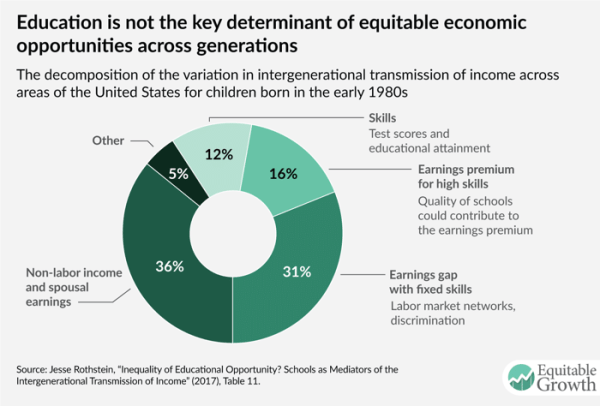
Our latest research, after all, shows that schools are not the biggest factor in economic mobility. That is, success in getting through high school and maybe college to get a better job than your parent had is mostly not do to the schools themselves, but other factors. And Rowe is right that a big part of those outside factors is family structure.Rothstein

The real disagreement at the heart of our school-reform dilemma is about what comes next. By and large, Americans don’t like to talk about the real problem. We don’t like to talk about the fact that some Americans don’t have an equal shot at the American dream. We don’t like to acknowledge the obvious truism that band-aid reforms to some schools here and there are laughably inadequate solutions.

We can’t even agree on what poverty means. For many Americans, especially conservatives and religious Americans, the main cause of poverty is “individual failings.” If only people worked harder and delayed gratification, the thinking goes, they would move up to better jobs and nicer neighborhoods. As recent surveys show, the rest of us tend to blame social structure and “difficult circumstances.” The most important factor in persistent poverty—in this way of thinking—is the way society itself discriminates against poor people, squeezing them into worse houses, with worse schools and worse jobs.

Unless and until we can figure out this persistent disagreement about what it means to be poor in America, our sporadic attempts at school reform will continue to disappoint. Like Bill Gates, well-meaning but poorly informed reformers will wonder where all their money went with so little to show for it.

The Headline You’ll Never Read

Cereal gets stale after about two weeks. Cheese can last a while. Milk goes bad much quicker. But conservatives never seem to tire of hysterical warnings about left-wing takeovers of public schools. Your humble editor experienced a dizzying bout of déjà vu this morning reading Newt Gingrich’s furious warning about the influence of “radical, left-wing” teachers. I had to check my watch and even my calendar to make sure what year it was. It serves as another reminder: When it comes to culture-war rants about public education, there is one headline that we’ll never see.

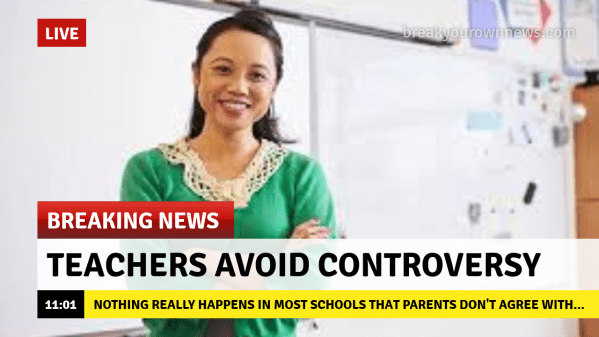
breaking-news

The headlines we’ll never see…

Don’t get me wrong: I understand why conservative activists like Gingrich want people to think left-wingers are taking over public schools. No conservative parent is likely to open her wallet for a politician who tells her there’s nothing much to worry about. So Gingrich tries to build back his political clout by warning FoxNews readers about a “thinly veiled attempt to instill radical, left-wing political views in impressionable children.”

Gingrich is reacting to an obscure story out of Minnesota, dug up by conservative muckrakers. In Edina, Minnesota (population 51,350), the school board is apparently implementing a new inclusivity curriculum. Students will read books such as A Is for Activism. [SAGLRROILYBYGTH may remember the title from earlier fuss-and-feathers controversies about it.] As Gingrich fumes, “This is pure, unapologetic political indoctrination of American youth.”

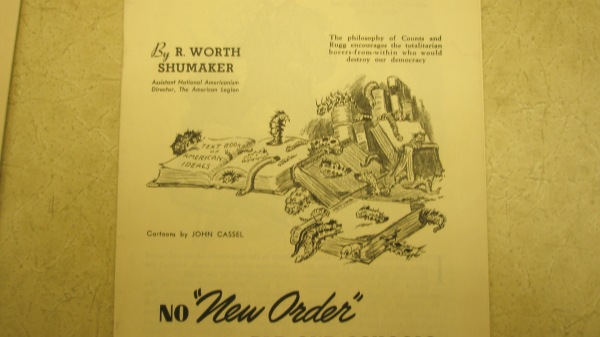
As I argued in my book about the history of educational conservatism, Gingrich is reading word-for-word from an old conservative playbook. In the 1930s, for example, conservative activists went haywire over a textbook series by progressive-ish scholar Harold Rugg. Back then, leaders of the American Legion foamed and fumed that Rugg’s educational scheme “encourages the totalitarian borers-from-within who would destroy our democracy.”

OLYMPUS DIGITAL CAMERA

Boring…boring…boring…(c. 1941)

There’s no doubt that Harold Rugg really did hope to push American school and society to the political left. And I’m guessing some of the teachers in Edina feel the same way. But the notion that teachers and education professors are able to sneakily install a mind-warping left-wing curriculum in American public schools is simply ludicrous. Even if we wanted to—and again, I admit that some teachers and ed-school professors really do want to—such conspiracy theories miss a central truth about American education.

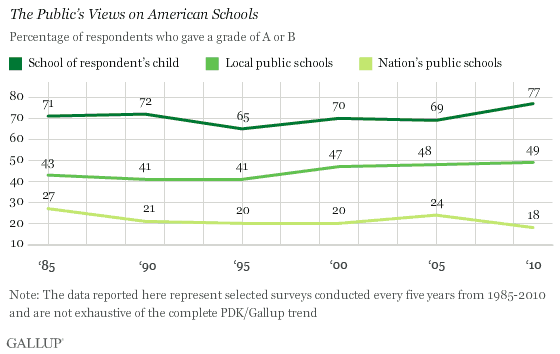
And that fundamental truth about schools and schooling generates the headlines you’ll never see. By and large, when conservatives want to rile up their base, they need to dig pretty hard to find teachers and districts that veer very hard to the political left. By and large, most schools are fairly traditional places, focusing on non-controversial tasks such as preparing students for jobs or college. Teachers, by and large, tend to avoid controversy.gallup people like their local schools

And that, perhaps, is what makes Gingrich’s job so hard. We know that most people—whatever their political affiliation—are happy with their local public schools. When Americans actually send their kids to a public school, they tend to be very happy with that school, even if they are pessimistic about the state of public education as a whole.

For Gingrich to get any attention, he has to pick out unusual examples of school districts far away that are doing something fairly unusual. Why? Because most of Gingrich’s audience is actually HAPPY with their local schools. Those schools don’t dabble in anything even remotely controversial. If a local community is Gingrich territory, the schools will be, too

Can Anyone Really Teach For America?

It’s personal for me. I remember being shocked and perturbed when I started teaching and realized the kinds of lives some of our students lived. It’s one thing to see it on TV; it’s another to get to know a kid who only comes to school when he feels like it because he lives in a house without any responsible adults, where there is no food but there are plenty of drugs and prostitution. Every teacher wants to help. And every good teacher realizes he or she can never help enough–the problems are so big and so overwhelming for so many kids that one great history class seems awfully meaningless in comparison.

A new memoir brings this crusty old question up one more time: How much impact can a teacher really have on students’ lives? Reading with Patrick by Michelle Kuo tells the story yet again. Kuo goes from Harvard to Arkansas with Teach For America. She finds herself shocked and unprepared for the conditions in which her students live.

At The Atlantic, reviewers gush. They write that Kuo manages to avoid the “every kind of awful” clichés of the teacher-as-savior genre.

Veteran teachers aren’t so smitten. Curmudgucrat Peter Greene laments the stale story. As he puts it,

only in teaching do we get this. Students who drop out of their medical internship don’t get to write memoirs hailed for genius insights into health care. Guys who once wrote an article for the local paper don’t draw plaudits for their book of wisdom about journalism and the media.   But somehow education must be repeatedly Columbusized, as some new tourist is lionized for “discovering” a land where millions of folks all live rich and fully realized lives.

Coincidentally, this week I’m asking the grad students I work with to consider this very question. Given the many structural and social inequities that create “tough” schools, how much positive influence can one teacher have on students’ lives?

As Greene points out, in every generation affluent Americans like to “discover” the “shocking” conditions in some urban schools. It’s such a cliché that the Onion can parody the predictable storyline without even breaking a sweat. In my class, I’m asking students to consider both the question itself and the way American pop culture keeps finding itself surprised to hear the same story.

We start with the movie Blackboard Jungle. In 1955, this movie shocked audiences by its depictions of gang warfare, sexual assault, and unruly teenagers. Oh, and of course rock-and-roll music, which was apparently a big thing at the time.

Of no surprise to SAGLRROILYBYGTH, in Blackboard Jungle, an earnest new teacher has some trouble with these violent and turbulent teens. Of even less surprise, he manages to forge positive relationships and get most of them to reevaluate their ideas about school and literature.

Next up: Up the Down Staircase. This 1960s memoir told the same story. In the 1967 film version, we see the earnest and affluent teacher move in to an urban high school. The students are rowdy. They are not all white. They give the teacher trouble.

After some twists—including one frank African American drop-out who explains to the naïve teacher the uselessness of school credentials in his life—the teacher manages by dint of personal awesomeness to help her students get something out of school.

Last but not least, we hear the story again in 2007’s Freedom Writers. In this version, we have an earnest and affluent teacher—wait for it—teaching in a gritty and violent urban school.

I don’t know if you need to hear the rest. It’s the same story told in twenty-first century accents. After significant struggle, by dint of extraordinary effort and personal moxie the heroic teacher manages to connect with her students. The students recognize their own potential as writers, thinkers, and voices for social change.

Don’t get me wrong: I am not saying these stories aren’t heroic in some sense. Most Harvard grads don’t take Kuo’s detour through Arkansas before law school. And even fewer return when things get scary. And I’m certainly not saying I don’t share the moral dilemma of these teachers.

But I still struggle to make sense of a few key questions:

  • Why do Americans keep finding themselves surprised to hear this same story?
  • Are these really “inspiring” or “hopeful” stories, when nothing has actually changed for most students?
  • What long-term impact can isolated, self-sacrificing teachers have in a hierarchical society?

From the Archives: Give Us Money! Please! Now!

Do you get the same phone calls I do? As a nerd, I’ve attended several different colleges. And my phone sometimes rings with a call from an earnest undergrad working the alumni phones at Northwestern or Wash U or Madison, asking me to please consider a donation—”even a small one!” As a teacher and a historian, I always tell them I’ve got nuthin. As I worked on my new book about evangelical higher education, though, I couldn’t help but notice the connections between ALL schools when it comes to pleading for alumni cash.

One of the central themes of the new book is that evangelical colleges have sometimes bucked trends in secular/mainstream/pluralist higher ed. At other times these evangelical institutions have been subject to the same forces that shape all schools. Like all institutions, evangelical colleges have always needed money. Like all universities and colleges, evangelical schools have tried to tap their alumni for funds. In some cases, though, evangelical schools threw in a culture-war twist.

During the twentieth century, funding patterns changed for higher ed. Big research schools started getting more and more money from big research institutions such as the National Institutes of Health and the Department of Defense. However, as historian Roger Geiger pointed out, that sort of big-grant research money tended to go to the same schools over and over. For example, during the 1920s, new Rockefeller funds poured twelve million research dollars into universities. Back then, though, only six schools—Caltech, Princeton, Chicago, Cornell, Stanford, and Harvard—received more than three-quarters of that money.Gordon 1944 ad for donations in Watchman Examiner

Other colleges—evangelical or not—scrambled to find money elsewhere. For most small schools, tuition dollars continued to represent the biggest single source of revenue. Tuition funding is risky, though. In any given year, it can go down drastically and suddenly if enrollment lags. Just ask Sweet Briar.

In response, most colleges—including evangelical ones—scrambled to build donor networks to collect reliable donations. Over the course of the twentieth century, these administrative departments grew larger, more professional, and far more influential.

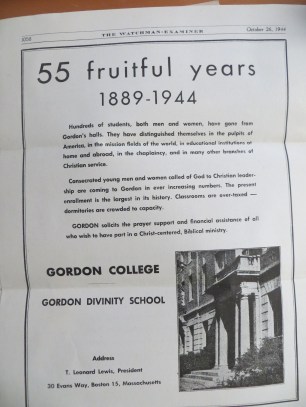
Most evangelical colleges participated in this trend enthusiastically. Sometimes, though, evangelical schools did it in a unique way: They harped on the unique culture-war features of their institutions. Gordon College, for example, tried to appeal to evangelicals in general to support their work. In the 1940s, for instance, they advertised their school as a vital evangelical institution. “Consecrated young men and women,” they pleaded, “called of God to Christian leadership” needed Gordon, and Gordon needed money.

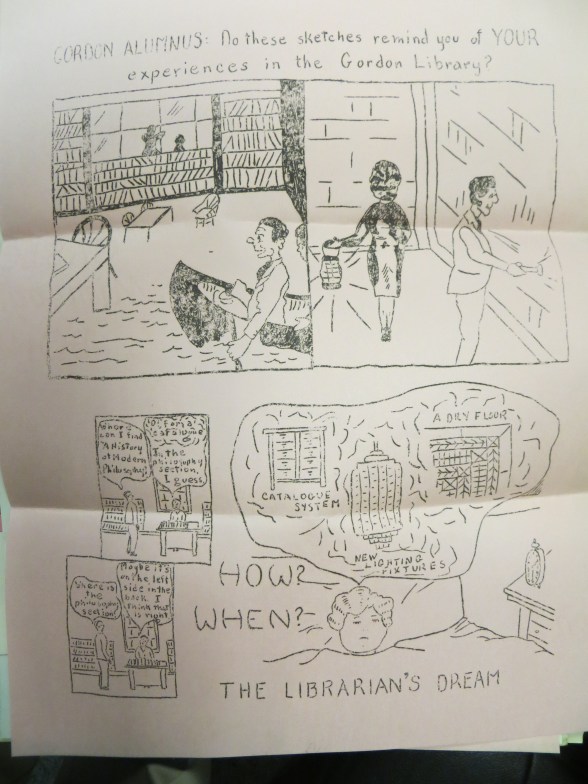
At the same time, Gordon experimented clumsily and amateurishly with directed appeals to alumni. One plea for library funds didn’t make any mention of evangelical values. It simply begged alumni to donate. (It’s not clear exactly what year this appeal went out, but it is located in a box of materials from before 1944.)plea to alumnus funds for library cartoon

As the century progressed, many evangelical schools continued both strains of fund-raising appeal. They asked alumni for money, like all schools. But they also asked evangelical culture-warriors to support their work. At Biola, for example, the alumni office sent out a personal appeal in 1970. Here’s what they told alums:

Headlines in the 60’s were frightening.  Hippies and Heart-transplants; Racism and Demonstrations; Assassins and Murderers; Mini-skirts and moon landings.  We read much about power, most of it explosive: flower-power, black-power, atomic power, student power.  The decade was full of change, violence, war, noise and new things.

Power—‘all power’—the explosive power of the Word of God created headlines at BIOLA in the 60’s. Student Population Explodes; Classrooms Crowded Out; Thousands Accept Christ in Orient; 1708 Grads Take Message to Frustrated World.

God used investments like yours to make things happen at BIOLA in the 60’s.

Biola, like a lot of evangelical colleges, sold itself in the 1970s as the healthy conservative anti-college, the stalwart Christian school that not only resisted pernicious trends in mainstream higher ed, but also created a powerful form of counter-counter-cultural higher education.

By the end of the century, evangelical colleges and universities—just like almost all institutions of higher education—had organized bureaucracies to solicit donations from alumni. My guess is that they have continued to emphasize both the distinctive elements of their evangelical promise as well as the mundane institutional needs they face.

I’ll go out on a limb this morning: I bet those of you who attended evangelical colleges get the same kinds of alumni appeals I get from my secular alma maters. But I also bet that your letters sometimes talk about particular evangelical values. They probably sometimes talk about boring financial needs such as a new library, and they probably sometimes emphasize the dire need for Christian values and leadership in these dark times. But they ALWAYS ask for money.

I Love You but You Didn’t Do the Reading

I’ve never really wanted to run a textbook company, but I’ve never not wanted to more than now. Pearson and other edu-types have had a rough week–here are some of the highlights:

The fake history we all remember: The myth of the spit-on Vietnam vet. HT: RH

Where do the white nationalists come from? The New Yorker profiles Mike Enoch. HT: RP

New Mexico puts science back in its K-12 science standards. HT: VW

Trump’s war on knowledge, by Ariel Dorfman at NY Review of Books.

What has Bill Gates learned about learning? He describes his twenty-first century education about education on his blog.Bart reading bible

How do writers write? Peter Greene offers his eight rules for writing right.

There’s nothing new about “fake news:” An interview with Kurt Andersen, author of Fantasyland, at Religion Dispatches.

Wowzers. Pearson apologizes for racist stereotypes in nursing textbook. Some examples:

  • “Jews may be vocal and demanding of assistance.”
  • “Blacks often report higher pain intensity than other cultures.”

Thanks to everyone who sent in tips and stories.

History, not Faith

Why do so many white evangelicals support President Trump? Not just in a passive, least-worst, anyone-but-Hillary sort of way, but actively and even enthusiastically? Why have some white evangelical leaders become what historian John Fea calls “court evangelicals?” After all, President Trump is no one’s idea of a Christian. One recent argument ties evangelical Trumpism to faith, but not surprisingly, I think it has a lot more to do with historical imagination. For people who fantasize about a lost American “Shining City upon a Hill,” Trump’s “take-back-America” rhetoric punches important buttons.
Trump make america great again

It’s the hat, stupid.

Over at Religion Dispatches, Eric C. Miller interviews Kurt Andersen about Andersen’s new book Fantasyland: How America Went Haywire. I haven’t read the book yet, but I’ve got it ordered. It sounds fantastic and I’m looking forward to reading the whole thing.

I can’t help but spout off a little, though, about some of Andersen’s arguments in this interview. Andersen describes his explanation of the odd relationship between the starchy moralists of America’s evangelical subculture and the wildly careening leadership of President Trump. Andersen makes connections between charismatic belief and Trumpism, but I think there’s a much more obvious and important explanation. Trump appeals powerfully not to anyone’s ideas about God and worship, but rather to white evangelicals’ implicit vision of American history.

On a side note, I couldn’t help but shudder at one of Andersen’s other statements. Like a lot of pundits, he makes some major goofs about the nature of creationism these days. As Andersen puts it,

Just in the last 15 years, it has become Republican orthodoxy to disbelieve in evolution and to challenge evolution instruction in the public schools. This is a uniquely American phenomenon, and it is a product of a religious tradition that, starting about a half a century ago, decided to make that stand in favor of creationism.

I added the emphasis to point out the problem. Andersen’s not alone on this point, but he is deeply wrong. Radical creationism’s political oomph is not at all uniquely American. To cite just one example, Turkey’s government has made even more aggressive moves in favor of creationism. This is not a minor error, but a major misreading of the nature of modern creationism. As I’m arguing in my current book, following in the footsteps of the great historian of creationism Ron Numbers, radical young-earth creationism is not “uniquely American,” but rather a popular and politically potent response to the dilemma of post-modern life, worldwide and across many religions.fantasyland
That’s a big intellectual problem, but it is not my major beef with Andersen’s argument this morning. No, the real question today is about the relationship between America’s politically active white evangelical Protestant community and the shoot-from-the-hip political style of President Trump. How could it happen?

For Andersen, the connection can be tied in part to one wing of evangelical belief. For charismatic Christians, Andersen explains, belief in the unbelievable is part and parcel of their culture of dissent. Here’s how Andersen made his point, with emphasis added:

[Miller]: Then I have to ask you about Donald Trump. He is now America’s Conspiracy-Theorist-in-Chief, a position that he attained with support from 81 percent of white evangelicals. Does this research help account for that?

[Andersen]: It’s bizarre. It’s interesting, because he is not, in any meaningful sense, a Christian. So why is it that our most fervently Christian fellow citizens support him so strongly? Well, as you say, our most fervently Christian white citizens. I think there is something there—it suggests that there are other reasons, cultural and economic reasons, together with the religious motivations that are driving that support.

But for my purposes, within this Fantasyland template, I think that they have some things in common beyond resentment of the elites and some of these other traits that are not necessarily connected to belief in the untrue—a lack of respect and all that. But Trump has shown a unique willingness to embrace claims that are demonstrably untrue—that Barack Obama wasn’t born here and a conspiracy covered that up; that Ted Cruz’s father was involved in the JFK assassination; that five million illegal immigrants voted against him in the 2016 election; and on and on and on. The fact that he is so indifferent to empirical reality and so willing to stand up and embrace explanations that simply confirm his pre-existing ideas or are convenient for him because they make him seem better or his enemies worse—it’s somewhat unkind, I understand, to say that he shares that tendency with religious people, but I think that is shared.

There is no evidence that people who speak in tongues are speaking a holy language. There is no empirical evidence that faith healing works. There is no real evidence that Jesus was resurrected. I could go on. So, if believing these sorts of things as a matter of faith is central to your identity, then you might identify with a guy who is willing to take strong stands on unprovable claims. If he also shares—or pretends to share—your cultural biases and resentments, then you’re going to like him! That’s about as close as I can come to explaining this strange embrace. Certainly in terms of his lifestyle, his brutal disdain for the least among us, he is so, so unchristian. I haven’t entirely figured that out—it’s another book.

Now, I agree with a lot of what Andersen has to say. I agree that “cultural biases and resentments” are the key to understanding white evangelical Trumpism. But I disagree that we can best explain Christian Trumpism by invoking “religious motivations.”

Not that there aren’t plenty of white evangelicals who justify their Trumpism in religious language. Some leaders like to say that Trump is their modern David or Cyrus. But they wouldn’t say or even allow themselves to think that they can support Trump because they already believe in unbelievable things. I get what Andersen’s saying: If you are accustomed from your religious background to a conspiratorial or fantastic mindset you are more likely to choose and support a conspiracy-theorist president. However, it’s misleading to suggest that such religiously driven beliefs are a leading explanation for Christian Trumpism.

If it’s not mainly due to their religious beliefs, why DO so many white evangelicals actively support Trump? I think Andersen is on the right track when he talks about “cultural and economic reasons,” and “cultural biases and resentments.” As I’m arguing in my new book [have you pre-ordered your copy yet?] about evangelical higher education, a leading theme in evangelical intellectual life has been the story of evangelical exile, of being kicked out of the centers of political power. Among white American evangelicals, a unique historical vision of themselves as the true Americans has fueled a century of culture-war vitriol.

From the 1920s through today, white evangelicals have been goaded and guided by this unique sense of usurpation. Unlike other powerful religious minorities, such as American Catholics, white evangelicals tell themselves over and over again that the United States used to be solidly theirs. Unlike other religious groups—even groups that are closely connected to them by theology such as African-American evangelical Protestants—white evangelicals have been sure that they deserve to claim or reclaim their role as America’s religious voice.

In short, we can’t look to theology or faith to understand evangelical Trumpism. It’s tricky, because evangelical Trumpists will explain their decisions in the language of faith. But if we listen only to such biblical justifications, we’ll miss the far-more-important real reasons for evangelical Trumpism.

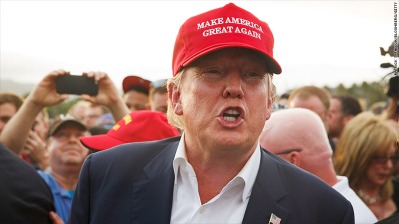
For almost a century now, white evangelicals have wanted to “take back America.” Their college campuses have been seen as both citadels and havens for an imagined real America, the kind of America from which the rest of America seemed to have strayed. When a political candidate comes along and declares his wish to “make America great again,” it resonates powerfully. Just ask Reagan.

It is this history of resentment, of a sense of historical exile, of usurpation, that best explains white evangelical Trumpism.

Are We in Danger from the Bigots and Ignoramuses?

Are you afraid of creationists? If you’re a secular, progressive person like me, you might be. You might fret that our school boards and textbook publishers are being bullied by radical creationists who want to inject theocratic rules into our classrooms. If that’s you, I’ve got two bits of good news for you. First, you’re not alone. And second, you’ve got nothing (much) to worry about.

Don’t get me wrong: It makes sense for us to be nervous. These days, the top levels of political power are in the hands of creationists or their puppets. The Ed Secretary, the Vice President, the Secretary of Housing and Urban Development…all are devoted radical creationists. So why not worry?

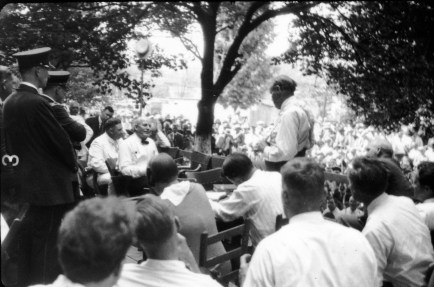
Darrow and Bryan at Scopes

“Are you now or have you ever been…an ignoramus?”

After all, plenty of smart people have warned us about the looming creationist threat. Back in the first years of our current creation/evolution controversy, for example, Maynard Shipley warned that creationist “armies of ignorance” were forming, “literally by the millions, for a combined political assault on modern science.” As Shipley put it in 1927,

The Fundamentalists are well organized; they are in deadly earnest, believing as they do that their particular brand of religion cannot survive and flourish together with the teachings of religious liberalism and modern science.  For the first time in our history, organized knowledge has come into open conflict with organized ignorance.

Shipley wasn’t alone back then. Perhaps most famously, attorney Clarence Darrow literally made the case against creationism at the Scopes Trial. When creationist celebrity William Jennings Bryan said that Darrow wanted to poke fun at the Bible, Darrow disagreed. His goal, Darrow said, was

preventing bigots and ignoramuses from controlling the education of the United States.

These days, science activists share Darrow’s and Shipley’s worry. The National Center for Science Education, for example, named its blog in honor of Maynard Shipley’s 1920s-era Science League of America. As the NCSE’s Josh Rosenau explained, Shipley’s fight against creationist “armies of ignorance” was “eerily similar” to the NCSE’s twenty-first century mission.

Don’t get me wrong—I agree with Rosenau and his 1920s forebears. We all need to be vigilant to maintain the true inclusivity of our public schools. No single religious (or anti-religious) group can be allowed to dictate class content. Given free rein, creationist activists would love to do just that—to purge mainstream evolutionary science from the classroom. For that matter, many creationist activists would likely want to doctor the reading lists in English class too and take history classes in theocratic directions. Just ask David Barton.

But as I finish up my book about American creationism, I’m more convinced than ever that we don’t need to freak out. Why not? Because radical creationists these days aren’t even allowing themselves to dream about organizing in their millions for a combined political assault on modern science. Rather, radical creationists are preoccupied with far more limited sorts of activism. These days, radical creationists aren’t storming scientific citadels. Instead, they are building Berlin Walls to keep their fellow creationists inside their threatened and shrinking areas of influence.

How do I know?

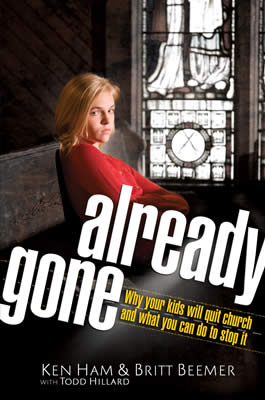
This week, I’m reading Ken Ham’s 2009 book Already Gone. Ham is the organizational wizard behind America’s leading radical creationist outfit, Answers In Genesis. In Already Gone, Ham reports the findings of an AIG survey by sympathetic market researcher Britt Beemer. Beemer surveyed roughly 1,000 twentysomethings who had been brought up in radical young-earth creationist homes and churches.

already-gone

A leak in the ark.

What did Beemer find? Most creationist twentysomethings had stopped going to church. Many of them had ditched their young-earth beliefs. Even more alarming to Beemer, the percentages of young people who had moved from young-earth creationism to an acceptance of evolutionary theory was higher among people who had regularly attended creationist Sunday-school classes. That’s right—going to a young-earth Sunday school every week when they were kids tended to make creationists abandon radical young-earth creationism in their twenties.

In light of those scary (to them) findings, Ham and Beemer made some suggestions. Long term, yes, Ham wants to foment a true “revolution” in American society. He really does want to “change the culture.” In other words, Ham would love to organize his creationist armies in their millions for a combined assault on modern science. But “strategically,” Ham argues, radical young-earth creationists need to recognize that their armies are melting away. The goal of young-earth creationists, Ham insists, must be—for now—to turn inward, to focus on teaching their children how to remain radical in the face of overwhelming social pressure to renounce young-earth beliefs. (Quotes from page 165, sixth printing, 2009.)

So, if you’re a secular person, should you be nervous about the political influence of theocratically minded creationists? In one sense, you should. Activists like Ken Ham don’t pretend they don’t want to move America back toward an imagined golden age of fundamentalist dominance. But in a day-to-day sense, you don’t need to worry. Radical creationists these days are on the defensive. They might fuss and fume about changing laws and SCOTUS decisions, but in fact they are preoccupied with patching holes in their own sinking ship.

I Love You but You Didn’t Do the Reading

Blink and you’ll miss it. Another week has come and gone. Here are some ILYBYGTH stories that might have flown under your radar:

What do college students really think? Two different surveys give us different numbers. HT: DW

“Is history objective?” Academic historians get a weird email. Is it a right-wing set up?

What’s going on on campus? Michigan and other schools flooded with violent and racist propaganda.Bart reading bible

Harvard likely under investigation for racist admissions policies.

Have evangelicals evolved from “public moralists to leaders of tribal identity”? That’s Jennifer Rubin’s charge this week at WaPo.

Free speech for some! That seems to be the majority opinion, according to a new survey reviewed by Conor Friedensdorf in The Atlantic.

California looks at new LGBTQ-friendly textbooks.

When do religious kids abandon their faith? It’s not during college, according to new research from PRRI.

Are conservatives deserting the charter-school movement?

Life at the “Christian Hogwarts:” Healing and prophecy at Bethel School of Supernatural Ministry, Redding, CA.

Thanks to all the SAGLRROILYBYGTH who sent in tips and stories.