…still Think “Evangelical” Is Not a Political Label?

Albert Mohler can say what he wants. To this reporter, there is a much more obvious conclusion. For those of us who struggle to understand evangelical identity, another recent poll seems like more evidence that we can’t rely on religious ideas alone.

SAGLRROILYBYGTH are sick of hearing about it, but I can’t stop mulling it over. In my upcoming book about evangelical higher education, for example, I argue that a merely theological definition of American evangelicalism will not suffice. The reason it is so important to study evangelical colleges, universities, seminaries, and institutes—at least one of the reasons—is because these institutions make it startlingly obvious that religion and theology are only one element defining evangelical identity, sometimes a remarkably small one.

Smart people disagree. Recently, for example, Neil J. Young took Frances FitzGerald to task for over-emphasizing the political element of evangelical identity. And a few months back, John Fea called me on the carpet for over-emphasizing the culturally and politically conservative element of evangelical higher education.

And smart people will surely disagree about the implications of recent poll results from the Washington Post and Kaiser Family Foundation. To me, they seem like more proof that American evangelicals are more “American” than “evangelical,” at least when it comes to their knee-jerk responses to poll questions.

The poll asked people whether poverty was more the result of personal failings or of circumstances beyond people’s control. As WaPo sums it up,

Christians, especially white evangelical Christians, are much more likely than non-Christians to view poverty as the result of individual failings.

Now, I’m not much of a Christian, and I’m not at all evangelical, but I can’t help but think that blaming the poor’s lack of effort for their poverty is not a very Christian attitude. And plenty of Christians agree with me. According to Julie Zauzmer in WaPo, African-American Christians tend to blame circumstances by large margins. The divide stretches beyond race. Democrats tend to blame circumstances. Republicans tend to blame individual failings.

Zauzmer reached out to experts to try to explain why white evangelical Christians might feel this way. She gave Albert Mohler of the Southern Baptist Theological Seminar a chance to explain it away. And Mohler did his level best. The reason white evangelicals blame the poor for their poverty, Mohler told her, was because

The Christian worldview is saying that all poverty is due to sin, though that doesn’t necessarily mean the sin of the person in poverty. In the Garden of Eden, there would have been no poverty. In a fallen world, there is poverty.

I just don’t buy it. If we really want to understand why white evangelical Americans tend to blame the poor for their poverty, we are better off looking at Reagan than at Revelation, at Goldwater than at Genesis. Blaming the poor has deep political and cultural roots. American conservatives—at least since the early twentieth century—have insisted that poverty in the Land of Opportunity must be due to individual failings rather than to structural problems in society. When American evangelicals mouth such notions, they are allowing those political and cultural beliefs to speak louder than their strictly religious or theological beliefs.

If we want to understand American evangelicalism—especially among white evangelicals—we need to understand that the “conservative” half of “conservative evangelicalism” is just as vital as the “evangelical” half. We need to understand that white evangelicals are complicated people, motivated by a slew of notions, beliefs, and knee-jerk impulses.

Why did so many white evangelicals vote for Trump? Why do so many white evangelicals blame the poor for their poverty? If we really want to make sense of it, we can’t focus on the merely religious beliefs of evangelicals. We have to look at the big picture.

What Kind of School Abuses Its Students?

Depressing news: No matter how hard you try to insulate and protect your kids, you can’t rely on schools to help. From the fanciest prep schools to the firmest fundamentalist redoubts, no school is safe.

You may have seen the news. Recent self-investigations at elite prep schools have turned up sordid but depressingly unsurprising news. Institutions such as Andover and Choate looked the other way at sexual abuse of students by faculty members, even writing strong letters of recommendation so that abusers could move on to fertile new fields.

frederic lyman

Preying on the elite…

The New York Times reported recently, for example, that Frederic Lyman serially abused students at a string of fancy prep schools. When he was found out, he was asked to leave and given a glowing letter of recommendation.

As SAGLRROILYBYGTH are sadly aware, evangelical schools have similar ugly histories. Institutions such as Bob Jones University have engaged in their own processes of self-examination and come up with some alarming results. Time after time, victims were blamed, abusers were enabled.

It forces us to ask the tough question: Why can’t schools protect students? After all, institutions such as Bob Jones University and Choate rely on their reputations as peculiarly protective places. BJU promises to keep students safe from any hint of liberalism. Choate promises to insulate students from any hint of the hoi polloi. Yet neither of them protect their students in this most basic way.

I’ve argued earlier in these pages that this is more than just a weird irony. Rather, it is precisely because of their peculiar status that these sorts of unusual schools cover up sexual abuse. After all, the pattern holds for other types of schools as well. It was not in spite of, but because of, their unique status as football powerhouses such as Penn State and Florida State covered up shocking sex-abuse revelations.

Perhaps it is due to the fact that niche schools have the most to lose—in terms of their all-important reputations—that they have such terrible records when it comes to sexual abuse.

From the Archives III: Playing the Rice Card

Editor’s Note: I am happy to say that my book about the history of evangelical higher education has entered its final production stages. We are on track to release Fundamentalist U by January 1, 2018. The sad fact, though, is that so much great archival material got cut from the final draft. In this series, I’ll be sharing some of these too-good-too-lose gems from my work in the archives.

Were white evangelicals racist? Short answer: Yes. Long answer: Yes, but.

In Fundamentalist U, I’m working hard to tease out the ways evangelical and fundamentalist colleges, institutes, universities, and seminaries wrestled with questions of race and racism in the twentieth century. It wasn’t easy, but I had to cut one of the most intriguing sections of my chapter.

Here’s what happened: In 1970, fundamentalist publisher John R. Rice came out in favor of Bob Jones University’s racial-segregation policy. The leaders of Moody Bible Institute had just invited Rice to give one of the most prominent speeches in their annual Founder’s Week celebration.

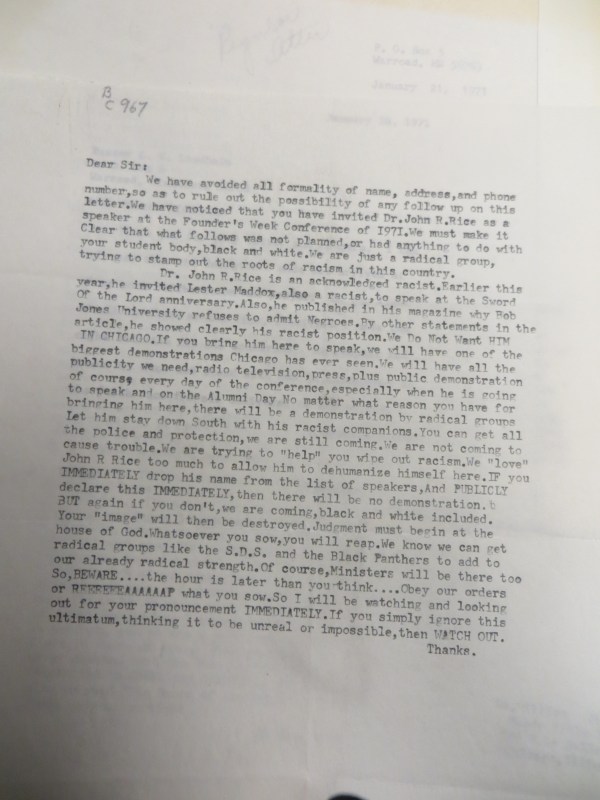
What was MBI to do? Like most white evangelicals in the era, they had moved away from the unabashed racism that they had shown since the 1930s. But they hated to alienate Dr. Rice and the potent strain of unreconstructedly racist fundamentalism that he represented.anti john rice demonstration warning letter

As MBI’s leaders hemmed and hawed, they received a clumsy letter opposed to Rice’s appearance at MBI. The authors go to awkward lengths to insist they are not students at MBI—and honestly I have no evidence that they were—but the language and content of the letter seem to suggest that it was written by MBI students.

What does this tell us about white racism at evangelical institutions? Here are some of my thoughts and I’ll welcome yours:

1.) White evangelicals in 1970 often opposed their historic racism.

2.) They often did so as part and parcel of their evangelical belief.

3.) Institutions—even ones that wanted to move away from their segregated pasts—hesitated to alienate powerful fundamentalist factions.

4.) Students at evangelical schools closely watched the goings-on at secular colleges and often mimicked the activism of their secular peers.

5.) Student activists often misunderstood the attitudes of their school administrators.

In this case, at least, MBI President William Culbertson was as ardently anti-racist as any student, but he didn’t want to hurt his school by insulting John R. Rice too publicly. When the cards were down, however, Culbertson went ahead and cut off Rice, consequences be damned.

As Culbertson wrote to John R. Rice, they both agreed on theology, but they had split on questions of race and racism. If Rice were to come speak at MBI, Culbertson concluded, it would give

the impression that the Institute agrees with your views in this regard. This cannot be.

I Love You but You Didn’t Do the Reading

July’s almost out the door, and apparently that means the return of book-burnin’ season. Check out that story and a few others you might have missed:

Is history destiny? Vouchers described this week as tools of segregation by foes, or the best ticket out of segregation by fans.

The latest speaker to be banned at Berkeley? Anti-creationist Richard Dawkins. The students didn’t like Dawkins’ statements about Islam.

Trump’s outreach to HBCUs can’t find any takers.

Evangelicals and politics: historian Chris Gehrz wonders about the relationship.

Yikes: Watch Elizabeth Johnston, aka “The Activist Mommy,” burn her Teen Vogue. Why? The magazine included information about anal sex.

From the Archives II: The Scams and the Sacred

Editor’s Note: I am happy to say that my book about the history of evangelical higher education has entered its final production stages. We are on track to release Fundamentalist U by January 1, 2018. The sad fact, though, is that so much great archival material got cut from the final draft. In this series, I’ll be sharing some of these too-good-too-lose gems from my work in the archives.

Fundamentalists never knew whom to trust. It made sense. After all, since the 1920s, fundamentalists had been telling one another that mainstream institutions had gone to the dogs. Colleges like the University of Chicago, magazines such as Time, denominations such as the Methodists…all had once been trustworthy—in the eyes of fundamentalists—and all had succumbed to a deadly mania for secularism and liberalism. Any school, any church, any preacher could have its or his head turned by the siren song of liberal theology. Any school could slide into soul-damning modernism at any time. This deep skepticism of everyone outside of the charmed circle of trusted fundamentalist institutions, ironically, made it easier for scam artists like George Martin to fleece the faithful.

IMG_1872

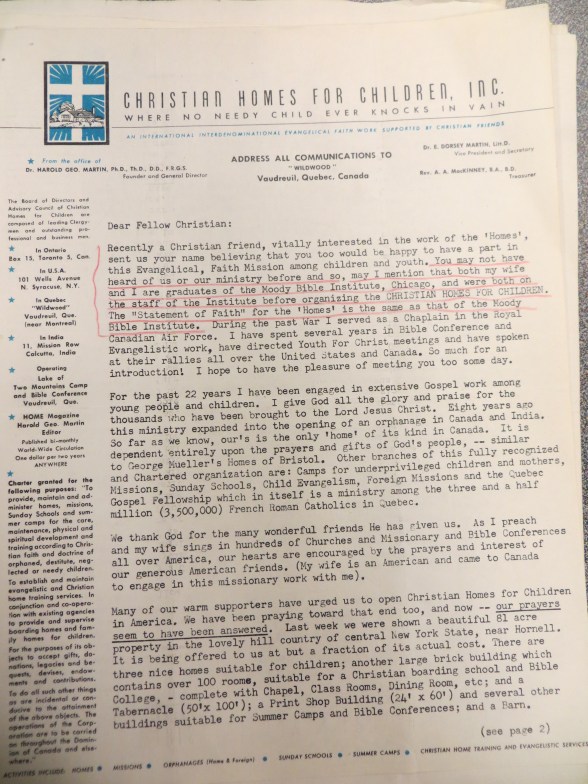
Martin pleads for fundamentalist funds, based on his MBI background

How did he do it? It wasn’t a quirk, or an isolated case. Rather—at least, this is the argument I’m making in Fundamentalist U—con men like Martin were able to take advantage of a central, defining element of American fundamentalism.

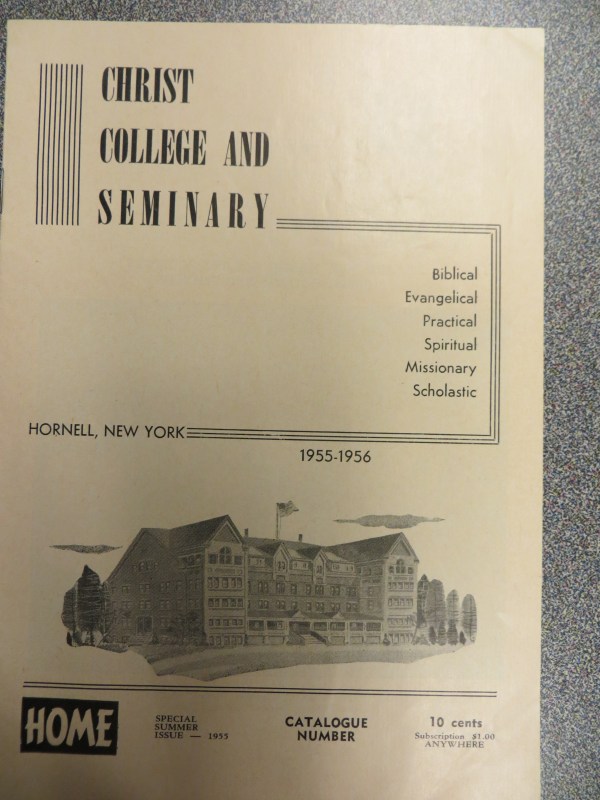
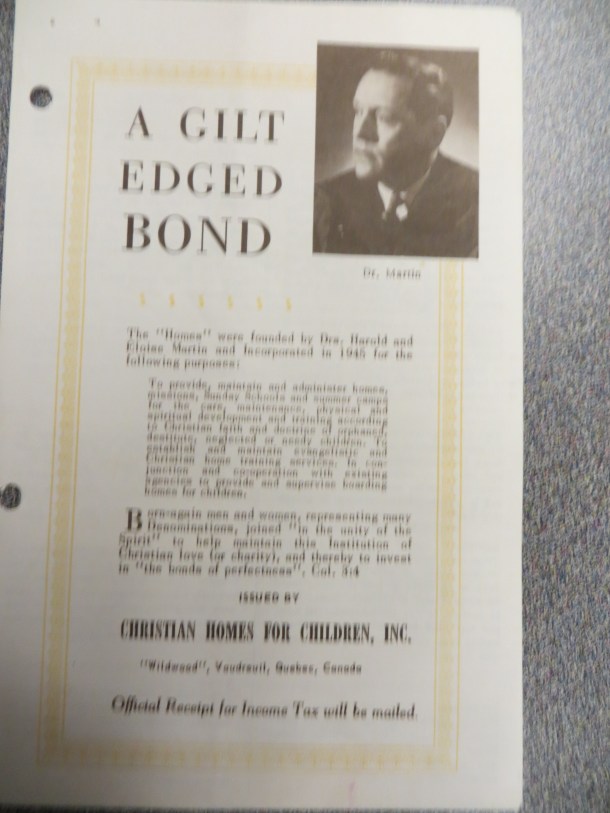
Here’s the story: Martin ran an orphanage and college in Hornell, New York. In the 1950s, he solicited funds and donations for this fundamentalist project. Fundamentalists were no dummies; before they sent him money, they wanted to know he was trustworthy; they wanted to know that he had good theology and sound finances. They wanted to know their money was really going to spread the Gospel and to teach new generations of fundamentalists.

But how could they know for sure? Because fundamentalism was a staunchly interdenominational protest movement, it had no governing boards, no presbyteries, no denominational supervision. The only way for fundamentalists to know if an institution was trustworthy—financially or theologically—was by reputation and rumor.

So vouching played a key role in defining fundamentalism in practice. Fundamentalists nationwide looked to reliable authorities to vouch for various institutions. And Martin knew it. He boasted of his connection to the most venerable evangelical institution of all, the Moody Bible Institute. And he advertised in impeccably trustworthy fundamentalist magazines such as Sunday School Times.IMG_1875

Nevertheless, rumors continued to circulate that Martin’s operation was nothing but a scam. Local fundamentalists denounced him, and secular journalists from Maclean’s magazine published a damning expose. Donations, the Maclean’s article described, didn’t fund gospel work but rather luxury cars and houses for Martin and his family.

That brings us, though, to the fundamentalist pickle. Since the 1920s, fundamentalists had warned one another that mainstream magazines such as Maclean’s were not to be trusted. After all, such magazines called ALL fundamentalists con men and scam artists. Even the most respected institutions such as Moody Bible Institute were not much respected outside of fundamentalist circles.

Some fundamentalist leaders tried to police their own ranks. Keenly aware of their responsibility to their fundamentalist readers, the editors of Sunday School Times interrogated Martin about his finances. In 1954, they demanded more information—detailed information—about Martin’s income and expenses. They demanded full disclosure.

Martin refused.

What could SST do about it? Not nothing, but not as much as editor Harry F. Jaeger hoped. In the world of American fundamentalism, Jaeger could not simply kick Martin out. There was no process for disbarment, excommunication, or banishment.

But SST and other fundamentalist institutions weren’t powerless. Jaeger sent a powerful message to the fundamentalist community by pulling Martin’s ads from SST. The magazine would no longer offer Martin its implicit endorsement. And Jaeger could and did use his influence to sway other fundamentalist leaders.

For example, he wrote to Moody Bible Institute president William Culbertson to warn him of Martin’s scams. Martin, after all, based his reputation largely on Martin’s record as an MBI alum. MBI should worry, Jaeger wrote, that its reputation was being abused. As Jaeger put it,

Under the circumstances, it seems to me that his work should not be presented to the Christian public for support.

What did MBI do? As usual in the world of American fundamentalism, they were extremely hesitant to condemn a fellow fundamentalist, especially if the evidence came mainly from secular critics. But they didn’t ignore the criticisms, either. To start, they stopped running Martin’s ads in Moody Monthly, in spite of Martin’s protests.

IMG_1888

Your money, please…

When fundamentalists wrote to MBI for assurance, though, MBI only gave them the run around. In 1963, for instance, one administrator wrote to an inquirer, saying he had “no firsthand knowledge of the organization.”  He noted that the popular magazine Maclean’s had just written a damning expose of Martin’s school.  MBI itself, however, was not sure “whether the article is fair or factual.”

The fundamentalist public, after all, had grown accustomed to unfair treatment at the hands of mainstream journalists. Was Martin merely being misrepresented by hostile secular and liberal critics, as he claimed? Or did he really take the money of well-meaning fundamentalist backers and buy himself fancy cars and houses, as his critics insisted?

There was no easy way for the fundamentalist community to know for sure. They relied almost exclusively on reputation. If Martin claimed to be part of the Moody Bible Institute alumni community, then he must be trustworthy…right?

Only years later, when local evangelical sources had corroborated the charges made by the Maclean’s reporter did MBI administrators begin sounding a more clearly negative note.  Even then, in 1968, MBI administrators did not actively denounce Martin and his fraudulent school.  Rather, they only responded to inquiries with batches of clippings about Martin’s depredations.

It made fundamentalists nervous. It was very difficult to tell who was really representing the fundamentalist movement and who wasn’t. Both legit schools and fakes would be denounced in the mainstream press as bogus. And established institutions such as Moody Bible Institute were extremely reluctant to expose anyone’s shady dealings.

Fundamentalism was built on a shaky structure—supported mainly by reputation and rumor. And this set-up made for predictable abuses. Scam artists like George Martin weren’t the exception, but rather a predictable result of the lack of any higher (human) authority in the world of twentieth-century fundamentalism.

A Texas-Sized Dilemma for Conservatives

How can you befuddle Texas conservatives? Make them choose between banning transgender bathrooms and the NFL. That’s the strategy taken recently by the Texas Association of Business.

Here’s what we know: Texas is mulling over its own version of a transgender bathroom bill. The bill would require students in public schools to use the bathroom corresponding to the gender they were assigned at birth. So, in other words, if I were identified as a male when I was born, but when I was fifteen I identified as female, I would legally be compelled to use the boys’ bathroom at my public high school.

According to the Dallas Morning News, business groups in Texas are alarmed. They look at the fallout in states such as North Carolina, where a similar bathroom bill led to billions of dollars in lost business. The Texas Association of Business ran an ad in the Dallas area, warning that the National Football League would pull its draft ceremony out of Texas if the bill passes.

It’s not an idle threat. The NFL has officially opposed “discriminatory” legislation. As an NFL spokesman put it,

If a proposal that is discriminatory or inconsistent with our values were to become law there, that would certainly be a factor considered when thinking about awarding future events.

For conservative Texans, the choice might be a tough one. They might want to affirm their devotion to traditional notions about gender. But they also want to host the NFL draft.

Now, as SAGLRROILYBYGTH know, I’m firmly in favor of transgender rights. But if I weren’t—if I were a conservative type wondering if the Benedict Option was right for me—I would take this sort of announcement from the NFL as stark evidence that I had lost the fight over the meaning of gender.

If the NFL, home to scantily clad cheerleaders, ass-kickin’ macho men, Blue-Angels flyovers, and Hank Williams Jr….if the NFL considers gender traditionalism to be “discriminatory,” then it does indeed seem that conservatives have lost the fight on this one.

From the Archives I: Extremism in the Defense of Bible Prophecy Is No Vice

Editor’s Note: I am happy to say that my book about the history of evangelical higher education has entered its final production stages. We are on track to release Fundamentalist U by January 1, 2018. The sad fact, though, is that so much great archival material got cut from the final draft. In this series, I’ll be sharing some of these too-good-too-lose gems from my work in the archives.

You may have heard it before. There is a myth circulating in nerd circles about the history of fundamentalism in the twentieth century. It’s not true and historians have punctured it convincingly. If we needed any more proof, the archives are full of evidence.

As the old story goes, fundamentalists were humiliated at the Scopes trial in 1925. They retreated in anger and disgust from participation in mainstream life, building up a network of inward-looking institutions such as colleges, church networks, and parachurch organizations. Then—depending on which version you hear—either Billy Graham in 1957 or Jerry Falwell in 1976 broke out of this self-imposed fundamentalist ghetto to leap back onto America’s center stage.

It’s hooey, as historians such as Matthew Sutton and Daniel K. Williams have shown. As Professor Sutton put it in American Apocalypse, the “rise-fall-rebirth” story just doesn’t match the historical record. Fundamentalists never retreated from political involvement or mainstream cultural engagement. In Sutton’s words, fundamentalists’

agenda was always about more than correct theology; it was also about reclaiming and then occupying American culture.

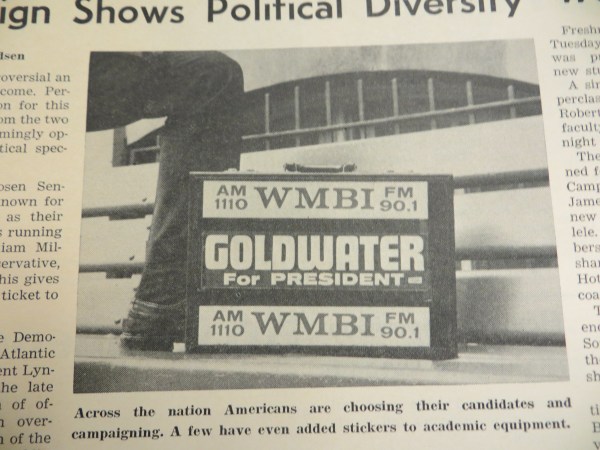
I’m making this argument in my book as well. Even at schools such as the Moody Bible Institute that were supposedly the most otherworldly, the most focused on Bible prophecy and the farthest removed from the nitty-gritty politics of the so-called “New Christian Right,” fundamentalists never withdrew from politics, never retreated from mainstream involvement. As this photo makes clear, in the 1960s MBI ardently engaged in partisan politics, pushing hard for a conservative Goldwater presidency.1964 WMBI and Goldwater

It wasn’t only in the 1960s, either. MBI’s leaders always fought in the political arena. Back in the 1920s, for example, President James M. Gray worried that MBI’s radio station had come under undue political pressure. What did Gray do? “The time for fighting has begun,” he warned. He used every weapon in reach to oppose the new radio regulations, including the Capitol-Hill influence of Missouri Senator James M. Reed.

Gray’s political activism was not the exception, it was the rule. No matter where you look in the archives, you see fundamentalists and neo-evangelicals fully engaged in mainstream politics. There was no retreat. There was no withdrawal. And, of course, that means Jerry Falwell’s 1970s leap into politics was not as ground-shaking as Falwell liked to say it was.

I Love You but You Didn’t Do the Reading

Your humble editor has been doubly distracted this week. My book about evangelical colleges is entering its final stages and I’ve been poring over copy-edits. Plus, we got to spend time with some long-lost family members. In the meantime, the interwebs kept spitting out stories. Here are some we might have missed, with extra history added in so you can follow along at home…

More trouble at troubled Bryan College. Long-time faculty member fired, anti-administration petition makes the rounds.

What’s wrong with Frances FitzGerald’s new book? Neil Young says it misses the real point of being evangelical.Bart reading bible

Peter Greene: Don’t believe the talk about a “teacher shortage.”

Is evangelical support for Trump a good thing for progressivism? John Fea wonders if Trumpist evangelicals are making their “Pickett’s Charge.”

From the archives: What did progressives think of William Jennings Bryan in 1945?

  • A taste: “The man who had never been a bigot associated himself with the most narrow-minded religious fanatics. The man who had been the apostle of democratic freedom and of public education had become an advocate of governmental restrictions on the freedom of learning. . . . And it’s high time some serious study was given to the social applications of Bryanism rather than of Darwinism.”

Teaching religion in Chicago’s public schools. Is the answer “religious literacy?” I’m still skeptical.

What’s the latest scheme for predatory faux-profit colleges? Fake Latin names.

From the archives: Glenn Branch gets his hands on a rare 1925 anti-evolution pamphlet.

What’s so “classical” about Classical Schools? At National Review, John Miller gives a short history and endorsement.

The Dog That Didn’t Bark

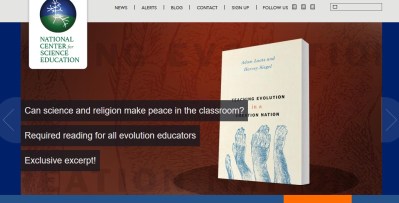
Heading for the beach? Be sure to take along some classic beach reading: Chapter Three of our Teaching Evolution in a Creation Nation!NCSE TECN excerpt

The National Center for Science Education has posted an excerpt from our book on its website. I hope this brings in some new readers.

Now all you cheapskates out there can get a taste of our book without plunking down twenty bucks to read the whole thing.

In this chapter, I make my case that the crucial period in our twentieth-century battles over creationism and evolution education was not the 1920s with its Scopes Trial, or the 1960s with its flood of young-earth creationist activism. Rather, if we really want to understand the creation/evolution debate, we have to understand what happened on both sides between 1930 and 1960, when the battle moved out of the headlines.

At least, that’s the argument I try to make in this chapter. It’s no surprise to SAGLRROILYBYGTH, but I firmly believe that both sides in our current creation/evolution debate will benefit from understanding a little bit more about each other and about the history of their disagreement. And now, thanks to the National Center for Science Education, maybe a few more science geeks and teachers will check out our book.

I Love You but You Didn’t Do the Reading

You might have been out fishin’, but the interwebs kept foaming over. Here are some stories SAGLRROILYBYGTH might have missed:

From the University of Colorado, Boulder’s latest token conservative scholar reflects on his experience.

Trump, Bannon, Conway: Historian Andrew Wehrman says they would be right at home with America’s Founding Fathers.

Cut it out: Tom Englehardt argues in The Nation that progressives should stop insulting Trump.

Atheists strike back, ninety-two years later. Freedom from Religion Foundation sponsors a statue of Clarence Darrow in Dayton, Tennessee.

We know Republicans don’t like colleges these days.

Who gets to define “hate?” American Conservative Rod Dreher tees off on the Southern Poverty Law Center.

Bart reading bibleIf Americans really do oppose school segregation—as they tell pollsters they do—then why are schools getting more and more segregated? In The Nation, Perpetual Baffour makes the case that class prejudice has supplanted racial prejudice.

Harvard considers banning fraternities and sororities. It hopes to diminish exclusionary, inegalitarian arrangements.

  • At The Atlantic, Conor Friedersdorf asks, “is there any American institution that trades on unapologetic exclusion and perpetuates inegalitarian arrangements that benefit an in-group more than Harvard?”

Why does the Trinity Lutheran decision matter? Not because of playgrounds, but because of vouchers.

Don’t do it: Medievalist argues against luring college students into medieval studies with Game of Thrones references.

Queen Betsy’s civil-rights deputy apologizes for saying that 90% of campus rape accusations were due to regret over drunken hook-ups.

The segregationist history of school vouchers.

Curmudgucrat Peter Greene on the ignored dilemmas of rural schools.

Why bother killing the Department of Education? It has already been dying on its own for the past thirty years.