Are Evangelicals Unfit for Office?

Remember Larycia Hawkins? Senator Bernie Sanders does. In a recent hearing, Bernie suggested that a Wheaton College grad was unfit for office since he publicly supported his alma mater in its fight against Professor Hawkins.

During the recent presidential campaign, Candidate Sanders sounded friendlier to evangelical Protestants. He even ventured into the fundamentalist lion’s den, making a speech at Liberty University.

Down in Virginia, Bernie didn’t make a secret of his disagreement with conservative evangelical politics. But he did say some friendly things about Liberty, such as the following:

You are a school which tries to teach its students how to behave with decency and with honesty and how you can best relate to your fellow human beings, and I applaud you for trying to achieve those goals.

This week, Bernie wasn’t applauding. He suggested that any earnest evangelical was unfit for public office.

Before we get to his ferocious criticism of evangelicalism, let me say a few words of clarification: I like Bernie. I’m no evangelical myself. I’m just a mild-mannered historian who has written a book about the history of schools such as Wheaton and Liberty.

And maybe I’ve spent too much time in the archives of evangelical institutions, but Bernie’s recent accusation seemed pretty surprising to my ears. I’m at a loss to know how we should understand this situation.

Here’s what we know: according to Christianity Today, Senator Sanders was questioning Russell Vought in his hearing for his appointment in the Office of Management and Budget.

Vought is a Wheaton alum and had defended the school’s decision to initiate termination proceedings against tenured political science Professor Larycia Hawkins. Hawkins had sparked controversy by wearing hijab and asserting that Christians, Jews, and Muslims all worship the “same God.”

Vought disagreed. He applauded Wheaton’s firm stance. Only evangelical Christians, Vought wrote, can truly be saved. Only through the redemptive power of Jesus’s sacrifice can people come to God. As Vought put it bluntly,

Muslims do not simply have a deficient theology. They do not know God because they have rejected Jesus Christ his Son, and they stand condemned.

Bernie didn’t like it. He challenged Vought:

Are you suggesting that all of those people stand condemned? What about Jews? Do they stand condemned too? I understand that Christianity is the majority religion. But there are other people who have different religions in this country and around the world. In your judgment, do you think that people who are not Christians are going to be condemned?

It’s a pickle. For secular folks like me (and Bernie), Vought’s language seems pretty harsh. Is sounds as if he is damning to hell everyone who doesn’t agree with him. And, in a way, he is. But Vought’s belief is nothing radical. In fact, however, it is one of the central tenets of evangelical belief. The National Association of Evangelicals recently offered a four-point statement of basic evangelical belief:

  • The Bible is the highest authority for what I believe.

  • It is very important for me personally to encourage non-Christians to trust Jesus Christ as their Savior.

  • Jesus Christ’s death on the cross is the only sacrifice that could remove the penalty of my sin.

  • Only those who trust in Jesus Christ alone as their Savior receive God’s free gift of eternal salvation.

Some evangelical pundits were quick to lambaste Bernie. Russell Moore of the Southern Baptist Convention called Bernie “breathtakingly audacious and shockingly ignorant.” Senator Sanders, Moore charged, was trying to impose an utterly unconstitutional religious test for office.

I don’t know what to think. On the one hand, I agree with Bernie. Vought seemed to make his point in a particularly offensive way, using language calculated to seem harsh and intolerant. I don’t want public officials who see non-evangelicals as somehow inferior. And there are plenty of evangelicals who agree with me. Even at Wheaton, after all, plenty of earnest evangelicals decried the school’s decision to oust Professor Hawkins.

On the other hand, Vought’s statement was nothing but basic evangelical belief. Perhaps Vought said it more loudly than people like me find polite. But Vought and anyone else is perfectly free to think the rest of us are condemned. As a religious belief, that doesn’t do me any harm. In fact, however, I am no more offended by Vought’s belief that I am condemned than I am by scientologists’ notions that I am not “clear.”

What do you think? Is Bernie right to raise the red flag? Or should Vought and his comrades be free to voice their religious beliefs loudly and proudly?
Trump Makes Conservative College Dreams Come True

You can hear the cheering all the way from Michigan to Washington DC. The long-held dreams of Hillsdale College just might be coming true. This unique conservative institution has labored for 50+ years to become the premier intellectual training ground for American conservatism, and its influence in the Trump administration seems proof that it’s really happening.

hillsdale college

Take that, Harvard!

SAGLRROILYBYGTH are well aware of the Hillsdale story, but for those readers who aren’t, here it is in a nutshell: Back in the 1960s, the college dedicated itself to a self-consciously dissenting notion of conservative American higher education. Hillsdale is generally friendly to evangelical thinking, but it has never really been an integral part of the network of conservative evangelical schools I’m focusing on in my new book, Fundamentalist U. Some elements of its mission, though, are very similar.

Back in the early 1980s, for example, one of the fundamentalist schools I’m studying proclaimed its culture-war mission: In 1981, Liberty University’s Ed Hindson declared,

A few thousand highly committed and thoroughly trained young people, who were willing to put their Christianity to work in every sector of our society, could see America changed in our life time.

If you substitute “conservatism” for “Christianity” in Hindson’s sentence, you’d end up with something like what Hillsdale is looking for. Hillsdale’s newfound influence in the Trump administration seems proof that the plan is working, at least in part.

What does “conservative higher education” mean in Hillsdale, Michigan?

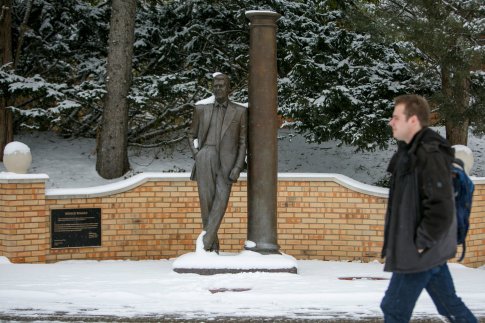
The school stridently refuses to accept any government funding. Its core curriculum teaches a traditional vision of the European canon, guided by “Judeo-Christian values.” Its campus proudly features statues of conservative heroes such as Margaret Thatcher and Ronald Reagan. The faculty have always welcomed leading conservative thinkers, including Russell Kirk back in the 1970s, and today’s superstar conservative-evangelical historian and public intellectual D. G. Hart.

hillsdale college reagan statue

The Gipper chillin on campus…

When your humble editor read this morning that Hillsdale President Larry Arnn is getting some rare and valuable one-on-one time with Secretary Betsy DeVos, we wondered just how far Hillsdale’s star had risen with the new administration.

Turns out, pretty far.

In all the hubbub-ery following Trump’s inauguration, we missed one story: Back in February, President Arnn claimed to be on a short list for DeVos’s job. And, according to the school newspaper, Hillsdale alumni filled some important roles in the Trump administration. Josh Venable (Class of 2002) became chief of staff in the Ed Department. David Morrell (2007) served as associate counsel to Trump. And two alums, Brittany Baldwin (2012) and Stephen Ford (2010) wrote speeches for the President and VP.

At least, they did back in February. In the current fast-changing White House, maybe they are out by now.

The bigger point, however, remains the same. Hillsdale’s dreams, like those of other conservative schools such as Liberty University, Patrick Henry College, and The King’s College, has long been to exert more influence in government and politics. Hillsdale doesn’t talk about the “Christian” part as much, but the goal is very similar.

Those of us who scratch our heads and wonder how any intellectual—progressive, conservative, or other—could support the clown-prince buffoonery of Trump would do well to appreciate the ways Trumpism is making long-held conservative dreams come true.

Why Are Teachers Mad at Billionaires?

It’s not just because of the cars they drive. For as long as there have been school systems, there have been outsiders who have promised radical reform. Today’s crop of tech billionaires is no different and good teachers can only shake their heads and wait for the billionaires to figure it out. If only some of the billionaires had read one book—or maybe two—they’d see the problem with their approach.

In today’s New York Times, Natasha Singer wisely warns of the lack of democratic oversight in today’s tech-based school reforms. There is another lesson billionaires should learn, though, even if they don’t care about democratic input. The history is clear: Sweeping tech-based revolutions in schooling have (almost) always ended up stashed in the hallway closets of schools across the country. There is one obvious and important exception, as historians David Tyack and Larry Cuban pointed out over twenty years ago.

Of course, we need to be fair: It’s a good thing that billionaires devote some of their loot to improving public education. Mark Zuckerberg, for example, has repeatedly put his money where his mouth is. He pledged $100 million to Newark. His foundation is now promising to invest heavily in schools. Good for him.

The problem, though, is that such outsider attempts miss a vital part of real school reform. As Tyack and Cuban argued in 1995, school reform plans work when they allow teachers to do their jobs better. They flounder when they try to force schools to adopt tech-based answers to questions no one is really asking. It doesn’t matter how expensive the plan is or how good it looks on paper.

tyack cuban tinkering

Read these works, ye mighty, and despair…

Consider, for example, the 1950s attempt to bring better schooling to rural American kids. The Carnegie Foundation teamed up with the US Congress to pour tens of millions of dollars into a radical reform program. Believe it or not, they put planes in constant motion over the Great Plains states, beaming closed-circuit educational television programs to rural schools.

It seemed like a foolproof idea, a perfect solution to rural educational oblivion, made possible by the new technology of television.

It didn’t work, though. It seems too obvious even to mention, but rural schools found that the educational TV programs didn’t fit their classroom goals. Kids didn’t learn anything. The hokey programs went unwatched, and the expensive TVs were put into hallway closets to collect dust.

As I’m finding in my current research, this pattern of well-intentioned, expensive, and unproductive technology-based radical school reform has an even longer history.

Over two hundred years ago, English reformer Joseph Lancaster insisted he had solved the problems of urban education. His new-fangled modern factory model could educate the hordes of urchins that were cramming into modern American and European cities.

No surprise: It didn’t work either. Or, to be nerdily specific, it worked…but not in the ways Lancaster had over-promised.

Lancaster’s reform plan worked—as will any reform plan in any century—when it inspired teachers, parents, students, mayors, and taxpayers to pay a lot of eager attention to their local public schools. It didn’t work when it promised a tech-based anonymous reform plan that could instantly fix any school anywhere.

lancaster schools

Radical school tech reform, c. 1807

So why are teachers mad at billionaires? Because good teachers know this central truth about what Tyack and Cuban called “the grammar of schooling.” Like any other social institution, schools are impervious to silver-bullet tech reforms. Public schools will not be magically fixed because billionaires are suddenly and temporarily interested in them.

The recipe for improving schools is not new, nor is it secret. Every good teacher already knows it. Schools are made better when an entire community is excited and involved in them. Sometimes, that excitement and involvement can be boosted by eye-catching new technology. More often, though, involvement comes from long hours and years spent in classrooms, cafeterias, meeting rooms, and athletic fields.

What the New Yorker Found in Ohio

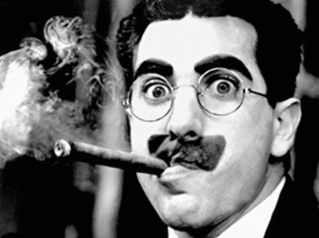
…ahem. It’s difficult to know what to say at this point. Those of us living in flyover country like to rant and rave about the arrogant obliviousness of big-city fancy folks. Deep down, though, we hope we’re just jealous; we hope the New Yorkers and their ilk are a lot smarter than they seem. Time and again, though, the city slickers seem to go out of their way to prove they are just as ridiculous as they first appeared. Yesterday, for example, I took to these pages to complain about science-missionary attitudes. Today it just gets worse.

groucho marx surprised

I just don’t know what to say…

Today’s non-revelation comes from Amy Harmon, the author of yesterday’s article about science-missionary James Sutter. Harmon mea-culpa’d her way through today’s article, breathlessly sharing her revelations, brag-scolding herself for the “preconceptions that had shaped my original notions.”

For example, Harmon reported that she actually liked one of the climate-change skeptics she met, even “admiring her spunk in the face of a hostile world.”

And Harmon was wowed by the fact that there was diversity—even in Ohio! Some of the students embraced climate-change science.

To Harmon and her editors, such things counted as newsworthy revelations.

I’m flummoxed and I could use some help. Am I being unfair to Harmon and her New York presumptions? Or is it depressing that the nation’s leading newspaper really considered it “news” that people had conflicting ideas about climate change? …that some climate-change skeptics had otherwise admirable personalities?

Science Missionary Flounders in Ohio Public School

It’s difficult to believe that smart, educated, well-dressed people still haven’t gotten the message, but apparently…they haven’t. It has just happened again: A well-intentioned science missionary has blundered into hostile territory. He was flummoxed when angry locals didn’t immediately embrace his message. We’ve said it before and we’ll say it again: If you really want to teach real science to creationists or climate-change deniers, you need to take a different approach.

Here are the details from the most recent episode: The New York Times carried the story of a smart and credentialed science expert who deigned to enter Trump territory to teach climate change. Some students balked. The teacher wasn’t prepared for such hostility. He doubled down in his attempt to help denialists see the light. Some did, but others turned implacably against him and his climate-change message.

00climateclass-02-master675

Why won’t you agree I’m right…?

Let me be crystal-clear from the outset. I agree wholeheartedly that we need to do a better job of spreading the word about real science. I am dismayed by Trump’s anti-intellectual climate-change denialism. I cheer and support all efforts to teach good science.

But I can’t understand how so many of my allies still suffer from the “missionary supposition.” Like the science teacher in this story, they think that the obvious truth of climate change (or evolution) is enough to convince everyone they meet. Even worse, as in this case, some science missionaries approach their mission fields with a lamentable arrogance. Students in this story didn’t like the way the teacher kept reminding them that he was doing them a big favor; telling them that he had given up higher-paying jobs to come help them. One particularly hostile student fled from the class, complaining that the message was only that she was “wrong and stupid.”

What should the teacher have done instead? Happily, the NYT called ILYBYGTH science-communication guru Dan Kahan. And Professor Kahan told them the obvious truth: Denying science is not about knowledge, it is about identity. When the people in this particular science class responded angrily to the science missionary, it was because they felt attacked, insulted, and condescended to.

Whether you’re Bill Nye, Richard Dawkins, or a classroom science teacher, the lessons have been clear for a long, long time. If we really want people to know and understand climate-change science or evolution, we need to ditch our missionary suppositions. We need to get rid of our assumption that people who don’t agree with us are simply ignorant. Or evil.

Like any teacher worth his or her salt, our first goal should be to get to know our students, to connect with them as people, not to treat them as sadly deficient ignoramuses. If and only if we do that can we ever hope to be trusted enough to talk about sensitive ideological issues.

I’ll say it again: Nothing in this prescription includes watering down science to flatter hostiles. Never would I suggest we skirt controversy in order to keep everyone happy. Rather, the smart play is to recognize our own blundering missionary history. Instead of plunking down in hostile territory and assuming that locals will rush to embrace our message, we need to take time to understand why people distrust us.

I Love You but You Didn’t Do the Reading

Doncha just love that new-week smell? There was a lot going on this week that SAGLRROILYBYGTH might have missed. Here are some of the stories we gathered to keep you up to speed:

Was he or wasn’t he? Creationists often insist that Darwinism leads to racism. Historian Ted Davis takes a careful look at Darwin and racism at BioLogos.

READING woman apple

Words, words, words…

Evergreen State professor Bret Weinstein advised to stay off campus for his own safety. He had protested against mandatory protests. Scott Jaschik gives the latest at IHE.

Closing the circle: Progressive school dreams result in conservative schools. Paul Ryan harts Eva Moskowitz’s Success Academies.

Deeper than ever: Charles Lipson makes the case that our current political climate is more vicious and divided than it’s ever been. HT: MM

Is New York’s plan catching on? Boston announces new free-college-tuition plan.

Another picnic in No Man’s Land: A new Catholic association for religious scientists.

A conservative’s commencement speech without politics: Peggy Noonan tells Catholic University graduates to read books.

What can Betsy DeVos do to salvage her tenure? Free-marketeer Michael Petrilli collects advice from five education wonks.

Will the Trump administration allow a birth-control waiver for religious institutions? Leaked memo says they will.

Thanks to all who sent in stories and tips.

Conspiracy and American Jihad

Michael Gerson is right. Feverish conspiracy theories have become “a kind of discrediting madness” among American conservatives. But it’s not only a problem on the right. Progressives are prone to embracing outlandish conspiracy theories, too. (*Paging Louise Mensch*) What are we supposed to do, then, whether we’re progressive or conservative, when we see evidence of a real, frightening conspiracy? Of prominent preachers calling for American jihad and civil war?

In general, it’s difficult for a historian like me to get too worked up by hyperbolic claims of conspiracy. It’s not that historians don’t see plenty of conspiracies in the archival record. Rather, as I’ve argued in these pages before, digging into archives shows us lots of evidence of real conspiracies. It is precisely the abundance of conspiracies that keeps us calm. There are so many conspiracies afoot, operating at cross-purposes and usually in bungling fractious competition with one another, that the ultimate goals of such conspiracies foil themselves.

When my progressive friends have warned of theocratic fundamentalist or creationist conspiracies, I’ve replied time and again that fundamentalists and creationists are among the most divided groups in America. The notion that they could combine to impose a Handmaid’s-Tale sort of theocracy simply doesn’t match the historical record.

I was flummoxed, then, by a recent Jim Bakker video.

Remember Jim Bakker? Of PTL Ministries? In a recent video circulated by Right Wing Watch, Bakker insisted that any impeachment of Trump would lead to a “civil war in the United States . . . Christians will finally come out of the shadows” to fight for what’s right.

Even for a mild-mannered historian like me, it’s hard not to be disturbed by such threats of American jihad. And it’s easy for secular people like me to see more evidence everywhere we look. We know, for example, that a whopping 81% of white evangelical voters voted for Trump. Those of us who study evangelical history might politely argue about the meaning of evangelical support for Trump, as John Fea and I did a while back, but it’s not too difficult to make a case that Bakker’s violent Trumpism might have plenty of support.

So should we freak out?

Not yet. Here’s why: Clearly, violent extremism is real and dangerous. Whether from Portland, the PTL, or campus radicals, we can’t afford to pooh-pooh the threat of real theo/political/racial violence. But in order to recognize and fight the danger of extremism we need to avoid the temptation of lumping together all those with whom we disagree.

Rather, we need to understand and encourage the diversity within every group. It is hard for secular progressives like me to truly understand, but no one will be more horrified by Bakker’s jihadist rhetoric than other evangelical Protestants. If we leap to assume that Bakker’s extremism represents the thinking of all white evangelicals, we turn our greatest potential anti-extremist evangelical allies into imagined pro-Bakker extremist enemies.

Are conspiracies real? Are Bakker’s fulminations dangerous? Yes, and hell yes.

The proper response, though, is not to score cheap points against conservative evangelicals by using Bakker’s words against them. The real goal should be to recruit anti-Bakker allies from among his many evangelical opponents.

How Many Americans REALLY Believe in a Young Earth?

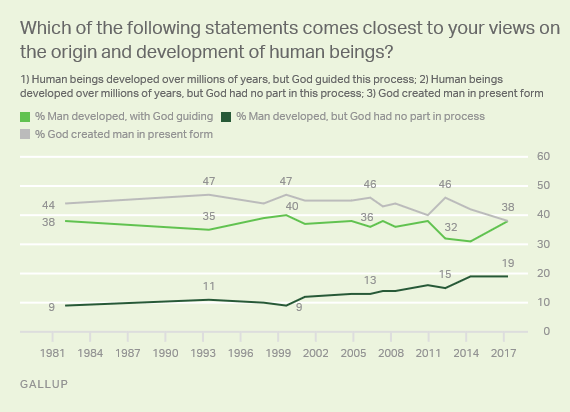
The new numbers are out. And they are, well, new. But before we leap to any conclusions about the numbers of Americans who believe in a recent divine creation of our species, we need to look at the full story.

Here’s what we know: The new Gallup poll about creationism shows a dip in numbers of respondents who think humanity was created in “pretty much its present form” within the past 10,000 years or so. Since the 1980s, the number has hovered at about 44-47% of respondents. This year, it dropped to only 38%.

gallup data 2017

Are we getting better at science? Or only getting better at answering poll questions?

We might want to say that the radical form of young-earth creationism is losing steam. And it might really be. But there’s a more nuanced conclusion we can draw if we scratch a little deeper at the numbers.

Before we begin, though, we need to lodge a complaint about terminology. Gallup calls people “creationists” only if they believe that humanity was created in its current form within the last 10,000 years. Sure, those folks are creationists, but so are the many people who believe God created humanity over a longer stretch of time. Calling only young-earth types “creationists” means taking sides in a family feud between branches of the evangelical/creationist family, as I’m arguing in my current book about evangelical higher education. I don’t think the Gallup folks really mean to do that and they should take a hard look at their terminology.

But let’s put those gripes to one side for now. Gallup gives us some demographic info about the YEC respondents. Not surprisingly, a large majority of people who go to church every week (65%) opted for a recent direct creation of humanity. And exactly half of non-Catholic Christian respondents did.

This demographic info helps us see a more likely real portrait of Americans’ beliefs about the origins of our species. When we ask more targeted questions about people’s beliefs, we get a far more complicated picture. Political scientist George Bishop of the University of Cincinnati crunched some different polling data from Harris. Of those who picked Gallup’s recent-creation option, Bishop found, over half (56%) also believed that dinosaurs had gone extinct over 65 million years ago. Over half (54%) also believed that all non-human animals share common ancestors.

In other words, among the people who picked Gallup’s recent-creation-of-humans option, lots of them also believe in evolution and an ancient earth.

Other poll questions have come up with similarly confounding results. The 2009 Harris poll, for example, found that only 29% of respondents agreed that “Human beings evolved from earlier species.” But a much larger 53% of respondents said they “believe Charles Darwin’s theory which states that plants animals and humans have evolved over time.” With such drastic differences, it’s hard to know what Americans truly believe.

So what can we make of all these higgledy-piggledy poll results? Here’s what I think: If we want to know how many people want to identify politically as young-earth creationists, then Gallup’s numbers are trustworthy. Lots of active evangelicals know that they are supposed to think that our species has been created recently.

But if we want to know what people really think about evolution and creation, the Gallup numbers are not very helpful. In most cases, as I’m arguing in my current book about American creationism, people don’t really have clear, coherent ideas about evolution and creation. Most of us hold in our heads a grab bag of ideas and beliefs, facts and falsehoods.

We don’t find it difficult, for some reason, to believe in both Adam & Eve and evolution. We don’t find it challenging to accept the notion of an ancient earth while still holding on to our belief in a recent creation. In short, what Americans believe about creationism and evolution is far more jumbled than what we tell pollsters we believe.

I Have a Date!

It wasn’t something I could say very often in high school…or in college…or throughout the 1990s, for that matter. But I can say it now: I’ve got a date! In this case, I only mean a publication date for my upcoming book, Fundamentalist U: Keeping the Faith in American Higher Education.

There’s still a lot to do. The copyeditor at Oxford will take a whack at my manuscript. Then she’ll send me a list of suggested changes and edits. I’ll give the whole thing the once-over and send it back. Then they produce proofs. At that stage, I will fine-tooth-comb the proofs, looking out for any typos. Most important—and most time-consuming—I will also prepare an index. It takes a lot of time, but with my second book I found indexing to be surprisingly satisfying intellectual endeavor.

So when will the new book hit the shelves? January 1, 2018.

At least, that’s our current plan. Things can happen and slow down the process, but if all goes well, the new year will have a new book for company.

Does “Blasphemy” Help?

How are we to understand them? Some of the recent college blow-ups seem to defy traditional common sense. Most recently, for example, students at Evergreen State College have taken to attacking biology professor Bret Weinstein. As in earlier cases, the violence of the reaction doesn’t seem to match the alleged offense.

Over at Heterodox Academy, Jonathan Haidt calls this a kind of “witch hunt,” a modern efflorescence of blasphemy trials, a type of “fundamentalist religion.” Does that kind of parallel help us make sense of these campus controversies?

Here’s what we know: In cases from Yale to Claremont McKenna to Middlebury to Berkeley, protesters have exploded—sometimes violently—in order to demonstrate their disagreement with certain forms of speech.

In some cases, the protesters have insisted that harboring hurtful language does harm to the campus community. At Middlebury, for example, students protested the presence of Charles Murray. Murray was accused of perpetuating racist ideas.

And, in some cases, the ferocity of the student reaction seems out of proportion to the alleged crimes. At Claremont McKenna College, for example, an administrator inadvertently implied that there existed a racial norm at the school. At Yale, an instructor downplayed the seriousness of offensive Halloween costumes. In each case, the student response was enormous and militant.

How are we to understand the violence of these student reactions?

I’ve tried a few explanations myself. Recently, I suggested that we look not at the “college” part of these protests, but at the “elite” part of them. A while back, I suggested that we should celebrate this kind of student activism. I even suggested a better way for protesters to accomplish their stated goals.

Jonathan Haidt writes that we need to take a different perspective. The vitriol and intensity of recent campus flare-ups, Haidt argues, is best understood as a kind of religious impulse, a witch-hunt, an anti-blasphemy campaign.

There are some parallels. First, many of today’s campus protesters feel that merely allowing certain forms of speech constitutes grave harm. Like many sorts of religious speech, merely encountering certain words is perceived as harmful. Second, there is a definite in-group feel to recent campus demonstrations. Many participants seem to want primarily to demonstrate their position on certain issues. The main goal does not seem to be humdrum policy change, but rather a literal demonstration of morality. Plus, the language of recent protests is often starkly black and white. Anything besides total agreement is seen as an utter betrayal.

What do you think? Does it help you understand the Evergreen State protests if you think of them as a kind of blasphemy trial? If you take it out of the realm of secular policy deliberation and into the realm of good vs. evil?

Or is that just a way for us to downplay the seriousness of the protests? Calling something a “witch-hunt,” after all, is yet another way to cut off dialogue.