The Real Reason Trump Hates the Education Department

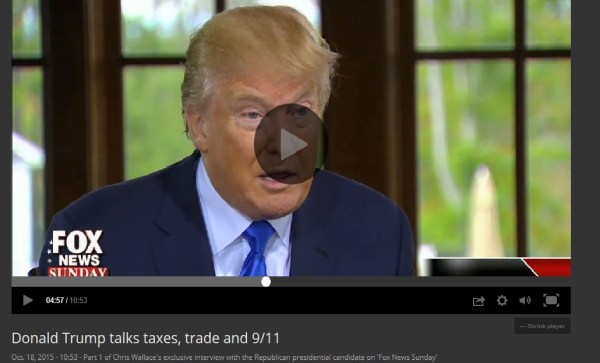
It wasn’t hard to predict. As I argued a few months back in the pages of Time Magazine, this round of GOP primaries would be full of threats to the Education Department. In a recent interview, front-runner Donald Trump made the usual accusations. But I wonder if there is another, more obvious reason why conservatives like to take potshots at the Ed Dept.

Don't trust anyone under 37...

Don’t trust anyone under 37…

In his recent interview with Chris Wallace, Trump made the usual conservative noises: The Ed Department is trying to replace local control of schools with control by “Washington bureaucrats.” Trump blasted competitor Jeb Bush as supporting the sinister Common Core. Trump’s solution? Get rid of the Education Department entirely. It is home to egregious “waste, fraud, and abuse.” [You can find Trump’s education comments starting just before the five-minute mark in the video clip.]

Since its birth, the Education Department has been the target of conservative ire. President Reagan wanted it gone. In the run-up to 2012, the Ed Dept was one of the targets Rick Perry could remember.

As I’ve argued in my recent book, things weren’t always this way. Attacking federal influence in education only became the default “conservative” position in the late 1930s or early 1940s. At that time, conservatives horrified by New Deal growth lambasted any exertion of federal influence. Before then, however, influential conservatives eagerly embraced the possibilities of federal control over education. Such control, conservative leaders in the 1920s insisted, could force new immigrants to become Anglicized and “Americanized” at a faster clip. Such control, conservatives hoped, could cram traditional values down the throats of leftist teachers nationwide.

Only after the New Deal equated federal power with progressive politics–in the minds of many conservative activists, at least–did “Big Education” come to be equated with “Left-wing Influence.”

I wonder, though, if there’s a simpler psychological reason why today’s conservatives hate the Ed Dept. The department is a novelty. As education nerds are well aware, the Ed Dept recently celebrated its thirty-sixth birthday.  36!  It was created only in 1979 by President Jimmy Carter.

So here’s my hunch: Conservatives have many reasons to promise to cut the Education Department. In The Donald’s case, he can use the Common Core to attack rival Jeb Bush. He can appeal to voters’ sense of distrust of “Washington bureaucrats.” He can make it look as if he has concrete plans to slim government and eliminate waste.

But he also can imagine a time without such a department. Indeed, neither he nor anyone else of a certain age needs to imagine it at all. The Education Department is so brand-spankin new that conservatives have no trouble concluding that we will get by just fine without it.

Why Didn’t They Talk about Schools?

There was plenty of talk. Senator Sanders admitted he was “sick and tired of hearing” about Secretary Clinton’s emails. Senator Webb jabbed Wall Street. Governor O’Malley championed the middle class. And Governor Chafee was also there. But nobody said anything about K-12 education. Why not?

There was some talk about higher education. Both Senator Sanders and Secretary Clinton insisted we need some way to relieve student debt loads, maybe with free college tuition. Governor O’Malley bragged about low tuition rates in his state.

But only Secretary Clinton mentioned early childhood education, saying offhand that every child needed it to live up to his or her “God-given potential.”

Seems odd. The Democratic Party, after all, is the party of both Head Start and Race To The Top. The Democrats’ Big Tent includes both “Test-Em-n-See” Arne Duncan and Curmudgucrat Peter Greene.

It seems in the high-stakes world of primary debates, these stark differences between leading Democratic voices would offer a chance for some lively back-and-forth on key issues. What should we do with the Common Core? How should teachers be evaluated? How do we know if a school is doing a good job?

We didn’t hear it.

Loudmouth education parvenu Campbell Brown calls it a conspiracy. The Democratic Party, she claims, is in the back pocket of the teachers’ unions. They don’t even dare RSVP to her debate invitation.

Peter Greene thinks the answer is even simpler: “when it comes to public education in this country, none of the candidates actually gives a shit.”

In The Atlantic, David Graham thought there was just nothing much to disagree about. “Overall,” Graham opined, “the Democratic candidates simply don’t have the same divisions that the Republicans one [sic] do.”

But none of those explanations makes sense. This sort of forum offers candidates a chance to grab attention. Clinton’s identification with the Obama administration makes her an easy target. Yet none of them took it.

Here in the Great State of New York, we’ve seen how protest candidates can and do win votes by blasting other Democrats. I’m stumped why none of these candidates—not even the fire-breathing Senator Sanders—took this opportunity to do so.

Here’s my hunch: In the fervent calculations of any serious presidential campaign, candidates must make careful bets about issues and positions. In the face of Mr. Greene’s assertion that the candidates don’t care, I think candidates will care about what they think voters will care about.

Why didn’t candidates make political hay about K-12 education? Because they thought it would not win them any votes. With their finely tuned political antennae, these leading candidates concluded that Democrats in general did not want to hear about it.

Compare that to the GOP, where every candidate is forced to pay lip service to creationism. Compare that to the GOP, where every candidate falls all over him- or herself to show off his or her penchant for “education reform.”

Leading Democrats, in contrast, don’t air their differences in public. Why not? I’m no cynic, but it seems obvious to me that all candidates have agreed implicitly that their differences will not give them a competitive advantage. In short, none of them is willing to bank on a groundswell of support for iconoclastic progressive educational notions.

Ignorance Unto Death

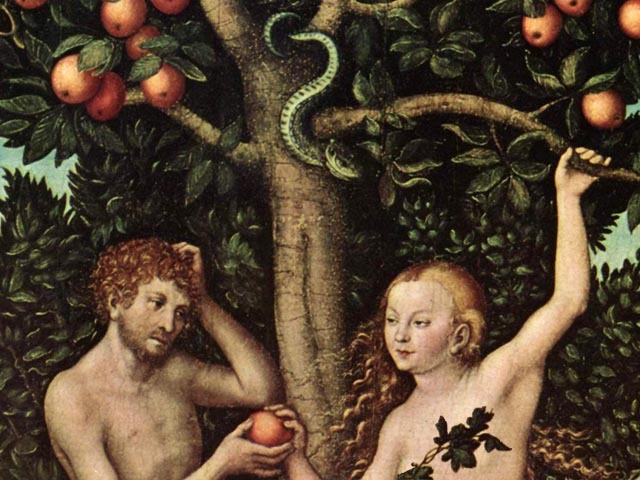
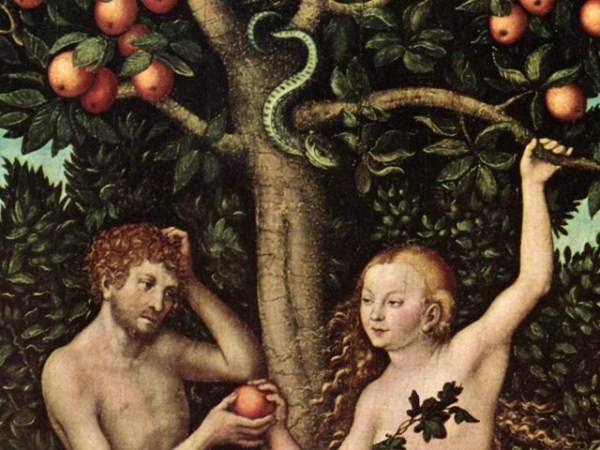
It is a dilemma at the heart of Christian faith: To know or to obey? The original sin of Adam & Eve, after all, was to become as gods by eating from the Tree of Knowledge of Good and Evil. This week, a state supreme court judge in Oregon faced the unenviable task of ruling whether faithful people knew by faith or by fact. Not surprisingly, she punted. Especially in schools and universities, questions of knowledge and faith will continue to bedevil us all. I’m arguing in upcoming books that religious people deserve considerable wiggle room when it comes to requiring knowledge about evolution or US history, but it’s not impossible for policy-makers to be bolder than they have been.
What did you know? And when did you know it?

What did you know? And when did you know it?

In the Oregon case, two parents from a strict religious sect were convicted in 2011 in the death of their infant son David. The boy had been born prematurely. The parents did not call for medical help but rather treated David at home. After nine hours, David died. Were the parents criminally liable for their faith-based failure to get medical help?

Oregon Supreme Court Justice Virginia Linder recently said yes. Sort of.

For our purposes, the most intriguing elements of this case are the tangled web of meanings in this case surrounding faith and knowledge. If the parents “knowingly” allowed their baby to suffer from treatable ailments, according to Oregon law, then they are criminally liable. But they hoped to force the state to prove that they “knew” it. They hoped to force the government to prove that they must know something that they refused to know.

Justice Linder did not decide the big question. Instead, she noted that the parents defended their actions with a different set of knowledge claims. The parents said they did not know the baby was sick. They said he appeared healthy until the very last minute. Doctors disagreed. They said any reasonable person could have discerned that the baby was in severe medical crisis.

In other words, the parents did not claim that they “knew” their faith could save the baby. They said instead that they didn’t “know” he was so very sick. The parents DID insist that the state had to prove that they “knowingly” refused care to their baby. As Linder summarized,

At trial, defendants argued that, because they withheld medical treatment from David based on their religious beliefs, the Oregon Constitution requires the state to prove that they acted “knowingly”—that is, they knew that David would die if they relied on prayer alone and, despite that knowledge, failed to seek medical treatment for him.

Justice Linder affirmed earlier court decisions that the parents were guilty of criminal neglect for their actions. The state, she ruled, did not have to prove that they “knew” of the harm they caused. But she did not decide if the parents must have known something they refused to know.

The complexity of the case shows yet again the durability of questions of knowledge and faith. Can the government insist that parents provide medical care for their children? In Oregon, yes. But can the government insist that parents “knew” their child needed medical care? That is a far more difficult question, and one that this ruling painstakingly sidesteps.

As SAGLRROILYBYGTH are well aware, nowhere do these questions of faith and knowledge clash more regularly and predictably than in the area of education. Can the government require that students “know” evolution? …that kids “know” how to prevent sexual transmitted infections? …that kids “know” how the first humans came to North America?   Also, how have private schools and universities attempted to shield young people from these sorts of knowledge?

Alas, secular progressive types like me cannot relax and claim that public schools should always promote knowledge over ignorance. After all, I agree that certain types of knowledge are not appropriate for certain groups of students. For example, we should teach all children about horrifying historical episodes, such as lynching in the USA or the Holocaust.   But we should not expose young children to gruesome images of charred corpses, sexually mutilated before being lynched. At least, I don’t think we should.

Such images are true. People should know about them. But I do not think seven-year-old children should be exposed to that sort of knowledge. I agree that schools should work to keep young children ignorant about such knowledge, even though I acknowledge that it is true and important.

The difference, in other words, is not that conservative religious people want to keep knowledge from children, while progressive secular folks want to give knowledge to children. The difference is only in what sorts of knowledge we want to shield students from, and how.

As I argue in a chapter in an upcoming book about ignorance and education, we can see these questions starkly exposed in the history of curriculum for private conservative evangelical schools. I looked at US History textbooks produced by Bob Jones University Press and A Beka Book. In each case, from the 1980s to the end of the twentieth century, publishers made claims about historical knowledge in each succeeding edition that were farther and farther afield from mainstream historical thinking.

Know this, not that.

Know this, not that.

In a later edition, for example, a history textbook from A Beka explained that humanity expanded around the globe after the fall of the Tower of Babel. Obviously, that is a very different explanation from what kids would read in a mainstream textbook. Publishers like A Beka hoped to shield students from mainstream knowledge about history by replacing it with an alternate body of knowledge. These textbooks do not simply try to create ignorance by blocking knowledge, but rather try to foster ignorance about a certain sort of knowledge by producing a convincing set of alternate knowledge.

When it comes to evolution, too, questions of knowledge and belief quickly become tangled and tricky. I’m arguing in an upcoming book with co-author Harvey Siegel that students in public schools must be required to “know” evolution. But too many public-school enthusiasts, we argue, have a cavalier attitude about this sort of knowledge. Yes, students must “know” and “understand” the claims of evolutionary theory. But if they choose not to believe them, that is their business.

Perhaps an easier way to make the distinction is to say that public-school students can be required to “know about” evolution. They must be able to explain it correctly. They must be able to describe accurately its main points. But if they think it would harm their religious beliefs to say they “know” that humans evolved via natural selection, then they have the right to insist that they only “know about” it.

It’s not an easy distinction. Nor was it easy for Justice Linder to decide what to say about the Oregon case. Do parents have the right to their religious beliefs? Yes. Can they not know something that everyone else knows? Yes, certainly. Do they have the right to insist on that relative ignorance if it causes palpable harm to others? Not in Oregon.

But this ruling does not decide if the parents in this case “knew” that their faith would save Baby David. It only states that parents do not have the right to insist that the government prove that they knew it.

HateMyProfessor.com

HT: JG

Can fundamentalist colleges trust their faculty? We see this week an unfortunate blow-up in the continuing saga of power struggles at Bryan College in Tennessee. Does this bitter squabble between president and faculty represent an inherent problem for conservative evangelical schools? The history of these colleges suggests something along those lines.

According to Chattanooga’s Times Free Press, Bryan President Stephen Livesay has doubled down on his fight for control. As we’ve documented in these pages, for the past few years the college has gone back and forth in its struggle, with faculty approving a no-confidence vote last spring, and members of the board resigning this past summer.

He said, he said, c. 1953

He said, he said, c. 1953

As SAGLRROILYBYGTH are sick of hearing, I’m up to my elbows in my new book about the twentieth-century history of conservative evangelical colleges. Time and again, administrators and trustees have demonstrated a deep distrust of their faculty.

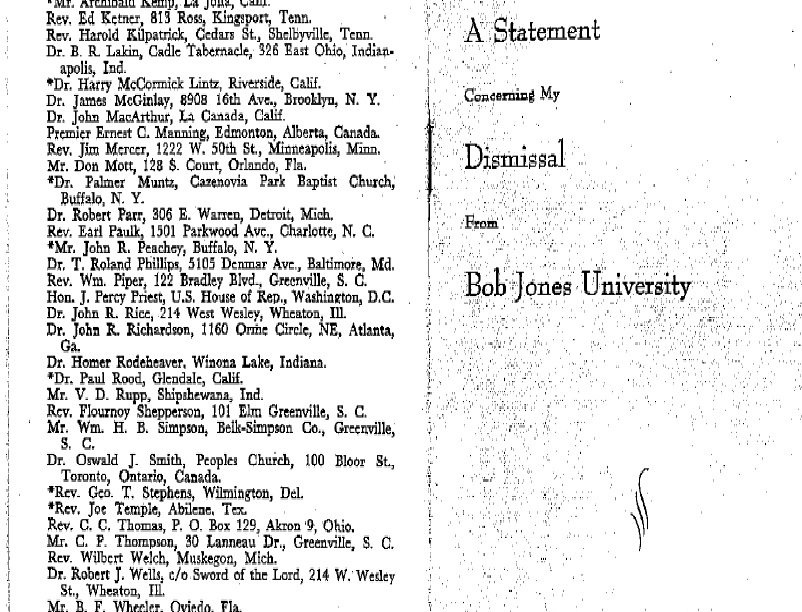
In the 1930s, for example, Bob Jones College purged a suspect group of teachers. One of the fired faculty, Joseph Free, penned a protest letter. He had previously worked at three different colleges, Free wrote,

two of them orthodox. (But not obnoxious.) My loyalty was never questioned. . . . It simply never occurred to me that I was not free to express my opinions and I did express them. How was I to know that loyalty meant dictatorship?

Perhaps more famously, this pattern was repeated at Bob Jones University in the 1950s. Ted Mercer was fired in the summer of 1953, accused of a host of crimes including planning a “revolt of many faculty members.” Mercer himself claimed to have been blindsided by his dismissal. Maybe he had become too popular with students and faculty. Perhaps Bob Jones Sr. was too zealous in his jealousy of other administrators. In any case, Mercer went on to a long career at Bryan College.

The abiding distrust of faculty at fundamentalist colleges has not been unique to Bryan and Bob Jones U. At Wheaton College as recently as 1961, faculty scientists were pressed into a needless and humiliating mea culpa. After a conference on evolution and creationism in 1960, anxious trustees forced Wheaton administrators to tighten the school’s official position on the origins of humanity. No longer would it suffice for faculty to agree that God created. Since 1961, they have had to affirm that Adam and Eve were real historical personages and the true parents of the species. Professor Russell Mixter had to affirm his orthodoxy over and over again in order to allay the fears of Wheaton’s guardians of orthodoxy.

Nor was Dr. Mixter’s ordeal out of the ordinary at Wheaton. As historian Michael S. Hamilton wrote in his brilliant 1994 study of Wheaton’s history, the board of trustees has always been distrustful of the faculty. In Hamilton’s words, trustees have believed “the faculty represented the single greatest danger to maintaining the college’s Christian character.”

As usual, Hamilton’s history proves prescient. According to the Times Free Press, new rules at Bryan College seem intended to crush any whisper of faculty independence. New rules restrict professors’ ability to call meetings, for example. As the TFP explains,

Under this new policy, a faculty member is required to go through a seven-step process that includes approval from the Academic Council, a written rationale stating the purpose of the meeting and a waiting period of at least a week.

This sort of contrived impotence may seem shocking to those unfamiliar with the unique traditions of fundamentalist higher education. Within that charmed circle, however, it seems like nothing more than a new take on an old tradition: When the going gets tough, the faculty get blamed.

Fundamentalist Colleges Save Lives

Maybe they were right. One of the hallmarks of conservative evangelical colleges has always been a clampdown on student behavior. The goal was to protect student morals, but a side benefit seems to have been protecting student health. A new study finds…surprise, surprise…that smoking pot and binge drinking lead to more risky sex among undergrads.

A hundred years ago, conservative evangelical Protestants reeled from the horror stories oozing out of America’s elite colleges. Fundamentalist preachers warned their flocks that colleges in the 1910s no longer protected students’ faith or morals. As a result, fundamentalists founded their own network of rigidly conservative schools. In addition to fundamentalist theology, all of these colleges adopted draconian rules for students: No smoking, no dancing, no drinking…and certainly no unmarried sex.

The view from 1931, Bob  Jones-style.

The view from 1931, Bob Jones-style.

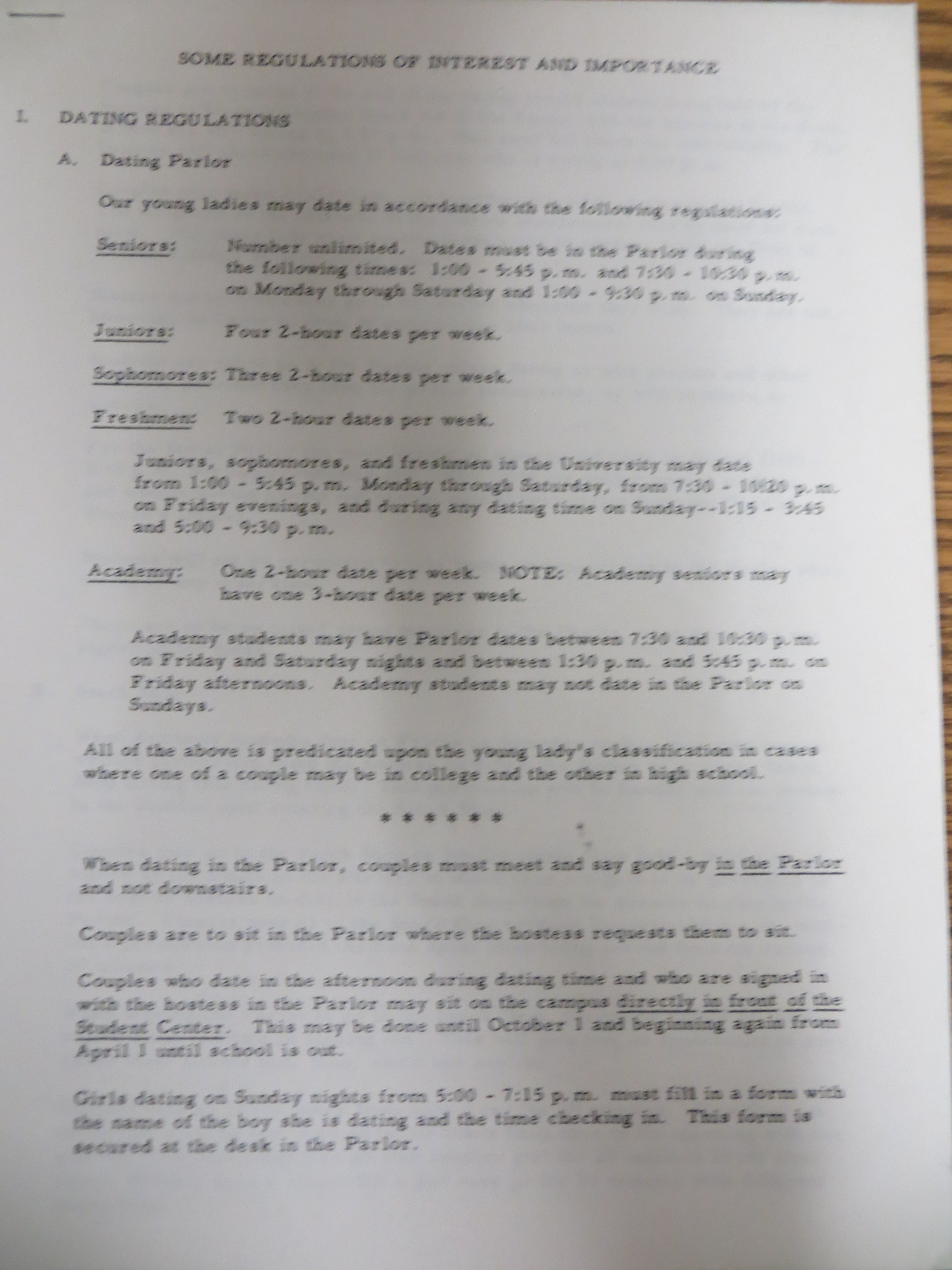
As I work on my new book about the history of these schools, I’m struggling to make sense of these ubiquitous student rules. It’s easy enough to find the paper trail in the archives. At Bob Jones College, for example, founder Bob Jones Sr. placed the burden of avoiding sex on women.

Jones explained his thinking in an open letter from the 1920s:

The Bob Jones College discourages extravagance in dress AND INSISTS UPON MODESTY.

We request our girls to wear simple dresses in classes. We have a laundry where these dresses can be laundered.

The girls in the Bob Jones College voted to wear their dresses two inches below the knee cap. This is short enough for style and long enough for decency.

The girls in the Bob Jones College last year had the reputation of being the most attractive group of girls in the country, and as a whole, they dressed very simply.

There is one regulation which we wish our girls to thoroughly understand. WE DO NOT ALLOW OUR GIRLS TO WEAR EACH OTHERS CLOTHES. The only exception is in the case of sisters.

Bob Jones College was not alone in the effort to control sex by controlling women. One student who attended Wheaton College in the 1920s remembered a similarly strict regime of sexual policing. “Well,” this former student remembered in a 1984 interview,

The control was rather tight. Of course, that was in those days when . . . when the separation of the sexes was very strict, and the . . . the regulations were . . . dress regulations and so forth were quite strict.

Did students find ways to get around these rules? Of course. It’s harder to find, but as I delve into the archives of these colleges I find examples of students being punished for drinking, smoking, attending movies, and, of course, hooking up. One student at Bob Jones College was caught climbing out of his girlfriend’s dorm window at midnight. He said they had been praying together. A student at Wheaton remembered his roommate speaking to his girlfriend through a system of prison wall-taps.

All in all, though, the draconian system of student rules meant a different campus experience than at non-fundamentalist colleges. Over the years, the rules have loosened up, but they remain more restrictive than at other schools.

What has been the result? On the one hand, the system of sexual policing seems to pushed sex on campus into dangerous and degrading directions. Bob Jones University, for example, admitted its terrible and terrifying record of ignoring and even tacitly encouraging sexual abuse and victimization.

But we can’t help but think that stricter rules against drugs and alcohol must do something to protect students, as well. Don’t get me wrong: I’m no apologist for evangelical universities. I’m not evangelical myself; I don’t work at an evangelical college; I don’t dream of a school in which students don’t use drugs or have sex.

However, there seems to be demonstrable evidence that drinking and using drugs leads to risky behaviors. The researchers at Oregon State found direct connections between smoking pot, binge drinking, and unhealthy sexual practices. Students who used more drugs on any given day were more likely to have sex without a condom, for example.

The stricter rules about drugs and sex at evangelical colleges were put in place to protect student morals, not their health. As I’ve argued before, if we want to understand conservative attitudes about sex, we need to shift out of the medical mindset. However, perhaps there has been a positive side-effect.

I would love to see a study like this in which researchers looked at student behavior at a variety of schools. Did school rules against booze and sex discourage risky behaviors? Or did the added illicitness simply push students to take more risks?

Bill Gates Pushes a Rope

Must be tough. All that money and doodly-squat to show for it.

Bill Gates gave a speech yesterday about his plans to fix American education. He has found the secret, he explained. It took him seven years and ba-jillions of dollars, but he has found it. Seems like he could have just spent a few hours and thirty bucks to discover why his big plans are still doomed to failure.

Gates isn’t alone. Other new-rich tech types have also crashed on the reefs of education reform. Most recently, Facebook’s Mark Zuckerberg frittered away $100 million in a good-hearted but wrong-headed attempt to help Newark’s public schools.

To be fair, Bill Gates has spent more time and effort (and moolah) than Zuckerberg in his attempts to improve America’s public schools. His foundation has funded a host of reform efforts.

What has he learned? As he put it yesterday,

We set out on this path seven years ago. If I had to place our foundation somewhere on our own learning line today—where the starting point is absolute ignorance and the end point is knowing everything about great teaching and how to spread it—I would say we’re not even halfway to our goal.

But I believe we are on the right track. For today, and for the coming years, this is our vision: Every student deserves high standards. Every student deserves an effective teacher. Every teacher deserves the tools and support to be phenomenal. And all students deserve the opportunity to learn in a way that is tailored to their needs, skills, and interests.

Gates’s current plan focuses on improving teachers. In his words:

Building effective teacher feedback and improvement systems everywhere is the most important movement in American education today.

Good teachers make a huge difference, he argues correctly. And good school districts do what it takes to make their teachers better.

So what is wrong with Gates’s strategy? It’s not a secret and it’s not a surprise. Mr. Gates could have spent a few hours with David Tyack’s and Larry Cuban’s book Tinkering Toward Utopia to figure out something that every veteran teacher knows already. And it would only have cost him thirty bucks.

Read these works, ye mighty, and despair...

Read these works, ye mighty, and despair…

To wit: Good teachers are hungry for help. They want reform that will help them do a better job at what they are already doing well. But ALL teachers are good at dodging fads and gimmicks. They have to be. Every experienced teacher has survived wave after wave of “the latest thing.” We have tall bookshelves stacked with chart-packed three-ring binders about how to implement each new reform.

Teachers know what to do. When someone offers them something that helps them do it, they jump on board. Smartboards, for example, or teaching teams, are one-time “reforms” that have now become standard operating practice in many public schools. Why? Because they work. They help teachers do a better job at their jobs.

As Tyack and Cuban document, however, history is littered with the Ozymandian dreams of earlier generations of Gateses and Zuckerbergs. At the advent of television in the 1950s, for example, the US government and the Ford Foundation plunked down tens of millions of dollars to have a plane always circling the Great Plains states, broadcasting the latest educational TV programming for schools. No kidding. The plan was to have the country’s smartest experts teaching kids directly. No more vagaries of teacher quality or school efficiency. This multi-million-dollar reform was going to use the latest technology to fix American public schools in one fell swoop.

Did it transform schools? No. Why not? Because good teachers struggled to find a way to incorporate that expensive “reform” into their teaching. For some reason too mysterious for the experts to divine, students in Kansas did not want to sit quietly while fuzzy black-and-white professors laboriously explained sentence structuring or osmosis.

Bill Gates is pushing a rope. Trying to fix America’s teachers from the outside is a losing proposition. The language itself generates its own defeat. Instead of fixing America’s teachers, Gates and other well-heeled know-it-alls should focus on HELPING America’s teachers.

Creation College Scorecard

How can you do it? How can outsiders push colleges to do more of what they want? The rage these days is to issue rankings. Since colleges are ferociously competitive and many of them are teetering on the brink of insolvency, college leaders are willing to do what it takes to move their colleges up any ranked list. Everyone from President Obama to young-earth impresario Ken Ham is issuing their own unique college scorecards.

Whom can a creationist trust?

Whom can a creationist trust?

In each case, influential outsiders promise that their scorecards offer students and parents a helping hand. President Obama, for example, insisted that his new scorecard was “meant to help students and parents identify which schools provide the biggest bang for your buck.” Ken Ham, too, promises that his Answers In Genesis ministry now has

resources to help young people (and their parents) with the upcoming college years. In addition to our annual College Expo weekend for students thinking about attending a Christian college (which will be here at the Creation Museum this November 6 and 7), we have just updated our special CreationColleges.org web site. It helps young people (and parents) narrow the overwhelming process of choosing a college even more.

These scorecards, though, do more than just provide information. They pressure schools to move in a certain direction. If college presidents want to move their schools up the list of rankings, they will make changes based on the scorecard’s values.

And college presidents DO want to move their schools up the rankings. Any rankings. Colleges and universities these days are locked in a death-struggle for students and tuition dollars. If they can’t attract ever-increasing numbers of applicants, they won’t survive.

President Obama wants schools to pay more attention to student finances. His recent scorecard compares schools based on their financial performance: How much do average graduates earn? How much debt to students accumulate?

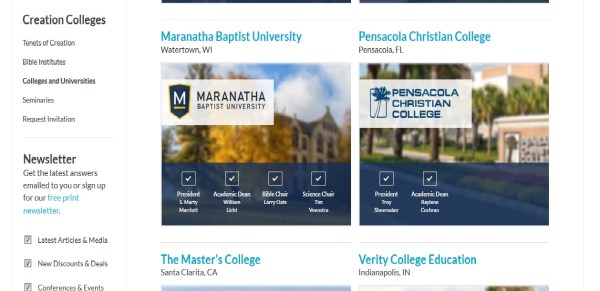
Ken Ham is playing the same game. His recently updated Creation College guide offers families information about the ways colleges measure up to Ham’s definition of creationist orthodoxy. Students can see if a school teaches young-earth creationism. They can also see if the president has agreed, and if other key leaders in the Bible and Science Departments have signed on.

Clearly, some conservative evangelical colleges will be tempted to do whatever it takes to get Mr. Ham’s stamp of approval. Some, like Bryan College, have already tightened their statements of faith and pushed out controversial teachers. Others will consider making similar moves.

Don’t like it?  Then why not try putting together a college scorecard of your own?  You could rank colleges based on whatever criteria you choose.  What are the most Benedict-Option-friendly colleges?  What are the most progressive colleges?  What colleges are the best for teaching evolutionary science?  Etc.!

Sneaking into the Top Ten

We made it!…just barely.

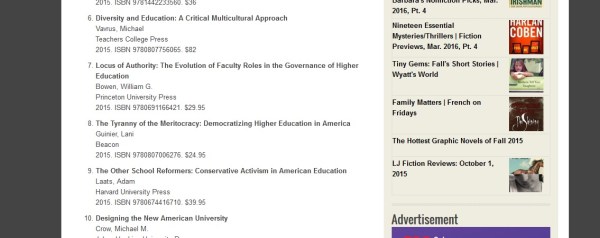
The Library Journal’s September top ten best-sellers list for education includes my new Other School Reformers, squeaking in at number nine.Library Journal top ten

Nice to hear. I don’t think I’ve made a “top ten” list since my freshman year of high school, when I came in at tenth for our nine-person lacrosse team.

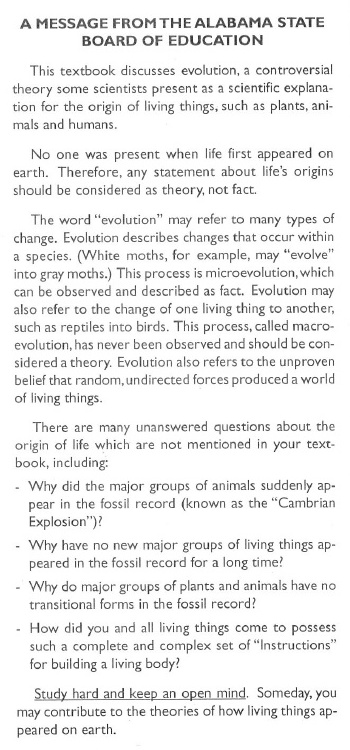
New Evolution Stickers for Alabama

What should they say instead?

Alabama’s famed textbook-warning stickers might be on their way out. The National Center for Science Education reported recently that new science standards in the “Heart of Dixie” make the old stickers outdated.

Watch out!  Learnin' ahead!

Watch out! Learnin’ ahead!

Alabama’s textbooks have carried the warning since the beginning of the twenty-first century. New standards, though, suggest that evolution will no longer be scientia non grata in the state.

So here’s a puzzler for the SAGLRROILYBYGTH: If the old stickers are out, what should new stickers say instead? Of course, smart-alecks will suggest that we leave science textbooks sticker-free. That is the smart answer, but it leaves us with nothing to talk about on a Tuesday.

So let’s make up new stickers. A few ground rules:

1.) The language has to be readable and straightforward. No jargon.

2.) Maximum 250 words.

As SAGLRROILYBYGTH are well aware, I’ve been working on a new evolution/creation book with my co-author Harvey Siegel.  For years now, we have wrestled with this big-picture question.  In short, we want science teachers to teach evolution and nothing but evolution in their public-school science classes.  But we need to help teachers, students, and families understand that learning evolution does not need to impinge on any sort of religious belief.

Our simple prescription: Students need to know about it.  They need to understand it.  But they do not need to believe it.  Students need to be able to explain intelligently what scientists think about evolution.  If they choose not to accept it, that is their business.  More than that: It is the public schools’ business to make sure students and families feel welcomed, whatever their religious beliefs.  It is the schools’ business to encourage students to be who they are.

With all that in mind, here’s my entry:

These textbooks include information about evolution. Evolution is our current best scientific understanding of the ways species came to be different from one another.

Science encourages you to be skeptical about evolution and every other idea. If you choose not to believe that evolution is the best explanation of the origin of species, you have every right to doubt it.

You need to know about evolution. You need to be able to explain how scientists think it worked. You do not have to agree with these scientists.

Okay, okay,…it’s a long way from perfect.  Can you do better?

…He’s Sitting over There

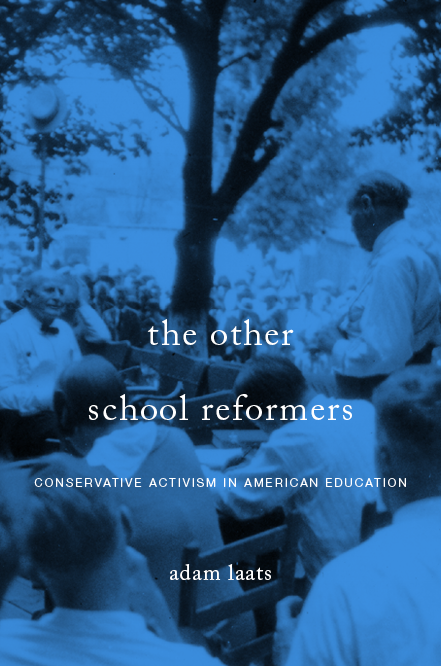
The reviews keep coming in! My German is more than a little rusty, but your humble editor noted this morning a new review of The Other School Reformers on the H-Soz-u-Cult page. Thanks to Lukas Boser Hofmann and the H-Soz-u-Cult list.

Does he like it? If my translation can be trusted, then yes indeed. He raises central questions and offers some helpful ideas.

With his Continental perspective, Boser points out a fair criticism. My book really does focus on the experience of American activists and traditions. As he suggests, we would all profit from comparative cross-national studies. As he asks, how have conservative ideas formed European educational policies? How have different nations struggled to determine the content of their curricula? Such comparisons would indeed offer a more comprehensive definition of what it has meant to be “conservative,” about education or any other issue.

I’m grateful for Boser’s claim that my book succeeds in giving conservatism and conservative activists a more accurate place in educational history. (At least, that’s my understanding of this section:

dem es den Konservativen einen Platz im grand narrative der US-amerikanischen Schulgeschichte einräumt. Dieses grand narrative wird von Laats durch die Verknüpfung der vier zeitlich und örtlich unabhängigen Einzelfallstudien und durch den Einbezug der Konservativen als wichtige Akteure ausgebaut und gestärkt und nicht etwa in Frage gestellt.

Maybe the SAGLRROILYBYGTH can offer a clearer translation. As I read it, though, Boser generously says that I’ve succeeded in incorporating conservatism into the “grand narrative” of American educational history. For me, after all, the primary motivation for the book was to find out why conservatives show up in so many educational histories as merely pesky gadflies, roadblocks in the inevitable progress of progressive education.  In my experience, at least, conservatives have played a much stronger leading role in shaping the course of American education.

At the end, Boser notes my sloppy style and predilection for puns (“seinen Hang zu Wortspielereien und Alliterationen – beispielsweise in den Kapitelüberschriften – und den manchmal etwas saloppen Stil.”) Ouch. In spite of such flaws, though, Boser concludes that my book is overall entertaining (“unterhaltsame”).

As SAGLRROILYBYGTH are aware, if I can’t be punny, I won’t bother. I wouldn’t like to be thought of as a sloppy writer, though.

In the end, I’m extremely gratified to hear that I managed to make a potentially dry and jargon-y book more pleasant to read, at least in Dr. Boser’s opinion.