Sex In, Kids Out

Toronto’s Thorncliffe Park Elementary School started its year half empty. Why? Parents were concerned that students would gain knowledge, so they pulled their kids out in protest.

Will Toronto parents trust the public school?

Will Toronto parents trust the public school?

It sounds weird when we say it that way, but it is true. In this case, parents worried that a new sex-ed curriculum imposed by the provincial government would expose kids to too much information, too early. In some ways, the story is a repeat of a familiar culture-war pattern. In others, it shows how things are changing.

First, the facts: Last spring, the Ontario government released its new health curriculum. Outraged parents organized to protest against the content. As one protesting parent put it last spring,

I want my kids to come home from school and play with toys, not their body parts. . . . Why are we introducing these concepts to kids who aren’t even old enough to tie their shoelaces?

As schools opened this fall, parents continued their protest, nearly emptying one elementary school and holding protest school meetings in a park across the street. An unknown protester spray-painted “Shame On You” on the school building.

In some ways, this protest is playing out the familiar culture-war script we saw throughout the twentieth century. As I argued in my last book, time and again conservative parents insisted on their right to decide what their kids should be taught about sex.

We also see a familiar fight over the terms of the debate. What is actually in the curriculum? Protesters in Toronto have distributed fliers warning that kids are encouraged to have sex, encouraged to masturbate and to exhibit their full anatomy to friends and strangers. Not so, reply the writers of the curriculum. In earlier protests, such as the school boycott in Kanawha County, West Virginia, in 1974-75, protesters distributed similar fliers making similarly inflated claims about the content of controversial textbooks.

Another familiar sight is the undercurrent of traditional pedagogy. Yes, the protesting parents are teaching their children in a park, but they are also imposing a traditional style of teaching. One volunteer teacher, for instance, expressed surprise that the seven- and eight-year-olds in her group had never been taught basic sentence structuring. Not only did she teach her makeshift class without any reference to sex, but she also imposed a more traditional style of teaching grammar.

But Toronto’s school-sex boycott is also different in some ways. Instead of the whitebread “100% American” protests of the twentieth century, this protest largely emanates from the Muslim community. Parents are defending their right to have a say about the curriculum. They are also insisting that school lessons must not conflict with their religious values. In this case, though, those religious values are not the implicit Protestantism that we see so often here in the United States. Rather, in this neighborhood of Toronto, the traditional values being defended are those of Islam.
Keep em innocent...?

Keep em innocent…?

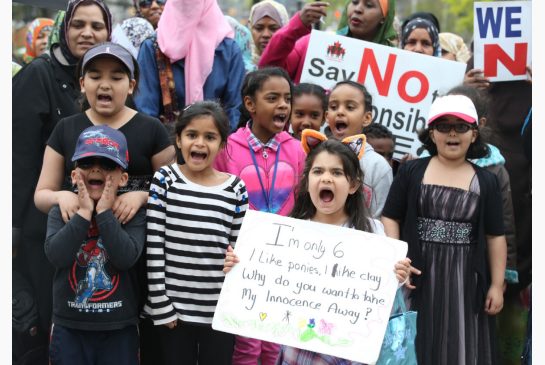
Perhaps most telling, this protest underlines one of the central truths of public schooling. Though it seems weird to say it, parents assume that schools must keep certain forms of knowledge away from their kids. In this case, parents do not say that the sex-ed curriculum is untrue. Rather, they only insist that it is too early for their kids to know such things, or that such knowledge conflicts with their religious values. As this widely circulated photo suggests, protesters want their kids to be kept “innocent” of some forms of knowledge.

What is school for? Not only to spread knowledge, but also to protect certain forms of ignorance.


Progressive Microaggressions

HT: DK

Are we progressive professors guilty of our own species of microaggression? Fredrik deBoer says yes.

DeBoer teaches at Purdue and blogs about culture and higher ed. In a recent post, deBoer worried that his progressive colleagues seem strangely willing to mock and belittle their conservative students. Not in the classroom. In spite of conservative laments about overt professorial hostility, deBoer claims that most left-leaning faculty “are so sensitive to the impression that they’re biased against their conservative students that they bend over backwards to accommodate them.”

But deBoer accuses his allies of a curious blind spot. They tend to mock conservative students on Facebook and other social-media outlets. DeBoer comes to the smart conclusion:

People are really, really invested in consistency and fairness. And if academics don’t make a huge improvement in projecting them, they will be the razor with which our throats are slit.

He’s referring to two particular recent episodes. At Duke, some conservative students protested against a leftist summer reading assignment. At North Carolina, a student accused the school of coddling terrorists.

As deBoer reports,

many academics I know have reflexively, unthinkingly laughed off these conservative complaints. They’ve bombarded social media with “lols” and “wtfs.” They’ve mocked these students as rubes. They’ve given every outward appearance of not even attempting to evaluate these students’ claims with the same care, sensitivity, and fairness that they evaluate the claims of progressive students invoking the language of trauma and triggers. In other words, they’ve rushed to confirm every complaint conservative critics of the academy have made, and the most damning one in particular: that we treat our progressive students with more kindness and approval than our conservative students, and that we use the formal procedures of the university to do it.

I wholeheartedly agree with Dr. DeBoer’s warnings, but I think he could take it one step farther. Not only do my fellow progressive academics tend to assume too much about their campuses and their social-media worlds, but they do so out of a woeful and widespread ignorance. Some of us assume that young people will somehow naturally sympathize with left-leaning ideas. We couldn’t be more wrong.

If the campaign against microaggressions has any moral heft, it is because it is at heart a campaign against ignorance. Yet as sociologists such as Elaine Howard Ecklund have argued, many scholars display shocking ignorance about their own students.

Even if we progressive professors are polite to our conservative students, are we guilty of microaggressions that only the students themselves notice? Do we betray our own ideals by failing to learn more about our students’ backgrounds? Are there things we don’t even notice about our classes that might make conservative students feel unwelcome?

Creationists and the New “Ape-Man”

Evolutionary science marches on, it seems. The possible discovery of another extinct human species might seem to deflate creationists’ intellectual bubble. How have creationists handled the news?

In the long history of the evolution/creation wars, creationists have always pointed to gaps in the fossil record as proof of evolution’s empty claims. And evolutionists have repeatedly found evidence of “ape-men,” which turned out to be hoaxes as often as not.

Will the REAL ape-man please stand up?

Will the REAL ape-man please stand up?

The latest discovery of a collection of hominin fossils in a cave in South Africa has brought this old argument to the surface again. These days, creationists are more prepared to handle these sorts of scientific revelations.

Some of the scientists involved have claimed that the bones belong to a previously unknown human species, homo naledi. They’re not sure how old they are, and they’re not sure how the bones got into this cave, but they’re confident the bones come from a new sort of old human.

For creationists who accept mainstream evolutionary science, the news is nothing but exciting. But for those who insist on a young earth and an instantaneous creation of modern humans by divine fiat, the existence of other ancient human species would seem to present a pickle.

At Answers In Genesis, the answer is simple: these bones are probably from some form of ape, and if they are from a type of human, then it was a type descended from Adam & Eve. At the Institute for Creation Research, there are fewer ifs. As ICR writer Frank Sherwin reported,

As always, we at the Institute for Creation Research are extremely skeptical, taking such breaking news stories with a little more than a grain of salt. We have found that with more time and research, the preliminary spectacular claims of alleged “human ancestors” dissolve into a footnote, a non-story. We predict, on the basis of the creation model, Homo naledi too will become just one more dead end in the questionable human evolution parade. In fact, the story itself is rife with caution, unanswered questions, and speculation.

For those of us outside the world of creationism looking in, these sorts of distinctions are a source of continuous puzzlement. Why are Neanderthals okay, but more than two human ancestors not? How can young-earth creationists allow for Homo Naledi, but not make room for a necessarily diverse genetic background for our species?

Doctor Carson, I Presume?

Conservatives love Ben Carson! But they don’t seem to know one of the most important things about him. At least judging from the utterly unscientific evidence on hand at this humble blog, it looks like people want to know more about Dr. Carson’s peculiar religion.

SAGLRROILYBYGTH are well aware that we’ve spent our share of time discussing Carson’s ideas and background. As a devout Seventh-day Adventist, Carson has publicly and explicitly supported his denomination’s firm and fairly extreme creationist doctrines.

Unlike most other conservative Protestant denominations, SDA believers have a good reason to believe in a literal six-day creation within the past 8,000 years ago or so. Their founding prophet, Ellen G. White, saw it herself.

Today in the ILYBYGTH newsroom, we got some evidence that suggests people are curious about Dr. Carson’s religion. In this screenshot captured early this morning, we can see a number of people came to these pages searching for news about Carson’s denomination. Is he a Seventh day “aventist?” What religion is he? What church does he attend?

Who is this Carson fellow, anyway?

Who is this Carson fellow, anyway?

Conservatives love him, but it seems some of them want to know more. Would it be a turn-off for some voters if they knew about Carson’s denomination? Historically, as I argued in my first book, some conservative evangelical Protestants viewed Seventh-day Adventism as a dangerous and deceptive cult.

Things have changed, for sure. I wonder, though, if news of Carson’s denomination would hurt his chances with some conservative Christians.

Conservatives against Kim Davis

Which side are you on?

That’s the question that fuels most of our culture-war animosity. Instead, the question we should all be asking is this: What’s the right thing to do? In the case of same-sex refusenik Kim Davis, some conservative intellectuals and pundits are willing to break ranks and see the bigger picture.

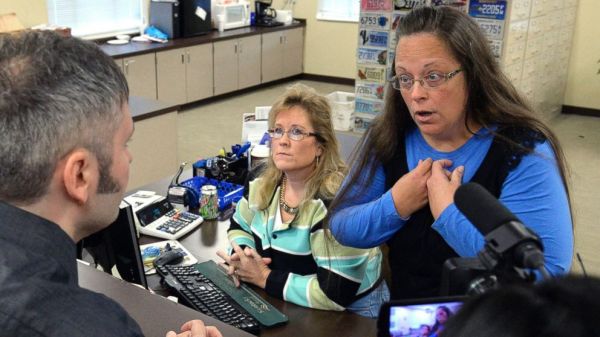
In case you’ve been milking the last warm days of summer and haven’t seen this story, Kim Davis is the Kentucky county clerk who has been jailed and released for her refusal to issue same-sex marriage certificates. Opportunistic conservative politicians such as Mike Huckabee have promoted Davis as a conservative Christian hero, stage-managing Davis’s release as an American triumph, equal parts Christianity Triumphant and Rocky III.

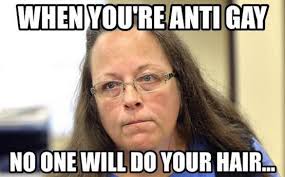
Governor Huckabee’s shameful pandering to frustrated Christian voters should be an embarrassment for every conservative out there. But progressives also could stay a little classier in this case. For those like me on the progressive side of things, the furor and venom over the Kim Davis case burst onto our Facebook feeds like a sweaty middle-school pimple. I don’t agree with Davis’s refusal to do her job, but I also think it is counter-productive and petty to attack Davis’s hairstyle.

Missing the point...

Missing the point…

We could all learn a lesson from a few conservatives who refuse to conform to their culture-war scripts. Fox News anchor Shep Smith, for example, earned the ire of conservative viewers for pointing out the obvious hypocrisy in the case. Critiquing the Huckabee rally, Smith commented,

They set this up as a religious play again. This is the same crowd that says, ‘We don’t want Sharia law, don’t let them tell us what to do, keep their religion out of our lives and out of our government.’

Predictably, conservative Fox News viewers reacted furiously, calling Smith a “puke” and accusing him of “anti-Christian bias.”

But Smith was not alone. Conservative intellectuals also took issue with Davis’s brand of publicity-hogging culture-warriorism. Writing in the pages of The American Conservative, crunchy conservative Rod Dreher warned that Davis had ignored the central point of civil disobedience. Dreher argues,

It’s clear that there are many Christians who support Kim Davis because she’s doing something, even if that something is arguably counterproductive. This is unwise. . . . If the public comes to think of religious liberty as the constitutionally guaranteed right to ignore the Constitution whenever it suits us, the cause of religious liberty — which is guaranteed by the First Amendment — is going to suffer tremendously. Conservatives are supposed to understand the difference between the vice of cowardice and the virtue of prudence. If religious liberty means that even officers of the state can defy the law without consequence, then it makes every individual a potential tyrant.

Writing from the conservative bastion of the Southern Baptist Convention, Russell Moore and Andrew T. Walker made a similar point. While Moore and Walker bemoaned the “judicial overstep” and “government inaction” that led to this situation, they did not excuse Davis’s reckless behavior. “We must recognize,” they note,

the crucial difference between the religious liberty claims of private citizens and government officials. Let us be clear: Government employees are entitled to religious liberty, but religious liberty is never an absolute claim, especially when it comes to discharging duties that the office in question requires. While government employees don’t lose their constitutional protection simply because they work for the government, an individual whose office requires them to uphold or execute the law is a separate matter than the private citizen whose conscience is infringed upon as a result of the law. It means the balancing test is different when it comes to government officials because of their roles as agents of the state. Government officials have a responsibility to carry out the law. When an official can no longer execute the laws in question due to an assault on conscience, and after all accommodating measures have been exhausted, he or she could work for change as a private citizen, engaging the democratic process in hopes of changing the questionable law.

We must be very clear about the distinctions here between persons acting as an agent of the state and persons being coerced by the state in their private lives. If the definition becomes so murky that we cannot differentiate between the freedom to exercise one’s religion and the responsibility of agents of the state to carry out the law, religious liberty itself will be imperiled.

For these brave conservative commentators, agreement with Davis’s opinion of same-sex marriage did not mean an automatic endorsement of Davis’s actions. All of us could learn from their example.

Those of us who consider ourselves progressives should commit to examine every case with the same gimlet eye. Just because we agree with someone’s position in general does not mean we must agree with their actions in every case.

Conservatives should be reminded to differentiate between today’s headlines and the big picture. Civil disobedience is a right and duty of us all, at times. But not every act of civil disobedience is equal, and civil disobedience has never meant simply flouting the laws we don’t like.

More important, we must all be willing to speak up against our own “side” when it is in the wrong. The first question should not be “Which side are you on?” but always “What is the right thing to do?”

Obama-Core?  More like Conserva-Core!

Who’s to blame?  In this year’s ferocious presidential debates, GOP candidates are falling all over themselves to point fingers about the Common Core State Standards.  Jeb Bush, who still supports the standards, has come under withering attack from folks such as Mike Huckabee, who used to.  A new report from the liberal-leaning Brookings Institution lays out the real history of the standards.  It’s true: If we have to assign praise or blame for these standards, we should be looking to the right.

Report author David Whitman does a nice job of detailing the story back to the 1980s. Still, I can’t help but be miffed when he says that this is a “surprising” story, one that “few are familiar with, and even fewer have written about.”  Of course, as SAGLRROILYBYGTH are well aware, your humble editor has been trumpeting this history in these pages and in venues such as Time Magazine.

Conservative intellectuals, too, have done what they can to draw attention to this history.  In the pages of The Weekly Standard, for instance, free-market maven Michael Petrilli has told the story to anyone who will listen.

Such complaints aside, however, Whitman’s report is still worth reading.  He details the history of the Common Core standards themselves.  As he describes correctly, in the 1980s the drive for “high standards” was a leading conservative issue.  As Ronald Reagan’s second Secretary of Education, William J. Bennett pushed hard to make these standards a reality.

In the 1990s, Lamar Alexander continued the conservative push for more rigorous state standards.  Alexander never envisioned increasing federal control of local education.  Rather, he saw these standards as an appropriate way that the federal government could provide help to state governments as they hammered out their education policies.

Whitman also argues convincingly that conservative opposition to the standards is really about something else.  The standards themselves are fairly popular when they are not called “Common Core.”  Whitman blasts conservative politicians for using “the big lie technique” to smear the standards, to create misinformation among the public.  As Whitman cites, many Americans think the standards force children to learn about sex and evolution, when they really don’t.

Make no mistake about it: Whitman’s report is a partisan attack on conservative opposition to the Common Core.  And the SAGLRROILYBYGTH know that I generally don’t go for knee-jerk partisanship.  In this case, however, Whitman has his historical facts straight.

The Common Core was meant to be a conservative initiative.  It was meant to push schools toward more rigorous learning, away from touchy-feely progressive nostrums and toward ol-fashioned book learnin.

Whitman’s liberal glee at pointing out this irony is overdone at times, but his argument is still solid.  The Common Core represents an historic win for educational conservatives.  Why won’t they admit it?  Why do conservatives love to lose when it comes to education policy?

The Missionary Imposition in Our Public Schools

They’re out there. In spite of decades of talk about “Godless” public schools, there are plenty of Christian teachers who see their work as a missionary endeavor. That ain’t right, but conservative Christians aren’t the only ones to use public schools to spread religious ideas.

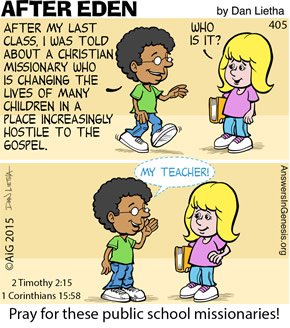
As a new cartoon from young-earth creationism ministry Answers In Genesis makes clear, lots of conservative Christians like the idea that public-school teachers will do their best to preach the Gospel as part of their jobs.

Heroic missionaries in our public schools?

Heroic missionaries in our public schools?

The creationists at AIG are certainly not alone in their celebration of public-school missionary work. At the conservative Christian Pacific Justice Institute, for example, Brad and Susanne Dacus encourage teachers to evangelize on the job. As Marc Fey of Focus on the Family writes about their work, it will help teachers spread the Gospel in “one of the greatest mission fields in our country today, our public schools.”

This sort of missionary vision for America’s public schools has a long history. Going back to the 1940s, groups such as Youth For Christ worked to get old-time religion into modern public schools. Beginning in 1945, as the idea of the “teenager” took on new cultural clout, YFC founder Torrey Johnson hoped to make YFC a group that would speak in the language of the new teen culture. As he explained to YFC missionaries, young people in the 1940s were

sick and tired of all this ‘boogie-woogie’ that has been going on, and all this ‘jitterbugging’—they want something that is REAL!

As early as 1949, YFC leaders such as Bob Cook argued that “high school Bible club work [was] the next great gospel frontier.” As he put it, YFC must aggressively evangelize among secular public high school students, since “atomic warfare will most certainly finish off millions of these youngsters before routine evangelism gets around to them.” By 1960, YFC claimed to have formed 3,600 school-based Bible clubs in the United States and Canada.

By 1962, these ad-hoc Bible clubs had been organized into a YFC program known as “Campus Life.” Campus Life included two main components, outreach to non-evangelical students and ministry to evangelical students.

In order to engage in this public school evangelism, national YFC leaders told local activists they must “invade the world where non-Christian kids are.” As an operations manual for Campus Life leaders warned its readers, their first entry into that hostile territory could be frightening. It described common feelings among YFC evangelists on their first approach to a public high school:

There it looms—a huge, humming, hostile high school. Hundreds, thousands of students, a professional corps of teachers and administrators, all busily turning the wheels of secular education.

To you, it’s a mission field. It has masses of kids who need spiritual help, even though most of them don’t know it. You and the Lord have decided to invade that field through the strategy called Campus Life.

This missionary attitude about public schools has also had a long and checkered history among creationists. Writing in 1991, for example, Henry Morris of the Institute for Creation Research called public schools “the most strategically important mission field in the world.”

As have other conservative Christians and creationists, the ICR repeatedly described public schools as unfairly biased against Christianity. As Henry Morris’s son and intellectual heir John D. Morris put it, “today’s public high schools and state universities are confrontational to the creationist student.” Aggressively secular teachers, John Morris warned, “take it upon themselves to ridicule Christianity and belittle and intimidate creationist students.”

Throughout the 1980s, ICR writers described the double impact of their missionary work in public schools. First, it would protect creationist kids from secularist hostility. Second, it could bring the Gospel message of creationism to students who would not hear it elsewhere. Missionary teachers had a unique opportunity. In 1989, one ICR writer explained it this way: “As a teacher,” he wrote, “you are a unique minister of ‘light.’ Your work will ‘salt’ the education process.” Similarly, in 1990 John Morris argued that the greatest hope for a decrepit and dangerous public school system lay with “Christian teachers who consider their jobs a mission field and a Christian calling.”

Every once in a while, you’ll hear young-earth creationist activists insist that they do not want to push creationism into public schools. But they certainly do want to make room for creationism. They hope to use public schools as a “mission field” to spread their Gospel.

They shouldn’t. But before we get too angry about it, we need to reflect on what this really means for our creation/evolution debates.

To folks like me, the most important value of public education is that it is welcoming to all students and families. It should not push religious values upon its students. It should not even imply that one sort of belief is proper and others are not.

As my co-author Harvey Siegel and I argue in our upcoming book (available in February!), the goal of science education must not be to indoctrinate children into any sort of belief about human origins.

Modern evolutionary science is currently our best scientific explanation of the history of human life. Therefore, we need to teach it in science class, unadulterated with creationist notions of design or supernatural intervention.

But too often, the implied goal is to free students from the shackles of their outdated religious ideas. Too often, the goal of evolution education is to change student belief about natural and supernatural phenomena. Progressive teachers like me sometimes slide into an aggressive ambition to help students see the world as it really is.

We shouldn’t. Not if students have religious reasons for believing otherwise. As I’ve argued at more length in the pages of Reports of the National Center for Science Education, too often evolution educators make the same mistaken “Missionary Supposition” that has tarnished conservative Christianity.

Are creationists in the wrong when they use public schools as a “mission field?” Definitely.

But they are not wrong because their religion is wrong.

They are wrong because public schools by definition must remain aggressively pluralist. They must welcome people of all religious faiths, and of none. In order for evolution education to move forward, we must all remember that public schools can’t promote any particular idea about religion, even the religious idea that young-earth creationism is silly.

The Kids Aren’t Alright…with Transgender

My Fellow Progressives: What if time isn’t on our side? We tend to think that each new generation will get cooler, more tolerant, more progressive. But what about those stubborn conservative kids who consistently disprove our assumptions? A new student protest in Missouri shows once again that young people are not somehow automatically progressive.

Who is the future here?

Who is the future here?

Academic historians learnt this lesson the hard way. Beginning in the 1930s, liberal academics assumed that the fundamentalists of the 1920s had melted away in the glare of modernity. In their liberal imaginations, historians such as Norman Furniss explained that fundamentalism had died away, a vestige of an older, stupider time.

For many liberal historians, the fact that they no longer saw fundamentalists on their campuses or in the headlines of their newspapers proved their case. It backed up their assumptions that the modern world would squeeze out people who embraced a decidedly old-fashioned way of reading the Bible.

Of course, fundamentalists hadn’t died away after the 1920s. Beginning in the later 1950s, evangelists such as Billy Graham brought the fundamentalist tradition back to America’s headlines and center stage. It took a new generation of historians, many of them raised in fundamentalist families, to explain what had happened. Writers such as Ernest Sandeen, George Marsden, and Joel Carpenter demonstrated the continuing strength and vitality of American fundamentalism.

Protestant fundamentalism, these historians showed, was a thoroughly modern phenomenon. In the face of progressive assumptions that people would naturally become more secular and more morally sophisticated, lots of Americans actually became more religious and more firmly moored in Biblical morality.

Progressives today share a similar short-sighted demographic hangover. Many of us, even those of us too young to have lived through the social movements of the 1960s, remember the vibe of youth power. As Andrew Hartman has argued so eloquently in his new book, the ideas of the 1960s fueled much of the later culture war vitriol. In the face of much evidence to the contrary, it was often assumed by 1960s culture warriors (and their successors) that youth was somehow naturally progressive.

Not your father's GOP...

Not your father’s GOP…

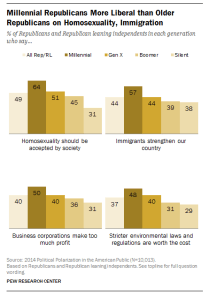
To be fair, my fellow progressives aren’t entirely wrong. We tend to assume that young people will be less anti-gay, less racist, less conservative, and we can point to good poll data to back it up. As Pew reported last year,

in addition to the [Millennial] generation’s Democratic tendency, Millennials who identify with the GOP are also less conservative than Republicans in other generations: Among the roughly one-third of Millennials who affiliate with or lean Republican, just 31% have a mix of political values that are right-of-center, while about half (51%) take a mix of liberal and conservative positions and 18% have consistently or mostly liberal views. Among all Republicans and Republican leaners, 53% have conservative views; in the two oldest generations, Silents and Boomers, about two-thirds are consistently or mostly conservative.

But there’s a big problem embedded in these kids of poll data. Though many young people tend toward more liberal views, there are still enormous percentages of people who buck the trend. The recent protest in Missouri can illustrate the ways young people can and will embrace socially conservative ideas.

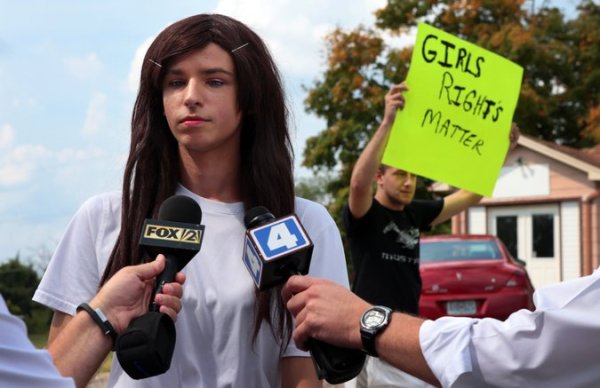
In that case, a transgender high-school senior, Lila Perry, had been allowed to use the girls’ bathroom. Students walked out in protest. The students and their parents, supported by outside groups such as the Alliance Defending Freedom, tend to consider Lila to be still male, in spite of her identification as female. As one activist parent put it, his daughters encountered an “intact male” in the locker room.

In spite of what we might expect, we don’t see in this case progressive young people fighting against the bureaucracy. Instead, the bureaucracy in this case moved quickly to establish a policy protecting the rights of transgender students. In reply, conservative students insisted on the rights of “real” girls to be protected from such students.

If history is any guide, as more young people become progressive, the conservative holdouts will become more firmly attached to their conservative principles. Conservative young people will become more likely to take action. Protests like the one at Hillsboro High School will become more common.

Teachers, Tests, and Gay Marriage

Quick: What do high-stakes tests have to do with gay marriage? Michael Petrilli argues that teachers who discourage students from taking the tests are like government officials who refuse to issue same-sex marriage certificates. Whether you like his argument or not, Petrilli is drawing on a long but ambivalent American tradition.

By now you’ve heard of Kim Davis. She is the county clerk of Rowan County, Kentucky. She has attracted national attention with her refusal to issue marriage licenses to same-sex couples.

Heroically flouting the Constitution?

Heroically flouting the Constitution?

Petrilli, in many ways the leading public voice of market conservatism in education, implies that progressives might not want to be so quick to condemn Davis’s pugnacious policy. After all, Petrilli writes, many progressive teachers these days encourage parents to opt-out of high-stakes tests. Are those teachers similar to Davis? Petrilli asks,

Here the question isn’t whether parents have a right to excuse their children from taking the state assessment. (They almost certainly do.) The issue is whether educators can face sanctions for encouraging parents to engage in an act of civil disobedience. Is that akin to refusing to give the test (which surely is reason for dismissal)? What if they merely inform parents of their rights?

As I argued in my recent book, this argument about the role of teachers has long roots. When it comes to educational culture wars, the winds have blown both ways. When conservatives felt that school law enforced their side, they insisted teachers must obey. When they felt otherwise, they lauded brave teachers who resisted.

Back in the 1920s, for example, William Jennings Bryan knew he had popular opinion on his side. He refused to allow teachers to teach evolution against the wishes of their local communities. As Jennings famously argued back then, “The hand that writes the paycheck rules the school.”

Similarly, when left-leaning teachers from the 1930s through the 1950s were thought to be too friendly to communism, conservative activists insisted on teacher obedience. In 1950s Pasadena, for instance, conservative leader Louise Padelford blasted progressive teachers who sought to drill suggestible students in the need for “social change,” rather than simply teaching “reading, writing, spelling, grammar, arithmetic, history, etc.”

When the shoe is on the other foot, of course, conservatives have praised teachers for bravely resisting the dictates of educational higher-ups. Writing from the Pacific Justice Institute, for instance, Brad and Susanne Dacus have offered teachers a handy guide for safely and legally evangelizing in public schools. Too many teachers, the Dacuses warn, cower before the seemingly invincible might of secularism. “Would you be willing,” they ask,

to take a stand for the sake of the young, innocent children who are bombarded by a pro-homosexual agenda? As a parent, would you be willing to stand up for your child’s right to express his religious views? Many are timid about standing by the Word of God when it has the potential to create a ruckus. Reading through the Gospels reminds us that Christ was not afraid to make a ruckus in the name of truth. The New Testament, especially the book of Acts, focuses on the apostles’ goal to take a stand for the Gospel, regardless of the circumstances. We are not alone in this challenge. Be reminded of the verse in Joshua, which says,

“Be strong and courageous. Do not be afraid or terrified; do not be discouraged, for the Lord your God will be with you, wherever you go.”

To be fair, Petrilli will have none of this argument. He specifically notes, for instance, that public-school science teachers have a responsibility to teach evolution—and only evolution—as science. If they don’t like it, they can resign.

Petrilli’s argument, like those of other conservative activists going back a hundred years, relies on the fact that we Americans aren’t quite sure of what we want teachers to do.

Do we expect teachers to be brave rule-flouters, a la Dead Poets Society?

Or instead to we insist that teachers embody “the rules,” a la Principal Skinner?

The correct answer, of course, is “Yes.” We Americans expect the impossible of our teachers. We count on them to be both daring iconoclasts and sober rule-followers. We depend on them to encourage students to wonder and to inhibit students from wiggling.

So is Michael Petrilli right? Are dissenting teachers like dissenting county clerks? Only half. In the American tradition, teachers do indeed have to embody the rules and respect for the rules. But teachers also have to embody the right moral decisions, even when those decisions go against the rules.

Why Do People Go to College?

Do young people go to college to become better people? Or to earn more money? The obvious answer, it seems, is “Yes.” A new poll from Clark University suggests that most young college graduates went to school for both economic and mind-expanding reasons.

What do you wanna do with your life?

What do you wanna do with your life?

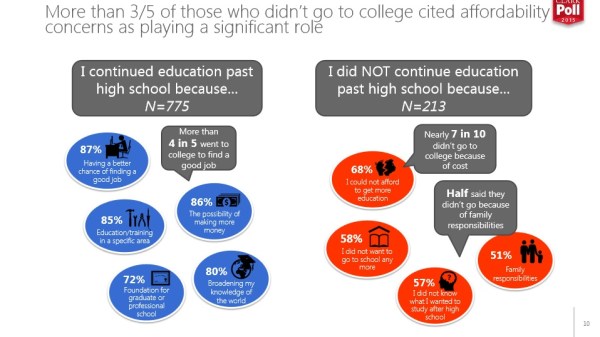
Jeffrey Jensen Arnett and his colleagues at the storied Clark University polled 1,000 adults between the ages of 21-29. The results confirmed the argument of historian Roger Geiger, who concluded that attending college has always been about “knowledge, careers, and culture.”

Large majorities of respondents wanted a better economic future. But they also wanted to increase their “knowledge of the world.” And, of course, many of the bolder respondents admitted that they were attracted by “the potential to have fun.”

Polls like this provide yet more evidence that the death of the humanities has been greatly exaggerated. As smart people have pointed out, people still go to college for more than pecuniary reasons. Young people still want to have their minds blown. College students certainly hope their degree will help them make more money, but that’s not the only reason they go to college.