Who Cares about Adam?

I don’t get it. Even after all these years studying conservative Christianity and creationism, I still don’t really get it. I mean, I understand the logic and history, but I have a hard time making sense of the ferocious emotion that goes into debates over the existence of an historical Adam & Eve. An author interview in Christianity Today outlines some of the tricky questions involved.
Who cares?

Who cares?

But first, a primer for those like me on the outside looking in: The debate over the historicity of Adam & Eve has a long history in conservative evangelical Protestantism. For us outsiders, making sense of this issue will go a long way toward helping us understand the theological underpinnings for young-earth creationist belief. Without making sense of this theology, it can be easy for mainstream scientists and observers to conclude mistakenly that young-earth creationism is nothing but some kind of cult of personality, a quirk of history.

At least since the 1960s (of course it is an ancient belief, but in 1960 it gained popularity among conservative American evangelicals as a vital theological notion central to orthodox belief), conservative evangelicals have insisted that the obvious meaning of Genesis is that God created two first humans in the Garden of Eden. These two, Adam & Eve, became the progenitors of the entire human race. Theologically, creationists have insisted, our belief in an historical Adam & Eve underpins our trust in the Bible. As Simon Turpin of young-earth ministry Answers In Genesis expressed it,

The debate over whether Adam was historical is ultimately a debate over whether we trust what the Scriptures clearly teach. If we cannot be certain of the beginning, then why would we be certain about what the Scriptures teach elsewhere? The uncertainty of truth is rampant in our culture partly due to the influence of post-modernism which is why many believe the issue over Adam’s historicity is unimportant.

For many creationists, believing the plain truth of the creation story in Genesis means believing in the trustworthiness of Jesus Christ. As Andrew Snelling of the Institute for Creation Research explained,

It is impossible to reject the historicity of the book of Genesis without repudiating the authority of the entire Bible. If Genesis is not true, then neither are the testimonies of those prophets and apostles who believed it was true.

Of course, for mainstream scientists, the notion that human genetic diversity came from only two original humans does not fit the evidence. In order to have today’s genomic sequence, I’m told, humanity must have begun with thousands of original humans.

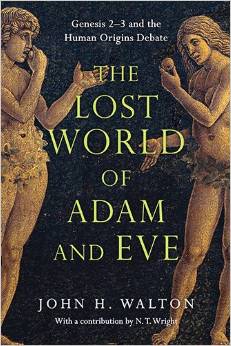
John Walton of Wheaton College explains to Christianity Today why evangelicals can accept this science while still remaining true to a conservative reading of Scripture. In his new book, The Lost World of Adam & Eve, Walton argues that Adam & Eve can be read as the “priests” of early humanity, not the only two first humans.

Again, for those of us outside of conservative evangelicalism, the controversial nature of such claims can be hard to figure. Recently, theologian Peter Enns was booted from Westminster Theological Seminary for advocating similar ideas. Walton explains in this interview why it is possible to respect the authority of the Bible while still reading Genesis in a way that is not contrary to modern science. Walton insists that

You can affirm a historical Adam, but that doesn’t have quite the implications for biological human origins that are often assumed.

The key, Walton argues, lies in reading Genesis as the original readers would have. To them, Walton says, creation would be more about how the world of Adam & Eve was “ordered,” not just how it was “manufactured.” We can understand Adam as both a real person, a real creation, and as an “archetype” for humanity. Though there may have been other early humans, Walton explains, Adam & Eve served as the ones in God’s sacred space.

Why do such ideas matter? Again, for folks like me trying to understand conservative Protestantism from the outside, it can be difficult to make sense of the ferociously controversial nature of such arguments.

Yet they are at the heart of conservative evangelical Protestantism. As I argued in my 1920s book, conservative evangelicals have never agreed on the proper relationship of Genesis to either modernist theology or science. From J. Gresham Machen in the 1920s to Harold Lindsell in the 1970s, conservative intellectuals battled to affirm the notion that any compromise is deadly to faith.

And as I’m finding in my current research, these battles have long sent shock waves through the world of conservative higher education. Recently, Bryan College has firmed up its insistence that faculty members affirm their belief in an historical Adam & Eve. In 1961, Wheaton College did the same thing.

And fundamentalists are not the only ones who will spring to repudiate theories like Walton’s. Leading atheist pundits, too, agree that Genesis requires an historical Adam & Eve. Jerry Coyne, for example, laments the apologism of folks like Walton. Of course, Coyne does not want people to reject mainstream science in favor of a belief in an historical Adam. Rather, he hopes people will simply accept the obvious conclusion that the Bible is a book of myths.

If all of these whirling debates make your head hurt, join the club. For those of us outside the circle of evangelical Protestantism, it can be very difficult to understand the ferocious feelings at play in the Adam debate. But that ferocity lies at the heart of evangelical belief. Historically, any attempt to rationalize our reading of the Bible, any attempt to explain away the most obvious interpretation of Scripture in favor of one that accords with modern science, any effort to bring our faith into harmony with science…all have been seen as the beginnings of apostasy.

For evangelical readers, Adam & Eve matter. For those of us trying to understand conservative Christianity, this complicated debate will be a good place to start. Why would professors lose jobs over it? Why would Christianity Today dedicate a major article to this interview with John Walton? Why will Walton’s position provoke such furious responses?

Christian School Causes Student to Abandon Creationism

How can parents make sure their children don’t lose their faiths? Enrolling them in religious school is not enough. As a recent story from the BioLogos Forum makes clear, education ranges far beyond schooling. Too many hasty critics, religious and secular alike, have assumed that we can control education by controlling schooling. It’s just not that simple.

This Christian learned to embrace evolution, but not in school...

This Christian learned to embrace evolution, but not in school…

In the pages of the BioLogos Forum, college sophomore Garrett Crawford shared his educational story. Crawford was raised in a conservative evangelical household. He went to a Christian school, one that presumably hoped to shield Crawford’s faith from secularism. While at that school, Crawford relates, he grew curious about the scientific evidence for evolution. After a lot of reading and study, Crawford concluded that he could no longer believe in young-earth creationism. After a lot more reading and study, Crawford concluded that Christian faith does not require a belief in a young earth. It is entirely theologically legitimate, he decided, to accept the science of evolution.

In Crawford’s case, his education took him in directions his school never intended.

Such stories shouldn’t surprise us. After all, with just a moment or two of reflection, we can all think of ways that our “education” has differed from our “schooling.” Yet in all of our tumultuous educational culture wars, pundits rush to make sweeping claims about education based on scanty evidence from schools.

We’ve seen this recently in the pages of the New York Times, when philosopher Justin McBrayer declared–based on data that was not just slim, but positively anorexic–that Our Schools Were Training Amoral Monsters.

Among conservative Christians, too, this tradition of school-bashing has a long history.  In the 1970s, for example, fundamentalist school leader A.A. “Buzz” Baker decried the tendency of many conservative Christians to rush into school-founding for the wrong reasons. In his book The Successful Christian School (1979) Baker warned that too many parents and pastors rushed to open new schools because they thought

Public education has failed! It is failing to provide a good academic education while exposing our children to a godless, secular-humanistic approach to life.

Leading young-earth creationists have long assumed that the best way to protect their children’s faith is by attending creationism-friendly schools. Ken Ham, for example, argued that Christian colleges and universities can lead students astray from true faith when they abandon young-earth thinking. As he put it,

the real issue concerns Christian colleges, universities, and seminaries that break away from the authority of Scripture in Genesis—held to by the majority of scholars up through the Reformation—and teach students that God’s Word doesn’t mean what it says. That’s what makes students doubt the truthfulness of the Bible as a whole, and can be a major reason many of them walk away from the Christian (not “creationist”) faith, as we see happening in our culture today.

From the other side, many secular or liberal critics insist that fundamentalist schools are nothing but indoctrination factories. As friend of ILYBYGTH (FOILYBYGTH) Jonny Scaramanga told the BBC, his fundamentalist schooling experiences were nothing short of “horrendous.” During his sojourn in a fundamentalist school, Scaramanga remembers, he did nothing but recite back theological nostrums. The school was so socially crippling, Scaramanga relates, for the rest of his life he was “always playing catch up.”

Scaramanga’s own case, however, shows that schooling of any sort is only one part of a person’s education. Scaramanga himself has now become a leading voice in the anti-fundamentalist education scene. Like Garrett Crawford, Scaramanga’s education took him in directions that his schooling never intended.

The take-away? Of course we should all care about the way schools operate. Better schools will help produce better educations for all students. At the same time, though, we all need to remind ourselves that formal schooling makes up only one slice—sometimes a small slice—of a person’s education.

How many of us, after all, can say that we came out the way our schools intended?

Religious Students, Secular Schools

HT: HH

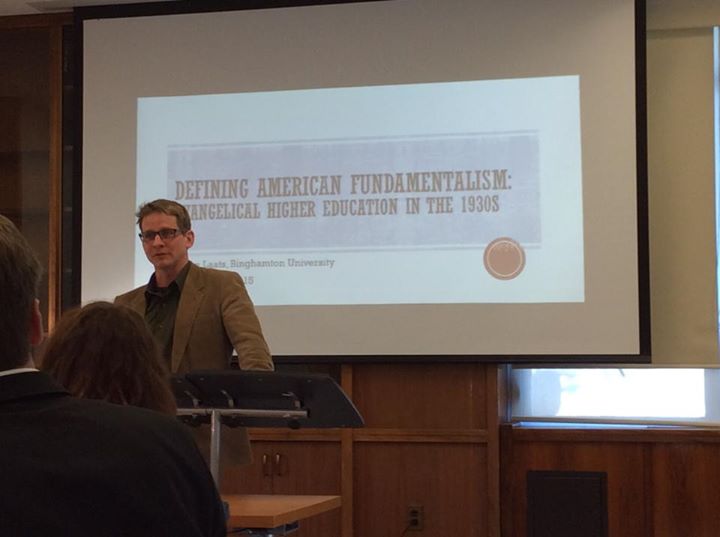
Thanks to all those who came out Wednesday to participate in my talk at Binghamton University about fundamentalist colleges in the 1930s.  Not only was a good time had by all, but the conversation made clear that even at this, our most “secular” of colleges, religion is thriving.  Despite the ignorant nostrums of elite secular academics and fuming fundamentalists, conservative religious students and faculty seem to thrive at pluralist schools like ours.

Don't hate me  because I'm beautiful...

Don’t hate me because I’m beautiful…

For those who are just tuning in, this talk was part of our series in “Religion in the Modern University.”  I shared my current research into conservative evangelical colleges.  The conversation after the formal talk revealed that both students and faculty at our beloved public university come from all sorts of religious backgrounds, including conservative evangelical Protestantism.

Unlike the schools I’m studying, our “secular” college does not actively encourage any specific sort of religious belief.  Nevertheless, our school proves a congenial home for students and faculty who hold conservative evangelical beliefs.

This flies in the face of some common assumptions about secularism and higher education.  As sociologist Elaine Howard Ecklund found in her study of elite secular academics, many of them have absolutely no idea of the high level of religious belief at their own non-religious elite universities.

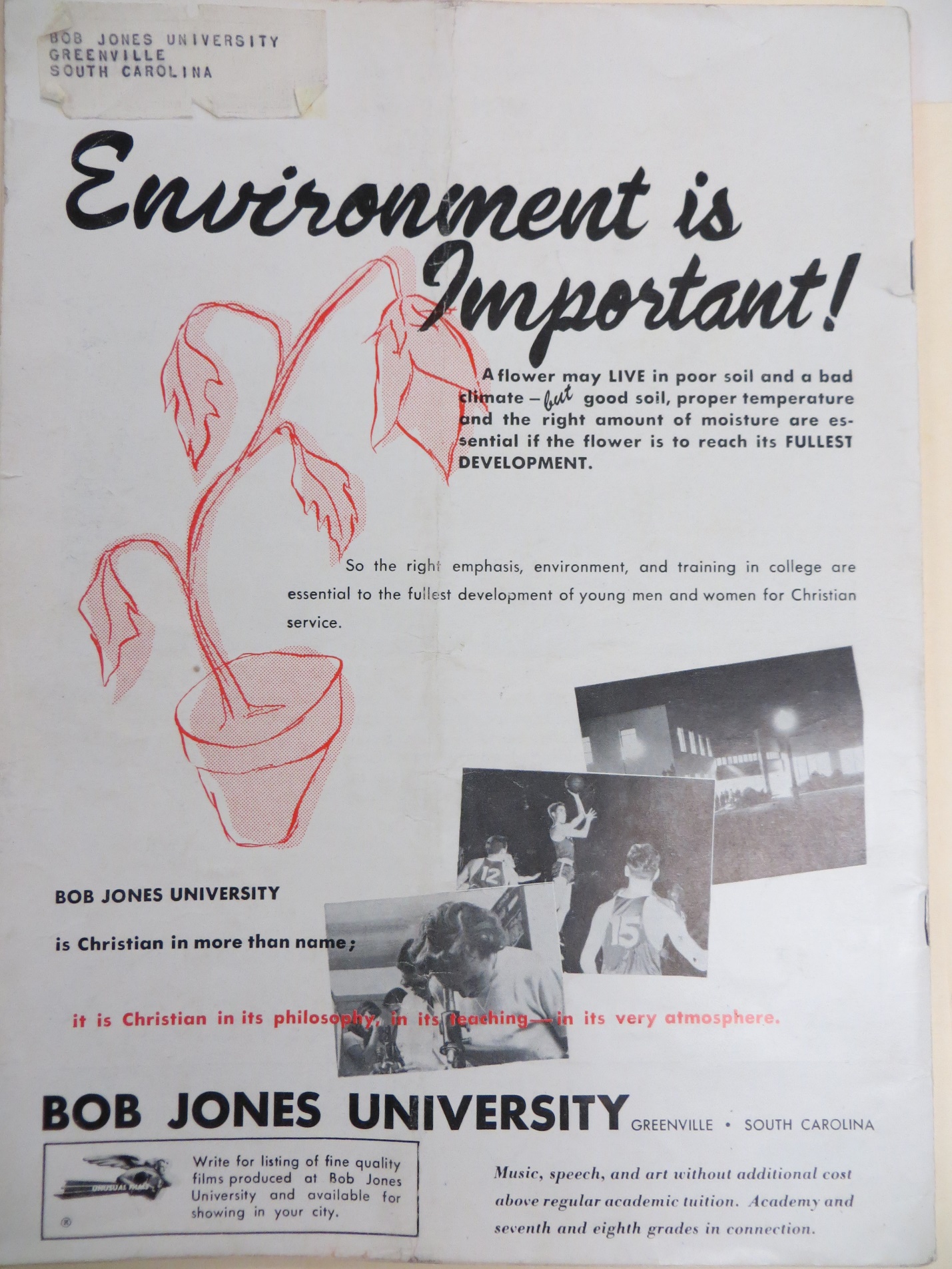
Fundamentalists, too, have long assumed that “secular” colleges were hostile to their sort of religious belief.  As fundamentalist college founder Bob Jones Sr. was fond of saying in the 1920s, he would

just about as lief [sic] send a child to school in hell as to put him in one of those institutions.

At Bob Jones University, as at other fundamentalist universities, this notion that only a truly fundamentalist school can protect students’ faith remained central throughout the twentieth century, as this 1956 advertisement demonstrated.

Fundamentalist students, fundamentalist schools

Fundamentalist students, fundamentalist schools

More recently, too, creationist leader Ken Ham took me to task for questioning his insistence that creationist families must send their children to young-earth-friendly colleges.  As Ham concludes,

at the very minimum I do urge parents to ensure they do all they can to equip their children to be able to defend the Christian faith against the attacks of our day, and to stand uncompromisingly on the authority of the Word of God.

Does that mean that religious students need to go to schools that share their faith?  I don’t think so.

I certainly understand the many differences between a pluralist school like our beloved Binghamton University and schools with a unified religious message.  But we need to remember that so-called “secular” colleges like ours are often very friendly places to creationists and fundamentalists.

Evil and a Young Earth

It’s one of the oldest and toughest questions for monotheists. If God is all-powerful, and the world has evil in it, then God is responsible for that evil. Creationist leader Ken Ham recently argued that only a young-earth attitude can explain away this problem of theodicy.

Ham was reacting to a viral video of Irish comedian Stephen Fry. (Youtube has since taken the video down due to copyright claims.) In the interview, Fry blasted God as evil, capricious, and flat-out monstrous. “Because,” Fry explained,

the God who created this universe, if it was created by God, is quite clearly a maniac, utter maniac. Totally selfish. We have to spend our life on our knees thanking him?! What kind of god would do that?

Of course, theologians and atheists have wrestled with this challenge for centuries. Ham, the well-known leader of Answers In Genesis, explained recently that other forms of creationism could not handle the challenge.

Intelligent Design, Ham argued, fails because it argues only for a vague creator. If there is only a bland, inexact creator, then Fry’s challenge is correct. He, or She, or It, must have created everything, including evil.

Other creationists just don't get it...

Other creationists just don’t get it…

Evolutionary creationism, too, can’t handle evil, according to Ham. The sort of creationism embraced by the BioLogos folks stumbles in the face of Fry’s challenge, Ham says. “If God did use millions of years of evolutionary processes,” Ham wrote,

then He is responsible for all the death, suffering, disease, extinction, pain, cancer, and other evils in this world.

Only a young-earth approach gives a satisfying account of the origins of evil. In Genesis, as Ham reads it, God’s original creation was evil-free. Only when the sinful choices of Adam & Eve introduced evil into the world did things go awry.

For this to make sense, Ham says, we need a real, literal Adam & Eve. We need to take God at His Word. Otherwise, jokers like Fry have the last laugh.

I Love It When You Call Me Stoopid, Or, Half-Time in the Culture-War Locker Room

HT: DW

Are creationists stupid? The writers of one Saturday Night Live skit think so. The question that’s got us curious this morning, though, is why leading young-earth creationist Ken Ham is so eager to publicize the skit. To this writer, it looks eerily similar to what a coach tells a team in a good half-time speech.

To be fair, the Kat & Garth skit doesn’t say that ALL young-earth creationists are stupid. But this particularly stupid pair of vest-bedecked singin’ idiots happen to be creationists. As the news host threatens to kick them out for their stupidity, they plead, “No, please, we came all the way from the Creation Museum!”

Love the New Album!

Love the New Album!

You might think that the brains behind the Creation Museum itself might want to let this ill-begotten gag fade quietly into the Saturday night. You’d be wrong. Instead, Ken Ham has shared this video with all his many followers. Why? According to Ham, this skit is proof of the besieged nature of authentic Christianity. It proves, Ham writes, that

the mocking of anything Christian in the culture is growing. We see increasing attacks by the secularists on Christianity—they have become so bold now that they’ve been successful in removing crosses, Nativity scenes, and Ten Commandments displays, and have been imposing their own atheistic religion on the culture. Recently, they have been increasingly spreading lies in a propaganda campaign of misinformation about our future Ark Encounter project (and had been doing that in regard to the Creation Museum for many years).

As we’ve seen, this has become part of our culture-war script. Both sides in every contest rush to proclaim their own status as victim. Ham’s Ark Encounter is a good example. Until they were recently scrapped, the project had expected to receive hefty tax breaks. Progressives bemoaned these tax breaks as an example of Kentucky theocracy. The victims, progressives insisted, were Kentucky tax-payers forced to foot the bill for Ham’s fundamentalist building spree.

As with the SNL persecution, Ken Ham insisted that his ambitious Ark Encounter was the underdog. Local newspapers, Ham complained, attacked the project due to their “anti-Christian agenda.”

Why the rush to victimhood? It seems to resemble nothing more than a half-time speech. No team gets psyched up to hear that things are going fairly well and that they should relax. Rather, coaches insist either that they are just on the verge of triumph and one more big push will put them over the top, OR that they are being hammered mercilessly and unfairly and they must unite and focus all their strength.

As Ken Ham told readers in one recent blog post, the successes of a recent atheist billboard campaign proved the need for urgent action. When atheists win, Ham warned,

they have successfully removed the Christian religion and are now imposing their religion of atheism on the culture! Just because they remove a Christian message does not mean there is a neutral situation—there is no neutral position. One is either for or against Christ!

Consider how much less exciting it would be for Ham and other culture warriors to agree that their opponents make good points, but that they respectfully disagree. It is hard to get a good culture-war riled up that way.

Forget the Intelligent Designer: What about Creationist Graphic Designers?

[Thanks to JS for PACE materials.]

Ken Ham is right again.  I’m no creationist, much less a young-earth type, but Mr. Ham’s Answers In Genesis organization has done it again.  As they did with their museum, AIG has managed to overcome the traditional stylistic weirdnesses of creationist outreach.

Weird science, but good-looking graphics...

Weird science, but good-looking graphics…

Ham has bragged recently about the high-class materials his group has cranked out.  In answer to the new version of Cosmos, Answers In Genesis has produced classroom materials to rebut the claims of the popular science show.  As Ham put it,

The AiG graphics department and publications team did a great job designing Questioning Cosmos. Its full-color glossy pages are packed with illustrations, questions for discussion, and detailed answers and explanations to help parents, teachers, and youth group leaders teach young people (and adults!) how to discern what observational science is presented in the Cosmos series and what material is best described as an evolutionary infomercial.

Even those of us who want more evolution taught in public schools must admit that Mr. Ham is right.  The anti-Cosmos materials don’t look any different than mainstream school texts.  Just as Answers In Genesis has done with its museum, this outreach effort has erased some of the obvious outward signs of the non-mainstream nature of creationist science.

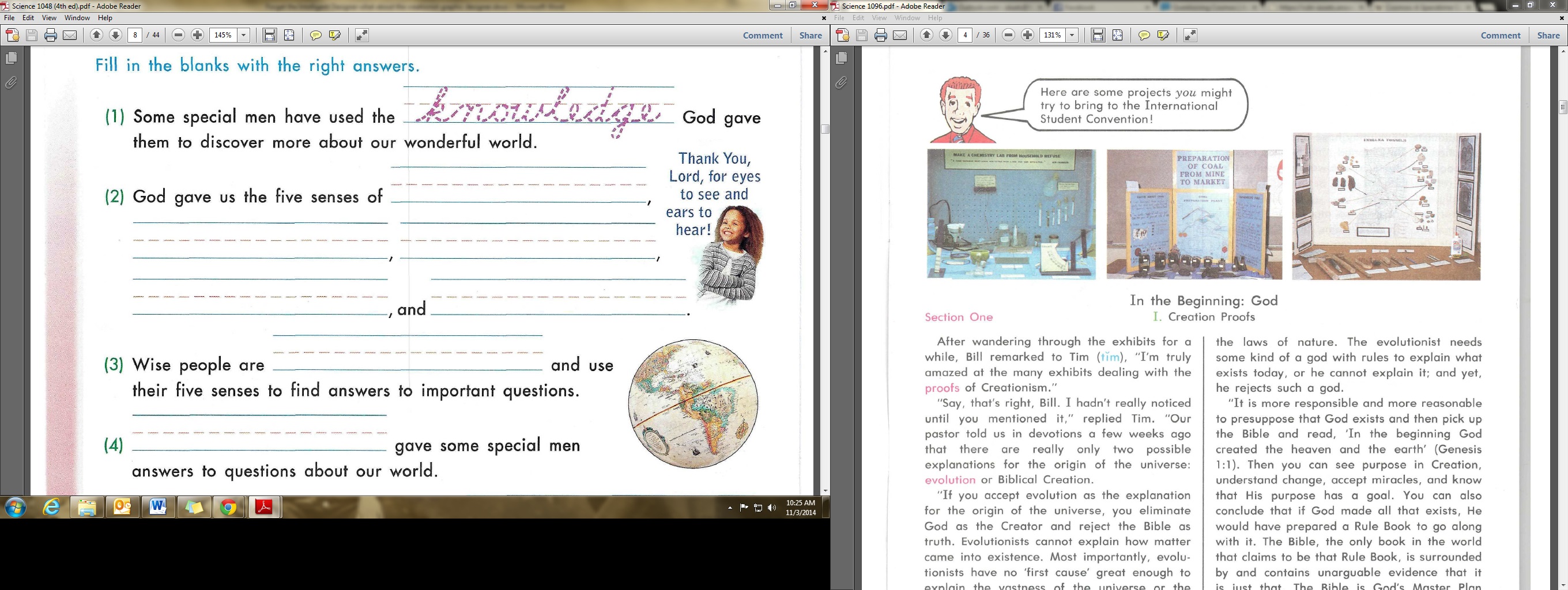
It used to be easy.  Creationists used to produce school materials that looked hokey, weird, old-fashioned.  Consider just a few samples from Accelerated Christian Education.  As these pictures show, not only is the science much different from mainstream science, but the workbooks themselves seem obviously out of date.  The graphics are weird, the comics are jerky, and the lettering looks homemade.

Creation science used to look as if it were created in six days...

Creation science used to look as if it were created in six days…

Creation science books used to LOOK different...

Gee whillikers!

That’s just not the case with AIG’s anti-Cosmos materials.  The graphic design is very similar to the production values we’d expect from mainstream school materials.  And that matters more than we might think.  Parents, school administrators, and, most important, children tend to judge books by their covers.  The shoddy production values of cheap creationist pamphlets used to make them less attractive.

In the case of Answers In Genesis, mainstream science-ed materials can no longer count on such weak and ugly competition.

Is This the Creationist Conspiracy?

Anti-creationists have warned about it for generations: Creationists are joining forces to sweep away reason and science. A growing conspiracy of dunces threatens to upend centuries of progress. But a recent tiff between leading American creationists demonstrates just how fractured and divided creationists really are.  And it demonstrates the ways hysterical anti-creationism may do more harm than good.

The threats of a creationist conspiracy go back to the roots of America’s evolution/creation culture wars. In his 1927 book, The War on Modern Science, Maynard Shipley warned that the fundamentalist “forces of obscurantism” threatened to overthrow real learning. As Shipley put it,

The armies of ignorance are being organized, literally by the millions, for a combined political assault on modern science.

Ever since, science writers have warned of this impending threat. Isaac Asimov, for instance, warned in 1981 of the “threat of creationism.” Such unified anti-scientists, Asimov believed, had made great strides toward setting up “the full groundwork . . . for legally enforced ignorance and totalitarian thought control.” Like Shipley, Asimov noted that not all religious people are creationists, but also like Shipley, Asimov failed to notice the differences between creationists. The only religious people one could trust, Asimov wrote, were those “who think of the Bible as a source of spiritual truth and accept much of it as symbolically rather than literally true.”

What Asimov missed was the crucial fact that many creationists DO endorse real science; many folks who think of the Bible as more than just symbolic also accept the ideas of an ancient earth and human evolution.

This is more than just a quibble. When leading scientists and science pundits lump together all creationists as “armies of ignorance,” they needlessly abandon and heedlessly insult potential allies in creation/evolution debates. When science writers such as Jerry Coyne attack all religious discussion as “accommodationism,” they unnecessarily alienate creationists who want to teach more and better evolution.

A recent interchange between leading creationists demonstrates the way international creationism really works. Creationism in practice is not a horde of Bible-believing fanatics, relentlessly unified on the age of the earth and the origins of humanity. In practice, rather, creationism is a splintered and fractious impulse, fighting internal foes more viciously than external ones.

The “evolutionary creationist” Deborah Haarsma, leader of BioLogos, recently reached out to young-earth creationist leader Ken Ham of Answers In Genesis. Haarsma was “troubled” by Ham’s angry polemic about a third creationist, Hugh Ross of the old-earth Reasons to Believe.

We all have our differences, Dr. Haarsma said. But why can’t we come together over our shared Biblical faith? About our shared concern that young people are leaving the church? Why can’t we at least sit down together for a cordial dinner and talk over our differences?

Ken Ham publicly rebuffed Haarsma’s efforts. Ham agreed that his animus toward Ross was not at all personal. As Ham explained, “I don’t consider Dr. Ross a personal enemy . . . he is actually a pleasant person.” But Ross was also an “enemy of biblical authority.” And Haarsma was no better. “People like Dr. Haarsma,” Ham wrote,

make it sound like they have such a high view of the Bible, whereas in reality, she has a low view of Scripture and a high view of man’s fallible beliefs about origins!

There will be no dinner. There will be no grand alliance of creationists. Instead, we see the ways some creationists will tend to isolate themselves into smaller and smaller like-minded communities.

This story spreads beyond the borders of the United States. As historian Ronald Numbers described in The Creationists, in the mid-1980s the minister of education in Turkey wrote to the San-Diego based Institute for Creation Research. Turkey’s schools, the minister wrote, needed to “eliminate the secular-based, evolution-only teaching dominant in their schools and replace it with a curriculum teaching the two models, evolution and creation, fairly” (pg. 421). And Islamic creationism, much of it based in Turkey, has thrived. However, Numbers concluded, “the partnership between the equally uncompromising Christian and Muslim fundamentalists remained understandably unstable” (425). Numbers cited the rhetoric of American creationist leader Henry Morris: “Mohammed is dead and Jesus is alive!” As Numbers noted acerbically, such talk was “hardly calculated to win Muslim friends” (425).

There will be predictable tensions between different types of creationists. Though some conservative religious voices will work to spread evolutionary theory among evangelicals, others will focus on what Ken Ham called “rebuilding a wall” (Nehemiah 6:1-3).

Folks like me who want to see more and better evolution education will be wise to reach out to those conservative religious folks who also believe in evolution. Instead of copying the tactics of Ken Ham, as Jerry Coyne is prone to do, science promoters should embrace allies and make friends. Instead of shrieking about the “armies of ignorance,” science promoters will do well to look closer at the creationist population. There are plenty of friends there.

Creation and the Ice Bucket Challenge

What does a young earth have to do with pouring a bucket of ice over your head?  According to Georgia Purdom of Answers In Genesis, the popular ice bucket challenge might not be the innocent do-gooderism it seems to be.

Unless you’re living under a rock, you’ve seen images of people pouring buckets of ice over their heads.  The idea is to spread the word about the work of the ALS Association.  And it’s working.  Celebrities from all over the media map have done the deed, including former POTUS George W. Bush.

So why would AIG be against it?  According to Answers In Genesis, the Ice Bucket Challenge funnels money and attention to an immoral organization.  In the words of AIG’s Georgia Purdom,

the ALS Association that is promoting the frigid challenge promotes an unethical search for a cure. Many researchers are willing to use embryonic stem cells and cells taken from “electively aborted” fetuses to search for a cure.

Does this imply that President Bush is not pro-life?  That Bush and all the Ice-Bucketeers are somehow making a political statement in favor of embryonic stem cell research?


Creationists Love Angry Science Teachers

Why would America’s leading young-earth creation ministry go to the National Education Association convention?  After all, Answers In Genesis castigates the NEA for its “godless, liberal agenda.”  AIG frets that the NEA combats conservatives’ right to homeschool their children and to teach godly creationism.

But that anti-God bias is exactly why the creationists go every year.  Answers In Genesis tries to engage NEA attendees with the gospel of creationism.  The creationist outreach at the NEA convention hopes to explain the goals of creationists and melt the hard hearts of some secular teachers.

The folks at AIG are not the first conservatives to try such tactics.  For generations now, the National Education Association has been perceived by conservative education activists as the enemy.  The NEA is seen as promoting secularism and a wrong-headed moral relativism.  As conservative gadflies Mel and Norma Gabler argued in the 1970s, the NEA had always tried to get public schools to teach that “there was no absolute transcendental God, Bible, or system of beliefs.”

And even long before the Gablers, conservatives tried to maintain their influence with the NEA.  As I note in my upcoming book about conservative educational activism in the twentieth century, the patriotic school activists in the American Legion pioneered this approach.  For the stalwart conservatives in the American Legion, the NEA offered the best way to influence American public education.  Therefore, they held their noses and collaborated on American Education Week.  Starting in 1921, the Legion and the NEA encouraged schools nationwide to focus on a certain theme for a week.  They tried to get everyone in every community engaged with their public schools.  For the conservative leaders of the American Legion, this was a way to promote patriotism and religion in public schools.  For the leaders of the NEA, this seemed like a good way to direct the public’s attention toward its schools.

For conservatives, then, the NEA has long been a target.  Generations of conservatives have hoped to influence the NEA with conservative educational ideas.  Does it work?  The conservative creationists at AIG seem to think so.  One missionary to the NEA relates the story of “Tom,” a hostile secular science teacher.  After spending time with the creationists at the NEA convention, Tom was able to understand more about the wholesome gospel mission of the creationists.  Walls were broken down, hearts were touched.


The Left Seizes Science

You’ve heard the howls from creationists over Neil deGrasse Tyson’s recent Cosmos series.  But did you know non-creationist conservatives also get cheeved at Tyson’s science punditry?

Science Snob?

Science Snob?

The creationist complaints make sense.  The hugely popular new science series pointedly called out young-earthers for their belief in a newish universe.  The series also insisted on the creation of species through evolution.

But the complaints of non-creationist conservatives might not seem so obvious.  In the pages of National Review, Charles C.W. Cooke took Tyson to task for his leftism, not just for his love of evolution.  Cooke accuses Tyson and others of his ilk of a puffed-up condescension, of glibly associating liberal politics with superior intellect.

Too many of these self-righteous faux-nerds, Cooke writes, wrap their insouciance in the mantle of science.  For these Tyson fans and wanna-bes, being smart does not mean doing actual intellectual work, but rather simply adopting a pre-packaged list of things to dislike.  As Cooke puts it, that list includes anything

southern, politically conservative, culturally traditional, religious in some sense, patriotic, driven by principle rather than the pivot tables of Microsoft Excel, and in any way attached to the past.

This sort of prejudice against anything recognizably conservative likes to call itself the side of “science,” Cooke argues.  Yet among progressives, real science often takes a beating.  “Progressives . . . ,” Cooke says,

believe all sorts of unscientific things — that Medicaid, the VA, and Head Start work; that school choice does not; that abortion carries with it few important medical questions; that GM crops make the world worse; that one can attribute every hurricane, wildfire, and heat wave to “climate change”; that it’s feasible that renewable energy will take over from fossil fuels anytime soon . . .

Yet in spite of this demonstrably unscientific attitude, Cooke laments, the Left insists on calling itself the “reality-based” party.

Cooke is not the first to complain about such things.  In the first generation of creation/evolution controversies, anti-evolution activists worked hard—and failed—to claim “science” for their side.  As I noted in my 1920s book, leading anti-evolutionist William Jennings Bryan maintained his membership in the staunchly pro-evolution American Association for the Advancement of Science.  He refused to allow that leading science group to be wholly taken over by fans of evolution.

Similarly, prominent 1920s fundamentalist activist William Bell Riley fought hard to keep his generation of Neil deGrasse Tysons from pushing conservatives out of the world of science.  As Riley put it in a 1927 speech, the creation/evolution debate was not a debate between

Experts on the one hand, and, as someone has said, ‘organized ignorance,’ on the other.  This is not a debate between the educated and the uneducated.

Like Bryan in the 1920s and Cooke in 2014, the conservative Riley was loath to cede the scientific and intellectual high ground to evolution-lovers.

One of the results of that first decade of evolution controversies was the formation of durable cultural associations, the associations about which Cooke complains.  Since the 1920s, “science” has become indelibly associated in the public mind with progress, with social experiment, with iconoclasm.  Politically, if not logically, all of those things are part of the broad package of cultural leftism.  And, like it or not, conservatism has been associated time and again with obstructionism and heedless obscurantism.

For conservative pundits like Cooke, trying to fight that tradition will be an uphill battle.