US Government Employs Creationist Scientists

Thanks to the ever-watchful Sensuous Curmudgeon, we learn of plans to open a new, enormous creation museum near Boise, Idaho.  But in exploring the announcement of this planned mega-museum, we came across an interesting tidbit: Two of the creationist scientists involved in this project worked for the US government as geologists.  Does this mean that the government is funding creation science?  And does it prove the creationist claim that their experts are engaged in “real” science?

As reported yesterday by the Boise Weekly, the Northwest Science Museum has big ambitions.  Its founders want to open an enormous display area, 300,000 to 450,000 square feet.  They hope to build a full-size replica Noah’s Ark that could rival the plans of the more-established Creation Museum in Kentucky.

Big Plans for Boise

Big Plans for Boise

Whether or not the Idaho creationists succeed in their lavish plans, they will likely end up adding another stop to those who want to tour the nation’s many creation museums.  More interesting, the announced plans also raise crucial questions about creationism and government support for religion.

In their attempt to raise funds for their new project, the leaders of the Boise museum published a prospectus that includes information about themselves.  According to this document, the leadership team includes two experienced geologists.

Douglas J. Bennett, founder of the museum, has degrees in geology and science education from Boise State University.  For the past eighteen years, Bennett has worked as a geologist for the US Bureau of Reclamation.  Similarly, museum founder Brent Carter earned a degree in geology from a large public university and worked for 42 years as a geologist for the same US Bureau, retiring with the title of Chief Geologist of the Pacific Northwest Region.

More than the opening of a new creation museum, these careers raise important questions for those of us interested in issues of evolution and creationism.

First, some might suggest that long governmental careers for these ardent and active creationists implies government support for religion.  But does it really?  After all, the government likely hired them to do specific jobs.  They had the necessary qualifications.  Whatever they chose to do in their private lives wouldn’t be any of the government’s business.  Nor would the government be supporting these men’s religious work, as long as each geologist didn’t do his creationist research while on the clock.

More interesting, we have to ask what these careers tell us about the intersection of mainstream science and creation science.  In the recent debate between leading creationist Ken Ham and leading science pundit Bill Nye, Nye repeated his charge that creationism blocked kids from learning science.  Ham retorted with several examples of successful creationist scientists and engineers.

The careers of Bennett and Carter seem to help the creationist case.  After all, if they have both had successful careers as geologists, how can we say that creationists can’t do science?  One might suggest that the sorts of engineering tasks these creationists engaged in were not primary science.  But it seems to me a stretch to say that these creationist geologists did not have careers specifically in the science that is contested.  In other words, both of these men worked as geologists, though their religious beliefs gave them very non-mainstream ideas about that geology.

Consider—again from the museum prospectus—the tasks Bennett claimed to have worked on for the US government.  As part of his job, Bennett

Performed surface and subsurface geotechnical studies and exploration programs utilizing diamond drill, power-auger, test pits, tunnels, and other processes to secure data for seismotectonic, ground-water, and other special studies of dams, reservoirs, canals, tunnels, spillways, power plants, and related structures.

One might say that none of this engineering work includes primary geological research.  And if it did, someone who believed in a young earth and a recent world-wide flood would be at a crippling disadvantage.  But anti-creationists sometimes make a different point.  Bill Nye, for instance, has warned that a creationist nation will soon fall behind in technology and engineering.

The careers of Bennett and Carter seem to demonstrate the weakness of that argument.  Indeed, Nye argues that creationism will turn kids away from science-related careers.  But in the case of these two men, at least, it was precisely their religious beliefs that led them to careers in geology.

So does this case show government support for creationism?  Not really.  But it does offer evidence that creationism does not necessarily deter young people from going into science-related careers.  Indeed, because of the tumult over the nature of biology and geology, perhaps creationist beliefs actually drive some young people into careers in science.



Zombie Science on Noah’s Ark

Smart people don’t say it’s not science.  Some call creation science “dead science.”  But anyone with eyes to see and ears to hear can see the bustling activity in the world of creation science.  A recent blog post from Answers In Genesis offered an introduction to what creation science can look like.  If it’s not dead, but not quite alive in the normal sense, maybe the best term for this sort of research is “undead science” or “zombie science.”

Alternative Science in Action

Alternative Science in Action

As those of us who follow the creation/evolution debates are well aware, Answers In Genesis is planning a big new museum project.  They want to build a replica of Noah’s Ark to prove its practicality.  Indeed, this ark project has attracted a sub-controversy of its own, with secularists complaining about public tax benefits going toward this explicitly sectarian religious project.

In a recent blog post, AIG explained some of the scientific challenges of their Ark project.  AIG demonstrated some of the unique features of the sort of creation science practiced by AIG scientists. As the post explained, one of the challenges of designing a replica Ark is figuring out how many animals would be on board.  Most believers in a literal world-wide flood do not insist that Noah’s Ark contained two of every species we have today.  Rather, they say that the Ark contained two of every “created kind,” as described in Genesis.  That is, the Ark did not have two wolves, two dingoes, two foxes, two dogs, etc.  Instead, the Ark had two of the “kind” of canine.

The term AIG scientists use to describe these “created kinds” is “baramin.”  In the recent blog post, AIG uses the example of the mule deer to show how scientists can figure out what kind of created kinds were on the Ark.  Creation scientists hypothesize that fossils from the baramin must be in a certain fossil layer, since those fossils were predictably laid down at a certain point in the Genesis flood.  In this case, the most likely fossil deposits, according to AIG, were from “moschids buried in rock layers deposited by localized catastrophes just after Flood.”  Those samples allow creation scientists to figure out what the baramin on the ark would likely have looked like.

Is this science?  It’s tempting for those of us outside the circle of creationism to pooh-pooh this sort of thing as outlandish non-science.

But more thoughtful non-creationists have offered more subtle explanations.  Philosopher Philip Kitcher, for example, argued that we should understand this not as non-science, but as “dead science.”  This sort of thinking, Kitcher said, had a long and influential career as mainstream science.  However, it has been replaced by better science.

Historian George Marsden also offered an explanation of this sort of scientific thinking.  Marsden argued that early creationists worked in a Baconian framework.  Science, according to this way of thinking, must begin with an authority.  From that firm starting point, scientists can collect and classify information.  This is not non-science, but rather a certain form of dissenting science.

Throughout the twentieth-century history of creationism, creationists themselves have insisted on the scientific legitimacy of their projects.  The leading creation scientist of the 1920s, George McCready Price, repeatedly argued that non-creationists were behind the times.  As Price told an audience in London just a few months after the 1925 Scopes trial,

I am perfectly confident that any competent person who will take the time to traverse the evidence now available on this side will reach the same conclusion that I have reached—namely. That the theory of Organic Evolution was a very plausible theory for the times of comparative ignorance of the real facts of heredity and variation and of the facts of geology which prevailed during the latter part of the nineteenth century; but that this theory is now entirely out of date, and hopelessly inadequate for us, in view of the facts of geology and of experimental breeding as we know them.  We are making scientific history very fast these days; and the specialist in some corner of science who keeps on humming a little tune to himself, quietly ignoring all this modern evidence against Evolution, is simply living in a fools’ paradise.  He will soon be so far behind that he will wake up some fine morning and find that he needs an introduction to the modern scientific world.

Mainstream scientists in the 1920s and ever since would dispute Price’s prediction.  But in every generation since the 1920s, creationists have developed and honed their distinct version of science and of scientific research.  As this Ark Encounter article makes clear, over the past century creationists have identified research problems and research methodologies that are utterly foreign to mainstream science.  They have built schools, museums, and academic publications.  They have changed and honed their thinking.

“Dead” science does not grow and change in this way.

So if this sort of creation science is thriving and changing, it seems misleading to adopt Kitcher’s label of “dead science.”  I know creationists won’t like the idea of calling it “zombie science” or “undead science.”  But is there a better term to describe this unique sort of active-but-dead kind of research?


Bad News for Everyone

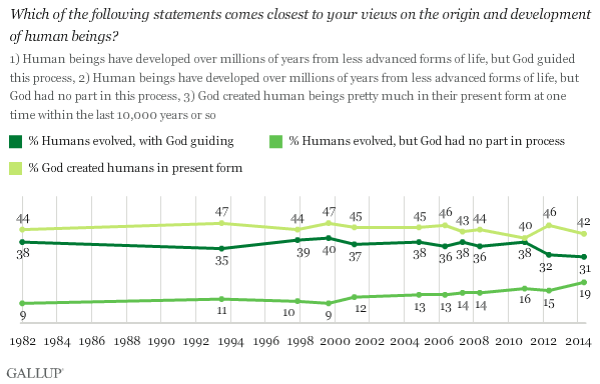
Have you seen it yet?  The new Gallup poll on creationism and evolution is out.  The numbers are about the same as they have been for the past thirty years.  But beyond those numbers, the backgrounds of Gallup’s respondents has some bad news for creationists.  It also has bad news for evolution-lovers.

Stable Numbers Since the 1980s

Stable Numbers Since the 1980s

Since the 1980s, Gallup’s pollsters have been offering respondents three options about the origins of humanity.  This time, 42% chose the young-earth creationist option: “God created human beings pretty much in their present form at one time within the last 10,000 years or so.”  In contrast, 31% chose “Human beings have developed over millions of years from less advanced forms of life, but God guided the process.”  A whopping 19% selected “Human beings have developed over millions of years from less advanced forms of life, but God had no part in the process.”

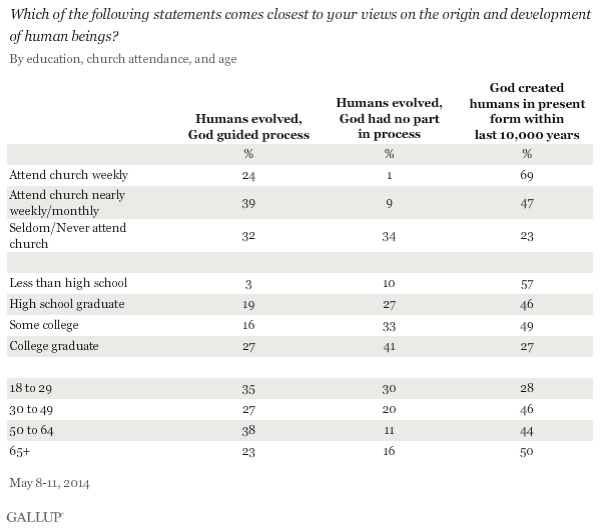
Those numbers have remained fairly stable for the past generation.  But another result of the recent poll numbers needs some examination.  The young-earth position is much more common among less educated adults.  For those with less than a high-school diploma, 57% selected the young-earth option.  A far smaller proportion, only 27%, of Americans with a college degree chose the young-earth explanation.

"Organized Ignorance?"

“Organized Ignorance?”

This is bad news for everyone.

For creationists, these numbers suggest that more education means less creationism.  Throughout the lifespan of American creationism, creationist intellectuals have fought a rearguard action against accusations of ignorance.  In 1927, for example, Minneapolis fundamentalist leader William Bell Riley told a reporter,

Every time I hear the argument that this is a controversy between experts on the one hand, and, as someone has said, ‘organized ignorance,’ on the other, I smile.  This is not a debate between the educated and the uneducated.

Riley’s smile grew more and more strained as the 1920s wore on.  And later generations of creationists found it even more difficult to take the intellectual high ground.  These numbers mean bad news for them.

But the numbers mean bad news for evolution mavens, too.

Though more college grads embrace a non-young-earth understanding of the origins of humanity, 27% is still a significant number.  It means that over a quarter of adults who have been to college—educated adults, that is—select a young earth as the best explanation.  Over a quarter!  Some of those, to be sure, may attend what young-earth creationists embrace as “Creation Colleges.”  Ken Ham of Answers In Genesis, for example, publishes a list (and a map!) of schools that he views as faithful to the Bible’s obvious meaning.

But many of those college-educated young-earth creationists likely attend non-creationist colleges as well.  As anthropologist David Long demonstrated in his study of creationists at a large public university, studying biology at a secular university does not tend to shake the faith of creationist students.  Of his interview subjects, only one abandoned her creation faith as she majored in biology.  And it wasn’t the science that convinced her.  She had already begun to move away from her faith in high school, due to an early pregnancy and the sour reaction of her church community.

As I argued a while back in the pages of the Chronicle of Higher Education, anti-creationists are too fond of calling all creationists “ignoramuses.”  Certainly, some folks must embrace creationism because they just don’t know better.  But many educated adults DO know about evolution.  They simply choose young-earth creationism instead.  That is a troubling fact that anti-creationists have always had a hard time dealing with.


Was I Fair to Ken Ham?

Ken Ham complains that I was not precise enough.  I think I was.

Here’s the issue: On his blog today, leading young-earth creationist Ken Ham chided yours truly for saying “Ken Ham” when I really meant something like “conservative Christians.”  Ham was reacting to a recent post of mine in which I asked about Ham’s inordinate influence over some conservative Protestant colleges.  In that post, I noted Ham’s recent pronouncements about leading evangelical schools such as Calvin College and Bryan College.  I wondered if conservative schools had to bend over backwards to satisfy Christian critics like Ham.  Did schools like Bryan College have to toe the Ham line in order to maintain their support base among conservative evangelical Protestants?

Be More Precise, Please

Be More Precise, Please

Ham said I needed to be “more precise.”  Ham made the fair point that Science Guy Bill Nye often used the unfair rhetorical strategy of reducing all creationism to simply Ken Ham.  Of talking about creationism as if it were just a one-man crusade to bilk taxpayers and fool schoolchildren.

When it comes to Bill Nye’s language, I agree with Ham.  Bill Nye–with whom I generally agree–does not always seem to understand creationism.  In a recent post, for instance, I agreed with Mr. Ham that Bill Nye “Misse[d] the Boat on Creationism.”  I have also agreed with Mr. Ham that Mr. Nye’s use of phrases such as “Ham’s followers” is sneaky and unfair.

But in this case, I was not doing any such thing.  In my essay about Mr. Ham’s influence on conservative Christian colleges, I was talking precisely about the work of Mr. Ham and Answers In Genesis.  If I was incorrect about the influence of Ham in the recent controversy at Bryan College, I’ll apologize.  But I won’t apologize for mistakes I didn’t make.

Ham also notes that I expand my questions to include the state of conservative evangelical colleges and sexual assault.  As ILYBYGTH readers know, this is a question that has been bandied about here recently.  Those who are new to the blog will not be aware that we do not simply attack “fundamentalist” schools as rape havens.  Indeed, our recent string of commentary began with questions about a journalist’s unschooled presumptions about the nature of fundamentalism.  We do not assume that sexual assault is somehow unique to conservative religious colleges, but it does seem that there is a connection between the opaque authoritarian cultures of many conservative colleges and a culture that blames the victims of sexual assault.

The central point of interest to me, though, then and now, is whether and how Mr. Ham has come to wield such authority over conservative evangelical colleges.  In the case of Bryan College, at least, Ham’s worries led to changes at the school.  I can’t help but wonder if Ham’s say-so is of enormous influence at similar colleges and universities.  This is not a question about conservatism in general.  This is not a question about creationism in general.  This is a specific question about the influence of Mr. Ham’s Answers In Genesis ministry.


Ken Ham Is My Guidance Counselor

Why does Ken Ham care where you go to college? Where you send your kids?   Because “college” is more than just a collection of classes and academics. For religious conservatives as for everybody else, “college” represents a formative experience. The ideas one will encounter, the personal connections one will make, and the changes in one’s outlook and worldview all make the college years some of the most transformative in our lives.

In recent years, Ham, America’s (and Australia’s) leading voice for young-earth creationism, has established himself as the arbiter of creationist orthodoxy in college attendance. And his word carries weight in the world of evangelical higher education.

Recently, for instance, Ham warned readers at Answers In Genesis about the dangers of attending Calvin College. Students at that storied Christian school, Ham explained, were “being influenced . . . to undermine the authority of Scripture in many ways.” When faculty engage in evolutionary research and teaching that might turn away from Ham’s strict attitudes about knowledge and creation, Ham warns, students will too often abandon their creationist faith.

As a precaution, Ham offers readers a list of schools that adhere to the young-earth creationism taught by Ham’s Answers In Genesis ministry. To be safe, Ham warns, parents and students ought to stick with schools that have proven their fidelity to these ideas.

Ham’s anxiety over the crumbling orthodoxy in Christian higher education is nothing new. As I argue in my 1920s book, many of today’s evangelical schools had their origins in the founding decade of American fundamentalism. Back in the 1920s, religious schools often faced a choice between fundamentalist orthodoxy and modernist adaptation. Most chose modernism. The University of Chicago, for example, founded as a Baptist beacon of learning, became the leading voice for theological modernism, employing such folks as Shailer Mathews and Shirley Jackson Case. In contrast, a few Christian schools, most famously Wheaton College, sided with the fundamentalist movement.

Leading fundamentalists in the 1920s also founded a spate of new schools to embody their theological and cultural conservatism. Perhaps most prominently, evangelist Bob Jones Sr. opened Bob Jones College (now Bob Jones University) in 1926. The goal of this school was to form the fundamentalist character of young people while educating them in the best traditions of arts and sciences. In order to reassure parents that the school would never slide toward theological modernism or cultural liberalism, Jones and his allies established a rock-ribbed charter. This charter hoped to guarantee the continuing orthodoxy of the school. The charter’s second paragraph outlined that orthodoxy:

The general nature and object of the corporation shall be to conduct an institution of learning for the general education of youth in the essentials of culture and in the arts and sciences, giving special emphasis to the Christian religion and the ethics revealed in the Holy Scriptures, combating all atheistic, agnostic, pagan and so-called scientific adulterations of the Gospel, unqualifiedly affirming and teaching the inspiration of the Bible (both Old and New Testaments); the creation of man by the direct act of God; the incarnation and virgin birth of our Lord and Saviour, Jesus Christ; His identification as the Son of God; His vicarious atonement for the sins of mankind by the shedding of His blood on the Cross; the resurrection of His body from the tomb; His power to save me from sin; the new birth through the regeneration by the Holy Spirit; and the gift of eternal life by the grace of God.

Perhaps most notably, the next line specified that this charter “shall never be amended, modified, altered, or changed as to the provisions hereinbefore set forth.” Also remarkable, according to a 1960 reminiscence by Bob Jones Sr., at its founding BJU decreed that every graduating senior would pledge to monitor the school’s continuing fundamentalism. “Should the policy and conduct of the University ever, in my lifetime, deviate, in the slightest particular, from the letter or spirit of this Creed,” seniors would promise,

I hereby pledge myself to exert all my influence to affect a change in conditions; failing which, I will resort to such legal measures as the courts may offer to the end that the institution may be kept true to the University Creed and the original intentions of the founder.

Most evangelical colleges established similar creeds and many promised never to amend them. Not many others, to my knowledge, required such strict supervision by their alumni.

These days, Ken Ham has taken over the role of orthodoxy’s gadfly. In addition to his warnings about waverings from his definition of creationism at Calvin College, Ham has warned that other evangelical schools might be threatening the faith of their students. And Ham’s warnings carry weight.

In one recent episode at Bryan College, for example, Ham’s public worries about faculty orthodoxy led the school’s leadership to instigate a new sort of creationist orthodoxy pledge for faculty. From now on, faculty must publicly avow their belief in a real, historic Adam and Eve. As I argued at the time, the fallout from Bryan College’s policy shift might lead to a shake-up of faculty. More directly relevant, the furor at Bryan seems to testify to Ham’s influence. Worried that creationist parents might not send their students and their tuition dollars, Bryan’s leaders acted to shore up their image as a home of young-earth creationist orthodoxy.

Also intriguing, I must ask again if the drive to protect their reputations as safe theological and cultural havens has led some conservative evangelical schools to cover up incidents of sexual assault. Of course, these are very serious allegations, and I do not ask these questions lightly. I am certainly not accusing Ken Ham or the leadership of these schools of condoning sexual assault. But the drive to present a public face as a uniquely safe environment for fundamentalist students certainly puts undue pressure on college leaders. It is not unfair to wonder if such pressure might lead schools to downplay any cases that might threaten those reputations.

Outside the world of conservative evangelical Protestantism, colleges spend an inordinate amount of time and treasure to attract students. Flashy dorm rooms, high-visibility sports programs, celebrity faculty, and lavish campus lifestyles all hope to convince families to send their kids and their money to certain schools. The pressure on recruiters is intense.

There is a similar pressure on evangelical colleges. Influential voices such as that of Ken Ham are able to exert outsized influence by warning creationist families toward or away from certain schools. Without Ham’s imprimatur, conservative schools may lose the loyalty of students and families.


What Should The Science Guy Say?

It’s coming up. 

In just a few short weeks, Bill Nye “The Science Guy” will debate the scientific premise of creationism with Ken Ham at Answers In Genesis’ Creation  Museum.

What should Nye say?

Science writer Greg Laden offered this morning a short list of points he’d like Nye to make.  In general, Laden suggests that Nye focus on the unscientific nature of creationism.  The debate over divinity was real and important in the history of science, Laden points out, but that debate has come and gone.  Laden doesn’t use the phrase, but his argument is reminiscent of philosopher Philip Kitcher’s definition of creationism as “dead science.”  In this vision, it makes no sense to debate the science of creationism, since creationism is not even bad science.  Creationism, rather, represents an understanding of science that has been thoroughly and completely discredited.    

Laden’s debate prep brings up two important questions.  First, what would people advise Ken Ham to say?  And second, do we agree with Laden’s advice to Nye?

First things first: What do you think Ken Ham should say?  For those of us who live mental lives outside the boundaries of religious creationism, is there anything he could say that would convince us that his creation science should be taken seriously?  For me, the answer is no.  I’ve defended Ham in the past and taken heat for it from ardent anti-creationists.  But in this case, I’ll be flummoxed if Ham uses any arguments beyond his scriptural stock-in-trade.  That is, I don’t guess Ham will try to convince people like me who are not moved by references to Biblical passages. 

I’m thinking Ham will likely harp on the scientific merits of young-earth creationism, when in fact his argument would be much stronger if he tried a different approach.  To people like me, at least, Ham’s scientific credentials have no leg to stand on.  But as religious dissenters young-earth creationists can claim much more wiggle room in education and culture.  If Ham wanted to reach out to people beyond the ranks of his current religious supporters, he should argue for creationists’ rights as aggrieved minorities, as a religious group, not as a contender for scientific legitimacy. 

But Ken Ham is not likely to take this approach, since he has built his career on the promise that young-earth creationism is better science than mainstream science.  He will likely trot out his compelling but ultimately vacuous arguments about observational science vs. historic science.  He will likely ask Bill Nye some variant of his ultimately senseless question: “Were you there?”  If Ken Ham hopes to maintain his role as the charismatic leader of the young-earth creationist movement, he can’t really do anything else. 

Question two: What should Nye say?  I don’t think Laden’s advice is the first best answer.  IMHO, the most effective answer to young-earth creationists such as Ken Ham is a theological one, not a pop-science one.  As do the folks at BioLogos, I think the most effective message young-earth creationists need to hear is that Biblical faith does not require faith in a young earth.  As science pundits tend to agree, young-earth creationism is not really science, it is something else.  It is an outgrowth of a particular religious understanding.  Therefore, the strongest arguments against it are religious, not scientific. 

Also, I don’t think Nye should use his precious exposure to creationists to blast the dead-science nature of young-earth creationism.  Many creationists will expect a hostile attack on their belief system.  They will not be moved by it.  They will not be convinced by it, since they will not credit its source.  I think it will be more effective for The Science Guy to do what he does best: explain what science is.  Young-earth creationism is based on a very different way of defining knowledge.  If Bill Nye can explain what real science is—instead of attacking the reasons why young-earth creationism doesn’t meet that definition—he can expose some of the creationists in the debate audience to a very different way of understanding the entire debate. 


The Real Pharaoh’s Secret: The Creation Museum

Get this: one of the new Doritos commercials was filmed at Answers In Genesis’ Creation Museum.

Image Source: Answers in Genesis Creation Museum

Image Source: Answers in Genesis Creation Museum

How do I know?  Ken Ham told me.  And the other five bajillion people who follow him on Facebook.

Why did Doritos film at the Creation Museum?  Are they peddling their snacks as young-earth creationist favorites?  Not according to Ham.  He says part of the museum simply has the style of an “Egyptian temple” so the filmmakers liked it.


You Don’t Need a Young Earth to Get to Heaven

Do creationists use intimidation and spiritual threats to coerce young people to believe?  Not as often as some critics assume.

Young-earth creationist leader Ken Ham of the organization Answers In Genesis repeated his call recently that Christians do not need to believe in a young earth.

For outsiders like me, this can appear puzzling.  After all, those of us outside the circle of conservative evangelical belief often assume that all conservative evangelical Protestants spend their time sweating over their eternal fate.  We might make the mistake of assuming that conservative evangelicals thrive by threatening sinners with hellfire, brimstone and damnation.

Take, for example, the Christian beliefs of young-earth creationists.  From the outside, it’s tempting to assume that the more insistent YECs must somehow bully new generations into embracing their beliefs.  After all, those beliefs are so radically different from the ones embraced by mainstream science that it seems impossible for young people to become YECs unless compelled.

This is why some prominent atheists have called this kind of creationism “child abuse.”  As we’ve seen in these pages, smart young people brought up in the faith have wondered why their trusted adult leaders sold them a scientific bill of goods.  As Anna wondered recently in her illuminating ILYBYGTH series about her youth as a YEC, “It is still a bit difficult for me to look back on authority figures and members of my community that I looked up to and respected and wonder: are they just ignorant, or are they purposely deceptive?”

For us outsiders then, it can seem surprising that arch-creationist Ken Ham takes time to point out that young-earth belief is not a salvation issue.  That is, Ham insists that good Christians can disagree about the age of the earth.  As he puts it,

Many great men of God who are now with the Lord have believed in an old earth. Some of these explained away the Bible’s clear teaching about a young earth by adopting the classic gap theory.

Others accepted a day-age theory or positions such as theistic evolution, the framework hypothesis, and progressive creation.

Scripture plainly teaches that salvation is conditioned upon faith in Christ, with no requirement for what one believes about the age of the earth or universe.

Ham hastens to add that discarding a belief in a young earth can have “very severe consequences.”  In sum, since the Bible clearly describes the origins of earth, disregarding that message puts Christians on the very slippery slope to disregarding Biblical authority as a whole.

“All biblical doctrines,” Ham concludes, “including the gospel itself, are ultimately rooted in the first book of the Bible.”

Make no mistake: Ken Ham wants you to believe in a young earth.  But this is not a threat.  This is not a tent-preacher warning that only YEC can save your soul.

Too many outsiders like me ignore these kinds of nuance in the intellectual world of conservative evangelical Protestantism.  We end up calling YECs child abusers or worse, without taking the time to understand the real culture of young-earth creationism.  That might make for good headlines, but it does so at the heavy cost of relying on caricature rather than reality.

Do Rich Creationists Deserve the Awesome Fossil?

Everyone agrees on one thing: It’s an awesome fossil.

Image source: Answers In Genesis

Image source: Answers In Genesis

So awesome, mainstream scientists complain, it shouldn’t be used to preach the anti-science on tap in Answers In Genesis’ Creation Museum.

Not so fast, creationists retort.  They insist the rare fossil helps make the scientific case for a young earth and a real global flood.

According to a news release from the young-earth creationist ministry Answers In Genesis, a wealthy benefactor donated the half-million-dollar Allosaurus skull fossil to the Creation Museum.  That benefactor wanted the fossil to be used to help make the case for Biblical young-earth creationism.

The skull will be prominently displayed in the Creation Museum.  AIG scientist Andrew Snelling claims that the skull helps prove the historicity of Noah’s global flood.  Since the skull was so well preserved, Snelling argues, it proves an extremely rapid burial, which fits with a catastrophic flood.

Mainstream scientists complain that the skull should reside elsewhere.  Happy Atheist PZ Myers, for example, laments the fact that such a priceless scientific find should be “locked up in a non-research institution and used to gull the rubes.”

In an Associated Press report, Kentucky paleontologist Dan Phelps worried that the Creation Museum would not let mainstream scientists use the skull for research.

This mainstream complaint raises an interesting question: Would mainstream paleontologists conduct research on the skull, even if they were invited?  After all, the presence of scientists from non-creationist research institutions would be a huge boost for AIG’s claims to be a legitimate scientific institution.

Would any mainstream scientists agree to work at the Creation Museum?


Thank God You’re Wrong

When in doubt, look to the heavens.  These days, your view might be blocked by a billboard from the young-earth creationist outfit Answers In Genesis.

Image Source: Answers In Genesis

From Times Square. Image Source: Answers In Genesis

If you look closely enough, you might see a clue as to why the creation/evolution debates have been so divisive for so long.

According to their press release, yesterday AIG rented billboards in high-visibility sites in New York’s Times Square and San Francisco’s Fisherman’s Wharf.  Soon similar billboards will hit the skies in Los Angeles.

The billboards announce, “To All Our Atheist Friends; Thank God You’re Wrong.”

Image Source: Answers In Genesis

San Francisco. Image Source: Answers In Genesis

AIG leader Ken Ham described the choice of wording.  AIG wanted to be “cordial and engaging,” he explained.  Though these high-profile billboards were an explicit response to Christian-bashing billboards posted by atheist groups, Ham said he wanted to take the high road.

Image Source: Answers In Genesis

An Atheist Billboard. Image Source: Answers In Genesis

“We are not angry at the atheists at all,” Ham wrote.  Instead, AIG feels “burdened” by atheists’ separation from God.

For those new to the creation/evolution debates, it might seem surprising that this latest publicity stunt does not mention creationism, dragons, or zip lines.  After all, AIG has had some success in the past with such creation-focused billboards.

But as Ken Ham repeats, creationism is not the main interest of his organization.  Rather, salvation is the point; creationism is merely the vital theme.

For those of us interested in conservative themes in American education, this distinction matters.

Many non-creationist commentators on the creation/evolution issue assume that if readers can be convinced of the scientific truths of evolution, the debate will be over.  Even the insightful philosopher Philip Kitcher seemed to fall into this trap in his book Living With Darwin.

These AIG billboards demonstrate the difficulty of the issue.  The young-earth creationists at AIG care a lot about creationism, but that is not their central concern.  Their central concern is salvation.  As long as evolution is seen as a threat to salvation, it will never be open to discussion and compromise.

More perspicacious religious minds understand this.  Francis Collins and the BioLogos Foundation set out to prove not only that evolution is true, but that evolution does not threaten salvation.  Without that focus on salvation, creation/evolution discussions will get nowhere.

These AIG billboards do more than attract attention in America’s big cities.  They demonstrate the true heart of the evolution/creation controversy.