Bible in America: RAH interview with Robert Alter

Fundamentalists don’t always make the best historians.  American fundamentalists tend to insist on an American past that is far too rosy.  When she was still an up-and-coming Presidential nomination contender, for example, Michele Bachmann insisted that the Founding Fathers had “worked tirelessly” to end slavery.   Though she later tacked away from her statement, noting that she meant John Quincy Adams, it doesn’t take a slanted leftist historical perspective to notice that her claim is just not true.  The Founding Fathers may have accomplished a good deal.  Some of them may even have tried to improve the conditions of slaves, or to hurry the day when human chattel slavery would be abolished.  But overall, the issue of slavery was one that the Founders explicitly pushed off on a later generation.

However, as we’ve noted here in the past, one of the historical claims of fundamentalists in America lines up more neatly with the findings of non-fundamentalist academics.  On the Religion in American History blog, Randall Stephens recently interviewed scholar Robert Alter about his newish book, Pen of Iron: American Prose and the King James Bible.

Alter’s book is focused on the ways Biblical themes and language infuse American literature and culture.  In the RAH interview, he makes the point that American culture in the past was thoroughly Biblicized:

“In nineteenth-century Protestant America, the Bible, almost always in the King James Version, was a constant companion for most people. They not only heard it in church, but very often it was regularly read out loud in the family circle at home.”

Fundamentalists often make the case that America is and should remain a Christian, Biblical society.  They insist on a vision of American history in which early European settlers and Founding Fathers planned to create a Christian Nation.  (For the leading example of these kinds of arguments, check out David Barton’s Wallbuilders articles.)

Academic historians have noted that these historical claims must be treated carefully.  John Fea, for instance, has argued that there was indeed a good deal of Christian intent among the founding generation, but this is often used by activists in unfair and ahistoric ways.

However, it is only fair to notice that in some cases, the vision of the past promoted by fundamentalist activists lines up neatly with that of non-fundamentalist scholars.  According to Robert Alter, at least, American culture in the past really was thoroughly infused with the KJV Bible.


The Bible in Early America

Was early America Fundamentalist?  Fundamentalists like to say that it was.  Fundamentalists argue that America was always meant to be a Christian nation.  To pick just one recent example, Presidential hopeful Rick Santorum took some heat a couple of days ago for his presence at a fiery fundamentalist sermon in Baton Rouge.  According to the Huffington Post, Pastor Dennis Terry hit this theme pretty hard.  He told his audience,

“I don’t care what the liberals say, I don’t care what the naysayers say, this nation was founded as a Christian nation…There is only one God and his name is Jesus. I’m tired of people telling me that I can’t say those words.. Listen to me, If you don’t love America, If you don’t like the way we do things I have one thing to say – GET OUT. We don’t worship Buddha, we don’t worship Mohammad, we don’t worship Allah, we worship God, we worship God’s son Jesus Christ.”

This understanding of the Christian roots of American society is an article of faith among most fundamentalist Americans.  Among fundamentalists, no one has more credibility in this argument than David Barton.  Barton has built a career out of his historic vision.  For example, in a 2008 article Barton listed voluminous examples of religious quotations from leading founders.  Barton’s point here, as in most of his work, is that the roots of American society are profoundly Biblical.  Barton argues tirelessly that twentieth-century US Supreme Court rulings have erroneously erected an unconstitutional “wall of separation” between Christianity and public life.  Barton has attracted a large an influential audience in Fundamentalist America.  Journalists have oohed and aahed at the extent to which Barton’s work has drawn adoring praise among conservatives.  For example, one New York Times article noted that leading Republican presidential candidates such as Mike Huckabee, Newt Gingrich, and Michele Bachmann all extolled Barton’s work.  Huckabee called Barton “maybe the greatest living historian on the spiritual nature of America’s early days.”

Predictably, liberal criticsatheist activists,  and academic historians have vehemently disputed Barton’s work.

But careful historians agree that the influence of the Bible in early American public life was overwhelming, even if they qualify the meaning of “overwhelming” somewhat.  One of the most prominent twentieth-century historians of early America, Perry Miller, claimed in 1939 that “New England was founded as a Puritan commonwealth and was intended to be a holy and unique corner of the world.”  Later in his long career, Miller argued that this intense public religiosity lasted well into the nineteenth century.  In a 1955 article, Miller noted the rationalism of Jefferson and Franklin, but he said those beliefs were swamped in the late 1700s by intense Biblicism “among the masses.”  Even in the first years of the nineteenth century, Miller believed, the overwhelming majority of Americans understood their world through Biblical lenses.  “The Old Testament,” Miller noted, “is truly so omnipresent in the American culture of 1800 or 1820 that historians have as much difficulty taking cognizance of it as of the air people breathed.”

Since the time Miller wrote, new generations of academic historians have explored the religiosity of early New England and found room for a less strictly Biblical culture.  David Hall, for instance, wrote about the common phenomenon of “horse-shed” Christians.  Such folk, in the words of one early minister, were nominally Christian, but they preferred to spend their time on Sundays “between the [religious] Exercises . . . [to] Discourse of their Corn and Hay, and the prices of Commodities, of almost any thing that they discourse of on Working dayes.”  In other words, these horse-shedders were intensely religious in everything except theology.  They went to church, made the socially acceptable mumblings, but they didn’t take their religion very seriously.  I doubt any fundamentalist, whether in 1620 or 2020, would want to claim such folk as a basis for a truly Christian society.

According to Hall, even in these early decades of British settlement in New England—the period and locale in which the best case can be made for a thoroughly Biblical American culture—we need to understand the extent to which early Americans discounted the importance of the Bible in their daily lives.  Simply counting the percentage of people who went to church, then reading the sermons they listened to, can’t tell us if and how they really embraced that faith.  Just as important, Hall argued, was the great number of early New Englanders who focused their lives on commerce, and thought more of horse-sheds than of altars.

Even more compelling, as Hall notes, are the ways that early New Englanders used the Bible as one of the many religious influences in their lives.  For evidence, Hall analyzes the fascinating diary of Samuel Sewall.  Sewall had come to Boston as a child in 1661.  As an adult, he kept a careful record of his daily activities as well as his deeply religious mental world.  By today’s standards, Sewall would certainly qualify as a fundamentalist.  He and his family held daily Bible readings; Sewall sang psalms and prayed in his bedroom closet; and Sewall met with a small group of like-minded Christians for prayer sessions.  He attended church regularly and took careful notes of the sermons he heard.  According to Hall, the adult Sewall knew the Bible almost by heart, and he arranged his life by its precepts.  Nevertheless, Sewall’s religiosity was also formed by a vast array of less Christian portents.  He carefully noted lightning, rainbows, the birth of deformed children, eclipses, conjoined twins, and other omens from the natural world.  For Sewall, these were not rival religious events.  Rather, they formed part of his Puritan sacramental nature.  The Bible played a central role in his faith, but so did wonders and portents with roots in the nature religions of earlier European history.

To return to our question: Was Samuel Sewall part of a deeply Christian America?  Can we take his example as proof that early New Englanders understood their world Biblically?  And, if so, can we insist on more Bible in our current public life?  Among academic historians, the most careful recent exploration of these issues is John Fea’s Was America Founded as a Christian Nation?  In this book, Fea tries to overcome the simple yes-or-no answers that dominate public debate about the issue.  Fea, himself an evangelical Protestant who teaches at Messiah College in Pennsylvania, argues that in some senses, early America truly was a Christian nation.  For example, in its self-understanding compared to the Barbary States, the people of the United States tended to think of themselves as part of a Christian nation.  It was “Christian” as opposed to “Islamic” or “Buddhist.”  However, Fea notes that in some sections of the colonies and early united States, especially Virginia, Christian doctrine did not play a dominant role.  Furthermore, many of the most prominent Founding Fathers, such as Thomas Jefferson, could hardly be called Christian.

In the end, Fea offers a careful answer to his question.  “Many inhabitants of the early American Republic,” he writes, “but not all of them, lived in political communities where Christianity, and in most cases Protestantism, was such an important part of the culture that the framers of government thought it was necessary to sustain that culture by privileging Christianity.”  Like most academic historians, Fea insists that the most important part of any answer might be: It Depends.

So let’s return to our main question.  Are fundamentalists right?  Was America always meant to be an explicitly Christian society?  Did early European settlers and the Founding Fathers all agree on the importance of Biblical precepts in public life?  Finally, do secular folks today who object to public Christianity simply misunderstand American history?

Is it true?

First of all, it is important in these discussions to recognize the vast sweep of time that sometimes gets bundled together as “early America.”  Perry Miller (at least in part) and David Hall were writing about New England settlers in the early 1600s.  Fea generally focuses on the generation of the Founding Fathers, over a hundred years later and much more geographically diverse.  It is tempting to mix up the many “early” regions and time periods into an argument that early Americans were uniformly Biblical, or that early American culture was Biblical.  It is more accurate, however, to note the vast differences in time and place between Boston in 1620 and Philadelphia in 1780.

If we really want to understand the power and influence of the Bible in “early” American culture, we must repeat John Fea’s line: It Depends.  In some senses, early America really was founded on Biblical belief.  The dominant ideology of the generation that settled British New England in the early 1600s really was a Biblical theology.  We cannot hope to understand much about that culture without grounding it in an aggressively Biblical worldview.  Perhaps more important for understanding today’s Fundamentalist America, the cultural influence of that early settler culture in New England has punched above its weight for centuries.  Americans since at least the mid-nineteenth century have given a privileged place in historical memory to the first generations of “Pilgrims.”  Fundamentalists did not force this understanding upon an unwilling secular America.  Rather, this understanding is shared widely among Americans of all cultural backgrounds.  No matter where we live in America, young children are usually taught stories about the First Thanksgiving.  Children are taught that the first settlers came to America to escape religious persecution.  This is true even in areas in which a local history might logically trump the Squanto-and-Turkey story.  For example, young Americans in Florida could be taught that the first European Americans built a fort in what is now Florida.  They didn’t wear buckles on their hats and shoes, but rather those big conquistador-style helmets.  In other words, the true diversity of early European settlement in what is now the United States does not get its due in the stories American children learn.  Pride of place still goes to the kind of New England Mind that Perry Miller focused on.  It seems unfair to single out the historical memory of fundamentalists when it is still so widely shared among Americans of all beliefs.

In the end, from one angle, when Fundamentalist America insists that the US of A was founded as a Biblical society, they can make a reasonable claim.  There really was a thoroughly Biblical culture among the leadership in early New England.  And that particular story of the founding of America, no matter how ardently academic historians may try to point out the many other founding stories, still resonates powerfully among most twenty-first century Americans, Fundamentalist or not.

But we must also temper our enthusiasm for this historic vision by some important caveats.  Even among that first generation of New Englanders, the Bible was used in ways that twenty-first century Fundamentalist America would find disturbing.  Christians like Samuel Sewall freely mixed omens, portents, and wonders from the natural world into their Biblical worldview.  Furthermore, even among that particular group of New England “Puritans,” many of the nominal Christians were Christians of the “horse-shed” type, more interested in farming than salvation.

Also important, Puritans in New England made up only one small faction of British settlement in the New World.  Early settlers in Virginia, for example, didn’t care as much about the Bible or God’s vision for a Covenant Society.  Settlers came to Virginia primarily to make money.  As historian Edmund Morgan has argued, most of the backers of Virginia’s Jamestown colony “looked toward legitimate profits.”  They were not interested in establishing a Biblical commonwealth.  Instead, they asked themselves whether they should first look for gold, a water passage to the Pacific, or valuable plants.  The main concern, Morgan argued, was not a lack of Bibles, but a lack of labor.

For those outsiders who hope to understand Fundamentalist America, then, the most important lesson about the roots of a Biblical society is this: a twenty-first century Fundamentalist can state with absolute confidence that one root of today’s United States was thoroughly Biblical.  It’s true.  Academic historians will tell you that this is only true for some of the leaders of one part of British North America.  They will tell you that even among early New Englanders, commitment to the official theology was often lukewarm at best.  That is also true.  For our purposes, however, the fact that there are other roots to the United States complicates the story, but it doesn’t change the fact that Early America—in the way Fundamentalist America wants to understand it—really was a Biblical society.

FURTHER READING: John Fea, Was America Founded as a Christian Nation? (2011); Edmund Morgan, American Slavery, American Freedom (1975); Perry Miller, The New England Mind: The Seventeenth Century (1939); Miller, “The Garden of Eden and the Deacon’s Meadow,” American Heritage, December 1955, p. 55-61, 102; David Hall, Worlds of Wonder, Days of Judgment (1989)

FROM THE ARCHIVES: The Bob Dylan Bible Apocalypse

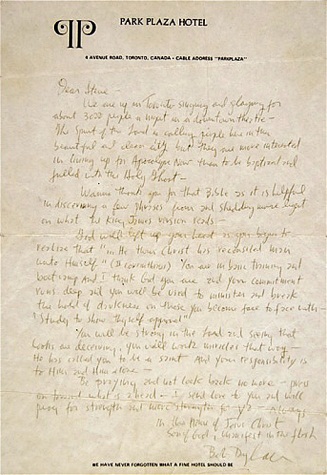
From the fantastic website Letters of Note ILYBYGTH recently dug up a missive by Bob Dylan dating from his Fundamentalist Phase.

In this April, 1980 letter, Dylan thanks his friend for a new Bible.  It’s not clear from the letter what edition the gift Bible was, but Dylan said the new edition helped him understand the King James Version.

Dylan wrote from Toronto.  His audiences, he said, heard the call of “the Spirit of the Lord,” but they were more interested in lining up to see Apocalypse Now than to be “baptized and filled with the Holy Ghost.”

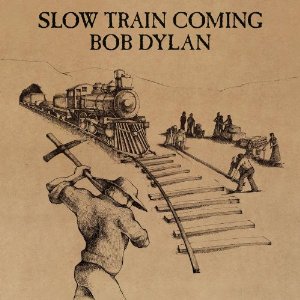
It’s news to me, but apparently any self-respecting Bob Dylan fan has long pondered the meaning of Dylan’s “Jesus Years.”  It seems between 1979 and roughly 1983, Dylan embraced evangelical Christianity and cranked out a few missionary albums, starting with “Slow Train Coming.”

The story goes something like this: in a drug-fueled crisis, with critics viciously panning his recent creative output, Dylan embraced the Word.  The meaning and sincerity of this period in Dylan’s life has been the subject of long debate among Dylan fans and other interested parties.  Some Jewish commentators have lamented Dylan’s apostasy.  Evangelicals have celebrated his recognition of their worldview.  But did he really mean it?  Some commentators conclude that Dylan blundered around his evangelical Christian faith just as he blundered through worlds of drugs and sex.  Others insist that Dylan later repudiated his Bible years as merely an unfortunate drug-fueled mistake.  Still others contend that Dylan represents the true power and healing grace of Biblical Christianity. 

A choppy documentary film about the “Jesus Years” seems only to have deepened the mystery and controversy.

Whatever fans and critics may conclude about the longevity of Dylan’s fundamentalism, this Toronto letter, at least, shows that for some stretch of time, Dylan talked the talk of evangelical Christianity.  His hopes for the Toronto crowds sound similar to those of any other fundamentalist preacher.

For ILYBYGTH readers, the meanings of Dylan’s fundamentalist years have different implications.  From one perspective, we can read Dylan’s conversion as an insight into the meanings of fundamentalist America.  When Dylan reached a late-1970s low, one of the preachers who understood his dark night of the soul, apparently, was Bill Dwyer of the evangelical Vineyard Fellowship.  At least according to documentary director Joel Gilbert, this Biblical outreach organization had become popular among the Southern California music scene, and Dylan fell into its outreach arm and embraced its apocalyptic message.

In this interpretation, the story demonstrates the often-surprising cultural power of fundamentalism.  Even in the midst of the famously Satanic rock-and-roll lifestyle, fundamentalism becomes a powerful cultural force.  Dylan and his associates were drawn to the inestimable power of Jesus’ saving grace.  It offered them a compelling personal, social, and cosmological message that made sense to them.  Fundamentalism, in this understanding, can hold its own among those most deeply immersed in the intensely hedonistic world of American celebrity.

Seen from another perspective, however, Dylan’s embrace of fundamentalist America can appear as nothing more than one drastic lifestyle choice at America’s all-you-can-take cultural buffet.  That is, Dylan clung briefly to fundamentalist Christianity just as he clung briefly to heroin, then later clung to fundamentalist Judaism.  Dylan chose Biblical Christianity, but other American celebrities fled from the intense despair of celebrity into the spiritual arms of yoga, veganism, Zen Buddhism, psychotherapy, or other anti-celebrity spiritual shelters.  In this reading, fundamentalist America is simply the rock to which a despairing Dylan clung.  It is not the bedrock of all American virtue, but rather just another option in an ultimately meaningless cultural panoply.  Dylan’s brief embrace of fundamentalist America only demonstrates, in this reading, the ways fundamentalism has lost its status as The One Truth.  Fundamentalism, in this reading, has become just another menu option for the spiritual thrill-seeker.

Whatever else it may mean, Dylan’s story can tell us something about the appeal of fundamentalist America to those outside its boundaries.  Whatever Dylan may have been experiencing as a crisis of the soul, when he reached out for the opposite, he found Bible-based evangelical Christianity.  To him­—and to generations of his fans and devotees—this kind of apocalyptic, Bible-based, aggressively proselytizing fundamentalist Christianity represented the opposite of everything he had stood for.  When his secular, hedonistic lifestyle led Dylan to an unsupportable personal crisis, he embraced fundamentalism as its shining opposite.

The Bible in American Public Life

What does the Bible DO in America? What does it mean for fundamentalists to say that the Bible used to be—and ought to be again—“America’s Book?” Let’s start by taking a quick look at some stories from history and culture that help demonstrate the complicated role played by the Bible in American public life.

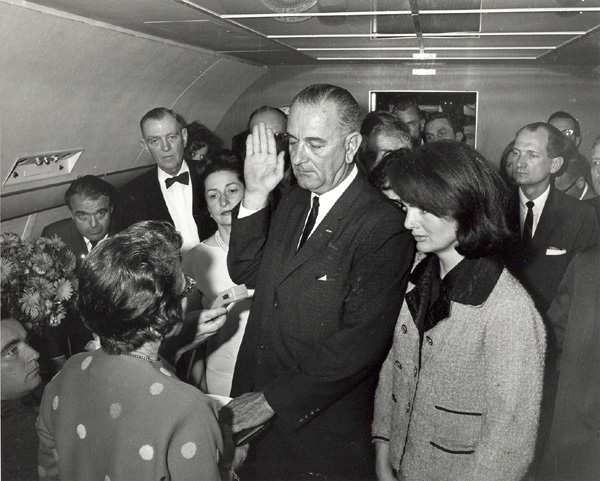
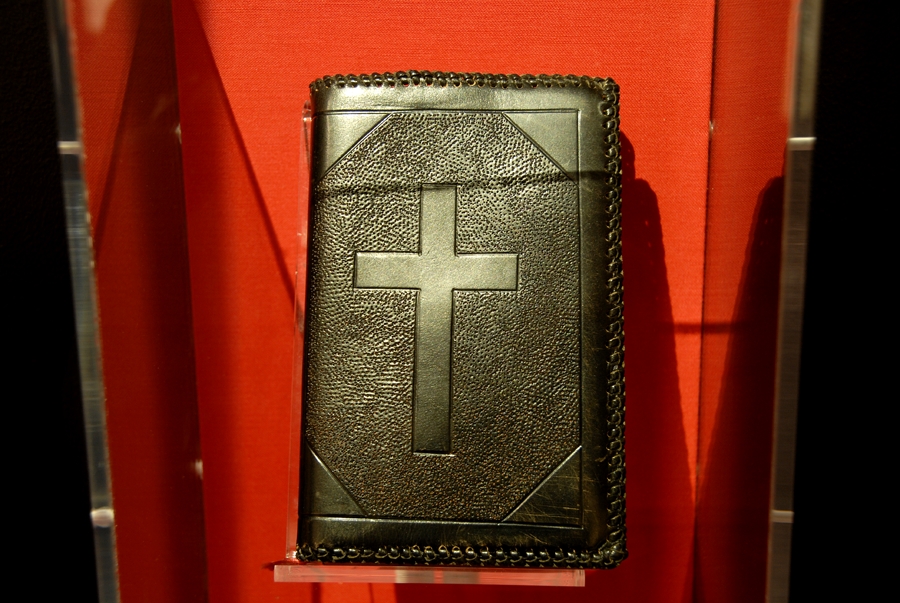
Story #1: November 22, 1963. With President Kennedy shot dead, the Secret Service scrambled to protect Vice President Lyndon Baines Johnson. He was hustled off to the airfield, riding low to keep his head down. Once Jacqueline Kennedy arrived, the swearing-in process went ahead on the overheated, overcrowded Air Force One. In order to make the inauguration official, a few things were required. They needed someone to perform the ceremony. LBJ tapped local judge and loyalist Sarah Hughes. They needed to record the ceremony for proof of its legitimacy. Someone found a Dictaphone that could serve in a pinch. And they needed a Bible. They searched the plane and found a Roman Catholic missal that had been a gift to the late President. It would do.

Story #2: Anywhere in America, anytime. Take a drive in any part of the country. Look at the road signs. If you’re lazy, just look at some maps. You can’t drive far without hitting a Bethel, or a Salem, or a Mt. Horeb, or any of a thousand more Biblical names.

But the question remains: so what? What does it mean that lots of people who founded towns often named them after Biblical places? What does it mean that in order for a President to be sworn in—even in desperate emergencies—people grabbed the Bible-est looking book they could find? Does this mean we live in a Biblical society? Or does it simply show that the Bible is a kind of inherited intellectual wallpaper for our culture?

Let’s take another look at our stories and see what we can deduce. First, what does it mean to have our physical landscape dotted with Bible-named towns? In the central New York region in which I live, these kinds of towns dominate the landscape. But they are not the only kinds of town names. Just a little north of me there is a cluster of towns named for ancient Greek places: Virgil, Ithaca, Marathon, Syracuse, and so on. One early settler, apparently, was a classics professor at Cornell and threw Greek names around. It doesn’t make the people who live there now any more Greek than living in “Manhattan” makes people Dutch or Algonquian.

Plus, it’s difficult to imagine many Americans these days really care about the Biblical roots of their landscape markers. In Wisconsin, for instance, Mt. Horeb is better known these days as the source of fancy mustard than as a descendant of the place where Moses received the Ten Commandments. Nevertheless, we must admit it tells us something about the Biblical nature of our public culture that so much of our landscape is identified this way. If place names are a jumble of history and culture, with places named for early settlers, for Indian names or mistaken interpretations of them, for strands from culture and religion…we must admit that the most common religious strand for these kinds of names is Biblical. If it doesn’t tell us much about life in Salem, or Bethel, or Mt. Horeb, it does tell us something about the cosmography of the first settlers of those towns. When they reached into their intellectual toolbox to find names for their muddy new towns, they found them in the Bible. Imagine, for instance, if those place names came from a different religious tradition. Instead of driving through Eden, Mt. Sinai, and Bethel, what if we drove through Singri, Bangalore, and Chitti? Of course, that would not make our culture Hindu any more than Biblical names makes it Biblical. But it DOES tell us something about the cultural and religious history of our landscape.

Fundamentalists might tell us that our culture is rooted in the Bible and Biblical place names are evidence of the deep organic roots of Biblicism in American culture. They might argue that the town founders of places like Mt. Horeb established themselves as the successors of Old Testament populations trembling in the felt presence of a Living God. Even if we disagree, I think it goes too far to dismiss the importance of the sacred history of our named landscape too blithely. Along with other important cultural roots, the Bible has stamped its cultural importance on our maps. It might not make the people living there Biblical, but it demonstrates at least that one of the wellsprings of American culture has long been the Bible.

But what about LBJ? Why does it matter that he was sworn in on a Catholic missal? As politico Larry O’Brien later remembered, the scene on Air Force One was chaotic. It was hot, overcrowded, somber, and anxious.

 There was a sense of trauma and threat. As the plan coalesced to inaugurate LBJ right then and there, aides scrambled to provide the officiating judge with a Bible. That, after all, had been the tradition. Though recent scholars and activists have insisted that Washington never really did so, (see comments below) most of the folks on Air Force One likely believed that Washington had added “So help me God” to the Oath of Office, then bent humbly to kiss the Bible.

Despite what later conspiracy theorists might claim, there is no Constitutional reason why LBJ—or any President—really needed a Bible to make the Oath official. The first President Roosevelt, for instance, did not use a Bible for his swearing-in, nor did John Quincy Adams. But as in so many things Presidential, tradition meant at least as much as Constitutionality.  Whether it began with Washington or only with Chester Arthur in 1881, the Kiss-the-Bible-So-Help-Me-God tradition has persisted through the twenty-first century.

So in order to make LBJ’s inauguration feel more official, more legitimate, the folks on Air Force One that November day felt they needed a Bible. But here’s the kicker: they didn’t use one. Instead, they found a Roman Catholic missal that President Kennedy had on board the plane. According to Larry O’Brien,  he assumed at the time that it was a Bible. After all, it had all the markings: a leather-y binding, a prominent cross on the cover.

So what does this mean for understanding the role of the Bible in Fundamentalist America? Like Biblical place names, it is a complicated story. First of all, it demonstrates the powerful symbolism of the Bible as America’s official book. To become President, it is traditional, though not required, to swear on a Bible, or even on two, as did Ike, Truman, and Nixon. So, in other words, when it comes to important, official acts, a Bible is the most prominent public book in America.

Consider other possibilities. The President might swear an oath on the Constitution. That, after all, is the document the new President is promising to defend. Nevertheless, in our tradition, when any promise is meant to be serious, it is sworn on a Bible, or even a stack of them. But when people on Air Force One found a Bible, it wasn’t actually a Bible at all. A missal is a collection of prayers connected to the Catholic sacred calendar. It is a religious book, to be sure, but not actually a Bible. Yet no one on Air Force One cared, or thought to check to make sure the book was an actual Bible. That tells us something about the role of the Bible in America’s cultural imagination. A Bible, for those folks on Air Force One, meant a religious book, a physically big book with a cross on the cover. They wanted, in other words, something that LOOKED like a Bible. It didn’t need to contain the actual words of the Bible to serve its purpose as an officializer of the inauguration. The Bible, in this context, is more of a symbol of a Bible than an actual collection of specific sacred scriptures.

This is not the way Fundamentalists think of the Bible. For Fundamentalists, the words of the Bible matter. The fact that Presidents take their oaths of office on a Bible may reassure Fundamentalist America that their Bible is (still) America’s official book. But for lots of other Americans, the Bible is just a symbol of a big, official-looking, historic-looking book. The words themselves don’t really matter. Presidents, in this view, are not swearing to enforce Biblical truths, but only following a quaint but harmless tradition in taking an oath on a Bible. This complicated double meaning of the Bible in public life will be the subject of the next few posts here at ILYBYGTH. At the very least, we agree that the Bible is not just another book for Americans. The Bible, like Biblical place names, has a unique role as part of the cultural wallpaper of American life. But not necessarily as the religious guidebook that Fundamentalists want it to be.

INTRO: God Hates . . . Figs? The Bible as America’s Book

If you log your required hours on Facebook, you’ve probably already seen this one.  The provenance of this photo isn’t clear, but it has been flying through many of the interweb’s tubes lately.  I got it from the site Stuff Fundies Like  The folks there speculate it must have come from an annual Peeps diorama contest.  Makes sense.  Who else would spend the time?

I’m including it not only because it’s hilarious, but because it helps me introduce ILYBYGTH’s newest thread: Why do fundamentalists care so much about what the Bible says?  For non-fundamentalist Americans, it seems like a bizarre fetish.  Why, after all, would we base our public policies on a group of texts from a relatively obscure bunch of herders writing their ancient prohibitions thousands of years ago in the dust and dismay of the Jordan River valley?  Why should the science curriculum in our children’s schools be influenced by the creation myth of one obscure group of ancient people?  The criticisms seem too easy to bother to make.  Perhaps we could similarly ban exploration of the North Pole since it will disrupt the operations of Santa’s Workshop?  Maybe a powerful faction of our government could get together weekly for ‘Fairy Breakfasts’ to discuss the use of the Tooth Fairy as a non-governmental supplier of dental care?

Yet unlike these other quaint myths, the Bible does play a significant role in guiding contemporary American politics and culture.  Those who indulge in snarky critiques of Bible believers—Peep-based or otherwise—are really the ones who have a fundamental misunderstanding of American culture.  Through the late twentieth century, according to Gallup polls, roughly one-third of Americans agree that “the Bible is the actual word of God and is to be taken literally word for word.”  In addition, roughly one-half of Americans believe that the Bible is the inspired word of God, though perhaps not literally true word for word.  In 2000, when asked, “Do you believe the Bible answers all or most of the basic questions of life, or not?” 65% of respondents answered yes.  The corollary is obvious: there is a strong public sentiment in the US of A that the Bible should somehow be included in all decisions, public and private.  A significant proportion of citizens do not find it odd to use this collection of ancient Hebrew writings to make twenty-first-century policy decisions.

Posts on this thread will explore the reasons for this widely shared belief.

  • First, ILYBYGTH will look at the history of the Bible in public life.  How has it been used as a textbook in American public schools?  What does it mean that one of the most pressing emergencies on November 22, 1963, a day seared into national consciousness, was to locate a Bible so that LBJ could be sworn in as the new President on Air Force One?
  • Next, posts will delve into reasons why fundamentalists care so much about it.  Why do fundamentalists insist that the Bible should be allowed to dictate public policy?  Why do they think the Bible must remain the guide, moreover, to our understanding of science and humanity?
  • Third, ILYBYGTH will look at the ways the Bible has been seen as a universal panacea.  Historically, fundamentalists have seen the Bible as a literally miraculous book.  The merest exposure to its pages, many fundamentalists believe, can convert the ignorant to fundamentalism.  Similarly, reading the Bible has been seen as an inoculation against all forms of spiritual danger and doubt.
  • And finally, at the end of all times, we’ll explore the end of the world, Bible style.  We’ll look into different readings of Bible prophecy and predictions of the apocalypse.  Such prophecies have tended to focus the fundamentalist mind on the tricky question of Biblical interpretation.  For most fundamentalists, one of the Bible’s unique powers is that its meaning is clear to all readers.  So how have so many earnest interpreters differed on such key questions as the end of all times?

Of course, this plan is subject to change and digression.  And new Bible questions are welcome from readers and commentators.  If you consider yourself a Bible believer, why do you think the Book has such supreme importance?  If you’re a skeptic, how do you feel about fundamentalist insistence on the Bible as the source of all knowledge and true wisdom?


ANTI-EVOLUTION Ib: Poor Results II

For biblical Christians, however,the question is not so simple.  As evolutionary ideas became more influential, a large segment of Christians concludedthat such ideas were not compatible with their scriptural beliefs.  Some critics (including this author in an upcoming post) may argue that anti-evolutionreligious beliefs only developed recently, and that they therefore are not essential parts of traditional belief systems. But that argument doesn’t recognize that anti-evolution beliefs naturally only developed as the evolutionary threat became more culturally powerful.  Why would traditional Christians develop an anti-evolution theology before they had to?  Why would biblical Christians consider the importance of their special creation beliefs when such beliefs were unchallenged?

In short, biblical Christiansbelieve that the Bible is God’s instruction book for human living.  It is essential—not optional but
essential—that every part of it be respected and heeded.  God gave this book to humanity.  God wanted humans to use this book as their
path to salvation.  The Bible, in one way of explaining it, was God’s invitation to humanity to join him in blessed eternal life.

Any idea that contradicts thewords of that Scripture must be not only wrong, but pernicious.  The Bible clearly and concisely explains theorigins of life, including human life. Any merely human idea, such as evolution, that contradicts that biblical explanation does not even need to be considered.  It must simply be rejected.

Although it is not usually a goodidea for humans to try to deduce divine reasoning, this case almost shouts out for such an explanation.  We can see in the social results of widespread evolution education an example of what can happen when humans ignore God’s rules and try to substitute rules of their own.  God gave humans the Truth.  That truth was not only true, but healthy for humans to understand and believe.  When more people were taught biblically, society was less disgusting.  When more people were taught that humans were
created by a loving God, s ociety was less similar to a zoo with no cages.

Even for those who are not impressed with a scriptural argument, however, evolution education should still be understood as a deadly threat.  Even if one is not convinced that the Bible or other holy writ must be the starting place for our understanding of humanity and the universe, the notion that children today are educated in a way that is starkly different from the past should give one pause.  Because even if we are convinced of the basic truth of evolution, we can’t help but notice that it is a fundamentally different way of understanding humanity.  It has been taught to generations of American kids, now, without an adequate understanding of the moral revolution that it
implied.

It might be easier to understand the problem if we imagine a little more intellectual distance, a different perspective.  Consider how you felt when you read about the religious worldview of an isolated Amazon culture suddenly attacked by modern western culture.  The Yanomamo, for instance.  Just as with other cultures that have been overwhelmed by Western Euro-Americanism, the path of this
previously isolated group was depressingly predictable.  The people descend into alcoholism and depression.  Suicide and crime rates
shoot up.  Young people spend their days huffing glue and cutting their arms.  Their fundamental cultural norms were shattered; their traditional explanations of life and the universe no longer hold up.
There is no longer any compelling reason for young people to exert themselves.  They look, instead, for animal pleasures to fill the void.  And the obvious question becomes: Why is it bad when it happens to them, but acceptable when it happens to your own culture?

ANTI EVOLUTION I: FURTHER READING

William J. Bennett, The Index of Leading Cultural Indicators (New York: Simon & Schuster), 1994; Richard Dawkins, “Put Your Money on Evolution,” The New York Times Review of Books, April 9, 1989, pp. 34–35; Arnold B. Grobman, The Changing Classroom: The Role of the Biological Sciences Curriculum Study (New York: Doubleday, 1969); Gerald Skoog, “The Coverage of Human Evolution in
High School Biology Textbooks in the 20th Century and in Current State Science Standards,” Science and Education 14 (2005): 395-422.