Join ILYBYGTH for the Debate

You know you’re going to watch the debate tomorrow between young-earth creationist Ken Ham and science popularizer Bill Nye.  So why not join us as we live-blog throughout the event?

It will be streamed live at 7 PM New York time and will be found at debatelive.org.

We will offer live commentary and invite readers’ comments as the debate moves along.

We’ll be especially interested to see what sorts of arguments each speaker will bring out.  As we’ve discussed before, this debate might have the effect of imposing a limited definition on the meanings of “creationism.”  But will it?  Watch it with us and let’s see.

Creation Debate Update: Squeezing Out the Middle

Forget the Super Bowl.  Next Tuesday, February 4th, at 7 PM New York time, we’ll all be watching the debate between young-earth creationist Ken Ham and science popularizer Bill Nye.  It looks as if Nye and Ham agree on their goals: squeezing out the middle.  Both debaters want to draw attention to young-earth creationism, and their agreement threatens to exacerbate the divide between evolution and creationism.

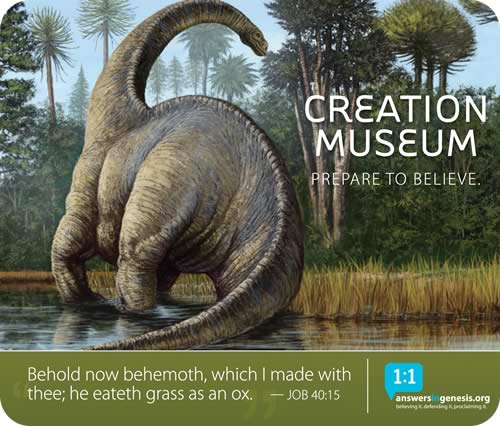
The debate host, Answers In Genesis’ Creation Museum, will be streaming the action live for all of us to see.

Ken Ham has suggested that the debate might be a perfect learning opportunity for teachers and students in public school science classes.  From Ham’s point of view, this debate might be a chance to reach students who might not otherwise be aware that mainstream evolutionary science is full of holes.

Bill Nye, too, has explained his reasons for engaging in this debate.  In these pages and elsewhere, evolution-education mavens have wondered if this debate only legitimizes the dead science of the young-earth creationists.  As “The Science Guy” explained, “I don’t think I’m going to win Mr. Ham over.”

So why debate?  Nye says, “I want to show people that this belief is still among us. . . . It finds its way onto school boards in the United States. . . . I’m not going in as a scientist as such . . . I’m going in as a reasonable man.”

So it seems both debaters have the same goal.  Both men want to make people aware of the claims of young-earth creationism.  From Ham’s perspective, such awareness will help keep smart young Christians from leaving the faith.  From Nye’s point of view, if people know what creationism is, they will help fight against it politically.

With such agreement, it seems likely both debaters might succeed.  This debate might elevate the profile of young-earth creationism.  One casualty, it seems, will be other visions of creationism.  Ken Ham’s brand of young-earth creationism, after all, is only one extreme form.  Many religious people believe that humans and life were created at some point by God.  But they do not believe that they must discard the findings of modern science.  The folks at BioLogos, for example, insist that fervent Biblical Christianity can go hand-in-hand with mainstream evolutionary science.  And “old-earth” creationists such as Hugh Ross agree that God did it all, but they don’t insist that he did it only 6,000 years ago.

If this debate succeeds—at least according to the goals of both Ken Ham and Bill Nye—those “other” creationist belief systems will likely get squeezed even further out of the conversation.  That’s a shame.  Too many observers already equate “creationism” with young-earth creationism.  It may make for more lively debates, but it makes for less productive and civil conversations.


What Should The Science Guy Say?

It’s coming up. 

In just a few short weeks, Bill Nye “The Science Guy” will debate the scientific premise of creationism with Ken Ham at Answers In Genesis’ Creation  Museum.

What should Nye say?

Science writer Greg Laden offered this morning a short list of points he’d like Nye to make.  In general, Laden suggests that Nye focus on the unscientific nature of creationism.  The debate over divinity was real and important in the history of science, Laden points out, but that debate has come and gone.  Laden doesn’t use the phrase, but his argument is reminiscent of philosopher Philip Kitcher’s definition of creationism as “dead science.”  In this vision, it makes no sense to debate the science of creationism, since creationism is not even bad science.  Creationism, rather, represents an understanding of science that has been thoroughly and completely discredited.    

Laden’s debate prep brings up two important questions.  First, what would people advise Ken Ham to say?  And second, do we agree with Laden’s advice to Nye?

First things first: What do you think Ken Ham should say?  For those of us who live mental lives outside the boundaries of religious creationism, is there anything he could say that would convince us that his creation science should be taken seriously?  For me, the answer is no.  I’ve defended Ham in the past and taken heat for it from ardent anti-creationists.  But in this case, I’ll be flummoxed if Ham uses any arguments beyond his scriptural stock-in-trade.  That is, I don’t guess Ham will try to convince people like me who are not moved by references to Biblical passages. 

I’m thinking Ham will likely harp on the scientific merits of young-earth creationism, when in fact his argument would be much stronger if he tried a different approach.  To people like me, at least, Ham’s scientific credentials have no leg to stand on.  But as religious dissenters young-earth creationists can claim much more wiggle room in education and culture.  If Ham wanted to reach out to people beyond the ranks of his current religious supporters, he should argue for creationists’ rights as aggrieved minorities, as a religious group, not as a contender for scientific legitimacy. 

But Ken Ham is not likely to take this approach, since he has built his career on the promise that young-earth creationism is better science than mainstream science.  He will likely trot out his compelling but ultimately vacuous arguments about observational science vs. historic science.  He will likely ask Bill Nye some variant of his ultimately senseless question: “Were you there?”  If Ken Ham hopes to maintain his role as the charismatic leader of the young-earth creationist movement, he can’t really do anything else. 

Question two: What should Nye say?  I don’t think Laden’s advice is the first best answer.  IMHO, the most effective answer to young-earth creationists such as Ken Ham is a theological one, not a pop-science one.  As do the folks at BioLogos, I think the most effective message young-earth creationists need to hear is that Biblical faith does not require faith in a young earth.  As science pundits tend to agree, young-earth creationism is not really science, it is something else.  It is an outgrowth of a particular religious understanding.  Therefore, the strongest arguments against it are religious, not scientific. 

Also, I don’t think Nye should use his precious exposure to creationists to blast the dead-science nature of young-earth creationism.  Many creationists will expect a hostile attack on their belief system.  They will not be moved by it.  They will not be convinced by it, since they will not credit its source.  I think it will be more effective for The Science Guy to do what he does best: explain what science is.  Young-earth creationism is based on a very different way of defining knowledge.  If Bill Nye can explain what real science is—instead of attacking the reasons why young-earth creationism doesn’t meet that definition—he can expose some of the creationists in the debate audience to a very different way of understanding the entire debate. 


To Debate or Not to Debate

Bill Nye and Ken Ham will be going a few rhetorical rounds next month.

The mega-popular science educator will broach the creationist lion’s den of the Creation Museum on February 4th.  The topic: “Is creation a viable model of origins in today’s modern scientific era?”

Image Source: Answers In Genesis

Image Source: Answers In Genesis

Are these debates worthwhile?  In the past they had decisive impact on the formation of American creationism and fundamentalism.  But these days such debates are a different animal.

Science pundits don’t like it.  Jerry Coyne warned that Bill Nye will only be putting money and legitimacy in Ham’s deep pocketsPZ Myers wisely concludes that each side will likely only speak past the other.

I agree.  The audience at this debate will likely not be moved by either man’s arguments.  No matter how scientifically accurate or biblically flawless, logical arguments tend not to be the deciding factor in determining one’s beliefs about human origins.

As David Long’s ethnography demonstrated so powerfully, creationists can thrive in mainstream scientific environments without abandoning their religious ideas.  Many creationists have simply been taught to regard mainstream scientists as deeply flawed and bumbling fools.  It is easy to dismiss plausible-sounding talk from someone we have already deemed unreliable.

It’s hard to imagine Ham’s Cincinnati audience won’t be prepared to dismiss Nye’s mainstream science talk out of hand.  I assume Nye is hoping that he may still plant a few seeds of science doubt in the minds of those who hear him.  Not much reason to offer Ham such a plum chance to look like a reputable scientific authority.

At the start of America’s public evolution/creation battles, this legacy of public debating functioned much more powerfully, since creationists had not yet set up alternative institutions.  As I describe in my 1920s book, some of the most influential creationists of the 1920s received humiliating public trouncings in popular debates.

At a talk on the campus of the University of Minnesota, for example, fundamentalist leader William Bell Riley found himself surprised by a student prank.  Someone lowered a monkey onto the stage as Riley tried to convince his audience that creationism was reputable science.  “Every time I hear the argument that this is a controversy between experts on the one hand, and, as someone has said, ‘organized ignorance,’ on the other, I smile,” Riley told the St. Paul Pioneer Press in 1927.  “This is not a debate between the educated and the uneducated.”

Similarly, in London, creationist godfather George McCready Price found himself hooted off the stage in the days following the 1925 Scopes Trial.  He had tried to tell the merciless audience that the theory of evolution was doomed as mainstream science.  Such flawed science, Price insisted, may have worked fine

for the times of comparative ignorance of the real facts of heredity and variation and of the facts of geology which prevailed during the latter part of the nineteenth century; but that this theory is now entirely out of date, and hopelessly inadequate for us. . . .  We are making scientific history very fast these days; and the specialist in some corner of science who keeps on humming a little tune to himself, quietly ignoring all this modern evidence against Evolution, is simply living in a fools’ paradise.  He will soon be so far behind that he will wake up some fine morning and find that he needs an introduction to the modern scientific world.

The audience didn’t buy it.  Price found himself heckled so mercilessly that he could not complete his presentation.  That London debacle was Price’s last public debate.  After that experience he focused his considerable energy on founding alternative scientific institutions to prevent future creationists from needing to convert mainstream scientists.

Back in those days, creationists and fundamentalist scientists still attempted to tell audiences that they represented the true mainstream of scientific discovery.  Such early creationists eagerly debated in a variety of settings in hope of convincing middle-of-the-road audiences that evolutionary science was not real science.

In that context, public debates held promise for both sides.  Creationists hoped to prove that they had better science.  Evolutionary scientists hoped to demonstrate the scientific vapidity of creationism.

These days, both sides have hardened.  Creationists these days are not unaware of the fact that their science does not represent the scientific mainstream.  Evolutionary scientists are not hoping to relieve creationists of their naïve ignorance.

Rather, both sides in these debates enter and exit with the same set ideas.  Each side knows who to trust on that stage and who to ignore.  No matter how persuasive Ken Ham can be, he doesn’t really hope to change Bill Nye’s mind.  Rather, this exercise merely serves to give each charismatic speaker the chance to gain a sliver of legitimacy and respectability in the opposite camp.


Is This Child Abuse?

Arch-creationist Ken Ham wants to train up a spiritual army of young Christian creationists.  Does that count as child abuse?

I’m no creationist, but I just don’t think so.

Ham trumpeted the training of a new generation of young “soldiers” at an Answers In Genesis conference at Atlantic Shores Baptist Church in Virginia Beach, Virginia.  By teaching young people the truths of young-earth creationism, Ham claimed he was “preparing them for the spiritual war going on around us.”

Image Source: Answers in Genesis

Image Source: Answers in Genesis

This language of child soldiers makes me nervous.  Plus, I don’t like the notion that young people are being turned away from real evolutionary science by this sort of religion posing as science.  To me, this seems like another painful example of the ways faith has been tangled unnecessarily with real evolutionary science, resulting in bad science and tortured theology.

But it is child abuse?

Leading skeptics have called it that, folks such as physicist Lawrence Krauss and biologist Richard Dawkins.  They assert that cramming this false science down young people’s throats counts as abuse.

Let’s look at both sides of this argument.

Why might someone call this child abuse?

1.)    These young people are being told things are true, when they really aren’t.  They are being taught, to cite just one example, that dinosaurs and humans coexisted a few thousand years ago.  Worst of all, relationships of close trust between parents, teachers, and children are being exploited to promote the veracity of this false science.  Loving mothers, loving fathers, caring teachers tell innocent young people that this is scientific truth.  Ingenuous young people take their word for it.  Such deception is abusive.

2.)    In this essay, Ken Ham explicitly calls them soldiers—spiritual soldiers, but soldiers nonetheless.  This seems a terrible violation.  Young people should not be exploited as culture-war cannon fodder.

Why might defenders disagree?

1.)    There is no threat or coercion here.  Though it may come as a surprise to outsiders like me, Answers In Genesis makes it very clear that believing in a young earth and recent special creation are not required for Christian salvation.  In other words, Ken Ham and his colleagues do not threaten young people with terrifying visions of hellfire if the children don’t embrace creationism.

2.)    The parents and teachers seen here are apparently sincere in their belief that creationism is true.  They are trying to pass that truth to their children and pupils.  There’s nothing abusive in passing along the best knowledge to the next generation.

3.)    Though science pundits such as Bill Nye have argued against it, believing the young-earth creationism of Answers In Genesis will not hurt the life chances of these young people.  According to Gallup polls, nearly half of American adults share a belief that humanity has only been around for a few thousand years.  And as I’ve argued elsewhere, careers in science-related fields do not seem thwarted by a belief in young-earth creationism.  Consider the case of US Representative Paul C. Broun Jr. of Georgia.  Broun is a fervent creationist, a medical doctor, and a member of Congress.  Not a bad career!

Image Source: Answers In Genesis

Image Source: Answers In Genesis

Is it child abuse?  No.  And calling it that is irresponsible.  After all, there is real child abuse out there.  It is horrific and terrifyingly common.  Calling this sort of science/religion education ‘child abuse’ is only an ill-considered scare tactic.

Perhaps this argument could use some illustration from another religious tradition.  Consider the recent career of child abuse in the Catholic Church.  As we all know only too well, the despicable actions of some priests and prelates in that church have caused untold suffering.

But the abuse perpetrated by members of the Catholic Church does not extend to its anti-scientific teachings.  After all, the Catholic Church teaches young people that certain wafers and wine can magically transform into flesh and blood.  And then young people are taught to eat that flesh and drink that blood.  For outsiders like me, teaching children to engage in this sort of ritual cannibalism is creepy and anti-scientific.  It is also demonstrably false: the wafers and wine are always really just wafers and wine.  Nevertheless, it is not child abuse for Catholics to teach their children this mystery of transubstantiation.  Calling such teaching ‘child abuse’ would disrespect the real suffering that real child abuse has caused within the Catholic Church.

A similar logic may apply in this case.  The young-earth creationism peddled by Answers In Genesis is not true.  But it is sincerely believed by its adherents.  Teaching those ideas to young people is not child abuse.

Unfortunately, we can picture what real abuse might look like in similar cases.  As Billy Graham’s grandson has pointed out recently, evangelical Protestant organizations have also engaged in real child abuse.  They have conspired, just as did the Catholic hierarchy, to cover up that terrible real abuse.  We could imagine a scenario in which a Protestant organization such as Answers In Genesis called together thousands of children and abused some of them.

But that is not the case here.  This was an educational gathering.  To call it ‘child abuse’ makes a mockery of the all-too-real threat of abuse.


Evolution Down Under

Every once in a while, we hear an intelligent but deluded science pundit tell us that the United States is the only industrialized country with a significant creationist population.

It’s just not true.

A survey released recently by the Australian Academy of Science gives us some clues about the prevalence of anti-evolution thought Down Under.

Thanks to the National Center for Science Education’s blog, we hear about this survey of just over 1500 Australians.

The survey is not quite what we would hope for.  We would like to hear more specific questions about Australians’ beliefs about evolution.  This survey asked respondents if they thought evolution was occurring today.  Nine percent answered that they did not believe in evolution.  Another ten percent answered that evolution is not occurring today.  Twelve percent said they were not sure, and seventy percent thought evolution was occurring today.

These answers don’t tell us all we would like to know.  For instance, it is entirely possible—likely, even—that an informed young-earth creationist would answer that evolution was occurring today, in many ways.  Creationists often distinguish between “macro-“ and “micro-“ evolution (a distinction that drives mainstream scientists bonkers).  Such folks can happily agree that evolution is occurring today without agreeing that the earth is older than 10,000 years.  They can agree that evolution is going on now without agreeing that God did not create humanity in a literal week roughly 6,000 years ago.

In addition, other sorts of creationists could also agree that evolution went on today.  There’s no reason why intelligent-design mavens, believers in old-earth creationism, or “evolutionary creationists” would disagree that evolution was occurring right now.  But such agreement doesn’t tell us enough about the contours of anti-evolution thought, in Australia or anywhere else.

Another intriguing question from this survey asked respondents if humans lived at the same time as dinosaurs.  Just over a quarter (27%) of respondents thought that early humans lived at the same time as dinosaurs.  Of course, this question, too, leads to more questions.  Do such respondents believe in the Answers-in-Genesis sort of human/dinosaur cohabitation?  Or are they simply misinformed about the way life began?

One thing seems clear from this survey.  Significant percentages of Aussies, for whatever reason, do not agree with fundamental tenets of mainstream science.  Sorry, Bill Nye, but creationism is not “unique” to the United States.


Science at the Creation Museum

Thanks to the ever-watchful Sensuous Curmudgeon, we came across a recent article in Scientific American in which an evolution-believing science teacher journeyed to Answers in Genesis’ Creation Museum outside of Kentucky.

Image Source: Answers in Genesis Creation Museum

Image Source: Answers in Genesis Creation Museum

For folks like me and the author Jacob Tanenbaum, the scientific claims of the museum are impossible to accept.  A science teacher, Tanenbaum recoiled at the misleading scientific claims made by the museum.  “What disturbed me most,” Tanenbaum reported,

“was the theme . . . that the differences between biblical literalists and mainstream scientists are minor. They are not minor; they are poles apart. This is not to say that science and religion are incompatible; many scientists believe in some kind of higher power, and many religious people accept the idea of evolution. Still, a literal interpretation of Genesis cannot be reconciled with modern science.”

Fair enough.  During my trip to the Creation Museum, though, what struck me most powerfully was simply how plausible it all seemed.  For those who did not set out to debunk the information, the museum seemed just as authoritative as Chicago’s Field Museum or any other natural-history museum.

But what Tanenbaum wrote makes sense: the Creation Museum presents a misleading picture of the differences between creation science and mainstream science.

My beef with Tanenbaum is with his own misleading conclusion.  The problem with such creation science education, Tanenbaum argues, is “that 40 percent of the American electorate seems to have forgotten what science is. Considering that our nation put a man on the moon and invented the airplane and the Internet, this development is extraordinary.”

Tanenbaum may be a gifted teacher of mainstream science, but this conclusion suggests that he is not deeply versed in the culture of creation science that he condemns.  For those of us who want to understand creationism, we need to get beyond this naive assumption that creationists don’t know what science is, or that they are somehow hypocritical in their use of technology.

As I argued in a recent commentary in the Chronicle of Higher Education, simple ignorance does not explain American creationism.  Many creationists have studied mainstream science.  In many cases, such as that of leading creation science author Henry Morris, they have earned advanced technical degrees.  And, beyond such stand-out leaders such as Morris, many rank-and-file creationists have extensive science educations.  As political scientists Michael Berkman and Eric Plutzer discovered in their National-Science-Foundation-funded study of high-school biology teachers, of those teachers who espoused a belief in young-earth creationism (i.e., the Creation-Museum type of creationism), fully 55% had earned college degrees in science.   Furthermore, Berkman and Plutzer’s review of other such surveys led them to the following conclusion: “the overall evidence suggests that the high support for creationism in the classroom cannot be attributed primarily, or even substantially, to overall scientific illiteracy in the United States” (pg. 52).

Also, as creationists often remind themselves and their evolutionist foes, belief in evolution is not necessary for sophisticated engineering.  Dobzhansky’s claim that nothing in biology makes sense except in the light of evolution may be true, but that would not stop creationists from traveling to the moon, perfecting airplanes, or inventing the internet.

In the end, I think it makes a big difference whether Americans with creationist beliefs have “forgotten what science is” or if they have a distinctly different definition of science.  Building an anti-creationist argument on the foundation that creationism disables technical education, as does Tanenbaum and other prominent pro-science voices such as Bill Nye, is both a false claim and poor strategy.

Please don’t misunderstand me: this is not a brief for creationism.  However, if those of us, like me, Bill Nye, and Jacob Tanenbaum–who stand outside the borders of creationism looking in–if we really want to understand creationism, we must abandon our own naive assumptions about the meanings of that creationist belief.

ILYBYGTH in the Chronicle of Higher Education

Hot off the presses!  I’m happy to say that the Chronicle of Higher Education is running a commentary of mine in this morning’s edition.

Readers of ILYBYGTH might not find much new in this piece.  I argue that many evolution educators display a woeful and unproductive misunderstanding of creationism.  For instance, evolution supporters generally assume that creationists such as US Representative Paul Broun must be utterly ignorant of science.  In fact, Broun and many other creationists often have degrees in science.  Broun, for instance, has a BS in chemistry and an MD.

As political scientists Michael Berkman and Eric Plutzer have demonstrated, creationists often know plenty about evolution.  Creationists just don’t believe it.

Another tricky point about Representative Broun’s particular style of creationism rests in the nature of representative democracy.  As I ask in the CHE piece, “Do we really want to demand than an elected official not fight for the ideas in which his constituents believe?”

I also appreciate the comments on the online CHE article.  There are some of the usual displays of huffy antagonism.  For instance, one reader suggested that the best lenses to understand creationism would be “abnormal psychology” and “cult theory.”  But other commenters raised more intriguing points.  One suggested that the real issue is that American education tends not to teach students anything they don’t know already.  Another pointed out that any teaching that seems to come between parents and children will be resisted.

I’ll look forward to reading more comments as they come in.  Especially since many of them make excellent counter-arguments.


Creationists Excel in Science

What’s wrong with teaching creationism?  Some folks say creationism will block America’s students from learning science.  I oppose the teaching of creationism as science in public schools, but this argument does not hold up.  As uncomfortable as it might be for non-creationists like me, we need to abandon the false argument that creationism is incompatible with learning science.

We see it now and again.  For instance, in a recent editorial in Church & State, Americans United for the Separation of Church and State insisted that creationism “leaves youngsters woefully unprepared for the demanding science courses many of them will encounter in college.”

Similarly, in his recent Youtube video against creationism, Bill Nye “The Science Guy” insisted that creationism would cripple science education.  “I say to the [creationist] grownups,” Nye announced,

“if you want to deny evolution and live in your world, in your world that’s completely inconsistent with everything we observe in the universe, that’s fine, but don’t make your kids do it because we need them. We need scientifically literate voters and taxpayers for the future. We need people that can—we need engineers that can build stuff, solve problems.”

This is a powerful argument.  We must teach science well and thoroughly, otherwise young people will not be able to understand the world.  Young people robbed of scientific education will not be able to contribute to society.

Unfortunately for those of us who want to promote more comprehensive evolution education, this argument does not hold up when we examine it closely.  Turns out creationist students can do just fine with science.  We need to grapple with this inconvenient truth.  It seems that—somehow—creationists do fine with science.

Consider a few examples.

From the recent headlines, US Representative Paul Broun received a lot of criticism for his comments that evolution, along with embryology and the Big Bang, were “lies from the pit of hell.”  Many of Broun’s critics insisted that Broun was utterly ignorant of science.  Now, I don’t agree with Broun’s ideas about evolution or astrophysics.  But we non-creationists have to acknowledge that Broun, an MD with a bachelor’s degree in chemistry, is not really utterly ignorant of science.  He certainly understands it differently, but it is a false refuge to conclude that he is simply ignorant.  He has been educated in science.  It appears he somehow chooses creationism in spite of this education.

Or take one of the most famous creationists of the twentieth century, Henry Morris.  In spite of Bill Nye’s lament that creationism will block the flow of “engineers that can build stuff,” Morris held a PhD in hydraulic engineering from the University of Minnesota.  At the same time, Morris led the way for a new sort of creationism with his books and institutional leadership.

There are other leading creationists with scientific credentials.  Kurt Wise, for instance, earned his PhD in geology at Harvard.

But we non-creationists could take some solace from the notion that exceptions are always possible.  We could tell ourselves that a few outliers do not prove that creationism is somehow compatible with scientific education.  Like the folks at Project Steve, we could take comfort from the fact that overwhelming numbers of scientists DO embrace evolution.

However, those who have looked closely at the broader picture suggest that creationists often do just fine with mainstream science education.

Political scientists Michael Berkman and Eric Plutzer, for instance, found in their large-sample survey of high-school biology teachers that many self-professed creationists had completed lots of college-level science classes.  Of the teachers who professed a belief in young-earth creationism, 32% had completed a full-semester course in evolutionary science.  More than one in ten (13%) held a graduate degree in science.  Almost half (49%) had earned forty or more college credits in biology.

These creationists managed to do fine in what Americans United called “the demanding science courses” in college.  The creationist teachers, to evolutionists’ chagrin, must be acknowledged to be among Bill Nye’s “scientifically literate voters.”

Clearly, something else is going on here.  For those of us outside the circle of creationist thinking, it is difficult to understand how creationists can combine the utterly unscientific notions of a young earth with such widespread success in the highest levels of academic science.  How do they do it?

David Long’s ethnography provides at least one clue.  Long studied creationist students enrolled in a secular biology program at a large public university.  The results suggest some disturbing lessons for those of us who want a more thorough evolutionary education.  As one of his informants described, doing well in college science classes was a snap.  “I take those really big classes,” this student informed Long,

“because it’s really easy to excel in those huge classes.  I mean, I got like a hundred on every test.  You have to be an idiot pretty much not to.  If you just sit, and you listen to what they’re saying, and you know how to take tests, it’s very easy to do well in those classes.”

Long’s ethnographic study can’t tell us how common this experience is among creationist students.  But it suggests a far more complicated educational reality than the black-and-white schemes suggest by Bill Nye and Americans United.  In a nutshell, creationists do fine in college science classes.  They do fine in science-related careers such as engineering, teaching, and medicine.

If we really want to improve evolution education in the United States, we need to wrestle with this perplexing fact: Creationists excel in science.


Darwin Denounced as “Jew” in Turkish Textbooks

Every now and again we hear from evolution educators that creationism is somehow unique to the United States.  In his recent popular video denouncing creationism, for instance, Bill Nye “The Science Guy” said exactly that.

Not so fast!  As scholars such as Ronald Numbers have documented, creationism has long been an international affair.  In places such as Australia and Turkey, for instance, creationism has strong and apparently growing support.

And, thanks to the Sensuous Curmudgeon, we come across a story from the international edition of the Financial Times demonstrating the durability of Turkish anti-evolution education.

The FT story demonstrates both the similarities and differences of creationism across national and cultural boundaries.  In some senses, the story could come straight out of the USA.  Other parts seem uniquely Turkish.

For instance, the story describes a controversy over the use of anti-evolution textbooks in Turkish schools.  A teachers’ union has taken legal action to block schools in Istanbul from using anti-evolution textbooks.  Just as in the USA, the Turkish government has made moves to loosen Turkey’s traditional government secularism in a strongly religious nation.  The government, according to the FT article, has allowed more schools to favor religious themes.

All of this sounds like it could have come directly from the evolution/creation controversies in the USA.

But other parts of the story have a uniquely Turkish twist.  The schoolbooks, for example, denounce Darwin as Jewish.  According to the FT, the textbooks warn students that Darwin “had two problems:  first he was a Jew; second, he hated his prominent forehead, big nose and  misshapen teeth.” The books mock Darwin’s lack of formal education, noting strangely that he preferred to spend his time with monkeys in the zoo.

Such anti-Semitic attacks do not usually appear in America’s evolution/creation controversies.  More common would be attacks on Darwin’s atheism.  For the record, Darwin was not Jewish.  However, a creationist attempt to discredit Darwin by “accusing” him of Jewishness makes some sense in a Turkish context.

Clearly, context matters.  Students in Louisiana’s publicly funded schools might read textbooks promoting creationism and evangelical Protestantism.  Students in Istanbul’s publicly funded schools had read that Darwin could not be trusted because he was Jewish.