MOOCing Jesus

Does online education work? A new survey of college faculty by Gallup for Inside Higher Education offers an unstartling new answer: It depends. Here at ILYBYGTH, we have a different question: Does online education work for conservative religious colleges?

After all, as I’m exploring in my new book, conservative religious colleges have always had a different goal from secular schools. Instead of just hoping to prepare students for careers and intelligent life, conservative schools have also intended to bolster the faith of their students. They have worried that any change might lead them into a slow slide into secularism. As a corollary, most conservative schools have maintained stricter lifestyle rules over students than secular colleges have. Conservative schools have insisted that classes be led faithfully, not just competently. But can they do this in online classes?

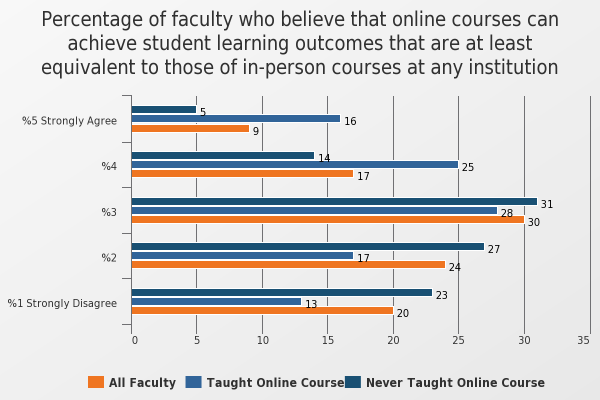
The survey of faculty for Inside Higher Ed includes some interesting points. [You can click to get the entire report, but you have to register.] In brief, faculty remain unconvinced that online education can deliver equal results to old-fashioned in-person classes. Online classes might do a good job—in some cases—at delivering content. But most faculty agree: there is something important lost when face-to-face interaction isn’t a leading part of university classes.

IHE CHART

Source: Carl Straumsheim, “Online Ed Skepticism and Self-Sufficiency: Survey of Faculty Views on Technology,” Inside Higher Education, October 29, 2014.

The survey specifically excluded some of the schools we’re interested in, what it calls “Bible colleges and seminaries.” And none of the questions included anything about student faith.

But no one interested in online higher education these days can ignore the fundamentalist elephant in the room. Liberty University, a school founded by Jerry Falwell in 1971, now claims almost 100,000 online students. In addition to standard online coursework, Liberty offers online spiritual help, too. Students can join online prayer groups and Bible blogs.

But this menu of religious fare does not seem to match the traditional goals of conservative religious colleges. At most schools, the faith of students has been the primary concern, not merely an additional click on a webpage. And most college administrators have been keenly worried about sliding into heterodoxy and secularism. In his brilliant 1994 dissertation about Wheaton College, historian Michael Hamilton explained this sentiment like this:

The paradigm that has dominated Wheaton through the [twentieth] century holds that colleges, more than any other type of institution, are highly susceptible to change, and that change can only move in one direction—from orthodoxy toward apostasy. . . . The very process of change, no matter how slow and benign it may seem at first, will always move the college in a secular direction, inevitably gathering momentum and becoming unstoppable, ending only when secularization is complete.

This mindset, I believe, is common among conservative evangelical schools. From Wheaton, to Biola, to Gordon, to more conservative schools such as Bob Jones and Liberty…all have worried that change will equal declension. All have been concerned, first and foremost, that novelty will lead faculty and students to abandon their faiths.

So here’s the question we wished Inside Higher Ed had asked professors at conservative schools: How can online education remain orthodox? How can the faith of students be preserved if student/teacher interaction is weakened?

And perhaps this is the toughest question for the folks at Liberty University: Has their wildly successful pursuit of online education changed their goal? Has Liberty abandoned its religious mission? Or, rather, could this massive online presence be compared to the televangelism of an earlier generation? Could the thousands of online students be seen as an enormous “mission field” for Liberty’s evangelical message?

Bryan College: Creationism Déjà vu All Over Again

It’s all over but the shouting.  That’s the news from Bryan College.  Thanks to the ever-watchful Sensuous Curmudgeon, we see that Bryan College has settled its legal dispute with two of its professors.  The creationist courtroom drama may have been avoided, but we are left with one question: If this is part of a predictable pattern at conservative evangelical colleges, can we learn a better way to handle each new episode?

Why can't we all just get along...?

Why can’t we all just get along…?

Two Bryan College professors, Stephen Barnett and Steven DeGeorge, have settled their lawsuit with the school, according to the local newspaper.  Readers may remember that the school abruptly changed its statement of faith to insist that Adam and Eve did not descend from another species.  Faculty members had to make a tough decision: Could they agree to the newly explicit language about humanity’s origins?  Barnett and DeGeorge argued that it was not fair—nor even legal—for the school to impose such a decision on faculty.  It appears they have decided to drop the lawsuit, though the terms of this settlement have not been made public.

Why did Bryan’s leadership feel a need to make such a change?  They were in a tight spot.  As I’ve argued before, leading young-earth creationists such as Ken Ham are able to wield outsized influence on evangelical colleges.  Even the whiff of suspicion that a school has abandoned the true faith is enough to drive away students and their precious tuition dollars.  At Bryan—and I’m claiming no inside knowledge here, just a historian’s best guess—the leadership felt obliged to shore up its orthodox creationist bona fides.

This tension is nothing new at evangelical colleges.  Perhaps the most startling example of the deja-vu nature of the Bryan situation is an eerily similar case from Wheaton College in 1961.  In that case, faculty such as Russell Mixter hosted a conference on origins.  Whatever actually occurred at that meeting, rumors flew that Wheaton had opened itself to the teaching of evolution.  As a result, anxious trustees rammed through a change to the obligatory faculty creed.  From then on, faculty had to attest to their belief in “an historical Adam and an historical Eve, the parents of the human race, who were created by God and not descended from lower forms of life.”

Back then, Mixter signed.  He was more interested in the broad outlines of what he called “progressive creationism” than the details of the Garden of Eden.  But the nervousness of the leadership at Wheaton was palpable.  In addition to the change in creed, the school took out big advertisements in evangelical magazines such as Christian Life that trumpeted Wheaton’s continuing creationism.

The stories are so similar that it is hard to believe they are separated by over fifty years.  And they lead us to obvious questions: Why do evangelical colleges have such anxiety about their reputations as creationist colleges?  Why do leaders feel such a compelling need to publicize their continuing orthodoxy?  And perhaps most important, if these controversies are so predictable, why is there no better way to handle them?

As historian Michael Hamilton has argued about Wheaton, “Anxiety about constituent response hangs over virtually every decision the college has made since 1925.”  The same could be said for Bryan and every other school that relies on conservative evangelical families for its student bodies.

Each of these schools’ identities, after all, relied on the notion that they have been “safe” alternatives to mainstream schools.  At the more conservative Bob Jones University, for example, founder Bob Jones promised a different sort of college experience.  In 1928, just a few years after the school was founded, Jones promised,

fathers and mothers who place their sons and daughters in our institution can go to sleep at night with no haunting fear that some skeptical teacher will steal the faith of their precious children.

And even though Wheaton College was a very different sort of evangelical school, this central notion was the same.  In the 1930s, Wheaton advertised itself as a “safe college for young people.”

This pledge means more than just institutional window-dressing.  For conservative evangelical schools, the issue of orthodoxy looms large.  This stretches beyond the issue of creationism.  As we see in cases such as the recent controversy at Gordon College, ideas about sexuality also prove intensely controversial.  If schools want to change their policies, or sometimes even to clarify existing policies, they risk sparking a no-holds-barred fight that might threaten the continuing existence of their college.

No wonder school leaders are nervous.

The most recent episode at Bryan seems to have limped its way off the public stage.  But not without resentment, bitterness, and feelings of betrayal all around.  So we are left with a few questions for the leaders of conservative colleges: If this is such a central organizing principle of conservative orthodox colleges, why do they seem never to learn?  Why does today’s controversy at Bryan copy the pattern of Wheaton’s in 1961 so exactly?  Is there no better way to handle this predictable tension?

College Christians Strike Back

Do evangelical Protestants need to boycott pluralist universities? That’s the plan this morning from Joe Carter at the Acton Institute.  To those aware of the longer history of conservative Christianity and higher education, this sounds like déjà vu all over again.

Carter is reacting to the latest round of de-recognition of Intervarsity Christian Fellowship. This time, the campuses of the California State University system will no longer accept IVCF as a full member of their communities.  At issue is the system’s newly enforced policy of non-discrimination.  No student organization will be allowed if it does not open its leadership ranks to all comers.  For IVCF, that’s a no go.  The organization insists that leaders must agree with its evangelical statement of faith.

This higher-education controversy has been going on for a while. Most prominently, as we noted in these pages, Tufts University de-recognized its campus IVCF chapter.  Other schools have followed suit.

De-recognition has consequences, but it doesn’t mean the organization is banned. Rather, a de-recognized group is not allowed free use of campus facilities for its meetings.  It is not allowed to take part in campus-wide recruitment fairs.  Perhaps most significantly, de-recognition sends a symbolic message that an organization is no longer part of a campus community.

How should evangelicals react? Joe Carter says they should go their own way.  As Carter puts it,

Colleges and universities are businesses that exist in a competitive educational market. A free market solution is to refuse to support the business’ “product.” In other words, Christians should refuse to attend schools in which their beliefs are “derecognized.” Similarly, alumni should refuse to provide donations to support a college or university that considers our faith not welcome on the campus.

We’ve seen this argument before. As I argued in my 1920s book, the first generation of fundamentalist leaders worried about the state of higher education.  At both pluralist and religious schools, fundamentalists charged, anti-Christian teaching and attitudes threatened the faith of young Christians.

Some leaders insisted that the only answer lay in the boycott. Evangelist Bob Jones Sr., for instance, opened his own college in order to offer fundamentalist parents an alternative.  As Jones remembered decades later in a private letter,

Going about over America in my evangelistic work, I ran into so many people who had lost their faith in schools, some of which were supposed to be Christian schools and that had at least been built with Christian money but that had compromised and brought religious liberals into the school; and young people had lost their faith. I kept one fellow from committing suicide because of what happened to him in a certain school that had been built with sacrificial gifts of Christian people but an institution that had gone modernistic.  I made up my mind there ought to be a certain type school somewhere in America, but I did not want to build it.  I was at the height of my evangelistic career and had open doors all over the world. . . . I went on to tell [his wife] that there is an idea going around that if you have old-time religion you have to have a greasy nose, dirty fingernails, baggy pants, and you must not shine your shoes.  And I told her that religious liberals were putting that over.  I said, ‘I want to build a school that will have high cultural and academic standards and at the same time a school that will keep in use an old-time, country, mourner’s bench where folks can get right with God.’

As a result, conservatives who agree with Joe Carter have a place to go. A network of evangelical colleges and universities offer alternatives to schools that might de-recognize Christian student groups.  Whatever one’s theology and preferences, from fundamentalist Bob Jones University deep in the heart of Dixie to evangelical Wheaton College just outside of Chicago; from Manhattan’s aggressive The King’s College to LA’s laid back academic Biola vibe.

If evangelicals really feel a need to boycott pluralist campuses, they have no shortage of Christian options.

Children Must Submit

First learn to obey

First learn to obey

HT: MM

What is the role of the child in school? Many conservative thinkers, now and in the past, have insisted that children must learn to submit to teachers’ authority. Before they can learn to read or figure, children have to learn that obedience is their proper attitude. These days, this penchant for submissive children has leached out of the world of traditionalist thinking into the burgeoning world of charter schooling. A recent interview with a leading scholar highlights the ways conservative values have reasserted themselves as the mainstream norm.

Thanks to a watchful colleague, I came across this interview with Penn’s Professor Joan Goodman. Professor Goodman works in the Teach for America program at Penn and spends a good deal of time in urban charter schools. In many of those schools, Goodman finds a rigorous standardization and a vigorous effort to train children to be submissive. As Goodman told EduShyster,

these schools have developed very elaborate behavioral regimes that they insist all children follow, starting in kindergarten. Submission, obedience, and self-control are very large values. They want kids to submit. You can’t really do this kind of instruction if you don’t have very submissive children who are capable of high levels of inhibition and do whatever they’re told. . . . They want these kids to understand that when authority speaks you have to follow because that’s basic to learning.

At the same time, Goodman notes, the schools insist on lockstep performance by teachers. Every teacher is supposed to be delivering the same content at the same time in the same way. Goodman calls it a “very uniform and scripted curriculum.”

Ask anyone familiar with urban charter-school education these days, and you’ll hear similar stories. For those of us trying to figure out what “conservatism” means in education, this leads us to some difficult questions: Did these goals and values move from fundamentalist and conservative activists into the mainstream? And if they did, how?

In my historical research into the worlds of conservative educational activism, I’ve seen it time and again. For decades—generations, even—conservative thinkers have insisted that submission is the first lesson of successful schooling. Without submissive children, teachers will not be able to transmit information. Without the successful transmission of information from teacher to student—according to this conservative logic—education has not happened.
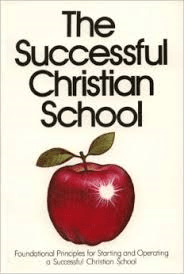
Originally published in 1979...

Originally published in 1979…

In the world of Protestant fundamentalist education, youthful obedience is often elevated to a theological value. Writing for an A Beka guide in the late 1970s, fundamentalist writer Jerry Combee warned that Christian teachers must be stern disciplinarians. “If Christian educators give one inch on discipline, the devil will take a mile.” Combee continued,

Permissive discipline, for example, is wrapped up with teaching methods that always try to make learning into a game, a mere extension of play, the characteristic activity of the child. Progressive educators overlooked the fact that always making learning fun is not the same as making learning interesting. . . Memorizing and drilling phonetic rules or multiplication tables are ‘no fun’ (though the skillful teacher can make them interesting). They can have no place in a curriculum if the emotion of laughter must always be attached to each learning experience a la Sesame Street.

That same A Beka guide to good fundamentalist schooling promised that good schools always taught in lockstep. At the time, A Beka offered a curriculum for private start-up Christian fundamentalist schools. Not only would schools get curriculum infused with dependably fundamentalist theology, but

the principal can know what is being taught. He can check the class and the curriculum to make certain that the job is getting done. Substitute teachers can also step in and continue without a loss of valuable teaching time.

Some bloggers confirm that fundamentalist schooling has continued to emphasize obedience over intellectual curiosity. Jonny Scaramanga, Galactic Explorer, and Samantha Field have all shared their experiences with this sort of fundamentalist educational impulse. In their experiences, fundamentalist schools and homeschools have insisted on obedience, and have done so in a sinisterly gendered way. Young women and girls, especially, were taught to submit to male authority figures. Every student, however, seems to be pressed to submit and conform, not as a punishment, but rather as a foundation for education.

To be fair, as I argued in an academic article a while back, there has been a lot of disagreement among fundamentalist Protestants about proper education. Just as the folks at A Beka were insisting that proper education began with submission, the equally fundamentalist thinkers at Bob Jones University pushed a very different vision of proper education. Led by long-serving dean Walter Fremont, the school of education at Bob Jones promoted a more child-centered sort of fundamentalist education.

We also need to note that this insistence on submissive children is not just a fundamentalist one. Secular conservatives have long insisted that learning can only begin with obedience. In many cases, this has been a conservative response to a left-leaning progressive pedagogy. For example, leading progressive thinker Harold Rugg began his career with recommendations for proper classroom attitudes. In an article from the 1920s, Rugg instructed teachers to share authority with students. Good teaching, Rugg wrote, did not dictate to children; it did not insist on obedience. Rather, good teaching pushed students to think of themselves as autonomous, self-directed learners. Good teachers, Rugg insisted, asked students again and again, “What do you think?”

In the 1920s, this notion of proper student behavior divided progressives from conservatives. One conservative leader of the Daughters of the American Revolution offered a very different vision of good teaching. Writing in 1923, Anne Minor explained that the best teachers begin with “truth and integrity, orderliness and obedience, loyalty and love of country.”

In the 1950s, another conservative Daughter of the American Revolution warned that teaching had gone astray when it encouraged children to be “persistent in their own ideas, disobedient, and resent[ful of] parental discipline.”

Another secular conservative in the 1950s agreed. One letter-writer to the Pasadena Independent described the problems with progressive education this way:

discipline, as well as the lack of fundamental knowledge teaching [sic], is one of the biggest lacks of the progressive school. Some parents shift the discipline to the school which is wrong, of course, but if the parents are at fault for lack of discipline, so are the schools. . . . Lack of consideration of others is the biggest fault of children today, and should not be too difficult to correct. Tantrums should never be tolerated, sassiness and disobedience should be controlled at an early age.
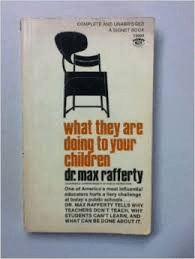
rafferty what they are doing to your children

And, of course, other conservative educational thinkers and activists also pressed for an obedience-first vision of good education. The leading secular conservative voice of the 1960s, Max Rafferty, agreed that schools could only function if children first learned to submit. As Rafferty put it in his 1964 book What They Are Doing to Your Children,

School, you see, was not considered ‘fun’ in those days. It was a mighty serious business and was conducted that way. At any rate, once the two premises are accepted that (1) boys won’t behave in schools unless compelled to do so and (2) boys must be made to behave so that they can learn things that are essential for them to know, then the whole paraphernalia of corporal punishment falls into proper perspective. . . . Things have changed of late in the field of discipline, and more than somewhat. They started to change at home first, back in the twenties and thirties. The prime mover in their change was the new psychology, which was widely publicized and which caused parents seriously to doubt their proper role vis-à-vis their children for the first time in the recorded history of the human race. . . . The result was the emergence of the least-repressed and worst-behaved generation of youngsters the world had ever seen.

As I researched my upcoming book about conservative activism in education, I found this theme repeated over and over. It goes something like this: Good schooling means the transmission of information to children. That transmission cannot occur unless children submit to teachers’ authority. Therefore, any meaningful education reform must begin with the establishment of an atmosphere of relentless obedience and submission.

Professor Goodman doesn’t talk about “conservatism” or “fundamentalism” in the schools she visits. And many of the reformers these days who push for youthful obedience and teacher standardization would never call themselves conservatives, let alone fundamentalists. But it is difficult not to notice the overlap.

Conservative notions of youth and education, it seems, have become the standard way to think about educational reform among groups such as Teach For America. First and foremost, in this understanding of education and youth, children must submit.

Are Christians Too Bigoted to Work With?

You may have seen the headline by now: Christian College Discriminates Against Homosexuals.  And the follow-up: City Cuts Off Christian College.  But isn’t it weirdly ironic that non-religious governments now seem to be repeating the separatist struggles of fundamentalists?  Doesn’t it seem odd that the drive for tolerance pushes pluralists to act like the more extreme religious separatists?

In this case, it was the public decision of Gordon College President D. Michael Lindsay to sign a letter to President Obama that sparked the furor.  [Full disclosure: Lindsay and I worked together as 2009 Spencer/National Academy of Education postdoctoral fellows, and I admire Lindsay personally and consider him a friend and colleague.]  Along with a host of other prominent evangelical leaders and intellectuals, Lindsay asked President Obama for a religious exemption to a planned executive order banning workplace discrimination against homosexuals.

Lindsay’s participation caused a furious reaction.  Gordon alumni and students petitioned Lindsay to retract.  Gordon College’s accrediting agency promised to investigate.  And most notably, the nearby city of Salem, Massachusetts canceled its partnering contract with Gordon to operate an historic city building.

Let me be clear about a couple of points.  First, I personally agree that institutions should not discriminate against homosexuals.  Public governments, especially, have a duty to include all members of society, not only passively, but actively.  IHMO.  Also, I do not wish to argue whether Lindsay’s position is or is not “anti-gay,” since he has publicly insisted that Gordon College does not discriminate against homosexuals.  And though I find it curious, I don’t want to ask why President Lindsay has become the center of this controversy, even though the letter was signed by many other evangelical leaders as well.  Even on my humble little blog, for example, I’ve experienced a surge of search terms such as “D. Michael Lindsay bigot” and “Gordon College Anti Gay.”  Why has Lindsay become the focus in this case?  Why not all the other signatories?

Though interesting, we have to leave such questions aside for now.  From an historical point of view, there is a more interesting aspect to this case.  It seems that those who support tolerance and diversity have, in some ways, adopted the position of the traditionally conservative fundamentalists.

Here’s what I mean: In the twentieth century, conservative Christian colleges carried on a furious and often angry internecine debate about the propriety of partnering with non-Christian institutions.  Schools such as Gordon and Wheaton College earned the vicious denunciation of more conservative schools such as Bob Jones University.  Among the many accusations, more conservative, “fundamentalist” schools often insisted that the more open, “evangelical” schools had tainted themselves by their open association with non-Christian ideas.  Separatist fundamentalists often cited the Bible passage 2 Corinthians, chapter 6, verse 14:

Be ye not unequally yoked together with unbelievers: for what fellowship hath righteousness with unrighteousness? and what communion hath light with darkness?

In order to be truly Christian, separatists argued, believers could not allow themselves to be joined with those who did not share their belief.  So, for instance, when fundamentalist megastar Jerry Falwell worked with conservative Catholics and Jews in the Moral Majority, fundamentalist leaders at Bob Jones University denounced Falwell as the “most dangerous man in America.”

This rigid separatism, indeed, has been one of the hallmarks of American fundamentalism.  Some fundamentalists have insisted that they must practice even a “secondary separation,” not sharing Christian fellowship with other Christians if those other Christians share fellowship with questionable folks.

Now, it seems the city of Salem feels it must practice a strangely similar form of separatism.  As Salem Mayor Kimberly Driscoll informed Gordon College in a recent letter, the city must separate itself from the college.  Why?  Because, Driscoll wrote, Lindsay’s position implied open discrimination against the LGBT community.  The college had every right to do so, Driscoll believed, but the city could no longer be affiliated with such things.  The city’s non-discrimination law, Driscoll informed Lindsay, “prohibits our municipality from contracting with entities that maintain discriminatory practices.”

This is not the only time when the beliefs of liberals and fundamentalists have neatly swapped sides.  In the creation-evolution debates, for example, creationists took over evolutionists’ positions.  As historian Ronald Numbers has pointed out, by the 1990s creationists began appropriating the language of 1920s liberals.  In the 1920s, evolution supporters insisted that teaching only one theory was bigotry.  By the 1990s, creationists started saying the same thing.

In this case, we see a weird and clearly unintentional echo.  Mayor Driscoll feels compelled to separate her government from any entity that practices discrimination against homosexuals.  It is not enough, morally, for her government itself to avoid such discrimination.  The principle of separation seems to have migrated from fundamentalists to their supposedly tolerant opponents.


I Hart Lyle Spencer

I want to shout it from the rooftops. I love this man!

Mr. Spencer, I Love You.

Mr. Spencer, I Love You.

Thanks to his Spencer Foundation, I’ll be able to spend the next year traveling to archives to research my new book. My grant from the Spencer Foundation will fund my trips to a variety of evangelical colleges. I’m looking forward to diving into the world-class collection at the Billy Graham Center Archives, for example.

My goal in this book is to explore the history of evangelical higher education in the twentieth century. What did schools such as Wheaton College, Bob Jones University, Biola University, Bryan College, John Brown University, and a host of others hope to teach their students? Most interesting, since the emergence of “fundamentalism” in the 1920s, how did these colleges try to teach their students what it meant to be an evangelical Christian in a rapidly secularizing America?

Naturally, these questions changed over time. In the 1920s, for example, the first decade of “fundamentalism,” evangelists and evangelical intellectuals struggled to define what it meant to be a “fundamentalist.” For Bob Jones, it meant eschewing many of the outward trappings of modern life as well as cultivating a Bible-first way of knowledge. For President Blanchard of Wheaton College, it meant more of a theological steadfastness.

By the late 1940s, the world of conservative evangelicalism had changed radically. I want to explore the ways these changes emerged on evangelical campuses. What would it mean for a family in 1950 to choose to send their sons or daughters to “evangelical” Wheaton instead of “fundamentalist” Bob Jones? Or to Biola instead of one of the growing crop of non-religious colleges, including my own beloved Binghamton University (founded 1948)?

Each new generation offers new topics. Moving into the late 1960s, conservative colleges experienced a very different “Sixties.” I’m interested in exploring the ways evangelical students and faculty developed a counter-counter-culture. And in the late 1970s, the emergence of a “New Christian Right” in mainstream American politics was both fueled and influenced by developments in evangelical higher education.

Central to all these investigations will be the experience of students and faculty at evangelical colleges. Luckily, the archives of all these schools have rich collections of their own students’ experiences. At the Billy Graham Center Archives, a host of oral history interviews also tracks the school memories of evangelicals from across the decades.

Thanks to the Spencer Foundation, I’ll be able to devote the next year to full-time research. For readers who are unaware of the Foundation, it is the best thing going in education research. I’m not saying that only because of my generous grant. Every academic knows about the Spencer Foundation’s programs, including its dissertation fellowship and its postdoctoral fellowship. In my case, a postdoc from the Spencer Foundation and National Academy of Education allowed me to complete two books, my 1920s book and my upcoming one about educational conservatism in the twentieth century.

So I say it with unabashed enthusiasm: I Love Lyle!


Dynasties and Christian Colleges

Why do conservative Christian colleges pass from father to son?  That’s the question asked recently by Mark Oppenheimer in the New York Times.  He looks at the dynastic succession of school presidents at schools such as Liberty and Bob Jones.  But does Oppenheimer give short shrift to the history of the question?

It’s an intriguing line of inquiry.  Leading schools such as Liberty University, Oral Roberts, and Bob Jones University all have histories of passing leadership from father to son.  Sometimes this has worked well, Oppenheimer points out, but sometimes it has not.

Why have conservative schools constructed these sorts of dynasties?  Oppenheimer explains it as a sort of sectarian necessity.  Colleges such as Liberty and BJU started as outgrowths of the founders’ evangelistic efforts.  Those efforts included the creation of a sub-cultural identity.  Only a limited circle of true believers could be trusted to carry on the legacy.  As a result, Oppenheimer argues,

It would thus be a small band of insiders, versed in the particulars of the founder’s message, who would even be eligible to carry it into the future. That may be why, for example, the presidential search committee at Bob Jones University, while not seeking another Jones descendant, has stated “a preference for a B.J.U. graduate.”

Oppenheimer wisely consulted scholars such as Matthew Sutton and D. Michael Lindsay.  Lindsay warned not to read too much into this dynastic tradition at evangelical schools.  After all, the cases Oppenheimer cites make up only a handful, among hundreds of colleges.  And they are only at the “newer colleges.”

I have the greatest respect for President Lindsay as a scholar, school leader, and all-around nice guy.  [Full disclosure: Lindsay and I served together as postdoctoral fellows with the National Academy of Education.]  But in this case, Lindsay whitewashes the connection between legacy and Christian colleges.  And unfortunately, Oppenheimer lacks either the word count or the historical knowledge to push Lindsay on the issue.  It’s a shame.

After all, in contrast to Lindsay’s assertion, dynasties in evangelical colleges go way back.  And there seems to be some tentative connections we could suggest between the drive for orthodoxy and the family connections.  For example, the flagship evangelical school, Wheaton College, passed from father to son in 1882.  And though this might make today’s evangelicals uncomfortable, Charles Blanchard, son of founder Jonathan Blanchard, originally took the school in an explicitly fundamentalist direction.  To be fair, as I argue in my 1920s book, the meanings of “fundamentalism” as Blanchard the Younger understood them in the 1920s were significantly different than they became after Blanchard’s death.

There can be no mistake, however, in Charles Blanchard’s intention.  He wanted to align Wheaton College with fundamentalism, with orthodoxy, with the fight against modernism.

The question we still need to ask, though, is how much this drive for orthodoxy resulted from the dynastic structure of the college.  Did Charles Blanchard feel pressure to maintain his father’s orthodox legacy?  Did Bob Jones Jr.?  Jerry Falwell Jr.?

Oppenheimer asks a good question in this article.  But we wish he had the space and the background to push it a little further.

Does Fundamentalism Promote Sex Abuse?

Do conservative Protestant evangelicals have a problem with sex abuse? Does evangelicalism suffer from an overabundance of “Christian cesspools” of abuse?

I’ve been chastised for asking whether this is a specifically fundamentalist problem—that is, a problem of theology—or rather an institutional problem. That is, is it specifically fundamentalist theology and “purity culture” at fundamentalist schools that encourages rape and sexual assault? Or do we see the same sorts of systemic abuse in non-fundamentalist colleges and universities? At big football schools, for example, administrators protect rapists to protect the football program. Could “party culture” be just as conducive to rape and sexual assault as “purity culture?”

In an article about the sex-abuse travails at Bob Jones University, Boz Tchividjian says this is not a question of theology, but of “authoritarianism.” Tchividjian argues that church structures lend themselves to sex abuse, but that this sort of abuse could happen “in any culture, elevating leaders beyond accountability, leaving victims’ rights to their whim, and sidelining critics who challenge their rule.” Yet Tchividjian’s work has illuminated the gruesome world of sex abuse and rape in evangelical and fundamentalist institutions.

As Kathryn Joyce describes in a recent essay in American Prospect, Tchividjian’s anti-abuse group GRACE was called in to Bob Jones University in 2012 to investigate accusations of widespread institutional neglect of charges of rape and sex abuse. Tchividjian, grandson of evangelist Billy Graham and former law professor at Liberty University, has long campaigned for more transparency about sex abuse among evangelicals. In Joyce’s AP piece, Tchividjian made his case for the terrible evangelical record with sex abuse. “One study,” Joyce writes,

has found that 93 percent of admitted sex offenders describe themselves as religious. Offenders who report strong church ties abuse more often, with younger victims. That’s not because Christians are inherently more abusive, he said, but because they’re more vulnerable to those who are. Tchividjian repeated what one convicted sex abuser told clinical psychologist Anna Salter in her book Predators: Pedophiles, Rapists, and Other Sex Offenders: “Church people”—always looking to see the best in people, to welcome converts, to save sinful souls—are “easy to fool.”

“When something does surface, all too often the church leadership quiets it down. Because they’re concerned about reputation: ‘This could harm the name of Jesus, so let’s just take care of it internally.’

Tchividjian rattled off ways in which Christians’ openness can allow abuse to go unchecked: Perpetrators tend to use scripture to coerce, justify, and silence. If they’re clergy, they will exploit their positions; if they’re laypeople, they will take advantage of a church hungry for volunteers and rely on the trust given to members of a church family. “The reason why offenders get away with what they do is because we have too many cultures of silence,” Tchividjian said. “When something does surface, all too often the church leadership quiets it down. Because they’re concerned about reputation: ‘This could harm the name of Jesus, so let’s just take care of it internally.’

In case after case, Tchividjian and his colleagues unearthed terrible and terrifying stories of abuse and cover-ups. Of students like Katie Landry at Bob Jones University. When Landry reported her rape to Dean Jim Berg, Berg allegedly told her that there was a “sin in your life that caused your rape.”

Tchividjian says this is a question of organizational structure, not of theology. But his own work seems to make the case that fundamentalist culture seems particularly prone to this sort of victim-blaming. As in this story from BJU, it seems fundamentalist cover-ups have the ability to use theologically inflected language to cow victims into silence.

I’m certainly sensitive to charges of fundamentalist-bashing. Indeed, my first take on the recent spate of “exposes” of sex abuse at fundamentalist colleges was to wonder if this was just another attempt to dismiss dissenting colleges. But there does seem to be a connection between fundamentalism—both theology and culture—and this climate of sex-abuse cover-up. It might not generate higher numbers of abuse victims than other opaque institutions—ask anyone at Penn State, Florida State, or a host of other non-fundamentalist institutions—but it seems fair to say that fundamentalism has generated a sick culture of abuse.


Ken Ham Is My Guidance Counselor

Why does Ken Ham care where you go to college? Where you send your kids?   Because “college” is more than just a collection of classes and academics. For religious conservatives as for everybody else, “college” represents a formative experience. The ideas one will encounter, the personal connections one will make, and the changes in one’s outlook and worldview all make the college years some of the most transformative in our lives.

In recent years, Ham, America’s (and Australia’s) leading voice for young-earth creationism, has established himself as the arbiter of creationist orthodoxy in college attendance. And his word carries weight in the world of evangelical higher education.

Recently, for instance, Ham warned readers at Answers In Genesis about the dangers of attending Calvin College. Students at that storied Christian school, Ham explained, were “being influenced . . . to undermine the authority of Scripture in many ways.” When faculty engage in evolutionary research and teaching that might turn away from Ham’s strict attitudes about knowledge and creation, Ham warns, students will too often abandon their creationist faith.

As a precaution, Ham offers readers a list of schools that adhere to the young-earth creationism taught by Ham’s Answers In Genesis ministry. To be safe, Ham warns, parents and students ought to stick with schools that have proven their fidelity to these ideas.

Ham’s anxiety over the crumbling orthodoxy in Christian higher education is nothing new. As I argue in my 1920s book, many of today’s evangelical schools had their origins in the founding decade of American fundamentalism. Back in the 1920s, religious schools often faced a choice between fundamentalist orthodoxy and modernist adaptation. Most chose modernism. The University of Chicago, for example, founded as a Baptist beacon of learning, became the leading voice for theological modernism, employing such folks as Shailer Mathews and Shirley Jackson Case. In contrast, a few Christian schools, most famously Wheaton College, sided with the fundamentalist movement.

Leading fundamentalists in the 1920s also founded a spate of new schools to embody their theological and cultural conservatism. Perhaps most prominently, evangelist Bob Jones Sr. opened Bob Jones College (now Bob Jones University) in 1926. The goal of this school was to form the fundamentalist character of young people while educating them in the best traditions of arts and sciences. In order to reassure parents that the school would never slide toward theological modernism or cultural liberalism, Jones and his allies established a rock-ribbed charter. This charter hoped to guarantee the continuing orthodoxy of the school. The charter’s second paragraph outlined that orthodoxy:

The general nature and object of the corporation shall be to conduct an institution of learning for the general education of youth in the essentials of culture and in the arts and sciences, giving special emphasis to the Christian religion and the ethics revealed in the Holy Scriptures, combating all atheistic, agnostic, pagan and so-called scientific adulterations of the Gospel, unqualifiedly affirming and teaching the inspiration of the Bible (both Old and New Testaments); the creation of man by the direct act of God; the incarnation and virgin birth of our Lord and Saviour, Jesus Christ; His identification as the Son of God; His vicarious atonement for the sins of mankind by the shedding of His blood on the Cross; the resurrection of His body from the tomb; His power to save me from sin; the new birth through the regeneration by the Holy Spirit; and the gift of eternal life by the grace of God.

Perhaps most notably, the next line specified that this charter “shall never be amended, modified, altered, or changed as to the provisions hereinbefore set forth.” Also remarkable, according to a 1960 reminiscence by Bob Jones Sr., at its founding BJU decreed that every graduating senior would pledge to monitor the school’s continuing fundamentalism. “Should the policy and conduct of the University ever, in my lifetime, deviate, in the slightest particular, from the letter or spirit of this Creed,” seniors would promise,

I hereby pledge myself to exert all my influence to affect a change in conditions; failing which, I will resort to such legal measures as the courts may offer to the end that the institution may be kept true to the University Creed and the original intentions of the founder.

Most evangelical colleges established similar creeds and many promised never to amend them. Not many others, to my knowledge, required such strict supervision by their alumni.

These days, Ken Ham has taken over the role of orthodoxy’s gadfly. In addition to his warnings about waverings from his definition of creationism at Calvin College, Ham has warned that other evangelical schools might be threatening the faith of their students. And Ham’s warnings carry weight.

In one recent episode at Bryan College, for example, Ham’s public worries about faculty orthodoxy led the school’s leadership to instigate a new sort of creationist orthodoxy pledge for faculty. From now on, faculty must publicly avow their belief in a real, historic Adam and Eve. As I argued at the time, the fallout from Bryan College’s policy shift might lead to a shake-up of faculty. More directly relevant, the furor at Bryan seems to testify to Ham’s influence. Worried that creationist parents might not send their students and their tuition dollars, Bryan’s leaders acted to shore up their image as a home of young-earth creationist orthodoxy.

Also intriguing, I must ask again if the drive to protect their reputations as safe theological and cultural havens has led some conservative evangelical schools to cover up incidents of sexual assault. Of course, these are very serious allegations, and I do not ask these questions lightly. I am certainly not accusing Ken Ham or the leadership of these schools of condoning sexual assault. But the drive to present a public face as a uniquely safe environment for fundamentalist students certainly puts undue pressure on college leaders. It is not unfair to wonder if such pressure might lead schools to downplay any cases that might threaten those reputations.

Outside the world of conservative evangelical Protestantism, colleges spend an inordinate amount of time and treasure to attract students. Flashy dorm rooms, high-visibility sports programs, celebrity faculty, and lavish campus lifestyles all hope to convince families to send their kids and their money to certain schools. The pressure on recruiters is intense.

There is a similar pressure on evangelical colleges. Influential voices such as that of Ken Ham are able to exert outsized influence by warning creationist families toward or away from certain schools. Without Ham’s imprimatur, conservative schools may lose the loyalty of students and families.


Can Christian Colleges Say the R-Word?

Do conservative Christians encourage rape?  It’s a difficult thing to talk about, but it is a question these days at the center of discussions about conservatism, Christianity and higher education.  Most recently, blogger Samantha Field related the stories of students at Pensacola Christian College who had been punished by the school after suffering sexual assaults.  The accusations have attracted enough attention that PCC has felt obliged to make a public denial.  The school said it has been “harassed and victimized” by these accusations.  PCC, the school insisted, has always acted in accordance with the law.

This is not only an issue at Pensacola Christian College.  As journalist Kiera Feldman argued in a recent New Republic article, a similar culture of institutional arrogance prevails at Patrick Henry College.  And Bob Jones University has gone back and forth with its efforts to examine its own culture.  More broadly, Billy Graham’s grandson attracted attention a few months back for asking if evangelical Protestants had a worse record of dealing with sex abuse than did the Catholic Church.

These are difficult questions to ask.  For an earlier post about this issue, I’ve been called insensitive (fair, and I apologize again), ignorant (sometimes fair, sometimes unfair) and guilty of condoning or excusing cover-ups (utterly unfair).  What I asked was whether or not these accusations of institutional misconduct rely on stereotyped assumptions about conservative evangelical Protestants.  In other words, is there something specifically about the religion of these schools that is somehow to blame?  Or is it an institutional culture at these conservative schools that blames victims and excuses criminals?  Is there something about the Christian nature of these schools that promotes and excuses rape?  Or is this a question of institutional mismanagement?  Finally, we have to ask, is this whole thing somehow more aggravated at these schools than it is at secular or pluralist schools?

After reading more about these cases, it seems the attitude toward rape of school leaders really is wrapped up intimately with their institutional tradition, and maybe even with their theological tradition.  It seems this is more than just another case of fundamentalist-bashing.  In the past, I have defended young-earth creationists against accusations that they are guilty of criminal abuse.  I’ve chided secular journalists—with whom I’m generally sympathetic—for misrepresenting the claims of young earth creationists.  These cases from conservative colleges seemed to me, at first, to represent similar sorts of knee-jerk anti-fundamentalist stereotyping.  I didn’t try to cast doubt on the sincerity of the victims, to be clear, but I did ask whether the accusations against the schools unfairly tied belief in an inerrant Bible to cases of institutional misconduct.

I do not come from a conservative evangelical or fundamentalist background.  But for a living, I study conservative educational activism, especially the educational thinking of conservative Protestants in the United States.  I’m aware of the history of American fundamentalism, including the ways theology has been profoundly combined with hierarchical gender notions.  As I wrote in my 1920s book and as Margaret Bendroth argued in hers, in its early decades American fundamentalism relied on notions of male dominance and female submissiveness.

We know that all colleges these days are struggling with proper ways to handle sexual assault cases.  The charges against schools such as Patrick Henry College, Pensacola Christian College, and Bob Jones University suggest that the campus culture at these conservative schools makes that difficult task much harder.  It seems the fundamentalist culture of these schools has intensified the already brutal culture on many secular college campuses.

This does not mean that every fundamentalist condones sexual assault, of course.  This does not even mean that every student, faculty member, or administrator of these schools agrees with the overall school culture.  Nor can we even say with confidence that this culture is somehow a necessary outgrowth of the theology of the schools, rather than primarily a question of hierarchical, closed-off, inflexible administrative structure.  But it does seem that the dominant atmosphere of these schools needs to share blame in this aggravated culture of condoning and excusing sexual assault.

The best comparison, it seems to me, is the atrocious record of the Catholic Church with its recent sex-abuse scandals.  No one says that every Catholic—let alone every Catholic priest—is part of this scandal.  Nor do we even say with confidence that this is something caused directly by the theology of the Catholic Church.  And we can of course point out that far more non-Catholics committed sex abuse than did Catholic priests.  But such objections miss the point.  There was something profoundly wrong with the way the power structure of the church handled those cases.  It seems there’s a similar connection here between institutional structure and moral accountability.

Those few who might use these cases to suggest that Christianity as a whole is a rape-centered religion are just as wrong as they have ever been.  And we must remember that there is a wide variety in conservative evangelical colleges.  A culture that dominates at BJU, PHC, or PCC will be very different from the culture at other evangelical schools such as Wheaton.  But even remembering those important caveats, there is something deeply troubling with the institutional power structure in these fundamentalist schools.

What will colleges do to respond?  As I’ve argued elsewhere, these schools rely on their reputation as havens of religious orthodoxy in a secularized society.  As the first Bob Jones insisted when he founded Bob Jones College in the 1920s,

Fathers and mothers who place their sons and daughters in our institution can go to sleep at night with no haunting fear that some skeptical teacher will steal the faith of their precious children.

Today’s school leaders, no less than the founders, must be able to say confidently that students will be theologically and physically safe.  How can they reassure parents and future students that they have responded to these accusations?