Outlaw Colleges

Why do so many otherwise right-thinking Americans embrace leftist ideas?  For generations, conservative intellectuals have blamed the skewed perspective of American colleges and universities.

This morning in the pages of National Review Online, Victor Davis Hanson offers a ten-point condemnation of the American higher educational system.

For those unfamiliar with the real history, it might be tempting to assume that conservatives turned against the higher-education system during the campus tumults of the 1960s and 1970s.  Free speech movements, hippies, sit-ins, campus radicals occupying dean’s offices…there was certainly enough reason for conservatives to look askance at campus culture in those years.  But conservative intellectuals and activists had worried about the state of higher education long before that.

In the 1920s, for example, religious conservatives worried that mainstream campuses converted faith-filled young people into atheists and skeptics.  As I describe in my 1920s book, the first generation of fundamentalists realized that college determined culture.  William Jennings Bryan, for example, often trumpeted the findings of James H. Leuba.  Leuba had studied the beliefs of college students, and in his 1916 book The Belief in God and Immortality, Leuba concluded that the number of self-identified religious believers declined during college years.  In speech after speech in the 1920s, Bryan used Leuba’s numbers as proof that college wrecked faith.

Bryan wasn’t the only one.  Throughout the 1920s, evangelist Bob Jones Sr. warned of the dangerous effects of typical college curricula on young people.  One of the reasons Jones founded his own uniquely religious school, he explained in sermons, was because too many young people became college “shipwrecks.”  He told the story of one hapless family who had scrimped and saved to send their beloved daughter to

a certain college.  At the end of nine months she came home with her faith shattered.  She laughed at God and the old time religion.  She broke the hearts of her father and mother.  They wept over her.  They prayed over her.  It availed nothing.  At last they chided her.  She rushed upstairs, stood in front of a mirror, took a gun and blew out her brains.

In the 1930s, too, conservatives fretted that college corrupted culture.  Beyond the ranks of religious conservatives, activists in patriotic organizations such as the American Legion warned that colleges had been subverted by anti-American socialist moles.  As I argue in my upcoming book, worries about the subversive state of higher education became a central tenet of their conservative ideology.  For instance, in 1935 New York Congressman, red-hunter, and American Legion co-founder Hamilton Fish attacked the state of higher ed.  He named names, including Columbia, New York University, City College of New York, the University of Chicago, Wisconsin, Penn, and North Carolina.  These elite schools, Fish warned, and many others, had become “honeycombed with Socialists, near Communists, and Communists.”  A less prominent American Legion writer echoed this sentiment.  “Colleges all over the land” Legionnaire Phil Conley warned in a 1935 article, had begun teaching “the overthrow of our government . . . through subterfuge and through destroying faith and confidence in our democratic institutions.”

Long before “The Sixties,” then, conservatives concluded that colleges and universities threatened to shatter the cultural cohesion that had made America great.  These days, too, conservative intellectuals often condemn the state of higher education.  Of course, just as with earlier generations of conservatives, today’s conservatives may find many different reasons to worry about what goes on in America’s campuses.  Publications such as Minding the Campus and from the National Association of Scholars offer conservatives forums for sharing their complaints about the state of higher ed.

In the pages of National Review Online, we read one summary of conservative complaints about college today.  Victor Davis Hanson calls the state of higher education criminal.  He damns “virtual outlaw institutions” that take students’ money mainly to line their own pockets and fuel the narcissistic lifestyles of fat-and-happy professors and administrators.  “If the best sinecure in America,” Hanson concludes,

is a tenured full professorship, the worst fate may be that of a recent graduate in anthropology with a $100,000 loan. That the two are co-dependent is a national scandal.

In short, the university has abjectly defaulted on its side of the social contract by no longer providing an affordable and valuable degree. Accordingly, society can no longer grant it an exemption from scrutiny.

Hanson offers a ten-point brief.  College can be saved, he argues, if these senseless traditions are subjected to radical reform.  First, abolish tenure.  Second, rationalize hiring.  Third, take ideological garbage out of the curriculum.  Fourth, add transparency to the admissions process.  Fifth, cut the fat out of administration.  Sixth, remove the useless teaching credential.  Seventh, add national competency tests for faculty.  Eighth, publish school budgets.  Ninth, eliminate expensive and unnecessary university presses.  Finally, open campuses to real free speech.

Taken together, Hanson suggests, these radical reforms promise to renew the promise of American higher education.  Without them, American students and their families will continue to be held at intellectual and financial knife-point by the highway robbers known as professors and administrators.

How bout it?  Have you experienced college strife?  For those readers who come from conservative religious backgrounds, did your college experience shatter your faith?  Or did college turn you from a patriotic youth into a skeptical adult?  And what about Hanson’s broader challenge?  Do colleges take students’ money and offer only a skewed ideological indoctrination in return?


Fundamentalists Go to School

Homeschool, fundamentalist colleges, mainstream law school.

That’s the educational career described movingly this morning by “Georgia” at Defeating the Dragons.

Georgia describes her parents’ decision to pull her out of public schools.  Though her parents were indeed staunchly conservative religious folks, the decision, as she remembered, was more about academic rigor than about Jesus.

When it came time for college, she first attended Pensacola Christian College.  As I’ve written elsewhere, the founders of this school chastised the leaders of Bob Jones University for not being strict enough.

From there, she moved to the relatively liberal Liberty University, “relatively” being the key word here.  With that degree under her belt, she attended Vanderbilt University Law School.

For those of us outsiders who are trying to understand conservative thinking about education, her story can tell us a great deal about one family’s attitudes.  As she remembers it, there was (and is) a good deal of bitterness and disagreement within her own family about the contours of proper education for conservative Christians.


Creation Colleges

Where did you go to school?  Did you learn about evolution?  WHAT did you learn about it?

Non-creationists like me are often dumbfounded by the notion that so many educated Americans believe in a young human species.  But a quick look at the large number of young-earth-creationist colleges shows us how easy it is to earn a college degree without leaving the intellectual boundaries of young-earth creationism.

As recent Gallup polls consistently demonstrate, almost half of American adults agree that humanity was formed in “pretty much its present form” within the past 10,000 years or so.  And of those young-earth creationist adults, the same proportion went to college as non-creationist adults.  That is, believers in a newish human species are just as likely to have a college degree as believers in a long history for the species.

As always, it’s vitally important for outsiders like me to recognize the many different sorts of creationist belief.  Young-earth creationism, the notion that the earth has only been in existence for about as long as is described in the Bible’s Book of Genesis, is only one version.  Intelligent design theorists, like those of the Discovery Institute, or evolutionary creationists, like those of Biologos, also oppose mainstream evolutionary science, but without insisting on a young earth.

And, to be fair, this Gallup question only asks about the age of the human species, not the age of the earth.

Nevertheless, the notion that such large percentages of educated Americans agree that humanity is so new, and so un-evolved, always makes me wonder what kind of education Americans are receiving.

The leading young-earth creationist organization Answers in Genesis provides a handy guide.  To be fair, the map of creationist colleges provided by AiG makes no claims to be an exhaustive guide to all creationist institutions of higher education.  Rather, this map only includes those schools whose presidents have signed AiG’s statement of faith.

A quick glance at the map shows how easy it will be for most college-bound young people to find a college that affirms young-earth beliefs.  Even in my neighborhood of sunny Binghamton, NY, two schools made the AiG map, Davis College and Baptist Bible College.

The sponsoring schools include such fundamentalist heavy-weights as Bob Jones UniversityLiberty University, and Pensacola Christian Colleges.  Other sponsors include smaller schools such as Jackson Hole Bible College and Ohio Christian University.

For those of us trying to understand creationism from the outside, this thriving culture of creationist higher education provides a crucial clue.  We can’t know what all the students, or even all the professors at these schools believe, but the schools themselves devote themselves to promulgating the notion of a young human earth and divine creation by fiat, as described in Genesis.

Faith and Football

Forget Tim Tebow.  The real story in the world of fundamentalist football is Liberty University. The fundamentalist Virginia school founded in the early seventies by Moral Majority frontman Jerry Falwell wants to become the face of conservative Christian college ball.

This isn’t news, but Bill Pennington offered a new look at the program in last weekend’s New York Times.

Pennington points out that a big sports program can signal the emergence of a religious school from sectarian obscurity, as happened with Knute Rockne’s Notre Dame, or a later generation’s Brigham Young University.  Pennington gets the dates wrong; Rockne pulled Notre Dame football to national prominence in the 1920s, not the middle of the century.  But the point still holds.  Football made Notre Dame an American story, not just a Catholic one.

Image source: Wikipedia

According to Pennington, Liberty is different.  The vision of both founder Jerry Falwell and current chancellor Jerry Falwell Jr. is of a team that competes with the likes of Alabama and LSU while remaining staunchly fundamentalist.  As Falwell Jr. told Pennington,

‘“We think there would be a vast, committed fan base of conservative, evangelical Christians around the country and maybe even folks who are conservative politically who would rally behind Liberty football,” Falwell Jr. said, smiling at the thought. “They would identify with our philosophy.”’   

In order even to have a shot at such elite play, schools need money.  According to Falwell Jr., that should not be a problem.  Thanks largely to an exploding online program enrolling over 80,000 students, Liberty has announced it will soon reach one BILLION dollars in net assets.

Could they make it happen?  In the world of big-time college ball—to paraphrase an old prayer—with money, all things are possible.

Pennington’s article is worth reading, especially for those interested in college football.  Those interested in the world of conservative Christian higher education will wish Pennington probed a little deeper.  The story of Liberty University in 2012, after all, is much bigger than just an ambitious football program.  As Karen Swallow Prior of the Liberty University faculty pointed out recently, the campus culture has been changing in other important ways as well.  In addition to a loosening of the dress code, students at Liberty have begun showing more diversity in terms of politics and culture, according to Prior.

Liberty watchers have to wonder: Did all these changes—a push for big-time ball, loosening of the dress code, broadening of the politics of the student body—did these changes result from the big on-line payday, or did these changes lead to that payday?  That is, did Liberty make itself the big winner in the new world of online higher education by broadening its appeal?  Or did the broadening happen after the money starting rolling in so fast, according to Falwell Jr., that “we can’t spend it fast enough”?

These questions aren’t new to the world of fundamentalist higher education, nor are they unique to Liberty.  In the 1920s, Bob Jones University also fielded intercollegiate athletic teams.  However, school founder Bob Jones Sr. quickly dropped the program.  Friends said Jones worried that sports would pull the new school too far from its central mission.  Enemies whispered that Jones feared having to accommodate any outside influence in his flagship university.

Liberty University will certainly wrestle with this same tension.  As any football fan knows, money drives success.  It will be difficult for Liberty to compete without putting athletic success first.  And it will be hard to do that without changing the focus of the school from the religion of Falwell to the religion of football.


The Evolution of Liberty University

First flip-flops, now College Democrats.  What is next for Liberty University?

Karen Swallow Prior commented recently on the changing face of the school founded by Jerry Falwell just over forty years ago.  Prior, chair of Liberty’s English department, notes the remarkable achievements of Liberty.  Since 1971, it has grown to almost 100,000 students (including online) and has almost hit one BILLION dollars in net assets.

Like other Protestant fundamentalist schools, Liberty was founded with the specific intention of educating conservative evangelical Christian students in an environment that encouraged their faith.

Prior argued in Christianity Today that the school has been evolving.  A few years back, it eased up its dress code, allowing students to wear jeans and sandals if they preferred.  As Prior put it, “Administrators knew that the university couldn’t meet the goal of its founder of becoming a ‘world class’ evangelical university by requiring its students to dress like Mormons on mission.”

More recently, Prior writes, the school has had to wrestle with the thornier question of student politics.  Might a school explicitly founded as a conservative institution allow an organization of College Democrats?  As has been the question for fundamentalist higher education since the 1920s, there is an enduring tension between growth and fidelity to mission.  As I’ve analyzed in my 1920s book and an article in History of Education Quarterly, fundamentalist colleges have struggled to understand themselves as either “world class” universities or intentionally provincial ones.  Can they escape from the “scandal of the evangelical mind” without abandoning their unique faith mission?

At Bob Jones University, for example, founded in 1926, students have had to pledge their fidelity to an iron-bound statement of faith.  They have also had to pledge that they will prevent the school from every wavering from its commitment to those principles.

Doubtless Liberty will continue to struggle with this tension.  As Prior explains,

“whether Republican, Democrat, or Libertarian, Liberty students seem to recognize that none of the political parties aligns consistently with their faith. And so, they seem less willing than preceding generations of students to put their faith in politics.”

In the News: Tebow in Fundamentalist New York

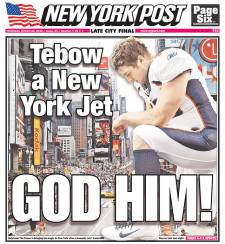
I know I’m not alone in hoping for some kind of Tim Tebow media blackout.  I was hoping the end of the football season, especially with the Broncos’ defeat, would bring some quiet to the Tebow-as-Christian-in-a-strange-land stories.  But Tebow’s move to the New York Jets brought a new round of media focus on Tebow’s style of loud public Christian-ness.
IMHO, the most interesting comment on the Tebow move came from Paul Moses at dotCommonweal.  Moses noted that the New York press tended to gasp at the incongruity of an extravagantly Christian celebrity in the extravagantly pagan Big Apple.

Moses pointed out,

The Times put it this way: “Tebow is also a somewhat incongruous fit: an outspoken Christian playing  in a city known for its extensive night life and a member of a  franchise made famous by the bachelor stylings of Joe Namath and  currently known for the profane speeches of its coach, Rex Ryan.”

And this, from the National Enquirer: “It is unclear how the pie-eyed pundit of the pigskin will respond to the multitude of temptations New York has to offer.”

Moses took such papers to task for assuming too much about life in New York City.  New Yorkers are a decidedly religious group.  Moses cited a Gallup poll from 1991 in which a majority of respondents–53%–said they prayed at least once a day.  The problem, Moses claimed, is that too many people equate Manhattan with the entirety of New York City.  In Manhattan, 17% of poll respondents claimed to be atheists.  In the Bronx, that number dwindled to 1%.

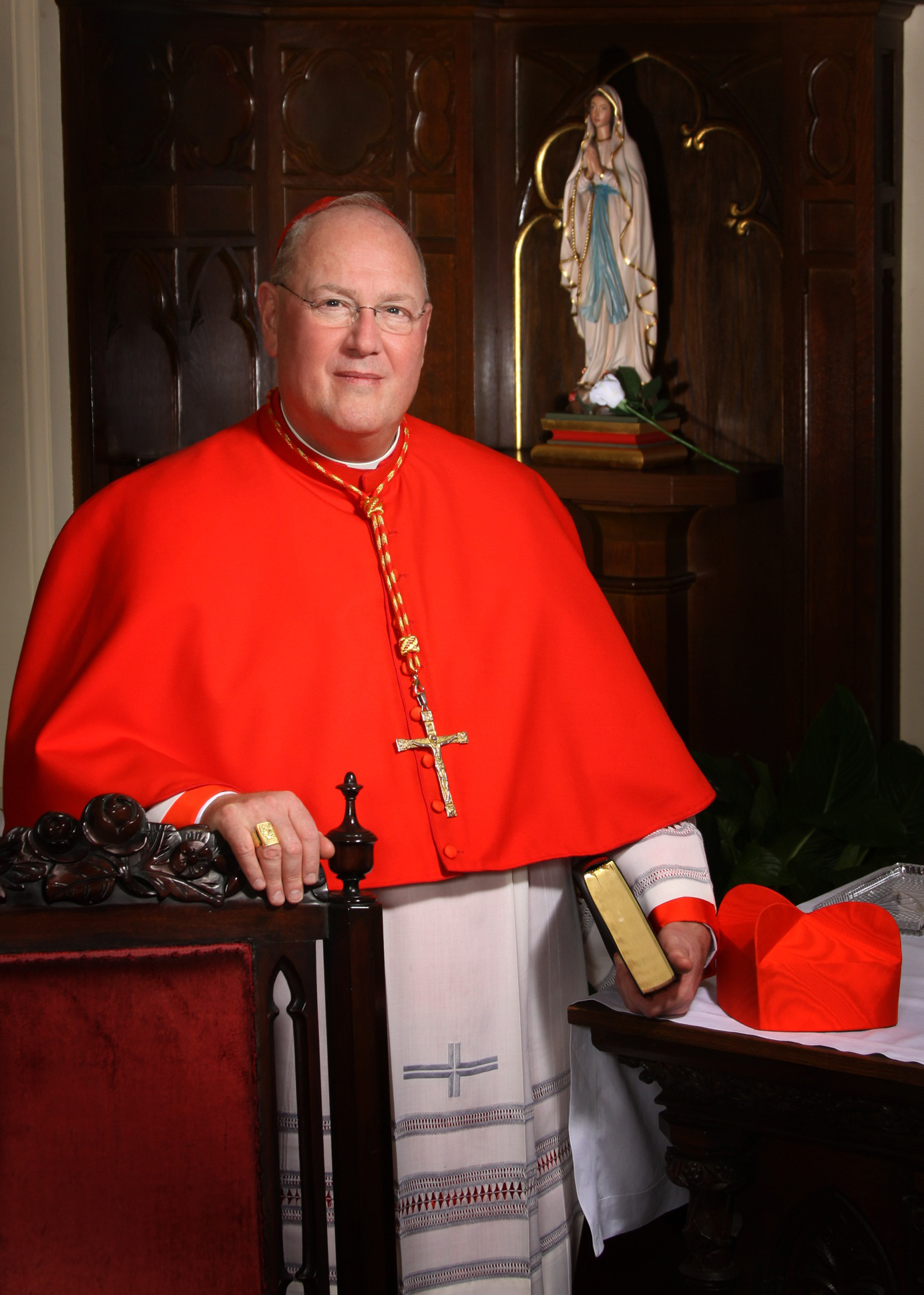
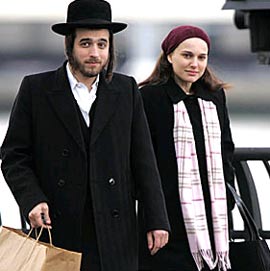
As we’ve pointed out here before, people who do not know much about Fundamentalist America often assume that religiosity goes up only with distance from big cities, education, and indoor plumbing.  It is just not true.  The myth might come from the association in the United States of conservative evangelical Protestantism with conservative religion as a whole.  But if we look at other conservative religious folks, New York City has as much of a claim to fundamentalism as anywhere else.  In the Catholic Church, for example, New York City is now home to genial Archbishop Timothy Dolan.  Dolan’s blog and very public presence inject a strain of conservative religiosity into life in the Big Apple.  And, of course, outside of Christianity, New York City is host to innumerable conservative religious groups.  The old joke about the hayseed who comes to New York and is surprised by the number of “New York Amish” demonstrates that New York has its own profound tradition of deeply conservative culture and theology.

Even within the bounds of conservative Protestantism, large urban areas have always served as strongholds.  True, someone wanting a Protestant fundamentalist education could go to Bob Jones University in lovely Greenville, South Carolina.  Or she could go to Liberty University in Lynchburg, Virginia.  But she could also head to Los Angeles to Biola University, or to Chicago’s Moody Bible Institute or Wheaton College.

The roots of this commonly held misperception, I think, come from the utter dominance of conservative evangelical Protestantism in some rural areas.  When folks from the big city drive around in fly-over country, they are shocked by the public dominance of this type of fundamentalism.  But such folks ought to look closer at their own cities.  Look for storefront Pentecostal churches.  Look for big cathedrals.  Look beyond the stereotypes of cities as home only to nightlife and paganism, and you’ll notice a deeply religious urban America.

There might be a few translation difficulties as Tebow  moves from the Bible Belt to the Big Apple, but there will not be any lack of fundamentalists ready to greet Tebow as he (if he?) makes his New York Jets debut.