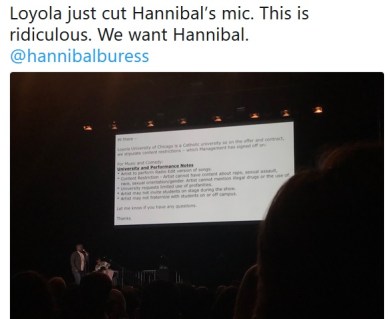
Here’s what we know: The Chronicle of Higher Education is reporting on a free-speech stunt by comedian Hamilton Buress. The well-known comic (so I’m told. I’d never heard of him, but that doesn’t mean much) had signed a contract for his bit at Loyola University in Chicago. He had agreed not to discuss certain subjects, including sexual abuse, rape, race, or sexual and gender orientation.
Buress didn’t only ignore the contract. He projected an image of the list of forbidden topics, then proceeded to make a joke about each one in turn. When he got to a joke about child sexual abuse by the Catholic church, the (Catholic) university cut off his mic.
What do you think?
Me, I’m torn. On the one hand, the guy signed a contract. He agreed not to make certain jokes.
On the other hand, Buress’s deliberate and provocative method of spurning the contract, IMHO, is more than just comedy. It makes a powerful point about the need to speak freely about sensitive topics.
Would I want him to perform at my kid’s fifth birthday party? Probably not. But do I think his stunt was a healthy shake-up of campus stultification? I think so.
White evangelicalism—the church of the “slave state,” at Forbes. [Editor’s note: The original Forbes article was taken down as “way out of bounds,” but the text is still available at this new link. Thanks to alert reader for pointing it out.]
What would arch-creationist Ken Ham say if someone accused him of hate speech? We don’t have to guess. At his recent talk at the University of Central Oklahoma, Ham defended his vision of proper Christian morality. Did he capture ancient Christian wisdom? Or spout off twenty-first century bigotry?
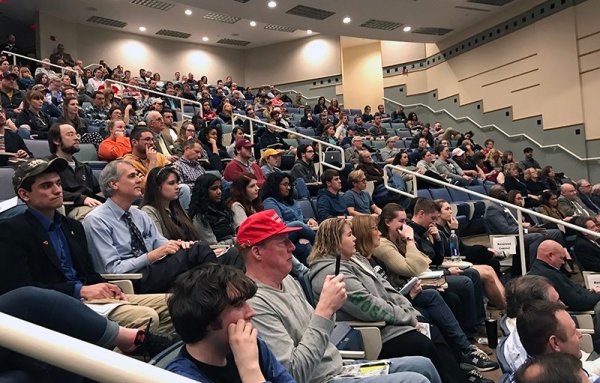
Part of the 500-person audience at UCO.
As SAGLRROILYBYGTH recall, we’ve tussled over this issue recently. When UCO rescinded Ham’s original invitation, we wondered if free speech was still alive. I argued at the time that free speech was something of a red herring in this case–and many similar college cases. The real issue is sponsorship. The student organization at UCO did not want to pay Ham to speak, due to Ham’s views on sexuality and marriage.
In the end, UCO President Don Betz squared the circle by using money from a separate slush fund to pay for Ham’s visit. And the talk went off without a hitch. During the Q&A, one audience member asked Ham directly about gay rights. Here’s how the interchange went, according to Religion News Service:
One questioner — a self-described “spirit-filled Christian” and member of the LGBTQ community — said: “I sought the Lord and churches for why I feel attracted to the same sex. I found the church nor churches’ traditional view on (LGBTQ) fit my experience of hearing the Lord speak directly to me. Science, not the church, gave me peace. How can you say my experience of still being a child of God isn’t valid?”
Ham said he would start by asking how the person heard from God: “My way of dealing with that would be to say, ‘Let’s judge what the actual written word of God says. Let’s judge what you’re saying against what it says.’
“Because I have a different worldview in relation to marriage and gender doesn’t mean I hate that person,” Ham added. “Sometimes, people accuse us of hate speech because we disagree with them. It’s a clash of worldviews. That doesn’t mean we hate someone. In fact, the Bible commands us to love everyone, and that’s what we do.”
What do you think?
From my perspective, Ham’s answer sidesteps the central point. I don’t want to put words in anyone’s mouth, but my hunch is that anti-Ham protesters at UCO didn’t care if Ham personally hated or loved them. The real question is whether or not he wanted to take away their civic rights to marriage equality.
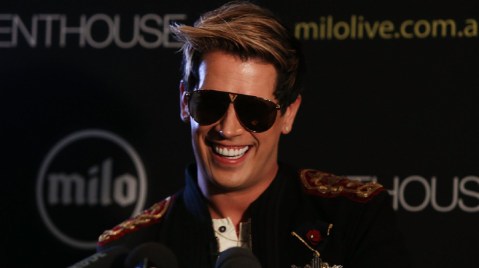
Should they or shouldn’t they? At UCLA, conservative students invited Milo Yiannopoulos to campus. A conservative professor advised them against it. His reasons for doing so highlight another fundamental question buried beneath our campus-free-speech shouting match.
A “legitimate” conservative? Or just a “despicable asshole”?
The issues from UCLA might seem vastly different at first. The College Republicans had issued a speaking invitation to right-wing bomb-thrower Milo. He planned to talk on the topic, “Ten Things I Hate About Mexico.” In an open letter published at Weekly Standard, one of their few conservative faculty mentors, Gabriel Rossman, advised them to cancel the invitation, for conservative reasons. And they did.
Why?
Professor Rossman condemned Milo as nothing but—using the words of Charles Murray—“a despicable asshole.” If UCLA conservatives were really dedicated to promoting conservative ideas and principles, inviting Milo was a bad idea. As Rossman put it,
You need to ask yourselves, what is your goal as an organization? If you’re in it for the lulz and just want to see the world burn, then I guess go ahead and bring in a vapid provocateur.
But if your mission is to spread conservative ideas, you should recognize that hosting Yiannopoulos will only render your organization and our ideas toxic.
Prof. Rossman’s advice—which the students heeded—raises another central underlying question in our debates over campus free speech. Last week in these pages, Agellius noted that the real question was not just creationism or homosexuality or nationalism. The real question, he wrote, was this:
It’s all about who gets to define “discrimination” isn’t it?
If Ken Ham’s version of Christianity is considered ipso facto discriminatory, then it makes some sense that he wouldn’t be invited to speak at a school dedicated to fighting against anti-homosexual discrimination. But if it isn’t, then it doesn’t.
Prof. Rossman’s advice raises a related question. He encourages UCLA’s conservative students to invite provocative conservative speakers. He lauded the decision to bring “War on Cops” author Heather MacDonald to campus. As he explained,
I can understand why some people were offended by Heather Mac Donald’s ideas when she spoke on campus last year. But reasonable people can disagree about whether all Americans, and especially African Americans, on net benefit from aggressive policing. More to the point, Mac Donald expresses her pro-police position without animus, so sponsoring her talk was an entirely legitimate and honorable thing to do.
Milo is different, Rossman thinks. His goal is only to push leftist students into vulgar displays of coercive thuggery. Rossman’s against it; against the entire “epater les SJWs performance art model” that Milo represents. [Editor’s note: SJW = “Social Justice Warrior.”]
We might say that Professor Rossman considered some so-called conservative speakers beyond the pale of legitimacy. Did College Republicans have the right to invite him? Rossman says yes. But was it good conservative strategy to do so? Rossman says no.
The central question, though, is not about Milo or Ken Ham or any single speaking invitation. The central question, it seems to me—following Agellius—is this: Who decides what “extremism” and “legitimacy” are?
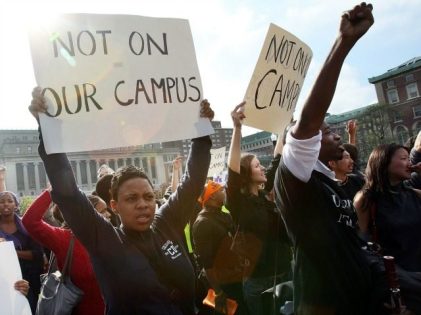
Is it “illegitimate” to oppose same-sex marriage? The Oklahoma student protesters said yes. Ken Ham says no.
Is it “extreme” to deride Mexico? To try to provoke UCLA students into wilder and wilder displays of speech-blocking ferocity? Professor Rossman says yes. The College Republicans, apparently, agreed.
Does a creationist have the right to free speech? That’s the question we’ve been wondering about here at ILYBYGTH lately, ever since arch-creationist Ken Ham got bumped from a talk at the University of Central Oklahoma. News from state legislatures brings up another campus challenge: Do student groups have the right to discriminate?
First, the update, thanks to Donna: According to Ken Ham’s Answers In Genesis organization, he has been re-invited to UCO. Apparently, Ham will talk on campus, then move to a nearby church for a Q&A.
Today, we’ve got an even trickier free-speech/free-assembly question to examine. Should student groups be forced to abide by university anti-discrimination rules? Even for their own leaders? Americans United for Separation of Church and State lists a burgeoning new crop of state laws that would force campuses to make exceptions.
In Virginia, for example, a state senate subcommittee unanimously approved a new bill that would allow student groups to discriminate in their leadership choices. Emphasis added below:
Establishes several provisions for the protection of expressive activity on the campus of each public institution of higher education, including (i) permitting any individual who wishes to engage in noncommercial expressive activity on campus to do so freely, as long as such expressive activity does not materially and substantially disrupt the functioning of the public institution of higher education and (ii) prohibiting any public institution of higher education from (a) denying a student organization any benefit or privilege available to any other student organization, or otherwise discriminating against a student organization, on the basis of the expressive activity of the members of such organization or (b) restricting a student organization’s ability to require any leader or other member of such organization to affirm and adhere to the organization’s sincerely held beliefs, comply with the organization’s standards of conduct, or further the organization’s self-defined mission or purpose.
The rub comes once again with the question of university support. Speakers on campus are generally free to do whatever they want, short of issuing threats or starting riots. People can talk their heads off in public areas. There have been important exceptions, as when one professor physically attacked an anti-abortion speaker on the campus of UC-Santa Barbara. In Ken Ham’s case, he wasn’t merely speaking on campus. He was sponsored and promoted by the student government. Some student groups objected to university sponsorship of a speaker that they saw as beyond the pale of legitimate public speech.
Liberal critics make the same case against these student-group laws. In AU’s opinion, such laws are a travesty. As they put it,
Religious freedom is the right to believe—or not—as we see fit. It doesn’t include a right to discriminate—and especially not while using taxpayer dollars or using the tuition fees of the very students who are being excluded. Religious student groups, of course, still have First Amendment rights on campus. They have been able to access school facilities for their meetings and use school bulletin boards to advertise their events like any other group. But they don’t have the right to force public universities to subsidize discrimination. If student groups want to discriminate, they shouldn’t receive public university recognition, tuition fees, or state taxpayer money to do so.
What do you think? Should student groups be free to discriminate? Should public money support student groups that discriminate?
I didn’t think it was all that complicated, but at least two smart people have misunderstood my complaint, so I’ll try to clarify. If SAGLRROILYBYGTH think I’m splitting hairs or being overly persnickety, I’ll shut my yap. But I don’t think I am and I don’t think the point is all that abstruse.
But I assumed—correctly it appears—that Prof. Coyne does reject some claims to free-speech protections. Prof. Coyne and I agree: Just because someone claims free-speech protection doesn’t mean they should get it. Some claims are bogus. Some are even harmful, at least potentially. The most obvious case is the perennial free-speech claim of America’s creationists. In state legislatures, bill after bill purports to protect the free-speech rights of creationist students and teachers.
Especially since we agree on everything, Prof. Coyne wondered what my beef was. As he put it,
Laats’s beef seems to be this: if I, Professor Ceiling Cat Emeritus, favor free speech on college campuses, why don’t I favor free speech in the classroom?
Coyne goes on to explain—and I agree with him as far as he goes—that creationist teaching in classrooms is not the same as controversial invited speakers on university campuses. However, he didn’t identify my beef correctly. Here it is: If Prof. Coyne doesn’t recognize the legitimacy of creationists’ claims to free-speech protections, why doesn’t he grant other people similar rights to un-recognize free-speech claims?
After all, Professor Coyne makes it clear. He says,
I do not recognize creationists’ desire to teach goddy stuff in the classroom as a “free speech” claim. [His emphasis.]
Coyne means, I think, that creationists can’t claim protection for their speech if it establishes a government religion unfairly, contra the First Amendment. By doing so, creationists give up any right to free-speech protection for their creationist teaching. The important point, IMHO, is that Prof. Coyne recognizes that some free-speech claims are faulty. Those claims are not legitimate and they do not deserve the protection they demand. Creationists insist on their right to free speech; they insist that their rights to be heard are often dismissed unfairly. In general, I think Prof. Coyne and I agree—we don’t lose any sleep over such creationist complaints, because we do not recognize them as legitimate claims to the protection of free-speech rights.
Which leads us to the main question again: If Prof. Coyne is willing to dismiss some claims to free-speech protection as illegitimate, why doesn’t he at least respect the anti-Bannon argument, even if he disagrees with it?
In other words, though I agree with Professor Coyne both that Bannon should be allowed to speak and that creationists should not be allowed to teach creationism in public-school science classes, I disagree with his glib dismissal of the arguments of the anti-Bannon protesters.
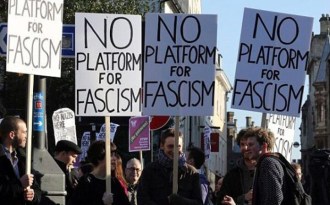
I think we need to acknowledge that there are real and important reasons why some intelligent, informed, well-meaning people refuse to recognize Bannon’s claims to free-speech protections. Further, there are good arguments to be made that a private (or public) institution has a responsibility to consider the implications of its speaking invitations. By inviting Bannon to speak, an elite university like Chicago is conferring on Bannon and Bannon’s ideas more than a touch of mainstream legitimacy. Blocking someone from speaking at the University of Chicago is not the same as blocking his or her right to holler on a street corner. I don’t think the Chicago protesters are hoping to shut down Breitbart; they are merely hoping to deny Bannon the enormous prestige of a Chicago speaking appearance.
Now, in this particular case I think the decision should swing in Bannon’s favor. But that does not mean that the anti-Bannon protesters don’t have a decent case to make. It does not mean that the UChicago protesters are “discarding one of the fundamental principles of American democracy because they don’t like its results,” as Prof. Coyne accused.
Some free-speech claims are bogus and don’t deserve to be recognized. The Chicago protesters and I merely disagree about the proper decision in this one particular case. They are not necessarily against free speech; they are disputing Bannon’s claim to free-speech protections; they are against their university recognizing Bannon’s legitimate status.


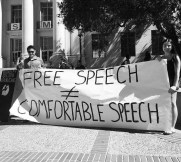 In Ken Ham’s case, he wasn’t merely speaking on campus. He was sponsored and promoted by the student government. Some student groups objected to university sponsorship of a speaker that they saw as beyond the pale of legitimate public speech.



 I Love You but You're Going to Hell