I Love You but You Didn’t Do the Reading

Racist Simpsons and other stories that came across our desks this week…

The White House Bible study group, at BBC. HT: MC

  • A “high-protein diet” of conservative evangelical Christianity for the Cabinet.

Much Apu about Something: The Simpsons punts on its racial stereotypes, at EW. HT: MM

How much public school can you buy for $25 million? Not as much as this billionaire wanted, at PI. HT: MM.

The “free-speech crisis” is worst at evangelical colleges, says Sarah Jones at NR.

Peter Greene asks: Why are we still giving Big Standardized Tests?

“Teaching for homecoming:” Why Wendell Berry thinks education is dangerous, at Forma.

  • “I know you all are learning a lot of methods about how to teach, and I’ll tell you something: None of them will work.”

Pro-choice “callous and violent,” says Ross Douthat at NYT.

The progressive perfidy of “dialogue:” Rod Dreher at AC.

There Is No Free-Speech Crisis at Evangelical Colleges

Have you seen it yet? Sarah Jones recently excoriated evangelical higher education as the home of the real free-speech crisis. Students and faculty alike, Jones reported from experience at Cedarville University in Ohio, are continually deprived of any right to authentic self-expression. She’s right. But that doesn’t mean there’s a free-speech crisis at evangelical colleges. There can’t be.

cedarville-logo-social-media-default

No one said it was for freedom of speech…

Why not? It’s not for the reasons Pietist Schoolman Chris Gehrz describes, though he makes an important point. As he argues, different evangelical schools have hugely different records and policies when it comes to free speech.

And it’s not because Jones misses the boat on the ways evangelical colleges restrict student and faculty speech. I agree with her entirely that the environments of many evangelical campuses can be restrictive, oppressive, and even dangerous. When students don’t feel free to report sexual assault or abuse, for example, they are put in a horrible position.

Yet even granting the truth of Jones’s alarming exposé, I don’t agree that evangelical colleges represent the real free-speech crisis in American higher education. They can’t. Evangelical colleges don’t have a free-speech crisis any more than my school faces a religious crisis for not adequately teaching students how to be good Christians. We don’t want to train good Christians. And evangelical colleges have never wanted to open their chapels, classrooms, and cafeterias to unrestricted speech.

Rather, as I argue in my recent book about evangelical higher education, restricting free speech is a central, defining element of the tradition. It sounds sinister when I say it like that, but it’s true. Professor Gehrz is absolutely correct that some schools today have stricter rules than others, but for almost a century now, the point of evangelical higher education is precisely to impose certain restrictions on faculty and students, restrictions abandoned by mainstream colleges.

To suggest that these restrictions are part of a “crisis” misses the point. Please don’t get me wrong: I sympathize whole-heartedly with Jones and the other students and faculty who dislike their alma maters’ heavy hand. I would dislike it, too. But that heavy hand is not a “crisis.” It can’t be. It is the entire raison d’etre of evangelical higher education.

Consider the promises of evangelical leaders throughout the twentieth century. Explaining the purpose of his new college in Florida, founder Bob Jones Sr. explained it this way in 1928:

Fathers and mothers who place their sons and daughters in our institution can go to sleep at night with no haunting fear that some skeptical teachers will steal the faith of their precious children.

At Bob Jones College, as at all the schools that joined the fundamentalist movement in the 1920s, restricting faculty speech was a primary purpose, not an unfortunate necessity. Unlike mainstream colleges, including mainline Protestant ones, fundamentalist colleges would willfully impose strict lists of mandatory beliefs for faculty members. They would impose long list of behavioral rules for students. And they insisted always that their goal was to shape students’ hearts in a certain religious direction.

Lest readers think the tradition was only in the 1920s, or only at fundamentalist Bob Jones University, consider this quotation from relatively liberal Wheaton College in 1963. President V. Raymond Edman told recalcitrant students about his vision for Wheaton. “This college,” Edman told students,

will be a place Christian parents can send their children to with the confidence that their faith will be established and not shaken.

In other words, the entire point of the network of dissenting evangelical colleges was to police faculty belief and student thought. Evangelical colleges that restrict speech these days don’t face a crisis. They fulfill a promise.

I Love You but You Didn’t Do the Reading

Spring still feels pretty far away up here in the woods. Here are some stories that kept us occupied this past week:

Trumpism and the authoritarian personality, at NYT. HT: HD.

Speak no revival: Liberty bans talk of RedLetterRevival, at RNS.

FBI, MLK, and the first televangelist, at R&P.

ok teacher march

Teachers march in OK.

  • “History does not repeat itself, but often, it does rhyme. Today, the White House has an evangelical advisory board and a coterie of televangelists to march alongside the executive branch. Are the African American members of President Trump’s evangelical advisory council the modern day Michauxs?”

How do radical creationists change their mind? Not by argument, at RD.

  • “However well-intentioned you are, bludgeoning people with fact after argument after fact will only entrench them in their position and reinforce a perception of being persecuted by the world.”
  • How can creationists refuse to acknowledge scientific evidence? Easy, at ILYBYGTH.

Arizona’s up-and-coming Betsy Devos clone, at NR.

Why don’t Americans care more about World War I? At The Guardian.

Shocking: Mother uses stun gun to wake her teenager for Easter services. At RNS.

LGBTQ at evangelical colleges: Author interview at IHE.

Hullabaloo at Taylor, too.

Oh my: New flat-earth poll finds only 2/3 of young people “confident” that the earth is a sphere, at LS.

Too far for the Atlantic: Kevin Williamson fired for advocating hanging women who had abortions.

Sweepin Down the Plains: Oklahoma teachers march 110 miles, at NBC.

Are college history classes teaching students to be critical thinkers? Erm…not really, says Stanford’s Sam Wineburg at IHE.

Who Cares about Fundamentalist U?

It’s not just a topic for evangelical intellectuals. Recently, journalist Lauren Gilger asked me some great questions about my new book. Among the most pressing is this one: Why should the rest of us care about evangelical higher ed?

KJZZ_Gen_BlackBlue

Why care about evangelical colleges?

You can listen to the whole interview at Phoenix’s KJZZ: The Show.

I Love You but You Didn’t Do the Reading

The holiday week didn’t seem to slow down the culture-war rhetoric. Here are a couple of ILYBYGTH-themed stories that came across our desk this week. Thanks to everyone who sent in stories and tips.

Historian Sean Wilentz on the difference between “liberals” and “progressives.”

  • “there is a rumor abroad in the land that only progressives care about the powerless and the poor, whereas liberals are just vaguely left-of-center fig leaves for plutocrats and globalizers. . . . This was edifying and improbable pandering.”

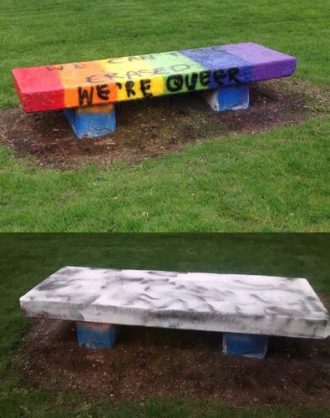
    wheaton rainbow bench

    ARE the times a-changin?

LGBTQ issues at evangelical colleges, at NPR. HT: EC.

Yes: Why do white evangelicals love Trump?

Double standards, elite liberal hypocrisy, and Trump-shaming, at FPR.

It’s tough to be a teacher, by Andrew Heller.

What do Hungarian school children read in their textbooks? “It can be problematic. . . . for different cultures to coexist.” At NYT. HT: HD.

The David defense: Trump’s relationship with Stormy Daniels in biblical language, at Vox.

Life after polygamy in Short Creek, at R&P.

Schools are getting safer these days, in spite of how it feels. From NCES.

The coming collapse of Christian colleges, by Rod Dreher at AC.

More teachers’ strikes: Kentucky teachers stay home, at CNN.

Should history be patriotic? At The Atlantic.

Want to save the humanities?

R-E-L-A-X…

Is the sky falling for evangelical colleges? Rod Dreher says yes. I say no.

Dreher is responding to a recent NPR piece describing the tensions at evangelical colleges over student sexuality and gender identity.

As the article describes, colleges aren’t sure what to do. For many conservative evangelicals, homosexual practice is unacceptable. But so is rejecting and harassing Christians. To Dreher, the conundrum is proof that evangelical colleges—like all evangelical institutions—need to take drastic Benedictine steps. As Dreher puts it,

the environment in which traditional Christian colleges and educational institutions work is rapidly changing: politically, legally, and culturally. We cannot count on anything anymore. . . . Somehow, faithful small-o orthodox Christians have to figure out how to educate within this hostile new heterodoxy. We will have to form new institutions, ones built to be resilient in the face of anti-Christian modernity.

Sounds scary. But as I argue in my new book about the history of evangelical higher education, this predicament is nothing new. To the contrary, this dilemma has been the driving force behind evangelical higher education for a hundred years now. Consider this plea from Dean Lowell Coate of Marion College, c. August, 1923. Mainstream higher ed, Dean Coate fretted, had been taken over by “evolution, destructive criticism, and liberalism.” What evangelicals needed, Coate insisted, was to

ignore the whole worldly system, and organize courses independent of the world’s stereotyped curricula, engage the strongest conservative scholarship in America, raise the educational standard above the present unchristian philosophy, stablish [sic] it upon ‘the faith once for all delivered to the saints,’ and then challenge the world to meet the new scholarship.

Guess what? It worked. The fundamentalist movement of the 1920s set up a startlingly successful network of colleges, universities, seminaries, and institutes. Evangelical colleges have faced the challenge of rapid change for almost a century and they have always found a way to remain true to both their religious mission and their academic aspirations.

Cover art final

Is the sky falling? Yes, but it has been falling for over a century now…

Now, as SAGLRROILYBGTH are tired of hearing, I don’t have a dog in this fight. I’m not evangelical, nor am I personally invested in evangelical higher ed. If I were, though, I would listen to Aaron Rodgers and not Rod Dreher. The challenges faced by schools today are serious and dire—but they are not more serious and dire than the challenges that have always confronted evangelical academics.

Can Jesus Make a Profit?

It’s true—there are lots of topics that I had to leave out of my new book about evangelical higher education. Among the most difficult choices was the decision to focus tightly on one group of interdenominational evangelical schools that had its roots in the 1920s fundamentalist movement. Lots of important and interesting evangelical colleges got (mostly) left out of the story: Oral Roberts University, Regent University (VA), and Patrick Henry College, to name a few.

grand-canyon-university_2015-03-23_14-34-58.004

Cactus, cross…and ka-ching?

A recent call from a journalist has me yearning to have been able to include one of the most unusual and idiosyncratic stories in the history of evangelical higher education—the tangled tale of Grand Canyon University.

Like a lot of evangelical schools, Grand Canyon University started out as humbler Grand Canyon College, an institution catering to local Southern Baptists. With such a small draw, the school had trouble keeping the lights on. In an effort to attract more students, it adopted an interdenominational evangelical posture. So far, so ho hum. All evangelical colleges—well, almost all—could tell similar tales in the 1960s, 1970s, and 1980s—tales of dwindling enrollments and desperate attempts to lure more students.

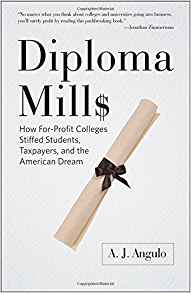
What makes GCU so interesting is its radical 21st-century attempt to rewrite the Christian college playbook. In order to stay afloat, in 2004 GCU converted into a for-profit institution. There’s nothing new about for-profit higher education. As my friend and colleague A.J. Angulo has argued so powerfully, the for-profit sector has a long and often shameful history.

What IS unusual is an evangelical college hoping to join the for-profit club. To be sure, plenty of evangelical colleges make money. Most famously, Liberty University made gagillions of dollars in online education in the past dozen years. But that money isn’t a profit for shareholders; it is plowed back into campus resources, including the newly respectable Liberty football team.

diploma mills

Tsk, tsk. Not a club I’d think Christian colleges would want to join…

If recent news is any indication, there are good reasons why evangelical colleges don’t try to make a profit. In Phoenix, GCU has recently agreed to buy back its right to be a non-profit school. It won’t be cheap. The school plans to spend almost a billion dollars (yes, that’s B-illion with a B) to buy back its stock.

Some of the benefits are concrete. As a non-profit institution, GCU will once again be eligible to accept tax-deductible donations. It will be able to participate in NCAA sports and compete for research grants. As all colleges must do to survive, these trappings will allow GCU to look like a “real” college.

The quest to maintain status as a “real” college has always animated evangelical schools. They have fretted that their doctrinal peculiarities and severe campus rules would cause higher-ed outsiders to look down their noses at them as mere “church colleges.”

So GCU’s desire to reclaim its non-profit status makes perfect sense in the longer story of evangelical higher education. This morning I’ve got a different question. All evangelical colleges want to have sports, research, and the other trappings of “real” colleges. But they’ve also insisted on their status as “real” Christian institutions, though they have never been able to agree on a precise definition of that term.

So here’s the question: How could GCU have ever moved into the for-profit world? Could an evangelical college ever hope for respect if it made a profit off of its students? Wouldn’t that undermine its claims to being a truly Christian institution?

Thanks, CHE!

No, no, no, not THAT Che. I mean the Chronicle of Higher Education. Peter Monaghan recently featured my new book in their pages.

CheHigh

urm…different CHE.

Monaghan put his finger squarely on several of the most important issues in the world of evangelical higher education.

For example, as Monaghan explains, the world of evangelical higher education is not somehow trapped in the past. As he puts it,

Many newcomers to the inner workings of fundamentalist Christian colleges are surprised to learn that the institutions consider themselves not just righteous but also thoroughly “modern.”

The differences between evangelical and non-evangelical higher education is therefore not as stark as some outsiders might think. As Monaghan concludes,

Like elite secular institutions . . . fundamentalist ones seek to thrive by “developing a niche that they can exploit,” selling themselves as “experiences” that transform young people. They describe themselves as hubs of academic endeavor, with prospectuses little different from those of their nonreligious peers. Leaders also promote their institutions’ distinguishing features, like size, location, and sports programs, aware that evangelical families want to provide their children with more than doctrinal guidance during their college years.

Almost makes you want to read the whole book, don’t it?

We’re Trending!

You might have trended before. I don’t think I have. I’m a little dizzy…

IHE FU story

Does this mean I’ll need new outfits?

How Did Christian Colleges Become Racist?

People keep asking: Why are white evangelicals so racist? This week we see it in The Atlantic and at Forbes. At leading evangelical colleges—in the North anyway—there’s a big, obvious answer that this week’s pundits don’t mention.

Here’s what they’re saying:

  • Michael Gerson wondered what happened. At his alma mater Wheaton College in Illinois, a strident anti-racism among white evangelical leaders slipped away.
  • Chris Ladd places the blame on slavery and the lingering dominance of Southern Baptists. As Ladd writes,

Southern pastors adapted their theology to thrive under a terrorist state. Principled critics were exiled or murdered, leaving voices of dissent few and scattered. Southern Christianity evolved in strange directions under ever-increasing isolation.

The question should bother all of us, white or not, evangelical or not. Why do so many white evangelicals seem comfortable or even enthusiastic about Trump’s Charlottesville-friendly MAGA message?
1940s postcard library

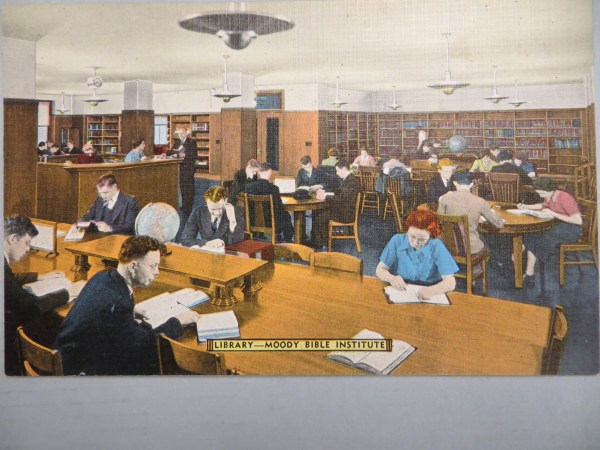
Not a lot of diversity, c. 1940s

Since neither Gerson nor Ladd bring it up, I will. At some of the leading institutions among white evangelicals, there is an obvious culprit. It’s not the political power of the slave state. It’s not craven lust for political influence. As I’m arguing in my new book about evangelical higher education, Christian colleges have always been desperate to keep up with trends in mainstream higher education. And those trends pushed white evangelicals to mimic the white supremacy of mainstream higher education.

Of course, evangelical colleges were happy to stick out in some ways. In the classroom, for example. Evangelical institutions of higher education have always prided themselves on teaching dissident ideas about science, morality, and knowledge. In social trends, too, evangelical colleges didn’t mind having stricter rules for their students about drinking, sex, and dress codes.

When it came to academic luster, however, fundamentalist academics in the first half of the twentieth century were desperate for the respect of outsiders.

At Gerson’s alma mater, for example, President J. Oliver Buswell quietly discouraged African American attendance in the 1930s. Why? There’s no archival smoking gun, but Buswell explicitly discouraged one African American applicant, suggesting that her admission would lead to “social problems.”

When we remember the rest of Buswell’s tenure, his reasons for discouraging non-white applicants become more clear. Against the wishes of other Wheaton leaders at the period, Buswell fought hard for academic respectability. He tried to decrease teaching loads, increase faculty salaries, and improve faculty credentials. As Wheaton’s best historian put it, Buswell

passionately believed that one of the best ways to earn intellectual respect for fundamentalist Christianity would be to make certain that Wheaton achieved the highest standing possible in the eyes of secular educators.

In the 1930s, that respect came from a host of factors, including faculty publications and student success. It also came, though, from limiting the number of African American students and the perceived “social problems” interracialism would impose.

Buswell and Wheaton weren’t the only northerners to impose segregation on their anti-racist institutions. Cross-town at Moody Bible Institute, leaders similarly pushed segregation in order to keep their institution respectable in the eyes of white mainstream academics.

Like other white evangelical institutions, in the late 1800s Moody Bible Institute was committed to cross-racial evangelical outreach. On paper, in any case. And MBI always remained so on paper, but by the 1950s the dean of students broke up an interracial couple. The dean was not willing to say that there was anything theologically wrong with interracial dating, but he separated the couple anyways, worried that public interracialism would “give rise to criticism” of MBI and its evangelical mission.

Why do so many of today’s white evangelicals seem comfortable with Trump and his white-nationalist claptrap? Why didn’t they hold on to the anti-racism that had animated white evangelicals in the past? Both Ladd and Gerson make arguments worth reading.

On the campuses of northern evangelical colleges, though, there was another powerful impulse. For evangelical college leaders, being a real college meant earning the respect of white non-evangelical school leaders. Between the 1930s and the 1950s, uncomfortable as it may be to acknowledge, mainstream white college leaders expected racial segregation. White evangelical college leaders weren’t more racist than non-evangelicals. They were just more desperate to seem like “real” colleges.

HT: DL, EC