I Love You but You Didn’t Do the Reading

In like a lion–we’re reeling from an early March blizzard. It left your humble editor plenty of time to scour the interwebs for stories you might like:

Arizona lawmakers push “conservative thought” onto campus, at NYT. HT: HD.

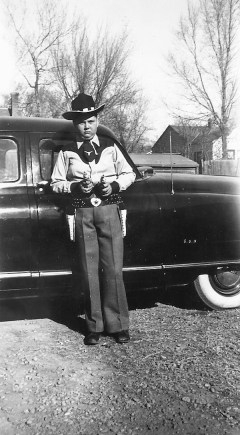
Guns and boys: A pictorial history of Americans’ gun fetish, at HNN.

guns and boys

How long have Americans been in love with guns?

Praying at school—the story from McKinney, Texas, at RNS.

How segregated are public schools? A new survey at Brookings.

Did the Nazis really burn the Reichstag in 1933? New proof, at Telegraph.

Notes from the fundamentalist underground: Campus strife at evangelical Taylor University, at IHE.

West Virginia teachers head back to the salt mines, at CNN.

…or DO they? Strike continues after all.

Lehigh University rescinds Trump’s honorary degree from 1988, at TMC.

Charter schools worldwide—what do they look like with fewer rules? Hechinger Report describes Sweden, New Zealand, and France.

LDS scientist: Mormons have nothing to fear from evolutionary theory, at SLT.

Why did China ban Winnie the Pooh? At BBC.

Is religion for suckers? Mark Bauerlein on Steven Pinker, at FT.

Shipping conservatives to the gulag: Rod Dreher’s latest at AC.

Poison Pens at Evangelical Colleges

What’s going on at Taylor University in Indiana? According to a recent anonymous newsletter, the evangelical campus is seething with

gossip, slander, backbiting, profanity, vulgarity, crude language, sexual immorality (including adultery, homosexual behavior, premarital sex and involvement with pornography in any form), drunkenness, immodesty of dress and occult practice.

Zoiks!

Taylor’s administration struggles to respond to this conservative carping. For those in the know about the history of evangelical higher education, this sort of anonymous poison-pen assault has always been part of life at Christian colleges.

As I found in the research for my new book, critics from both the evangelical left and the fundamentalist right have often resorted to anonymous open letters in their attempts to influence policy at their schools. The archival files bulge with letters and newsletters of this type.

At Biola University, for example, a self-identified group of disgruntled fundamentalists buttonholed President Samuel Sutherland with a list of concerns in 1969. As they wrote anxiously,

we are deeply concerned about danger signs showing themselves among some of our conference speakers and members of the student body! Indications now present seem to point to a trend that the school is moving from its Biblical foundation.  May God prevent such a tragedy!

The students were concerned with the slackening of the student dress code, particularly for women. The rules stated that skirts and dresses must not be shorter than one and a half inches above the knee. As the conservative students complained, though,

the failure of a number of Biola girls to adhere to the dress rule is altogether too evident.  Excessive bodily exposure of Biola girls has even been seen in the seminary section of the library and has proven a hindrance to study. . . . We urge the administration to be rigorous in enforcing the rules and regulations of Biola Schools.  IN particular, the dress length rule should be observed because of its obvious Biblical basis.

Rock and roll, too, had snuck onto campus. As the protesters warned,

Unfortunately, many students here are experiencing a diet of music consisting primarily of the popular beat of the day.  Our group does not advocate avoidance of popular tunes!  However we do oppose the trend toward an exclusive diet of rock and roll even to the extent that our religious music is to be constructed around the beat.

All in all, the fundamentalist protesters in 1969 worried about the very continuation of Biola as a safe evangelical school. As they concluded,

Many great schools of the past today are under the sway of heresy.  We do not believe that loss happened within a few months.  We believe the erosion was gradual.  May God help all of the administration and faculty at Biola Schools to become more alert in detecting danger signs and in taking action to prevent the deterioration that has begun here.

These sorts of anonymous pleas for reform and renewal haven’t only come from nose-out-of-joint fundamentalists. Liberal students, too, have penned their share of open letters. The archives are full of em, but my personal favorite comes from Moody Bible Institute.
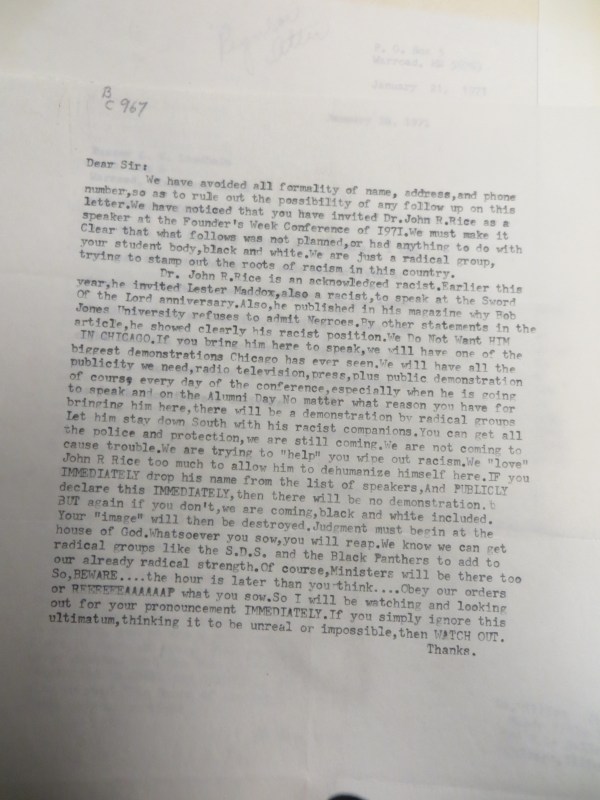
anti john rice demonstration warning letter

From the MBI Archives: BEWARE!

In 1971, MBI invited John R. Rice to speak at its annual Founder’s Day event. Before he could make the trip to Chicago, Rice came out in favor of the racial segregation at Bob Jones University. What was MBI to do? The leadership didn’t want to endorse Rice’s brand of Southern-fried racism. But they also didn’t want to anger his considerable fundamentalist following. As they dithered, they received an anonymous letter warning them to cancel Rice’s appearance.

The letter claimed to be written by non-students. To this reporter, however, the tone sounds awfully similar to the phrasing used by evangelical students everywhere and the letter-writers seem to know a lot more about Rice and MBI than any outsider would. For example, they had read Rice’s publication, Sword of the Lord. They knew about Rice’s recent support for racial segregation at Bob Jones U.

What should MBI do? The letter writers made threats:

We Do Not Want HIM [Rice] IN CHICAGO. If you bring him here to speak, we will have one of the biggest demonstrations Chicago has ever seen.

It would get ugly. As the letter concluded,

BEWARE . . . . the hour is later than you think. . . . Obey our orders or REEEEEEAAAAAP what you sow.

In the end, MBI canceled Rice’s speech. Perhaps the administration shared the letter-writers’ concern that their “ ‘image’ will . . . be destroyed.”

What will happen at Taylor? The conservative newsletter complains that the current campus is going to the dogs, according to Inside Higher Education. In classes, the newsletter exclaims, students learn

permissive views of human sexuality, hostility toward creationist perspectives, rejection of the rule of law (especially on the immigration issue) and uncritical endorsement of liberal-progressive ideas[.]

Such poison-pen missives have had a big impact in the past. Perhaps Taylor’s administration will take the path of least resistance and make some move to mollify the “conservative underground.”

Dress for Success!

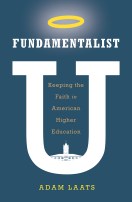
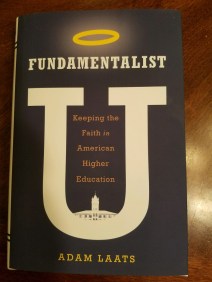
Well, friends, March 1st is just around the corner. And that means the official release of my new book, Fundamentalist U: Keeping the Faith in American Higher Education. Cover art final

I’ve heard from none of you that you plan to “Harry-Potter” this release. That is, that you plan to camp out all night at the bookstore on Wednesday, February 28th, dressed as your favorite personage from Fundamentalist U. For those of you who will be doing so, I’ll share here a few images of the people you might choose to dress up as.

I’m not sure how many of them were in Hufflepuff…

All of these people play important roles in the history of conservative evangelical higher education. For bonus points, can you match the pix to the names? Or the names to the relevant institutions?

Here they are, in no particular order:

  1. Mark Noll
  2. Elisabeth Howard Elliot
  3. Russell Mixter
  4. Henry Morris
  5. James M. Gray
  6. Clifton Fowler
  7. Hudson Armerding
  8. Charles Blanchard
  9. Larycia Hawkins
  10. J. Oliver Buswell

Have fun, and see you at the bookstore!

Trumpist Towers? Or Critical Colleges?

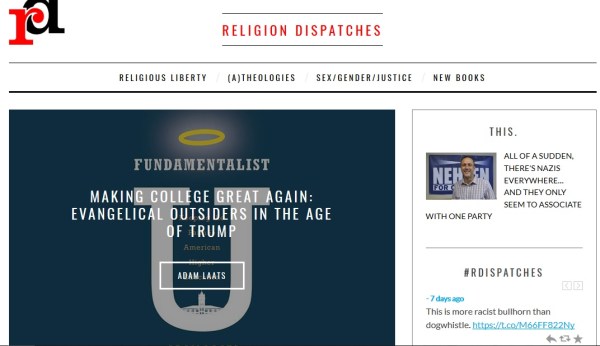
I’ve said it before and now I’m saying it again: Trumpism speaks to long traditions among white evangelicals. And time and again, evangelical colleges have been the institutional homes of Trump-like yearnings to “make America great again.” As I argue this afternoon over at Religion Dispatches, however, evangelical colleges have also played another key role.

RD screenshot

Are evangelical colleges bastions of Trumpism? Or are they the only places evangelicals can turn to find out what’s wrong with loving The Donald?

I won’t give away the entire argument. SAGLRROILYBYGTH might be bored to tears with the topic and you can read the whole thing if you’re interested. But I will say that it’s no surprise that President Trump loves Liberty University. It’s also no surprise, however, that the Liberty community isn’t sure if they love him back.

I Love You but You Didn’t Do the Reading

Happy Monday! Another week come and gone and nothing to show for it except a handful of headlines:

Does college push students to the left? Not really, a new study finds. At IHE.

A Catholic view: Radical creationism suffers from “an impoverished theology,” at America.Bart reading bible

What does a conservative Koch-funded school look like? Now we know, at Wichita Eagle.

Schools don’t teach much about slavery, at WaPo.

What goes on in evangelical study centers on college campuses? At RNS.

Who’s afraid of institutional life? An interview with an evangelical college president at CT.

New bill would ban South Dakota schools from teaching about gender identity, at MN Star-Tribune.

Florida takes the lead on privatizing public education, at AP.

Mumbling Toward Gomorrah

Which side are you on? That’s the question college administrators hate to answer. A few recent headlines make it clear that conservative evangelical college leaders continue to prefer mumbling through some of the touchiest issues they face. As I found in the research for my new book about evangelical higher education, it has always been thus.

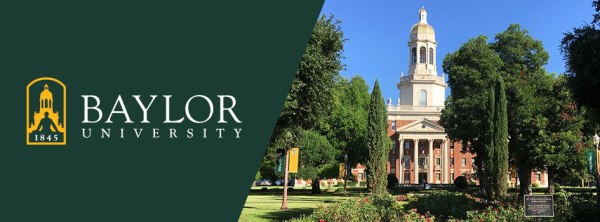
baylor-header

What’s their position on homosexuality? …how much time do you have?

I was reminded of this dilemma when I came across a conservative lament about Baylor University in Texas. One outraged correspondent wrote to Benedictophile Rod Dreher to complain that Baylor had ditched its Baptist tradition. Officially, according to this American conservative, Baylor’s code of student conduct prohibits homosexual relationships. But as he or she described, it can be very difficult to actually find that rule spelled out. As s/he told Dreher, in order to find out that Baylor officially bans homosexuality,

You must start here Student Misconduct Defined https://www.baylor.edu/student_policies/index.php?id=32401 only to be redirected here for Sexual Conduct Policy https://www.baylor.edu/student_policies/index.php?id=32294 which says literally nothing, but directs you here: https://www.baylor.edu/content/services/document.php?id=39247. This tells you almost nothing but at least tells you sex is only allowed in marriage–but these days, who knows that means? The Baylor website basically says they understand marriage according to the 1963 Baptist Faith and Message but tough shit, we aren’t going to give you a link; you’re are on your own. I found it: http://www.baptiststart.com/print/1963_baptist_faith_message.html And it turns out that according to the Baptist Faith and Message, marriage is defined as being between a man and a woman. Whew! I’m tired already! Lots of link-chasing and more than a few logical inferences from different webpages are necessary to conclude that in fact, homosexual contact is prohibited by Baylor policy.

Baylor isn’t the only evangelical school to founder in the face of sex policy. SAGLRROILYGYTH may remember a recent case from Boston. Gordon College’s President D. Michael Lindsay set off a firestorm a couple of years ago when he reminded the Gordon community of Gordon’s long-standing policy against homosexual relationships among students. The Gordon community remains painfully divided over the question, with entire faculty committees resigning their leadership roles in protest over leadership decisions.

Now, I’m no evangelical. I’m not conservative. I wouldn’t send my child to a school that banned homosexual relationships, even if that school buried those rules deep in ivy. But as an outside observer, I can’t help but notice what so many school leaders have always known: Sometimes the best policy is mumbles. Anything else can blow up in your face.

After all, Lindsay at Gordon wasn’t changing any rules. He was not imposing a new, draconian policy. Rather, he was simply stating established Gordon rules. And that was enough to create an uproar. It would be difficult for other school leaders not to get the message. Time and time again, cautious school administrators and others can see the enormous benefits of mumbling. Of studied silences. Of intentional ambiguity.

Baylor considers itself a mainstream school, a powerhouse in both faculty lounges and football fields. The fact that its policy officially prohibits homosexual sex isn’t something it likes to promote.

Similarly, President Lindsay’s statement about student sex did nothing more than openly state the school’s longstanding policy, yet his statement has led to prolonged anguish for the Gordon community.

With stakes so high, it certainly seems to be in colleges’ best interest to maintain some flexibility in their official policies. This strategy is nothing new.

To describe just one example from my new book, in the 1960s Wheaton’s administrators faced a similar upsurge from the Wheaton community. Students wanted to revise the forty-year-old student pledge. The old rules against movies, alcohol, and card-playing—rebels insisted—reflected the college’s sad fundamentalist past. They insisted on more flexible rules in order to give them more moral responsibility.

In 1967, President Hudson Armerding agreed, sort of. He approved and announced a new set of guidelines for student behavior. From then on, instead of the old list of banned activities, students were expected to abide by the following rules:

                1.) Cooperate constructively in the achievement of the aims and objectives of Wheaton College and the responsibilities of citizenship in the community and nation.

2.) Exhibit Christian conduct, based on principles taught in the Scriptures, which will result in the glorification of God, the edification of the Church and his own growth in grace

3.) Observe, while under the jurisdiction of the college, Wheaton College’s ‘Standards of Conduct.’

4.) Take maximum advantage of the educational opportunities available to him by ordering his life so that he can live in harmony with both the academic and non-academic goals.

5.) Make full use of his God-given abilities so as to achieve maximum personal development.

6.) Continually evaluate his commitment to Christ and to the purposes of Wheaton College.

Armerding was a past master at mumbling through these questions. He could tell students with a straight face that he had heard their complaints. He really did approve a new approach.

Yet at the same time, President Armerding could tell conservative alumni and trustees that the new rules left the old ones in place. Students still had to abide by the old standards of conduct while on campus. He could look parents in the face, as he did in a 1971 chapel talk, and tell them that nothing had changed. As Armerding put it, Wheaton would never approve

a shallow permissiveness [that] conveys a distorted view of God who deals far differently with His children. . . . We believe that students should be disciplined and corrected and that this should be consistent with the teachings of the Word of God.

The questions in the 1960s and 1970s weren’t about homosexuality. But the strategies were the same. As do administrators at all types of colleges, many evangelical school leaders cherish the value of fuzzy, possibly two-sided rules.

The Ugly Truth: Sex Abuse at Evangelical Colleges

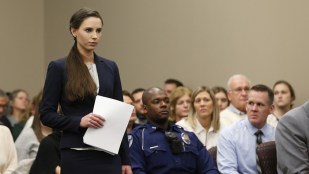
I wish it were a shock or a surprise. Instead, the terrible stories coming out of the Larry Nassar case are all too familiar: young people threatened and abused, an abuser tolerated for the sake of victory, the whole story hushed up. Why did so many responsible adults look the other way? One phrase from gymnast and whistleblower Rachel Denhollander struck me: “not simple institutional protectionism.” Denhollander sees it as a theological problem, but in the research for my new book about evangelical colleges, I found a more complicated truth.

rachel denhollander

Denholland testifies…

Of course, the demon of sexual abuse and institutional cover-up is not a problem for evangelical churches and colleges alone. The Catholic Church, big football schools like Penn State, and in the Nassar case, Michigan State all have an atrocious record of institutional protectionism.

However, I argue in my book that evangelical colleges faced a peculiar double-pronged problem. First, in the early years of the fundamentalist movement, leaders were keen to protect the reputation of their controversial movement. Second, without an outside arbiter—a denominational convention or presbytery or Vatican—fundamentalist institutions tended to turn into self-contained fiefdoms. The thoughts and plans of charismatic leaders tended to become authoritative, if not authoritarian.

A couple of examples will illustrate the trend. In the 1930s, Denver Bible Institute was wracked with a gruesome sex-abuse scandal. The accused leader and perpetrator, Clifton Fowler, turned to a blue-ribbon panel of Bible-institute worthies to clear his name. The panelists tried hard, in the words of the chair, to keep their investigation a “strictly private matter among Christian brethren.” They wanted to find out the truth about Fowler, but they didn’t want to publicize it. They were worried about the reputation of fundamentalism as a whole and Bible institutes in particular. It wasn’t a cover-up, exactly, but it was a form of discouraging complaint and public outcry.

This sort of “institutional protectionism” isn’t exactly theological, but it has been a tradition written deep into the bones of conservative evangelical and fundamentalist institutions since the 1920s. The movement has always had a sense of beleaguered outsider status, of being ripped off and usurped, kicked out of its rightful role as leaders of denominations and higher education. Certainly, this sense of hyper-defensive circle-the-wagons clubbishness is related to the theology of fundamentalism, but it is not itself a theological notion.

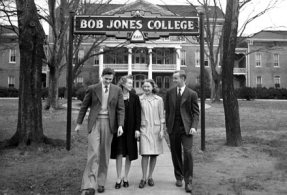
Maybe one more example will help illustrate the tradition. At Bob Jones College during its Tennessee years (1933-1947), founder and president Bob Jones Sr. established the patterns that guided the school for decades. Unfortunately, those patterns also fostered and abetted sexual abuse. During the 1930s, Jones established his rule against “dirty gripers.” Anyone who complained—faculty and students alike—about conditions at the school, Jones insisted, was not welcome. As Jones put it in a chapel talk:

we are not going to pay anybody to ‘cuss’ us. We can get ‘cussin’’ free from the outside. . . . We have never been a divided college. . . . Gripers are not welcome here. If you are a dirty griper, you are not one of us.

It is not difficult to see how this rule discouraged student victims from coming forward. With no other authority to turn to, evangelical colleges like Bob Jones College sometimes deteriorated into authoritarian echo chambers. For years, students and faculty at institutions like this had no chance to condemn their abusers.1940circa-cl000198-bjcsign-4students

This sort of authoritarian structure isn’t strictly a theological thing, but it is also a central part of the fundamentalist tradition. As in the Denver case, Bob Jones College leaders had to create some sort of self-supporting authority. They couldn’t turn to denominational boards or conventions. Instead, they vested authority in other ways, including in overweening charismatic leaders like the Bob Joneses.

Again, these sorts of institutional protection are not at all unique to evangelical colleges. But there are historical patterns that are specific to the fundamentalist movement. Those patterns can make abuse worse. At times, they are linked to theology, as Denholland pointed out. Far more common, though, they are a result of the unique history of evangelical institutions as a self-consciously defensive group that had no higher bureaucracy to help figure out disputes.

Confirmed Sighting

It exists! Thanks to the folks at Oxford, I have received the first copy of Fundamentalist U. Looks good!

fundy u FIRST COPY

Hot off the presses…

Thanks to everyone who pre-ordered a copy. Those pre-orders will be shipping on Thursday. The kindle version will be available then, too. The hardcover release will be on March 1.

In the meantime, you can read some blurbs to see what leading nerds have had to say about it. You can also read a short Q&A at RACM, here and here.

I Love You but You Didn’t Do the Reading

From Missouri Satanists to Alabama racists to Kentucky fundamentalists, this week saw it all. Here are some ILYBYGTH-themed stories that came across our desk:

If Christians can refuse to bake cakes, can Satanists refuse to wait for an abortion? Friendly Atheist Hemant Mehta talks with Lucien Greaves about the case at Missouri’s Supreme Court.

Can a university expel a student for a racist rant? The ACLU says no in a case from Alabama, at IHE.

Indian evangelicals and the changing face of the American megachurch, by Prema Kurien at R&P.Bart reading bible

“Truth Decay:” Chester Finn spreads the blame for fake news beyond civic ed, at Flypaper.

Fundamentalists were right! College really does endanger children’s faith, at IHE.

Texas judge says God told him to interfere with a jury, at Americans United.

What do Americans “know” about evolution? Glenn Branch reviews the latest numbers, at NCSE.

Online School of Tomorrow closes today, leaving Ohio students scrambling, at CPD.

Want to earn millions? Resign in scandal from presidency of Michigan State, at IHE.

Curmudgucrat Peter Greene on the difficulties of healing the country’s racist past.

Should evangelicals defend Trump? Mark Galli critiques court evangelicals, at CT.

The quandary: Conservative intellectuals in the Age of Trump, at WaPo.

  • Best line: “Trumpism has torn down the conservative house and broken it up for parts.”

What makes Ben Shapiro tick? At Slate.

Fundamentalists Were Right

For a hundred years, conservative evangelicals have told themselves that college is a dangerous place. As I argue in my new book about evangelical higher ed, the threat posed by mainstream schools pushed fundamentalists in the 1920s to invest in their own network of interdenominational schools, safe colleges for fundamentalist youth. A new study suggests that fundamentalist fears are still well founded.

20171226_121555

How today’s fundamentalists view college…

Back in the 1920s, fundamentalists loved to recount horror stories of college gone bad. As evangelist Bob Jones like to tell revival crowds in the 1920s, one Christian family he knew scrimped and saved to send their beloved daughter to a fancy college. What happened?

At the end of nine months she came home with her faith shattered. She laughed at God and the old time religion. She broke the hearts of her father and mother. They wept over her. They prayed over her. It availed nothing. At last they chided her. She rushed upstairs, stood in front of a mirror, took a gun and blew out her brains.

Other fundamentalist pundits shared an apocryphal letter from a damned college graduate. This letter, from 1921, told the folks at home,

My soul is a starving skeleton; my heart a petrified rock; my mind is poisoned and fickle as the wind, and my faith is as unstable as water. . . . I wish that I had never seen a college.

Back then, fundamentalists didn’t just rely on anecdotal evidence. They shared social-science evidence of the dangers of mainstream higher education, especially psychologist James Leuba’s 1916 study of college-student religiosity. The students he interviewed tended to grow less religious during their college years. The takeaway? College must be doing something to strip students’ faith.

20171226_121545

Those darn college professors…

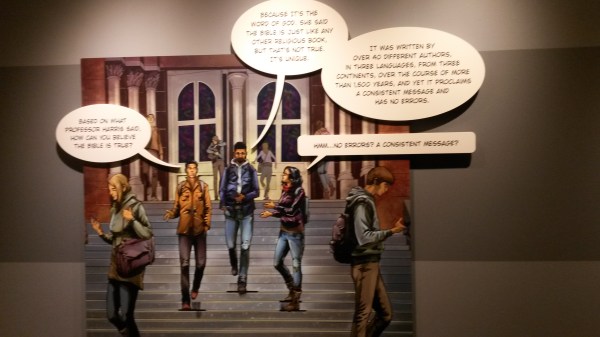
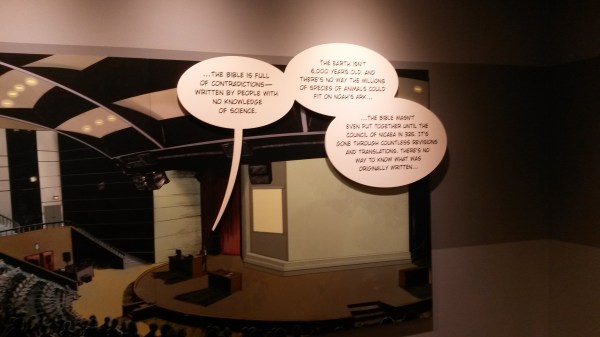
These days, conservative evangelicals are just as nervous as ever about college. On my recent trip to Answers In Genesis’s Ark Encounter in Kentucky, I was surprised to find a huge walk-through comic book illustrating the dangers of higher education.

And, over a hundred years after Leuba’s book, new research seems to suggest that mainstream colleges really do tend to water down student religiosity. The survey by the Interfaith Youth Core was most interested in the ways college students reacted to religious diversity. Along the way, they found that among 7,194 students at 122 colleges, religious activities as a whole tended to drop during the first year of college.

Forty-three percent of the freshman respondents said they had talked about religious ideas in high school, while only a quarter said they did in college. When it came to religious diversity, the numbers are even starker. Thirty-seven percent of respondents said they had attended a religious service of a different faith than their own in high school, but only 20% did in college.

College students also reported friendlier attitudes toward liberal ideas after a year of college, from 55% up to 63%. And a majority said they felt some pressure to change their religious ideas and that they tended to keep their religious ideas to themselves.

So while people like me might worry that students are not getting enough exposure to religious diversity, fundamentalists will likely worry more. Even if college students are shying away from other religions, they are also shying away from their own.