My Experts Can Beat Up Your Experts

None of us knows what we’re talking about. That is the problem driving much of our culture-war animus. We can’t possibly understand all the nuances of every field of study, so we rely on networks of competing experts and authority figures to tell us what to believe. I do it, you do it . . . we all do it.

This week, we’ve seen it again with the topic of teaching American history. A coalition of conservative scholars and activists has signed an open letter attacking the new framework of Advanced Placement US History guidelines. They hope to use their collective clout to prove that the “experts” are not all on one side of this debate.
Your Experts Will Send Our Kids to Hell!

Your Experts Will Send Our Kids to Hell!

As SAGLRROILYBYGTH are well aware, these new history guidelines have proven intensely controversial. Conservative lawmakers in Oklahoma have proposed nixing the new standards for Sooner schoolchildren. Conservative pundits have blasted the framework as biased and warped. Professional organizations such as the National Council for History Education and the American Historical Association have fought back, insisting that the new framework is exactly the sort of thing we need in America’s history classrooms.

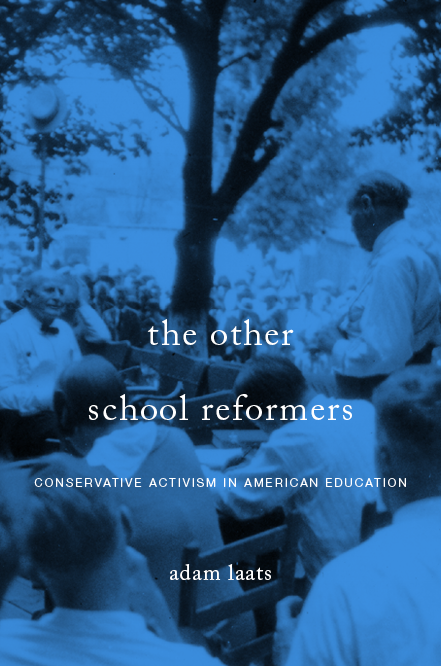
And, as I argue in my new book, these battles over the nature of American history have a long history themselves. In the 1930s, conservatives successfully blocked a popular series of textbooks that they felt told a slanted, anti-American vision of the nation’s past. More recently, the attempt in the 1990s to write a set of national history standards was sunk when conservatives made similar complaints.

In those battles as in this one, culture-war combatants have hoped to win their case by compiling intimidating lists of experts who back their respective positions. This week’s letter includes a mix of signatories. Some of them really are leading academic historians, such as George Marsden and Joseph Kett. And they take their inspiration from a recent diatribe by renowned historian Gordon Wood. Other signers are not historians, but conservative scholars who disagree with the general drift of mainstream academic life, folks such as Robert George and Patrick Deneen. Yet another category of signer is that of activist conservative historians, a rare breed including folks such as Ronald Radosh and Victor Davis Hanson. Plus, there are political signatories such as Lynne Cheney.

The letter complains that the new APUSH framework pushes an “arid, fragmentary, and misleading account of American history.” The new framework, the letter argues,

Is organized around such abstractions as “identity,” “peopling,” “work, exchange, and technology,” and “human geography” while downplaying essential subjects, such as the sources, meaning, and development of America’s ideals and political institutions, notably the Constitution. Elections, wars, diplomacy, inventions, discoveries—all these formerly central subjects tend to dissolve into the vagaries of identity-group conflict. The new framework scrubs away all traces of what used to be the chief glory of historical writing—vivid and compelling narrative—and reduces history to a bloodless interplay of abstract and impersonal forces. Gone is the idea that history should provide a fund of compelling stories about exemplary people and events. No longer will students hear about America as a dynamic and exemplary nation, flawed in many respects, but whose citizens have striven through the years toward the more perfect realization of its professed ideals. The new version of the test will effectively marginalize important ways of teaching about the American past, and force American high schools to teach U.S. history from a perspective that self-consciously seeks to de-center American history and subordinate it to a global and heavily social-scientific perspective.

As a professional academic historian, I’m certainly not neutral in this fight. My sympathies lie with the new framework. Don’t get me wrong: I admit that these conservative charges are not without merit. Academic historians really have isolated themselves over the past forty years. Americans love history, but they find academic history simply beside the point. Academic historians have tended to obsess over issues that only other academics care about, leaving high-schoolers and regular folks to learn their history from journalists and from Hollywood. But that has always been the case with scholarly work and it does not mean that the big lessons of the past forty years should not be taught to high-schoolers.

More important here, though, is the way culture-war issues are often addressed by letters like this one. Because none of us can understand the nuances of every issue, because none of us really understands what all the fuss is about, we rely on networks of competing authorities to give us our culture-war positions.

In the creation/evolution battles, for instance, we’ve seen this time and time again. Nearly every pro-evolution argument these days starts with some statement that mainstream scientists all agree on the fact of evolution. Activist organizations such as the National Center for Science Education compile bulletproof lists of all the scientists who agree that evolution occurs via natural selection. It has always been this way. In the 1968 US Supreme Court case of Epperson v. Arkansas, the National Science Teachers Association submitted a statement signed by 179 leading scientists. Evolution, the signatories told the court, had become a “fundamental scientific principle” supported by all “scientists and other reasonable persons.”

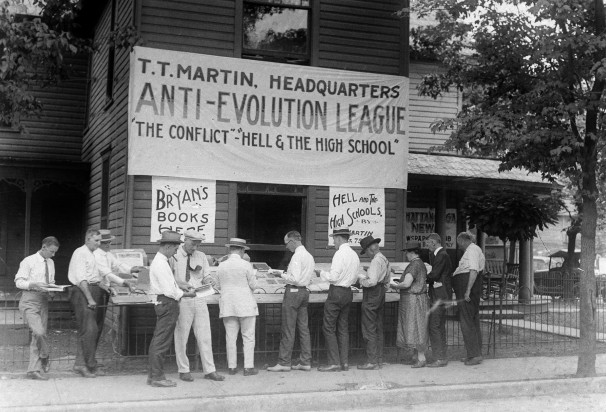
Creationists, of course, have always compiled similar lists of experts. As I noted in my first book, sometimes such lists took over the whole argument. For instance, T.T. Martin’s 1923 book, Hell and the High Schools, was a slim 175 pages. Of those pages, a full 67 were nothing but lists of anti-evolution scientists and experts.

For those few true experts such as Ronald Numbers or Glenn Branch, it is possible to wade through these lists of names to tease out the scientific street cred of each person. For most readers, though, the lists of experts serve only to prove the reliability of writers’ claims.

In every culture-war field, we rely on experts we trust to tell us what to believe. And then we believe it, whether or not we really know what we’re talking about. This doesn’t mean we’re stupid. It doesn’t mean we’re ignorant. As Dan Kahan argues so convincingly, our beliefs about evolution tells us about who we are, not about what we know.

What are we to believe about the new Advanced Placement US History standards? Are they the best wisdom of historians, vetted by true experts in the field and reflecting the latest developments of academic knowledge? Or are they the puerile croaking of a self-satisfied and out-of-touch ivory-tower elite, bent on promoting ideology over true knowledge?

The answer, of course, depends on which group of experts you prefer.
Would You Buy Cookies from a Girl with a Penis?

It is difficult to ask that kind of question, because we don’t like to think about children and sexuality at the same time. It’s even more awkward, since we don’t seem quite sure what we mean when we say “boy” and “girl.” Recently the Girl Scouts announced their continuing policy to allow transgender girls to participate in scouting. Today in the Christian Post we see some explanation of why religious conservatives dislike it.

As SAGLRROILYBYGTH are well aware, ideas about gender are among the most contentious in today’s culture wars. We’ve recently seen in these pages a productive interchange across the culture-war trenches.

...can we talk?

…can we talk?

In general—and I’m painting with a broad brush here—conservatives tend to see gender as a God-given and immutable part of human identity. People are born male or female, just as God created them. On a more sophisticated level, conservative intellectuals might look askance at gender-bending ideas as merely the latest efflorescence of cultural degeneration. When Rome rotted, for example, sophisticated Romans scoffed at old ideas about divinity and sexuality. The moral thing to do, with this mindset, is to fight all attempts to blur the bright line between boys and girls.

On the other side, progressives—including your humble editor—tend to see gender as more fluid. People are born with a wide spectrum of biological parts. Babies are assigned one gender at birth, based usually on their dominant physical sex characteristics. That assigned gender does not always match a person’s true gender, or a person may not identify with any particular gender at all. In this mindset, the moral thing to do is to recognize and value the ways people discover and identify their own genders.

The Girl Scouts now officially agree with this position. As their “Chief Girl Expert” explained recently, they have decided to recognize girls as those young people who identify as girls, regardless of external biological characteristics and regardless of the gender they were assigned at birth. As she put it,

If a girl is recognized by her family, school and community as a girl and lives culturally as a girl, Girl Scouts is an organization that can serve her in a setting that is both emotionally and physically safe.  Inclusion of transgender girls is handled at a council level on a case by case basis, with the welfare and best interests of all members as a top priority.

What’s wrong with that? The socially conservative American Family Association started a petition to encourage the Girl Scouts to change their minds. As the AFA explained,

This means girls in the organization will be forced to recognize and accept transgenderism as a normal lifestyle. Boys in skirts, boys in make-up and boys in tents will become a part of the program. This change will put young innocent girls at risk.

Adults are willing to experiment on our kids – both the boys who are confused and the girls who will wonder why a boy in a dress is in the bathroom with them.

The Girl Scouts of America has lost its moral compass and needs your encouragement to rescind this new policy. Since 2003, bad policies like this have resulted in GSA’s enrollment dropping by over one million girls, almost 27% of its membership.

In this statement we can see what some conservatives object to in the Girl Scouts’ decision. First, the AFA says that this decision will normalize transgenderism. Fair enough, I think. But to folks like me, that seems like a good goal. To some conservatives, it does not. To the AFA, transgender girls are not brave people who have worked hard to wrestle with fundamental questions about their true selves. Rather, they are “boys in skirts. . . . boys who are confused.” For many conservatives, this notion that transgender girls are really boys seems enormously powerful.

Also, the AFA charges that these masquerading boys will be put in intimate and potentially sexual contact (“boys in tents”) with “real” girls. Just as we’ve seen elsewhere when the question of transgender youth comes up, there is worry among conservatives that the inherent aggressive sexuality of males will put “young innocent girls at risk.”

Moreover, these sinister changes are not merely accidental. According to the AFA, they are the calculated efforts of wrong-headed progressive adults. As I argue in my new book, this accusation against progressives’ proclivity to engage in dangerous experimentation on kids has a long history. In this conservative mindset, progressivism isn’t just wrong, it is dangerous to children.

Finally, in this AFA petition we see an appeal to a bedrock conservative notion. The AFA accuses the Girl Scouts of having lost their “moral compass.” Just as with our cultural disagreements over the notion of gender itself, conservatives and progressives tend to disagree over the idea of a moral compass. For many conservatives, we know—and have always known—the distinction between right and wrong. The rules have been laid out for millennia. When organizations change or challenge those rules, some conservatives think, they have willfully abandoned those God-given rules.

Progressives, for their part, tend to value the ability to adapt to changing and unique circumstances.  What is the morally correct thing to do?  In general, we should value all persons, regardless of their differences.  In this case, that means welcoming transgender girls into the Girl Scouts.  To do otherwise would be cruel and immorally rigid.

Predictably, it will be very difficult to communicate when we have such fundamental disagreements.  Predictably, progressives will accuse conservatives of hatred and bigotry. Conservatives will accuse progressives of encouraging sexual license among children. Both accusations are intensely hurtful. Who wants to be a bigot? Who wants to be a pimp?

Isn’t there any better way to have this discussion?

The Creeping “Christian” Coup

Take a stroll around America and you’ll see bajillions of “Christian” book stores, “Christian” schools, “Christian” churches. Of course, these institutions represent a certain sort of Christianity, a conservative evangelical Protestant one. There are lots of Christians who do not fit this definition of “Christian.” But a new set of survey data from the Pew Research Center for Religion and Public Life shows that the gap between the two seems to be narrowing. There are fewer Christians overall, but “Christians” are doing just fine.

Anytown, USA

Anytown, USA

So get ready for it. In the next week or so we’ll hear lots of exclamations about the recent Pew numbers. We’ll be told that the United States is becoming less Christian. As the folks at Pew tell us,

The Christian share of the population is declining and the religiously unaffiliated share is growing in all four major geographic regions of the country. Religious “nones” now constitute 19% of the adult population in the South (up from 13% in 2007), 22% of the population in the Midwest (up from 16%), 25% of the population in the Northeast (up from 16%) and 28% of the population in the West (up from 21%). In the West, the religiously unaffiliated are more numerous than Catholics (23%), evangelicals (22%) and every other religious group.

Does this mean we’ll see an abatement in culture-war scuffles over religion? Will America disagree less about abortion? Gay rights? School prayer? Evolution?

Not likely. In fact, we should expect the opposite.

Here’s why: Christianity’s share of the overall population might be dwindling, but evangelical Christianity has shrunk, if at all, by a much smaller percentage. In the words of the Pew report,

The new survey indicates that churches in the evangelical Protestant tradition – including the Southern Baptist Convention, the Assemblies of God, Churches of Christ, the Lutheran Church-Missouri Synod, the Presbyterian Church in America, 0ther evangelical denominations and many nondenominational congregations – now have a total of about 62 million adult adherents. That is an increase of roughly 2 million since 2007, though once the margins of error are taken into account, it is possible that the number of evangelicals may have risen by as many as 5 million or remained essentially unchanged.

I don’t know why the pollsters lumped Missouri Synod Lutherans in with evangelical denominations, but they certainly belong in the conservative camp. In any case, as anyone who knows the long history of our culture wars is aware, the fiercest fights have usually been between liberal and conservative Protestants.

Many of our liberal and secularizing culture-war leaders have come from mainline Protestant denominations. These days, for example, from the United Church of Christ, the denomination formerly known as Congregationalism, The Reverend Barry Lynn heads the liberal Americans United for Separation of Church and State. In the 1920s, as I argue in my first book, liberal Protestants such as Edward Birge and Edwin Conklin led the fight for evolution education.

If that sort of liberal Christianity continues to dwindle, it is entirely possible that Americans will come to agree that to be a “Christian” means adhering to a conservative evangelical Protestant faith. It might even snowball. The new Pew numbers show that evangelicalism is the only major religious group to pick up adherents from other churches. As they put it,

The evangelical Protestant tradition is the only major Christian group in the survey that has gained more members than it has lost through religious switching. Roughly 10% of U.S. adults now identify with evangelical Protestantism after having been raised in another tradition, which more than offsets the roughly 8% of adults who were raised as evangelicals but have left for another religious tradition or who no longer identify with any organized faith.

If evangelical Christianity bucks the trend of shrinking Christian identification, it makes sense to think that soon more and more Americans will identify evangelicalism with Christianity as a whole. What might that mean?

It’s impossible to predict, of course, but I’ve got a couple of hunches. First, we’ll see a stronger distinction between liberal evangelical Protestants and conservative ones. There is a strong tradition of politically progressive evangelicals, but its story tends to get swamped when people talk about evangelicalism.

Second, we’ll see a continuing weakening of the racial divisions between conservative evangelicals. As the new Pew report asserts, “Black Protestant” groups are also growing. But the Pew pollsters don’t differentiate between very different sorts of African American evangelicals. If evangelicalism becomes more of a stand-in for Christianity as a whole, pollsters will begin to connect conservative evangelicals across the race line. The interesting questions will become how many conservative evangelicals there are out there, not how many “Black Protestants.”

Third, and for SAGLRROILYBYGTH perhaps the most interesting, we will likely see a heating-up of culture-war rhetoric. Conservative evangelicals will frame themselves more and more vociferously as the voice of “Christianity.” With smaller numbers of liberal Christians to naysay, the identification of conservative evangelicals with the entire Christian community will become ever tighter.

Bush at Liberty: “Seven Thousand Acres of Shared Conviction”

He didn’t have much choice. These days, any front-runner for the Republican Party presidential nomination seems required to make a speech at Liberty University. But when Jeb Bush gave his commencement address at Liberty this week, he did not have to emphasize one of American fundamentalism’s deepest-held convictions. But he did.

As the sophisticated and good-looking regular readers of I Love You but You’re Going to Hell (SAGLRROILYBYGTH) are well aware, I’m working on a book about the history of schools like Liberty. And among the issues I’m struggling with are the distinctive traditions that set off fundamentalist and evangelical colleges from other religious schools.

Certainly, as Roger Geiger outlined in his definitive new history of American higher ed, in the United States every religious group has scrambled to establish its own colleges and universities. It has become a way for religious groups to confirm their legitimacy and American-ness.

So, for Catholics, and Lutherans, and Methodists, and Nazarenes; for Muslims, and Jews, and Mennonites…every religious group has its own network of schools that train its young people in its distinctive faith traditions as well as in professional skills and the liberal arts.

Unlike most of those other traditions, however, the network of fundamentalist colleges that developed since the 1920s has seen itself not only as a haven from a hostile wider American culture, but more specifically as an enclave of true Americanism. Unlike most other conservative Protestants, even, fundamentalists have a fairly unique proprietary feeling about the US of A.

Back in the day, brainy Catholic kids might have gone to Georgetown or Boston College, either to become priests or just become educated Catholics. And they did so in order to study in an intellectual refuge from the relentless anti-Catholicism that permeated mainstream culture for so long.

Since the 1920s, brainy evangelicals and fundamentalists have gone to Bob Jones or Wheaton or Liberty, either to become pastors or just to become educated evangelicals. But these evangelical schools were not seen as islands set off from a hostile mainstream America. Or, to be more specific, they were seen as islands, but only in the sense that they represented a last resort of true Americanism. Such schools often talked about their need to preserve a slice of the true America.

Since the 1950s, those schools that aligned with the more moderate “evangelical” wing of fundamentalism tended to downplay this tradition. Schools who clung to the “fundamentalist” label—such as Bob Jones, Pensacola Christian College, the late Tennessee Temple University, and Liberty—often doubled down on their sense of usurped Americanism.

When Governor Bush made his Liberty speech, he made the usual paeans to religious freedom and religious liberty. But he also went the extra rhetorical mile to endorse Liberty’s sense of itself as an outpost of true Americanism. As Bush put it,

How strange, in our own time, to hear Christianity spoken of as some sort of backward and oppressive force. Outside these seven thousand acres of shared conviction, it’s a depressing fact that when some people think of Christianity and of Judeo-Christian values, they think of something static, narrow, and outdated. We can take this as unfair criticism, as it typically is, or we can take it as further challenge to show in our lives the most dynamic, inclusive, and joyful message that ever came into the world.

“Seven thousand acres of shared conviction”! A phrase surely calculated to warm the hearts of Liberty’s leaders. The implication, clearly, is that Liberty represents an enclave of purity, a reservation for America’s Moral Majority, which promises to preserve American values until that day that they can be spread back into the rest of America’s 2,432,000,000 acres.

Creationists against Racism

Do they really mean it?

These days, leading creationists claim to be anti-racist. But fundamentalist Protestantism has a sour history of racism. Do today’s creationists have a fair claim to be authentically anti-racist? Short answer: Yes. Though it might muddy our progressive assumptions, we need to recognize that dissent from mainstream science has also often included dissent from mainstream racism.

Today’s conservative pundits usually don’t like to talk about it. But historically, as I argue in my new book, in the United States conservatism has been tied pretty closely to racism. And as we’ve seen in these pages, white racism has enjoyed strong support within fundamentalist circles.

Let me be clear: Unlike some progressive pundits, I’m not insisting that white conservatives these days are *really* all a bunch of racists. And unlike some progressive historians, I don’t believe that the *real* explanation for the politicization of conservative evangelicals in the 1970s was white racism. But the historical record is pretty clear: Throughout most of the twentieth century, white conservatism was bound up with traditional notions of white dominance.

There is, however, one glaring and important exception to this rule. Among white conservative creationists, there has been a long record of anti-racism. This has usually not been motivated by a civil-rights style of social activism, but rather from creationism itself. If Adam and Eve were the literal historic parents of all humanity, then there can’t be real differences between the races.

Today’s leading young-earth creationist ministry, Answers In Genesis, has long trumpeted its anti-racist creationism. As AIG likes to explain, racism can’t survive if we really believe in Adam, Eve, and Noah’s Ark.

AIG’s position is nothing new among dedicated creationists. As Bradley Gundlach argues in his terrific new(ish) book, Process & Providence, at the dawn of our modern evolution/creation battles, creationists defined themselves as opposed to racist mainstream science. In 1859, Professor Gundlach writes, the main evolutionary question at conservative Princeton Seminary was not Darwin’s new book. Rather, the creationists at Princeton in 1859 were outraged by the new scientific fad of “polygenism.” Leading contemporary scientists embraced the notion that human races were actually different species. Creationists at Princeton said no.

As the creation/evolution battles heated up in the 1920s, too, the anti-evolution crusade had the better claim to anti-racism. White mainstream science at the time often proved friendly to notions of “scientific racism.” As I describe in my new book (page 49 for those of you following along at home), leading evolutionary pundit Henry Fairfield Osborn supported both evolutionary theory and the racism that he thought went along with it.

Of course, simply because dedicated and consistent creationists have often been anti-racist, we can’t conclude that all creationists are anti-racist. Perhaps most famously, Bob Jones University in South Carolina has been fervently creationist AND fervently racist throughout most of its history.

The point here, rather, is that mainstream science has not always been right. Creationists these days can legitimately claim a more consistent history of anti-racism than can mainstream scientists. The same theological impulse that leads young-earth creationists to insist on a young earth also leads them to insist that all of humanity has the same roots.

Required Listening: Us & Them

Can we talk across the culture-war divide?  That’s the question journalist Trey Kay is asking in his new podcast series, Us & Them.  Is it worth talking to someone with whom we have fundamental disagreements?

In his first episode, Trey Kay describes his culture-war-defying friendship with conservative activist Alice Moore.  Kay first got to know Alice Moore when he was working on an earlier documentary about the 1974-75 textbook controversy in Kanawha County, West Virginia.

As the sophisticated and good-looking regular readers of I Love You but You’re Going to Hell (SAGLRROILYBYGTH) are well aware, this Kanawha County story also plays a prominent role in my recent book about educational conservatism.  Alice Moore played a leading role as a conservative leader in that tumultuous school boycott.

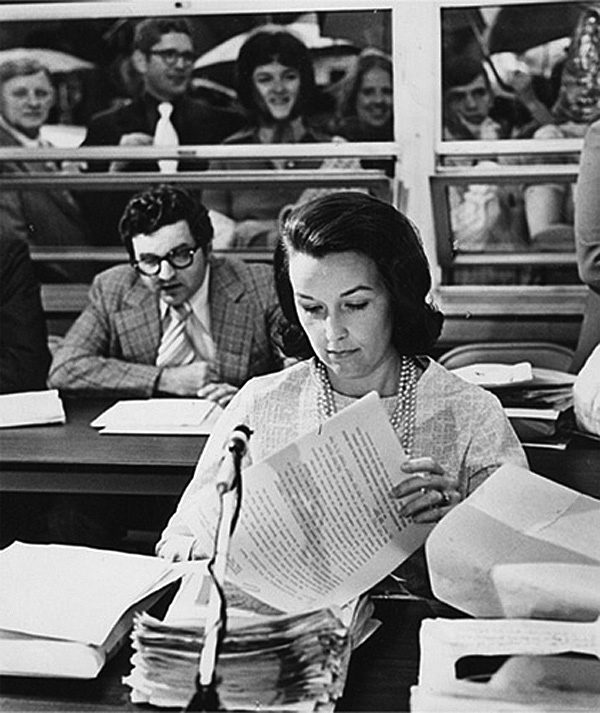
Ms. Moore makes her case in a crowded 1974 school-board hearing...

Ms. Moore makes her case in a crowded 1974 school-board hearing…

In his first podcast, Kay describes his continuing friendship with her.  The two of them inhabit different culture-war realms; Kay is a self-identified “blue-state liberal,” while Moore is a “red-state conservative.”  More than that, Ms. Moore believes in a conservative evangelical Protestantism that liberals often find intellectually outrageous.

Can the two of them be friends?

At the very least, it would take careful diplomacy on both sides. As Kay asked himself, “I have core beliefs.  What if I truly felt that they were under attack?”

Check out the whole episode when you’ve got a few spare minutes.  Kay and Moore manage to do the things friends do: Get a meal together, talk about politics and religion.  Yet neither of them budges an inch on his or her core beliefs.

Are such conversations worth having?  As Kay includes in this episode, his editor wasn’t sure.  She told Kay, “I don’t know how you can stand to have this conversation.”  It seemed to Kay’s editor that he was listening to Moore, but Moore wasn’t listening back.

Frenemies?

Frenemies?

Yet Kay remained convinced there was some value to such outreach programs.  He asked historian Jonathan Zimmerman’s opinion.  Zimmerman insisted that Americans need to speak with each other; we need a common language to discuss “American problems . . . shared by all of us.”  The most dangerous culture-war idea going around, Zimmerman said, is that those who disagree with us are either morally warped or ignorant.

Trey Kay hopes his new series will help figure out “what might happen if we take the time to listen to each other.”  Can it work?

Ah Ha! Proof of Liberal Profs!

HT: VB

Everyone knows college professors are a liberal bunch, right? A new study from Harvard University, a school just outside of Boston, Massachusetts, seems to confirm this beloved stereotype. But is it really proof?

First, some background. As the sophisticated and good-looking regular readers of I Love You but You’re Going to Hell (SAGLRROILYBYGTH) are well aware, the notion that the professoriate skews liberal is a deeply held culture-war notion. Conservatives decry it, even pushing through a mandatory conservative chair at Colorado University. Even perspicacious liberal thinkers worry about it. Historian Jonathan Zimmerman of New York University, for example, has suggested that true intellectual diversity requires some sort of affirmative action for conservatives.

It is not a made-up phenomenon. As Neil Gross argued in his new(ish) book, Why Are Professors Liberal and Why Do Conservatives Care?, there really does seem to be a tilt toward liberalism in higher-ed faculties. Not because liberals are smarter (sorry, liberals), and not because conservatives suffer from discrimination (sorry, conservatives), but because historical patterns have pushed more liberals into the profession.

An article in the Harvard Crimson describes the political donations of the faculty. Turns out, those faculty members who give money to political parties tend to give almost only to the Democrats. In the Arts & Sciences faculty, the majority tipped a whopping 95.7% in the direction of the Democratic Party, compared to a measly 3.7% who gave to the Republican Party. Things were a little more balanced in the Business School, with 36.7% of donations going to the GOP. In some departments, such as the Graduate School of Education, a Brezhnevian 100% of donations went to the Democrats.

Should we worry?

If we hope for a system of higher education that pushes students to think critically about a range of issues, should these numbers cause us to consider home-colleging our students? Both for us liberals and our conservative colleagues, is it time to think about creating a better sense of real intellectual diversity on college faculties?

I think not, for a couple of reasons. First, as both the Crimson article and Professor Gross’s book insist, a tilt toward the Democratic Party does not equate with a rigid groupthink. From the history of the culture wars, we can see proof that conservatives do very well in schools dominated by liberal faculties.

Leading young-earth creationist Kurt Wise, for example, studied under the vehemently anti-creationist Stephen Jay Gould at Harvard. Both scholars reported a cordial and productive relationship. Dr. Wise is not alone. For generations, leading conservative scholars, intellectuals, and pundits have done just fine in schools with liberal-leaning faculty. From William F. Buckley Jr. at Yale to Dinesh D’Souza at Dartmouth, nerdy conservatives thrive in elite colleges.

Perhaps the explanation can be seen in the work of sociologist Amy Binder. Binder and a colleague studied conservative students at two elite colleges. Binder argued that conservative students are certainly shaped by their environments. But at both a large western public flagship college and an elite eastern one, conservative students honed and shaped their conservatism, rather than being groomed away into liberal ideologies.

More important, perhaps, is the fact that almost nobody actually attends the elite colleges that culture-war punditry focuses on. Harvard, Yale, Dartmouth, Colorado, Brown, NYU…perhaps the faculties on these schools tip heavily in a liberal direction. But very few students go to these schools. Of the young people who go to college, many more of them go to less-fancy places.

My hunch—and I’d love for someone to get some numbers to back this up or refute it—is that the faculty at less-elite colleges tends to be more politically and culturally conservative. From the field of teacher education, I have heard anecdotes that suggest it’s true.

The Crimson article gives us some proof, but not about higher education. Rather, all we see is that Harvard faculty tip liberal. Harvard may have plenty of influence, but it doesn’t actually do much. Though the alumni might bother people with their smug self-satisfaction, there really aren’t too many of them around.

The Coming Split at Conservative Colleges

Is your school for bigots?…Or for apostates? That’s the choice that conservative school leaders have faced throughout the twentieth century. And it is coming round again. As the US Supreme Court hears arguments about same-sex marriage in Obergefell v. Hodges, conservative religious schools and colleges should gear up for another divisive debate over equality and theology. If SCOTUS rules in favor of same-sex marriage, will evangelical and fundamentalist schools face a return to the hot tempers of 1971?

More bad news for conservatives...

More bad news for conservatives…

The case itself is a combination of cases from four states. In short, SCOTUS is trying to decide two issues: whether or not the Constitution requires states to allow same-sex marriage; and whether or not same-sex marriages in one state must be recognized by all states.

Conservative Christians have made their feelings clear. Among the hundreds of friend-of-the-court letters are one from the US Conference of Catholic Bishops and one from Governor Mike Huckabee’s advocacy group.

At the Christian Post this morning, we see nervous worries about the possible fall-out for conservative Christian schools. Justice Samuel Alito made an explicit reference to the precedent on every conservative’s mind: the Bob Jones University case. Back in 1970, the leaders of BJU refused to allow racial integration on their South Carolina campus. As a result, the Internal Revenue Service took away BJU’s tax-exempt status. By 1983, BJU had taken its case all the way to the Supreme Court. It lost.

Alito asked Solicitor General Donald Verrilli if the precedent would apply:

JUSTICE ALITO:  Well, in the Bob Jones case, the Court held that a college was not entitled to tax­exempt status if it opposed interracial marriage or interracial dating.  So would the same apply to a university or a college if it opposed same­ sex marriage?

GENERAL VERRILLI:  You know, I ­­ I don’t think I can answer that question without knowing more specifics, but it’s certainly going to be an issue. ­ I don’t deny that.  I don’t deny that, Justice Alito.  It is ­­ it is going to be an issue.

Conservatives worry that this might mean the end of religious schools and colleges. Should religious schools refuse to provide housing for same-sex married couples, the federal government could revoke their tax-exempt status. For most schools, that would mean a sudden and impossibly steep tax bill. When schools are already teetering on the brink of financial insolvency, it could certainly mean the end.

But that’s not all. If history is any guide, Christian school leaders should also prepare for another kind of crisis. Back in the 1970s, fundamentalist schools endured a vicious and destructive split over Bob Jones University’s position on racial segregation.

As I’ve been finding in the archives this past year, even schools that agreed with BJU’s fundamentalist theology sometimes disagreed with BJU’s position against interracial marriage. At the Moody Bible Institute, for example, leaders decided to cancel an invitation to pro-BJU fundamentalist leader John R. Rice. The decision subjected MBI’s leaders to withering criticism from fundamentalists nationwide.

Reporters and observers have noted that SCOTUS’s decision in this case might raise questions for leaders of conservative religious schools. Those leaders should also consider another likely outcome. If SCOTUS’s decision puts pressure on school leaders to recognize same-sex marriages, it might lead to another in a long line of bitter fights among schools.

Will conservative evangelicals and Catholics submit to the law of the land? Or will they resist, citing a higher authority? Will conservative schools lose their conservative credibility if they give in to the new cultural ethos?

It’s not going to be an easy choice. If I were the president of a conservative Christian school or college, I’d get myself ready for a lose-lose decision. Do I want my school to be labeled a bunch of fanatical bigots? Or would I prefer to join the ranks of schools that don’t take their religions very seriously?

Bizarre Attacks on Conservatives

Watch out! Conservative ideas might subject you and your family to thuggish home invasions. Even more creepy, conservative ideas might get you erased from your own personal history. As we observe American conservatism from the outside here at ILYBYGTH, we’ve noticed the steady stream of conservative complaints about persecution. Today’s crop of victim alerts, though, rises to a new level of weirdness.

As one sophisticated and good-looking regular reader of I Love You but You’re Going to Hell (SAGLRROILYBYGTH) noted recently, conservatives are not the only ones to emphasize their own status as victims. Patrick asked,

Who doesn’t emphasize their own victimhood these days? Perhaps the question should be why doing so has become an American tradition. One way of looking at it is to point out that we are an optimistic bunch, perpetually hopeful that if we consistently expose unfairness and hypocrisy, we will help solve the problem by raising awareness of it. Why else would the news always be so depressing?

It makes intuitive sense that every side in our tumultuous culture wars would complain loudly about their own suffering. It is the same dynamic as any family squabble. Victims get justice. Aggressors get punished, at least in theory.

Bubbling up from the conservative commentariat this morning we find two new claims to victimhood. In Wisconsin, we hear, conservative activists have been subjected to jackbooted attacks. And one high school has taken steps to erase its memory of one of its conservative graduates.

First, to Wisconsin: David French’s exposé of hardball culture-war politics tells the story of mild-mannered conservative families subjected to brutal attack. In the aftermath of Wisconsin’s Act 10, conservatives have been targeted as part of a concerted campaign to embarrass and humiliate them. In short, according to French, Milwaukee District Attorney John Chisholm pushed a “John Doe” investigation of Wisconsin conservatives.

In this kind of investigation, proceedings are kept secret. Investigators have wide latitude to seize relevant documents. As a result, conservative activists had their homes invaded by terrifying police agents. Doors were pounded on. Floors were stomped on. Children were shaken out of bed. Neighbors gathered and gaped. Conservatives were threatened. Computers and phones were seized. Dogs barked.

As French put it, “For select conservative families across five counties, this was the terrifying moment — the moment they felt at the mercy of a truly malevolent state.”

These raids turned at least one Wisconsin conservative into an outlaw, in her imagination at least. As she explains,

I used to support the police, to believe they were here to protect us. Now, when I see an officer, I’ll cross the street. I’m afraid of them. I know what they’re capable of.

Yikes.

Conservatives targeted for home invasions precisely because of their conservative activism. Police used as intimidation agents, to harass and intimidate political activists. All bluster aside, these are profoundly disturbing charges.

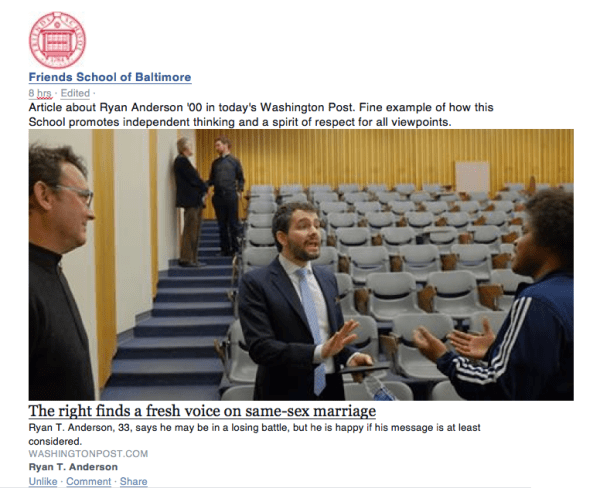
Even more bizarre, though, is the story coming from a Baltimore high school. Ryan T. Anderson, an outspoken opponent of gay marriage, was first lauded, then removed, from his high school’s Facebook page.

Anderson had been the subject of a front-page story in the Washington Post. The article called Anderson a “fresh voice” for traditional marriage.

At first, according to a story in the Heritage Foundation’s Daily Signal, Anderson’s high school posted news of this alumni success on its Facebook page. Later, the school took down the post. Why? In the words of school head Matt Micciche,

I can understand why the belief that Mr. Anderson’s views were being endorsed by the school would be deeply troubling to some members of our community. The nature of these views goes beyond the realm of abstract political ideology and calls into question the fitness of same-sex families to raise children and the right of gay and lesbian citizens to marry the person they love. While Mr. Anderson undoubtedly has the right to express such views, by posting this article we created legitimate confusion as to whether or not they were being validated by the school.

Maybe it is less scary to be removed from Facebook than to have one’s house broken into by aggressive police, but the implications of this Baltimore story are, IMHO, more sinister.

We're proud of our alumni!  Oh, wait...no.

We’re proud of our alumni! Oh, wait…no.

By removing notice of the significant conservative accomplishments of Anderson, his alma mater, in effect, suggested that conservatism is somehow shady, illegitimate, disreputable . . . even shameful.

I don’t say this as an endorsement of Anderson’s ideas. Nor do I claim to understand the intricacies of Wisconsin’s culture-war politics. For those of us trying to understand conservatism and the culture wars, though, both these stories raise important questions:

  • Is it legitimate to oppose same-sex marriage?
  • Do conservatives have a claim to victimhood?
  • Do these strange stories offer proof that conservative thinkers and activists have been uniquely and unfairly persecuted?

The Other School Reformers

Binghamtonians!  Are you busy next Tuesday nite?  You are now!

The place to be...

The place to be…

Come on down to RiverRead Books at 6:30 for a talk about my new book, The Other School Reformers. I’ll be sharing some of the questions that I’ve been wrestling with for the past decade or so, including the following things that keep me up at night:

  • What has it meant to be “conservative” about education?
  • Are our schools “conservative?” “Progressive?”
  • Why do conservatives love high-stakes testing?  Creationism? “Patriotic” education?
  • Should public schools teach “traditional” values?  Which ones?
  • And more!