What Does It Mean to Be Conservative about Education?

John Miller of National Review recently sat down with yours truly to talk about my new book, The Other School Reformers: Conservative Activism in American Education. For you cheapskates out there who haven’t yet bought your copy, you can listen to this ten-minute interview to get the gist. Then go buy a copy.

What is "educational conservatism?"

What is “educational conservatism?”

Miller asks great questions that get at the heart of my efforts:

  • What does it mean to be “conservative” about education?
  • What lessons should conservatives learn from this history?
  • What can this history tell us about current conservative angst over the Common Core?
  • …and more!

A Strange Poll Question for Conservatives

What would “Christian America” look like? No one really knows, but plenty of Republicans want to make it official. At least according to a new poll from the Public Policy Polling firm, significant majorities of likely GOP primary voters—57%–want to make Christianity the official religion of the USA. This brings us to a tough question: Do today’s religious conservatives intend to make a break with conservative tradition? Or are they just unaware of their own history?

The PPP poll gives some intriguing breakdowns. For those GOP voters who prefer Governor Mike Huckabee, a whopping 94% support the notion. Even those who support the more secular Rand Paul like the idea, by a margin of almost two to one.

Younger GOP voters are MORE likely to back the proposal. Among 18-45-year-olds, 63% say they support the idea. Only 51% of those over 65 do.

There are other intriguing aspects to this poll. For example, among supporters of Huckabee and of Paul, we see a neat flip-flop when it comes to evolution. Only a tiny margin (7%) of Huckabee backers say they “believe” in evolution, while a whopping 85% of Paul supporters do. Clearly, there’s a lot of daylight between the notions of “conservatism” and “creationism” these days.

But that’s not nearly as compelling, IMHO, as this weird question of establishing Christianity as the national religion. What would that mean? Would public schools nationwide all look a lot more like the ones in Greenwood, Indiana? Would other religions have to pay some sort of tax?

Perhaps most interesting from an historical perspective, do these likely GOP voters know that conservative Protestants—especially Baptists—have always been the leaders in making sure that the government was kept entirely separate from religion?

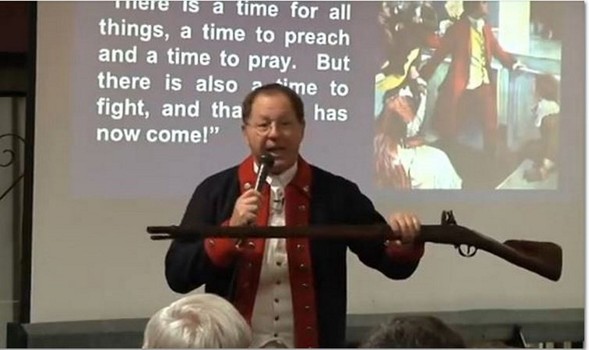
My hunch is that most of these respondents think of “Christian America” as a conservative concept, something along the lines of David Barton’s Wallbuilders and Representative Fisher’s Black Robe Regiment. In short, this strain of conservative thought emphasizes that the United States was founded by Christians, for Christians. The Founding Fathers, that is, were guided explicitly by Christian ideas and they never intended for any sort of wall of separation to be built. Judges should be free to have the Ten Commandments prominently displayed in their courtrooms. Town meetings and football games should be free to start with a prayer. Currency should continue to Trust in God. And so on.

Was America founded as a Christian nation?  Should we make it official?

Was America founded as a Christian nation? Should we make it official?

As I argue in my new book, this kind of Christian patriotism has had a long and strong pull on the conservative imagination. In the 1930s, for example, big-business groups such as the National Association of Manufacturers trumpeted the connection between religiosity, democracy, and free enterprise.

Traditionally, however, conservative Christians have always taken the lead on maintaining a strict separation between government and religion. In the aftermath of the Supreme Court’s 1962 Engel v. Vitale decision, for example, many conservatives jeered, but conservative evangelicals cheered. Secular conservatives like Herbert Hoover declared that the Court had just killed public education. But religious conservatives like William Culbertson of the Moody Bible Institute thanked the Supreme Court for its “protection in this important area.”

In that decision, of course, SCOTUS ruled that state governments could not impose a prayer on public schools. For some conservatives, that meant that the Court had kicked God out of the public square. For religious conservatives, it meant that religious belief and practice could never be dictated by a government body.

Which brings us back to this curious recent poll. Among the front runners for the GOP nomination, Governor Huckabee leads, along with Dr. Ben Carson, as the most religious of the conservatives. One might think that Huckabee’s supporters would be horrified at the idea of establishing a national religion. ANY national religion. But that is clearly not the case. As the demographics suggest, younger conservatives seem more comfortable with the idea of establishing Christianity as the national religion.

Maybe they know something we don’t. My guess, though, is that these young conservatives have a new understanding of “Christian America.” Unlike their grandparents and great-grandparents, conservative Baptists today do not seem convinced that their first job is to keep the government at arm’s distance.

Religious Students, Secular Schools

HT: HH

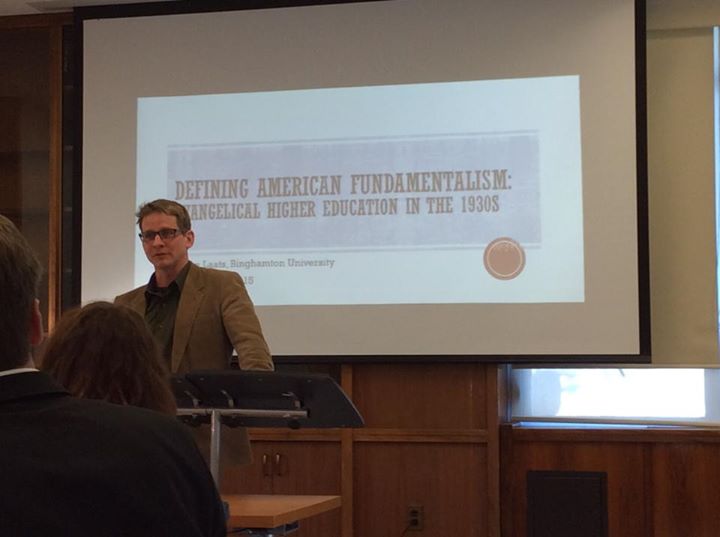
Thanks to all those who came out Wednesday to participate in my talk at Binghamton University about fundamentalist colleges in the 1930s.  Not only was a good time had by all, but the conversation made clear that even at this, our most “secular” of colleges, religion is thriving.  Despite the ignorant nostrums of elite secular academics and fuming fundamentalists, conservative religious students and faculty seem to thrive at pluralist schools like ours.

Don't hate me  because I'm beautiful...

Don’t hate me because I’m beautiful…

For those who are just tuning in, this talk was part of our series in “Religion in the Modern University.”  I shared my current research into conservative evangelical colleges.  The conversation after the formal talk revealed that both students and faculty at our beloved public university come from all sorts of religious backgrounds, including conservative evangelical Protestantism.

Unlike the schools I’m studying, our “secular” college does not actively encourage any specific sort of religious belief.  Nevertheless, our school proves a congenial home for students and faculty who hold conservative evangelical beliefs.

This flies in the face of some common assumptions about secularism and higher education.  As sociologist Elaine Howard Ecklund found in her study of elite secular academics, many of them have absolutely no idea of the high level of religious belief at their own non-religious elite universities.

Fundamentalists, too, have long assumed that “secular” colleges were hostile to their sort of religious belief.  As fundamentalist college founder Bob Jones Sr. was fond of saying in the 1920s, he would

just about as lief [sic] send a child to school in hell as to put him in one of those institutions.

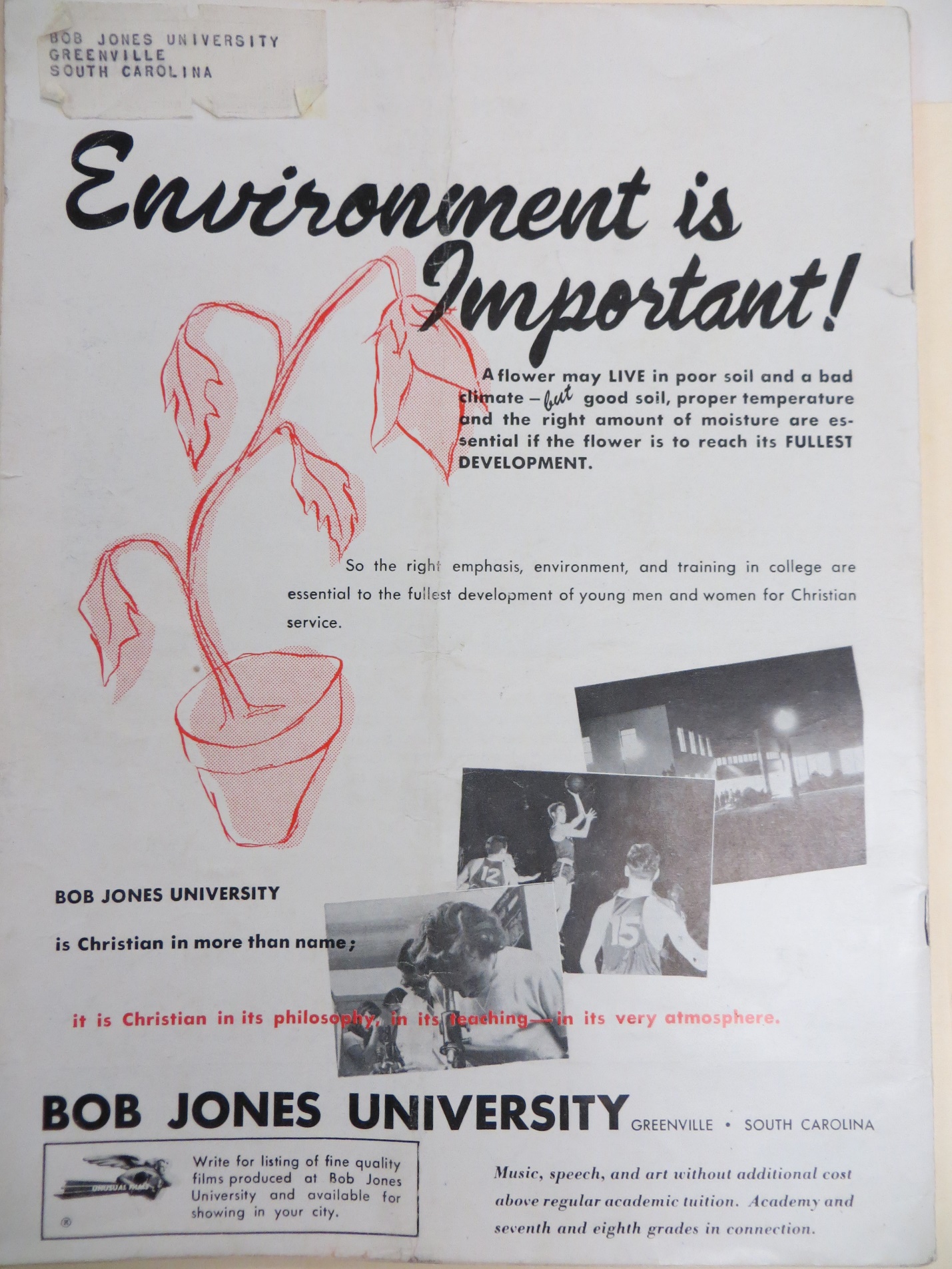
At Bob Jones University, as at other fundamentalist universities, this notion that only a truly fundamentalist school can protect students’ faith remained central throughout the twentieth century, as this 1956 advertisement demonstrated.

Fundamentalist students, fundamentalist schools

Fundamentalist students, fundamentalist schools

More recently, too, creationist leader Ken Ham took me to task for questioning his insistence that creationist families must send their children to young-earth-friendly colleges.  As Ham concludes,

at the very minimum I do urge parents to ensure they do all they can to equip their children to be able to defend the Christian faith against the attacks of our day, and to stand uncompromisingly on the authority of the Word of God.

Does that mean that religious students need to go to schools that share their faith?  I don’t think so.

I certainly understand the many differences between a pluralist school like our beloved Binghamton University and schools with a unified religious message.  But we need to remember that so-called “secular” colleges like ours are often very friendly places to creationists and fundamentalists.

Jesus and American Sniper

HT: SD

Every smart Christian knows that real religion is bigger than any one country, any one patriotic tradition. But in the United States, conservative evangelicalism has become so tightly bound with traditions of patriotism and national pride that it can be difficult to separate the two. Just ask Randy Beckum.

Until Monday, Dr. Beckum served as both University Chaplain and Vice President for Community Formation at Mid-America Nazarene University, a small-ish holiness school in Kansas. After a controversial chapel talk, Beckum found himself out of a job. Beckum had wondered aloud if America’s fascination with the film American Sniper meant that “our culture is addicted to violence, guns, war, revenge and retaliation.”

Evangelical Christians need a reminder, Beckum said, that

We have to be very careful about equating patriotism with Christianity.   We never say God and…anything.  God is above all, everything else is underneath. I love my country and am thankful for freedom. But the earliest Christian creed was very politically incorrect and dangerous. Jesus is Lord and Caesar is not. We have put “our way of life”/freedom on the top rung.

For those of outside of the world of MidAmerica Nazarene University, these seem like rather unremarkable sentiments. But at that school, they sparked a firestorm of controversy. As one MNU student tweeted, “So your [sic] saying that my long list of family members in military [sic] are not good Christians?”

MNU President David Spittal denied that Beckum’s removal from the VP job had anything to do with the patriotism controversy. But Blake Nelson, a “resident educator” at MNU, objected. As Nelson wrote in an open letter to the MNU community,

When one exercises his or her right to wrestle with big questions, and is demoted the next week, it feels as if we have all been demoted. If someone’s job security isn’t safe in the aftermath of their wrestling with the Word of God, none of us are safe. No matter what language it is couched in, a demotion like this creates fear where there should be freedom. Whether or not it was intended to be, this is an implicit attack on free expression. If it looks like a duck, and quacks like a duck, it’s probably a duck. The message is clear. This is a censure.

For conservatives throughout the twentieth century, too, it has been difficult to separate patriotism from religious sentiment. As I argue in my new book, educational conservatives have long blended the two into an organic whole. Conservative Texas leaders Mel and Norma Gabler, for example, always linked creationism, traditional Protestantism, patriotism, and free-marketism in an seamless conservative fabric.  As an admiring biographer wrote in 1986,

They understood why the new history, economics, and social study texts trumpeted Big Brother government, welfarism, and a new socialistic global order, while putting down patriotism, traditional morality, and free enterprise. Simply stated, Mel and Norma realized that the Humanists in education were seeking to bring about the ‘social realism’ which John Dewey and other ideologues had planned for America.”

Dr. Beckum and the MNU community are finding out just how hard it can be for conservatives to separate out their love for Jesus with their love for America.

The Social Sciences Need More Conservatives!

Let’s start with some ifs. IF diversity is really a minimum requirement for vibrant intellectual life, and IF college professors really tip toward liberalism and leftism, and IF academic groupthink has had a damaging effect on social sciences . . . IF those things are true, then don’t we need to improve political diversity in order to encourage real intellectual progress? A new study by a group of social psychologists argues that we do.  Only by encouraging researchers who embrace conservative worldviews, they write, can social scientists make real progress.

This academic team is not a collection of conservative pundits. As have other self-identified liberal academics such as Jonathan Zimmerman, these psychologists argue that in order to preserve even the liberal goals of the liberal arts, some sort of academic affirmative action is required.social-scientist
First, some background: this new study will be published soon in the journal Behavioral and Brain Sciences. It has been made available in an unedited, uncorrected pre-publication form to invite peer comment. The authors include José L. Duarte of Arizona State University, Jarret T. Crawford of The College of New Jersey, Charlotta Stern of Stockholm University, Jonathan Haidt of New York University—Stern School of Business, Lee Jussim of Rutgers University, and Philip E. Tetlock of the University of Pennsylvania. These academic psychologists are careful to note that none of them identify as political or cultural conservatives. Their argument is not a bitter lament from an excluded right wing, but rather a call to action by concerned academic insiders.

ILYBYGTH readers may remember Jonathan Haidt’s 2012 book, The Righteous Mind. In a nutshell, Haidt argued that Americans of all political stripes make up their moral minds first, then adduce reasons to explain their positions.

This new argument is different. The authors limit their claims to the field of social psychology. Their field, they contend, is

At risk of becoming a cohesive moral community. Might a shared moral-historical narrative in a politically homogenous field undermine the self-correction processes on which good science depends?

For example, studies of public attitudes toward climate change have described disagreement with mainstream science as “denial.” By calling one side “science” and the other side “denial,” doesn’t the very structure of the study adversely affect its outcome?

As the authors warn, “Embedding any type of ideological values into measures is dangerous to science.”

Not only does political homogeneity threaten to derail the answers found by social scientists, it tends to skew the questions they ask. As an example, the authors describe the career of the idea of “stereotype accuracy.” Due largely to ideological commitments, social psychologists had assumed that stereotyping was a false and negative tendency. In the 1970s, however, a rare conservative psychologist examined the question in a new way, and “found results that continue to make many social psychologists uncomfortable.” In this case, conservative psychologist Clark McCauley found that many stereotypes are actually based on rational assumptions and fact.

Why are there so few political and cultural conservatives in this academic field? The authors suggest a range of possibilities. They reject the notion that academic careers attract liberals because liberals are somehow smarter than conservatives. But they do find that the field may suffer from a self-propagating tendency. Since it is perceived as hostile to conservative thinkers, young conservative academics steer clear. Professor Haidt includes a sample of comments by conservative graduate students from his earlier work. One conservative academic told Haidt that he or she remained in the academic “closet.” Due to anti-conservative prejudice, this person wrote, “I find myself hiding my intellectual views and values every day.” Another conservative graduate student wrote that “the political ecology became too uncomfortable for me.”

This sort of weeding-out, the authors warn, threatens the field. By encouraging a culture of similar-minded researchers, the field of social psychology undermines its own scientific validity.

What is to be done? The authors offer a laundry list of suggestions, including more funding for conservative graduate students and an active recruitment process for tenure-track university positions. Universities are already good at searching for diverse faculties and student bodies. They only need to expand their notion of “diversity” to include a true intellectual, cultural, and political diversity. More broadly, the authors encourage all social psychologists to examine their own prejudices. “Instead of assuming,” they suggest,

That stereotypes are inaccurate without citing evidence, ask, ‘How (in)accurate are stereotypes? What has empirical research found?’ Instead of asking, ‘Why are conservatives so prejudiced and politically intolerant?’ . . . ask, ‘Which groups are targets of prejudice and intolerance across the political spectrum and why?’”

These are issues near and dear to ILYBYGTH hearts. Time and again, conservative intellectuals and pundits have complained that higher education has been lost to a morass of identity politics and destructive Red-Guardism. Perhaps most famously, William F. Buckley Jr. quipped that he would rather trust the government to the first four hundred people listed in the Boston phone book than to the faculty of Harvard University. More concretely, as I’m uncovering in my current historical research, conservative evangelicals have devoted considerable amounts of time and treasure to the establishment of dissenting conservative colleges, where students and faculty will be free to pursue truth undeterred by self-defeating and short-sighted secular humanism.

Certainly, this study will likely be embraced by conservatives as more proof that their complaints are justified. I wonder how many conservative intellectuals, though, will embrace the liberal premises of this study as well as its conservative-friendly conclusions. That is, will conservative thinkers agree that diversity is a requirement for true intellectual growth? Many conservatives, after all, have rejected racial affirmative-action programs that promise greater intellectual diversity. Can conservatives accept this study on conservative grounds?

It is worth repeating that this article limits its claims to the field of social psychology. But clearly its implications are worth considering for academia as a whole. Do mainstream colleges need a dose of true political diversity?

OK: AP not OK

What does creationism have to do with the Continental Army? What does George Washington have to do with the Genesis Flood? This week the news from Oklahoma gives us an example of the ways conservative ideas influence every classroom, not just the science labs.

We will have more success understanding those ideas if we see them as part of a conservative notion of proper education. These are not just ideas about science, or the Book of Genesis, or George Washington at Valley Forge, but they combine all these things into a powerful educational impulse. As I argue more extensively in my new book, in order to make sense of any aspect of educational conservatism, we need to look at it as a whole, not just as a series of separate incidents.

First, let’s look at the goings-on in the Sooner State. Representative Dan Fisher has introduced a bill that will challenge the teaching of Advanced Placement US History in Oklahoma’s public schools. Why? As do many conservatives, Fisher believes that APUSH teaches a warped, slanted, leftist view of America’s past. The new APUSH framework, Fisher explains, emphasizes “what is bad about America.”

Fisher wants to blast progressive history out of Oklahoma's schools.

Fisher wants to blast progressive history out of Oklahoma’s schools.

Fisher is not alone. As we’ve explored in these pages, conservative activists have lashed out at the new APUSH framework. I’ve argued also that many conservatives see these AP standards as only the latest efflorescence of a vicious left-wing assault on real American history. These conservative notions about sneaky progressive subversion in history classrooms have a long history themselves, as I describe in the book. At least since the 1920s, conservative thinkers and activists have lambasted history curricula as hopelessly skewed. Children learn that the USA has been built on a legacy of greed and genocide. Children learn that traditional heroes such as George Washington and Thomas Jefferson have feet of clay, or worse.

Representative Fisher, for instance, is a member of the Black Robe Regiment, according to the Tulsa World. As do many religious conservatives, this group ties together a romantic history of the United States with conservative attitudes about Scripture and religion. In those connections we catch a glimpse of the ways conservative thinking about education can link creationism with US History.

I want to be careful about what I’m saying here. I’m not arguing that there is some sort of vast underground conservative conspiracy connecting creationism with Fisher’s anti-APUSH activism. Nor am I saying that Fisher’s brand of religious conservatism is somehow the most real sort of conservative attitude about education. There are plenty of conservatives who will have no truck with this kind of religious and traditionalist interpretation of America’s past. But I do believe that deeply held attitudes about proper education fuel both creationism and Fisher’s sort of historical revanchism.

What’s the connection? At its heart, I suggest that this sort of conservatism springs from a notion that real education must come from a delivery of correct information from authoritarian sources to learners. That is, many conservatives—perhaps a better word would be “traditionalists”—believe that education must be a transmission of truth from top to bottom. That truth, if we back it up to its source, must come from God as the ultimate authority.

Perhaps this definition of proper education as the delivery of truth to each new generation seems unobjectionable. It is not. For about a century, educational thinkers have suggested that this “transmission” method is not good education. These “progressive” reformers have tried to impose instead an idea that students must construct knowledge on their own, not merely accept it or download it from authoritarian sources.

In the specific case of the new APUSH framework at issue in Oklahoma, historians have insisted that historical learning does not simply mean transmitting facts to children. And smart conservatives acknowledge that real education includes much more than just telling young people things that are true. But at its core, we might separate “traditionalist” from “progressive” ideas about education along these lines: Traditionalists think of education primarily as moving information from authoritative source to learners. Progressives think of education primarily as having learners construct knowledge.

With this sort of general attitude about education and knowledge, it’s easy to see the connections between creationism and the Continental Army, between George Washington and the Genesis Flood. For some religious conservatives, including apparently Representative Fisher of Oklahoma, knowledge about any subject must rely on traditional truths. Those truths have been delivered to us from on high. Proper education, in this mindset, consists of passing those truths along, not subjecting them to smarmy and self-satisfied criticism.

What Conservatives Want in Schools

When I started the research for my new book, lo those many years ago, my first stop was College Park, Maryland. The National Archives hold the papers of William J. Bennett, Reagan’s second Secretary of Education. To my thinking back then, Bill Bennett personified the tradition of conservative activism in education. In a recent long interview with Bill Kristol on The Weekly Standard, Secretary Bennett shares his memories of his conservative leadership in education. Among other things, Bennett articulates a long twentieth-century tradition of conservative thinking about proper education.

In addition to some wacky stories of practical jokes by President Reagan, Secretary Bennett explains what motivated him about America’s schools.

When he first took the job, Bennett explains, he visited 120 schools. Over and over again, teachers and students told him they needed some way to teach basic truths about American virtue, about American culture. The question he heard again and again, he explains, was, “How do we teach these kids moral values? They’re so different. They come from diverse backgrounds.”

It’s simple, Bennett insists: “There are certain common values.” Not only that. Students should not be taught vaguely how to learn, but rather should be taught knowledge. As he put it, “You have to start by learning something. . . . Content is what really develops the mind, the brain.”

The most important thing he has done in his entire career, Bennett explains, is his publication of his best-selling Book of Virtues. After it came out in 1993, the BoV spent eighty-eight weeks on the New York Times bestseller list. The big accomplishment of the book, Bennett says, is that it salvages traditional stories from our culture that are in danger of being lost. It insists that we all share common values, no matter our religious or cultural backgrounds.

As I argue in my new book, this notion about the first goal of American education has long been a central unifying theme of diverse conservative politicians and activists. Long before Bennett took over as Education Secretary, Max Rafferty had articulated similar sentiments from his post as State Superintendent of Public Education in California.

In addition to his bully pulpit in California, Rafferty authored a syndicated column that took his conservative ideas nationwide. Many of those ideas sound as if they could come directly from the mouth of Bennett himself. For instance, in one column from the 1960s, Rafferty argued,

Without the great hero-stories, we are left in the schools with statistics on immigration and economic development, dry-as-dust treaties and proclamations, accounts of population trends and antitrust legislation to give the children in the guise of history. They will grow up inevitably with the same amount of love and reverence for their native land which they would feel for a mathematical theorem or a chemical formula.

The best education, Rafferty wrote in another 1960s column, must include

the grand old stories that you and I remember so fondly from our childhood. Ben Franklin and his famous pun about hanging together or hanging separately. . . Sam Houston at San Jacinto, reminding enemy dictators for all time to come that Americans would forget attempts to enslave them only when Texans forget the Alamo—these and a hundred more great stories cluster about our history, bulwarking and supporting it, mingling it in a Red, White and Blue mist, clamorous with voices out of our past, dramatizing American history and American institutions so that wide-eyed children will always remember.

As Secretary Bennett remembers in this interview, his biggest success has been in putting a compilation of these traditional stories into the hands of millions of students, parents, and teachers. Like his boss President Reagan, Bennett argues that traditional stories teach virtue. Having students memorize these ancient nuggets of wisdom has done more to educate generations of Americans than all the progressive nostrums oozing out of high-falutin schools of education.

There is no simple definition of “educational conservatism.” But in this interview, Secretary Bennett articulates something that comes pretty close: the notion that proper education consists of transmitting traditional facts and values into each generation of schoolchildren.

Conservatives, Evolution, and “The Question”

“Do you believe in evolution?”

That’s the question GOP presidential candidates dread. Governor Scott Walker of Wisconsin is the latest to hem and haw his way through an awkward press conference on the subject.

Of course, some GOP contenders have no need to fear. Ben Carson, for example, is a loud and proud young-earth creationist. But other potential nominees have had to dodge, duck, dive, and dip when the question comes up. Bobby Jindal, a former biology major at an Ivy League college, has confessed that he wants his own children to learn evolution. That doesn’t mean schools must teach it, though. Jindal wants “local schools” to decide what’s right for them. And Marco Rubio famously told GQ magazine that he was “not a scientist, man.”

Walker is the latest GOP notable pressured to answer “The Question.” At a London press conference, Walker did his best to avoid it. In the end, though, Walker felt obliged to clarify that he strongly believed that humanity was created by God, and that faith and science are compatible.

It has become such a staple of GOP press conferences that conservative pundits cry foul. Writing in the pages of the National Review, for example, Jonah Goldberg says these evolution questions are a cheap stunt, a way to make conservative candidates squirm. As Goldberg put it,

To borrow a phrase from the campus left, Darwinism is used to “otherize” certain people of traditional faith — and the politicians who want their vote.

As fellow conservative writer Kevin D. Williamson correctly pointed out, leading mainstream scientists will also insist that they don’t “believe in” evolution. Rather, they simply know it; they take it to be the best current explanation and model for understanding the way species have changed and developed.

Yet no matter how you slice it, “the question” has become a defining feature of Republican presidential candidates. Even candidates who seem personally to embrace mainstream evolutionary science are loath to alienate conservative religious voters. For many of those religious voters, evolution has become a moral litmus test, not just a statement of personal belief.

Homeschooling and Intolerance

What is the deal with homeschooling? It is really a plan to produce a private army of patriarchs, as some have suggested? Due to the fractured nature of homeschooling, it is very difficult to say anything accurate about homeschoolers as a whole. Thanks to the indefatigable Milton Gaither, we see this week a study that attempts to figure out if homeschooling really does lead to greater intolerance.

For those who are not familiar with his work, Professor Milton Gaither is an historian at Messiah College in Pennsylvania. In addition to his historical work on homeschooling, he also reviews all the new research about homeschooling on his must-read blog.Gaither homeschool

This week, Gaither reviews a study by Albert Cheng. In short, Cheng compiled data gathered from students at Biola University who had been educated in part at home. Cheng wanted to know if these homeschooled students were more intolerant than their public- or private-school peers.

Read Gaither’s full review for the deets, but the short answer is no. All other things being equal, homeschooled students at Biola were a bit MORE tolerant than school-schooled students. As Gaither points out, though, all other things are not equal. The difference in tolerance between homeschooled and school-schooled students was less than the differences between students from different social backgrounds.

In other words, homeschooling tends to make students in this sample more tolerant of people from other backgrounds, but the difference is not as striking as the differences between students from rich and poor families, white and black ones, boys and girls, etc.

What’s the upshot? Gaither concludes with some intriguing implications that you need to read in full. Do public schools make evangelicals less tolerant? Do students choose relatively liberal evangelical colleges like Biola because they are already more tolerant of differences? Can we say with any confidence that homeschooling, as such, does not tend toward intolerance?

What Do Conservatives Think?

I’ve been dying to know: What will conservatives think of my new book? Will they agree that I’ve tried to take an even-handed approach? Will they protest that I misunderstood the nature of “conservatism?”

Last week we received an encouraging review from a conservative ILYBYGTH reader. Today we read with interest the opinion of a conservative activist who played a leading role in the events described in the book.

Years ago, when I journeyed down to Charleston, West Virginia to research chapter five, Karl Priest was kind enough to take time to talk with me about his memories of the 1974-75 textbook protest. We also talked about his ideas of evolution, creationism, Christianity, and proper education. Since the 1975 protests, Priest has been an educational activist. On his blog, he recently posted a detailed review of my book.

According to Mr. Priest, the book has some good parts, but it also misrepresents the conservative side of the 1974-75 protest. He is consistently kind to me personally, noting that I am “a gentleman and a scholar.” He also concludes by saying,

For anyone willing to study, Dr. Laats’s book provides a comprehensive history of major conservative battles against progressivism.

Mr. Priest also concedes that at some points I capture fairly the thinking of Kanawha County’s conservatives. But he warns that my liberal biases blind me to the truth of the Kanawha County textbook battle. He insists that I “intentionally slurred” the book protesters in the opening of chapter five.

For those who would like to read his detailed critique of my argument, Mr. Priest has added a section to the review in which he moves point by point through the chapter.

Is he correct? In a few cases, I think he makes valid points. For example, he notes that I awkwardly wrote that one protester prayed with a fellow inmate and “saved” him. As Mr. Priest points out, no protester would use such language. The child was saved, but through the power of God, not through the doings of the protester.

More often, however, I think Mr. Priest is blinded by his own partisan interests. I say it with great respect and with gratitude for the time Karl has spent talking with me. In general, however, I think he is overly convinced that the textbook protesters could do no wrong. He assumes too much about the radical nature of textbook supporters.

For instance, he writes that the National Educational Association was not a mainstream group, but rather “an outside left-wing extremist group.” That does not seem a fair statement. The NEA was indeed generally associated with left-of-center politics, but it was entirely within the mainstream of American politics and culture.

As an historian, I have to examine the evidence and come to conclusions about controversial events. Karl is entirely correct that I’m influenced by my own biases, even when I don’t think I am. I encourage readers to check out his review and chime in with their own thoughts.