Walker Takes on the Professoriate

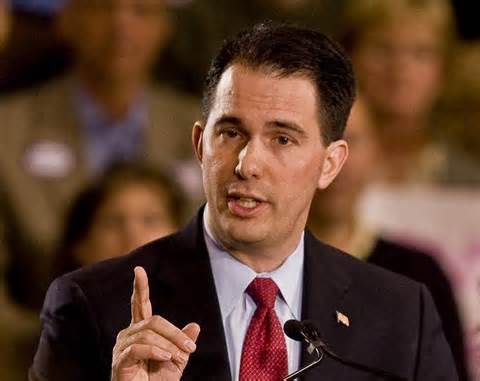
Want to get elected president? If you went to middle school, you know how it’s done: Find an unpopular group and attack them. Last week, Wisconsin Governor Scott Walker tried to pave his path to the Oval Office by attacking lazy good-for-nothing university professors. It might backfire. Walker’s plan has a long and spotty record among conservative politicians and activists. But in general, it’s a safe bet that Walker won’t lose conservative support by standing up to the professoriate.

Get to work, nerds!

Get to work, nerds!

In his new budget proposal, Governor Walker made huge cuts to the University of Wisconsin. The university could make up the shortfall, Walker suggested, by having faculty teach more classes. In short, Walker told reporters, this was nothing more than the core conservative principle of efficiency. The cuts will make the university

do things that they traditionally have not done. Like I said, things like maybe looking at the use of faculty and staff a bit more efficiently like others have done in government in the last four years at both the state and local level.

Naturally, Walker’s proposal has raised hackles among Wisconsin’s academics. History professor John Sharpless argued that he works at least as hard as anyone else. And after all that, Sharpless complained, he will retire with a smaller salary than a Madison bus driver. Walker’s implication that faculty are a bunch of “fat cats who are getting rich off the taxpayer,” Sharpless said, amounted to nothing more than a “crock of cow poop.”

Poop aside, Walker’s attack on the professoriate joins a long tradition among conservative politicians. As I recount in my new book, throughout the twentieth century conservative leaders blamed a leftist academic elite for America’s cultural decline.

In the 1930s, for example, conservative anti-communist leader Hamilton Fish insisted that faculty at leading colleges had become public enemy number one. The faculties at schools such as Wisconsin, Fish charged, had been packed with “socialists, near Communists and Communists.”

University professors make an easy target. As we’ve explored in these pages, many conservatives assume that academic types are overwhelmingly liberal. Governor Walker may be banking on the fact that any attack on college professors will be seen as a win for conservatism.

Does This Chapter Make my Book Look Fat?

Have you got your copy yet?  My new book is now available.  A conservative ILYBYGTH blog reader was kind enough to read the book and send me some reflections.  I’ll post them in full below.  They are very kind.  I’ll be sure to post news of less flattering reviews as well.

I finished reading The Other School Reformers.  These are just my thoughts and opinions.

I don’t think you made a mockery of conservatives / conservatism.  Some activists confound stereotypes, but there are certainly ones who confirm them.  It wasn’t always pretty, but it wasn’t mockery.  It’s just honest.  You talked about “specific people making specific claims about specific educational programs.”  And “specific times and places.”  (7)  It didn’t mean that every conservative would condone or support every action or idea.

I’m glad extremist examples were included.  Pointing out extremists, I think, can give valuable information.  I didn’t object at all to you talking about it.  In the whole context, it made sense to me to include extreme examples since the survival of the US was at stake.  (I don’t condone extremist tactics of course)  And as time went on, they found themselves “fighting for much narrower aims.”  (16)  I didn’t think this a couple years ago, but now think pointing out extremes is a positive thing and helps lead to an understanding that a reader wouldn’t get otherwise.

I started by reading the index, then going through the index again to see what people or ideas you were going to talk about the most.  That was helpful for seeing the continuity of the issues and just getting an idea of what the book was going to be about.

You made it very clear in the introduction and in the first chapter that your intent was to let conservatives speak for themselves and said that a few times in a few different ways.

Your introduction and first chapter were really well thought out and made the rest of the book clear.  I appreciated the quick progressions under A Moving Target starting on page (14) to get a good overview and to provide some understanding of the changes before delving in.

I appreciate that you started and ended with your personal experience in the schools.

I really enjoy your writing style. Though you allowed conservatives to speak for themselves and you put the spotlight on them, you were still the storyteller.  Imho, the style of your writing accurately portrays the feelings (of some conservatives and certainly the people you talked about), and keeps the reader engaged in the story.  There was a nice ebb and flow of being matter of fact, speaking in a bit of an indignant tone, and using creative language to get your point across.  Your writing enhances without sensationalizing or exaggerating.  (or if it does I think the reader knows that)  It can lead people to be introspective and curious.  (Well, it does for me.)

It was interesting to note that the Gablers didn’t seem to understand what a scientific theory was / is.  (195)   I may have said that before to you, but did note it in here.

You demonstrated all throughout the book change and continuity, and the goals and strategies.  There were many interesting things to note and some confirmations of things I’ve been thinking about.

I’d give it a ten out of ten, or a full 5 stars on Amazon.  I can’t see how it could have been better, it was so well thought out.  It provided the reader with a deep understanding of the issues and people.  It seemed to me that you delivered exactly what you said you were going to deliver in a way that made the argument for why you structured the book the way you did make sense.  If I’m supposed to find something negative about the book, that knowledge is above my head.

I enjoyed it!

Spelling and Vaginas: Have We Lost Higher Education?

Are new culture bullies taking over America’s college campuses? Jonathan Chait argued recently that today’s college campuses are suffering a new, more aggressive bout of political correctness. For those of us interested in higher education and America’s culture wars, Chait’s essay raises different questions: Have colleges and universities become hopelessly monolithic? Can students really learn anymore, or will they only be drilled in leftist platitudes?

Like Chait, I’m not asking this as a conservative, but as a liberal. Like Chait, I want college campuses to include a heady mix of ideas. I want students to see and hear a broad range of philosophies, many of which they will disagree with.

Chait catalogs some of the anti-liberal recent occurrences on elite campuses:

Speakers are cancelled; plays are cancelled; lecturers are shouted down. In many high-profile cases, it seems that leftist students are dedicated to blocking any speech they find distasteful. This kind of neo-Comstockery, Chait argues, is a far greater threat to liberalism than any right-wing speaker or writer could possibly create. It has created, as one professor told Chait, an “environment of fear” on college campuses.

Chait explores the way this sort of destructive cultural politics has ranged far beyond college campuses. Those interested in the strange unspooling of America’s culture wars should certainly read his essay in full. But this morning I’d like to ask a slightly different question: What is the relationship between conservatism and mainstream higher education?

It is not as simple as it might seem. Though many conservative intellectuals continue to insist that Chait’s Red-Guardism has squeezed out thoughtful conservatism at many colleges, the truth is more complex. It’s not true that college students these days can’t be conservative. Ironically, the campus climate Chait deplores seems to strengthen some students’ identification as conservative. It does seem, though, that students less committed to a conservative ideology will feel pressured to avoid provoking the wrath of the campus left.

First, there is ample evidence that conservative students are made MORE conservative in college. Sociologists Amy Binder and Kate Wood recently released their findings of conservative students at two elite universities. In each case, they found that conservative students tended to become more conservative at these purportedly leftist universities.

Beyond that, for students who identify as conservatives, there have long been prestigious schools outside of the mainstream that welcome and nurture conservative cultural values. As I’m finding in the research for my new book, conservative evangelicals have a wide choice of colleges that serve as comfortable intellectual homes for conservatives. Often, these schools also embrace political conservatism.

Finally, we have piles of anecdotal evidence that conservatives are often made more conservative by leftist campus environments. Most famously, William F. Buckley Jr. launched his career with an angry memoir about his student days at Yale. Dinesh D’Souza similarly served first as a conspicuous college conservative at Dartmouth. Less famous conservative students have shared similar experiences.

Given all this evidence, it’s not fair to say that conservative students aren’t allowed to be themselves. In spite of what conservative leaders say, conservatism has not been shouted out of American higher education. There is another problem, though. What about students who are not committed to conservatism? Is the climate on campuses today conducive to a true intellectual experimentation among earnest but undecided young people?

This is a much harder question to answer. In some famous cases, colleges have made efforts to include conservative intellectual role models for young people. The most extraordinary case has been that of the University of Colorado at Boulder, where Steven Hayward and Bradley Birzer have worked as visiting conservatives. At that school, students in the middle are guaranteed to have at least one committed conservative academic voice on campus.

In other cases, it seems as if conservatives really have been given the squeeze. The best example is the recent treatment of Intervarsity Christian Fellowship. Intervarsity has been derecognized at leading campuses nationwide. For committed Christian students, it will not be difficult to find a comfortable conservative church near school. But for those who aren’t committed, the exclusion of conservative organizations such as Intervarsity seems to limit students’ opportunities to hear and experience a real range of intellectual and religious ideas.

Chait raises important questions about the goals and limitations of speech-policing on campuses. We need to remember, however, that high-profile cases of neo-PC thuggery do not mean that all universities have been taken over by the leftist thought police. The real situation is more complex. Conservative students and professors seem to thrive. However, those on the fence might be robbed of opportunities to hear more than leftist platitudes.

Do campuses today encourage a real mix of ideas?  What have been your experiences?  Those of your children?  Your students?

Schools Can’t Solve Terrorism

Did you see the story? IMHO, one of the scariest aspects of the murders at Charlie Hebdo was the support given to the shooters by dissident French schoolchildren. Understandably, French society was horrified. Sadly, though, they’ve resorted to an ineffectual tradition of pass-the-buck education reform to address the problem.

We are not all Charlie...

We are not all Charlie…

As reported in the New York Times, significant numbers of kids in French schools refused to honor a moment of silence for the shooting victims. Teacher Eric Bettancourt reported that three-quarters of his class protested in favor of the murderers. One student told Bettancourt that the murders were justified.

What to do?

As have generations of well-intentioned reformers in the USA, the French seem to be engaging in the ineffective and counterproductive symbolic politics of educational culture wars. From now on, the education minister insists, students who sympathize with these kinds of attacks will be punished. About 1,000 teachers will get extra training in the tenets of secularism, or “laicite.” Schools will now have an official day of celebration for laicite. And students will endure a new program of “moral and civic training.”

I don’t know much about French education. But I do know that in the United States, this same impulse toward culture-war educational symbolism has proven useless for generations.

As I argue in my new book (now available), throughout the twentieth century conservative activists have imposed similar cultural symbolism on America’s public schools. If only students recite the Lord’s Prayer and Pledge of Allegiance, many conservatives have felt, society as a whole would magically become more reverent and patriotic.

Progressives, too, share this myopic understanding of the relationship between social norms and educational programs. Ever since the glory days of John Dewey at Chicago’s Lab School, progressives have assumed that putting students into cooperative groups will transform America into a true democracy.

French politicians seem to share these simplistic ideas.

I sympathize. It’s easy to want to do something to fix a bad situation. But slapping new punishments and programs on dissenting schoolchildren won’t do the job.

As have generations of American school reformers, these French fixes assume that opposition to laicite stems, at root, from ignorance, rather than dissent. If students can have an annual assembly in which the benefits of secularism are clearly laid out, reformers might suggest, then anger toward the secular order will wither.

In the American case, some earnest school reformers have had similarly naïve ideas about creationism. As political scientists Michael Berkman and Eric Plutzer argued so convincingly, opposition to evolution does not in fact correlate neatly with ignorance about evolution. Rather, as they put it (emphasis added),

it appears that anti-evolutionists choose not to accept evolution, choose to ignore scientific arguments demonstrating evolution, or express skepticism . . . as a hedge between what they have been taught in school and seen in museums on the one hand, and what they may have heard in church, on the other.

French support for terrorist attacks on Charlie Hebdo does not result from a simple lack of knowledge.  Punishing it will only make it stronger. Canned speeches and skits for schoolchildren will only make dissenting children laugh.

It does not take professional academic studies of education and schools to understand this point.  All it takes is any experience with schools themselves.  If a teacher told you something and you disagreed, how did that make you feel? If she went on to punish you for disagreeing, did that make you likely to agree with her?

Jesus vs. Koch Bros. in Kansas

So…what IS the matter with Kansas? Last week in the Guardian, Sarah Smarsh offered a mistaken look at the way big money and big religion work together to erode public education in the Sunflower State.

The way Smarsh describes it, “extremist Christians” have been fooled into working with “fundamentalist capitalists.” They both want to privatize public schools, but for different reasons. Her article underestimates and misunderstands the long tradition of American conservatism. New histories, including my new book on educational conservatism in the twentieth century, have laid out the long roots of deep organic connections between religious conservatives and free-market conservatives.

Smarsh describes current education policy in Kansas as dictated from “that ancient place where the religious and the greedy mingle.” As she puts it,

Today, the religious right and wealthy free-marketeers both long to privatize a system that educates 50 million students, but for different reasons. One wants to make 50 million Christians; the other, 50 million paying customers.

As Smarsh explains, at its root this alliance of religion with capitalism results from a cynical conspiracy among the big-money folks. She quotes Rob Boston of Americans United for Separation of Church and State:

The unholy union, he told me by phone from his Washington office, begins with the money holders. “They look at the shock troops of the religious right, and they think, ‘How can we tap into that power? How can we get them to endorse our agenda of privatization?” Boston theorized. In matters of public education, which the religious right finds distasteful along moral lines, “they’re already more than halfway there.”

In reality, according to Boston, big-money folks like the Koch brothers don’t care about Jesus. They only want to get their paws on the public-school sector to weaken the influence of the government and strengthen private business.

I’m no Koch fan. Nor am I a conservative Christian. I do indeed find it believable that some big-money types have hoped to co-opt religious conservatives to get their votes. But to say that the alliance of conservative Christians with big-business is some sort of elaborate scam does not fit the facts.
Right fools left...

Right fools left…

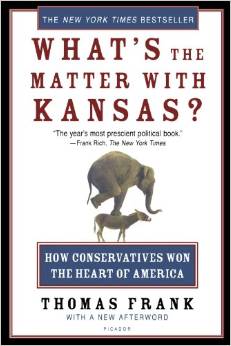
Just as Thomas Frank’s popular book What’s the Matter with Kansas did a decade ago, Smarsh’s argument resolves puzzling situations by resorting to conspiratorial explanations. Frank argued, roughly, that conservative schemers managed to convince working-class voters to vote Republican by waving the bloody shirt of abortion and gay rights. In essence, conservative strategists fooled people into voting against their own economic interests by emphasizing culture-war hot-button issues.

In Frank’s argument, conservative voters come off as dupes, conned into voting for Kansas Republicans because of an irrational attachment to pro-life ideas. Smarsh makes similar implications. Big business free-marketeers manipulate conservative Christians into fighting against public education, in this line of argument.

Let me be as clear as I can be: I don’t doubt that some libertarian business folks might HOPE to enact such a scheme, but the notion that conservative Christians are somehow rustic pawns of a corporate megalith are far too simplistic and Manichean.

Folks like Smarsh and Frank (and me, to be fair) have a hard time understanding how conservative Christians could support privatization, so they (we) jump to a false conclusion that big business has somehow fooled religious conservatives.

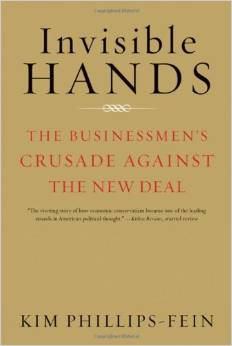
More careful historical treatments have noted the far more complicated connections between big business and evangelical Christianity. Kim Phillips-Fein, for example, looked at the roots of business conservatism in her 2009 book Invisible Hands. Phillips-Fein is certainly no fan of big business, but she describes the way industry leaders such as J. Howard Pew of Sun Oil dedicated much of their fortune to promoting evangelical Protestantism. This was more than a scheme or a scam. It was a long-term effort to promote conservative Christianity and big-business. It was an effort to bring both together for the good of both.
...or does it?

…or does it?

As I’ve found, too, many religious conservatives have embraced big business for reasons that Smarsh and Frank don’t seem to understand. Many religious conservatives have not been fooled into supporting capitalism, but rather see capitalism as an inherent part of their American Christian tradition.

In educational conservatism, at least, the deep organic connections between Jesus and capitalism were not imposed by any move of the sinister Koch brothers. Rather, religious conservatives themselves have long insisted that schools must teach both capitalism and Protestantism. Even a cursory familiarity with the writings of leading conservative activists will make these connections clear.

For instance, in a description of the decades-long educational activism of Mel and Norma Gabler, biographer Jim Hefley connected the dots (emphasis added):

The Gablers also began to grasp progressive education’s grand scheme to change America. They understood why the new history, economics, and social study texts trumpeted Big Brother government, welfarism, and a new socialistic global order, while putting down patriotism, traditional morality, and free enterprise. Simply stated, Mel and Norma realized that the Humanists in education were seeking to bring about the ‘social realism’ which John Dewey and other ideologues had planned for America.

For its part, big business also has a long tradition of pushing for more Jesus in public schools. The National Association of Manufacturers, for example, an industry group, offered in 1939 a new curriculum for schools nationwide. It was vital, NAM leaders argued, for schools to combine “the historical and spiritual foundations of the American system of government, free enterprise and religious liberty.”

I’ll say it again: I don’t doubt that tycoons such as the Koch brothers might hope to manipulate religious conservatives. But it hardly counts as manipulation to encourage conservatives to support a cause they already support.

When journalists such as Thomas Frank or Sarah Smarsh paint a conspiratorial picture of hapless religious conservatives taken in by evil-genius financiers, they do a disservice to those of us hoping to get a better understanding of the ways cultural politics really work in this country.

Americans Love ‘Nazi Propaganda’ Film; Conservatives Celebrate

Conservative pundits are gloating this morning. The new film American Sniper attracted huge audiences this past weekend. Americans love it, even though liberal pundits condemned it.

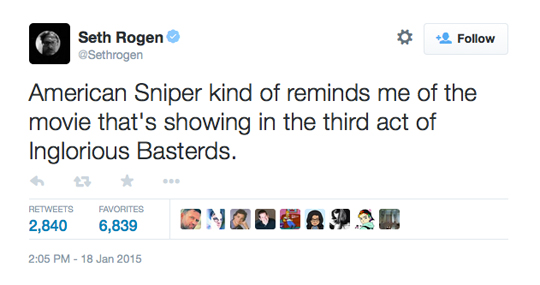
Most famously, actor Seth Rogen tweeted smarmily that the movie reminded him of a fictional Nazi propaganda film from the movie Inglorious Basterds. Apparently, in that fake film a German sniper is lionized.

Nazi propaganda from Hollywood...

Nazi propaganda from Hollywood…

American audiences, on the other hand, turned out in droves to see American Sniper. As conservative pundit Rich Lowry crowed in the pages of National Review, the movie marks the “return of the American war hero.” For liberals like Rogen, Lowry wrote, the story of real-life sniper Chris Kyle “smacks of backwardness and jingoism.”

At the Weekly Standard, Michael Graham argues that Hollywood liberals can’t seem to get it through their thick skulls that Americans want to see movies that are not aggressively “anti-American.” Mark Hemingway agreed. “Everyone in Hollywood,” Hemingway noted,

skews heavily left. . . . all these people line up to write checks for Hillary Clinton. . . . That might change now that they’ve seen that this film’s gonna make $90 million in one weekend in January. Maybe we’ll start to see more honest attempts at portraying soldiers.

Whose Values Rule the Schools?

What are the dominant values in American public schools? Progressive activists tend to think schools are dominated by conservatism. But conservatives say that progressives are in charge. New poll data suggest that conservatives are wrong. When it comes to general attitudes toward children and education, conservative values seem enormously powerful.

Progressives have always hoped that schooling would soon be transformed into a progressive paradise. But they have also always acknowledged widespread public resistance. As far back as 1925, scholars Otis Caldwell and Stuart Courtis—from the progressive bulwark of Teachers College, Columbia University—argued that the “new philosophy” of progressive education could transform schools into a “childish utopia.” Unfortunately, they wrote, most Americans weren’t interested. Instead, most people “blamed teachers and schoolmen generally for ‘new-fangled methods.’”

These days, leading progressives agree. Pundits such as Alfie Kohn insist that progressive ideas are the best. As Kohn once put it, progressive education is “hard to beat, but also hard to find.” In spite of the clear superiority of progressive methods, Kohn writes, most schools only use them in dribs and drabs. Conservative, traditional schoolrooms, Kohn notes glumly, tend to be the norm.

We might think that conservative activists would celebrate their domination of American public education. But in fact we see just the opposite. Historically, conservative activists have taken progressive dominance for granted. Many conservatives have assumed without question that the progressive nostrums of philosopher John Dewey had long ago triumphed.

Writing in the wake of a tumultuous school battle in 1950s Pasadena, California, for instance, conservative activist Mary Allen explained that “traditional education” had been abandoned in the 1930s. Why? Because at that time “some of Dewey’s followers prepared to use the schools to introduce a new social order.” To Allen as to generations of conservatives, conservative values had long since been kicked out of public education.

Today’s educational conservatives voice similar frustration. For example, Peter Collier has lamented the dominance in public education of the progressive tentacles of Columbia University’s Teachers College. A pernicious leftist stew of “critical pedagogy,” Collier noted, “slowly infiltrated leftist ideas into every aspect of classroom teaching.”

How important is "curiosity" as an educational goal?

How important is “curiosity” as an educational goal?

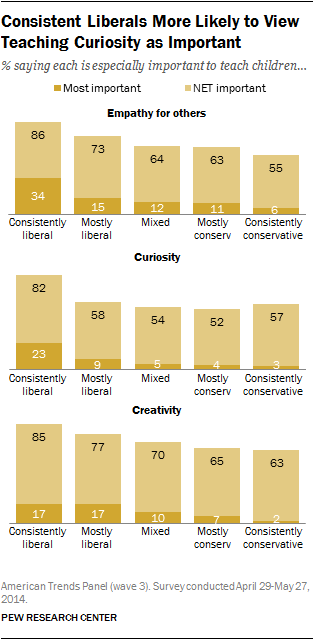
New poll data from the Pew Research Center for the People and the Press suggest that conservatives have this one wrong. When it comes to basic attitudes about children and proper education, conservative ideas tend to dominate. Those who call themselves “consistently liberal” find themselves on the outside looking in.

Who's the outlier here?

Who’s the outlier here?

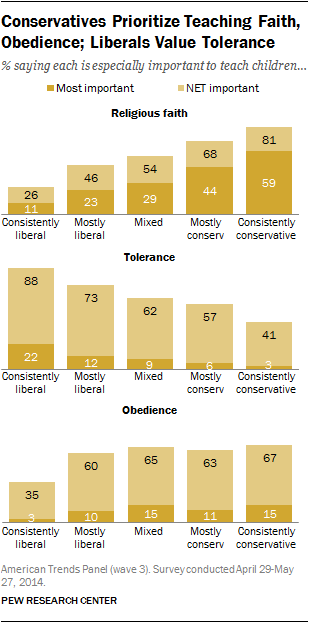
To be fair, the poll also suggests that Americans of all ideologies share broad agreement about the proper way to raise children. Huge majorities of the “consistently liberal,” the “mostly liberal,” the “mixed,” the “mostly conservative,” and the “consistently conservative” agree that children must be taught responsibility.

But in a couple of other categories, those who call themselves “consistently liberal” stand out. And those differences tell us something about the values that dominate our schools and society.

For example, the “consistently liberal” place a much higher value on teaching curiosity than do any other groups, by a huge margin. Nearly a quarter of the consistently liberal place this among the three most important factors for children, and over three quarters think it is important. In contrast, none of the other groups, including the “mostly liberal,” thought that teaching curiosity was nearly as important. Only nine percent of the “mostly liberal” called curiosity one of the most important values, and only fifty-eight percent considered it important. And though fifty-seven percent of the “consistently conservative” agreed that curiosity was important, only a paltry three percent of consistent conservatives placed it at the top of their lists.

In addition, large majorities of every group except the “consistently liberal” placed a high value on teaching obedience. Even among the “mostly liberal,” sixty percent found this important. At the high end, two-thirds of the “consistently conservative” thought obedience was an important idea for children, compared to just over one-third of the “consistently liberal.”

Of course, it’s notoriously difficult to define “progressive” and “conservative” ideas about education. But in general, it’s fair to say that progressives tend to value curiosity above obedience, exploration above authoritarianism. Yet those values are only shared by a small sliver of the respondents in this survey.

The good news for conservatives? They are wrong about the values that guide American public education.   Progressive notions of child-centered learning, of students freed from the dictation of authoritarian teachers and exploring the creative curiosity of youth, have not sunk the deep roots that conservatives have often assumed.

Instead, when it comes to central ideas about obedience and curiosity, this poll suggests that conservative attitudes are the norm.

Something New for the Shelfie

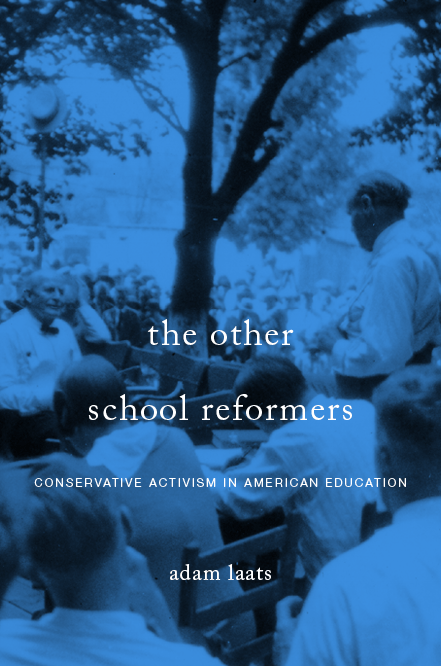
The first copies are in!  Thanks to the folks at Harvard University Press, I’ve got my hands on my new book, The Other School Reformers: Conservative Activism in American Education.

A snappy addition for the bookshelf...

A snappy addition for the bookshelf…

As far as I can tell, they should be getting into stores in the next few weeks.  So here’s my suggestion: Let’s all dress up as our favorite conservative activist, a la Harry Potter, and camp out outside our local bookstores until these babies hit the shelves!

Dibs on Max Rafferty…

The Perfect Valentine’s Day Gift

Nothing says “I Love You” more than a book about conservatism and education in American twentieth-century history. Looks like the timing will be perfect.

How to say "I Love You" (But You're Going to Hell)

How to say “I Love You” (But You’re Going to Hell)

My new book is slated for release in early February. Hard to know how it will be received, but one pre-reviewer has called it “a major rethinking of the history of American education.” Another has added, “it would be flat-out wrong to ignore this important book.” Pshaw. . .

For the sophisticated and good-looking readers of ILYBYGTH, the content might not be surprising. In this book, I try to figure out what it has meant to be “conservative” about education in the United States.  How have issues such as creationism, school prayer, and sex ed developed over the course of the twentieth century?  How are they related?  How have conservative attitudes and strategies changed?  How have they remained the same?

In the early days of my research, I had planned to explore the educational activism of leading conservative groups such as the American Legion and the Institute for Creation Research. I was stuck with two big problems, though.

First, the Legion and other conservative groups remained active throughout the twentieth century. How could I describe different conservatives without rehashing the chronology over and over again? I didn’t want to work from the 1920s to the 1970s in every chapter. What to do?

My second problem was one of definition. How could I choose which “conservative” groups to study? I could copy the method of leading conservative scholars such as Russell Kirk or George Nash and use my selection to make an argument about the definition of conservatism. Both Kirk and Nash picked their subjects to give a particular definition to conservatism. For both writers, being a true conservative has meant being a heroic intellectual battling waves of ignorance and knee-jerk leftism. But I’m no conservative myself, and I wasn’t interested in imposing a flattering (or un-flattering, for that matter) definition on American conservatism. What to do?

Luckily for me, I had some help. At a conference back in 2009, I was describing my research. One of the audience members suggested a new approach. Instead of picking and choosing which activists counted as “conservative,” instead of describing the activism of one group after another, why not do it differently? Why not let conservative activists define themselves? This leading historian suggested that I investigate events, not groups.

That’s what I did. I looked at the four biggest educational controversies of the twentieth century: The Scopes Trial of 1925, the Rugg textbook fight of 1939-1940, the Pasadena superintendent ouster of 1950, and the Kanawha County textbook battle of 1974-1975. In each case, conservative activists and organizations fought for their vision of “conservative” schools. By looking at controversies instead of organizations, I could let conservatives define themselves. And I could move chronologically through the twentieth century without rehashing the stories in each chapter.

Did it work? Now I have to let readers and reviewers be the judge. My goal was to explore what it has meant to be “conservative” in the field of education. I did not want to make the relatively simpler argument that conservatism has really meant X or Y. I did not want to give conservatives a heroic history they could draw upon. Nor did I want to give their enemies a catalog of conservative sins. I’m hoping readers think this approach has worked.

So if you’re looking for that perfect romantic gift, consider The Other School Reformers!

Conservative Warriors and Homosexuality

Where is the line? What can conservatives say about homosexuality that won’t be considered bigotry? The case of Professor John McAdams has lit up the conservative intellectual world with its implications for the eroding respectability of conservative opposition to gay rights and the utterly transformed intellectual environment on US college campuses.

Let’s start with a few caveats. First, full disclosure: I taught one semester at Marquette University, Professor McAdams’s school. I also taught for several years down the street at Marquette High School, which is no longer directly connected to the university. I feel an abiding love for both institutions. More important, I am unapologetically biased in this case. I believe it is legitimate and important to regulate speech in public (and some private) forums, including college classrooms. Hard as it is to hear, some ideas do not deserve to be granted equal status with others. Ideas that dehumanize classes of people are not just as good as other ideas. For instance, if a student in a seminar wants to insist that no white people can possibly understand US history because they are by definition part of an exploitative class, such talk should be ruled out of bounds. It would tend to exclude an entire class of people simply because of their cultural identity. Similarly, if a student wanted to rule that homosexuals were incapable of being moral in their relationships, or that women cannot understand certain concepts, or that non-citizens have no right to be heard in political discussions, such talk should be out of bounds.

Of course, many conservative intellectuals share that basic framework, but they disagree bitterly that traditionalist notions about homosexuality constitute that same sort of exclusionary mentality. In other words, many conservative thinkers agree that public speech shouldn’t be racist or chauvinist, but they disagree that conservative ideas about homosexuality fall into that same category.

The steamroller drive of homosexual rights in recent months and years has put some traditionalist conservatives on edge. A few recent cases have raised hackles among many conservative thinkers. At Mozilla and Gordon College, to cite just two examples, conservative intellectuals attracted instant and furious retribution for statements that have been perceived as anti-gay. In each case, ideas that would have been unremarkable just a few years ago are now taken as beyond the pale of respectable public speech.

In the case of Professor McAdams, college politics and bureaucracy have added new wrinkles into the question of acceptable conservative opinion about homosexuality. In brief, McAdams has been suspended with pay and asked to stay away from campus. Why? He blogged about the statements of a teaching assistant. That TA had told a student that opposition to homosexual marriage would not be considered in a class on ethics. The student complained to Professor McAdams, and McAdams outed the TA on his blog.

As McAdams noted, his support for the student prompted furious condemnation by “leftist academics,” who “demanded our head on a pike.” A group of prominent faculty at Marquette published an open letter on the issue. McAdams’s actions, they write, constituted “harassment and intimidation” of the TA. Other members of the Marquette community, they write, altered their behavior to avoid similar attacks from McAdams.

In the end, McAdams has been suspended with pay. The Fox-News commentariat has had its chance to recoil in horror at the anti-conservative “inquisition.”

There is, of course, more at stake here than intellectual positions about homosexuality and gay rights. We also must consider faculty politics and the unfortunate ways academics learn to teach. How do teaching assistants learn to handle disagreement among students? When does a tenured professor have a duty not to attack publicly a non-degreed teaching assistant? How should faculty respond when a colleague behaves in ways they dislike?

At the center of all these questions, however, is the question of conservatism and homosexuality. Not too long ago, opposition to gay marriage was a common part of our mainstream political discussion. These days, in college seminars, newspapers, technology companies, and public policy, any conservative notion that homosexuals do not have the right to marry one another is often considered rank bigotry.

Is it possible for conservative intellectuals to oppose gay marriage without being branded bigots? Has that culture-war train left the station?