Astorino Blasts the Common Core: “Our Children Are Not Guinea Pigs!”

Should conservatives embrace the Common Core? As we’ve seen [check out ILYBYGTH coverage here, here, or here, for instance], conservative intellectuals have disagreed about the new standards. New York gubernatorial hopeful and staunch conservative Rob Astorino offered a stinging attack on the new standards last week. His analysis of the good and the bad might give us some insight into the ways conservatives view these new standards. Indeed, Astorino’s comments might offer insight into conservative attitudes about education as a whole.

Astorino is leading the conservative charge against sitting New York Governor Andrew Cuomo. Astorino, a County executive from affluent Westchester County, just north of New York City, has pledged to take the Great State of New York in a more conservative direction. As part of that campaign, Astorino issued a blistering attack on the Common Core Standards.

http://vimeo.com/90498744

Flanked not only by the US flag, the New York flag, and a copy of the US Constitution, but also by a few cheerful children’s drawings, Astorino blasted the CCSS as an “untested experiment” that would lead America in dangerous directions. Indeed, Astorino repeated the word “experiment” or “experimental” a total of four times in the four-minute announcement. He also repeated the phrase “Andrew Cuomo’s Common Core exam” four times. Clearly, Mr. Astorino hopes to label the CCSS as both experimental and part of Governor Cuomo’s program.

Most compelling, Astorino announced last week that his own children will be opting out of the exams. The Opt-Out movement has attracted support from all across the political and ideological spectrum.

For Astorino, opting out is the right choice for conservatives. Why? He offered a laundry list of problems with the standards and with the associated exams.

First, with common standards and exams, Astorino warned, local schools will become “centralized organs of the Federal government.”

Second, these exams and standards will raise property taxes “through the roof.”

Third, these exams are not tested, but are simply the misbegotten brainchildren of people such as Bill Gates. According to Astorino, the exams came from the same political greenhorns who cobbled together the disastrous “Obamacare.” Worst of all, Astorino asserts, these standards and exams represent just the latest effort by distant educational elites to exert their unwanted and poorly conceived influence over all the nation’s schools. As he put it, “We’re risking our children’s futures for a few scraps from Washington.”

As I argue in my upcoming book about conservatism and American education, the notion that a scheming group of educational usurpers has taken—or is taking—control of our nation’s schools has a long and potent history. Astorino appeals to this tradition by taking a firm stand on what he calls this “expensive, experimental, Federal curriculum.”

So what’s a conservative to do? According to presumptive GOP gubernatorial candidate Rob Astorino, conservative parents should run for the hills.


Cruz at Liberty: Freedom under Attack

Senator Ted Cruz told the commencement crowd at Liberty University that they were in danger. Unless they remained willing to sacrifice for their faith, unless the Liberty community remained willing to get active in politics, the religious liberties of the United States could be crushed under the heel of a metastasizing federal government.  Unlike some typical graduation speakers, he hoped the career path of his audience would include some time in prison.

In some ways, Cruz’s commencement address sounded very similar to such addresses at colleges all across the nation and all across the political and religious spectrum. In spite of the fact that Senator Cruz has earned a reputation of one of the staunchest and most outspoken religious conservatives in national office, his speech often seemed mere boilerplate graduation fare: he told the crowd they were all inspirational; he told a few mildly humorous anecdotes; he allowed himself to notice how very famous he was; and he exhorted the crowd to get on out there and change the world.

But in the context of Liberty University, founded in 1970 by fundamentalist leader Jerry Falwell, Cruz also included more ideologically charged material. He reviewed the conservative vision of the nature of the United States. Throughout United States history, Cruz insisted, we see nothing more starkly evident than the fact that “Faith and freedom are intertwined.”

The United States had weathered storms, Cruz said, but he warned ominously, “religious liberty . . . has never been more imperiled than it is right now.”

Cases such as the Hobby Lobby suit or that of the Little Sisters of the Poor, Cruz told the Liberty audience, demonstrate the dangers to religious freedom. These cases are not about contraception, Cruz warned. If religious people can be forced to go against their beliefs to satisfy the demands of big government, Cruz warned, then the generations of sacrifice by Godly Americans will have been for naught.

The folks at Liberty had a chance to change things, Cruz concluded. If they were brave enough to remember that they were “called to action as believers,” Liberty grads could “change the world.” But they had to be willing to suffer for it, to sacrifice for it. Like The Reverend Dr. Martin Luther King Jr., Cruz told his Liberty audience, Christians need to be willing to go to jail to promote their beliefs.

“How many of us,” Cruz asked, “have been to prison for Christ?”


From the Archives: Saving Hearts and Minds in the 1930s and 1940s

What do we need to do to educate young people? Conservative activists, just like their progressive or leftist opponents, have long recognized that education goes far beyond school. Doing archival research for my upcoming book about conservative educational activism in the twentieth century, I found abundant evidence of conservative activism that ranged far beyond the classroom walls. Unfortunately, due to space considerations, much of that material did not make it into the final book draft.

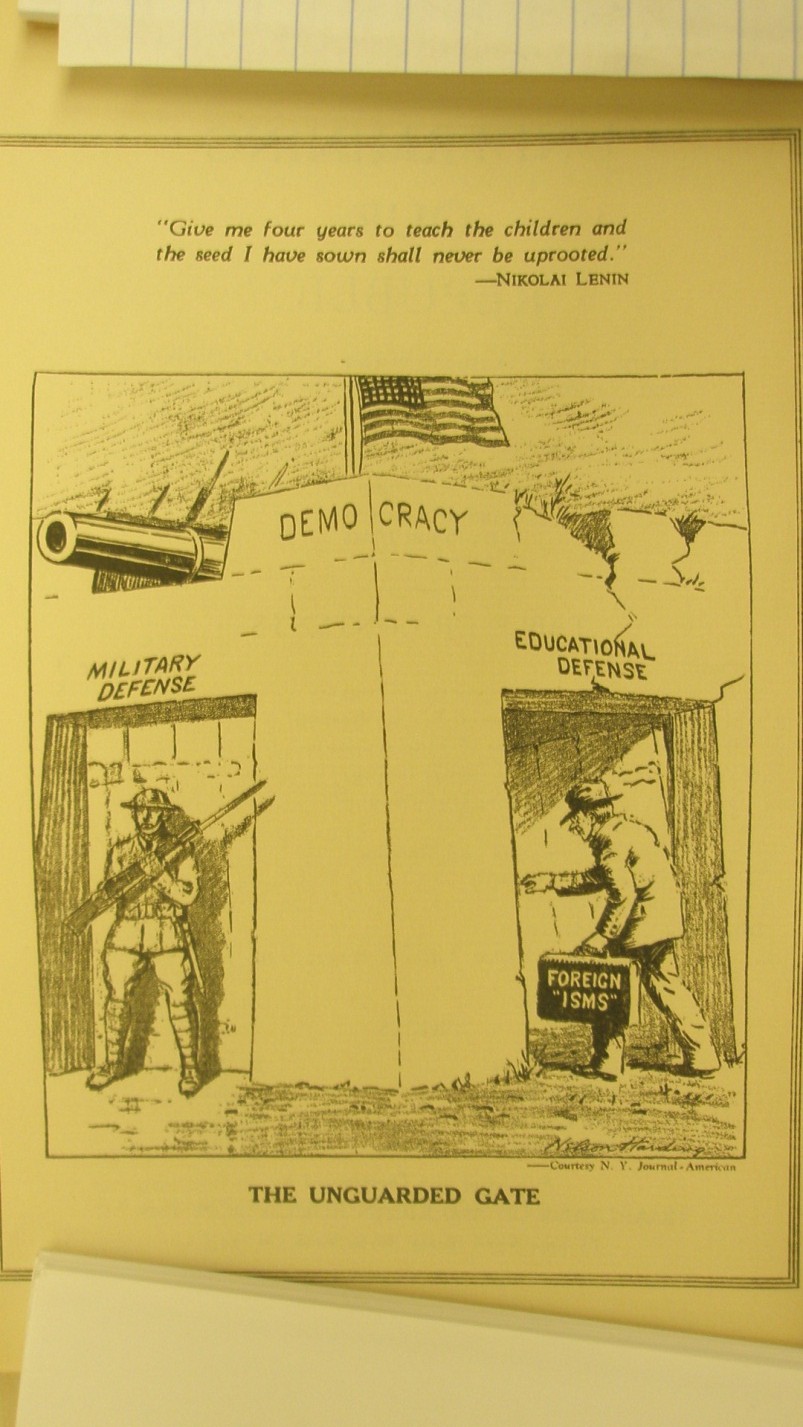
Today, I’d like to share some of the gems from the conservative patriotic activism of the American Legion, things I couldn’t fit in the book. Throughout its long existence, the AL has made education one of its primary concerns. Only if young people learned to love America, generations of AL activists have argued, would the nation remain strong. As this 1941 cartoon makes clear, some Legion members believed education was the “unguarded gate” through which un-American and anti-American sentiments could sneak into America’s body politic.

"The Unguarded Gate," from a 1941 magazine.

“The Unguarded Gate,” from a 1941 magazine.

Other Legion activists emphasized the need to fill children’s minds, souls, and schedules. Only by matching the energetic activism of communist subversives, some Legion voices claimed, could patriotic education match anti-patriotic. As national AL leader Homer Chaillaux warned in 1934, the Legion must provide a full menu of educational opportunities for young people, including baseball leagues, military training, Boy Scout groups, citizenship classes, and school awards. “The average citizen,” Chaillaux warned,

has either never heard of or knows nothing of the background of the Young Pioneers (a youth Communist group), the International Economic Conference of Students (a radical and pacifist student group), the Industrial Unions (at least 42 Communist Unions), the National Students’ League, the Trade Union Unity League, the American Civil Liberties Union (supposedly an organization standing for free speech, but we find them rising in defense of every Communist when in trouble), and numerous others traveling under camouflaged nom de plumes.

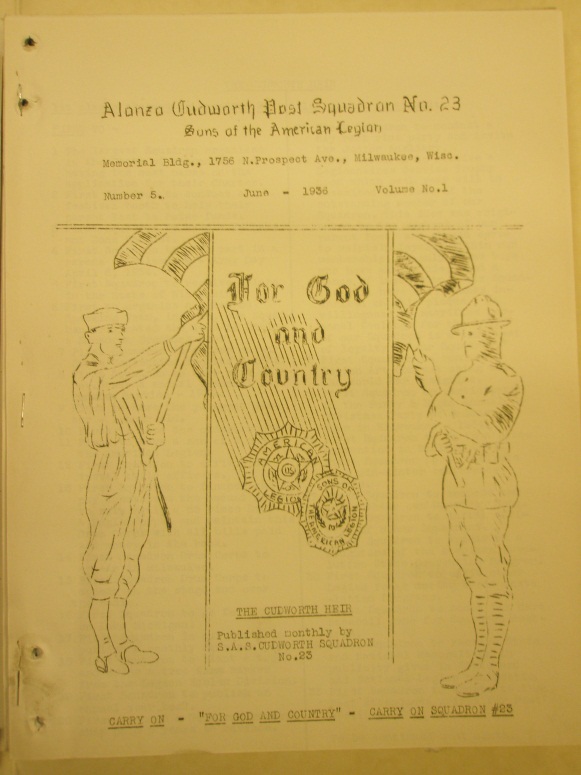
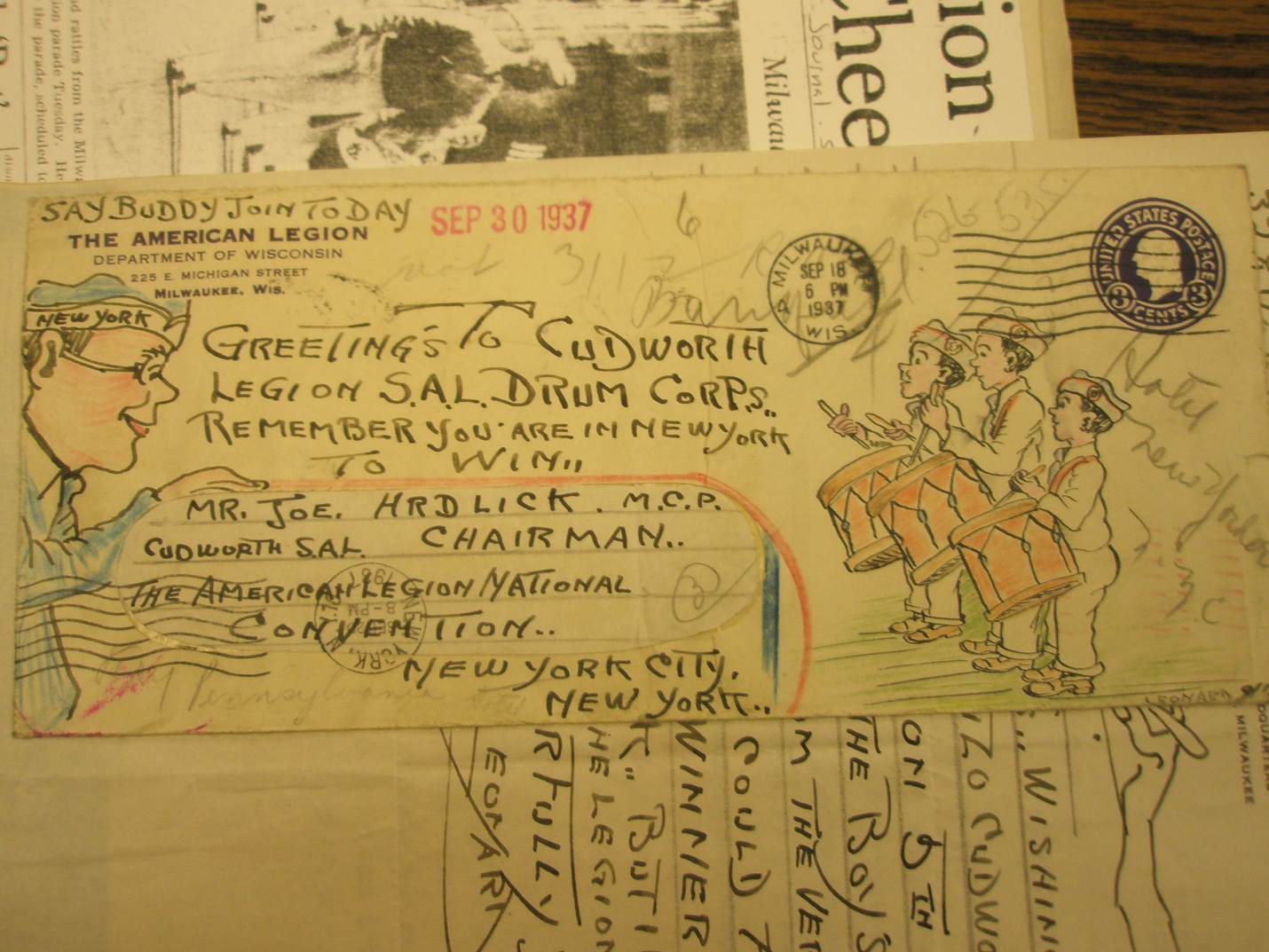
With this sort of foe, the American Legion wanted to be sure young people had patriotic, traditionalist American alternatives. Across the nation, local posts organized a wide array of youth activities.  I found these relics of such organizing from Milwaukee, Wisconsin.  As did posts around the nation, Legion adults set up youth chapters of the Sons of the American Legion, as well as marching bands, baseball leagues, essay contests, and a host of other activities meant to educate boys and girls into a firmly patriotic, socially conservative anti-communism.

A memento from a Milwaukee-area Sons of the American Legion Marching Band trip to the national championships.

A memento from a Milwaukee-area Sons of the American Legion Marching Band trip to the national championships.

From the same Milwaukee-area SOTAL club, a cover from a 1936 newsletter.

From the same Milwaukee-area SOTAL club, a cover from a 1936 newsletter.

As one Legion writer put it in 1930, these efforts must range far beyond just exhortation. They must envelop young people into a profound spiritual web of learning and becoming. In this writer’s words:

While the communist organizes his young pioneers, his youth movement in colleges, and so forth, let us do some organizing. Let us organize Boy Scout troops, ROTC units and boys’ baseball teams, if you please. Let us win and hold the confidence of our boys through such work. While the communist scatters literature among the youth of the land to teach it disrespect for parental authority, let us preach the doctrine of love of parents and love of home. While the communist ridicules the ethics of religion, let us teach its beauty and comfort and hope. While the communist preaches its cowardly philosophy of dissipating the fruits of labor and capital, let us strive to inculcate the manly principles of energy, ambition and thrift in the hearts of our people. While the communist, in the guise of the professional pacifist, spreads his doctrine to palsy the arm of our national defense, let us keep our people informed on matters pertaining to the need and necessity of national defense. … While the communist gathers up boys and girls and sends them to colleges and universities of his own endowment for the purpose of making teachers of communism and atheism out of them, let us make opportunity for patriotic and religious education more universal, in order that the schools and pulpits of tomorrow will be filled with right-thinking men and women.


Conservatives Blast the “Myth” of Rape Culture

Why do some conservative thinkers insist that anti-rape-culture activism is a fraud? That “rape culture” itself is a myth?

As we’ve seen in these pages, talk about rape culture is often tied to the atmosphere of colleges and universities. And it is understandably an incredibly sensitive subject. Even asking about the nature of rape culture can be seen as truckling to rapists and those who hope to explain rape away.

Full disclosure: I am one of those who thinks that denying this problem is part of the problem. I agree that colleges and universities need actively to confront cultures that encourage sexual assault. For too long, college administrators have winked at the “boys will be boys” attitudes that lie at the heart of rape culture. In these pages, I have asked whether this is worse at conservative Christian colleges. I have wondered if non-denominational Christian schools, “fundamentalist” schools such as Bob Jones University, Patrick Henry College, and Pensacola Christian College have a harder or easier time dealing with these issues. In those cases, I was accused of apologizing for sexual assault myself.

And watch: I won’t be surprised if I am accused of supporting rape culture for writing these words as well.

But I’m going to do it anyway. Because there’s a new question that stumps me. Why do some conservative intellectuals attack the very notion of rape culture? What is “conservative” about dismissing the existence of rape culture on college campuses?

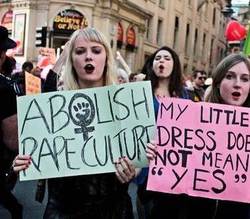
Minding the Campus Blasts Rape-Culture Activism

Minding the Campus Blasts Rape-Culture Activism

This past week, we’ve seen Caroline Kitchens of the American Enterprise Institute denouncing the “hysteria” over rape culture in the pages of Time Magazine. Kitchens asserted that there is no rape culture. There is no culture, that is, in which rape is apologized for and excused. America as a whole loathes rape and despises rapists, Kitchens points out. “Rape culture” only exists in the imaginations of over privileged college students and their tame faculty. Colleges such as Boston University and Wellesley ban pop songs and harmless statues as an overblown response to such rape-culture myths, Kitchens writes.

Kitchens claims the support of the Rape, Abuse, & Incest National Network (RAINN). She cites a recent RAINN letter to a White House Task Force. In order to help victims of sexual assault on college campuses, this RAINN letter asserts, administrators should understand that these are the acts of criminal individuals, not the result of a nebulous cultural trend.

It is rape-culture stereotypes themselves that absolve abusers of responsibility, Kitchens argues. “By blaming so-called rape culture,” she concludes, “we implicate all men in a social atrocity, trivialize the experiences of survivors, and deflect blame from the rapists truly responsible for sexual violence.”

Kitchens is not alone. In the pages of the conservative higher-ed watchdog Minding the Campus, KC Johnson has agreed recently that “rape culture” is a “delusion,” the product of overheated leftist imaginations. Johnson, a high-profile historian from Brooklyn College, worries that campuses from Dartmouth to Occidental to Duke suffer from an overabundance of intellectual cowardice and groupthink. “Fawning” media coverage has allowed for “transparently absurd allegations,” Johnson writes. Plus, harping on “rape culture,” Johnson argues, allows “activists to shift the narrative away from uncomfortable questions about due process and false accusations against innocent male students, and toward a cultural critique in which the facts of specific cases can be deemed irrelevant.” Finally, the blunt instrument of “rape-culture” accusations provides activists with “a weapon to advance a particular type of gender-based agenda.”

Such claims are intensely controversial. But before we examine the legitimacy of these arguments, we need to ask a more basic question: Why do conservative intellectuals make them? Now, I understand Johnson is no conservative himself. But it is telling that conservative organizations such as the American Enterprise Institute and Minding the Campus are the ones hosting these anti-rape-culture accusations.

Is there something “conservative” about disputing the existence of rape culture? Is “rape culture” a leftist ploy to assert (more) control over college campuses? To tighten the screws of the academic thought police? Or is something more profound at work? Do these conservative voices dispute the existence of rape culture in order to perpetuate traditional gender roles?


Can You Find the Conservative Education in This Picture?

Gracy Olmstead doesn’t mind tweaking the noses of her fellow conservatives.  She has encouraged them to relax about the dangers of the new(ish) Common Core State Standards, for example.  And now she wants conservatives to embrace Finland’s progressive-education model.

In today’s battles over classroom teaching and school organization, progressives often point to Finland as a guide.  Olmstead wants to claim Finland’s model as one for thinking conservatives.  I’ll admit: I’m stumped.  I can’t find the “conservative” elements Olmstead wants me to see in this picture.

A Conservative Model?

A Conservative Model?

Famously, Finland’s schools shun standardized tests.  Finland’s teachers are an elite cadre of highly trained professionals.  Students in Finland’s schools spend little time cramming or regurgitating information.  Students are encouraged to play, to think, to roam outside the boundaries of classrooms and textbooks.

Most progressives love this model.

Olmstead does too.  She says it embodies the core conservative principle of subsidiarity.  For those of us who haven’t been paying attention to conservative rhetoric for the past couple of years, “subsidiarity” is an old term that has attracted some new conservative devotees lately.  Paul Ryan, for instance, famously invoked the Catholic notion of subsidiarity as the moral justification for his 2012 budget plan.  Though other Catholic intellectuals disputed Ryan’s definition, Ryan used the term as shorthand for Reagan-esque encouragement of localism in government.  The best solutions were those closest to the problems.  Central governments should play only a subsidiary role, tackling issues local folks cannot.

Olmstead finds this principle at the heart of Finland’s school plan.  No centrally imposed curriculum, no dictatorial imposition of one-size-fits-all schooling.  She notes that some conservatives might not like the lack of private options for schooling.  But she does not stress the fact that American conservatives will likely also rebel at the very practices of schooling in Finland.  Olmstead quotes progressive guru Linda Darling-Hammond’s description of Finnish schooling:

In a typical classroom, students are likely to be walking around, rotating through workshops or gathering information, asking questions of their teacher, and working with other students in small groups.

Now, Olmstead’s enlightened conservatism may find this image appealing.  But many American conservatives (not all!) connect traditional classroom practices with effective schooling.  Indeed, one of the constant themes of conservative educational activism throughout the twentieth century, I argue in my upcoming book, has been this connection between traditionalist classroom practice and traditionalist social morality.

I applaud Olmstead’s open-mindedness.  But I wonder how many other conservatives will join her in her embrace of the Finnish model.


A Patriot’s History: The Movie!

What’s a patriotic conservative to do?  So often, history textbooks have been accused of peddling a leftist mishmash of America-bashing and skewed intellectual flag-burning.  As we’ve argued in these pages, for generations conservatives from the American Legion to David Barton have attempted to publish their own history textbooks that tell a more patriotic, more Christian story.

One of the most successful of those textbook efforts has been Larry Schweikert’s and Michael Allen’s 2004 A Patriot’s History of the United States. The book tells the story of the United States in a way that celebrates the triumphs and tragedies of America from a traditionalist patriotic viewpoint.  According to the book’s Wikipedia page, one reviewer from the Heritage Foundation wrote in 2005 that the book centered on a simple premise: “that there are principles and purposes reflected in American history that make this imperfect country worthy of our affection.”  Other reviewers had more hostile opinions.  David Hoogland Noon wrote in the pages of the History Teacher that this book was “written for an audience of the previously converted . . . hardly worth anyone else’s time.”

Via Andrew Palmer at Conservative Teachers of America we see that Schweikert is hoping to turn the book into a movie.  Schweikert has published a four-and-a-half minute trailer.  Tellingly, the dramatic intro promises the film will tell viewers “the history you always knew.”  In other words, the approach of Schweikert and Allen has been to confirm the traditional story of America’s greatness.  Not that this story has been one of unalloyed heroism, Schweikert and Allen might say, but overall the sweep of history has proven the United States to be the greatest nation on earth.

The choice of bits and pieces for this trailer tells us something about the movie’s approach.  First of all, it begins and ends with fireworks.  It includes scenic panoramas of cherry blossoms on the Mall in Washington DC, Ansel-Adams-like vistas of rocky outcroppings, and other traditional American eye candy.  As I watched, I took sketchy notes of some of the featured elements:

  • Happy colonists
  • Heroic suffering in the Revolutionary War
  • Heroic racing in wagons to settle the West
  • The Civil War
  • An Industrial Revolution with awesome achievement
  • D-day and Iwo Jima
  • Immigrants as ardent patriots
  • The Green Bay Packers!
  • Mount Rushmore
  • The Moon Landing
  • Martin Luther King Jr.
  • A jet in Vietnam napalming a field
  • Reagan calling on Gorbachev to tear down this wall
  • Baseball
  • The hockey “Miracle on Ice” of 1980
  • Lots of Fireworks.

Clearly, any movie trailer tells only part of the story.  This one certainly skews toward the positive elements of American history.  Unlike some academic histories, the story of the settling of the West is told as a heroic race to fill in land with settlers, not as the invasion of Europeans and the genocide of the native inhabitants.  As much as what was included, this trailer leaves out some important elements.  I saw no suggestion of race slavery, for example, nor of the systematic extermination of native peoples.

Will conservative teachers and schools embrace the film as conservatives embraced the book?  I don’t see why not.  In my experience, conservative intellectuals don’t want children to read patriotic lies about America’s past, but they do want children to read patriotic truths.  In the case of the American Legion’s 1926 textbook series, for example, as soon as the Legion leadership found out that the book was riddled with errors, the Legion pulled its support.  And as soon as David Barton’s book The Jefferson Lies accumulated accusations of inaccuracy, its original publisher yanked it.

My hunch is that the makers of A Patriot’s History would argue that they do tell the full story of America’s past.  The trailer, for example, did include clips of America’s troubling policy of napalming villages in the Vietnam War.  To be a success, I’m guessing, this film will have to convince conservative audiences of two things.  First, it must seem like a full and true history of these United States.  Second, it must make clear that this country—despite its historical blemishes—is the greatest nation on the earth.

The hard question remains: Would you want your kids to watch it?


Conservative Education for Dummies

How can a conservative person in America be sure her kids are getting a good education?  Relax, says Anthony Esolen in a recent article in the Imaginative Conservative.  It’s easy.  Just follow a few simple steps.

1.) Don’t give up on memorization.

2.) Read good books.

3.) Relax: your kids will get a good education.

Esolen advises conservative parents and school leaders to trust in the natural learning capacities of young people.  Children learn.  If we trust in our instincts, we will help.

One thing that works is to have children memorize things.  Too often, Esolen writes, educators look down their noses at “mere” memorization.  “For fifty years,” Esolen laments, “we have been cowed by the educational ‘experts’ into believing that it is contemptible, simplistic, backward, and ineffectual.”  But memorizing things—whether it’s the multiplication tables or Milton—lies at the heart of education.  Esolen relates the tale of a farmer who memorized Paradise Lost.  This was more than just rote memorization.  This was “getting it by heart,” a process of imbibing a priceless intellectual resource to spark real human-scale education.

What should be the content of this sort of real education?  Esolen wants conservative parents to relax.  There are good books everywhere that can form the base of an effective education.  Too often, Esolen says, educators focus on the crass, the cynical, or even the pornographic in a misguided attempt to expose children to the latest intellectual fads.  Why pervert your children’s minds by assigning Slaughterhouse Five, Esolen asks, when the list of good books is so long and so readily available?  Why not pick from any of the good books all around us:

Heidi, Treasure Island, The Wind in the Willows, The Jungle Book, The Secret Garden, The Yearling, David Copperfield, Silas Marner, Black Beauty, Kim, The Adventures of Robin Hood, Little Women, Oliver Twist, Tom Sawyer, Hans Brinkerthe fairy tales of the Brothers Grimm, and of Hans Christian Andersen.

For older students, pick from

Chaucer, Spenser, Shakespeare, Milton, Keats, Tennyson, Browning, Whittier, Dickinson, Frost, and many more. We have all of the wonderful novels of Jane Austen and Dickens and Eliot and Mark Twain and Walter Scott. There’s the great literature of the western world—Virgil and Dante and Cervantes and Tolstoy.

Relax.  Esolen insists, this process is “not like going to the moon. It is like looking up at the stars.”

If you educate your children this way, Esolen writes, no standardized test will have the power to frighten or dismay them.  They will know more than children educated by the most modern methods.  Indeed, they will know things, and other children will not.

What is a conservative parent to do?  According to Esolen, the answer is clear: Relax.  The tried-and-true methods and content of schooling are still the best.


ILYBYGTH in EdWeek: Progressive Education and the Conservatives Who Love It Too Much

Why do so many conservatives and creationists insist that they want more “critical thinking” in public schools?  In a recent commentary in Education Week, I argue that this trend is part of a longer tradition of anti-authoritarian education.

In the pages of EdWeek, I examine some of the new laws that have rightly been called “anti-evolution” efforts.  They usually are that.  They hope to introduce wiggle room in public-school science classes for creationist students and anti-evolution teaching.  A Virginia bill that recently died a lonely death in committee, for instance, would have insisted that students “develop critical-thinking skills, and respond appropriately and respectfully to differences of opinion about scientific controversies in science classes.”

I think, however, that the conservative impulse to encourage critical thinking among students goes even deeper than the evolution issue.  As I argue in the EdWeek commentary, several other legislative efforts in recent years have allowed students to opt out of school assignments that seem ideologically outrageous to students and parents.

Are these opt-out efforts “progressive?”  After all, they embody the anti-authoritarian ethos at the heart of progressive education.  But they do so for demonstrably conservative purposes.  Has the ideology of school dissent come full circle?

Can Atheists Be Conservatives? Can Conservatives Be Atheists?

Sorry, Charlie.

That was what the Conservative Political Action Conference told the American Atheists recently when CPAC rescinded the atheists’ invitation to have a booth at the upcoming CPAC meeting.

The conservative planners apparently took offense to American Atheist leader David Silverman’s plans to shake up the meanings of American conservatism.  As Silverman told CNN,

Conservative isn’t a synonym for religious. . . .  I am not worried about making the Christian right angry. The Christian right should be angry that we are going in to enlighten conservatives. The Christian right should be threatened by us.

Threatened or not, conservative Christian leaders objected to the atheists’ presence at the meeting, a gathering that plans to attract 10,000 conservative activists to Maryland next week.  Tony Perkins of the Family Research Council crowed, if the atheists are welcomed, “they will have to pack up and put away the ‘C’ in CPAC!”

Other conservatives disagreed.  As the proudly atheist conservative Charles C. W. Cooke opined in the pages of National Review,

given the troubled waters into which American religious liberty has of late been pushed, it strikes me that conservatives ought to be courting atheists — not shunning them. I will happily take to the barricades for religious conscience rights, not least because my own security as a heretic is bound up with that of those who differ from me, and because a truly free country seeks to leave alone as many people as possible — however eccentric I might find their views or they might find mine. In my experience at least, it is Progressivism and not conservatism that is eternally hostile to variation and to individual belief, and, while we are constantly told that the opposite is the case, it is those who pride themselves on being secular who seem more likely and more keen to abridge my liberties than those who pride themselves on being religious.

From an historic point of view, Cooke seems to have the better of this argument.  As Jennifer Burns has argued, the atheism of Ayn Rand has played a crucial formative role in post-war American conservatism.  Though some contemporaries such as William F. Buckley rejected Rand precisely because of her atheism and her aggressive moral embrace of capitalism, later conservative leaders such as Paul Ryan proudly claimed Rand’s influence.

But even when Ryan did so, he explicitly rejected the atheism at the heart of Rand’s thinking.  David Silverman is asking CPAC to do something much more difficult: welcome conservative atheists as atheists, not in spite of their atheism.

Boo!

Boo!

Stuff It, Perfesser…

Ouch.  This is what biologists and geologists must feel like when young-earth creationists get aggressive. In the past, I’ve chided mainstream scientists for their unwillingness to sympathize with creationists.  Now that the topic is US History and I’m the one under attack, I feel more sympathetic to the biologists in the room.

Here’s the story: A couple days ago I posted a short essay in the pages of the History News Network.  I compared the history of neo-Confederate attacks on mainstream US history to the decades of creationist attacks on mainstream science.  Why do textbooks still include hackneyed old myths, I asked.  Why insist that slavery was not a leading cause of the Civil War?  Why claim that thousands of slaves fought loyally for the Confederacy?  Such things just aren’t true, and I reminded my history colleagues (and myself) that we must remain active supporters of real history in America’s classrooms.    

A few commenters took me to task for swallowing the myths of false history.  “Whoever this Laats character is,” one James Bendy remarked,

he’s definitely drinking the Kool-aid of the history revisionists. What he calls “revised history’ is actually the unvarnished truth. Yes, there were thousands of free blacks who fought FOR the South, along with thousands of Asians, Spaniards, Jews, Italians, all kinds of Europeans, and several entire tribes of Native Americans. It’s all documented and proven beyond any doubt.

Another commenter accused me of “egotistical presumption and condescension” along with “narcissism and moral blindness.”

Really?

I hadn’t meant to be provocative, really.  I hoped to remind other historians that they needed to remain actively involved in history education in their local communities.  It was an historian from William and Mary College, after all, who discovered woeful mistruths in a textbook used by fourth-grade public-school students in Virginia.  All of us need to serve as this sort of watchdog.   

My surprise reminds me of the ways generations of mainstream scientists felt after engaging for the first time with anti-evolutionists.  As I note in my 1920s book about the first generation of Protestant fundamentalists, when University of Wisconsin President Edward Birge disputed the scientific accuracy of anti-evolutionism in 1921, he found himself under political attack by the wily William Jennings Bryan.  President Birge went on to warn Princeton biologist Edwin Conklin, if you mention evolution, “you will receive an enormous number of letters and much fool printed stuff.”  

President Birge was one of the first mainstream scientists to tangle with anti-evolutionists.  His lesson to Conklin has been repeated by generations of mainstream scientists who engage with the issue of creationism.  Lamentably, in these durable culture-war controversies, conversation has always taken a backseat to accusations.

The same certainly seems to be true in this case.  There really isn’t a controversy here; not a real one.  Neo-confederate histories rely on half-truths and outright fabrication to “prove” their preferred stories.  Activists rely on political pressure to crush out dissent and promote politically palatable myths instead of real history. 

To be fair, I don’t dispute the notion that this sort of anti-historical meddling goes on from the left, as well.  There’s also not much disagreement among historians that the leftist history peddled by the late Howard Zinn is full of misleading half-truths and exaggerations as well.  Yet Zinn’s People’s History continues to be used by activist teachers in America’s schools.  That’s a shame as well. 

So what’s an historian to do?  Do I have to swallow these insults in order to build bridges across culture-war divides, as I have suggested mainstream scientists need to do?  Or is it more important to fight back, to take on neo-Confederate historians and activists on a point-by-point refutation?

What would Bill Nye do?