150 Years Without History Are Enough!

It’s not a “conservative” thing, really.  Or a “progressive,” “liberal,” or “traditionalist” thing.  But I’ve mounted up on my high horse in the pages of History News Network to complain about the sad state of American history education.

Specifically, I’m stumped and saddened by the continuing prevalence of neo-Confederate histories in America’s public schools.  Or, at least, by the continuing desire of some activists and authors to keep neo-Confederate histories alive.

In the HNN essay, I argue that there are clear parallels between this sort of history education and the long campaign against the teaching of evolution in public-school science classes.   Just as in that case, I think there are plenty of conservative intellectuals who will agree with me that neo-Confederate myths shouldn’t be taught as real history, just as there are lots of conservative evangelicals who dispute the young-earth style of creationism peddled by Ken Ham.  Just as I wouldn’t want history teachers to use Zinn’s woefully slanted leftist People’s History of America in their classrooms, I bet there are plenty of conservatives who don’t want American kids to learn that the Civil Rights Movement was no big deal, or that lots of slaves fought FOR the Confederacy in the Civil War.

Take a look and offer your comments over there.  Bonus points if you can make sense of my oh-so-clever title BEFORE reading the essay on HNN!


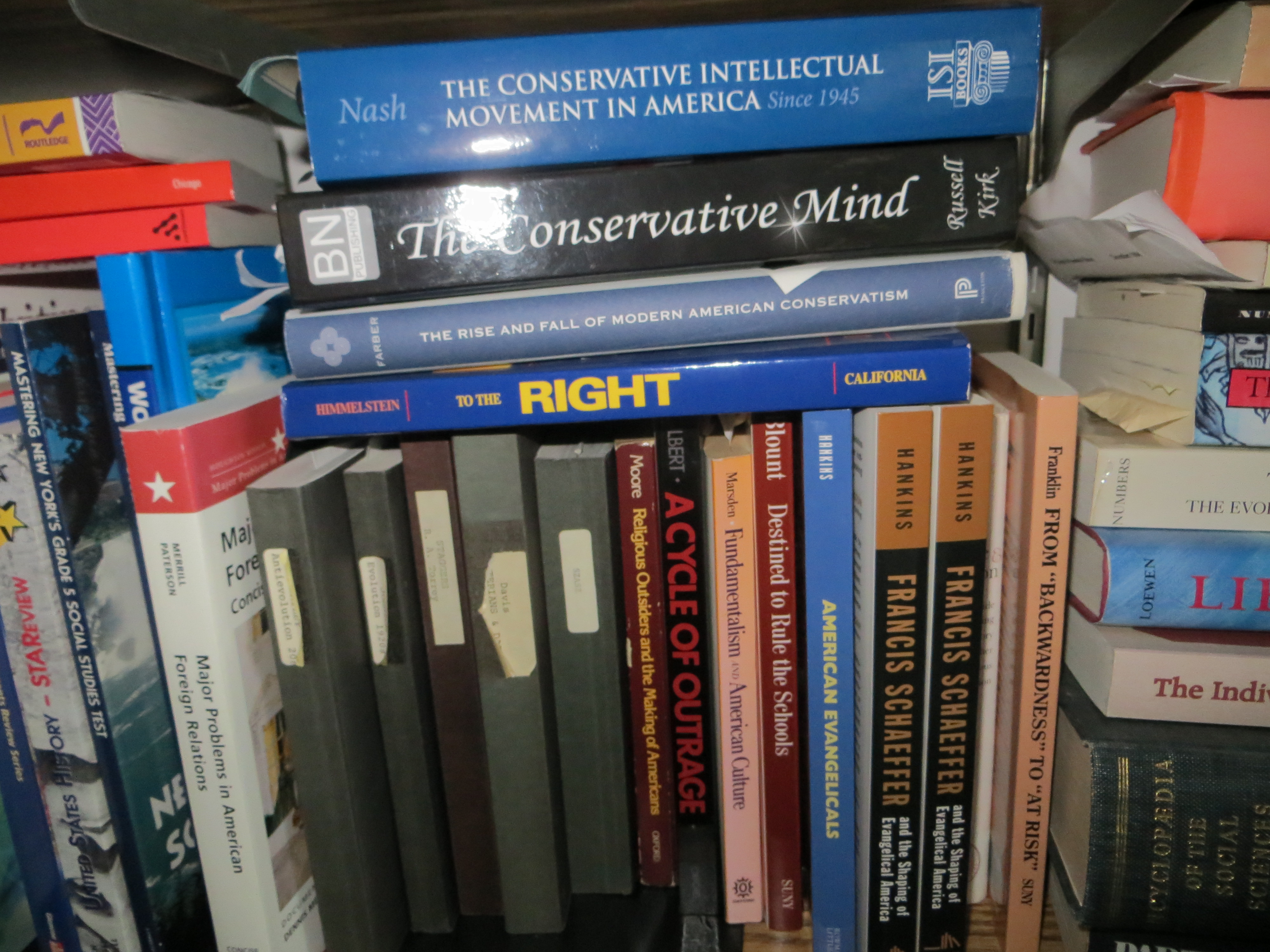
Shelfies II: Electric Boogaloo

Keep those shelfies pouring in!  Send ILYBYGTH a snapshot of your bookshelf.  What is on there?  Why?

Today we’re sharing our second shelfie.  Last time we posted our front-and-center pile of books.  This time, we’re going just to the left.

What's on YOUR shelf?

What’s on YOUR shelf?

Starting at the top, we have George Nash’s crucial 1976 Conservative Intellectual Movement in America.  Everyone who hopes to understand American conservatism should read this volume.  Nash famously argued that the postwar conservative intellectual movement brought together disparate strains of conservative thinking into a consciously fusionist effort.  Burkean traditionalists allied with libertarians and anti-communists to make a newly powerful movement.  The book itself is terrific, though some later readers have assumed that Nash was speaking more broadly than he was.  See below.

Russell Kirk’s The Conservative Mind has been just as potent a book as Nash’s among conservative nerds.  Writing in the 1950s, Kirk attempted to establish a long and unbroken chain of conservative intellectualism from Edmund Burke through the mid-twentieth century.  Along the way, Kirk emphasizes an idiosyncratic group of writers and politicians as leaders of conservatism, and repositions conservatism as a central tradition of American life and letters, rather than as a collection of fringe loudmouths.

I also like David Farber’s The Rise and Fall of American Conservatism.   Last spring, I taught a senior seminar for history majors in the history of American conservatism.  I waffled on whether to make Farber’s book the central narrative.  In the end, I chose to have students read Kirk instead.  Why?  Unlike Kirk, Farber writes from outside the movement.  He defines conservatism more narrowly, and in a way that would not challenge the thinking of the undergrads, I decided.  For Farber, conservatism consists mainly of a political fight against “liberalism.”  Conservatism got its start, Farber argued, with Robert Taft’s fight against the New Deal’s big-government approach to social welfare.  To many of the students I worked with, Reagan-esque anti-government conservatism is the only kind they know.  Farber’s book is a great history of that sort of conservatism.  But I wanted to get smart sophisticated students to make the definition of conservatism their central intellectual challenge.  Farber’s book made it too easy for students to think that Reagan’s style of conservatism was the ONLY definition of conservatism.

Jerome Himmelstein’s To the Right is a sociological look at the boundaries of American conservatism.  It is worth reading.  IMHO, though, it takes Nash’s definition too glibly as its starting point.  Himmelstein assumes too comfortably that “conservatism” is nothing more nor less than the definition William F. Buckley and his comrades gave it in the 1940s and 1950s.  Too simple.

Starting with the blue-bound dissertations on the left, I recommend two: Kenneth K. Bailey’s Anti-Evolution Crusade of the Nineteen-Twenties (PhD dissertation, Vanderbilt University, 1954); and Ferenc M. Szasz, “Three Fundamentalist Leaders: The Roles of William Bell Riley, John Roach Straton, and William Jennings Bryan in the Fundamentalist-Modernist Controversy ,” (PhD dissertation, University of Rochester, 1969).  Historians of religion will likely know Szasz’s name; he went on to a glorious academic career.  His dissertation study of these three leaders is still worth reading.  Bailey’s dissertation suffers from a simplistic understanding of the nature of fundamentalism, but his collection of newspaper accounts is still unbeaten.  I relied on both of these dissertation while writing my dissertation book.  For everyone interested in 1920s fundamentalism and anti-evolution, they are worth hunting down.

Laurence Moore’s Religious Outsiders is also required reading.  Though these days no historian of religion would say that Moore’s “outsiders” don’t get academic attention, at the time Moore’s book came out it pushed the field in healthy new directions.

I don’t know why James Gilbert’s A Cycle of Outrage doesn’t get more attention.  It is one of my favorite academic histories.  Gilbert takes a look in this book at a central question for all of us interested in education and culture.  Why was there such an explosion of anxiety in the mid-twentieth century about crime and criminality among young people?

Of course, I have the old dog-eared copy of Marsden’s Fundamentalism and American Culture relegated to a side position now that I’ve finally purchased the 2006 revised edition.

Educational historians out there will recognize Jackie Blount’s Destined to Rule the Schools.  Among educational historians, one of the most studied and fruitful lines of questioning has been the complicated relationship between femininity and schooling.  On the one hand, the systematization of public schooling often put men principals and superintendents in charge of female classroom teachers.  Women were seen as “naturally” more fit for caring for young people; men were seen as more fit for running the show.  But as Blount explores, many women were able to use stereotypes of femininity to build a professional network as school administrators as well.

Next up, two of Barry Hankins’ titles, American Evangelicals and Francis Schaeffer.  For people with an interest in the history of American evangelicalism, I can’t recommend the first title strongly enough.  Hankins is a terrific writer and a keen historian.  In this book he combines readability with academic thoroughness, which is hard to do.  And, as readers are aware, there are few intellectual figures as central as Schaeffer to the mind of evangelical America.  As you can see, I ended up with an extra copy somehow.  If anyone would like it, just let me know; I’ll be happy to put it in the mail for you if you send your land address.

It’s almost impossible to see hidden in there, but I also like Stephen Pyne’s Voice and Vision: A Guide to Writing History and Other Serious Nonfiction.  There are a lot of “so-you-want-to-write-a-dissertation” books out there, and I’m sure every nerd has his or her favorite.  I like Pyne’s book for its combination of nitty-gritty advice and head-in-the-clouds ambition.  It’s not easy to remember how difficult it can be for beginners to write academic history.  I always recommend Pyne’s book for graduate students with whom I work.  They never have any free time for extra reading, but I think Pyne’s guide is worth their time.

Last but not least, I’ve got Barry Franklin’s From ‘Backwardness’ to ‘At-Risk.’ I got this book to use with my doctoral history-of-ed class.  In the end, it got bumped from the syllabus.  But the book is still very much worth reading for those interested in educational history.  As the title suggests, it looks at the history of what we now call “special education.”  In addition to telling this story, though, Franklin offers insights into the way educational policy has been framed and the ways students have been defined.

OK, nuf sed!  Send in your shelfies so we can all get a sense of what you’ve got on your shelf and why.


Conservatives: Shut Up and Love the Common Core

What are conservatives to make of the Common Core State Standards?  As we’ve seen, some conservatives hate them.  Some don’t mind them.  Today we see a plea for conservatives to embrace the new standards as the best hope to fulfill long-held conservative school dreams.

In the Burkean pages of The Imaginative Conservative, Kevin T. Brady and Stephen M. Klugewicz argue that the new standards hold promise.   Forget threats that the new standards are a new federal power grab.  Forget worries that the new standards will water down our cultural heritage.  Forget predictions that school children will be forced to memorize Maoist proverbs.

Take a closer look, Brady and Klugewicz write, and conservatives will see plenty to like about the new standards.  The suggested readings include conservative favorites such as TS Eliot, Patrick Henry, GK Chesterton, and none other than Ronald Reagan.

Though some on the political Right have created a “straw man” out of the new standards, Brady and Klugewicz argue that the standards will actually serve to weaken the power of the political Left.  After all, the authors say, “teachers and educational bureaucracies already tend to lean Left.”  Too many teachers are woefully ignorant of true history and traditional literature.  The new standards will force such ideologically slanted teachers to explore the real cultural heritage of Euro-American civilization.

For instance, in order for a teacher to teach students Martin Luther King Jr.’s “Letter from Birmingham Jail,” teachers will need to connect with their heritage.  “In order for [teachers] to understand what King is writing about,” the authors contend,

teachers need to know who the 8thcentury B.C. Hebrew prophets were. They need to know a little about Paul of Tarsus, the Macedonian call, Socrates, Augustine, Thomas Aquinas, Shadrach, Meshach, Abednego, Roman persecutions, the Boston Tea Party, Hungarian freedom fighters, Jesus, Elijah Muhammad, Amos, Martin Luther, John Bunyan, Lincoln, Jefferson, and T.S. Eliot to understand King’s meaning. King spoke to an audience of clergymen and to many others who shared a common educated culture. If teachers do not know these references, they cannot teach this landmark document accurately. Moreover, teachers in Catholic schools are free to ignore the exemplars entirely and use Christian/Catholic texts: Thomas á Kempis, Thomas More, even papal encyclicals. Such a text-based approach ought to please conservatives, who have complained about the trend of “deconstructing” texts and promoting the idea that it is how the student “feels” about a text that is important, not what the text actually says.

We must note that one of the authors seems to have more than academic interest in the success of the new standards.  Kevin Brady owns a company that sells Common-Core aligned materials to schools.  The success of the Common Core will help his own wallet.  That said, the notion that all of America’s schoolchildren should learn a common core of knowledge does have long roots among American conservative educational thinkers.  Long before ED Hirsch, prominent conservative reformers such as Max Rafferty insisted that the way to fix American education is to give every student and every teacher a healthy dose of a common core of cultural knowledge.  And a generation before Rafferty’s leadership, curmudgeonly conservative Albert Jay Nock insisted that real learning should include the “Great Tradition” of learning first and foremost.

For almost a century, then, conservative thinkers and activists have yearned for a common core for America’s school children.  Is the Common Core the fulfillment of these conservative dreams?


The Most Important Thing Anyone’s Ever Said

What is the most important line in the history of American education?  Something from Ben Franklin?[1]  Frederick Douglass?[2]  Horace Mann?[3]  John Dewey?[4]

According to Bruce Frohnen in the recent pages of The Imaginative Conservative, that honor goes instead to Annette Kirk.  Her line from the 1980s, Frohnen argues, offers traditionalist conservatives and anyone who cares about real education the only thread of hope in the blasted and devastated landscape of American public education.

Conservative intellectuals have long taken a dim view of the state of American education.  Frohnen opens his recent jeremiad with a nod to the terrible state of today’s schools.  “Can public education in the United States be saved?” Frohnen asks.

Given the stranglehold of teachers’ unions over school districts and state legislatures, the constant meddling of an ideologically motivated federal Education Department, the sheer weight of bureaucracy, and the commitment to mediocrity? Perhaps not.

But traditionalists such as Frohnen are not the only ones who tend to throw the school baby out with the modern bathwater.  Leftist historian Michael Katz, for instance, opened a new era of revisionist educational historiography in 1968 with his assertion that schooling in the United States has always been “conservative, racist, and bureaucratic.”[5]  Also from the left, Marxist economists Samuel Bowles and Herbert Gintis denounced American public education in 1976 as a tool of the economic elite.   Libertarian historian Joel Spring famously denounced the cookie-cutter domineering of “The Sorting Machine.”

Frohnen agrees with these folks about the terrible state of public education in the USA.  But it’s hard to imagine Professors Katz, Spring, Bowles, or Gintis agreeing with Frohnen about school’s saving grace.  According to Frohnen, the only glimmer of hope in the last generation has been a line inserted by Annette Kirk into the 1983 blockbuster report A Nation at Risk.

You history nerds out there might think that Frohnen is referring to some of the most famous lines of that report.  Every survey of American educational history, for instance, talks about the reports catchy warning about a “rising tide of mediocrity.”  Most surveys, too, note the apocalyptic edge to the report’s conclusion.  “If an unfriendly foreign power,” the report noted, “had attempted to impose on America the mediocre educational performance that exists today, we might well have viewed it as an act of war.”  Ouch!  Take that, teachers’ unions!

But those memorable lines were not the ones to which Frohnen referred.  No, the most saving line of the report, Frohnen argues, was one inserted by the true conservative Annette Kirk.  In Frohnen’s words, Kirk made sure that the report included the principle that “parents are the first and primary educators of their children.”

Thanks to this perspicacious inclusion, American education has been saved from the worst strangleholds of state-dominated educracy.  Parents in the United States, Frohnen points out, still have the freedom to free their children from the school system entirely.  Homeschooling offers such parents their last best hope of seeing their children truly educated.


[1] “Genius without education is like silver in the mine.”

[5] Michael Katz, The Irony of Early School Reform: Educational Innovation in Mid-Nineteenth-Century Massachusetts (Cambridge, MA: Harvard University Press, 1968), 3.

Homeschool: Latest Frontier for the Fabulous

Why do parents homeschool?  At least one mother has told us recently that homeschooling has become yet another perk for the fabulously fabulous.

As anyone who follows historian Milton Gaither’s blog knows, the world of homeschooling in the United States is fabulously complex.  There is no simple answer to the question of why some parents choose to homeschool.

For some readers and contributors to this blog (see, for instance, the experiences of Anna), homeschooling has resembled nothing so much as a horrific theocratic prison, similar to the recent expose in the pages of American Prospect.  For these families, homeschooling has functioned as a way to bind up their children’s minds in the over-tight wrappings of fundamentalist theology.

Yet for many other conservative religious folks, homeschooling has included equal parts theology, culture, and pedagogy.  Some non-conservative readers out there might be as surprised as I was to discover the number of conservative evangelical Protestants who homeschool for very progressive-sounding reasons.  Or even the number of conservative creationist homeschoolers who want to teach their children about evolution responsibly and accurately.

But homeschooling is not only for conservative religious folks.  At least since the early 1970s, progressive educators and hippies have been attracted to the allure of “unschooling.”  And homeschooling has long been a traditional option for students who cannot attend school due to health problems or even due to pregnancy.

A recent piece in the New York Times offers another rationale for homeschooling: it’s the only lifestyle that can be fabulous enough for those who have already maxed out on their fabulous-ness.  Jennifer Kulynych’s self-outing as a fabulous homeschool mom took as a pretext her difficulty in admitting to her homeschool practice.  At work, Kulynych explains, she has trouble telling colleagues that she homeschools her daughter.  Too many people, she writes, make too many assumptions about homeschooling.

At its core, though, Kulynych’s self-outing seems like nothing so much as a brag about homeschooling as the last frontier for the fabulous.  Kulynych explains that she began homeschooling her daughter when their public school failed to challenge her daughter intellectually.  Since Kulynych’s daughter was too smart for school, and their family couldn’t afford ritzy private schools, Kulynych chose to homeschool.  Plus, Kulynych explains, she was not willing to see her daughter raised by nannies and tutors.  Instead, Kulynych chose to keep her job as a lawyer, while still arranging a perfect intellectual environment for her perfect intellectual offspring.  The fabulous experiment has not been without cost, Kulynych explains.  She goes without spare time in order to keep up the fabulous pace of her fabulous homeschooling lifestyle.  She enjoys spending time learning with her daughter, as she explains, as “co-conspirators in a counterculture adventure, eating our academic dessert first whenever we like.”

Don’t get me wrong: I’m not knocking Kulynych for homeschooling.  I’m all for parents who sacrifice for the good of their children.  But I do wonder if Kulynych’s self-aggrandizement will mark a new normal in the kaleidoscopic world of American homeschooling.  Homeschooling has always been counter-cultural.  The traditional countercultures, though, have been those of the left or right.  For Kulynych, at least, the “counter” in counterculture seems to rely mainly on being simply too cool for school.


Kopplin, Creationism, and Liberal Book Burnings

A network of charter schools in Texas uses religious textbooks.  Bad religious textbooks.

That’s the accusation leveled last week by anti-creationism activist Zack Kopplin in the pages of Slate.

For anyone who has looked at the textbooks cranked out by conservative religious presses, as I have, the charges sound true.  But does this sort of expose rely too heavily on shock value?  Does it really tell us anything about what goes on in those charter schools?  Or does it rely on the dangerous mentality of the book burner?

Kopplin’s investigation uncovered the dodgy content of books used by Responsive Education, a network of charter schools that claims 65 schools and a plan to open more in the coming year.  Kopplin, a young but seasoned activist, found textbooks rife with creationist-friendly ideas.  Moreover, the textbooks promote a religious vision of history and repeatedly promulgate half-truths and lies as historic fact.  The books take a questionable tone about homosexuality and seem to embrace a distressingly patriarchal vision of proper family life.  Worst of all, Kopplin argues, these textbooks are used in public schools, schools that ought to be open and welcoming to all students, not just religious conservatives.  These slanted textbooks are peddling fake science, bad history, and sectarian “values,” and they’re using tax money to do it.

Let me repeat: Kopplin’s charges ring true to me.  I agree that public schools must not push theology.  But as I finish up my current book manuscript about the history of conservative school activism in the twentieth century, I can’t help but notice the disturbing echoes of Kopplin’s crusade.  His anti-textbook campaign seems to revive the worst elements of wartime book burning.

Sound outlandish?  Let me offer some specific examples.

First and most worrisome, Kopplin relies on the tried-but-false McCarthyite tactic of guilt by association.  In his article, Kopplin points out that some ResponsiveEd schools might assign readings from the Patriots’ History of the United States, a skewed and partisan book.  To discredit the book, Kopplin notes that the book is beloved by conservative blabbermouth Glenn Beck.

More troubling, Kopplin tars ResponsiveEd schools with all the sins of every right-wing theocrat with whom they can be associated.  Consider, for example, Kopplin’s takedown of Oklahoma businessman and curricular contributor Tom Hill.  Hill, Kopplin charges,

is a follower of Bill Gothard, a minister who runs the Institute in Basic Life Principles, a Christian organization that teaches its members to incorporate biblical principles into daily life. IBLP is considered a cult by some of its former followers. Gothard developed character qualities associated with a list of “49 General Commands of Christ” that Hill adopted for his character curriculum. Hill then removed Gothard’s references to God and Bible verses and started marketing the curriculum to public schools and other public institutions.

The values taught by Responsive Ed can often be found word for word on Gothard’s website. The Responsive Ed unit on genetics includes “Thoroughness: Knowing what factors will diminish the effectiveness of my work or words if neglected.” The only difference is that Gothard’s website also adds “Proverbs 18:15” after the quote.

What does this really prove?  That some of the origins of ResponsiveEd’s curriculum can be tied to conservative evangelical Protestants?  Is that illegal?  Is that even worrisome?  After all, taken another way, Kopplin’s accusation can be taken as proof that ResponsiveEd’s curriculum has been DE-Biblicized.

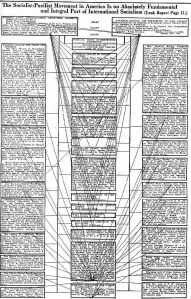
This sort of guilt-by-association has a terrifying history in American educational and political history.  Too often, left-leaning or liberal groups earned labels of “subversion” by association with communist thinkers or organizations.  Consider, for instance, the widely circulated “spider-web chart” used by patriotic activists in the 1920s, 1930s, and 1940s.  Any alleged association with leftist organizations, the chart accused, meant that organizations must not be trusted.

Image Source: Women's and Social Movements in the U.S.

Image Source: Women’s and Social Movements in the U.S.

In the late 1930s, a conservative campaign took off against a set of social-studies textbooks by left-leaning author Harold Rugg.  Time and again, those accusations were based on these guilt-by-association tactics.  Since Rugg taught at Teachers College Columbia, it was alleged, since he was a member of the Frontier Thinkers intellectual group, and since some members of that group had made statements or editorial decisions friendly to communism or Soviet Russia, Rugg was charged with treasonous intent.  His books were charged with all manner of subversive crime.  Just as anti-Rugg activists swung too wildly against Rugg’s books, so Kopplin seems over-ready to ban ResponsiveEd books based on questionable associations.

Another parallel between Kopplin’s article and earlier book-burning crusades is that Kopplin’s charges do not have much to do with actual classroom practice.  As Kopplin admits, he never actually witnessed the teaching in ResponsiveEd schools.  Rather, he relates that one classroom he looked at had the distinctive set up of an Accelerated Christian Education classroom.  Kopplin cites ILYBYGTH friend and guest writer Jonny Scaramanga as evidence that such classrooms teach terrible Bible-based schlock.

But here’s the problem: just as conservative book-burners in the 1940s gave too little thought to the ways Rugg’s textbooks might actually be used, so Kopplin does not offer any evidence about the actual goings-on in ResponsiveEd classrooms.  Anyone who has spent any time teaching knows that textbooks do not dictate classroom practice.  Take the most obvious example: What should we make of public-school classrooms that use the Bible as curriculum?  As religion scholar Mark Chancey has argued recently, the Bible can and should be taught.  But HOW it is taught makes all the difference.

I’m not saying that the ResponsiveEd curricular materials are wonderful.  But I am saying that jumping to conclusions about the practices at any school based mainly on textbooks is a fundamental mistake.

This is getting long, but here is one other creepy similarity between Kopplin’s article and earlier book-burning campaigns.  Like earlier campaigns, Kopplin’s charges have been passed along uncritically by allies seeking to discredit ResponsiveEd.  Intelligent, well-meaning critics such as Diane Ravitch, the Texas Freedom Network, and Americans United for Separation of Church and State have trumpeted the conclusions of Kopplin’s expose.

None of these liberal organizations seems troubled by Kopplin’s sketchy evidence or guilt-by-association tactics.  As an historian who has spent the better part of the last few years stuck in the anti-communist hysteria of the 1930s and 1940s, this knee-jerk boosterism alarms me.  For many patriotic book-burners in the 1940s, Elizabeth Dilling’s The Red Network served as a similar sort of convenient sourcebook for denunciation.  Too many conservative activists—even intelligent, well-meaning ones—repeated outlandish charges and baseless accusations from Dilling’s book.  The fact that a textbook author such as Harold Rugg showed up in Dilling’s pages served as proof positive for many school activists that his books must not be allowed in America’s public schools.

Creepiest of all, Kopplin’s language often echoes almost verbatim the language of 1940s book-burners.  For example, Kopplin engages in a sinister sort of hermeneutic when he says the following: “Some of Responsive Ed’s lessons appear harmless at first, but their origin is troubling.”

In other words, Kopplin admits that the books themselves might not be so bad, but since they came from conservative religious sources, we must automatically attack them.  This smacks too much of what political scientist Michael Rogin has described as “political demonology.”[1]

Consider some of the similar language from the 1930s/1940s anti-Rugg textbook fight.  One of the leaders of that anti-book battle, R. Worth Shumaker of the American Legion, told a correspondent that the dangers of the Rugg books only became clear if one went “back of the scenes.”  Reading the books themselves, Shumaker admitted, made them seem bland and harmless.  But once an earnest researcher discovered Rugg’s leftist connections, the slant of the textbooks became obvious.

Another American Legion activist agreed.  Hamilton Hicks admitted in a 1941 article that “intelligent people” could read Rugg’s book and find nothing wrong with them.  “Dr. Rugg,” Hicks accused, “is far too adept a propagandist to disclose his real purpose in any one textbook.”[2]  Just as Zack Kopplin warns that the ResponsiveEd textbooks might seem harmless until we understand their origins, so anti-Rugg activists admitted that Rugg textbooks might seem fine until their sinister backstory was uncovered.

We verge from activism to hysteria when we denounce textbooks for reasons other than the textbooks themselves.  If textbooks seem harmless, the first appropriate conclusion is that the textbooks are likely harmless.

So what is a liberal to do?  Kopplin makes an important point: public schools ought not cram dead science and bad history down students’ throats.  As organizations such as Texas Freedom Network have done, this situation calls for more rigorous examination.  What really goes on in ResponsiveEd schools?  They should not be allowed to use tax dollars to teach sectarian religion and false facts.  It is important for all of us to remember, however, the profound costs of over-hasty accusations.  Calling for book burnings is never an appropriate tactic.

Kopplin has made some serious charges.  So far, however, those charges have not been backed up by adequate proof.  More is at stake here than just one charter-school network.  If we veer into hysteria rather than activism, we repeat the worst mistakes of our history.


[1] Michael Paul Rogin, “Ronald Reagan,” The Movie and Other Episodes in Political Demonology (Berkeley: University of California Press, 1987), xiii.

[2] Hamilton Hicks, “Ours to Reason Why,” American Legion Magazine (May, 1941): 6, 51.

How to Save the GOP

What can conservatives do to shed their image as “a party of plutocrats who get a kick out of kicking the poor when they’re down”[?]

Writing in the pages of libertarian flagship Reason Magazine, A. Barton Hinkle pleads with conservatives to get on the charter-school bus.

Liberal politicians such as President Obama and New York City Mayor Bill De Blasio have handed conservatives a golden opportunity, Hinkle argues.  When liberals close down charter schools and limit vouchers, they doom low-income children to “reactionary” public schools.  By promoting market reforms, allowing parents to choose among a variety of schools, conservatives can kill two birds with one stone.

First, conservatives will be able to introduce a significant measure of market discipline into a social institution firmly dominated by entrenched and bloated unions.  Second, conservatives will be able to claim without flinching that they represent society’s least powerful.  Charter schools and voucher opportunities can benefit low-income parents the most.

Can this strategy work?  Can conservatives take the wind from liberals’ sails by promoting school privatization?

We’ve seen recently how it can fail.  Mayor De Blasio’s recent challenger Joe Lhota went all-in for charter schools.  Didn’t help.

Perhaps other conservative politicians will manage to do better.


Conservatives: Keep Religion Out of Public Schools

Do American religious conservatives want more Jesus in public schools?  That’s usually the assumption, from Kountze, Texas to San Diego, California.

Recently in the pages of The American Conservative, Leah Libresco argued the conservative case against more religion in public schools.  When religion is used by the state, she points out, it puts religion in the service of the state, not vice versa.

One commenter pointed out the paucity of this sort of sentiment among religious conservatives in the past thirty years.  Fair enough.  But let’s not forget how common such notions were among religious conservatives, especially for those from the Baptist tradition, throughout American history.

For example, as historian Jon Zimmerman argued in his 2002 book Whose America, the battle over weekday religious education in public schools pitted conservative Christians against liberal Christians.  Both sides wanted more good religion in public schools, but they disagreed bitterly over the content of that religious education.  Conservatives and self-identified “fundamentalists” often made the case that no religion was better than false religion for public school students.

Similarly, we need to remember the response among conservative evangelicals to the Supreme Court’s anti-prayer ruling in Engel v. Vitale.  In that important 1962 decision, SCOTUS ruled that public schools could not lead students in even the blandest, most ecumenical prayer.  As I argued in a recent article in the Journal of Religious History, many conservative evangelical intellectuals were well pleased.

The National Association of Evangelicals approved of Engel.  So did Presbyterian fundamentalist Carl McIntire.  As William Culbertson of the Moody Bible Institute put it, “The public as a whole and Christians who sense the necessity for safeguarding freedom of worship in the future are always indebted to the Court for protection in this important area.”

For Culbertson as for the other conservative Protestants who agreed with him, it would be better for public-school students not to pray at all in school rather than for them to chant the pablum imposed by the New York Regents.  That Regents prayer, after all, offered only the thinnest gruel of religion; it crushed any orthodoxy in its well-meaning goal of ecumenicalism.  “Almighty God,” students prayed, “we acknowledge our dependence upon Thee, and beg Thy blessings upon us, our teachers, and our country.”

As Leah Libresco argues in her recent conservative indictment of public-school prayer, that sort of religiosity does not teach young people the religion of their families.  It only teaches them a confusing lesson about the vague existence of a higher power.  For religious conservatives, the words of a prayer matter.  Better by far to ban meaningless prayers from public schools than to embrace a state-directed vision of the Almighty.


Common Core Poisons the Well

What’s wrong with the Common Core?  According to one conservative scholar, it threatens to take away the very glue that holds our culture together.

As we’ve seen, no one is quite sure what to make of the new Common Core State Standards.  In addition to debates over the efficacy of these new curriculum and assessment tools, progressives and conservatives all argue about whether or not these standards are ideologically dangerous.  Some conservatives say the standards are anti-Catholic.  Others blast them as a “progressive beer bong.”  Still other conservatives defend the Common Core standards as the least bad approach to public schooling.

In a recent speech, historian Terrence O. Moore of Hillsdale College revived another accusation: The Common Core is taking away our great stories.  According to the Christian Post, Moore blamed the new standards for culture-cide.  The standards, Moore insisted, “attempt to take away the great stories of the American people and replace them with the stories that fit the progressive, liberal narrative of the world.”

Too often, Moore concluded, the new standards encourage teachers and students to read about our culture’s great narratives, rather than spending time with the narratives themselves.  As a result, Moore said, the real aim of education is thwarted.  Instead of pushing the Common Core’s goal of “college and career readiness,” real education should push young people to become more human.

In his new book on the subject, Moore spells out his argument in fuller depth.  I admit, I haven’t read the book.  But I wonder if Moore is aware of his ideological genealogy.  In his book, Moore blames “The Story-Killers” of the Common Core standards for turning students away from their rich intellectual heritage.  He offers a “common-sense” solution to the problem.  With the general argument and even the offer of a new common-sense conservative approach to schooling, Moore is reviving the 1960s-era talk of Max Rafferty.

Max Rafferty isn’t a name we hear much in conservative talk about schooling and education, but it should be.  As California’s State Superintendent of Education in the 1960s and as a popular syndicated columnist, Rafferty spelled out many of the ideas that Moore seems to revive.

For example, in a 1963 collection of his newspaper columns, Rafferty complained of the mindless watering down of curriculum.  Students used to read our culture’s great stories, but since the 1930s more and more of them had been brutalized with intellectual pablum.  If you doubted it, Rafferty wrote, just try this experiment: Take any class of students.

suddenly, as though opening an enchanted window upon a radiant pageant, give them the story of the wrath of Achilles. . . .

Watch their faces. . . .

This is teaching.  This is what you trained to do. . . .

Let us say to these diluters of curricula, these emasculators of texts, these mutilators of our past, ‘We have had enough of you.  The world is weary of you. . . . With your jargon of behaviorism and Gestalt and topological vectors and maturation levels, you have muddied the clear waters of childhood long enough.  You have told us to teach the whole child, but you have made it impossible to teach him anything worth learning.  Little by little you have picked the meat from the bones of Education and replaced it with Pablum.  You have done your best to produce a race of barely literate savages.

Just as Moore apparently does in his recent book, Rafferty insisted that the solution for this “utilitarian” nonsense was simple “common sense.”  In a 1964 book, Rafferty laid out his vision of the power of common sense.  “Common sense,” Rafferty insisted,

                told us that the schools are built and equipped and staffed largely to pass on from generation to generation the cultural heritage of the race.

Common  sense took for granted that children could memorize certain meaningful and important things in early life and remember them better in later years than they could things that they had not memorized.

Common sense in recent years believed that putting children of like abilities together for at least a part of their school experience would help them to find their own rate of achievement and advance accordingly.

Common sense, since anyone could remember, had always held that children who did their homework covered more ground in school and learned more than children who didn’t.

Common sense told us that discipline, like good manners, had to be taught to a child over a period of years.

Does Professor Moore know about Rafferty’s arguments?  Or do these ideas just cycle back around for conservative intellectuals?

Max Rafferty’s books used to be widely read.  Not so much anymore.  I wonder if more conservatives would be interested in digging into their own intellectual heritage.

Learning by Discipline

What should schools do with students who behave badly?  Who assault other students?  Who treat teachers disrespectfully?

A new announcement about school discipline from Education Secretary Arne Duncan and Attorney General Eric Holder might drive some conservative pundits to distraction.  Discipline, the two leading officials of the Obama Administration announced yesterday, must be more sensitive to student background and more responsive to individual situations.  Blanket zero-tolerance policies, they proclaimed, lead to worse school discipline, not better.

Those zero-tolerance policies, however, grew out of a groundswell of popular conservative opinion throughout the 1980s and 1990s.  Conservative commentators and activists long complained that schools treated students too gingerly.  Good old-fashioned discipline, some conservative writers insisted, would help return schools to their proper role.  Instead of being places where polite students and teachers cower and wince at the domineering swagger of loud-mouthed punks, schools should be calm and orderly places where infractions of the rules are not tolerated.

Some studies have demonstrated the central importance of a reinvigorated school discipline to many conservative parents in the 1980s.  One Stanford study[1] of two new fundamentalist schools in the 1970s and 1980s found that leaders put bad discipline in public schools as one of their top reasons for opening their own school, right up there with “secular humanism,” “evolution teaching,” and the fact that “kids weren’t learning.”  In a fundamentalist school that opened in September 1974 with a grand total of eleven students, one teacher informed the Stanford researcher that most parents assumed that the fundamentalist school was “solving discipline problems the public schools could not.”

Another study, this one from Temple University in Philadelphia,[2] found that parents listed poor discipline as one of their top reasons for abandoning public schools in favor of private Christian ones.  Nearly 65% of switching parents listed “discipline” as a leading reason for changing schools.  By way of comparison, just over 68% of parents listed “secular humanism” as a primary reason for their switch.

It may come as no surprise that some conservative parents choose Christian schools out of fear of disorderly public schools.  Leading conservative religious writers throughout the 1980s insisted that public schools had utterly abandoned all attempt at imposing discipline.  Jerry Combee, for example, warned readers in a 1979 book,

Without Biblical discipline the public schools have grown into jungles where, of no surprise to Christian educators, the old Satanic nature ‘as a roaring lion, walketh about, seeking whom he may devour’ (I Peter 5:8).  Students do well to stay alive, much less learn.

Similarly, in his 1983 book The Battle for The Public Schools, blockbuster fundamentalist author Tim LaHaye insisted that one of the vital reforms that could save education was a return of traditional discipline.  As LaHaye put it, “We must return discipline, authority, and respect to public schools”

In 1986, conservative Texas school watchdogs Mel and Norma Gabler asked readers, “Why has discipline become so bad that policemen must patrol the halls of many schools?”  The Gablers’ answer was simple:

We were taught that if you plant potatoes, you get potatoes.  If you plant rebellion and immorality in children’s minds by teaching them that only they can decide what is right and wrong, that parents are old-fashioned, and that the Judeo-Christian Bible is a book of fairy tales, then what can you expect?  Garbage in—garbage out!

These conservative critiques of the sorry nature of school discipline were not limited to conservatives of a primarily religious background.  After his turn as Education Secretary under Ronald Reagan, William J. Bennett lamented the sorry state of school discipline.  In his 1994 book Index of Leading Cultural Indicators, Bennett cited a fraudulent but evocative historical comparison:

In 1940, teachers identified talking out of turn; chewing gum; making noise; running in the halls; cutting in line; dress code infractions; and littering [as “top problems”].  When asked the same question in 1990, teachers identified drug abuse; alcohol abuse; pregnancy; suicide; rape; robbery; and assault.

Due at least in part to this widespread sense that American public schools had reached a nadir of weak discipline, many states and school districts imposed variants of “zero-tolerance” policies.  According to these policies, student infractions would be met with an escalating series of ever-harsher punishments, including out-of-school suspensions and reports to police.  Politicians could claim that they were taking action to ensure a no-nonsense disciplinary attitude in America’s schools.

Yesterday’s announcement by Arne Duncan and Eric Holder represents the Obama administration’s repudiation of that zero-tolerance approach.  Though “zero-tolerance” may sound good, Duncan told an assembled crowd at Frederick Douglass High School in Baltimore, “Too many schools resort too quickly to exclusionary discipline, even for minor misbehavior.”  According to the Baltimore Sun, Duncan described a new federal approach that would de-emphasize suspensions and put more emphasis on creating nurturing in-school environments.  Attorney General Holder agreed.  Principals, not police, should be responsible for school discipline, Holder insisted.

Will conservatives care about this shift in school disciplinary policies?  If history is any guide, I’m guessing that conservatives will paint this new policy as yet another soft-headed, over-complicated liberal approach to a simple problem.  Folks such as Eric Holder and Arne Duncan may worry that zero-tolerance policies unfairly target racial minorities, but I’ll be surprised if conservative educational activists don’t complain that such social-science talk only obscures a far more obvious point.

If students misbehave in school, conservatives will likely insist, they should not be allowed to be in school.


[1] Peter Stephen Lewis, “Private Education and the Subcultures of Dissent: Alternative/Free Schools (1965-1975) and ChristianFundamentalistSchools (1965-1990),” PhD dissertation, StanfordUniversity, 1991.

[2] Martha E. MacCullough, “Factors Which Led Christian School Parents to LeavePublic   School,” Ed.D. dissertation, TempleUniversity, 1984.