When Is a Conservative Not a Conservative?

Some of the most intriguing personal stories of American conservatism tell of standout leaders who have switched from left to right over the years.  Of liberals, leftists, and radicals who had been “mugged by reality.”  It has been all too easy to make jokes about this tradition.

Q: What do you call a liberal with a daughter?  A: A Social Conservative.

Or, Q: What do you call a liberal with a mortgage? A: A Financial Conservative.

As Winston Churchill supposedly put it, “Show me a young Conservative and I’ll show you someone with no heart.  Show me an old Liberal and I’ll show you someone with no brains.”

In the pages of National Affairs historian Jonathan Bronitsky has offered a new vision of the long process of ideological conversion among some of the twentieth century’s most prominent side-switchers.

Of course, America has a long history of leaders changing from youthful leftism to mature conservatism.  Back in the nineteenth century, for instance, Tom Watson of Georgia started his career as an advocate of bi-racial populism and ended it as a bitter rabble-rousing racist.  William Jennings Bryan got famous as the voice of the little man and ended his career as the voice of the Bible.

In the twentieth century, too, casual students of conservatism have grown accustomed to the story that a group of New York Lefties switched over to conservatism due to the excesses of “The Sixties.”  Intellectual leaders such as Irving Kristol and Norman Podhoretz, the story goes, emerged from the intellectual contradictions of Trotskyism to create and embrace an energetic and engaging “neo-conservatism.”

In the cases of Irving Kristol and his historian spouse Gertrude Himmelfarb, Bronitsky argues that the love affair with Edmund Burke’s thoughtful conservatism went back much further.  As Bronitsky puts it,

Scholars routinely break down the intellectual conservatism that emerged in post-war America into three groups. First, there were “traditional” conservatives like Russell Kirk, John Crowe Ransom, and T. S. Eliot. They invoked Edmund Burke and his anti-radical appeal to tradition. Second, there were “New Conservatives” — as they were called in the post-war years — like William F. Buckley, Jr., Richard Weaver, and Peter Viereck. They looked to Burke as well as to Adam Smith with his moral justification for market economics. And third, there were libertarians like Robert Nozick, Albert Jay Nock, and Murray Rothbard. They admired Smith in addition to Friedrich Hayek with his contention that communism and fascism were merely opposite sides of the same totalitarian coin. Though the first generation of neoconservatives interacted with these three groups, they operated at a distance — or at least most intellectual historians have repeatedly insisted they did — preferring change over custom, reason over revelation, dogma over philosophy, and, thus, celebrating thinkers far removed from classical liberals like Smith, Hayek, and, particularly, Burke.

Bronitsky argues that this standard story does not work for Himmelfarb and Kristol the elder.  In their cases, the love affair with Burke and the tenets of conservatism went back decades, to the 1940s.

For those of us who struggle to make sense of the complicated kaleidoscope of American conservatism, this intellectual creation story matters.  What did it mean for Kristol and Himmelfarb to dance with the conservative devil as far back as the 1940s?  More intriguing, what did “conservatism” promise intellectually that “liberalism” had failed to produce?  How did “conservatism” solve the intellectual problems that Trotskyism could not?


Year-End Quiz: Do You Speak Conservative?

It’s the end-of-the-year rush for every sort of retrospective.  Can you take the ILYBYGTH challenge?

Thanks to the folks at the Texas Freedom Network Insider, we have several lists of the most contumacious quotes from America’s conservative punditry.  One list describes the year in creationist/no-climate-change quotations, one from the anti-Islam contingent, and one from the continuing “War on Christmas” campaign.

Here’s the idea: The Insider compiled these quotes as a demonstration of the intellectual outrageousness of contemporary conservatism.  Here at ILYBYGTH, we have a different goal: Can we understand what these conservatives meant?  Can we see the point each speaker hoped to make?  Of course, we know that some quotations are just plain dumb.  This is not only true for conservatives, of course.  Every sort of political blabbermouth can say stupid stuff.  But in some cases, it seems that the quips that seem the most outrageous to liberal secular folks like me actually represent a coherent, compelling conservative worldview.

If you call yourself a conservative, can you explain these quotations in terms that might seem less outrageous to non-conservatives?

Or, if you think of yourself as non-conservative, can you try to put yourself deep enough into the conservative mindset to understand what each speaker was getting at?

So put down the pumpkin pie, stop donning your gay apparel, and try the quiz!

Quote #1: Pat Robertson on the definition of Islam:

I hardly think to call it a religion, it’s more of — well, it’s an economic and political system with a religious veneer.

Quote #2: Rafael Cruz, father of obstreperous Tea-Party favorite Ted Cruz, on the connection between evolution and communism:

You know most Americans have their head in the sand about evolution. I’ve met so many Christians that tell me ‘well, evolution is a scientific fact.’ Baloney! I am a scientist, there is nothing scientific about evolution. But you know something, Karl Marx said it, ‘I can use the teachings of Darwin to promote communism.’ Why? Because communism, or call it socialism if you think communism is too hard a word, necessitates for government to be your god and for government to be your god they need to destroy the concept of God. That’s why communism and evolution go hand in hand. Evolution is one of the strongest tools of Marxism because if they can convince you that you came from a monkey, it’s much easier to convince you that God does not exist.

Quote #3: Fox News’ Megyn Kelly, complaining about efforts to imply that Santa was not white:

Just because it makes you feel uncomfortable doesn’t mean it has to change. Jesus was a white man, too. It’s like we have, he’s a historical figure that’s a verifiable fact, as is Santa, I just want kids to know that. How do you revise it in the middle of the legacy in the story and change Santa from white to black?

How bout it?  Can you beat this year-end quiz?  What did these conservatives mean?  For folks like me, can you do the mental gymnastics to put yourself into a world in which these statements make sense?  Be sure to check out the fuller lists at the Texas Freedom Network Insider.

Happy 2013 and best wishes as we slide into 2014!


Pre-K? No Way

Among some conservative intellectuals and pundits, nothing says “government overreach” like public education spending.

This morning in the pages of National Review Online, Michelle Malkin spits some bile at President Obama’s plans to invest in universal early-childhood education.

As have other conservatives such as Lindsey Burke and Rachel Sheffield of the Heritage Foundation, Malkin denounces federally sponsored pre-kindergarten schooling in the harshest terms.

Malkin argues that the vaunted promises of universal pre-k don’t stand up to intelligent scrutiny.  As have other fed-skeptics, Malkin seems to mix up a few federal reports.  She refers second-hand to a journalist’s citation of a 2010 study of pre-k’s long-term effectiveness.  If she really wanted to bash federally sponsored universal pre-k, though, she would have been wiser to cite the Department of Health and Human Services 2012 follow-up to that study.  The 2010 study suggested that Head Start programs had a significant positive impact on children.  The 2012 follow-up, in contrast, implied that those positive effects dissipated by third grade (roughly age 7/8).  The numbers seem pretty clear: universal pre-k is not the simple social and educational panacea that some progressives had hoped for.

But more than just these policy arguments, Malkin thinks federally sponsored universal pre-k has a bigger moral problem.  As she puts it,

Let’s set all of this science aside for the moment. There’s a bigger elephant in the room. As I’ve pointed out for years, these cradle-to-grave government-education/day-care services encourage drive-through, drop-off parenting. Subsidizing this phenomenon cheats children, undermines family responsibilities, and breeds resentment among childless workers who are forced to pay for costly social services.

Perhaps this moral dilemma is the reason why Malkin is not overly concerned with the social-science exactitude of her sources.  Her argument goes like this: federally sponsored pre-k doesn’t work.  And even if it did, it would still lead our society in morally monstrous directions.


School Is Life

For one homeless girl in New York City, school is life.  In any case, that’s the story told recently in a New York Times feature article.  “For Dasani,” the story opens,

School is everything—the provider of meals, on-the-spot nursing care, security and substitute parenting.

In the progressive tradition, as Bill Reese demonstrated so powerfully almost thirty years ago in Power and the Promise of School Reform, this vision of school as social-redistribution center fulfills a long-held and deeply cherished ideal.

But how do conservatives view this use of public schools?

To be sure, in various instances, as I noted in an article several years ago in Church History, conservatives have also taken advantage of the wide reach of public schools.  Conservative evangelicals, for example, have used schools as a convenient distribution network for Bibles and religious tracts.  But in general, conservatives in America have not yearned for redistribution the same ways progressives have.  Schools, many conservatives might agree, must be understood as educational institutions, not welfare agencies.  When public schools try to do too much, some conservatives might argue, they end up doing nothing at all.

When school reform has worked for conservatives, Ross Douthat argued recently, it has been when market-based reforms have made schooling more equitable for low-income and minority students as well as affluent whites.  That sort of concrete reform, Douthat wrote, has been the primary success conservatives have scored in overcoming their legacy as the party of white racism.

But that is not the sort of success trumpeted in the NYT feature.  Those market reforms, the article argues, merely move schooling and public services farther out of the reach of girls like Dasani.

No, the article concludes, for homeless youth like Dasani,

school and life are indistinguishable.  When school goes well, she is whole.  When it goes poorly, she can’t compartmentalize like some students, who simply ‘focus’ on their studies.

According to the New York Times feature, Dasani’s life as a homeless eleven-year-old in glitzy New York City is rough.  She shares a room in a shelter with her entire large family.  They endure infestations of mice, roaches, and sexual predators.  In contrast, Dasani’s classroom is a “cozy haven of book-lined shelves and inspirational words scrawled in chalk.”  At school, Dasani gets attention from a brilliant and caring classroom teacher, as well as a social worker and medical professionals.

For us at ILYBYGTH, this seems like a perfect example of a perennial question at the heart of educational culture wars.  What are schools for?  Ought they provide all the services needed by every child, no matter how extensive those needs might be?  Or should schools limit themselves to a narrower definition of “education,” focusing on academic work and leaving families to provide the rest?

In America’s twentieth century, one’s position on this question often served as a quick-and-easy definition of “progressives” vs. “conservatives.”  Progressives wanted schools to think of education as a whole-life question, meeting children where they were and providing every social service possible to ensure a high-quality education for everyone.  Conservatives, in contrast, have pushed for the elimination of “fads and frills” from public schools.  The government—in school or anywhere else—ought not take primary responsibility for children or anyone else.

In this story, we see one example of the way this long-running disagreement has been won, largely, by the progressive vision.  Dasani’s life is far from easy.  But her ability to secure a range of services through her public school demonstrates the long-run triumph of one central progressive idea.

The Ink Is Dry!

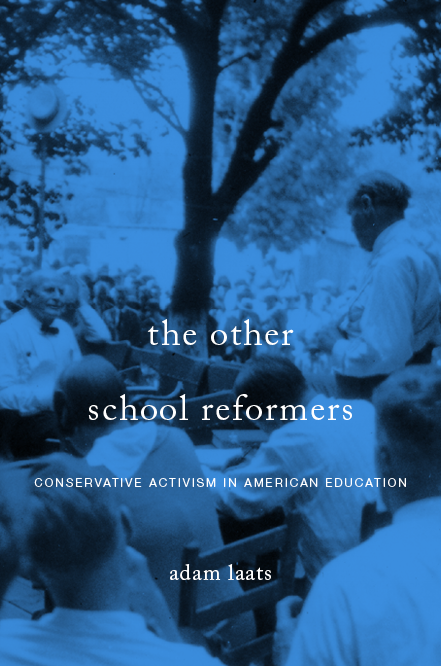
I’m tickled pink to announce I’ve signed a deal with Harvard University Press to publish my next book.  The subject?  No surprise to ILYBYGTH readers: the book takes a historical look at educational conservatism in America’s twentieth century.  What did conservatives want out of schools?  How did they work to make that happen?

I’m extremely pleased to have the book join HUP’s top roster of educational histories.  All my favorite books are on that list: David Tyack & Larry Cuban’s Tinkering Toward Utopia, Jon Zimmerman’s Whose America?, Jeffrey Moran’s Teaching Sex, and now Bill Reese’s Testing Wars.

I’m honored to join this all-star lineup.  My book—which at this point I’m calling The Other School Reformers: The Conservative Tradition in American Education—takes a look at the four most explosive school controversies of the twentieth century.  My approach has been to examine these four culture-war fights to see what sorts of educational reform conservatives wanted in each case.  At first, I thought I’d pile up histories of leading conservative organizations and individuals: the American Legion, Max Rafferty, the Gablers, etc.  But I couldn’t find a way to decide whom to include and whom to leave out.  Did the White Citizens’ Councils count as educational conservatives?  Did the Institute for Creation Research?  Did Arthur Bestor?

Instead of imposing my own definitions on the outlines of educational conservatism, I took more of a naturalist’s approach.  I set up my blind, so to speak, at the four most tumultuous fights over the content of American schools and watched to see what kinds of conservative activists showed up.

The school controversies were all very different.  First I examine the Scopes Trial of 1925.  Then the Rugg textbook controversy of 1939-1940.  After that, the firing of Pasadena’s progressive superintendent in 1950.  Finally, the literally explosive fight over schools and textbooks in Kanawha County, West Virginia, in 1974 and 1975.

What did I dig up?  In short, I argue that there is a coherent tradition linking conservative school reform across the twentieth century.  Not that these different activists had any sort of conscious organization or program.  Conservatives differed—often differed widely—about key issues such as public religion, race, and the role of government and experts.  More than that, the consensus among conservatives changed over time, as American culture and society changed.  For example, racial attitudes among white conservatives changed enormously between 1925 and 1975.  But in spite of all this change and difference, a recognizable tradition of educational conservatism linked these disparate school reformers.  Conservatives usually agreed with progressive school reformers that good schools were the key to a good society.  But unlike progressives, conservatives wanted schools to emphasize traditional knowledge and beliefs: patriotism, religion, and the benefits of capitalism, for example.

In addition, my book makes the case for the importance of understanding these conservative activists as school reformers in their own right.  Too often, the history of American education is told as the heroic tale of progressive activists fighting bravely against a powerful but vague traditionalism.  My book argues instead that educational conservatism is more than just a vague cultural impulse; conservatism has always been a raft of specific policy ideas for specific historical contexts, fought for by specific individuals and organizations.

So be sure to save some space in your holiday gift list for next year.  The book is slated to appear just in time for Christmas/Hannukah/Kwanzaa/Festivus 2014.


Cheap Art for Cheap Conservatives

What do American conservatives hang on their walls?  Fr. Dwight Longenecker argues that too many of them fall for the sentimental hypocrisy of Thomas Kinkade.  Instead, they ought to recognize the sincerity of painters such as Andrew Wyeth.

Speaking in broad brush strokes, the American art scene seems a dangerous place for conservative intellectuals.  Take your pick: urinals on walls, celebrity soup cans masquerading as cutting-edge, a urine-soaked Jesus…what passes for “art” these days often drives conservatives bonkers.

But that is not the grim totality of today’s art scene.  Beyond the Tea-Party politicism of painters such as Jon McNaughton, conservatives can look to a broad array of recognizably conservative themes and artists in recent memory.

Jon McNaughton's "The Forgotten Man"

Jon McNaughton’s “The Forgotten Man”

But beware, warns Fr. Longenecker.  It would be too easy for conservatives to embrace the hypocritical Christianity and on-his-sleeve sentimentality of fakers such as Thomas Kinkade.  Kinkade made his millions peddling paintings of an imagined America, a happy hobbit-land of glowing farmhouses and quaint clustered villages.  Such false nostalgia, Longenecker insists, is a mere distraction from the real themes of thinking conservatism.

Image Source: The Imaginative Conservative

Image Source: The Imaginative Conservative

Better to embrace the harder truths of a painter such as Andrew Wyeth, Longenecker argues.  Wyeth’s America is not as chipper as Kinkade’s, but it has a deeper sensibility.

Image Source: The Imaginative Conservative

Image Source: The Imaginative Conservative

As Longenecker concludes,

If Kinkade illustrates the worst aspects of American conservatism–a sickening sentimentality, shallow prosperity gospel Christianity and ruthless Walmart marketing, Wyeth illustrates an authentic conservatism–rooted in deep personal emotion, an understated faith in goodness, beauty and truth, a concern for value instead of money and a disregard for marketing.


Thanksgiving Reflection: The Pilgrims Were Communists!

Here’s a Thanksgiving riddle: Why do conservative intellectuals and pundits insist that America was founded by communists?

Over the past several years, this idea has become a common theme among conservative commentators.

Rush Limbaugh, for example, has explained that the real story of the Pilgrims might surprise many people duped by mainstream histories.  After all, Limbaugh concluded, “It was a commune, folks.”

Capitalist from (almost) the Start

Capitalist from (almost) the Start

Similarly, the Heritage Foundation explains that the Pilgrims practiced what early governor William Bradford called “communism.”

Libertarian John Stossel reminded readers recently of the Pilgrims’ communist beginnings:

The Pilgrims started out with communal property rules. When they first settled at Plymouth, they were told: “Share everything, share the work, and we’ll share the harvest.”

The colony’s contract said their new settlement was to be a “common.” Everyone was to receive necessities out of the common stock. There was to be little individual property.

That wasn’t the only thing about the Plymouth Colony that sounds like it was from Karl Marx: Its labor was to be organized according to the different capabilities of the settlers. People would produce according to their abilities and consume according to their needs.

It would seem that conservatives would hate this conclusion.  After all, the notion of the greatness of the American founders has long been a centerpiece of conservative thought.

So why do conservatives insist that the original settlers were communist?

For most conservatives, the communist experiment of early settlers is used to prove the superiority of private property and market principles.  In most tellings, early communism proved disastrous.  As a corrective, leaders such as William Bradford in Massachusetts introduced radical market-oriented reforms.

The original founders may have been communists, the story goes, but they quickly learned the error of their ways.  Capitalism and private property triumphed.

Is it true?

Ironically, unlike the normal historical back-and-forth, in which conservative historians insist that America’s founding was glorious and other academic historians point out the many flaws in that tale, in this case mainstream historians have argued that the early settlers were not really as communist as conservatives say they were.

Speaking to the New York Times a few years back, for example, Richard Pickering of the living-history museum Plimouth Plantation explained that the early Pilgrims did originally hold property in common, but the end goal was private profit.

In Jamestown, the charge of collectivism is even more tenuous, according to some historians.  Karen Kupperman of New York University concluded, “To call it socialism is wildly inaccurate.”  Kupperman explained that the entire settlement was part of a joint-stock company, one from which each settler hoped to reap a private, and hopefully enormous, profit.  Kupperman asked, “Is Halliburton a socialist scheme?”

So here’s one for your Thanksgiving diary: When it comes to the historical memory of America’s early founders, we see a perplexing reversal.  Conservative pundits insist that America was founded by communists, and mainstream historians rebut that the free-market has always been America’s true guiding star.

Still left unclear: Did the Pilgrims play football?

Catholics against the Common Core

Don’t do it, a group of Catholic academics advised their bishops recently.  Don’t let Catholic schools follow the new Common Core Learning Standards.

As with everything Catholic, the signatories of this letter were a diverse bunch.

They were led by Notre Dame’s Gerard Bradley and included prominent conservatives such as Anthony Esolen, Robert George, and Patrick Deneen.  Also signing on was Lehigh University’s intelligent-design black sheep, Michael Behe.

Why did this group want to keep the new standards out of Catholic schools?

For one thing, they argued the new focus on nonfiction threatens to water down the rich cultural heritage of Catholic schooling.  “Common Core,” the letter charges,

shortchanges the central goals of all sound education and surely those of Catholic education: to grow in the virtues necessary to know, love, and serve the Lord, to mature into a responsible, flourishing adult, and to contribute as a citizen to the process of responsible democratic self-government. . . . Perhaps a truck-driver needs no acquaintance with Paradise Lost to do his or her day’s work.  But everyone is better off knowing Shakespeare and Euclidean geometry, and everyone is capable of it.

But there is more at stake than just a profound, moral education.  Bradley’s letter worries that future new standards will directly contradict the specifically religious values at the heart of the Catholic faith.  As the letter put it,

In science, the new standards are likely to take for granted, and inculcate students into a materialist metaphysics that is incompatible with the spiritual realities—soul, conceptual thought, values, free choice, God—which Catholic faith presupposes.  We fear, too, that the history standards will promote the easy moral relativism, tinged with a pervasive anti-religious bias, that is commonplace in collegiate history departments today.

As Richard Perez-Pena noted in the New York Times, the letter-writers do not represent the entirety of Catholic opinion.  Sister John Mary Fleming, executive director for Catholic education at the United States Conference of Catholic Bishops, said she viewed the new standards as an opportunity, not a threat.  And Sister M. Paul McCaughey, superintendent of Chicago’s Catholic schools, agreed that Catholic schools must maintain their high educational standards, but did not see the standards as a problem.


College Is Dumb

What do college kids learn about these days?  It is a question about which conservatives have fretted for a long time.

Most recently, the Heritage Foundation warns that too many students, especially at America’s elite universities, are filling their heads with the mental junk food of Lady Gaga and zombie thrillers.  Worst of all, according to Mary Clare Reim on Heritage’s education blog, elite schools don’t seem to do much to encourage more substantial mental work.  For hefty tuition fees, Ivy League schools seem happy to have pampered youth meander lazily through fluff classes such as

“The Fame Monster: The Cultural Politics of Lady Gaga”; “Blame It on the Bossa Nova: The Historical Transnational Phenomenon”; “The Sociology of the Living Dead: Zombie Films”; “Fairytales: Russia and the World.”

Students are given the freedom, Reim laments, to fill their college years with nothing but such interesting but ultimately impractical mental games.

Reim cites a recent study from the American Council of Trustees and Alumni (ACTA).  The ACTA graded schools on how much core curriculum they require for their students.  By this measure, Harvard, Yale, and Stanford all get Ds.  Baylor and Colorado Christian University, on the other hand, move to the head of this class.

Reim’s worries place her in a storied tradition of nervousness among American conservative thinkers.  Since at least the 1920s, conservatives have worried that college students are being sold an intellectual bill of goods.  Classes are watered down, or worse, pernicious ideas are snuck in as the latest academic fad.

In the 1920s, for instance, William Jennings Bryan warned that elite schools such as Wellesley, Yale, and the University of Wisconsin filled the heads of students with pernicious nonsense.  In a dispute with Wisconsin’s president in 1921, Bryan snarkily suggested that Wisconsin should post the following warning sign:

Our class rooms furnish an arena in which a brutish doctrine tears to pieces the religious faith of young men and young women; parents of the children are cordially invited to witness the spectacle.

In 1935, one American Legion writer warned that “colleges all over the land” had been taken over by left-leaning numbskulls.

In 1950, one anonymous letter-writer wrote in to the Pasadena Independent to offer an explanation of why so many classes were so stupid.  If young people didn’t learn basic facts and skills, they would become easy prey for what this conservative writer called “propaganda leaders.”

In other words, keeping young people dumb was more than just laziness or faddishness.  Among conspiracy-minded activists, dumbing down colleges could work to prepare America for failure.

More recently, too, conservative intellectuals often assume that the content of higher education—especially at the most elite schools—ranges from sex-soaked to subversive.  Peter Collier, for example, in a recent article in the Weekly Standard, warned that left-wing ideas had taken over at Teachers College, Columbia University, beginning in the 1980s.  Under the name of “critical pedagogy,” Collier wrote, academics had “slowly infiltrated leftist ideas into every aspect of classroom teaching.”

Given the possible intellectual threat posed by socialism and blundering leftism, it seems conservative intellectuals might be happy to see courses that are merely stupid.


Keep Your Kid Conservative

Watch out!  Going to school might ruin a perfectly good conservative child.

That’s the message this morning from pundit and school-founder Dennis Prager.

In the pages of National Review Online, Prager gives conservative parents advice about how to keep their kids conservative.

The danger is clear, Prager warns.  Those who believe in “traditional American values” must fight a “war” with “the media and the schools” for control of their children’s minds.

Kids must be told repeatedly and explicitly about the propriety of conservative ideas.  Not only that, they must be intellectually inoculated against the sorts of left-wing propaganda they will be subjected to in college.  One way to do that is to get high-schoolers to spend some time in the world of work before college.  By seeing a slice of the real world, young people will be protected from the drivel that passes for academic thought these days, Prager claims.

Another option is to have young people spend a year or so after college studying their faith.  After all, he says, leftism itself is an influential faith on college campuses.  Students who are grounded in their own religious traditions will have a better chance of resisting the siren call of college leftism.

In general, Prager writes, young people who are taught character, not given a false sense of “self-esteem,” have the best chance to remain sensibly conservative.

Overall, Prager tells conservative parents, don’t fret.  “It is not all that hard,” he says, “to produce a son or daughter able to withstand left-wing indoctrination.”  It just takes some doing.