CSCOPE and the Dustbin of History

CSCOPE is dead.

Anyone who hopes to understand the sort of conservative crusade that killed CSCOPE should draw two lessons from the news.

First: Historians should be invited to more dinner parties.

Second: The question is not why CSCOPE was suddenly targeted, but rather why so many Americans are so deeply suspicious of educational experts.

But before we talk about such things, an update: As reported by the Houston Chronicle and Texas Freedom Network Insider, leading Texas politicians announced a few weeks back that the suddenly controversial curriculum management system would no longer be offering lesson plans for Texas school districts.

CSCOPE had come under attack from conservatives in Texas and around the country as promoting a witches’ brew of “progressive,” “Marxist,” “pro-Islam” ideas for Texas schools.  Liberals such as those at the Texas Freedom Network complained in exasperated tones about an irrational “witch hunt” against lessons that had been used without controversy for years.

What does any of this have to do with the loneliness of historians?  The book I’m now finishing looks at the 20th-century history of this sort of school controversy.  Again and again, conservatives discover that the teaching in their schools has been infiltrated by nefarious ideas such as evolution, socialism, progressivism, or filthy sex and violence.  In each case, once a set of textbooks or curricular program gained attention as an example of such ideas, it was quickly tossed out by conservative activists.

I hate to quote myself, but in this case an historian’s perspective makes this outcome seem predictable. As I noted a few weeks back, “CSCOPE might offer an ideologically balanced, pedagogically efficient way for Texas school districts to streamline their teaching systems.  But once it has acquired the reputation for leftist indoctrination, the writing is on the wall.”

This is why historians should be invited to more parties.  Especially if there is food.  Not because historians can predict the future.  Every case is different. But an historical perspective eliminates much of the surprise of unfolding events.  For those who know the 20th-century history of conservative activism in America’s schools, the anti-CSCOPE crusade seems remarkably predictable.

Another important lesson should be drawn from the premature death of CSCOPE.  The career of CSCOPE illustrates the profound cultural divide at the heart of America’s continuing educational culture wars.   Personally, I sympathize with the liberal critics of the Texas Freedom Network, who noted that many of the attacks against CSCOPE seemed “bizarre” or “paranoid.”  As a parent and citizen, I worry about the exaggerated attacks made on this curricular program.

Such attacks, however, must be understood as an irruption of a profound suspicion among Americans about what any outside interference in public school curricula.  Like other commentators, I am deeply skeptical about claims that CSCOPE was a vast conspiracy to subvert patriotic Christian values in Texas public schools.  But the important question is not why this particular program was targeted for attack after years of controversy-free use in schools. The question, rather, is why so many Texans jumped so quickly to join the anti-CSCOPE bandwagon.

This has been the case with every curriculum controversy in the past.  As historians Charles Dorn[1] and Jonathan Zimmerman[2] pointed out about the Rugg textbook controversy in the 1940s, though the Rugg textbooks were banished, similar books continued to be used widely.

In the Kanawha County blow-up of the 1970s, the same sentiment surfaced.  What had seemed like a humdrum approval process for a new set of reading textbooks became a violent struggle over the content of the curriculum.  In that case as in this, many observers scratched their heads and wondered why these particular books had suddenly become such lightning rods.

The depressing truth is that most Americans are deeply skeptical about the intentions of the people who write the books and lesson plans for our public schools.  With curricular materials such as CSCOPE, the Rugg textbooks, or the Interaction series adopted in Kanawha County, as soon as materials were accused of subversion, many Americans believed it.  As conservative leader Elmer Fike explained about the Kanawha County books, “You don’t have to read the textbooks.  If you’ve read anything that the radicals have been putting out in the last few years, that was what was in the textbooks.”[3]

The sudden outrage against CSCOPE shows us this same dynamic at work.  In Texas as in the rest of our nation, a politically powerful plurality are willing to believe outlandish accusations against relatively bland curricular materials.  Though the books and lessons themselves may be moderate in tone, a significant number of parents and politicians are quick to believe they have set out to destroy America.

Why did CSCOPE meet such a sudden and violent premature death?  Because for generations, a significant proportion of Americans have looked with grave suspicion at the intentions of “experts” who write such classroom materials.  Parents are not surprised to hear that textbooks contain hateful language and shocking subversion.  Such accusations confirm what too many parents already believe.

We will not understand the CSCOPE story, nor the similar stories sure to come in future years, unless we grapple with the fact that many parents maintain an awkward ambivalence toward public education.  Many parents may approve of their local schools, but they feel a need to defend those schools from the control of grasping autocrats at far-flung universities and think-tanks.  At the bitter heart of the CSCOPE saga lodges the uncomfortable truth that Americans do not trust educational experts.


[1] Charles Dorn, “‘Treason in the Textbooks:’ Reinterpreting the Harold Rugg Textbook Controversy in the Context of Wartime Schooling,” Paedagogica Historica 44:4 (August 2008): 477.

[2] Jonathan Zimmerman, Whose America? Culture Wars in the Public Schools (Cambridge: Harvard University Press, 2002), 79.

[3] Quoted in James Moffett, Storm in the Mountains: A Case Study of Censorship, Conflict, and Consciousness (Carbondale, IL: Southern Illinois University Press, 1988), 70.
A Conservative Plea for the Common Core

Don’t throw the conservative baby out with the Common Core bathwater. That’s the plea this morning from two leading conservative intellectuals.

Writing in the Weekly Standard, Chester Finn Jr. and Michael Petrilli rally conservative support for the new standards.

As we’ve noted in these pages, all sorts of conservative activists, from Phyllis Schlafly to the Heritage Foundation to the Tea Party, have denounced the centralizing tendencies of the Common Core.

The conservative credentials of Finn and Petrilli are difficult to dispute.  Both have long been leading voices for the movement to introduce market choices into public education and reduce the influence of unions and left-leaning schools of education.  Both have worked in conservative think tanks and conservative political administrations to fight for such measures.

They want conservatives to embrace the Common Core as the best available program to heal public education.  As they argue,

the fact that Obama thinks well of it doesn’t means there’s anything (else) wrong with it. This is understood by the many respected conservatives who back the Common Core, including such scarred veterans of the education-reform wars as Jeb Bush, Bill Bennett, John Engler, Chris Christie, Mike Huckabee, Sonny Perdue, Bobby Jindal, Rod Paige, and Mitch Daniels. They realize that academic standards are only the beginning, setting out a destination but not how to get there. They understand, however, that a destination worth reaching beats aimless wandering—and a big modern country is better off if it knows how all its kids and schools are doing against a rigorous set of shared expectations for the three R’s.

Finn and Petrilli offer three specific ways to use the Common Core to best conservative advantage.  Conservatives, they insist,

should maximize the good it can do and minimize its potential harm. Here are three useful steps:

  • Draw a bright line between the standards and the federal government. (Iowa Senator Chuck Grassley is onto one approach with his proposal to ban any further federal spending related to the Common Core.)

  • Overhaul No Child Left Behind as proposed by Senator Lamar Alexander and House education committee chairman John Kline, in effect rolling back the regulatory regime that has turned results-based school accountability into Uncle Sam’s business. (The tighten-the-screws alternative advanced by Senate Democrats would entangle Washington even further with states’ standards and accountability systems—as well as much more mischief.)

  • Continue to push aggressively in dozens of states for more school choice, both public and private—and allow voucher schools (and maybe charters, too) to opt out of their states’ standards and tests (Common Core or otherwise) if they can present alternatives that are just as rigorous. (Disclosure: the co-authors of this piece are still tussling over this one!)

Finn and Petrilli base their argument on a conservative vision of the recent history of American education.  As I’ve argued in the pages of Teachers College Record, conservative school reform proposals, no less than progressive ones, depend on their own interpretations of American history.

In this case, Finn and Petrilli remind their fellow conservatives that the fundamental ideas embraced by the Common Core, including elevated academic standards as well as rigorous standardized testing, began as conservative responses to a public education system that had strayed from its true mission. In the 1970s, they recount, control over public education had been seized by well-meaning but short-sighted leftists who emphasized equity at the expense of rigor.  After 1983’s Nation at Risk report, bold conservative reformers such as Ronald Reagan, Lamar Alexander, and William J. Bennett took steps to reverse that curse.

The solutions back then included increased public money for private education as well as ambitious new standards.  To lend heft to such standards, iron-clad standardized tests hoped to limit the ways educational bureaucrats could game the system.

The Common Core, Finn and Petrilli insist, represent an imperfect attempt to impose those higher standards.  In the end, by providing better information about school performance to parents and policy makers, the standards will fuel the conservative drive for greater privatization of public education.

So what is a conservative to do?  According to these scholars, the real conservative choice is to back the Common Core.  As they conclude, conservatives who take time to read the standards themselves “will be impressed by their rigor, thoroughness, solidity, and ambition—even their ‘conservative’ nature.”


Jesus and the Ivy League

Religious conservatives often insist that America’s colleges and universities used to be “our schools.”

For example, Protestant fundamentalist educational writer A. A. “Buzz” Baker pointed out in the 1970s that, although “it may come as a surprise to some,” most of America’s leading colleges “used to be ‘our’ schools.”[1]  Similarly, B. Gray Allison, a conservative evangelical from Louisiana, noted in 1968 as campuses nationwide roiled with cultural conflict that not only Harvard, Yale, and Princeton began with explicitly religious missions, but “even the early state-supported institutions had a concern for the perpetuation of what might be termed religious culture.”[2]

Over at the inimitable The Way of Improvement Leads Home, historian John Fea offers some evidence from the archives to back up those assertions.

On March 19, 1761, Fea reports, the College of Philadelphia’s (the future Penn) Board of Trustees approved some student rules that might warm the heart of twenty-first century religious conservatives.

Every student had to attend chapel.  Slacking off or not paying attention during prayer or Bible readings could call for punishment.

Plus, no sauntering!  Check out Fea’s full post here.


[1] A.A. Baker, The Successful Christian School: Foundational Principles for Starting and Operating a Successful Christian School (Pensacola, FL: A Beka Book Publications, 1979), 34.


[2] B. Gray Allison, “The American Campus as a Spiritual Force,” Christianity Today 12 (May 10, 1968): 5.


Does Jesus Love Shotguns? Liberty University and the Many Faces of American Conservatism

What do gun rights have to do with Jesus?

Nothing, right?

Then why did Liberty University offer a sweet scholarship to David Cole Withrow?

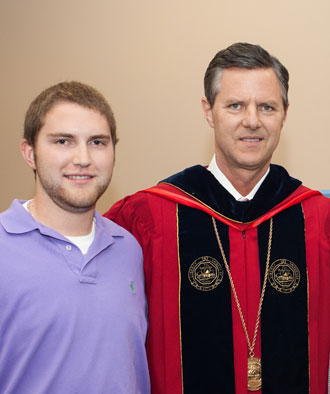
Here’s the latest, according to the Christian outlet World Magazine: Withrow had been punished for bringing two guns to his high-school campus in Princeton, North Carolina.  At first, it appeared he had accidentally left them in his truck.  As soon as he remembered his mistake, the story was first reported, Withrow informed school authorities of the guns.  In spite of the innocence of his mistake and his Eagle-Scout honesty in reporting the problem, school officials reported Withrow, who was charged with a felony and kicked out of school.  The story became a tempest in America’s culture-wars teapot.  Withrow became a symbol of an overreaching anti-gun governmental tyranny.  Since Withrow was wearing a Liberty University t-shirt in some public appearances, the University contacted him and offered him a full scholarship.

Falwell and Withrow

Falwell and Withrow; Image source, Liberty University

Turns out Withrow had known about the guns all along. According to World Magazine, Withrow admitted in court he had lied.  Nevertheless, Chancellor Jerry Falwell Jr. and Liberty University stand by their offer.  Withrow’s admission of dishonesty, Falwell announced, smacks of more heavy-handed state tactics.

So in the end, nothing really happened.  A conservative Christian youth will go to a conservative Christian college.

Why should those of us trying to understand the world of conservative educational thinking in America care about this story?

Because this story demonstrates the sticky web of connections between seemingly unrelated issues.  Liberty University was founded in the early 1970s by barnstorming evangelist Jerry Falwell.  The goal of the university was to produce new platoons of educated conservative Christians, ready to swing the United States back into the arms of its rightful Moral Majority.

This story demonstrates that the conservatism of Christian institutions such as Liberty University reaches beyond theology.  Liberty University may exist to teach students in a Christian environment.  But that environment also supports theologically unrelated notions, such as the rights of people to have and use guns, and the rights of people to be defended from an overreaching Obama regime.

As faculty star Karen Swallow Prior reported a while back, the broad cultural conservatism on Liberty’s campus may be relaxing a little. Students these days tend to wear less formal clothes, and some even started a Campus Democrat club.  Nevertheless, as Chancellor Falwell’s actions show in this case, Liberty still represents a bastion of an American conservatism that reaches far beyond Biblical interpretation.

What does Jesus think about shotguns?  I don’t know.  But the multifaceted ideology/theology/admissions policy on display in this story demonstrates the complexity of American educational conservatism.


Poem of the Week

If a picture is worth a thousand words, a good poem has to be worth a million, right?

We stumbled across this gem recently.  For those of us who are trying to understand educational conservatism in America, the sentiments expressed here go a long way.

“Buzzsawmonkey” left this poem as a comment on a recent essay by Stanley Kurtz in National Review.

The Red Faculty
—apologies to William Carlos Williams and “The Red Wheelbarrow”

so much depends
upon

a red prof
teaching

glazed eyed bored
students

to deride white
people.

Now, I realize the poem does not have much to do with Kurtz’s essay about the Common Core State Standards.  But it does sum up a good deal of conservative punditry about the lamentable state of American higher education.

I apologize for my ignorance if this poem has been around for a while.  It seems both too clever and too irrelevant to the essay it commented upon to have been used only in this context.  So please correct me if this is old hat.  This is my first sighting.

The skewed ideological environment of most college campuses has long been an article of faith among conservative activists and thinkers.  Long before William F. Buckley Jr. launched his career with his jeremiad about God and Man at Yale, conservatives warned about the terrifying intellectual bullying among once-hallowed quads.

In 1921, for example, William Jennings Bryan attacked the teaching at the University of Wisconsin.  In a scathing editorial, he sarcastically suggested the university post placards about the content of its curriculum.  “Our class rooms,” the warning could state, “furnish an arena in which a brutish doctrine tears to pieces the religious faith of young men and young women; parents of the children are cordially invited to witness the spectacle.”[1]

Neither the loquacious Bryan nor Buckley, however, managed to come up with as poetic an indictment as has Buzzsawmonkey.


[1] Bryan, “The Modern Arena,” The Commoner, volume 21:issue 6 (June 1921): page 3.

Core Wars

What do conservative activists hate about the Common Core State Standards?

A recent essay by conservative commentator Stanley Kurtz in National Review points out some conservative objections.

As we’ve noted recently, conservatives share with progressives a fervent opposition to the CCSS, though usually for different reasons.  Everyone from Phyllis Schlafly to the Heritage Foundation has warned of looming implications for culture, politics, religion, and education.  For those of us trying to understand conservative attitudes toward American education, these diatribes against the CCSS are a good place to start.

Kurtz was responding to an article in the Washington Post about Tea Party objections to the new shared standards.  Obama officials, Kurtz complained, responded with deceptive statements and obfuscation.  In the end, Kurtz argued,

. . . the Tea Party is right when it accuses the Obama administration of nationalizing education standards through the back door. The Founders opposed that for a reason. Once de facto nationalization is achieved, parents will lose their ability to influence their children’s education. Leverage that can be easily exercised at local school-board meetings or through representatives in state legislators will be lost to unaccountable federal bureaucrats (like Lois Lerner), and worse, to the even less accountable private education consortia that are developing the Common Core. So if educators try to impose politicized curricula or “fuzzy” math, parents will have no recourse.

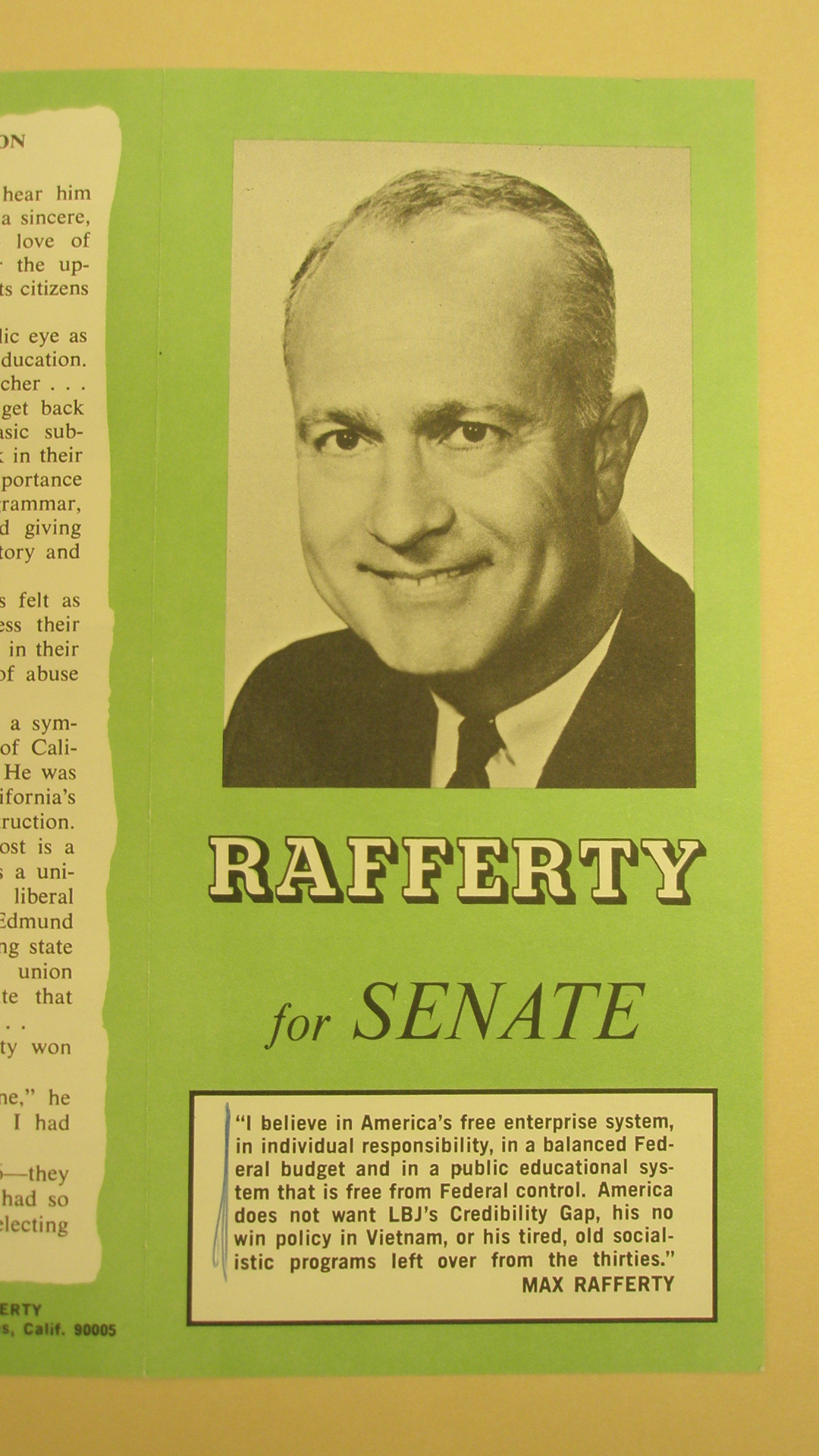
Kurtz’s “local control” argument echoes a long tradition among conservative education thinkers.  Most powerfully, California State Superintendent of Schools Max Rafferty pushed hard during the 1960s to combat increasing federal control.  Rafferty’s colorful prose often made the case more lyrically than I’ve seen it since.

In one speech from the archives,[1] Rafferty articulated a conservative position for local control that I suspect might still be appealing to today’s Tea Partiers.  As he told the California Small School Districts Association Convention on March 8, 1965,

You live and work in an out-of-the-way corner of this county.  A small town where the sky is still blue, where the roar and tension of freeway traffic has not yet penetrated; where a little boy can still run and play in open fields.  You’re there because you want to be.  You moved there deliberately a few years before because you liked that feeling of grassroots independence.  That unique sense of having an equal share in the controlling of one’s own destiny which has been the legacy of every American ever since the first little villages began to dot the New England countryside more than three centuries ago.  You’ve been happy there.  Your children are growing up clear-eyed and self-reliant with that indescribable look of quiet confidence which comes from life spent in a region where hills and trees are very real, very close at hand.  Where a neighbor is a lot more than someone who just happens to live close to you.  Suddenly, something goes wrong at your local school house, as things sometimes do.  Maybe it’s a new course of study which just doesn’t quite fill the bill.  Maybe it’s a neurotic old school administrator, we do run across one now and then!

No matter, you tell yourself, nothing can possibly happen in your community which can’t be solved by you and your neighbors, working and acting together in the traditional American spirit of mutual tolerance and good will.  But this time you’re wrong.  Shockingly, unbelievably wrong!  You and your friends try to arrange an appointment with your district superintendent to tell him of your problems and make your suggestions.  But you don’t have a district  superintendent anymore, in fact you don’t even have a district!  You try to contact your local school board, but it’s gone too!  A hundred miles away, a group of county or state officials meet once a month to decide the destiny of your children.  You don’t know any of them personally, in fact you never even heard most of their names!

But in our nightmare today, they tell you what your children will be studying.  They hire the teachers who will be molding the thinking and the behavior of your children throughout the years that lie ahead.  They decide whether or not the school bus is going to stop near your home or indeed if there is going to be a school bus at all.  Whatever they decide, you’re stuck with.

Rafferty worried about the Elementary and Secondary Education Act, the direct progenitor of No Child Left Behind.  As several of the commentators on Stanley Kurtz’s essay pointed out, the centralization of public schooling can be traced back through several generations of federal leaders, including President George W. Bush.

From the Hargis Collection.

From the Hargis Collection.

But that doesn’t mean that today’s version, the Common Core State Standards, will be greeted with anything but alarm among some sectors of conservative thought.


[1] This speech survives as a typescript in the Billy James Hargis Papers, University of Arkansas Mullins Library Special Collections, MC 1412, Box 48, Folder 2, Public Schools, 1950-1978 (1 of 2).  This collection of papers represents, IMHO, the best single-stop shop for any scholar hoping to understand the career of twentieth-century educational conservatism.  The Reverend Hargis was a leader in the Christian conservative movement in the second half of the twentieth century, and he was an avid collector of newsletters, correspondence collections, and other ephemera that shed a unique light on conservative thinking about education during the period.


Apocalyptic Academics: Conservatives and the Myth of Outrageous Schools

There it is again!

Today we find yet another example of conservative commentators lambasting the outrageousness of public education.  This firmly ensconced tradition of school-bashing doesn’t make much sense to me.  I would think conservatives would want to promote public education in America as one field in which conservative ideas and ideals have taken firm control.

Today’s example comes from the pages of Public Discourse, in an essay by Professor William Jeynes.  The opening paragraph highlights the terrible activism of public schools:

An inquisitive elementary school student asked his teacher, “Is it wrong to steal?” The teacher replied, “I don’t know. What do you think?” This incident in a major midwestern public school alarmed thousands of parents, and reminded myriad others why they value religious private schools: these schools are usually guided by a moral compass for academics and behavior that public schools patently do not offer.

This notion of vaguely outrageous teaching in America’s vaguely described public schools is a dominant theme of conservative talk about public schooling.

Browsers of conservative media hear about high-school students strip-searched during exams, or teachers rewarded for “stomping” on the American flag.

In all these stories, public schools and their teachers loom as out-of-control dictators, blasting away at traditional morality, patriotism, religion, and common sense.

Nor is this theme a new one among conservative pundits.

In the 1980s, for example, commentator Sam Blumenfeld warned readers that “the neighborhood school is controlled by a national educational and bureaucratic hierarchy completely insulated from local community pressures and answerable only to itself.”[1]

In the 1970s, US Representative John Conlan (R-AZ) worked hard to control what went on in public schools.  Debating House Bill 12851 in May, 1976, Conlan advised,

I think one of the things that perhaps the gentleman from Michigan is not aware of is that there is a significant current in education to teach children that there are no values, there is no right, there is no wrong, that everything is relative, and it all depends upon situational ethics.[2]

As I argued in my 1920s book, conservatives in that decade also insisted on the terrifyingly amoral or immoral dominance of public schools.  For instance, one well-funded insurgent group, the Bible Crusaders, warned that public schools had been taken over by a conspiratorial sect determined “to secretly and persistently work to overthrow the fundamentals of the Christian religion in this country.”[3]

In all these tellings, schools and teachers represent insidious threats to traditional values.  As with Professor Jeynes’ recent warning, a single example, often vague or imprecise, is used as proof of the continuing trend of public schools nationwide. For some reason, conservatives have long tended to exaggerate the perniciousness of public schools.

Of course, this is not only a conservative tendency.  Progressives, too, often hyperventilate over isolated examples of conservative influence in schooling.  As we noted recently, for instance, the specter of creationism often looms much larger in the progressive imagination than it does in actual schools.

In the face of such assertions of apocalyptic academics in public schools, more careful scholarship demonstrates that most teaching fits in with local community values.  Political scientists Michael Berkman and Eric Plutzer have noted that most teachers’ values match those of their school and district.[4]

Of course, there always are and always have been some teachers who flout local values.  But such events are newsworthy precisely because they are unusual.  In general, most teachers prefer to avoid controversy.  Most teachers, like most people, try to fit in.  The notion that teachers and schools are out to demolish the values of their students just doesn’t match experience.

Yet conservatives will presumably continue to trumpet examples of outrageous public-school teaching.  To a non-conservative like me, this does not make sense.  I would think conservatives would rather exaggerate the conservative nature of most public education.  These days, talk about public schooling is dominated by demonstrably conservative themes: privatization, competition, and union-bashing, to name a few.

Wouldn’t it make better strategic sense for conservatives to claim all of these as victories?


[1] Samuel L. Blumenfeld, Is Public Education Necessary?  (Old Greenwich, CT: Devin-Adair, 1981), 4.

[2] Congressional Record, May 12, 1976, pg. 13532.

[3] “The Bible Crusader’s Challenge,” Christian Fundamentals in School and Church 8 (April-June 1926): 53.

[4] Michael Berkman and Eric Plutzer, Evolution, Creationism, and the Battle to Control America’s Classrooms (New York: Cambridge University Press, 2010), 199-200.

Which Religious Right? A New Islamic College for America

Whom do we think of when we think of religious conservatives in the United States?  Folks who want to censor and ban books?  Who want to get kids out of public schools and into religious one?  Who question the authority of mainstream science?

Most important for today’s post, who do we think of when we think of religious folks who start their own schools and colleges in order to pass along their religious traditions?

The obvious suspects, of course, are conservative Protestants, especially those from the evangelical tradition.  As I argued in my 1920s book, conservative evangelicals have worked hard throughout the twentieth century to save young people from pernicious ideas such as materialism and evolution.  They have founded influential schools and colleges in order to do so.

But in this century, we need to consider a new type of conservative religious school, the Islamic academy.

Recently, Religion & Politics featured an excerpt from Scott Korb’s new book about Zaytuna College, “the Nation’s first Muslim liberal arts college.”

As Korb notes in this excerpt, Zaytuna College has big plans.  Its founders hope to make Zaytuna “a place where . . . the text of the Koran could meet the context of American culture.”  Korb also argues that Zaytuna’s famous co-founder, Sheikh Hamza Yusuf, is best understood as “conservative.”

In some ways, Sheikh Hamza’s educational ideology seems to echo that of his Christian co-conservatives.  For instance, Korb points out that Yusuf works with his siblings to promote religious homeschooling.  He has warned fellow Muslims, “We absolutely must remove our children from state schools.”

Though Korb’s excerpt did not include this, Sheikh Hamza has also worked together with other religious-conservatives intellectuals to discourage the availability of pornography in hotels.  Sheikh Hamza has publicly critiqued arrogant mainstream science, science that purports to know more than it can reasonably justify.

In all these ways, Sheikh Hamza and his new college seem to parallel the thinking of conservative Protestants in the United States.  However, there are some important differences.  Look, for example, at the books he recommends.  Some are classics from the conservative canon.  Michael Behe’s intelligent-design polemic Darwin’s Black Box made the list, as did William Bennett’s Book of Virtues, Newt Gingrich’s To Renew America and John Taylor Gatto’s Dumbing Us Down.  Nothing most conservative evangelicals might not endorse.  But Sheikh Hamza’s reading list includes progressive favorites, including Howard Zinn’s People’s History of America and Paolo Friere’s Pedagogy of the Oppressed.

More important, history matters.  Korb points out that many journalists have been too quick to call Sheikh Hamza a “‘moderate’ or ‘progressive’ Muslim” due to Sheikh Hamza’s stern anti-terrorism.   Yet even a profoundly conservative Muslim educator in 2013 faces a very different educational landscape than that faced by conservative evangelicals in 2013, or 1973, or 1913.  Unlike conservative evangelical Protestants, conservatives of other traditions don’t have the common feeling of having “lost” public education in America.  For conservative Muslims, like conservative Catholics and other sorts of conservative religious folks, the public schools in the United States have historically been hostile institutions.  Not so for many conservative evangelical Protestants.  Throughout the twentieth century and continuing today, anyone paying attention can hear a lingering desire among conservative evangelicals to “Reclaim YOUR School.”

What will it mean to have a new conservative college in the United States?  One from a very different faith tradition?  Perhaps this will continue the broadening of “conservatism” in America.  As James Davison Hunter predicted so many years ago, perhaps our culture wars will continue to change into broad, diverse coalitions of the “orthodox” against those on the other side.


Phyllis Schlafly Blasts the Common Core

Don’t do it, Phyllis Schlafly warned states recently. Don’t fall for the hoopla about the new Common Core State Standards.

Schlafly is often best remembered for her successful campaign to block the Equal Rights Amendment in the 1970s. But as historian Don Critchlow has argued, Schlafly’s career was about much more than just the ERA.  An examination of Schlafly’s activism can tell us much more about the changing face of “conservatism” in the twentieth century.

Image Source: Christian Post

Image Source: Christian Post

Now Schlafly has joined the chorus of conservative anti-CCSS voices.  As we’ve noted earlier here at ILYBYGTH, conservatives join many progressives in lambasting the new unified state standards, but usually for different reasons.

Writing in the pages of the Christian Post, Schlafly offers conservative parents and voters solidly conservative reasons to get up off the couch and take an interest in their local schools’ new curricular guidelines.  “Common Core,” Schlafly warns, “means federal control of school curriculum, i.e., control by Obama administration left-wing bureaucrats.”

The standards will not improve students’ academic performance, Schlafly argues. Nor will they achieve their trumpeted goal of making all students “college ready.”  Rather, these new standards represent only the latest left-wing drive to transform the United States into a “totalitarian government.” In Schlafly’s words,

Common Core means government agencies will gather and store all sorts of private information on every schoolchild into a longitudinal database from birth through all levels of schooling, plus giving government the right to share and exchange this nosy information with other government and private agencies, thus negating the federal law that now prohibits that.

Everything about the standards is “encrusted with lies,” Schlafly insists. The suggested content itself predictably indoctrinates students toward leftist ideas and policies. As conservatives have warned for decades, the suggested readings even veer into the “pornographic.”

So what is a conservative to do? According to Phyllis Schlafly, the new Common Core State Standards represent only the latest effort by leftist federal bureaucrats to seize control of children’s minds. Any red-blooded American must shudder at the implications.

Summer Reading List

Summer is here…or close enough.  What are people planning to read?  Seems like everyone and their brother are publishing their summer reading lists.  Hoping to beat Oprah’s 2013 list to the punch, here are a few from ILYBYGTH’s idiosyncratic dream library:

1.)    Jason Rosenhouse, Among the Creationists.

This is one I’ve been excited about for a long time.  Rosenhouse is an atheist mathematician with a familiar hobby.  For years he has traveled to creationist conferences and interacted with creationists and their ideas.  From the publisher’s description:

After ten years of attending events like the giant Creation Mega-Conference in Lynchburg, Virginia, and visiting sites like the Creation Museum in Petersburg, Kentucky, and after hundreds of surprisingly friendly conversations with creationists of varying stripes, he has emerged with a story to tell, a story that goes well beyond the usual stereotypes of Bible-thumping fanatics railing against coldly rational scientists. Through anecdotes, personal reflections, and scientific and philosophical discussion, Rosenhouse presents a more down-to-earth picture of modern creationism and the people who espouse it. He is neither polemical nor insulting, but he does not pull punches when he spots an error in the logical or scientific reasoning of creationists, especially when they wander into his own field, mathematics.

Right up my alley.  I’ve got the book on my table, top of my list.

2.)    Amy Binder and Kate Wood, Becoming Right: How Campuses Shape Young Conservatives.

As we noted here earlier, this book suggests that higher education is a more ideologically complicated place than many pundits suggest.  Many self-identified conservative intellectuals have panned the book as “patronizing.”  Bruce Bawer at Minding the Campus skewered the title as an example of “the insularity and obtuseness of the academic left.”  I’m looking forward to reading the book more carefully myself.  Do these criticisms hold water?

3.)    Charles J. Holden, The New Southern University: Academic Freedom and Liberalism at UNC .

For my next book project, I’m considering a look at conservative Protestant higher education through the twentieth century.  Holden’s new book examines the flagship “Southern” university in Chapel Hill during the formative decades between the World Wars.  As reviewer Wayne Urban noted in an H-Net review, Holden focuses on the ways UNC served as a bastion of “liberal” thinking and culture during these decades.  In my study of conservative evangelical Protestantism in the 1920s, I found that UNC did indeed often lead the charge for a politicized vision of what it meant to be both “intellectual” and “Southern.”  As I think about diving deeper into the world of “fundamentalist” university life, I hope Holden’s work will help broaden my understandings of the meanings of higher education in this period.

4.)    Hubert Dreyfus and Sean Dorrance Kelly, All Things Shining: Reading the Western Classics to Find Meaning in a Secular Age .

This title is not particularly new, nor is it focused tightly on the areas I usually read about. That’s why I think it will make good summer reading.  According to a gushing review in the New York Times, Dreyfus and Kelly begin with the assumption that “The gods have not withdrawn or abandoned us.  We have kicked them out.”  Since I spend so much of my time reading arguments for the continuing centrality of ferocious, doctrinal monotheism, this argument looks like an intriguing counterweight.

What else are people planning to read this summer?  Books from outside your usual “work” fare?  Books recommended long ago but put on the ever-growing “to be read” pile?