Take the Creation Museum Challenge

We can gnash our teeth.  We can pull our hair.  But no matter what we do, the Creation Museum of Answers In Genesis has pulled it off.  With its new $1.5 million dinosaur exhibit, the flagship museum of young-earth creationism has successfully mimicked the outward appearance of mainstream scientific museums.
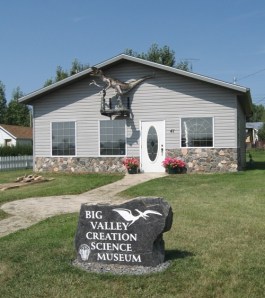
Big Valley Creation Science Museum

Big Valley Creation Science Museum

It used to be easy.  Creationist museums used to be only sad little affairs.  They used to look like this one from Alberta, Canada.  The Big Valley Creation Science Museum, pictured here, may do a great job in spreading the creationism gospel.  But no idle tourist would be likely to confuse it with mainstream museums such as the Smithsonian’s Museum of Natural History or Boston’s Museum of Science.

It used to be easy for outsiders like me to mock the lame pretensions of the many creation museums that dotted our great land.  And Canada.  As one angry visitor noted, even the bigger creation museums used to have strange, sad displays like this one from San Diego’s Creation and Earth History Museum.

Not a Lot of Big Bang for your Buck

Not a Lot of Big Bang for your Buck

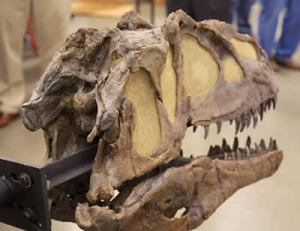
But here’s the new challenge: Can you tell which of the three pictures below comes from Kentucky’s Creation Museum display and which come from the Smithsonian and Boston’s Museum of Science?  As arch-creationist Ken Ham explained gleefully recently, this new display of a million-dollar Allosaurus fossil puts Ham’s Creation Museum in the same league as those mainstream museums.  As Ham put it,

For decades I’ve walked through many leading secular museums, like the Smithsonian in Washington, D.C., and have seen their impressive dinosaur skeletons. But they were used for evolution. Now we have one of that class, and it will help us defend the book of Genesis and expose the scientific problems with evolution.

So take the Creation-Museum challenge.  Just by looking, can you tell which of these images comes from a young-earth creationist museum and which come from mainstream ones?  (Don’t cheat.  But once you’ve given it a try, you can click on each image to see its provenance.)

Is this "real" science?"

Is This “Real” Science?”

Or Is It This One?
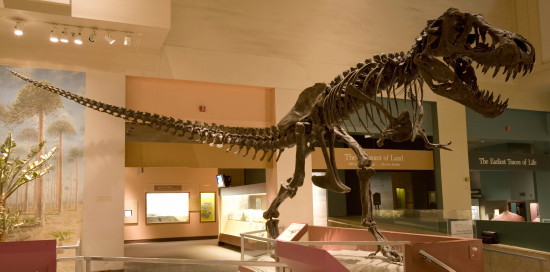
Or Is It This One?

Millions of Years?  Or Millions of Dollars?

Millions of Years? Or Millions of Dollars?

This successful mimicry is important.  In creationism’s twentieth-century struggle to establish alternative educational institutions to rival those of mainstream science, young-earth creationists often wrestled with significant disadvantages.  Not least of these were questions of funding, as historian Ron Numbers described in his must-read book The Creationists and I detailed in my 1920s book.  In the case of this priceless fossil, rich creationists Michael and Stephen Peroutka donated it to help the Creation Museum with its work.

It would be nice to think that America’s public would make its decisions about the age of the earth and the origins of humanity by weighing evidence and considering counter-claims.  To people like me, the Creation Museum’s claim that this well-preserved fossil serves as proof of a worldwide flood 4,300 years ago seems absurd.

But I don’t think we need to be very cynical to guess that appearance matters.  As Dan Kahan argues, what people believe about creation and evolution usually has more to do with their cultural identity than it does with scientific evidence.  If Answers In Genesis can make their museum LOOK like the Smithsonian, many visitors will assume it is just as good.  And if Answers In Genesis can crank out peer-reviewed science publications that attest to the scientific veracity of their claims, many readers will assume their science is just as good.

So take the Creation Museum challenge.  If you can’t tell the difference, how can you expect anyone else to?
 

Debate Analysis

So, the Ham-on-Nye has come and gone.  For those of you who missed it, you can still watch the debate for a couple of days.  Or you can follow our comments and discussion from last night.

I’m very curious to hear people’s reactions.  For me, as someone convinced that humanity had its roots long ages ago in a process that did not need (or receive) any divine guidance, I certainly did not hear anything from Ken Ham to make me question my beliefs.  Though I did find Mr. Ham to be engaging and warm.  Speaking from the “evolutionist” side, I thought Nye did a good job, though I wished several times that he had taken different approaches.  For example, I think it is a bad strategy to focus on the unlikelihood of Noah’s Ark.  As Steve Carrell can tell you, such questions can all be answered with a steadfast belief in the power of the supernatural.  They do not need to make naturalistic sense.

As I describe in my upcoming book, William James Bryan handled this “village atheist” objection nearly a century ago.  When arch-skeptic Clarence Darrow put Bryan on the stand at the 1925 Scopes Trial, Darrow pressed Bryan on the believability of the Bible.  How could Joshua have told the sun to stand still?  Didn’t Bryan know that such a feat would cause the Earth to melt?  Bryan’s reply shut down Darrow’s attack, IMHO.  As Bryan put it, to cheers from the audience, if Darrow had trouble believing in miracles, the problem lay not with the miracles, but with the man.  It does not seem as if Nye understands this fundamental epistemological attitude among many religious people, not only young-earth creationists.

How about you?  Did any creationist readers find Mr. Nye’s arguments new or worth consideration? 

Were there any other parts of the debate that you found surprising or intriguing?

Personally, I thought the best part of the evening were the last section, when both speakers took audience questions.  Questions two and four were the best.  Each asked Nye to explain a fundamental mystery of origins, to which Nye replied in each case, “Don’t know.  It’s a remarkable mystery.”  Then, in each case, Ham rebutted that it was not really a mystery at all.  It was explained in the Bible.  It was a humorous exchange, and illuminated the difference between mainstream science and Biblical knowledge.

Creation Debate Update: Squeezing Out the Middle

Forget the Super Bowl.  Next Tuesday, February 4th, at 7 PM New York time, we’ll all be watching the debate between young-earth creationist Ken Ham and science popularizer Bill Nye.  It looks as if Nye and Ham agree on their goals: squeezing out the middle.  Both debaters want to draw attention to young-earth creationism, and their agreement threatens to exacerbate the divide between evolution and creationism.

The debate host, Answers In Genesis’ Creation Museum, will be streaming the action live for all of us to see.

Ken Ham has suggested that the debate might be a perfect learning opportunity for teachers and students in public school science classes.  From Ham’s point of view, this debate might be a chance to reach students who might not otherwise be aware that mainstream evolutionary science is full of holes.

Bill Nye, too, has explained his reasons for engaging in this debate.  In these pages and elsewhere, evolution-education mavens have wondered if this debate only legitimizes the dead science of the young-earth creationists.  As “The Science Guy” explained, “I don’t think I’m going to win Mr. Ham over.”

So why debate?  Nye says, “I want to show people that this belief is still among us. . . . It finds its way onto school boards in the United States. . . . I’m not going in as a scientist as such . . . I’m going in as a reasonable man.”

So it seems both debaters have the same goal.  Both men want to make people aware of the claims of young-earth creationism.  From Ham’s perspective, such awareness will help keep smart young Christians from leaving the faith.  From Nye’s point of view, if people know what creationism is, they will help fight against it politically.

With such agreement, it seems likely both debaters might succeed.  This debate might elevate the profile of young-earth creationism.  One casualty, it seems, will be other visions of creationism.  Ken Ham’s brand of young-earth creationism, after all, is only one extreme form.  Many religious people believe that humans and life were created at some point by God.  But they do not believe that they must discard the findings of modern science.  The folks at BioLogos, for example, insist that fervent Biblical Christianity can go hand-in-hand with mainstream evolutionary science.  And “old-earth” creationists such as Hugh Ross agree that God did it all, but they don’t insist that he did it only 6,000 years ago.

If this debate succeeds—at least according to the goals of both Ken Ham and Bill Nye—those “other” creationist belief systems will likely get squeezed even further out of the conversation.  That’s a shame.  Too many observers already equate “creationism” with young-earth creationism.  It may make for more lively debates, but it makes for less productive and civil conversations.


What Should The Science Guy Say?

It’s coming up. 

In just a few short weeks, Bill Nye “The Science Guy” will debate the scientific premise of creationism with Ken Ham at Answers In Genesis’ Creation  Museum.

What should Nye say?

Science writer Greg Laden offered this morning a short list of points he’d like Nye to make.  In general, Laden suggests that Nye focus on the unscientific nature of creationism.  The debate over divinity was real and important in the history of science, Laden points out, but that debate has come and gone.  Laden doesn’t use the phrase, but his argument is reminiscent of philosopher Philip Kitcher’s definition of creationism as “dead science.”  In this vision, it makes no sense to debate the science of creationism, since creationism is not even bad science.  Creationism, rather, represents an understanding of science that has been thoroughly and completely discredited.    

Laden’s debate prep brings up two important questions.  First, what would people advise Ken Ham to say?  And second, do we agree with Laden’s advice to Nye?

First things first: What do you think Ken Ham should say?  For those of us who live mental lives outside the boundaries of religious creationism, is there anything he could say that would convince us that his creation science should be taken seriously?  For me, the answer is no.  I’ve defended Ham in the past and taken heat for it from ardent anti-creationists.  But in this case, I’ll be flummoxed if Ham uses any arguments beyond his scriptural stock-in-trade.  That is, I don’t guess Ham will try to convince people like me who are not moved by references to Biblical passages. 

I’m thinking Ham will likely harp on the scientific merits of young-earth creationism, when in fact his argument would be much stronger if he tried a different approach.  To people like me, at least, Ham’s scientific credentials have no leg to stand on.  But as religious dissenters young-earth creationists can claim much more wiggle room in education and culture.  If Ham wanted to reach out to people beyond the ranks of his current religious supporters, he should argue for creationists’ rights as aggrieved minorities, as a religious group, not as a contender for scientific legitimacy. 

But Ken Ham is not likely to take this approach, since he has built his career on the promise that young-earth creationism is better science than mainstream science.  He will likely trot out his compelling but ultimately vacuous arguments about observational science vs. historic science.  He will likely ask Bill Nye some variant of his ultimately senseless question: “Were you there?”  If Ken Ham hopes to maintain his role as the charismatic leader of the young-earth creationist movement, he can’t really do anything else. 

Question two: What should Nye say?  I don’t think Laden’s advice is the first best answer.  IMHO, the most effective answer to young-earth creationists such as Ken Ham is a theological one, not a pop-science one.  As do the folks at BioLogos, I think the most effective message young-earth creationists need to hear is that Biblical faith does not require faith in a young earth.  As science pundits tend to agree, young-earth creationism is not really science, it is something else.  It is an outgrowth of a particular religious understanding.  Therefore, the strongest arguments against it are religious, not scientific. 

Also, I don’t think Nye should use his precious exposure to creationists to blast the dead-science nature of young-earth creationism.  Many creationists will expect a hostile attack on their belief system.  They will not be moved by it.  They will not be convinced by it, since they will not credit its source.  I think it will be more effective for The Science Guy to do what he does best: explain what science is.  Young-earth creationism is based on a very different way of defining knowledge.  If Bill Nye can explain what real science is—instead of attacking the reasons why young-earth creationism doesn’t meet that definition—he can expose some of the creationists in the debate audience to a very different way of understanding the entire debate. 


The Real Pharaoh’s Secret: The Creation Museum

Get this: one of the new Doritos commercials was filmed at Answers In Genesis’ Creation Museum.

Image Source: Answers in Genesis Creation Museum

Image Source: Answers in Genesis Creation Museum

How do I know?  Ken Ham told me.  And the other five bajillion people who follow him on Facebook.

Why did Doritos film at the Creation Museum?  Are they peddling their snacks as young-earth creationist favorites?  Not according to Ham.  He says part of the museum simply has the style of an “Egyptian temple” so the filmmakers liked it.


Do Rich Creationists Deserve the Awesome Fossil?

Everyone agrees on one thing: It’s an awesome fossil.

Image source: Answers In Genesis

Image source: Answers In Genesis

So awesome, mainstream scientists complain, it shouldn’t be used to preach the anti-science on tap in Answers In Genesis’ Creation Museum.

Not so fast, creationists retort.  They insist the rare fossil helps make the scientific case for a young earth and a real global flood.

According to a news release from the young-earth creationist ministry Answers In Genesis, a wealthy benefactor donated the half-million-dollar Allosaurus skull fossil to the Creation Museum.  That benefactor wanted the fossil to be used to help make the case for Biblical young-earth creationism.

The skull will be prominently displayed in the Creation Museum.  AIG scientist Andrew Snelling claims that the skull helps prove the historicity of Noah’s global flood.  Since the skull was so well preserved, Snelling argues, it proves an extremely rapid burial, which fits with a catastrophic flood.

Mainstream scientists complain that the skull should reside elsewhere.  Happy Atheist PZ Myers, for example, laments the fact that such a priceless scientific find should be “locked up in a non-research institution and used to gull the rubes.”

In an Associated Press report, Kentucky paleontologist Dan Phelps worried that the Creation Museum would not let mainstream scientists use the skull for research.

This mainstream complaint raises an interesting question: Would mainstream paleontologists conduct research on the skull, even if they were invited?  After all, the presence of scientists from non-creationist research institutions would be a huge boost for AIG’s claims to be a legitimate scientific institution.

Would any mainstream scientists agree to work at the Creation Museum?


Science at the Creation Museum

Thanks to the ever-watchful Sensuous Curmudgeon, we came across a recent article in Scientific American in which an evolution-believing science teacher journeyed to Answers in Genesis’ Creation Museum outside of Kentucky.

Image Source: Answers in Genesis Creation Museum

Image Source: Answers in Genesis Creation Museum

For folks like me and the author Jacob Tanenbaum, the scientific claims of the museum are impossible to accept.  A science teacher, Tanenbaum recoiled at the misleading scientific claims made by the museum.  “What disturbed me most,” Tanenbaum reported,

“was the theme . . . that the differences between biblical literalists and mainstream scientists are minor. They are not minor; they are poles apart. This is not to say that science and religion are incompatible; many scientists believe in some kind of higher power, and many religious people accept the idea of evolution. Still, a literal interpretation of Genesis cannot be reconciled with modern science.”

Fair enough.  During my trip to the Creation Museum, though, what struck me most powerfully was simply how plausible it all seemed.  For those who did not set out to debunk the information, the museum seemed just as authoritative as Chicago’s Field Museum or any other natural-history museum.

But what Tanenbaum wrote makes sense: the Creation Museum presents a misleading picture of the differences between creation science and mainstream science.

My beef with Tanenbaum is with his own misleading conclusion.  The problem with such creation science education, Tanenbaum argues, is “that 40 percent of the American electorate seems to have forgotten what science is. Considering that our nation put a man on the moon and invented the airplane and the Internet, this development is extraordinary.”

Tanenbaum may be a gifted teacher of mainstream science, but this conclusion suggests that he is not deeply versed in the culture of creation science that he condemns.  For those of us who want to understand creationism, we need to get beyond this naive assumption that creationists don’t know what science is, or that they are somehow hypocritical in their use of technology.

As I argued in a recent commentary in the Chronicle of Higher Education, simple ignorance does not explain American creationism.  Many creationists have studied mainstream science.  In many cases, such as that of leading creation science author Henry Morris, they have earned advanced technical degrees.  And, beyond such stand-out leaders such as Morris, many rank-and-file creationists have extensive science educations.  As political scientists Michael Berkman and Eric Plutzer discovered in their National-Science-Foundation-funded study of high-school biology teachers, of those teachers who espoused a belief in young-earth creationism (i.e., the Creation-Museum type of creationism), fully 55% had earned college degrees in science.   Furthermore, Berkman and Plutzer’s review of other such surveys led them to the following conclusion: “the overall evidence suggests that the high support for creationism in the classroom cannot be attributed primarily, or even substantially, to overall scientific illiteracy in the United States” (pg. 52).

Also, as creationists often remind themselves and their evolutionist foes, belief in evolution is not necessary for sophisticated engineering.  Dobzhansky’s claim that nothing in biology makes sense except in the light of evolution may be true, but that would not stop creationists from traveling to the moon, perfecting airplanes, or inventing the internet.

In the end, I think it makes a big difference whether Americans with creationist beliefs have “forgotten what science is” or if they have a distinctly different definition of science.  Building an anti-creationist argument on the foundation that creationism disables technical education, as does Tanenbaum and other prominent pro-science voices such as Bill Nye, is both a false claim and poor strategy.

Please don’t misunderstand me: this is not a brief for creationism.  However, if those of us, like me, Bill Nye, and Jacob Tanenbaum–who stand outside the borders of creationism looking in–if we really want to understand creationism, we must abandon our own naive assumptions about the meanings of that creationist belief.

Evolution in American Schools: The View from the UK

—Thanks to EB.

What Scottish people look like.

Our Man in Scotland informs us of a recent news item in Scotsman.com.  It seems some Christian-press textbooks have suggested that the Loch Ness Monster can help disprove evolution.  If the earth is really only roughly six to eight thousand years old, the creationist line goes, humans and dinosaurs must have coexisted at some point.  Relics like the Loch Ness Monster show that such coexistence continues into the present.BTW, the article cites as an authoritative reference frequent ILYBYGTH commentator Jonny Scaramanga.  In addition, the article implies that such notions are included in curricular materials produced by two leading Christian school publishers, Accelerated Christian Education and Bob Jones University Press.  I can’t confirm that these textbooks really contain such materials.  However, it is true that the coexistence of humans and dinosaurs has long been a key idea for many creationist intellectuals.

For instance, The Creation Museum of Ken Ham’s Answers In Genesis actively promotes the notion that human history is replete with evidence of human/dinosaur coexistence.  I visited the museum a while back and was struck by the emphasis on the ubiquity of the dragon motif in a variety of human cultures.  This served as proof, AIG contends, that humans throughout history have lived alongside dinosaurs.

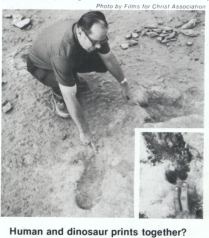
Further back in twentieth-century history, the debate over the authenticity of the Paluxy River tracks   covered similar ground.  Creationists interpreted these fossilized footprints in Texas as evidence that humans and dinosaurs had coexisted.

Not surprisingly, mainstream scientists disagreed.  For mainstream scientists, the notion that humans and dinosaurs coexisted is simply impossible.  Even a rough understanding of the evolutionary “bush” of life shows that millennia separated the age of dinosaurs from that of humans.  But, of course, taking a Biblical worldview, it is just as obvious that dinosaurs and humans coexisted.  If God created the world, humans, plants and animals after their kind in Eden, then there must be some crossover between dinosaurs and humans.

With this understanding, it would be shocking for creationists to teach students anything BUT a hope that Nessie proves to be a plesiosaur.  If true, Nessie would bolster creationists’ claims for a young earth.

In the News: Dinosaur Billboards and the Creation Museum

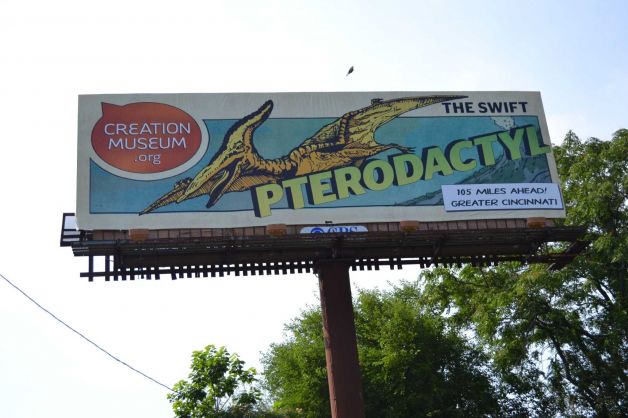
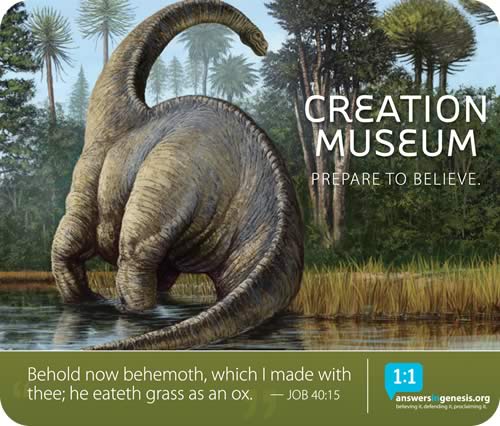
ABC News reported recently that Answers in Genesis’ Creation Museum has launched a new nationwide billboard advertising campaign.

The billboards feature retro-style dinosaurs, and appeared recently in cities such as Chicago, San Francisco, and Houston.  Some critics have wondered why the ads focus on dinosaurs instead of God, or whether this equates to a ‘Flintstones’ theology, but Ken Ham of Answers in Genesis pooh-poohed such folks.  Ham pointed out on his AIG blog that atheists have long used billboards to promote their point of view.