Fundamentalists Were Right

For a hundred years, conservative evangelicals have told themselves that college is a dangerous place. As I argue in my new book about evangelical higher ed, the threat posed by mainstream schools pushed fundamentalists in the 1920s to invest in their own network of interdenominational schools, safe colleges for fundamentalist youth. A new study suggests that fundamentalist fears are still well founded.

20171226_121555

How today’s fundamentalists view college…

Back in the 1920s, fundamentalists loved to recount horror stories of college gone bad. As evangelist Bob Jones like to tell revival crowds in the 1920s, one Christian family he knew scrimped and saved to send their beloved daughter to a fancy college. What happened?

At the end of nine months she came home with her faith shattered. She laughed at God and the old time religion. She broke the hearts of her father and mother. They wept over her. They prayed over her. It availed nothing. At last they chided her. She rushed upstairs, stood in front of a mirror, took a gun and blew out her brains.

Other fundamentalist pundits shared an apocryphal letter from a damned college graduate. This letter, from 1921, told the folks at home,

My soul is a starving skeleton; my heart a petrified rock; my mind is poisoned and fickle as the wind, and my faith is as unstable as water. . . . I wish that I had never seen a college.

Back then, fundamentalists didn’t just rely on anecdotal evidence. They shared social-science evidence of the dangers of mainstream higher education, especially psychologist James Leuba’s 1916 study of college-student religiosity. The students he interviewed tended to grow less religious during their college years. The takeaway? College must be doing something to strip students’ faith.

20171226_121545

Those darn college professors…

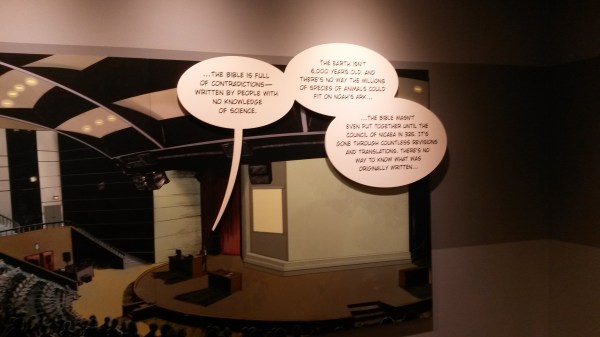
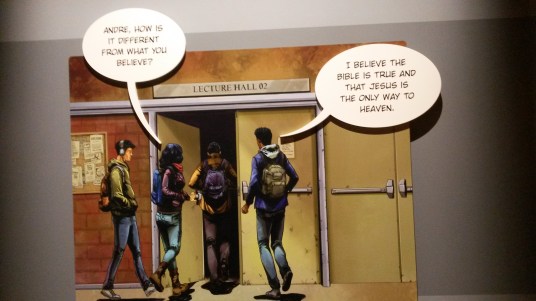
These days, conservative evangelicals are just as nervous as ever about college. On my recent trip to Answers In Genesis’s Ark Encounter in Kentucky, I was surprised to find a huge walk-through comic book illustrating the dangers of higher education.

And, over a hundred years after Leuba’s book, new research seems to suggest that mainstream colleges really do tend to water down student religiosity. The survey by the Interfaith Youth Core was most interested in the ways college students reacted to religious diversity. Along the way, they found that among 7,194 students at 122 colleges, religious activities as a whole tended to drop during the first year of college.

Forty-three percent of the freshman respondents said they had talked about religious ideas in high school, while only a quarter said they did in college. When it came to religious diversity, the numbers are even starker. Thirty-seven percent of respondents said they had attended a religious service of a different faith than their own in high school, but only 20% did in college.

College students also reported friendlier attitudes toward liberal ideas after a year of college, from 55% up to 63%. And a majority said they felt some pressure to change their religious ideas and that they tended to keep their religious ideas to themselves.

So while people like me might worry that students are not getting enough exposure to religious diversity, fundamentalists will likely worry more. Even if college students are shying away from other religions, they are also shying away from their own.

Creationists Understand[ing] Evolution

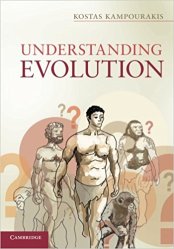
[Editor’s note: To SAGLRROILYBYGTH, Dr. Don McLeroy needs no introduction. As the genial conservative former head of the Texas State Board of Education, Dr. McLeroy is well known especially for his firm creationist beliefs. As I finish up my new book about American creationism, I reached out to Dr. McLeroy to ask him about his ideas. He graciously responded with an explanation and some questions of his own. He asked me, for instance, why I had so much confidence in mainstream evolutionary science. For the past few months, Dr. McLeroy and I have been reading key works together. He has explained to me why he finds some of Kenneth Miller’s work problematic and finds some convincing. I suggested a few of my favorite books, such as Edward Larson’s Evolution and Kostas Kampourakis’s Understanding Evolution. Dr. McLeroy read both and offered his explanation of why he found Dr. Kampourakis’s book ultimately unconvincing. I thought Dr. McLeroy’s critique of Understanding Evolution would be interesting to others, so I asked Dr. McLeroy for permission to publish it here. It appears below, unedited and unmodified by me.]

A critique of Kostas Kampourakis’ Understanding Evolution, Cambridge University Press, 2014

By Don McLeroy, donmcleroy@gmail.com

Kostas Kampourakis believes if you truly understand evolution—the idea that all life is descended from a common ancestor as a result of unguided natural processes—you will accept it and to this end he wrote his book. He does offer a unique contribution to the literature; besides an original discussion of “the core concepts of evolutionary theory and the features of evolutionary explanations,” (p. xi) he specifically concentrates on explaining why he believes evolution is hard to understand and why it has not won widespread acceptance. He emphasizes the conceptual obstacles to understanding evolution, how it is counter-intuitive and why there is so much religious resistance.

As for explaining the core concepts of evolution, his book succeeds; I do have a better understanding of evolution. However, I do not find his discussion of the conceptual difficulties of understanding evolution very compelling. The main obstacle for the evolution skeptic is the evidence doesn’t support it. And, if evolution is false, rejection of evolution is not counter-intuitive. However, he may be right; conceptual obstacles could play a major role in the evolution controversies. Only I think he has it totally backwards and the conceptual difficulties lie with the evolutionist inability to reject evolution.

Understanding core concepts

He devotes two chapters of his book to the core concepts of evolutionary theory: “Common ancestry” and “Evolutionary change.” They are unlike any other evolutionary explanations I have ever read. They are challenging, interesting and I enjoyed studying them.  One reason is because Kampourakis has an excellent imagination and he uses it to create “imaginary” examples to help illustrate evolutionary ideas. He has imaginary beetles, imaginary families, an imaginary Gogonasus man, imaginary slides with rolling balls, imaginary “Jons and Nathans,” and an imaginary pizza shop evolving into an imaginary cookie shop. These examples do help in understanding evolutionary concepts, but I am left wondering, why not use actual examples to illustrate these ideas? Are simple real life examples unavailable to explain evolution?

Kampourakis’ book, like every other evolutionary apologetic book I have read, leaves me a stronger skeptic. The first thing I do when I read a new book on evolution is to look for any actual evidence cited that supports evolution. These books all claim they have lots of evidence, but when I read the books I do not find it. Kampourakis agrees the first requirement of a good scientific theory is the “empirical fit or support by data.” (p. 209) He claims “The fact that we do not know some details yet, as well as that we may never know all the details, does not undermine how strongly evolutionary theory is supported by empirical data.” (p. 209) Therefore, how many actual facts do we see included in this book? He presents some biology but not much evolutionary evidence. Interestingly, I find more imaginary examples than actual examples. His strongest example is Neil Shubin’s Tiktaalik.

The conceptual difficulties

The unique purpose of Kampourakis’ book is to focus “on conceptual difficulties and obstacles to understanding evolution.” (p. 62) I find it interesting his goal is not for everyone to “accept” evolution but simply to “understand” it. Again, he seems to believe if only we could understand it, then of course, we would accept it.  I believe I do understand evolution. And, the more I understand it the more skeptical I have become. What amazes me is how many intelligent, educated people understand evolution and then accept it. Therefore, let’s examine the conceptual problem in reverse. The question would now be: What are the conceptual difficulties facing the evolutionist in ultimately rejecting evolution. I believe they are easily identifiable.

Not knowing they don’t have enough evidence

This brings us back to the key issue—the evidence. I believe the first and most significant conceptual obstacle in preventing the evolutionist from rejecting evolution is in not realizing how much evidence is needed to show evolution to be true. To illustrate, how much evidence has evolution presented to demonstrate how the myriads of biochemical pathways have supposedly developed naturally? Kampourakis’ book is completely silent on this issue. But, Kampourakis provides for more evidence for evolution by referencing a “Further reading” section at the end of his first chapter. Here he begins “There exist numerous books which present the evidence for evolution as well as the main processes. A nice book to start with is Jerry Coyne’s Why Evolution Is True, which provides an authoritative overview of evidence and processes. Another book with several examples and useful information is The Greatest Show on Earth: the Evidence for Evolution, by Richard Dawkins.” (p. 29) Therefore, based on Kampourakis suggestion, let us examine how well these two books explain the evolution of biochemical pathways.

In Dr. Coyne’s book, the only specific evidence he provides to demonstrate biochemical complexity is to hypothesize an imaginary common ancestor of sea cucumbers and vertebrates had a gene that was later co-opted in vertebrates as fibrinogen. (Coyne, ps. 131-3) Richard Dawkins presents even less evidence than Jerry Coyne. He describes the cell as “breathtakingly complicated;” stating “the key to understand how such complexity is put together is that it is all done locally, by small entities obeying local rules.” (Dawkins, p. 438) He also states some of the features of the cell descended from different bacteria, that built up their “chemical wizardries billions of years before.” (Dawkins, p. 377) These statements are not evidence. Click on the links associated with each picture to see what evolution must explain and decide for yourself how strong the evidence is for what Kampourakis’ experts present.mcleroy 1mcleroy 2mcleroy 3

In conclusion, Kampourakis, Coyne and Dawkins do not seem to be concerned about the lack of evidence supporting the evolution of biochemical pathways. And, this is only one small area evolution encompasses that needs explaining.

Not knowing how many just-so stories they tell

The second conceptual block the evolutionist faces in rejecting evolution is they don’t seem to realize or be bothered by how much they depend upon just-so stories in their explanations for how evolution actually happened. Kampourakis, to his credit, doesn’t spin too many just-so stories; he simply presents them as facts. Examine this table Kampourakis includes in his book (p. 172). These transitions are presented as facts, as the truth. Here, the conceptual block the evolutionist faces is the failure to ask the key question “HOW did this happen?” For example, can evolution answer these questions for the first four transitions?

  • HOW did repeating molecules arrive and HOW did these molecules become enclosed in a membrane?
  • HOW did these molecules become coordinated as chromosomes?
  • HOW did the RNA, DNA, and proteins develop protein synthesis and HOW did the genetic code information arrive?
  • HOW did the eukaryote cell arrive? Does the concept of endosymbiosis deal with enough of the complexities involved to assume the problem is basically solved?

kampourakis chartNot knowing the definition of science

Finally, the most foundational conceptual obstacle preventing the evolutionist from rejecting evolution is they have defined themselves into a box. Kampourakis, after a lengthy and excellent discussion of religion and how it relates to science concludes “Science is a practice of methodological naturalism: Whether a realm of the supernatural exists or not, it cannot be studied by the rational tools of science. Science does not deny the supernatural, but accepts that it has nothing to say about it. Science is a method of studying nature, hence methodological naturalism.” (p. 59) But, what if God really did create life? This would mean Kampourakis’ science would not be able to discover it. I find this an untenable situation for science.

The solution, as I see it, is to reject “methodological naturalism” and endorse “The National Academy of Sciences” definition of science. In its book Science, Evolution, and Creationism, 2008, the National Academy defines science as: “The use of evidence to construct testable explanations and predictions of natural phenomena, as well as the knowledge generated through this process.” (p. 10) This wording is excellent: it supports both a naturalist and a supernaturalist view of science. With it, science must only limit itself to “testable explanations” not methodological naturalism’s “natural explanations.” Now, the supernaturalist will be as free as the naturalist to make testable explanations of natural phenomena. Let the view with the best empirical evidence prevail. Unfortunately, with Kampourakis’ purely naturalistic view, he and his fellow evolutionists are trapped in a box with only naturalistic explanations; they then must accept naturalistic evolution.  As a Christian, I am free to accept or reject evolution. Kampourakis even documents leading Christian scientists who accept evolution by quoting Francisco Ayala and Kenneth Miller. (p. 46)

Conclusion

Kostas Kampourakis’ Understanding Evolution argues if you truly understand evolution you would come to accept it. For this to happen, he believes you just need to overcome conceptual obstacles standing in your way. I argue just the opposite; I believe if you truly understand evolution you will come to reject it. We agree though, for this to happen, you just need to overcome conceptual obstacles standing in your way.

Flipping the Culture Wars

“Which side are you on?” When Pete Seeger asked that question, he wanted to push vacillating leftists to the workers’ side. In today’s culture-war politics, one could be forgiven for being confused which side is which. As a recent commentary at American Conservative points out, the right used to be the side of stuffy censorship and outraged morals. Now that mantle has been claimed by the left.

The culture-war flip isn’t only in the world of art. During the twentieth century our creation/evolution battles experienced a dizzying reversal. In the 1920s, as I recount in my history of educational conservatism, conservatives wanted to ban evolutionary theory outright. Even more, many conservative activists had success in making their theocratic vision for public schools legally binding.

At issue in the Scopes Trial, for example, was Tennessee’s law against the teaching of human evolution. Back then, mainstream science activists were fighting merely to have evolutionary theory included in public schools.

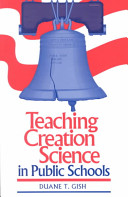
By the end of the twentieth century, the situation had flipped. As creationist pundit Duane Gish famously but incorrectly protested in 1995, at the Scopes Trial Clarence Darrow insisted “it was bigotry to teach only one theory of origins.” In fact, it wasn’t Clarence Darrow who said it, but Darrow’s fellow counsel Dudley Field Malone.

gish teaching creationism public schools

If you aren’t at the table, you’re on the menu…

But Gish’s sentiment was correct. At the Scopes Trial, evolution’s defenders insisted that all sides should be heard. By 1995, the tables had turned, and creationists merely wanted a seat at the table.

At American Conservative recently, Nick Phillips argued that the same culture-war flip has happened in the world of art. These days, we see progressive campaigners insisting that offensive images be banned. We hear of college protesters fighting to eliminate statues and paintings that portray sexist, racist themes. And Phillips asks,

We used to have a word for people who sought to enforce restrictions on the bounds of public discourse in order to insulate sacred norms from attack by non-believers. They used to be called “conservatives.” How did this happen? Why are leftists acting like conservatives?

Of course, this dynamic is as old as politics itself. Whoever has power works hard to keep it. Ideas that challenge the status quo are threats to whomever benefits from that status quo. When creationists appeal to our sense of fairness and inclusion, they have merely recognized that they can no longer simply legislate their vision. And when progressive art activists seek to ban images, they are demonstrating their feeling of proprietary control over the goings on in art houses and college campuses.

High Stakes Creationist Testing

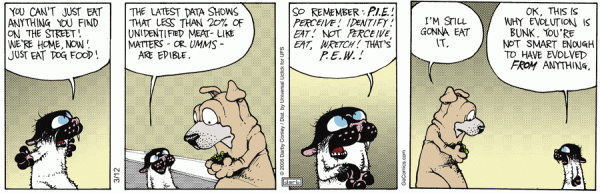
Another day, another creationism bill in Alabama. So far, so snooze. But did you know—I didn’t—that some of today’s creationism bills and laws include sections on how to grade creationist test answers? And because they do, it makes no sense to me why creationists would support these bills.get fuzzy evolution

Here’s what we know: Creationism watchdog National Center for Science Education recently posted the news from Alabama. A new bill would allow teachers to teach both creationism and evolution as science.

Here’s the kicker: Students are allowed to choose either creationism or mainstream science. Whatever they choose, they can get credit on tests as long as their answers match what the teacher taught them.

Apparently—also news to me but not to the folks at NCSE—Kentucky has long had a similar creationism law on the books. Here’s the Kentucky language:

For those students receiving such instruction, and who accept the Bible theory of creation, credit shall be permitted on any examination in which adherence to such theory is propounded, provided the response is correct according to the instruction received.

Okay, now call me silly, but doesn’t this sort of law present a terrible dilemma for creationists? I understand why the evolution mavens at NCSE don’t like it, but I am surprised that Kentucky’s or Alabama’s creationists do.

After all, conservative evangelicals celebrated when SCOTUS agreed to ban bland, ecumenical school prayers in 1962, as I demonstrated in this academic article. They loved the idea of school prayer, of course, but they hated the idea that their children would be praying the wrong prayer in public school.

These laws seem to push the same buttons. Why would creationists fight for laws that hem them in theologically? Because creationism is so ferociously controversial, that is, how could creationists give the thumbs up to a law that tells children one form of creationist thinking?

As SAGLRROILYGTH are well aware, nothing peeves young-earth creationist impresario Ken Ham more than his rival creationists. How can Alabama’s creationists decide WHICH creationism schools should teach? How can creationists smile if their children come home from school mouthing different creationist visions from those of their church?

Science and the Action Flick

It’s been said by enough smart people that we should start listening. Religion and science aren’t at war. This morning, a recent story about science and abortion suggests a new analogy for understanding the role science has always played in our hundred-years’ culture war. It has more to do with Jackie Chan and Bruce Willis than Galileo and John Scopes.

https://www.youtube.com/watch?v=s8vdwqbwf5k

SAGLRROILYBYGTH won’t be surprised to hear it. Historians like Ronald Numbers and sociologists like Elaine Howard Ecklund have long since punctured the tired old myth that religion and science have always been on opposite sides of our culture-war trenches.

The old story is that religious conservatives fear and loathe science. They insist—the myth says—on anti-scientific ideas about a young earth because they don’t like science. They fight against scientific progress using stem cells because they prefer God to knowledge. They put their heads in the sand and bat science away with a swat of their annotated Bibles.

https://www.youtube.com/watch?v=VN-qBcADvkE

It’s just not accurate. As Professor Ecklund writes in her recent book, her surveys of evangelical Protestants found very different attitudes. They like science and they think science and religion can get along. For example, evangelicals are actually slightly less likely than the general population (13.9% of evangelicals compared to 14.9% of all respondents) to think that science does more harm than good. And, as Ecklund puts it, evangelicals

are actually significantly more likely than the general population and significantly more likely than any other religious group to see religion and science as having a collaborative relationship.

News from the abortion front shows how the religion/science dynamic actually works. As Emma Green reports in The Atlantic,

New technology makes it easier to apprehend the humanity of a growing child and imagine a fetus as a creature with moral status. Over the last several decades, pro-life leaders have increasingly recognized this and rallied the power of scientific evidence to promote their cause. They have built new institutions to produce, track, and distribute scientifically crafted information on abortion. They hungrily follow new research in embryology. They celebrate progress in neonatology as a means to save young lives.

Nor is this conservative religious fondness for science new. As I argued in my book about educational conservatism, in the 1920s anti-evolution leaders counted on mainstream science to disprove Darwin’s ideas about natural selection. At the Scopes Trial, for instance, proto-creationist William Jennings Bryan assumed he could put leading scientists on the stand to disprove the atheistic pretensions of false evolutionary science.

It was only when Bryan couldn’t find credentialed scientists (except for one impressive gynecologist) willing to take his side that he decided to fight against the use of expert scientific testimony.

Today’s pro-life activists are on the other side. They’re finding proof for their claims from mainstream science, and they’re thrilled. These conservative religious activists don’t fear science. They don’t loathe science. Rather, they desperately want to use science to prove themselves right. Science is only bad when it seems to go against them.

To our ILYBYGTH eyes, this situation suggests the need for a new way of thinking about the culture-war relationship between science and religion. They are not at war. We don’t see religious conservatives fighting against science. Rather, we see both sides eagerly glomming on to any science-y sounding proof of their position.

So here’s my humble suggestion for a better way of imagining the real relationship: Science is like the gun in the big fight at the end of action movies.

Hear me out: In any decent action flick, the final fight between the hero and the main villain takes a ridiculously long time. Each combatant will sustain enough blows to fell a charging rhino, yet they continue to battle. In a lot of the good fights, one or the other of the combatants will pull out a gun at some point. He or she smugly thinks the fight is over, but the gun will inevitably be batted away. As the fight progresses, both combatants desperately strive to reclaim the gun, to end the fight once and for all.

The way I see it, science is the gun. Both sides want it. Both sides recognize its power. Both sides hope that they can use it to end this too-long conflict by seizing it and using it against the other side. The gun is only bad when the other guy has it. From abortion to creation to sexuality, everyone wants to claim that science is on their side, no matter what that side is.

Wait…ARE Creationists Just Dumber?

If you ask the Richard Dawkinses and the Bill Nyes of the world, creationism is a pretty simple problem. Those who won’t accept the evidence for mainstream evolutionary theory must be “ignorant, stupid, or insane (or wicked…)”. Those of us who know better have always pooh-poohed such simplistic science chauvinism. We argue instead that creationism is not mainly a question of knowledge, but of identity. A new study from the UK seems to challenge our assumptions. Maybe people who don’t accept evolution simply aren’t understanding it.

Here’s what we know: A group of researchers at the University of Bath studied over a thousand teenagers. Unlike studies in the USA, these teenagers showed a strong correlation between academic knowledge and acceptance of evolutionary theory. That is, students who understood evolution better tended to accept it more readily. Students who didn’t understand it as well tended to dismiss evolution or to say that both mainstream evolutionary theory and creationism could somehow both be true.

Here’s how the authors describe their conclusions:

before teaching, students with low acceptance had lower understanding of both evolution and of genetics; the low-acceptance students sat disproportionately in the foundation (rather than higher) science classes; low-acceptance students showed lower increments in the understanding of genetics; and student gain in the understanding of evolution correlated positively with gain in the understanding of genetics. We find no evidence either for a role for psychological conflict in determining response to teaching or that strong rejectors are more commonly of a higher ability.

We don’t want to jump to any grand conclusions of our own, but it seems for these students at least, better understanding and knowledge of mainstream evolutionary theory really did lead to greater acceptance.

understanding evolution

T’aint natural…

Does this mean UK creationists just don’t get it? I don’t think so. But I think it does underscore the notion that mainstream evolutionary theory is not a particularly intuitive thing. It is difficult for us to comprehend central notions of deep time and population genetics. As people such as Kostas Kampourakis have pointed out in detail, our intuitions seem to point us away from a thorough understanding of concepts such as natural selection.

Are creationists dumber? No. For these students, though, a passing acquaintance with mainstream evolutionary theory apparently led them away from it, not toward it.

HT: VW

The Ol’ College Tri-al

Want to scare a fundamentalist? Tell them you’re sending their child to a state university. As I’m arguing in my new book about evangelical higher education, anxiety about college has always been a primary concern of Protestant fundamentalists and other conservative evangelicals. Today’s fundamentalists are no different, as I discovered in my recent visit to the Ark Encounter. In this last (I promise) post about the Ark Encounter, I have one final puzzle about the ways the Kentucky creationists depict the dangers of mainstream higher education.

20171226_121522

Watch out! It’s a trap!

First, the history: When evangelist Bob Jones explained his reason for starting his own college in 1926, he liked to tell the story of one woeful Christian family who had scrimped and saved to send their daughter to a fancy university. As Jones told the tale,

At the end of nine months she came home with her faith shattered. She laughed at God and the old time religion. She broke the hearts of her father and mother. They wept over her. They prayed over her. It availed nothing. At last they chided her. She rushed upstairs, stood in front of a mirror, took a gun and blew out her brains.

Who wouldn’t be scared by that sort of story? Or consider the following example, reprinted throughout the early 1920s by a number of fundamentalist pundits. It was supposedly a letter to the folks at home from a recent college graduate. As he put it,

My soul is a starving skeleton; my heart a petrified rock; my mind is poisoned and fickle as the wind, and my faith is as unstable as water. . . . I wish that I had never seen a college.

For fundamentalists in the 1920s, the dangers of college weren’t only about debt burdens and sexual assault. College itself threatened to rob children of their faith, leave them “poisoned.”

Like now, fundamentalists back then didn’t just rely on hearsay. They devoured social-science reports of the deleterious religious effects of college. Most famous was James Leuba’s study of student religiosity, published in 1916. Leuba found that most college freshmen (85%) called themselves Christians, but only 55% of recent college graduates did so. The upshot, fundamentalists told themselves, was that the college experience must do something to undermine evangelical faith.

20171226_121545

Those darn college professors…

What was true in 1916 seems just as true a century later. Conservative evangelicals—at least the ones who built Kentucky’s Ark Encounter—are convinced that mainstream higher education is a spiritual minefield.

There’s good reason to think they’re right, at least in part. Sociologist Elaine Howard Ecklund studied elite academics and found that there did indeed seem to be some elements of anti-evangelical bias among them. Evangelical professors told Ecklund they tended to keep their faith “closeted.” Others reported hearing offhand comments in the faculty lounge deriding “stupid Christianity.”

While elite academics weren’t as uniformly anti-religious as some evangelicals might assume, they did tend to be less religious than the rest of the population. And a small minority told Ecklund that they actively sought to cure students of their religious proclivities. One physicist told her that he viewed religion as a “virus” that he hoped to cure. A social scientist said she started her classes with the following disclaimer:

You don’t have to distance yourself from religion and think about it from an outside perspective, but you do if you want to succeed in this class.  And so if you don’t want to do that, then you need to leave.

If I were an evangelical parent (I’m not), I would hesitate to send my child into an environment where they would be confronted with that sort of hostile, ignorant attitude. And certainly, Ken Ham and the Answers In Genesis crowd are intensely anxious about the goings-on in mainstream higher education. Ham explained his reasoning in a critique of ILYBYGTH a while back, and my trip to the Ark Encounter confirmed it.

20171226_121555

Can college students protect their faith?

Most of the exhibits were fairly predictable, if odd. They depicted the problems with mainstream evolutionary theory and old-earth creationism. They showed the way day-to-day life on the ark could have happened. Not what I’d expect to see in a mainstream science museum, but pretty close to what I expected to find at the Ark Encounter.

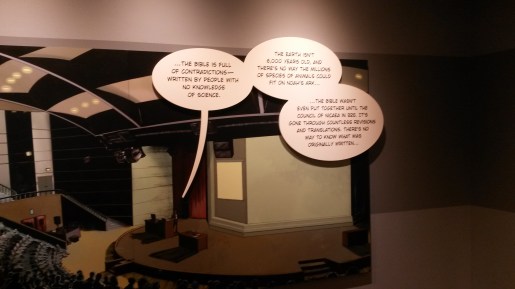
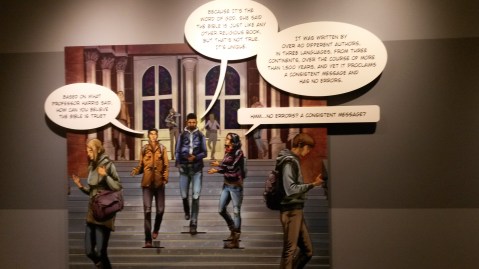
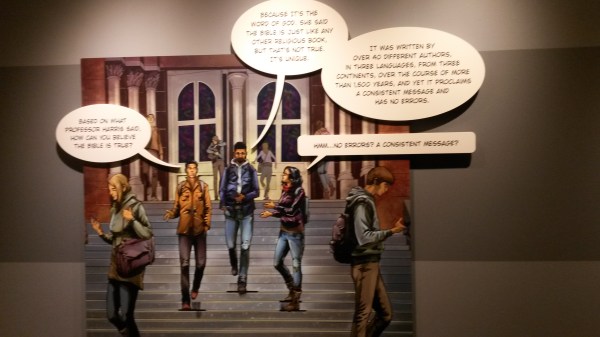
On the top floor, though, I was surprised by what I found. Ark Encounter includes a long corridor dedicated to a huge, walk-through comic-book tract. The comic book’s images have been blown up to fill the walls of the corridor, and visitors walk through the story. The plot is familiar—a student wonders about her faith. After some trials, she embraces it.

One of the trials is her smarky college professor. The central characters walk into a lecture hall, where they are told,

The Bible is full of contradictions—written by people with no knowledge of science. The earth isn’t 6,000 years old, and there’s no way the millions of species of animals could fit on Noah’s Ark…

One of the characters is a young-earth creationist and he patiently defends his faith to two friends, but their college experience puts that faith to a severe test.

The exhibit itself was a surprise, but the content wasn’t. The fears and anxieties of fundamentalists in 2018 aren’t too different from those of fundamentalists in 1918. But here’s the thing that’s been bugging me: Why does the Ark Encounter devote so much wall space to this college story, when Ken Ham thinks that the college years are already too late for successful soul-saving?

As Ham wrote in his 2009 book Already Gone, the kids that are leaving fundamentalist faith are making those decisions in their middle-school and high-school years. As Ham puts it,

Many parents will fork out big bucks to send these students to Christian colleges, hoping to protect them in their faith. But the fact is, they’re already gone.

If Ham wants his flock to understand that the college years are too late, why include this huge exhibit on the dangers of college at the Ark Encounter?

Eden and Zion

When you picture radical creationists, what do you think of? As I’m arguing in my new book about American creationism, it’s all too easy to fall into misleading stereotypes. Instead of asking about “creationism,” we need to get into the habit of talking about “creationisms.” After all, creationism in the USA and in the world is not one thing, but many. A new survey of LDS (Mormon) beliefs about creation and evolution gives us yet another reminder of this diversity.

Benjamin Knoll and Jana Reiss asked a sample of LDS members two questions about evolution. Here is a breakdown of their results:

God created Adam and Eve sometime in the last 10,000 years and humans did not evolve from other life forms.”

  • 53% “I am confident and know this is true.”
  • 21% “I believe and have faith that this is probably true.”
  • 13% “I believe this might be true, but I have my doubts.”
  • 7% “I believe this is probably NOT true.”
  • 6% “I am confident and know this is NOT true.”

“Evolution is the best explanation for how God brought about the emergence and development of life on Earth.”

  • 24% “I am confident and know this is true.”
  • 25% “I believe and have faith that this is probably true.”
  • 17% “I believe this might be true, but I have my doubts.”
  • 13% “I believe this is probably NOT true.”
  • 20% “I am confident and know this is NOT true.”

As always, the poll numbers leave us hankering for more. Some of the most contentious issues among American creationists were left out. We see that huge majorities of LDS members think our species was created as the Bible describes. But what do LDS members think about the age of the earth and universe? Do they think there might have been a long “gap” between creations? Or maybe that the “days” of creation were really long “ages?”

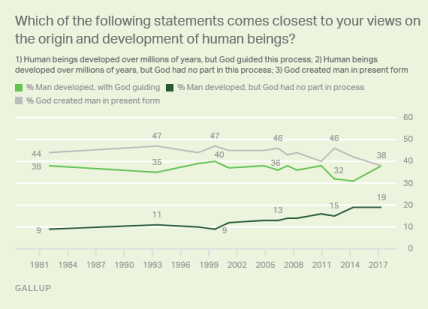
This survey just doesn’t say. However, it does give us some very helpful insights into LDS thinking on these questions. Not surprisingly, a large majority of LDS respondents agrees that humanity was created specially and recently. Also not surprisingly, the notion of God-guided evolution seems very divisive among LDS members.gallup creationism poll may 2017

Though the questions and possible responses don’t match up perfectly, it seems from this survey that LDS members are more likely than Americans as a whole to embrace a recent, special creation of our species. As Gallup has reported for the last few decades, the number of Americans in general who choose a recent special creation of humanity has fluctuated between 38 and 47%.

LDS respondents also seem a little less likely than Americans as a whole to take God out of the process. The Gallup numbers suggest that more and more respondents choose a God-free explanation. Among LDS respondents, only 13% didn’t think a recent special creation was likely.

Though they represent only 1.5% of all Americans, LDS members have unique clout in Utah. We shouldn’t be surprised, then, that evolution remains a contested topic in Utah’s public schools.

Arking the Right Questions

John Oliver thought it was just quirky. There’s a more obvious explanation.

john oliver ark manure

For the full scoop on poop, go to 6:20.

As I discovered on my recent trip to the creationist Ark Encounter, the displays spend a LOT of time explaining where all the poop went. They also explain in great detail how Noah crammed huge dinosaurs on a boat.

There’s more going on here than simple scatophilia. Other radical creationists, too, like to focus on some sorts of questions for sensible reasons. If we spend all our time talking about HOW Noah handled all the dinosaur manure, for example, we’ve already conceded the most important point, which is that Noah really existed with his real ark surviving a real world-wide flood. With dinosaurs on board.

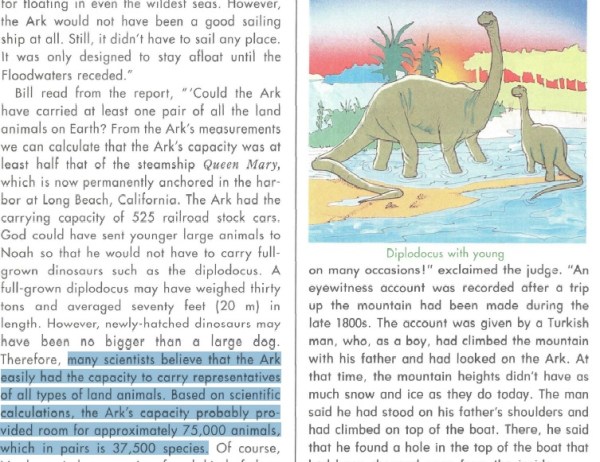
PACE 1096 diplodocus

How do SCIENTISTS think Noah squeezed dinosaurs onto his ark? From PACE 1096 (1986 edition)

The folks at Answers In Genesis aren’t the only ones to ask HOW questions instead of WTF questions. The fundamentalist curriculum specialists at Accelerated Christian Education, too, like to help young creationists focus on the details of their creationist vision. In PACE 1096, for example, creationists will read that Noah could easily have solved the problem of fitting huge dinosaurs on his ark if he simply used juvenile dinosaurs.

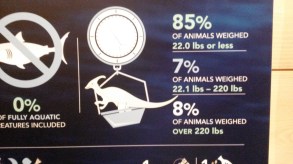
20171226_113428

From the Ark Encounter: It’s easy if you just use the small dinosaurs…

That’s the general argument at Ark Encounter, as well. Visitors will see charts and graphs of various species, explaining clearly how enormous dinosaurs could have been squeezed onto the ark. The dinosaurs themselves were comfortably situated in roomy cages on the deck.

20171226_114712

Plenty of room for all kinds of dinosaurs on board…

What about all the poop? The Ark Encounter offers an extensive explanation. In their vision, Noah and his crew fitted their boat with an elaborate system of pipes and pulleys. Excrement could easily be flushed into the floodwaters. Fresh water was collected on the roof, thanks to the endless rain.

20171226_114853

From the Ark Encounter: Focus on the HOW…

By focusing on these sorts of detailed, science-y sounding explanations, young-earth creationists can reassure themselves and their children that the ark really could have worked. I have to imagine that such conversations serve a vital function: By talking at length and in detail about HOW these things happened, creationists can rest assured that they DID happen.

20171226_114917

A #2 solution…

How I Spent My Christmas Vacation

For family reasons, I spent Christmas this year in scenic Florence, Kentucky. florence yallOnce the presents were opened and the piñatas destroyed, I snuck off to see the newish jaw-dropper from Ken Ham’s Answers In Genesis: The Ark Encounter.

It really was a remarkable sight—an enormous ark rising out of the Kentucky fields. For the next few days, I’ll be sharing my reflections about the trip.

20171226_112046

Wowzers.

As SAGLRROILYBYGTH know, I’m no creationist, but I’m not interested in poking fun at the young-earthers. I don’t even want to get into a shouting match about why this kind of science doesn’t make sense to me. Rather, as I finish up my new book about American creationism, I wanted to use my visit to understand radical creationism better. And it worked, sorta. My trip has my head whirling with questions like the following:

  • How does the Ark museum help explain why so many white evangelicals love Trump?
  • If the idea of dinosaurs hanging around with people is so radically different from mainstream science, why does AIG harp on it so much?
  • Why the fascination with poop?
  • Do other museums these days put huge blown-up comic books on the walls?
  • Who are the young-earth creationists competing with?
  • Why are the AIG folks so obsessed with college?

Right off the bat, though, I can’t help but remark on the most obvious lesson I learned from my field trip: In many ways, the Ark Encounter is at least as much about making money as about saving souls. Like all museums everywhere, we had to overpay for parking—ten bucks in a mostly-empty lot. And like all museums everywhere, for some reason we could have coughed up fifty-one cents for a squashed-penny Ark Encounter memento.

20171226_115845

Squeezing every penny out of visitors…