Alabama’s Fractured Evolution

So…will kids in Alabama learn about evolution? Depends on who you ask. The state just published its new science standards. If you listen to NPR or read the update from the National Center for Science Education, then the new standards are unabashedly pro-evolution. But if you read the Christian Post, then the new standards offer students a choice. This is more than a question of headlines. It helps us see the tricky nature of teaching evolution and other controversial subjects.

Po-tay-to...

Po-tay-toe…

All parties concerned seem to agree that the new standards require more evolution. And they agree that the new standards will move students away from repeating rote facts. The goal of the new standards will be to allow students to get their hands dirty in the evidence itself. As the NCSE describes, [the new standards no longer seem available online], students will soon be expected to

“[a]nalyze and interpret data to evaluate adaptations resulting from natural and artificial selection” and to “[a]nalyze scientific evidence (e.g., DNA, fossil records, cladograms, biogeography) to support hypotheses of common ancestry and biological evolution” (p. 48).

For pro-evolution folks [like me], this means kids in Alabama will learn more evolution. As Alabama science teacher Ryan Reardon told NPR,

“I’m gonna let the data smack ’em in the face,” Reardon says of his students. “I’m gonna ask them what that suggests, and then I’m gonna ask ’em what the ramifications are.”

To Reardon, the message of the new standards is clear: His students will be learning the truths of evolution and climate change. But for the editors at the Christian Post, the new standards mean something very different. The Christian Post reported that students would “Decide If Evolution Is Theory or Fact.” Decide. Allowing students to wade into the evidence themselves does not necessarily mean that they will conclude that evolution happened.

NPR wondered why these new evolution-friendly standards passed with so little “pushback.” Why have conservative evangelicals in Alabama seemed so willing to support these new standards? Perhaps the reason is more obvious than it seems. While teachers like Ryan Reardon plan to push students to see the truths of evolution, perhaps other teachers plan to push students to see for themselves the weaknesses of evolutionary theory.

As political scientists Michael Berkman and Eric Plutzer argued, state science standards are not the best predictor of the ways evolution is actually taught.

Alabama teachers like Ryan Reardon will likely guide their students toward a full understanding of evolutionary theory. But other teachers in the state will likely guide students differently. By helping students “decide” if evolution is a fact or “just a theory,” many science teachers in the state will likely continue to teach a mix of religious ideas in with their state-approved science curriculum.
...po-tah-toe.

…po-tah-toe.

Certainly, readers of publications such as the Christian Post might not see the new standards as an undiluted victory for evolution. If students are allowed to “decide” if evolution is a fact or “just a theory,” creationists will be able to claim a victory.

Are the new standards better? For those of us who want to see more and better evolution education, they certainly seem to be. But we need to be cautious about our expectations. These contradictory headlines show that teachers and schools will implement the new standards in contradictory ways.

Creationists and the New “Ape-Man”

Evolutionary science marches on, it seems. The possible discovery of another extinct human species might seem to deflate creationists’ intellectual bubble. How have creationists handled the news?

In the long history of the evolution/creation wars, creationists have always pointed to gaps in the fossil record as proof of evolution’s empty claims. And evolutionists have repeatedly found evidence of “ape-men,” which turned out to be hoaxes as often as not.

Will the REAL ape-man please stand up?

Will the REAL ape-man please stand up?

The latest discovery of a collection of hominin fossils in a cave in South Africa has brought this old argument to the surface again. These days, creationists are more prepared to handle these sorts of scientific revelations.

Some of the scientists involved have claimed that the bones belong to a previously unknown human species, homo naledi. They’re not sure how old they are, and they’re not sure how the bones got into this cave, but they’re confident the bones come from a new sort of old human.

For creationists who accept mainstream evolutionary science, the news is nothing but exciting. But for those who insist on a young earth and an instantaneous creation of modern humans by divine fiat, the existence of other ancient human species would seem to present a pickle.

At Answers In Genesis, the answer is simple: these bones are probably from some form of ape, and if they are from a type of human, then it was a type descended from Adam & Eve. At the Institute for Creation Research, there are fewer ifs. As ICR writer Frank Sherwin reported,

As always, we at the Institute for Creation Research are extremely skeptical, taking such breaking news stories with a little more than a grain of salt. We have found that with more time and research, the preliminary spectacular claims of alleged “human ancestors” dissolve into a footnote, a non-story. We predict, on the basis of the creation model, Homo naledi too will become just one more dead end in the questionable human evolution parade. In fact, the story itself is rife with caution, unanswered questions, and speculation.

For those of us outside the world of creationism looking in, these sorts of distinctions are a source of continuous puzzlement. Why are Neanderthals okay, but more than two human ancestors not? How can young-earth creationists allow for Homo Naledi, but not make room for a necessarily diverse genetic background for our species?

Doctor Carson, I Presume?

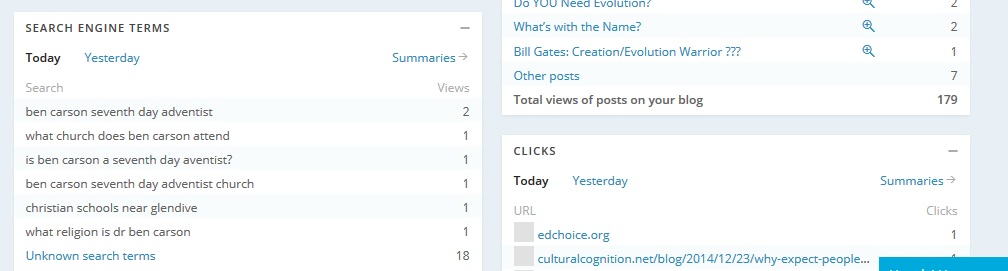
Conservatives love Ben Carson! But they don’t seem to know one of the most important things about him. At least judging from the utterly unscientific evidence on hand at this humble blog, it looks like people want to know more about Dr. Carson’s peculiar religion.

SAGLRROILYBYGTH are well aware that we’ve spent our share of time discussing Carson’s ideas and background. As a devout Seventh-day Adventist, Carson has publicly and explicitly supported his denomination’s firm and fairly extreme creationist doctrines.

Unlike most other conservative Protestant denominations, SDA believers have a good reason to believe in a literal six-day creation within the past 8,000 years ago or so. Their founding prophet, Ellen G. White, saw it herself.

Today in the ILYBYGTH newsroom, we got some evidence that suggests people are curious about Dr. Carson’s religion. In this screenshot captured early this morning, we can see a number of people came to these pages searching for news about Carson’s denomination. Is he a Seventh day “aventist?” What religion is he? What church does he attend?

Who is this Carson fellow, anyway?

Who is this Carson fellow, anyway?

Conservatives love him, but it seems some of them want to know more. Would it be a turn-off for some voters if they knew about Carson’s denomination? Historically, as I argued in my first book, some conservative evangelical Protestants viewed Seventh-day Adventism as a dangerous and deceptive cult.

Things have changed, for sure. I wonder, though, if news of Carson’s denomination would hurt his chances with some conservative Christians.

The Missionary Imposition in Our Public Schools

They’re out there. In spite of decades of talk about “Godless” public schools, there are plenty of Christian teachers who see their work as a missionary endeavor. That ain’t right, but conservative Christians aren’t the only ones to use public schools to spread religious ideas.

As a new cartoon from young-earth creationism ministry Answers In Genesis makes clear, lots of conservative Christians like the idea that public-school teachers will do their best to preach the Gospel as part of their jobs.

Heroic missionaries in our public schools?

Heroic missionaries in our public schools?

The creationists at AIG are certainly not alone in their celebration of public-school missionary work. At the conservative Christian Pacific Justice Institute, for example, Brad and Susanne Dacus encourage teachers to evangelize on the job. As Marc Fey of Focus on the Family writes about their work, it will help teachers spread the Gospel in “one of the greatest mission fields in our country today, our public schools.”

This sort of missionary vision for America’s public schools has a long history. Going back to the 1940s, groups such as Youth For Christ worked to get old-time religion into modern public schools. Beginning in 1945, as the idea of the “teenager” took on new cultural clout, YFC founder Torrey Johnson hoped to make YFC a group that would speak in the language of the new teen culture. As he explained to YFC missionaries, young people in the 1940s were

sick and tired of all this ‘boogie-woogie’ that has been going on, and all this ‘jitterbugging’—they want something that is REAL!

As early as 1949, YFC leaders such as Bob Cook argued that “high school Bible club work [was] the next great gospel frontier.” As he put it, YFC must aggressively evangelize among secular public high school students, since “atomic warfare will most certainly finish off millions of these youngsters before routine evangelism gets around to them.” By 1960, YFC claimed to have formed 3,600 school-based Bible clubs in the United States and Canada.

By 1962, these ad-hoc Bible clubs had been organized into a YFC program known as “Campus Life.” Campus Life included two main components, outreach to non-evangelical students and ministry to evangelical students.

In order to engage in this public school evangelism, national YFC leaders told local activists they must “invade the world where non-Christian kids are.” As an operations manual for Campus Life leaders warned its readers, their first entry into that hostile territory could be frightening. It described common feelings among YFC evangelists on their first approach to a public high school:

There it looms—a huge, humming, hostile high school. Hundreds, thousands of students, a professional corps of teachers and administrators, all busily turning the wheels of secular education.

To you, it’s a mission field. It has masses of kids who need spiritual help, even though most of them don’t know it. You and the Lord have decided to invade that field through the strategy called Campus Life.

This missionary attitude about public schools has also had a long and checkered history among creationists. Writing in 1991, for example, Henry Morris of the Institute for Creation Research called public schools “the most strategically important mission field in the world.”

As have other conservative Christians and creationists, the ICR repeatedly described public schools as unfairly biased against Christianity. As Henry Morris’s son and intellectual heir John D. Morris put it, “today’s public high schools and state universities are confrontational to the creationist student.” Aggressively secular teachers, John Morris warned, “take it upon themselves to ridicule Christianity and belittle and intimidate creationist students.”

Throughout the 1980s, ICR writers described the double impact of their missionary work in public schools. First, it would protect creationist kids from secularist hostility. Second, it could bring the Gospel message of creationism to students who would not hear it elsewhere. Missionary teachers had a unique opportunity. In 1989, one ICR writer explained it this way: “As a teacher,” he wrote, “you are a unique minister of ‘light.’ Your work will ‘salt’ the education process.” Similarly, in 1990 John Morris argued that the greatest hope for a decrepit and dangerous public school system lay with “Christian teachers who consider their jobs a mission field and a Christian calling.”

Every once in a while, you’ll hear young-earth creationist activists insist that they do not want to push creationism into public schools. But they certainly do want to make room for creationism. They hope to use public schools as a “mission field” to spread their Gospel.

They shouldn’t. But before we get too angry about it, we need to reflect on what this really means for our creation/evolution debates.

To folks like me, the most important value of public education is that it is welcoming to all students and families. It should not push religious values upon its students. It should not even imply that one sort of belief is proper and others are not.

As my co-author Harvey Siegel and I argue in our upcoming book (available in February!), the goal of science education must not be to indoctrinate children into any sort of belief about human origins.

Modern evolutionary science is currently our best scientific explanation of the history of human life. Therefore, we need to teach it in science class, unadulterated with creationist notions of design or supernatural intervention.

But too often, the implied goal is to free students from the shackles of their outdated religious ideas. Too often, the goal of evolution education is to change student belief about natural and supernatural phenomena. Progressive teachers like me sometimes slide into an aggressive ambition to help students see the world as it really is.

We shouldn’t. Not if students have religious reasons for believing otherwise. As I’ve argued at more length in the pages of Reports of the National Center for Science Education, too often evolution educators make the same mistaken “Missionary Supposition” that has tarnished conservative Christianity.

Are creationists in the wrong when they use public schools as a “mission field?” Definitely.

But they are not wrong because their religion is wrong.

They are wrong because public schools by definition must remain aggressively pluralist. They must welcome people of all religious faiths, and of none. In order for evolution education to move forward, we must all remember that public schools can’t promote any particular idea about religion, even the religious idea that young-earth creationism is silly.

Here’s Why Public Schools Will Never Eliminate Creationism

If the spotlight-loving science pundit Lawrence Krauss really thinks public schools can eliminate creationism in one generation, he’s off his rocker. But he’s in good company. Through the years, all sorts of writers and activists have made grandiose plans to use public schools for one sweeping reform or another. Unfortunately for them, that’s just not how America’s schools work.

The original bus from hell...

The original bus from hell…

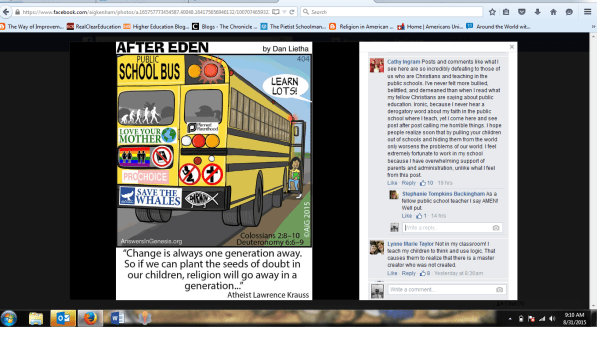
To be fair, in the Krauss quotation pirated here by the young-earth creationist ministry Answers In Genesis, Krauss does not say that this will be a school thing. He only says that we can teach our kids—in general—to be skeptical. Clearly, in the conservative creationist imagination of the folks at AIG, this teaching will take place in the public schools.

This AIG cartoon illustrates the many ideological trends that they think are taught in the public schools. Evolution, homosexuality, abortion, . . . all these ideas are poured down the throats of innocent young Christians in public schools. Furthermore, AIG thinks, Christian belief and practice are banned and ridiculed.*

In culture-war battles like this, both sides made sweeping and incorrect assumptions about public schooling. If the schools teach good science, Krauss and his allies assume, then creationism can soon be eliminated. If the schools teach good religion, AIG thinks, then children will go to heaven, protected from evolution and other skepticism-promoting notions.

As I argue in my recent book, these assumptions are hard-wired into our culture-war thinking. Both progressives and conservatives tend to assume that the proper school reform will create the proper society.

In the 1930s, for instance, at the progressive citadel of Teachers College, Columbia University, Professor George Counts electified his progressive audiences with his challenge. Public schools teachers had only to “dare,” Counts charged, and the schools could “build a new social order.”

Decades later, conservative gadflies Mel and Norma Gabler repeated these same assumptions. Conservative parents, the Gablers warned, must watch carefully the goings-on in their local public schools. “The basic issue is simple,” they wrote.

Which principles will shape the minds of our children? Those which uphold family, morality, freedom, individuality, and free enterprise; or whose which advocate atheism, evolution, secularism, and a collectivism in which an elite governs and regulates religion, parenthood, education, property, and the lifestyle of all members of society?

Professor Counts would not likely have agreed with the Gablers on much. But he would have agreed that the ideas dominating public schools matter. If the wrong ideas leach into the schools, then society will lurch in dangerous directions.

These days, both Professor Krauss and the creationists at AIG seem to have inherited these same assumptions. However, as this screenshot from AIG’s facebook feed demonstrates, public school classrooms are far more complicated places than any of our school activists have allowed. No matter what standards we write about science or religion, public schools will continue to function in ways that represent the wishes of their local community. No matter how daring they are, a few progressive teachers do not have the power to build a new social order.

Similarly, we cannot use schools to eliminate creationism. If we want people to think scientifically, then we need to wage a much broader campaign. We need to convince parents and children that modern evolutionary science is the only game in town.

Because even if we wanted to, we could never ram through any sort of school rule that would be followed universally. Even if public schools officially adhere to state standards that embrace modern evolutionary science, schools themselves will vary from town to town, even from classroom to classroom. The only way to change schools in toto is to change society in toto.

Chicken and egg.

As we see in this facebook interchange, one evangelical teacher claims she teaches with the “overwhelming support of parents and administration.” Another says she teaches her children in public schools to recognize the logical necessity of a creator.

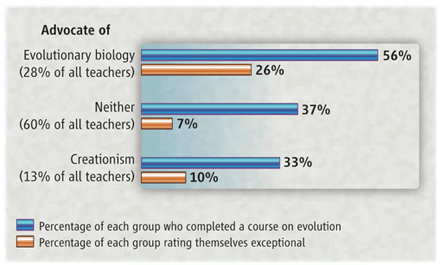
These facebook comments are not anomalies. According to political scientists Michael Berkman and Eric Plutzer, about 13% of public high-school biology teachers explicitly teach creationism. Another 60% teach some form of evolution mixed with intelligent design and creationism.

Not teaching the controversy, avoiding the controversy

Not teaching the controversy, avoiding the controversy

Why do so many teachers teach creationism? Because they believe it and their communities believe it. As Berkman and Plutzer argue, teachers tend to embrace the ideas of their local communities. In spite of the alarmism of the folks at AIG, public schools just aren’t well enough organized to push any sort of agenda. Public schools will never eliminate creationism. They just can’t.

SAGLRROILYBYGTH are sick of hearing it, but I’ll say it again: Schools don’t change society; schools reflect society.

*(Bonus points if you can explain why AIG is against saving the whales!)

Will I Go to Hell for Learning Science?

Those of us who want to get more and better evolution education into our public schools have our work cut out for us. Evidence keeps piling up that Americans still get nervous when it comes to mainstream science.

As my co-author Harvey Siegel and I argue in our upcoming book about creationism and evolution education, public schools don’t have a credible option. They must teach real evolutionary science—and ONLY evolutionary science—in their science classes. Anything else does a grave disservice to students.

Even creationist students. Those creationists, though, should not be forced to mouth vaguely religious platitudes as they learn about evolution. Rather, public school teachers must make their goal to teach students to know and understand evolutionary theory. If they choose not to believe it, that is their fundamental right.will i go to hell for learning science

As SAGLRROILYBYGTH know, my humble blog has wrestled with these issues of creationism and evolution education for years. Every once in a while, we get a glimmer of the harsh reality out there: People really don’t like evolution.

In the editor’s board of the blog, I can read some of the search terms that brought people to the blog. In the past, we’ve seen plaintive requests such as “Can a creationist and evolutionist be in love?”

Today we get another humdinger. In the search terms today we see, “Will I Go to Hell for Learning Science?” As David Long and other scholars have argued, learning evolution is profoundly disconcerting for some students. For those like this searcher, it is more than just a lack of knowledge that is the problem. Many students have deep worries that science these days is nothing but a lure of the devil.

Faculty Fudge Factors at Creationist Colleges

Ding! There it is again—the sound of another evangelical professor being ousted for harboring evolution-friendly ideas.  Some of us outsiders might think that evangelical colleges would slowly become more relaxed about evolution as time went on.  As this case shows, we’d be wrong.  The history of the past century has demonstrated that many evangelical colleges have grown MORE uptight, not less, about proving their creationist credentials.

In this case, the school is Bethel College in Indiana and the professor is Jim Stump. As Karl Giberson described recently, the flap at this Bethel [n.b., there are about one bajillion Bethel Colleges out there and it’s easy for outsiders to mix them up] echoes the trends of the past hundred years: Time and again, creationist colleges have sought to tighten both the image and reality of unshakeable creationist orthodoxy among their faculty.

Stump removal...

Stump removal…

As I’m uncovering as I work on my new book, this pattern has been the dominant theme at conservative evangelical colleges since the 1920s.

Beginning in the 1920s and repeated every generation, schools have tightened the requirements on their faculty. In every generation, some professors have sought to follow a middle path—exploring the science of evolution while remaining firmly committed to their religion. In every generation, nervous college administrators have sought to prove to the creationist community that their school will not tolerate any such thing.

In the 1920s, most schools agreed on ironclad faculty creeds. The hope was that these creeds would prevent faculty from becoming too friendly to evolutionary thinking. At flagship Wheaton College in Illinois, for instance, the trustees in 1926 adopted a creed that all faculty, staff, and administration had to sign annually. They included the following statement:


4. We believe that man was created in the image of God; that he sinned, and thereby incurred, not only physical death, but also that spiritual death which is separation from God; and that all human beings are born with a sinful nature, and in the case of those who reach moral responsibility become sinners in thought, word and deed.

At the time, this statement was thought to define the proper “fundamentalist” attitude toward creation. In 1960, however, a conference about evolution and creationism on Wheaton’s campus attracted ferocious criticism from the more stalwart creationists among the fundamentalist/evangelical community. Too many of the assembled theologians and scientists, critics thought, embraced the principle of evolution.

Among Wheaton’s faculty, zoologist Russell Mixter came in for the fiercest criticism. In spite of his protestations to the contrary, Mixter was accused of teaching and preaching evolution in his classes. In order to calm the storm, Wheaton’s administration altered its faculty creed. At the end of 1961, the school agreed to add the following item:

By Article IV of its ‘standards of faith,’ Wheaton College is committed to the Biblical teaching that man was created by a direct act of God and not from previously existing forms of life; and that all men are descended from the historical Adam and Eve, first parents of the entire human race.

The pattern continues today. At schools such as Bryan College and Northwest Nazarene University, creeds are tightened and faculty are ousted in order to preserve an impeccable reputation for creationism. Time and again, the sticking point has been the historicity of Adam & Eve. It is not enough, evangelical communities insist, for faculty vaguely to endorse the idea of a God-directed creation. Especially when it comes to the origins of humanity, some evangelicals require a belief in a real, literal origin in two real, literal people.

According to Karl Giberson, the folks at Bethel College in Indiana have taken this tradition one step further. Under pressure from the sponsoring denomination, the Missionary Church, Bethel now requires faculty to advocate its firm position on the historicity of Adam & Eve. In the past, at Bethel as at other evangelical colleges, faculty members could sign their annual statements of faith even if they thought that such statements did not require them to disavow mainstream evolutionary science. This policy hopes to push faculty members into a tighter relationship with the denomination’s official position on evolution.

Furthermore, from now on Bethel faculty are not allowed to take leadership positions in organizations that disagree on this point. As BioLogos leader Deborah Haarsma argued, Bethel’s new policy puts evangelical scholars like Jim Stump in a very difficult position. Stump has served as the content manager for BioLogos, an organization that embraces “evolutionary creationism.” The new Bethel policy, in effect, forced Stump to choose between the two organizations.

As the sophisticated and good-looking regular readers of I Love You but You’re Going to Hell (SAGLRROILYBYGTH) are well aware, I am a fan of the BioLogos approach. I’m no evangelical, but I think the way forward in our continuing evolution/creation battles is for both sides to agree to the science of evolution and the freedom of religious belief. As I argue in my upcoming book Teaching Evolution in a Creation Nation (due to hit shelves in February 2016), secular folks like me need to recognize the right of religious dissenters to disbelieve the claims of evolution, even as religious folks need to recognize the duty of public schools to teach evolution as the best available science.

But as I argue in my other upcoming book, schools like Bethel are also in a difficult position. In order to maintain intellectual credibility, they must embrace changing norms of academic excellence. But in order to maintain religious credibility, they must conspicuously root out any whiff of compromise. Not on every issue, but on issues such as evolution and same-sex marriage that seem to make up the foundations of their faiths.

As a result, over the course of the past ninety years, many evangelical colleges–including the relatively “liberal” ones–have made their policies more rigid when it comes to faculty beliefs about human origins.  The recent news from Mishawaka is only the latest attempt by an evangelical college to remove faculty fudge factors.

Let’s Fight about Evolution and Climate Change

Put your money where your mouth is. That’s the message Trey Kay explores in his new Us & Them podcast. What happens when creationists and scientists put up a challenge to their foes? Trey talks with a creationist and a mainstream scientist, both of whom have put up big money to lure their enemies into a losing debate.

The two sides are represented by creationist Karl Priest and physicist Christopher Keating. Priest has offered a $10,000 Life Science Prize. Anyone who can debate Joseph Mastropaolo and can convince a judge of the evidence for evolution will win the money. Keating has put up $30,000 to anyone who can come up with scientific evidence against human-caused climate change.

For those of us interested in educational culture wars, it doesn’t get much better than this. Trey talks with both men alone, then puts them together for a culture-war conversation. What makes creationists so confident? Mainstream scientists?

As Trey concludes, both men offer their prizes in an attempt to get attention for their side. Neither really hopes to convince the other.

That’s been the case for evolution/creation debates for a long time now. Some of us remember the recent head-to-head debate between Bill Nye and Ken Ham. As we discussed at the time, this sort of debate tends to preach to the choir on each side. For mainstream scientists, Bill Nye’s arguments sounded iron-clad. For creationists, Ken Ham made his case.

As historian Ron Numbers has documented, these evolution-creation debates have a long and checkered history. Time and again, high-profile public figures have challenged their foes to debate the issue. Does anyone really hope to solve the issue this way?

As Trey Kay explores in this podcast, it is easy enough to talk politely to one another. But once creationists and evolutionists try to debate, we quickly end up just spinning our wheels.

Can We Vote on Evolution?

Is there a democratic way to decide difficult technical questions? Last week, voters in Greece soundly defeated a complicated economic proposal. For those of us interested in educational culture wars, it raises an interesting question: Could we vote on evolution?

It's all Greek to me.  Except for the parts in English...

It’s all Greek to me. Except for the parts in English…

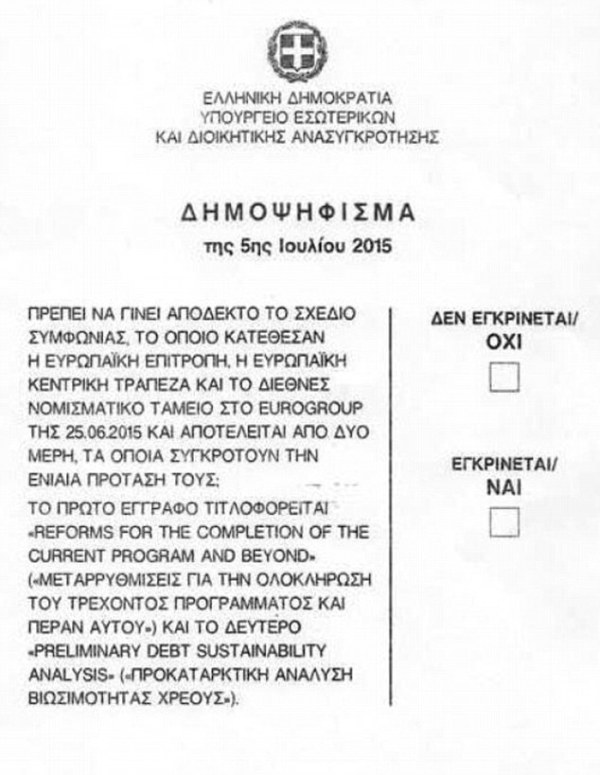
In Greece, voters faced a dauntingly worded ballot. In English, it read as follows:

Should the deal draft that was put forward by the European Commission, the European Central Bank and the International Monetary Fund in the Eurogroup of June 25, 2015, and consists of two parts, that together form a unified proposal, be accepted? The first document is titled ‘Reforms for the Completion of the Current Programme and Beyond’ and the second ‘Preliminary Debt Sustainability Analysis.’

Hrm? What would an “oxi” vote mean in this case? “Nai?”

Of course, the SAGLRROILYBYGTH will say that voters could simply look up the two documents and decide intelligently if they deserve support. But to think that most voters would do that seems woefully naïve, or perhaps refreshingly optimistic. In the United States, after all, poll data suggest that large numbers of Americans think that humans and dinosaurs lived side-by-side, and, as Rick Shenkman has pointed out, most of us don’t know basic facts about our government and society.

Many Greek voters, similarly, seemed to have only a tentative grasp on the question at hand. Instead of voting on the specifics of either of the reform plans, Greeks likely voted based on their impressions about the two sides of the issue. Voting “yes” was generally perceived to be a vote in favor of the euro, and against the leftist policies of the ruling Syriza party. A “no” vote, in contrast, was often seen as a vote against economic austerity and in favor of Syriza.  Even more confusing, some voters seemed to think that a “yes” vote meant taking pride in Greece’s place as a European nation, while others thought a “no” vote was the way to express Greek national pride.

Even after the vote, the results are confusing. Will the government now negotiate for an economic bailout? Will the government accept austerity measures after all as a condition?

One thing seems clear: many Greek voters used the referendum as a way to express something about who they were, whom they believed, rather than as a way to make a specific policy choice.

When it comes to evolution and creationism, we see similarly confusing commitments. Support for creationism remains high, not because people have not heard of evolutionary science, but because people want to show their support for traditional religion.

As Dan Kahan of Yale Law School puts it so well,* our positions on evolution/creation tell us about who we are, not about what we know. People who say they “believe in” evolution do not actually know any more about it than people who say they do not.

With all this in mind, could we imagine a scenario in which America voted on evolution? What would such a referendum look like?

These are preposterous questions in many ways, but bear with me for a minute. We’ve seen time and time again that large percentages of Americans believe that humanity has been created fairly recently. We’ve also seen that large percentages of Americans favor teaching evolution and creationism/intelligent design side-by-side in public schools. What if we tried to agree upon our school curriculum in a democratic way, by holding a national referendum on the issue?

It seems to me the wording of such a ballot might be crucial. If we asked voters, for instance, to vote on whether they thought evolution was true, we’d likely have a huge negative result. Americans just don’t want to agree to that, for a host of religious and cultural reasons.

But what if we asked voters if they wanted public schools to teach the best available science? And what if we asked voters if they believed most scientists thought evolution was the best scientific explanation of the development of life?

As I argue in an upcoming book, the wording could make a big difference. What do we really want our public schools to teach about evolution? Do we need children to believe that evolution is true? Or, rather, do we want to insist that children have a deep understanding of the science of evolution?

We can do more than guess. In 2012, the National Science Board experimented with two similar questions about evolution. When they asked respondents if “human beings, as we know them today, developed from earlier species of animals,” just under half (48%) said “true.” But when they changed the wording, that percentage leaped. When they asked people if “according to the theory of evolution, human beings, as we know them today, developed from earlier species of animals,” a whopping 72% of respondents agreed.

What if we were to vote on evolution? To my mind, if we did something like that, the ballot should have two simple questions:

1.) Do you want public schools to teach the best available science? And

2.) Do you think that scientists say humans evolved from other species?

With questions like that, we would get a whopping public voice of support for teaching evolution in public-school science classes.

*Exciting update! Professor Kahan has firmed up the date for his visit to our scenic campus. He’ll be giving his talk to our Evolution Studies Program on Monday, February 22, 2016. Good seats still available!

What I Did on my Summer Vacation

By Adam L.

I hope you choke on your sunscreen. While you are out and about doing summer fun stuff, I’ll be in the office putting together the index for my upcoming book.

Okay, okay, I’m being a little melodramatic. I actually enjoy the process of writing an index. It helps me get into the manuscript in a detailed way. It helps me think over what the main points are. And it helps me imagine what future readers might be looking for.

If you poke your head out the window and crane your neck, you still can't see the beach from here...

If you poke your head out the window and crane your neck, you still can’t see the beach from here…

Not to mention the fact that writing an index has its own share of intellectual challenges. For example, I’m wondering which subheading to use under “Darwinism.” Should I list anti-evolution protests as “Darwinism: equated with atheism, 7, 14—15”? Or should it be more general: “Darwinism: critiqued by anti-evolutionists, 7, 14—15”?

In any case, enjoy your dog days at the beach, or the mountains, or wherever it is that normal people spend their summer time. I’ll be festering in air-conditioned office comfort. When the snow flies in January, this book should be ready to share.