Fundamentalism and the Modern University

Are evangelical colleges modern? Or, with their insistence that knowledge has its roots in God’s Holy Word, are they somehow trapped in medieval ideas about knowledge and the purposes of higher education? The answer is more complicated than it might seem at first.

As the sophisticated and good-looking regular readers of ILYBYGTH (SAGLRROILYBYGTH) are sick of hearing, I’m hard at work on my book about evangelical higher ed. In the twentieth century, Protestant fundamentalists opened or transformed a network of colleges dedicated to protecting fundamentalist faith. If students are led astray at mainstream secular colleges, the thinking went, fundamentalists needed their own schools to teach each new generation of Christians how to be educated and evangelical.

As part of my reading list, I’m deep in Roger Geiger’s new book, The History of American Higher Education (Princeton University Press, 2015). I’m writing a full review for Teachers College Record and I’ll be sure to post links to that review when it comes out.

Are fundamentalists colleges modern? Or are they trapped in the 1600s?

Are fundamentalist colleges modern? Or are they trapped in the 1600s?

In the meantime, though, Professor Geiger’s survey of the first colleges raises some tricky questions for fundamentalist higher education. As with so many early American institutions, colleges such as Harvard and Yale represented the tail end of medieval traditions, just as they were changing into recognizably modern ways of thinking.

Conservative evangelicals like to point out that America’s leading colleges were often founded as religious schools. It’s true. Harvard and Yale were both intended, first and foremost, to defend orthodox Puritanism. Not only were they ferociously religious, but they envisioned their role in a radically non-modern way. Instead of serving as an institution that encouraged new thinking, Harvard and Yale in the 1600s and early 1700s both saw their role as passing along established truth. As Prof. Geiger puts it, in the early decades, “The corpus of knowledge transmitted at Harvard College was considered fixed, and inquiry after new knowledge was beyond imagining.”

Orthodoxy at these early schools was defended with a rigor that would make twentieth-century fundamentalists proud. Harvard’s first president, for example, was ousted for theological reasons. President Henry Dunster came to believe that infant baptism was not a scriptural practice. As a result, the General Court summarily got rid of him. In their words, no one could lead a college if they “manifested themselves unsound in the faith.”

Both Harvard and Yale made explicit their goals. In early years, Yale explained its primary religious mission:

Every student shall consider the main end of his study to wit to know God in Jesus Christ and answerably to lead a Godly sober life.

It was not much different at Harvard:

the main end of [a student’s] life and studies is, to know God and Jesus Christ which is eternal life, Joh. 17.3

In all these aspects, life at Harvard and Yale between the 1630s and 1720s seems remarkably similar to life at fundamentalist colleges in the early twentieth century. For schools such as Wheaton College, Bob Jones College, Bible Institute of Los Angeles, or Gordon College, these Puritan echoes resounded loudly. At all these fundamentalist schools, leaders insisted that the first goal was to help students understand themselves as Christians. The first intellectual challenge was to study seemingly distinct bodies of knowledge to see the hidden connections put in place by God.

In this way, then, it seems as if fundamentalist colleges—even those more liberal schools that eventually abandoned the “fundamentalist” label—hearken back to a pre-modern vision of higher education.

We have to be careful, though, before we assume too much. In other important ways, twentieth century dissenting religious colleges participated fully in the central intellectual tradition of modern higher education.

According to Professor Geiger, colonial higher education went through a revolutionary change in the 1720s-1740s. During that period, endowed professorships at Harvard gave some faculty members the independence to pursue new forms of knowledge. These professors began to incorporate the ideas of new thinkers such as Isaac Newton and John Locke.

The radical change came not only from the newness of the ideas, but from the notion that the college or university should be the place to explore such new ideas. As Professor Geiger puts it,

The significance and prestige of Newtonian science altered college teaching by introducing the experimental lecture employing apparatus, creating a demand for specialized professors and establishing the expectation that the curriculum should incorporate new knowledge.

A fundamental characteristic of the modern university emerged in the decades before the American Revolution. College, more than any other institution, came to be seen as the province of cutting-edge thinking. As Professor Geiger points out, even before Ben Franklin made his famous experiments with lightning, John Winthrop at Harvard used his endowed Hollis Chair funding to purchase equipment that would allow him to demonstrate the properties of electricity.

Just as the fundamentalist colleges of the twentieth century clung to the pre-modern notion that universities ought to pass along established truths, those same fundamentalist schools fully participated in the modern notion that universities ought to explore new truths.

An evangelical scientist, for example, such as Russell Mixter at Wheaton College in the 1950s, believed that no amount of human investigating could overturn the truths of Scripture. But Mixter (and others like him) also saw himself as an intellectual specialist, a scientist exploring the outer boundaries of biology to discover new things about God’s creation.

Are fundamentalist and evangelical colleges modern? In this sense, they certainly are. The faculty at twentieth- and twenty-first century conservative colleges are divided into academic disciplines. Each of them is expected to carry out research in his or her field. The definition of those fields may be different from the ones at secular institutions, but the fundamentally modern notion of research remains central.

At the same time, though, by envisioning themselves as the guardians of students’ faiths, fundamentalist colleges hearken back to the pre-modern roots of the Ivy League. As Professor Geiger argues about 17th century Puritan higher education, “the deeper purpose of the college course and the overriding preoccupation of the institutions were to demonstrate the truth of Christianity.”

Today’s evangelical colleges would agree.

Christian School Causes Student to Abandon Creationism

How can parents make sure their children don’t lose their faiths? Enrolling them in religious school is not enough. As a recent story from the BioLogos Forum makes clear, education ranges far beyond schooling. Too many hasty critics, religious and secular alike, have assumed that we can control education by controlling schooling. It’s just not that simple.

This Christian learned to embrace evolution, but not in school...

This Christian learned to embrace evolution, but not in school…

In the pages of the BioLogos Forum, college sophomore Garrett Crawford shared his educational story. Crawford was raised in a conservative evangelical household. He went to a Christian school, one that presumably hoped to shield Crawford’s faith from secularism. While at that school, Crawford relates, he grew curious about the scientific evidence for evolution. After a lot of reading and study, Crawford concluded that he could no longer believe in young-earth creationism. After a lot more reading and study, Crawford concluded that Christian faith does not require a belief in a young earth. It is entirely theologically legitimate, he decided, to accept the science of evolution.

In Crawford’s case, his education took him in directions his school never intended.

Such stories shouldn’t surprise us. After all, with just a moment or two of reflection, we can all think of ways that our “education” has differed from our “schooling.” Yet in all of our tumultuous educational culture wars, pundits rush to make sweeping claims about education based on scanty evidence from schools.

We’ve seen this recently in the pages of the New York Times, when philosopher Justin McBrayer declared–based on data that was not just slim, but positively anorexic–that Our Schools Were Training Amoral Monsters.

Among conservative Christians, too, this tradition of school-bashing has a long history.  In the 1970s, for example, fundamentalist school leader A.A. “Buzz” Baker decried the tendency of many conservative Christians to rush into school-founding for the wrong reasons. In his book The Successful Christian School (1979) Baker warned that too many parents and pastors rushed to open new schools because they thought

Public education has failed! It is failing to provide a good academic education while exposing our children to a godless, secular-humanistic approach to life.

Leading young-earth creationists have long assumed that the best way to protect their children’s faith is by attending creationism-friendly schools. Ken Ham, for example, argued that Christian colleges and universities can lead students astray from true faith when they abandon young-earth thinking. As he put it,

the real issue concerns Christian colleges, universities, and seminaries that break away from the authority of Scripture in Genesis—held to by the majority of scholars up through the Reformation—and teach students that God’s Word doesn’t mean what it says. That’s what makes students doubt the truthfulness of the Bible as a whole, and can be a major reason many of them walk away from the Christian (not “creationist”) faith, as we see happening in our culture today.

From the other side, many secular or liberal critics insist that fundamentalist schools are nothing but indoctrination factories. As friend of ILYBYGTH (FOILYBYGTH) Jonny Scaramanga told the BBC, his fundamentalist schooling experiences were nothing short of “horrendous.” During his sojourn in a fundamentalist school, Scaramanga remembers, he did nothing but recite back theological nostrums. The school was so socially crippling, Scaramanga relates, for the rest of his life he was “always playing catch up.”

Scaramanga’s own case, however, shows that schooling of any sort is only one part of a person’s education. Scaramanga himself has now become a leading voice in the anti-fundamentalist education scene. Like Garrett Crawford, Scaramanga’s education took him in directions that his schooling never intended.

The take-away? Of course we should all care about the way schools operate. Better schools will help produce better educations for all students. At the same time, though, we all need to remind ourselves that formal schooling makes up only one slice—sometimes a small slice—of a person’s education.

How many of us, after all, can say that we came out the way our schools intended?

A Strange Poll Question for Conservatives

What would “Christian America” look like? No one really knows, but plenty of Republicans want to make it official. At least according to a new poll from the Public Policy Polling firm, significant majorities of likely GOP primary voters—57%–want to make Christianity the official religion of the USA. This brings us to a tough question: Do today’s religious conservatives intend to make a break with conservative tradition? Or are they just unaware of their own history?

The PPP poll gives some intriguing breakdowns. For those GOP voters who prefer Governor Mike Huckabee, a whopping 94% support the notion. Even those who support the more secular Rand Paul like the idea, by a margin of almost two to one.

Younger GOP voters are MORE likely to back the proposal. Among 18-45-year-olds, 63% say they support the idea. Only 51% of those over 65 do.

There are other intriguing aspects to this poll. For example, among supporters of Huckabee and of Paul, we see a neat flip-flop when it comes to evolution. Only a tiny margin (7%) of Huckabee backers say they “believe” in evolution, while a whopping 85% of Paul supporters do. Clearly, there’s a lot of daylight between the notions of “conservatism” and “creationism” these days.

But that’s not nearly as compelling, IMHO, as this weird question of establishing Christianity as the national religion. What would that mean? Would public schools nationwide all look a lot more like the ones in Greenwood, Indiana? Would other religions have to pay some sort of tax?

Perhaps most interesting from an historical perspective, do these likely GOP voters know that conservative Protestants—especially Baptists—have always been the leaders in making sure that the government was kept entirely separate from religion?

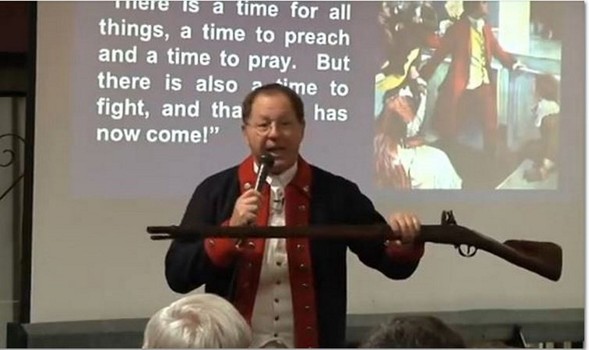
My hunch is that most of these respondents think of “Christian America” as a conservative concept, something along the lines of David Barton’s Wallbuilders and Representative Fisher’s Black Robe Regiment. In short, this strain of conservative thought emphasizes that the United States was founded by Christians, for Christians. The Founding Fathers, that is, were guided explicitly by Christian ideas and they never intended for any sort of wall of separation to be built. Judges should be free to have the Ten Commandments prominently displayed in their courtrooms. Town meetings and football games should be free to start with a prayer. Currency should continue to Trust in God. And so on.

Was America founded as a Christian nation?  Should we make it official?

Was America founded as a Christian nation? Should we make it official?

As I argue in my new book, this kind of Christian patriotism has had a long and strong pull on the conservative imagination. In the 1930s, for example, big-business groups such as the National Association of Manufacturers trumpeted the connection between religiosity, democracy, and free enterprise.

Traditionally, however, conservative Christians have always taken the lead on maintaining a strict separation between government and religion. In the aftermath of the Supreme Court’s 1962 Engel v. Vitale decision, for example, many conservatives jeered, but conservative evangelicals cheered. Secular conservatives like Herbert Hoover declared that the Court had just killed public education. But religious conservatives like William Culbertson of the Moody Bible Institute thanked the Supreme Court for its “protection in this important area.”

In that decision, of course, SCOTUS ruled that state governments could not impose a prayer on public schools. For some conservatives, that meant that the Court had kicked God out of the public square. For religious conservatives, it meant that religious belief and practice could never be dictated by a government body.

Which brings us back to this curious recent poll. Among the front runners for the GOP nomination, Governor Huckabee leads, along with Dr. Ben Carson, as the most religious of the conservatives. One might think that Huckabee’s supporters would be horrified at the idea of establishing a national religion. ANY national religion. But that is clearly not the case. As the demographics suggest, younger conservatives seem more comfortable with the idea of establishing Christianity as the national religion.

Maybe they know something we don’t. My guess, though, is that these young conservatives have a new understanding of “Christian America.” Unlike their grandparents and great-grandparents, conservative Baptists today do not seem convinced that their first job is to keep the government at arm’s distance.

Religious Students, Secular Schools

HT: HH

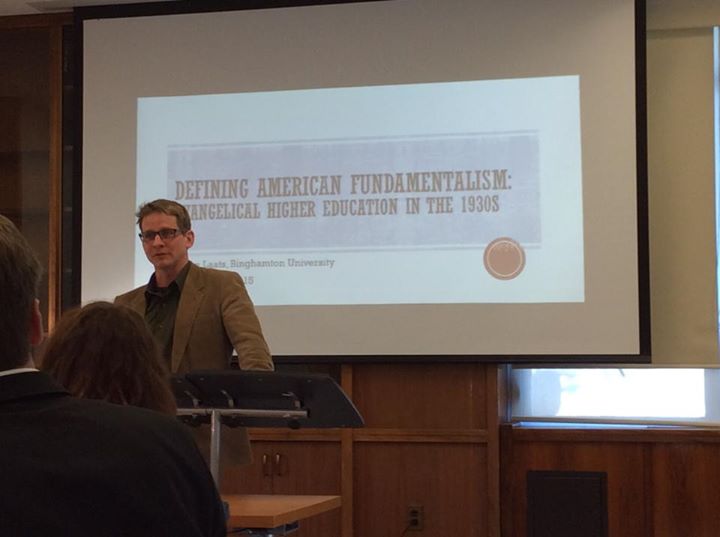
Thanks to all those who came out Wednesday to participate in my talk at Binghamton University about fundamentalist colleges in the 1930s.  Not only was a good time had by all, but the conversation made clear that even at this, our most “secular” of colleges, religion is thriving.  Despite the ignorant nostrums of elite secular academics and fuming fundamentalists, conservative religious students and faculty seem to thrive at pluralist schools like ours.

Don't hate me  because I'm beautiful...

Don’t hate me because I’m beautiful…

For those who are just tuning in, this talk was part of our series in “Religion in the Modern University.”  I shared my current research into conservative evangelical colleges.  The conversation after the formal talk revealed that both students and faculty at our beloved public university come from all sorts of religious backgrounds, including conservative evangelical Protestantism.

Unlike the schools I’m studying, our “secular” college does not actively encourage any specific sort of religious belief.  Nevertheless, our school proves a congenial home for students and faculty who hold conservative evangelical beliefs.

This flies in the face of some common assumptions about secularism and higher education.  As sociologist Elaine Howard Ecklund found in her study of elite secular academics, many of them have absolutely no idea of the high level of religious belief at their own non-religious elite universities.

Fundamentalists, too, have long assumed that “secular” colleges were hostile to their sort of religious belief.  As fundamentalist college founder Bob Jones Sr. was fond of saying in the 1920s, he would

just about as lief [sic] send a child to school in hell as to put him in one of those institutions.

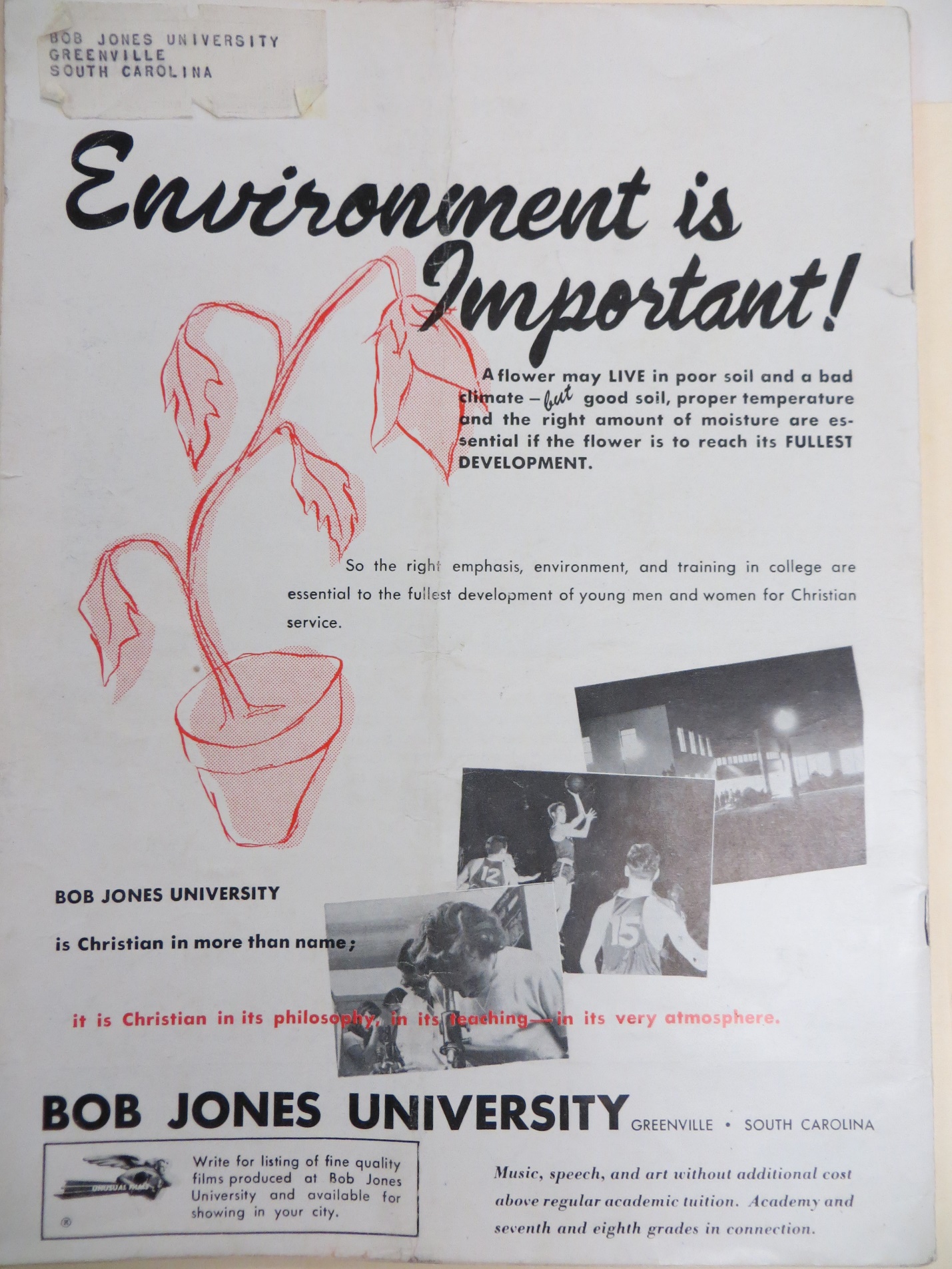
At Bob Jones University, as at other fundamentalist universities, this notion that only a truly fundamentalist school can protect students’ faith remained central throughout the twentieth century, as this 1956 advertisement demonstrated.

Fundamentalist students, fundamentalist schools

Fundamentalist students, fundamentalist schools

More recently, too, creationist leader Ken Ham took me to task for questioning his insistence that creationist families must send their children to young-earth-friendly colleges.  As Ham concludes,

at the very minimum I do urge parents to ensure they do all they can to equip their children to be able to defend the Christian faith against the attacks of our day, and to stand uncompromisingly on the authority of the Word of God.

Does that mean that religious students need to go to schools that share their faith?  I don’t think so.

I certainly understand the many differences between a pluralist school like our beloved Binghamton University and schools with a unified religious message.  But we need to remember that so-called “secular” colleges like ours are often very friendly places to creationists and fundamentalists.

OK: AP not OK

What does creationism have to do with the Continental Army? What does George Washington have to do with the Genesis Flood? This week the news from Oklahoma gives us an example of the ways conservative ideas influence every classroom, not just the science labs.

We will have more success understanding those ideas if we see them as part of a conservative notion of proper education. These are not just ideas about science, or the Book of Genesis, or George Washington at Valley Forge, but they combine all these things into a powerful educational impulse. As I argue more extensively in my new book, in order to make sense of any aspect of educational conservatism, we need to look at it as a whole, not just as a series of separate incidents.

First, let’s look at the goings-on in the Sooner State. Representative Dan Fisher has introduced a bill that will challenge the teaching of Advanced Placement US History in Oklahoma’s public schools. Why? As do many conservatives, Fisher believes that APUSH teaches a warped, slanted, leftist view of America’s past. The new APUSH framework, Fisher explains, emphasizes “what is bad about America.”

Fisher wants to blast progressive history out of Oklahoma's schools.

Fisher wants to blast progressive history out of Oklahoma’s schools.

Fisher is not alone. As we’ve explored in these pages, conservative activists have lashed out at the new APUSH framework. I’ve argued also that many conservatives see these AP standards as only the latest efflorescence of a vicious left-wing assault on real American history. These conservative notions about sneaky progressive subversion in history classrooms have a long history themselves, as I describe in the book. At least since the 1920s, conservative thinkers and activists have lambasted history curricula as hopelessly skewed. Children learn that the USA has been built on a legacy of greed and genocide. Children learn that traditional heroes such as George Washington and Thomas Jefferson have feet of clay, or worse.

Representative Fisher, for instance, is a member of the Black Robe Regiment, according to the Tulsa World. As do many religious conservatives, this group ties together a romantic history of the United States with conservative attitudes about Scripture and religion. In those connections we catch a glimpse of the ways conservative thinking about education can link creationism with US History.

I want to be careful about what I’m saying here. I’m not arguing that there is some sort of vast underground conservative conspiracy connecting creationism with Fisher’s anti-APUSH activism. Nor am I saying that Fisher’s brand of religious conservatism is somehow the most real sort of conservative attitude about education. There are plenty of conservatives who will have no truck with this kind of religious and traditionalist interpretation of America’s past. But I do believe that deeply held attitudes about proper education fuel both creationism and Fisher’s sort of historical revanchism.

What’s the connection? At its heart, I suggest that this sort of conservatism springs from a notion that real education must come from a delivery of correct information from authoritarian sources to learners. That is, many conservatives—perhaps a better word would be “traditionalists”—believe that education must be a transmission of truth from top to bottom. That truth, if we back it up to its source, must come from God as the ultimate authority.

Perhaps this definition of proper education as the delivery of truth to each new generation seems unobjectionable. It is not. For about a century, educational thinkers have suggested that this “transmission” method is not good education. These “progressive” reformers have tried to impose instead an idea that students must construct knowledge on their own, not merely accept it or download it from authoritarian sources.

In the specific case of the new APUSH framework at issue in Oklahoma, historians have insisted that historical learning does not simply mean transmitting facts to children. And smart conservatives acknowledge that real education includes much more than just telling young people things that are true. But at its core, we might separate “traditionalist” from “progressive” ideas about education along these lines: Traditionalists think of education primarily as moving information from authoritative source to learners. Progressives think of education primarily as having learners construct knowledge.

With this sort of general attitude about education and knowledge, it’s easy to see the connections between creationism and the Continental Army, between George Washington and the Genesis Flood. For some religious conservatives, including apparently Representative Fisher of Oklahoma, knowledge about any subject must rely on traditional truths. Those truths have been delivered to us from on high. Proper education, in this mindset, consists of passing those truths along, not subjecting them to smarmy and self-satisfied criticism.

Conservatives, Evolution, and “The Question”

“Do you believe in evolution?”

That’s the question GOP presidential candidates dread. Governor Scott Walker of Wisconsin is the latest to hem and haw his way through an awkward press conference on the subject.

Of course, some GOP contenders have no need to fear. Ben Carson, for example, is a loud and proud young-earth creationist. But other potential nominees have had to dodge, duck, dive, and dip when the question comes up. Bobby Jindal, a former biology major at an Ivy League college, has confessed that he wants his own children to learn evolution. That doesn’t mean schools must teach it, though. Jindal wants “local schools” to decide what’s right for them. And Marco Rubio famously told GQ magazine that he was “not a scientist, man.”

Walker is the latest GOP notable pressured to answer “The Question.” At a London press conference, Walker did his best to avoid it. In the end, though, Walker felt obliged to clarify that he strongly believed that humanity was created by God, and that faith and science are compatible.

It has become such a staple of GOP press conferences that conservative pundits cry foul. Writing in the pages of the National Review, for example, Jonah Goldberg says these evolution questions are a cheap stunt, a way to make conservative candidates squirm. As Goldberg put it,

To borrow a phrase from the campus left, Darwinism is used to “otherize” certain people of traditional faith — and the politicians who want their vote.

As fellow conservative writer Kevin D. Williamson correctly pointed out, leading mainstream scientists will also insist that they don’t “believe in” evolution. Rather, they simply know it; they take it to be the best current explanation and model for understanding the way species have changed and developed.

Yet no matter how you slice it, “the question” has become a defining feature of Republican presidential candidates. Even candidates who seem personally to embrace mainstream evolutionary science are loath to alienate conservative religious voters. For many of those religious voters, evolution has become a moral litmus test, not just a statement of personal belief.

Evil and a Young Earth

It’s one of the oldest and toughest questions for monotheists. If God is all-powerful, and the world has evil in it, then God is responsible for that evil. Creationist leader Ken Ham recently argued that only a young-earth attitude can explain away this problem of theodicy.

Ham was reacting to a viral video of Irish comedian Stephen Fry. (Youtube has since taken the video down due to copyright claims.) In the interview, Fry blasted God as evil, capricious, and flat-out monstrous. “Because,” Fry explained,

the God who created this universe, if it was created by God, is quite clearly a maniac, utter maniac. Totally selfish. We have to spend our life on our knees thanking him?! What kind of god would do that?

Of course, theologians and atheists have wrestled with this challenge for centuries. Ham, the well-known leader of Answers In Genesis, explained recently that other forms of creationism could not handle the challenge.

Intelligent Design, Ham argued, fails because it argues only for a vague creator. If there is only a bland, inexact creator, then Fry’s challenge is correct. He, or She, or It, must have created everything, including evil.

Other creationists just don't get it...

Other creationists just don’t get it…

Evolutionary creationism, too, can’t handle evil, according to Ham. The sort of creationism embraced by the BioLogos folks stumbles in the face of Fry’s challenge, Ham says. “If God did use millions of years of evolutionary processes,” Ham wrote,

then He is responsible for all the death, suffering, disease, extinction, pain, cancer, and other evils in this world.

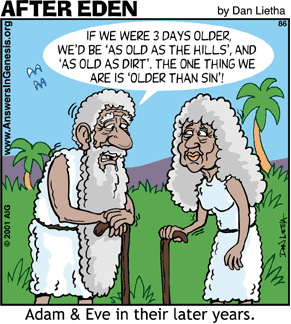
Only a young-earth approach gives a satisfying account of the origins of evil. In Genesis, as Ham reads it, God’s original creation was evil-free. Only when the sinful choices of Adam & Eve introduced evil into the world did things go awry.

For this to make sense, Ham says, we need a real, literal Adam & Eve. We need to take God at His Word. Otherwise, jokers like Fry have the last laugh.

“Enablers of Doubt:” What Do Science Teachers Learn about Teaching Evolution?

Creationists have an easy task. They don’t need to disprove evolutionary science. All they really need to do in public schools is create a reasonable doubt in students’ minds that evolution is the best available scientific explanation. That’s the argument, anyway, made in a recent article by political scientists Michael Berkman and Eric Plutzer. More interesting, from their point of view, are the ways science teachers learn to create that kind of reasonable doubt.*

You may remember Berkman and Plutzer from their terrific book, Evolution, Creationism, and the Battle to Control America’s Classrooms. You may also remember that Professor Berkman will be making a trip up to scenic Binghamton University next month to address our Evolution Studies Program. He’ll be talking about the new research from his new article.

For those who can’t make it up to Binghamton on March 30, you can check out the argument in the pages of The Annals. In evolution education, B&P argue that anti-evolution forces have acted similarly to tobacco companies or climate-change denialists. In each case, they write,

determined political actors have been able to force a stalemate—or even achieve a victory—on an issue by calling into question scientific consensus.

In other words, creationists these days can win merely by playing strategic defense.

Not teaching the controversy, avoiding the controversy

Not teaching the controversy, avoiding the controversy

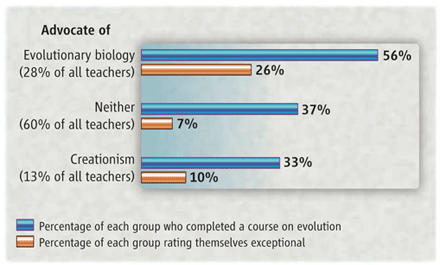
In their earlier survey work, B&P discovered that a large minority of high-school science teachers (28%) teach evolution as the only science game in town. A smaller minority, around 13%, teach creationism as science. The big middle group tended to teach a mish-mash of watered-down evolutionary science mixed with creationism-friendly ideas.

Using a new batch of focus-group data, B&P asked new questions:

How is it possible that young people who major in a scientific field and desire to be science educators lack confidence in their understanding of a central principle of modern biology? Where do teachers develop their belief that they are obligated to be “fair” to nonscientific accounts of creation? And how critical is personal faith in the development of the pedagogical choices that they will make over many years in the classroom?

To find out, B&P conducted focus-group interviews at four different sorts of colleges in Pennsylvania. They interviewed groups of students who planned careers as science teachers.

Significantly, B&P found that pre-service teachers had a shaky hold on evolutionary science, even though they often majored in biology. When the teachers looked ahead to possible future controversies in their own classrooms, an overwhelming majority of pre-service teachers expressed confidence that they could handle any controversy by using better classroom management techniques, not better science. As B&P put it,

The impression we got is that classroom management techniques and skills to negotiate controversy were aspects of professional capital that students felt they needed to absorb, internalize, and have at the ready. They understood that the content of science was also critical in any encounter with a skeptical parent or community member, but they did not feel they needed to own the content in the same way that they needed to become masters of management techniques.

Even when they knew the science and wanted to teach it, many of the pre-service teachers B&P interviewed seemed nervous about provoking any sort of controversy. As student teachers and then new teachers, their main goal was often to avoid attracting negative attention.

If a controversy did arise, pre-service teachers imagined they could take shelter behind their state’s standards or their district’s curricula. Without exception, the teachers-to-be insisted they did not want to become culture warriors in their classrooms. As B&P put it,

their primary identification as educators rather than scientists suggests that they are relatively passive recipients of arguments and political communication from elites and groups trying to shape popular opinion.

In short, teachers are people. As B&P argued in their 2010 book, teachers’ values tend to reflect the consensus values of their school communities. If they teach in a town in which large numbers of people are favorable to creationism, teachers will also be favorable to creationism.

Perhaps more important, teachers are people with very public jobs. Contrary to culture-war presumptions that teachers are somehow trying to undermine or subvert students in one way or another, most teachers are concerned with avoiding controversy.

As Professors Berkman & Plutzer conclude in this article, we are stuck too often in a “feedback loop” of evolution education. Student teachers didn’t learn much evolution in school, because teachers tended to avoid controversial issues. They don’t wrestle with issues of faith and doubt at public universities, since such issues are largely seen as religious, not scientific. As pre-service teachers, students are more concerned with studying nuts-and-bolts classroom issues, not basic science. And when they do their student teaching, they don’t often see classroom teachers wrestle with evolution in their classrooms.

Teachers become “enablers of doubt,” in other words, because anything else might stir up a hornet’s nest of controversy.  And almost all teachers are more interested in getting along with students and parents than in provoking controversy.

*The article requires a subscription to read the whole thing. If you don’t have access to a university library, ask your local public librarian to scour their databases. Many public libraries these days subscribe to pretty broad academic journal databases. Here’s the full citation to look up: Michael B. Berkman and Eric Plutzer, “Enablers of Doubt: How Future Teachers Learn to Negotiate the Evolution Wars in their Classrooms,” The ANNALS of the American Academy of Political and Social Science, March 2015, vol. 658 no. 1: 253-270.

Do Teachers Have the Right to Be Wrong?

How do we draw the line? How do we know when to punish a teacher for being wrong and when to insist that teachers have a right to express their views on controversial topics? A new bill in Montana again insists that creationist teachers should have legal protection to teach their views. Nor is this simply a Montana question. From its headquarters in Seattle, the Discovery Institute has proposed a model bill for legislatures nationwide. From Alabama to Colorado, Florida to South Dakota, lawmakers have offered similar bills.

The basic argument is the same: Teachers must be allowed to teach the full range of ideas about evolution and the origins of life. Should they? And if they shouldn’t, why not?

These are not easy questions, though they might seem so at first. Opponents of these sorts of creationist “academic freedom” laws scoff that no teacher has the right to tell students things that aren’t true. Supporters, on the other hand, might insist that this is a simple question of teachers’ rights to academic freedom.

Neither of those positions captures the complexity of the situation, though. For those of us who oppose these bills, it seems obvious that teachers must not be allowed to tell students things that are not true. As Glenn Branch of the National Center for Science Education put it, Montana teachers do not have the right to teach “bunk.”

The hard question, though, is who decides on the definition of bunk, and how. Historically, we’ve seen teachers persecuted for unpopular political beliefs. As historian Clarence Taylor has described, in the early 1950s eight New York teachers were fired for their leftist sympathies.

Throughout the twentieth century, as I argued in my new book, progressive teachers and school administrators struggled to protect their rights to their political opinions. These educators insisted on their right to hold controversial opinions. More pertinent, they insisted on their right to teach students about these ideas.

In hindsight, it’s clear that the rights of these teachers were egregiously violated. What’s worse, the climate of public education as a whole was degraded by these educational witch-hunts. Only a few teachers were actually purged, but a climate of fear pushed teachers and students to hew more closely to the patriotic party line. That’s not good education.

So creationists ask: Aren’t these bills protecting the same right? Don’t creationist teachers have the right to present all sides of scientific questions about origins?

Yes and no. As philosopher Harvey Siegel and I argue in our upcoming book, creationist teachers and students DO have enormous rights in public-school classrooms. Too often, evolution mavens get too wrapped up in winning culture-war battles to admit it. Far too often, science teachers imply that students need to believe evolution; earnest teachers want students to acknowledge the fact that real knowing means abjuring supernatural explanations of events. Creationist students have every right to dissent from such beliefs. If students want to believe that the earth is 6,000 years old, or that the earth is a floating turtle, or any other sort of thing, they have every right to do so.

Public schools must welcome a plurality of religious beliefs. Creationists—teachers and students alike—must be defended in their quest to protect their faith from assault, even if that assault is only implied or suggested.

By that same token, however, these sorts of academic bills fail on two counts. First, students in public schools have the right to be protected from religious indoctrination. No teacher may preach religious doctrine. Though creationists might howl in protest, even the most intelligently designed creationist bills have religious goals. Instead of protecting teachers’ rights to teach controversial subjects, in effect these sorts of academic freedom bills protect a non-existent right to preach a certain religion-friendly doctrine in public-school classrooms.

Second, students in public schools have the right to learn the best ideas available. When issues are truly controversial, students must be exposed to those controversies. But when ideas are not controversial, students must not be forced to mull false ideas as co-equal to truer ones.

This is not only an evolution/creation idea. In history classes, for example, students should not learn that the South won the Civil War. Or that most enslaved people preferred bondage to freedom. These ideas are held by lots of people, but that doesn’t make them just as true as other historical ideas.

Teach the controversy?

Teach the controversy?

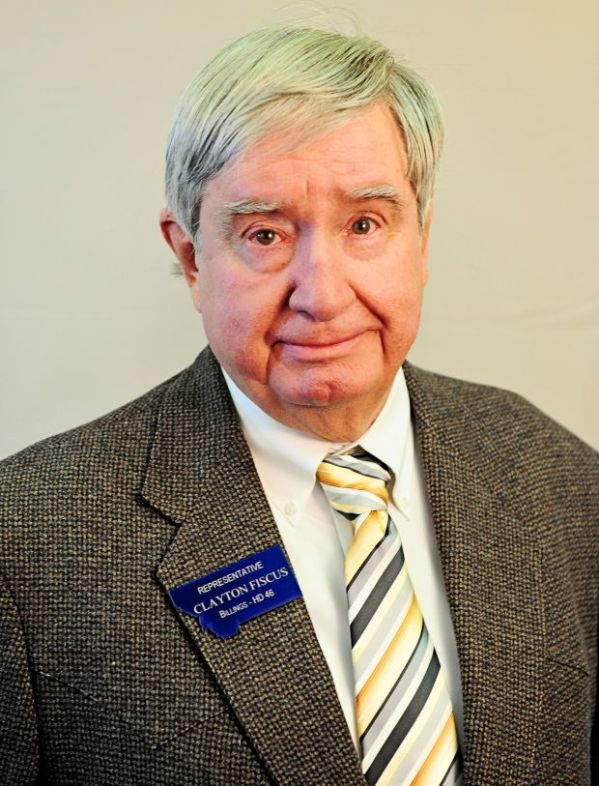
In science classes, the sorts of dissent that people such as Montana legislator Clayton Fiscus wants to protect are not equally scientifically valid. True academic freedom does not include the right to offer worse scientific ideas as equal to better ones. True academic freedom does not include the right to preach religious ideas as facts.

So do teachers have the right to be wrong? Yes, indeed. But they do not have a right to encourage students to believe any particular sort of religious belief. Nor do they have the right to pretend two sets of ideas are equally valid when they are not.

Spanked with the Bible Belt

Well, fry my biscuits;…things really are different down here. Historians have gone to great lengths to disprove the common misconception that fundamentalism is somehow only a southern thing, or only a rural thing. But there IS something profoundly different about Southern rural fundamentalism.

Go tell it on the mountain...

Go tell it on the mountain…

For those who are just joining us, I’m spending this year traveling to conservative evangelical colleges to research my next book, thanks to funding from the generous Spencer Foundation. Right now, I’m in scenic Lynchburg, Virginia, home of Liberty University. When I rolled into town, I saw something that blew my mind. No, it wasn’t the huge “LU” sign that had taken over a mountainside. I expected that.

Since the mid-1970s, academic historians have thrown out some old myths about American fundamentalism. Led by scholars such as George Marsden and Joel Carpenter, the new generation of histories no longer insist that fundamentalism is an outgrowth of hillbilly religion. Rather, fundamentalism has thrived in America’s biggest cities as well as in its rural hollers.

Consider my itinerary for this research year. To figure out what fundamentalism has meant across the twentieth century, I’ve traveled to schools such as Biola, Wheaton, and Gordon College. I plan to head to The King’s College and the Moody Bible Institute. My travels will take me to Los Angeles, Chicago, Boston, and New York City. Those are nobody’s ideas of rural backwaters. And yet they are the intellectual and spiritual headquarters of much of the fundamentalist movement.

Creationism in the lobby...

Creationism in the lobby…

Fair enough. But there is something different about things down here in the South, something different outside of bigger cities. Not only did I drive along Jerry Falwell Parkway to get here, but the lobby of my boring corporate hotel held a big surprise. The books for sale included the standard stuff about horses, cats, and jokes for kids, but there were also a lot of prayer, psalm, and Bible books. Even more remarkable, the shelf included relatively radical creationist books such as Ray Comfort’s Scientific Facts in the Bible.

This is the kicker: Sure, fundamentalism can thrive in big cities. It can certainly thrive in the North. But down here in the South, outside of big cities, fundamentalism becomes the usual fare. It becomes the accepted norm, not just one way to be religious. Even a non-religious, totally vanilla environment such as my hotel lobby offers books that prove the scientific veracity of the Bible.

...and horses.

Satan, Demons…and horses.

My hunch is that our so-called Bible Belt refers to those parts of our great country in which conservative Protestantism is something people assume they all share. It refers to those places where your new neighbor will ask you when you move in if you’ve found your church yet. It refers to those places where people think the “real” America is much whiter and more born-again Christian than it really is.

That’s my impression, anyway. I was raised in Boston, in a non-religious household. I’m guessing people more intimately familiar with life in the “Bible Belt” will know more about this sort of thing.