Atheists and Creationists Agree on This…

You know what they say about the middle of the road: you won’t find anything there but yellow stripes and dead armadillos. In the creation/evolution debates, the John Templeton Foundation has staked out some ground in that dangerous middle. And predictably, the only thing that fervent creationists and obstreperous atheists can agree on is that the Templeton Foundation is terrible.

What does the Templeton Foundation do? According to their website, the foundation

serves as a philanthropic catalyst for discoveries relating to the Big Questions of human purpose and ultimate reality. We support research on subjects ranging from complexity, evolution, and infinity to creativity, forgiveness, love, and free will. We encourage civil, informed dialogue among scientists, philosophers, and theologians and between such experts and the public at large, for the purposes of definitional clarity and new insights.

In general, the foundation uses its money to encourage dialogue between religion and science. With its prizes and grants, it encourages people to bridge the gap. For instance, the foundation provided millions of dollars to help launch BioLogos. How might scientists and theologians come together, BioLogos asked, to help evangelical Christians (and others) understand that evolution was nothing more than the “Language of God?”

Is "compromise" a compliment or a curse?

Is “compromise” a compliment or a curse?

Here at ILYBYGTH, this seems like an eminently worthwhile project. Time and time again, we have seen that science and evolution can wear very different cultural faces. Why bundle together ideas that do not necessarily have to go together? Why feed conservative worries that any understanding of science will somehow doom their children to atheism and immorality? Why not help Christians learn evolution? Why not recognize that some “creationists” really do embrace evolution? Why not listen to the life stories of Christians who have learned that evolution is not the devil spawn they were led to believe?

Partisans disagree. The Templeton Foundation has become the target of angry attack from the hardened edges of both creationism and atheism.

At the young-earth creationist ministry Answers In Genesis, for instance, leader Ken Ham recently blasted the efforts of the foundation. “Sadly,” Ham warned readers,

instead of pointing people to answers from God’s Word about history, organizations like BioLogos and the Templeton Foundation are actively discrediting the Bible’s history. Instead of encouraging people to start with God’s Word, they praise those who impose man’s ideas into the Bible.

Ham might not agree with science pundit Jerry Coyne on much, but they agree about the dangers of the Templeton Foundation. For different reasons, of course. Coyne blasts the foundation for watering down the message of real science, of truckling to culturally powerful and wealthy religious aficionados. “If there is to be interchange” between scientists and theologians, Coyne wrote recently,

let it be not a constructive dialogue but a destructive monologue, one in which science’s efforts knock the props out from under faith, one by one. And religion has nothing to say to scientists, at least nothing that will help us in our work. All religionists can do is educate us about the nature and influence of divine fairy tales that have inimically influenced world culture. Do we really need that?

Now, just because the Templeton Foundation has united both atheists and creationists against it doesn’t prove that the foundation is doing the right thing. But it seems logical to me that if our goal is to help people of every background understand the science of evolution, we should not spurn allies who promise to help. If theologians and scientists can come together to improve public understanding of what the Templeton Foundation calls the “Big Questions,” it seems to me an excess of self-righteousness to oppose it.

Here’s How We Get a Creationist in the White House

It will take more than six twenty-four hour days. Months ahead of time, the team to put Ben Carson in the White House has been assembled and is feverishly working to get a solid creationist in the White House in 2016.

As Eliana Johnson reports in National Review Online, Carson hasn’t announced his candidacy, but his team is now interviewing thirty-five potential staffers for a possible White-House run. When Johnson asked Carson if he were serious, Carson dodged. “We believe in being prepared,” Carson said,

And that requires a sophisticated and complex infrastructure if I decide to run. . . . It’s like the Boy Scouts: Be Prepared.”

Does Carson think he can win? He told Johnson that the recent mid-term elections pushed him closer. “People are starting to wake up,” Carson told her.

Conservatives love Carson. His rags-to-riches tale and unapologetic religious conservatism, along with his stop-complaining messages to his fellow African Americans, have endeared him to the conservative wing of the party.

That doesn’t mean he has a chance. In the past, conservative hard-liners have entered the primaries even if they don’t think they’ll win. Their goal, in some cases, has been to move the party in a more conservative direction. By running as an unyielding social conservative, Carson will force other GOP hopefuls to tack toward the right.

And whether he wins or not, Carson will bring a dose of good old-fashioned Seventh-day Adventist creationism to the race. Seventh-day Adventism, as historian Ron Numbers argued so convincingly, played a leading role in converting American religious conservatives to a young-earth creationism.

Have you read it yet?

Have you read it yet?

Of course, just because Carson is a member of that staunchly young-earth creationist denomination, it doesn’t mean that he would emphasize those beliefs from the White House. After all, similar fears were raised by conservatives when Catholics such as Al Smith (1928) and John F. Kennedy ran for President. Each candidate had to assure voters that policy would not be dictated from the Vatican.

But Carson has taken a different approach. Instead of distancing himself from the rather extreme form of creationism that is official dogma in his church, Carson has publicly embraced it. In an interview last year, Carson doubled down on his SDA creationism. “I’ve seen a lot of articles,” Carson explained,

that say, ‘Carson is a Seventh-day Adventist, and that means he believes in the six-day creation. Ha ha ha.’ You know, I’m proud of the fact that I believe what God has said, and I’ve said many times that I’ll defend it before anyone. If they want to criticize the fact that I believe in a literal, six-day creation, let’s have at it because I will poke all kinds of holes in what they believe. In the end it depends on where you want to place your faith – do you want to place your faith in what God’s word says, or do you want to place your faith in an invention of man. You’re perfectly welcome to choose. I’ve chosen the one I want.

Maybe I’m viewing the world through evolution-tinted glasses, but I can’t help but think that such a firm statement of YEC belief will be off-putting for many voters. But even if Carson can’t win the race, he can pull his fellow Republican prospects into more firmly creationist positions. By standing firm on a six-day recent creation, Carson can make the entire GOP field friendlier to creationism.

Take a Trip to a Science Museum with a Creationist

“See, fossils!  That’s science.”  So says Megan Fox, self-identified creationist homeschool mom, Tea Partyer, blogger, and Latest YouTube Sensation.

We’ve taken plenty of museum trips here at ILBYGTH: to the Institute for Creation Research’s museum in San Diego, to the big Creation Museum in Kentucky, and even to a medley of creation and mainstream science museums.  Now there is a new option: Take a trip to Chicago’s Field Museum with Megan Fox.  In this half-hour video, Fox explains all the problems with mainstream science.

Plenty of commentators have blitzed Mrs. Fox with insults.  More interesting will be an attempt for those of us outside the creationist community to find out what this creationist thinks about mainstream science.

I’m no creationist-basher, but Mrs. Fox does seem to have an unpleasantly loud and in-my-face personality.  Predictably, bloggers have teed off on her “expose” of mainstream science at the Field Museum. Atheist PZ Myers called Fox “Smug and Stupid.” At Dangerous Minds, she was called a “blithering idiot,” and worse.

I would imagine that many of the intelligent creationists out there wouldn’t have chosen Fox as their ideal spokesperson. But what if we watch her museum tour as a chance to learn more about her creationist vision of science? Historians have worked hard—maybe too hard—to explain the philosophical underpinnings of creationist and Protestant fundamentalist science.

Many agree with George Marsden, who has argued that at heart, fundamentalist science hearkens back to the scientific principles laid down in the 1600s by Francis Bacon. As Marsden wrote in Fundamentalism and American Culture (2006 edition, pg. 59):

the role of the interpreter, according to the same Baconian assumptions, was not to impose hypotheses or theories, but to reach conclusions on the basis of careful classification and generalization alone.

Other historians have agreed. Mark Noll, for example, argued in The Scandal of the Evangelical Mind (pg. 197),

Creationists regularly reaffirm the principles of Baconian science: no speculation without direct empirical proof, no deductions from speculative principles, no science without extensive empirical evidence.

Perhaps the most careful student of conservative Protestant encounters with mainstream science, Jon Roberts, argued similarly in his 1988 book Darwinism and the Divine in America (pp. 41-42 of that first edition from the University of Wisconsin Press),

Nonscientists were also enamored of the Baconian method, for they believed that it was the surest route to the certainty they associated with science. Asa Mahan, a prominent philosopher who served as the first president of Oberlin College, presented in 1872 a typical statement of the prevailing view within the American Protestant intellectual community: ‘Science is knowledge systematized. Into a scientific process, nothing but what is absolutely known can enter.’

Is this what Megan Fox is doing? More interestingly, which term fits Fox better: “blithering idiot” or “Baconian loudmouth”?

I think a better term for Fox’s scientific vision is one used by historian Ted Davis. Though the roots of Fox’s attitude toward proper science may have originated in Baconian principles, it seems misleading to suggest that Fox selected a Baconian framework out of thin air. Like most of us, Fox’s ideas of proper science seem to come from a mix of sources, some of them only dimly understood.

So, instead of calling Fox “Baconian,” I think we should use Davis’s label of “folk science.” As Davis explains, the term came from Jerome Ravetz, Scientific Knowledge and Its Social Problems (1971).

Of course, it is not only creationists who practice “folk science.” As Dan Kahan argues, there is not much daylight between creationists and non-creationists when it comes to actual knowledge about evolution. Most of us have only the vaguest grasp on the real meanings and implications of mainstream science. Unlike Mrs. Fox, however, most of us are willing to learn mainstream science when we go to the Field Museum, not try to pit our folk-ish understandings against the efforts of mainstream science educators.

HT: GB

Asking the Right Questions about Creationism

Is America a “creation nation?” Or have polls tended to inflate the numbers of creationists out there? In an effort to give a more nuanced answer to these questions, BioLogos has published Jonathan Hill’s survey results. Hill offers some powerful insights into central questions:

  • How many Americans really believe in creationism, evolution, or some mix?
  • Who cares the most about it?
  • Who cares at all?
  • And, most important, what factors go into making someone a creationist or an evolution supporter?

You may have seen this report referred to in Emma Green’s recent Atlantic article. Until now, however, you wouldn’t have been able to read the report for yourself. Green’s article had the provocative title “You Can’t Educate People into Believing in Evolution.” True enough, but that’s not news to readers and contributors to ILYBYGTH. Those who take time to read what’s out there about creationism know that creationism is not simply a lack of knowledge about evolution. Rather, creationism is better understood as part of a religious identity.

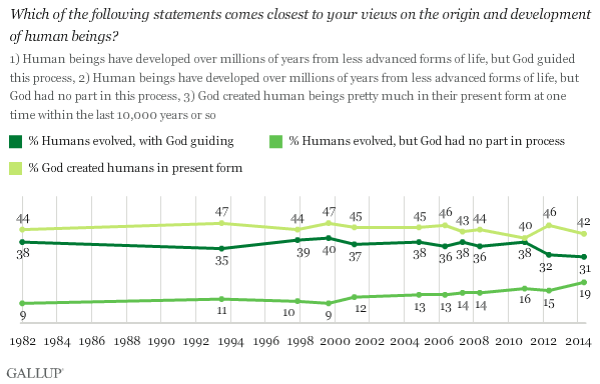
Professor Hill was funded by a BioLogos grant to conduct a large representative survey in the USA. He found that the typical Gallup polls seem to distort the numbers. In those repeated Gallup polls, respondents have three options: (1) humans evolved guided by God, (2) humans evolved on their own, and (3) humans were created within about 10,000 years. In those polls, since the 1980s about 40-45% of respondents have chosen the “young-earth creationist” answer (3). Somewhere between 9-19% have selected the “atheistic evolution” answer (2), and the rest chose number one, the theistic evolution model.

Gallup Questions and Answers

Gallup Questions and Answers

As even the Gallup folks would likely agree, these positions are not very subtle. They don’t allow respondents to explain or describe their own beliefs. Rather, they push people to pick one of three limited options. Professor Hill’s survey allowed people to say they were unsure. It also asked respondents to address different aspects of these beliefs separately. Finally, Hill asked Americans to say how certain they were about their beliefs.

Not surprisingly, those questions yielded very different results. When people can respond to different aspects of creationism differently, they tend to be more nuanced in their responses. For example, in Professor Hill’s survey, only eight percent of people affirmed their belief in both six literal days of creation and the recent creation of humanity.

When taken together, Hill found that 37% of respondents were “creationists,” 16% were “theistic evolutionists,” and 9% were “atheistic evolutionists.” The rest held mixed beliefs or were unsure. When you limit these numbers to those who said they were “very” or “absolutely certain” of their views, then only 29% of respondents were creationists, 8% were theistic evolutionists, and only 6% were atheistic evolutionists.

Also intriguing, only those who hold creationist or atheistic evolutionist beliefs tend to be sure they are correct. They also tend to think it matters to be correct. About three-quarters of creationists said they were sure about their beliefs, and about two-thirds of them said that it mattered a great deal. Among atheistic evolutionists, about 70% were sure of their beliefs, and about half thought it mattered a good deal. In contrast, among those who were unsure about humanity’s origins, only about one quarter thought it mattered a great deal.

In our continuing sniping at one another over the issues of creation and evolution, these numbers themselves matter a great deal. Since large numbers of Americans don’t know about these issues and don’t really care, the debates quickly become dominated by those on either end who feel confident about their own beliefs and who feel sure that it is important to be correct on these questions. We might see a debate between Science Guy Bill Nye and creationist impresario Ken Ham, but we won’t be as likely to see a round-table discussion between people in the middle.

Professor Hill’s survey also buttresses another conclusion popular here at ILYBYGTH: creationism and evolution are not mainly about what you know. Rather, they are questions about who you are. People do not simply pick creationism or evolution out of a neutral grab-bag of ideas. Creationists do not tend to abandon creationism in large numbers when they learn the ideas of evolution. Rather, creationism and atheistic evolution both seem most prevalent among people with recognizable clusters of identity markers. As Professor Hill concluded,

The most important takeaway here is that individual theological beliefs, practices, and identities are important, but they only become a reliable pathway to creationism or atheistic evolutionism when paired with certain contexts or certain other social identities. These positions are not free-floating ideas that individuals snatch from the air after considering all the alternatives; rather, they are found in certain social locations, and they become most plausible when shared with others (especially for creationists).

Read the results for yourself. There’s far more in the report than we can discuss here. For example, the survey raises a host of questions that we want to know more about:

  • Why are atheistic evolutionists so white?
  • Is certainty more important than knowledge?
  • How can we motivate those who don’t really care about creationism to get more involved in public policy debates?

Is Sex Ed Religious Persecution? Is Evolution?

Am I persecuted if my kid is taught sex ed that goes against my religious beliefs?  That’s the question coming out of Arizona this morning.

And it has echoes far beyond the questions of contraception and sex ed.  If kids have a constitutional right to protection from ideas that challenge their religions, it will change the ways we teach evolution, history, literature…really, everything.  But so far, courts have generally not recognized conservatives’ claims of religious persecution. The good news is that there is a simple solution, though it’s one that everyone might hate.

But that doesn’t stop conservatives from making their cases.  As the New York Times reports, a new sex-ed textbook controversy is roiling school politics in Arizona.  Back in 2012, conservatives pushed through a state law mandating that adoption be given preferential treatment in schools.  That is, children in Arizona public schools have to be nudged toward thinking of adoption as a more moral choice than abortion.  An alert parent noticed that a commonly used biology textbook discussed contraception, including the drug mefipristone. According to the NYT, mefipristone can be used to terminate a pregnancy.

A pro-choice lemur...

A pro-choice lemur…

In Gilbert, Arizona, a suburb of Phoenix, the school board voted narrowly that the information violated the 2012 law. What to do? The Gilbert school board ruled that two textbook pages must be removed, somehow.

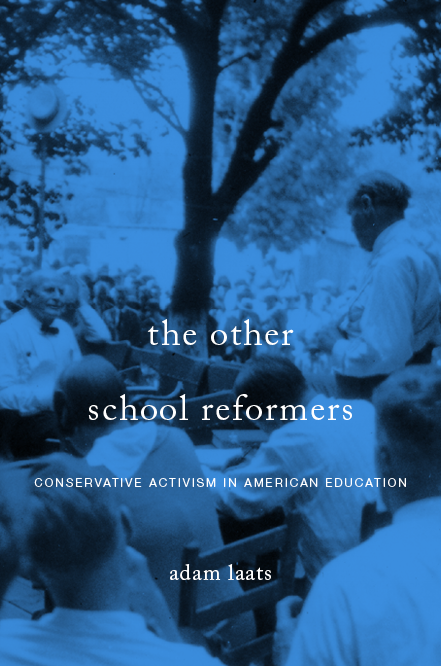
So far, so ho-hum.  In school controversies, textbooks have been snipped, blacked-out, removed, even burned.  What’s more, the narrative told by conservative school board member Julie Smith seems almost like pages from a tired old script. As I note in my upcoming book about educational conservatism in the twentieth century, nearly every conservative activist has told a similar story. From the 1920s to the 1970s, conservatives have insisted that they were floored by the salacious, socialist, or heretical material their kids brought home from school.

Mrs. Smith brings this tradition into 2014. As she told the New York Times, when her son told her what he was learning about contraception, “I almost drove off the road.”

But Mrs. Smith did not stop with this old chestnut. She also insisted that including this material in textbooks represented an unconstitutional abuse of her religious freedom. As she told the NYT, by having her son read about contraception, the schools “have violated my religious rights.”

Is Smith right? Do religious conservatives have a constitutional right to free exercise of religion in public schools? Is that right violated when public schools force students to learn ideas that contradict their religions?

This question received the most thorough examination in the tortuous path traced by the case of Hawkins County, Tennessee, in the late 1980s. Parents complained that textbooks promoted a bevy of anti-Christian ideas, including secular humanism and occultism. These conservative parents wanted to have their children exempted from reading such anti-religious material.

Mozert makes his case...

Mozert makes his case…

The conservative parents had some initial success in court, but eventually the 6th circuit court ruled against them. In the opinion of that court, the children did not have the right to protection from exposure to mainstream ideas. If the children had been forced to perform religious acts, the court ruled, the parents would have had a better case. But public schools have a duty, not just a right, to expose children to the best current knowledge about every subject, including presumably sex ed.

It’s not for me to tell conservatives what to do, but in this case, it seems Julie Smith is pursuing a losing strategy. Claiming to be religiously persecuted because children are exposed to mainstream ideas is not going to work. If, instead, conservatives could claim that their children were being forced to perform religious acts, conservatives would have a better case.

And, IMHO, contraception is not the right issue for conservatives to pursue with this strategy. Public schools don’t FORCE students to use contraception. Schools simply give students information about contraception.

Conservatives might have a better shot with evolution. Folks like me want to give every person in the United States more information about evolution. There is nothing religious about this goal. For me and other evolution mavens, evolution simply represents the best current science, and students must be exposed to the best current knowledge in every field.

The way I see it, exposing students to knowledge does not violate anyone’s religious rights. But here’s the kicker: The fact that I have a secular purpose in teaching evolution does not mean that evolution does not have religious meanings for others. Again, I don’t want to dictate political strategy to conservatives, but it seems to me creationists could have some success if they claimed that their children have a constitutional right to a certain sort of protection from evolutionary ideas in public schools. Not a right to be protected from hearing or reading those ideas. That would count as simple exposure.

But creationist kids WOULD have a right to be protected from performing religious acts in public schools. For some religious groups, saying that humans evolved from other animals is a religious act. For some religious groups, saying that the earth is billions of years old is a religious act.

In other words, IMHO, public schools have a right and a duty to expose all children to the best current knowledge in all fields. In biology, that means human evolution without any supernatural guidance. In geology, that means an ancient earth and cosmos. At the same time, however, creationist kids have a right to freely practice their religions. And they have a right to insist that the government does not push religious actions upon them. If their religion forbids them from saying that the earth is ancient, kids have a right not to be coerced into saying such things.

This may seem like an unsolvable situation, but there is a simple solution. Public schools and public school teachers have a simple two-word answer to all these conundrums. Instead of pushing students to say that the earth is ancient and that humans have evolved, teachers need only to help students to understand that scientists think these things to be true.

By letting kids say “Scientists say” humans evolved; by letting kids say “Scientists say” the earth is ancient, public schools protect themselves from charges of religious indoctrination. And at the same time, creationists get schools that will not be hostile to their faiths.

The bad news for Julie Smith from Gilbert, Arizona is that she cannot claim any similar sort of constitutional protection. Even if the fact that her son is learning about contraception causes her to drive her car off the road, the public school is not persecuting her by teaching such things.

A Brazillion Creationists Out There

How powerful is creationism worldwide? Some pundits have suggested that creationism is unique to the USA. But recent news from Brazil indicates that global creationism may be gaining steam.

The latest report from Brazil comes to us from the National Center for Science Education. Proposed legislation in that country would introduce US-style creationism to Brazilian public schools. My Portuguese is no good, but according to the NCSE report, this bill insists that schools include creationist science, including “the ideas that life has its origin in God, the supreme creator of the whole universe and of all things that compose it.”

Why? Because, in the words of the bill’s sponsor, “the creationist doctrine is prevalent throughout our country.”

Is it? Some science pundits, such as Bill Nye, contend that this sort of creationism is “unique” to the United States.

In this case, The Science Guy is flat-out wrong. Creationism—even if we limit it to just the Christian kind—is a global phenomenon. And the reasons for that globalism matter.

Pundits like Bill Nye might assume that creationism thrives in those corners of the globe that have not yet been incorporated into the global conversation. In some isolated regions, this theory goes, the obvious truths of evolution have not yet penetrated.

But that explanation gets it backward. The reason for thriving creationism in Brazil is not due to ineffective science education. It is due, rather, to explosively effective religious education. That is, Brazilian creationists are not simply religious primitives who have been isolated from the gospel of evolution. Instead, they are religious innovators who have been connected to a global gospel of creationism.

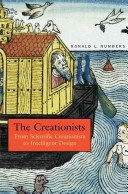
As usual, historian Ron Numbers—my grad-school mentor—put it best. In his book The Creationists, Ron captures this experience with a pithy chapter title: “Creation Science Floods the World.”

A growing force in Brazilian politics...

A growing force in Brazilian politics…

Throughout the twentieth century, conservative evangelical Protestants have successfully spread their religion throughout Latin America, finding a particularly congenial home in Brazil.

As a recent study from the Pew Research Center for Religion & Public Life makes clear, US-style evangelicalism has aggressively moved into Brazil, courting the country’s Catholics and converting them in large numbers.

For a hundred years, evangelical groups have spread via missionary organizations into Brazil. As Andrew Chestnut of Virginia Commonwealth University explains, groups such as the Assemblies of God have been particularly successful in Brazil. With this Pentecostal denomination, at least, Brazilian locals have taken over and made it their own. And they are now asserting their power politically.

For instance, the author of the recent creationist legislation, Marco Feliciano, is an Assemblies of God pastor. And he insists that Brazilians are on his side. Poll numbers back him up. According to the NCSE report, fully 89% of Brazilian respondents think creationism should be taught in Brazil’s public schools. Nearly that many, 75%, think ONLY creationism should be taught.

I’ve argued in the past that evolution educators often have a missionary zeal to spread the truth about evolution. This news from Brazil suggests that evolution’s missionaries are just not as good as the creationist types.

Firing Creationist Scientists

HT: AT

Can a scientist be fired for simply being a creationist? Or for teaching what Glenn Branch has called “zombie science?” In contrast to what sharp-tongued activists on both sides may say, the answer is not at all clear. The case of Mark Armitage in the California State University system brings these questions back to the fore.

Armitage, a microscopist formerly at Cal State Northridge, is suing his former employer for wrongful termination. Armitage had discovered some soft-tissue residue in a fossil from a Triceratops horn. Like many young-earth creationists, he took this as proof that the fossil layer was thousands of years old, not millions.

Though he left his creationist conclusions out of his peer-reviewed publications about the fossil, he did not leave those conclusions out of conversations with students. And, though Nature magazine could not get a satisfying answer from Cal State Northridge, it seems those conversations were the problem. Armitage was not accused of doing a bad job as a microscopist. That’s why he’s suing.

Armitage complains that he was fired for his religious beliefs. According to Armitage, he had always been open and forthcoming with his colleagues about his religious beliefs. He had always been praised for his work in the microscope labs. But he had also been open and forthright in sharing his views with students. And that seems to have been the problem. After one such conversation, Armitage claims that the department chair of biology “stormed” into Armitage’s microscope lab and roared, “We are not going to tolerate your religion in this department!!”

Does Armitage have a case? Can a public university fire a scientist for being a creationist? Or for teaching students creationism?

It seems as if it would be easier to decide these issues at the K-12 level, but the case of John Freshwater demonstrates how complicated it can be even there. Freshwater was an Ohio middle-school teacher fired for teaching creationism in a public-school science class. Freshwater hoped to appeal the case all the way to the Supreme Court. He didn’t make it, but the lower courts didn’t give us the satisfying precedent we might hope for. The Ohio Supreme Court avoided any decision about Freshwater’s constitutional right to his religious and academic views. Instead, the Ohio court decided against him due to his insubordination.

When it comes to teaching creationism in public higher ed, the case is even more fudgy. Consider the case of Emerson McMullen at Georgia Southern University. McMullen attracted negative attention from the Freedom From Religion Foundation for his blatant preaching of creationist religion in his history of science classes. The FFRF asked GSU to discipline McMullen, but the issue raises difficult questions of academic freedom. Even staunch anti-creationists such as PZ Myers and Larry Moran worry about this kind of college crackdown on creationists.

Even more confounding, the federal government does not seem to have any qualms about employing young-earth creationists as scientists. As we noted a while back, Douglas Bennett and Brent Carter worked for decades as geologists for the US Bureau of Reclamation, all the while actively promoting young-earth creationism.

Maybe the long government careers of Bennett and Carter provide the central clue. Maybe the government can employ creationists as scientists, but it can’t pay them to teach creationism as science. As far as I can tell, neither Bennett nor Carter taught anyone anything. And Armitage was fired, it seems, not for believing creationist ideas, but for teaching them as science.

Which returns us to our central question: Should public universities get rid of creationist scientists? Should they only get rid of them if the creationists in question actually teach creationism as science? Or should there be a more energetic inquiry into the scientific thinking of publicly funded scientists?

Are creationists the victims of religious persecution?  Jerry Bergman says yes...

Are creationists the victims of religious persecution? Jerry Bergman says yes…

For their part, creationists have long complained, like Mark Armitage, that they have been persecuted for their religious beliefs. Over thirty years ago, Jerry Bergman insisted that he had been fired from Bowling Green State University solely for his religion. As he argued in his 1984 book The Criterion,

Several universities state it was their ‘right’ to protect students from creationists and, in one case, from ‘fundamentalist Christians.’ . . . This is all plainly illegal, but it is extremely difficult to bring redress against these common, gross injustices. This is due to the verbal ‘smoke-screen’ thrown up around the issue. But, a similar case might be if a black were fired on the suspicion that he had ‘talked to students about being black,’ or a woman being fired for having ‘talked to students about women’s issues.’

Creationists today are just as positive that Armitage is the victim of both religious and scientific persecution. As the Pacific Justice Institute put it,

It has become apparent that ‘diversity’ and ‘intellectual curiosity,’ so often touted as hallmarks of a university education, do not apply to those with a religious point of view. This suit was filed, in part, to vindicate those ideals.

Similarly, the headline in the ferociously conservative World Net Daily screamed, “Scientist Fired for Making Dinosaur Discovery.”

As Armitage’s lawsuit wends its way through the courts, I have a hunch that even the most conservative creationists might privately acknowledge that Armitage was not fired for his discovery. Rather, Armitage seems to have been fired for teaching students that the earth is likely only several thousand years old.

As Nature magazine concluded in its recent story about the affair, employers can’t legally fire someone for his or her religious beliefs. But employers can fire employees for conduct that goes against the mission of the institution. If radically dissenting visions of science undermine the assumptions of secular mainstream science, can a creationist scientist be fired?

Binghamton: The Place to Be

If you care about our educational culture wars—and you know you do—there’ll be no better place to be in 2015 that Binghamton University in sunny Binghamton, New York. We’ll have two of the world’s best scholars coming to campus to talk about their work. They will share their research into some of the most confounding culture-war questions: Who decides how and what to teach about evolution? How has sex education spread worldwide?

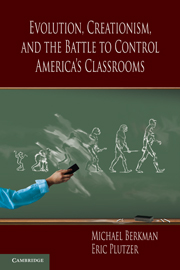
In late March, Professor Michael Berkman will be coming. Along with his colleague Eric Plutzer, Prof. Berkman published a bombshell book a couple years ago about the teaching of evolution in public high schools. Berkman and Plutzer are political scientists at Penn State. They got funding from the National Science Foundation to survey high-school science teachers about their teaching. Their results attracted a good deal of attention.

Required reading for anyone interested in evolution/creation issues

Required reading for anyone interested in evolution/creation issues

In the January, 2011 issue of Science (sorry, subscription required), for example, Berkman & Plutzer described the results of their survey. They found that about 13% of teachers taught creationism in public schools as science. Another roughly 28% taught recognizable evolution. The rest, roughly 60%, are the most interesting. This large majority of teachers reported that they taught a mish-mash of watered down evolution, religious- or religion-friendly ideas about creation, or a menu of evolution and creationism.

But the book was bigger than just this survey. As political scientists, Berkman & Plutzer argued that the important question was the way these decisions were made. Who decides what gets taught? State standards don’t do it. In states with good evolutionary science standards, teachers still teach non-evolution. Textbooks don’t do it. Glittering new science books with all the evolution bells and whistles can’t teach by themselves.

For Berkman & Plutzer, the answer was simple: Teachers. Teachers function as “street-level bureaucrats,” making daily decisions about what to teach and how to teach it. In most cases, teachers fit in with their local communities. If their communities want evolution to be taught, teachers teach it. But if communities want it watered down or kicked out, teachers do that, too.

Professor Berkman will be visiting our scenic campus as part of the Evolution Studies Program. We’re not sure yet what the focus of his talk will be, but he tells us he’s got some new data he’ll be sharing. Can’t wait to see what it is.

Our second campus visit will be from Professor Jonathan Zimmerman of New York University. Over a decade ago, Prof. Zimmerman defined the historical vision of America’s educational culture wars with his book, Whose America? In that volume, Zimmerman argued that two main tensions had divided Americans’ vision of proper education. Since the 1920s, conservatives and progressives had squared off on fights over patriotism and religion. Does loving our country mean teaching students to question it? Or to support it unhesitatingly? And should schools incorporate prayer and Bible-reading? Who gets included in history textbooks, and how?

Professor Zimmerman’s new book looks at sex education as a global phenomenon. Though the United States was an early exporter of sex ed, by the end of the twentieth century the US government joined some uncomfortable allies to battle sex education. As Zimmerman has argued, sex ed has created a new and sometimes surprising worldwide network of conservative alliances. For example, at a 2002 United Nations special session on children, US delegates joined Iran, Iraq, Sudan, Libya, and Syria in condemning a sex-ed proposal.

Who's for it?

Who’s for it?

When it comes to culture-war topics, national boundaries aren’t as important as we tend to think. It’s difficult for historians to look beyond them, though, due to language barriers and the high cost of research travel. In his new book, Prof. Zimmerman hopes to overcome those prosaic difficulties and tell the story of sex ed in its full global context.

And when he journeys north to our campus in early May, Zimmerman promises to share some of his insights from this book.

So whether you care about evolution, creationism, sex ed, history, school politics, school prayer, or any other culture-war issue, there will be nowhere more exciting than Binghamton University in 2015.

Be here or be square.

Forget the Intelligent Designer: What about Creationist Graphic Designers?

[Thanks to JS for PACE materials.]

Ken Ham is right again.  I’m no creationist, much less a young-earth type, but Mr. Ham’s Answers In Genesis organization has done it again.  As they did with their museum, AIG has managed to overcome the traditional stylistic weirdnesses of creationist outreach.

Weird science, but good-looking graphics...

Weird science, but good-looking graphics…

Ham has bragged recently about the high-class materials his group has cranked out.  In answer to the new version of Cosmos, Answers In Genesis has produced classroom materials to rebut the claims of the popular science show.  As Ham put it,

The AiG graphics department and publications team did a great job designing Questioning Cosmos. Its full-color glossy pages are packed with illustrations, questions for discussion, and detailed answers and explanations to help parents, teachers, and youth group leaders teach young people (and adults!) how to discern what observational science is presented in the Cosmos series and what material is best described as an evolutionary infomercial.

Even those of us who want more evolution taught in public schools must admit that Mr. Ham is right.  The anti-Cosmos materials don’t look any different than mainstream school texts.  Just as Answers In Genesis has done with its museum, this outreach effort has erased some of the obvious outward signs of the non-mainstream nature of creationist science.

It used to be easy.  Creationists used to produce school materials that looked hokey, weird, old-fashioned.  Consider just a few samples from Accelerated Christian Education.  As these pictures show, not only is the science much different from mainstream science, but the workbooks themselves seem obviously out of date.  The graphics are weird, the comics are jerky, and the lettering looks homemade.

Creation science used to look as if it were created in six days...

Creation science used to look as if it were created in six days…

Creation science books used to LOOK different...

Gee whillikers!

That’s just not the case with AIG’s anti-Cosmos materials.  The graphic design is very similar to the production values we’d expect from mainstream school materials.  And that matters more than we might think.  Parents, school administrators, and, most important, children tend to judge books by their covers.  The shoddy production values of cheap creationist pamphlets used to make them less attractive.

In the case of Answers In Genesis, mainstream science-ed materials can no longer count on such weak and ugly competition.

I Don’t Know What to Believe…

I don’t even know what to know, or what knowing means, or what believing might mean.  The good news is that I’m not alone.  No one seems sure of these things, especially not when it comes to touchy subjects like evolution. But I’m still confident of our argument that the best approach to teaching evolution is to encourage a separation in science classrooms of the need for students to KNOW evolution from the need for students to BELIEVE evolution.

It’s a tricky distinction, and I’m sympathetic to criticism that it may not make a real difference.

Some recent survey results make me wonder if this distinction might not even be a workable one in public schools. In the blog of the National Center for Science Education, the prolific Josh Rosenau notes the results of some survey work from the University of Alabama. In short, the researchers found that the more college students accepted evolution, the more they knew about it. Now, this confounds claims by cultural-cognition guru Dan Kahan that “knowing” evolution says more about who you are than about what you know. It is more a measure of belief than of knowledge.

For a mild-mannered historian like me, these conflicting survey results leave me scratching my head. Not only are we not sure if people need to “believe” evolution to “know” it, but we’re not even sure if we “know” that “believing” and “knowing” go together!

But I can’t just throw up my hands and go back to the archives. This question of knowledge and belief is central to all of us who care about evolution education. In my upcoming creation/evolution book with talented and stylish philosopher Harvey Siegel, we argue that public schools must teach evolution, but they must teach it in a way that separates claims of knowledge and belief.

Because there is one thing I do know, as a historian: Creationism is a religiously driven belief system. It is not exactly science, but this whole foofaroll about evolution education stems from the fact that creationism is a religiously driven belief system with claims to scientific legitimacy.

When it comes to educational policy, we have to make a delicate distinction that is usually lost in all the hot air. Creationists’ claims to scientific legitimacy do not carry any weight outside of their own religious circles. But that does not mean creationists do not have a right in the public square to believe in their own scientific legitimacy.  It means creationists have a right to public schools that do not force them to perform religious acts. Since affirming the truth of mainstream evolutionary thinking would be a religious act for many creationist students, public schools need to be more careful about insisting on such things.

In practice, in public schools, this means we face a situation that makes everyone unhappy. Creationism has no legitimate claim to a place in public-school science curricula, since it is derived from religious beliefs. But public-school science classes (and history classes, and math classes, and literature classes and gym classes) have no right to push creationist students to engage in religious acts, either.

Rather, to be more precise, public schools may teach ideas that tend to denigrate religious ideas. Schools shouldn’t do so casually or glibly, but if there is an important reason, they may do so. However, public schools may not force (or even encourage) students to engage in the (possibly) religious act of denigrating creationism themselves. In short, public schools CAN expose students to ideas students find religiously offensive. But public schools CAN’T ask students to do religious acts. If affirming the truth of evolution is a religious act, then public schools cannot insist upon it, or even imply that such an affirmation is desirable.

Creationists may hate this conclusion. Since the 1920s, anti-evolutionists and creationists have insisted that their beliefs are better science, true science. In court case after court case, however, experts have demonstrated the intellectual paucity of this belief. Creationists may not admit it, but they might recognize that their claims to scientific legitimacy don’t convince people outside of their own religious circles.

And for public education, that’s enough. My religious beliefs do not carry weight—as religious beliefs—in public schools. Even if my religious beliefs insist that they are better science. Or history. Or literature. Or physical education.

But traditional science-ed types will also hate this conclusion. As a set of religious beliefs, creationism is entitled to special consideration in public schools. Though the case law is somewhat mixed on this point, the moral case is compelling: Children of any religious or cultural background must be made welcome in every public school. Their beliefs may be challenged by the curriculum, but students cannot be asked to perform religious acts in those public schools. And acts that might not seem religious to me might be religious to religious people, or even to an imaginary “objective observer.”

Conservative Christians have had mixed results trying to make this case in court. Perhaps most famously, in 1987’s Mozert v. Hawkins, an appellate court ruled that conservative parents could not ban curricular materials they found offensive. The conservative parents had argued that textbooks with references to occult practices, evolution, and impolite children infringed on their rights to religious liberty. The books, the parents believed, hurt their children’s ability to freely practice their religion.

The constitutional complexity in this case was demonstrated by its tortuous path through the court system. One district court judge agreed with the parents on one point: textbooks that say there are multiple ways to worship God really are teaching religious content. In the end, the appellate court disagreed.

Other federal courts have made this difficult point. In another case from Tennessee, Wiley v. Franklin (1979), the court decided that

if that which is taught seeks either to disparage or to encourage a commitment to a set of religious beliefs, it is constitutionally impermissible in a public school setting.

The rub in these cases, it seems to me, is that courts have trouble defining the boundaries of religion. The final ruling in Mozert relied on the fact that the conservative children didn’t have to do or say or affirm anything about religion. They were only exposed to ideas that their parents considered offensive.

And that seems telling for our case here. Though I may find it a simple statement of fact, the notion that there are many paths to religious salvation has profound religious implications for many people. And though I may find it a simple statement of fact, the notion that the earth is bajillions of years old has profound religious implications for many people. Public schools should expose students to these ideas. But public schools cannot force creationist students to engage in the religious act of agreeing with these ideas.

The fact that affirming evolution is not a religious act for me does not mean it is not a religious act for anyone. For many creationist students, saying that evolution is true is a religious act. Schools can’t insist upon it. But understanding the basic concepts of evolution is not. Public schools must insist upon that.

Though this post is already too long, let me add one caveat. This argument does not agree with creationists’ insistence that evolution is a religion. Rather, it simply says that evolution is an idea that some religious people consider religious. This is a hugely important distinction.

Public schools cannot force students to do religious things. For many students, affirming that evolution is true would be a religious act.

At the same time, public schools must teach the best available knowledge. In science classes, the modern evolutionary synthesis is an example of that sort of knowledge.

So here is our goal: Separate out our demands on students. It is not as complicated as it may seem. Adding two or three little words can do it. Instead of asking students to say, “The earth is millions of years old,” we ask students to say, “Scientists say the earth is millions of years old.”  Instead of asking students to say, “Humans evolved from other forms of life,” we ask students to say, “According to scientists, humans evolved from other forms of life.”

Do I know that this will work? No, but I believe it will help.