Religious Extremists Capture Major Political Party

Old news, right? SAGLRROILYBYGTH won’t be surprised to hear that the Republican Party is addicted to the political support of conservative evangelicals. These days, though, we have a sad reminder of the fact that both major parties can fall victim to special-interest lobbies, lobbies that put children in a terrible educational position.

yeshiva

Who is watching out for the kids?

For Republicans, this is nothing new. For a long time now, Republicans have been trembling at the thought of angering evangelical creationists. The most egregious example, IMHO, was the waffling of former Governor Bobby Jindal.

Jindal, you may recall, was the popular governor of Louisiana who briefly made a bid for the GOP nomination in 2016. No matter what you might think of his politics, Governor Jindal is no dummy. He graduated from Brown with a degree in biology. He went on to Oxford, turning down acceptances at Harvard Medical School and Yale Law School. He may not have made much of a splash in the 2016 presidential race, but we can safely assume that Jindal knows plenty about evolution and many other things.

Yet in spite of all his knowledge, when asked what he thought about evolution in 2014, Jindal hedged. Yes, he wanted his own kids to learn about evolution. When it came to public schools, though, Jindal defended the rights of creationists. If a local school district wanted to teach creationism as science, Jindal argued, that should be up to them.

Bad thinking, but good politics, I suppose.

We see a similar tragedy unfolding these days in Arizona. To win election in the Republican Party, it seems, candidates felt pressed to endorse a bigger role for creationism in public schools.

It’s been true for a long time and it doesn’t seem like it is going to change any time soon. The Republican Party forces candidates to ignore their own ideas and truckle to the desires of radical young-earth creationist supporters.

Recent news from my adopted home state shows that this is not only a problem for the GOP. The Democratic Party, too, seems to have entered into a deal with religious extremists. Just as Republican pandering hurts schoolchildren in Louisiana and Arizona, so too does Democratic deal-making hurt kids in New York.

Here’s what we know: Governor Andrew Cuomo is accused of a sordid educational quid pro quo. He allegedly promised prominent Hasidic leaders that he would not interfere with their religious schools in exchange for a vital political endorsement.

If it’s true, it’s more than a shame. Politicians of every party have a duty to safeguard the educational chances of students. The schools in this case don’t seem to do that at all. As a lawsuit this summer charged, significant numbers of yeshiva students in New York aren’t adequately taught secular subjects such as English, history, and science. Their curricula for boys focus almost exclusively on studying ancient religious texts.

As the New York Times reported, the state has promised to investigate these schools.  As they wrote last summer,

In 2015, the city Department of Education said it was opening an investigation into about 36 private yeshivas to see if they were providing adequate secular education according to state law. But in the three years since that announcement, the city has not released any results. Jaclyn Rothenberg, a spokeswoman for the mayor, said the investigation is still active and the department would deliver the report “soon.” The city has visited 15 schools so far, according to Ms. Rothenberg.

A year ago, when asked when the education department planned to release a report on its investigation, a spokeswoman, Toya Holness, said the investigation is continuing. “We are treating this matter with utmost seriousness,” she said.

This month, Governor Cuomo was accused of promising the Hasidic community that the investigation would continue to languish in exchange for the political endorsement of an influential leader in the Hasidic community.

If true, the charges show how difficult it is to protect the educational rights of children. Children don’t vote.  Children don’t meet with governors to insist the law be obeyed. Children can’t promise a solid block of political support in exchange for special favors.

To be fair, I think the GOP problem is worse. But this story demonstrates that the problem is not only a “conservative” one. Rather, any political party risks being held in thrall to special-interest groups, groups that might not have the best interests of children at heart.
I Love You but You Didn’t Do the Reading

This week’s review of the latest news ‘n’ views from around the interwebs:

Atheists for Jesus: Pulling evangelical voters to the left at FA.

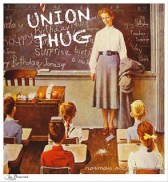
Peter Greene on why teachers join unions.

rockwell teacher union thugTexas school board gives history another once-over, and Hillary Clinton is out. At DMN.

Surviving purity culture at NPR.

In this culture, men and boys are talked about as being sexually weak and women and girls are supposed to be the holders of all sexual purity. So ultimately women and girls are responsible for the sexual thoughts and feelings and choices that men make, and it’s women and girls’ responsibility to dress right, to act right, to talk right, to do everything just right to ensure non-sexuality for all people — and if they don’t, they potentially risk being categorized as impure or as a harlot.

Parents in Leiyang riot over school quality, at The Economist.

A liberal ex-evangelical finds a church home, at NR.

Still no-go for yoga in many public schools, at The Atlantic.

What is behind the coddling of the American mind? It’s not just “safetyism,” says reviewer at IHE.

Students have not been coddled, they’ve been defeated.

Concerned scientists weigh in on removal of climate change and weakening of evolutionary theory in Arizona standards, at NCSE.

Queen Betsy misquotes Professor Haidt, at CHE.

Let’s call it ‘Haidt’s choice’: Pursue truth or pursue harmony.

Should the Scientists Say It?

Okay, so you know about the ongoing frouforole in Arizona over its new science standards. Recent developments in the case leave us wondering: How should scientists make their case? Why wouldn’t they make it in the strongest way possible?

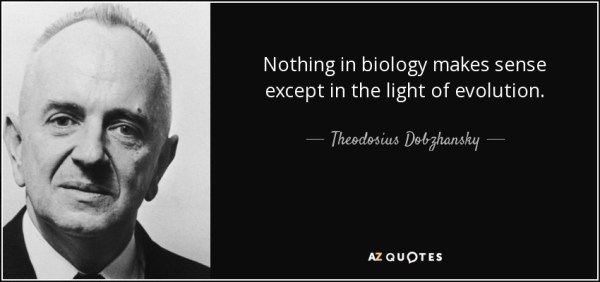
dobzhansky quotation

…here’s the most famous Dobzhansky line:

In case you’ve been napping, here’s a quick update: The political landscape in Arizona has led to some woeful watering down of the state’s science standards. Concerned scientists have weighed in, pleading with the state board of education to reject the shoddy new standards.

In their letter, the American Institute of Biological Sciences warns,

The proposed standards fail to properly address important aspects of evolution science and remove climate change science from the high school curricula.

Right on. Thanks to AIBS for weighing in. There’s no doubt that Arizona should maintain high-quality science standards.

This morning, though, we have to ask a question. To back up their point, AIBS offers two compelling reasons, but they leave out an obvious third one. Why?

I don’t think it’s because AIBS chose to stick only with science, their area of expertise. After all, one of their main points is economic. If Arizona wrecks its science standards, it will be shooting its economy in the foot. As AIBS puts is,

Arizona has made important investments in its universities. This has enabled companies throughout the state to hire skilled graduates who can leverage the knowledge generated by scientific research to create new products and expand existing markets. Importantly, in coming years, a growing number of jobs will require scientific expertise, even when those jobs do not require a college degree. Thus, it is important that science be properly taught to all students and at all grade levels.

According to the Arizona Commerce Authority, “Bioscience and health care in Arizona are thriving industries, treating patients and conducting groundbreaking research that will change the world. Arizona research institutions, industries and clinical care facilities collaborate in unique ways to create new products and improve care and outcomes.” The Authority reports on its website that bioscience and health care industries generate $21.4 billion in annual earnings for the state, and in 2015 were responsible for about 320,000 jobs in Arizona. Arizona will jeopardize its prior investments and future economic opportunities if it waters down science standards by eliminating essential scientific concepts and fields of study to placate political interests.

Exactly true. The economic knock-on effects of clamping down on mainstream science and science education will be huge. But that’s not the only reason AIBS gives for keeping good science standards.

As they argue, good education itself demands it. All of us should insist on the best for our kids, including the absolute best science education.

They cite the famous words of leading scientist Theodosius Dobzhansky,

“nothing in biology makes sense except in the light of evolution.” Dobzhansky offered these words decades ago, but they still ring true. Evolution is required to understand biology . . .

So far, so good. AIBS is 100% correct. Good science education is good in itself, and to be good it must include real evolutionary science. It’s also good for practical reasons, such as booming economic benefits.

But why, oh why, did AIBS leave out the other, screamingly obvious, part of their argument?

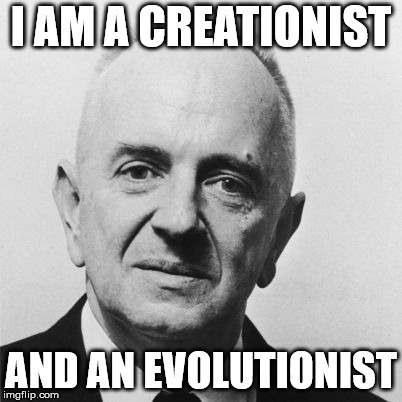
Dobzhansky meme creationisst

…Why not use the second-most famous Dobhansky quotation, too?

They could easily have added that evolutionary science does not deserve its reputation as an attack on religion. They could have simply added that Dr. Dobzhansky himself identified as “a creationist and an evolutionist.”

Why would AIBS do so? Consider their audience. If they want to stick to the science, fine. But clearly they don’t. They use economic arguments to speak to all Arizonans. Why not use the obvious religious argument as well? Why not point out that lots and lots (and lots) of creationists have absolutely no religious problem with real evolutionary theory?

I Love You but You Didn’t Do the Reading

Our weekly news ‘n’ views roundup:

Remembering 9/11:

Peter Greene: What Mark Zuckerberg and Bill Gates are doing in schools is something, but it’s not “philanthropy.”

Modern fauxlanthropy is not about helping people; it’s about buying control, about hiring people to promote your own program and ideas. It’s about doing an end run around the entire democratic process, even creating positions that never existed, like Curriculum Director of the United States, and then using sheer force of money to appoint yourself to that position. It’s about buying compliance.

Is American higher education addicted to opportunism? DG Hart reviews a new book about Wendell Berry and the university, at FPR.

How do they do it over there? A new UK report recommends adding atheism to the list of religions studied in publicly funded schools, at the Guardian.

conservative

Does anyone understand American conservatism?

Does anyone understand the history of American conservatism?

At Harvard and Yale, more freshman identify as LGBTQ+ than as conservative, at NBC.

Creationist victories in public schools, at AU.

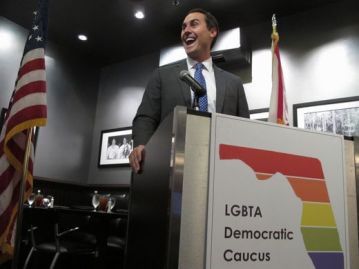
Can an evangelical candidate get Florida to vote Democrat? At NR.

CHris king

Can King pull evangelicals to the Blue side?

Gay’s not OK in PA: conservative evangelical college turns away a homosexual student, at IHE.

University of Nebraska surveys itself: Do conservatives feel welcome? At CHE.

How Creationists Win

For those of us who want secular public schools and mainstream evolutionary science only in public-school science classes, the news from Arizona could be either a glass half-full or half-empty. Either way, though, it serves as a clear reminder of how creationism wins.

Here’s what we know: In Arizona, the superintendent of public instruction picked Joseph Kezele to serve on an eight-person board reviewing state science standards. Kezele is the president of the Arizona Origin Science Association. He is an ardent young-earth creationist. In his work on the board, he has nudged the standards toward more skepticism about mainstream evolutionary theory.

To this reporter, the story reveals the most important reason creationists win. As I’m arguing in my new book, it’s not really about evolutionary science itself. Before we get to that main reason, though, let’s look at some of the contributing factors:

1.) Creationists win by being polite.

Kezele’s fellow board members don’t like his radical creationism, but they do like him. As the University of Arizona’s William Roth told the Phoenix New Times, in all their interactions Kezele was “polite and thoughtful.”

2.) Creationists win by taking advantage of their grandparents’ work.

In this case, Kezele has credentials as a faculty member at Arizona Christian University. A spokesperson for the Arizona Department of Education specifically identified Kezele’s faculty status as the main reason for Kezele’s inclusion on the board.

Though Arizona Christian University itself was founded only in 1960, it is part of the evangelical higher education network I described in Fundamentalist U. Since the 1920s, creationists founded their own network of universities specifically, in part, to provide a home for creationist scientists like Kezele.

These days, creationists like Kezele can only have higher-ed credentials because of the work of their parents, their grandparents, and in some cases, their great-grandparents. The fundamentalists who stormed out of mainstream colleges and started their own schools built a network that is still providing credentials and paychecks to radical creationists today.

3.) Creationists win by not asking for much.

In Arizona, according to Professor Roth, Kezele never tried to “foist any kind of creationism” on the committee. As Roth put it,

I never got the impression that he was really arguing for the inclusion of creationism in the standard. . . . I think he was pretty aware of the court rulings that religion is not going to be taught in science class.

Kezele did nudge the committee, though. For example, Kezele put his feet down to insist that the language be changed. Instead of explaining evolution as “THE” explanation for speciation, the new standards call evolution “AN” explanation. It’s a huge difference, to be sure, but worlds removed from actually adding any specific creationist content to the standards.

Historically, compared to the anti-evolution campaigners of the 1920s who sought to impose theocracy on America’s public schools, today’s creationist activists are fighting for curricular scraps and crumbs.

4.) Most important, creationists win these days for reasons that have nothing really to do with evangelical theology or evolutionary science.

It’s just politics. The superintendent who appointed Kezele wants creationism and evolution both to be included in public school science classrooms. But if she had not been elected, someone else who also favors creationism probably would have. As Arizona Central reported, Superintendent Diane Douglas was re-elected sought re-election from among a field crowded with creationism-friendly candidates. [Thanks to GB for the correction!]

Of the five Republican candidates for the job, four ardently supported teaching some sort of creationism in public schools. They may have had their personal reasons for wanting it, but they also made an obvious political calculation. If anyone is going to be elected in Arizona, that is, she must promise to make public schools creationism-friendly.

The reasons the candidates gave for supporting creationism in public schools were all about culture-war politics, not theology or science.

Candidate Frank Riggs, for example, argued that students needed creationism to be good Americans. As he put it, high-school students

should know what our founding fathers believed and put in our founding documents . . . “that all men are created equal, that they are endowed by their Creator with certain unalienable Rights.” . . . We can’t skip over that, or we do a huge disservice to our students.

Another candidate, Tracy Livingston, poured some unadulterated MAGA rhetoric into the mix. Why should public schools include creationism? In her answer, Livingston bemoaned the “fact” that

Schools don’t even allow Merry Christmas anymore.

Why support creationism in public schools? For candidate Livingston, at least, it was part of a culture-war playbook. To Make America Great Again, schools needed to give Christianity a special spot. Children needed to be taught in a vaguely Christian atmosphere, one that included creationism.

It’s not science. It’s not even really religion. Instead, the main reason for creationist victories is simple, ugly, culture-war politics.

How do creationists win? Lots of reasons. They win if they are polite. They win if they take advantage of the long work of previous generations, establishing creationist institutions that can provide credentials. They win if they don’t ask for much, but insist on a little.

Most importantly, though, they win because they own the Republican Party in some locations. To win election as state superintendent of public education, candidates raced to out-creationist one another. Creationism has become yet another culture-war red flag. It’s not really about theology or science, but about what side you want to be on.

I Love You but You Didn’t Do the Reading

No more wearing white, I guess. Around here, we’ve already had to turn on the heat. The interwebs stayed hot, though. Here is our weekly roundup of ILYBYGTH-themed stories:

Starving for Jesus: Wisconsin family kills one child, nearly kills another in Christian fast, at WSJ.

falwell on nike

Football, America, and God too.

Christian college drops Nike over anthem protests, at CHE.

Gresham Machen and segregationism at the old Princeton Seminary, at FM.

Wowzers, the big story: The inside resistance in the White House, at NYT.

Meanwhile, Trump explains the “great job” he’s doing to Bob Woodward, at WaPo.

Nobody has ever done a better job than I’m doing as president. (12:52)

Senator McCain’s legacy as a school reformer, at T74.

Great Books as the solution to campus protests, at CHE.

Both reactionary pundits mocking campus speech codes and the social-justice warriors they love to hate are complicit in reproducing the kinds of inequality that tribalism feeds on.

Is education a “fundamental right?” Jill Lepore reviews Justin Driver in The New Yorker.

Coming out to young-earth creationists, at BioLogos.

The politics of Christian crafts: Kristen Kobes Du Mez on “Hobby Lobby Evangelicalism.”

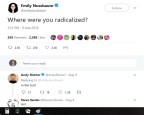
Where Were You Radicalized?

Have you seen it yet? Emily Nussbaum asked a simple question on Twitter: Where were you radicalized? I admit I haven’t read all the responses, but there’s one obvious one that I have heard from lots of my ex-evangelical friends that I’m not seeing.where were you radicalized

Some of the responses are compelling. Patrick Deneen, for example, blamed the effete and impudent snobs. Where was Deneen radicalized?

Princeton University, upon hearing colleagues using the words “flyover country” without irony or embarrassment, and where being anti-Christian was an acceptable and even required prejudice.

Other respondents share stories of feminist, economic, anti-war, or other radicalizing epiphanies. But here’s my puzzle: I’m not seeing tons of responses from people who say they were radicalized in church. I thought I would.

I don’t mean the people who heard a left-wing pastor sing and play guitar. I mean the people who sat in pews and listened to the conservative, maybe fundamentalist spiel over and over until they rejected the whole thing.

As I polish and revise my creationism book, I came across example after example of evangelicals who turned away from creationism precisely because of the young-earth ideas to which they were exposed at church.

For example, as two intrepid evangelical scholars relate, they met plenty of students who were “radicalized” due to the intellectual shortcomings of young-earth creationism. As one student told them,

My parents saw evolution as incompatible with religion; I agree, and when I decided the evidence did not support a 6-day creation, I stopped believing in God.

So for all those left-leaning evangelicals and ex-evangelicals out there, where were YOU radicalized? Was it in Sunday school? At church? At your religious school?

Civil Debate? Catcall? Or Creationist Ruse?

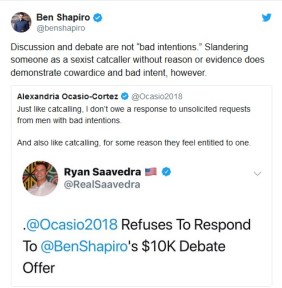
What would YOU call it? Conservative pundit Ben Shapiro says it’s nothing but civil debate. Leftist darling Alexandria Ocasio-Cortez dismisses it as a mere catcall. SAGLRROILYBYGTH might be reminded of something else: a long-standing creationist plea for attention.catcall ocasio cortez

Here’s what we know: Ben Shapiro offered a cool ten grand to Democratic primary winner Alexandria Ocasio-Cortez to debate. If you’ve been on vacation too long, you might need a little backstory. Ocasio-Cortez attracted tons of attention recently with her upset win in a New York Democratic primary election. She has electrified the Sanders left with her energy and victory.

On Twitter, Ocasio-Cortez denounced Shapiro’s offer as nothing more than “catcalling.” Shapiro responded that he only wanted “discussion and debate.”

I’m curious to hear what you think: is it legitimate for Shapiro to offer $10,000 for a debate? Or is that merely an extension of rude, aggressive unsolicited male attention?

And finally, how about this: is Shapiro’s debate offer a remix of an old creationist tactic? For years now, radical creationists such as Joseph Mastropaolo have offered $10,000 to any mainstream scientist willing to debate the facts of evolutionary science. In the opinion of one mainstream scientist, such tactics are obviously a “scam designed to lure the unsuspecting” into a shoddy creationist publicity stunt.

Is that what’s going on here? Is Shapiro merely hoping to attract attention? Or does he really want to engage in a civil debate? Or, as Ocasio-Cortez accuses, is this the equivalent of verbal street thuggery?

I Love You but You Didn’t Do the Reading

Another week in the books. Here are some of the ILYBYGTH-themed stories that swirled around the interwebs this week:

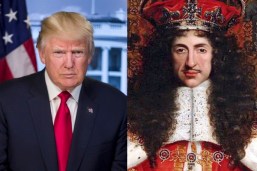
Forget Nixon, forget Mussolini: A better historic parallel to Trump, at HNN.

TRUMP CHARLES

The closer parallel?

Why did school-based Catholic priests commit more abuse? At HP.

The ugly truth from Alabama: Evangelicals, racism, and Trump, at WaPo.

Are low-income students being squeezed out of elite universities? Nope. But another group is. At AEI.

Is there a “socialist surge” among Democrats?

Did you see this one? Eighteen Oklahoma teachers explain why they’re quitting, at VICE.

How do elite schools stay so white? At NYT.

Historians wonder what to do in an era of “fake news” at CHE.

The Historical Lesson Historians Need to Learn

Who owns your history? Who gets to decide, that is, what is “real” history and what is politically motivated claptrap? For too long, academic historians like me have had it easy. We have glibly assumed our ability to define the boundaries of authentic historical thinking. A smart recent essay made that case once again. But as all of us should, the author needs to study the lessons of a different sort of history. After all, we have been down this road before.

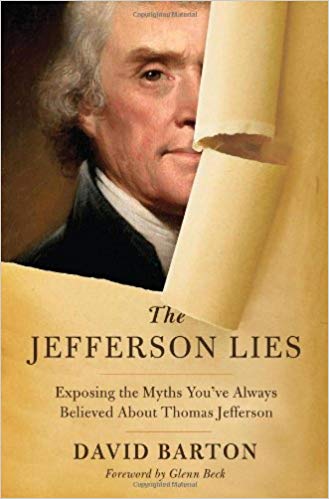
If you’re not familiar with the history wars, a quick look at the bumptious career of David Barton might help. Barton touts himself as a historian, tirelessly exposing the lies of left-wing academic historians. In short, he wants to prove that the United States was founded to be an evangelical nation.

jefferson lies

Calling it “pseudo” history isn’t enough…

A few years back, Barton’s book The Jefferson Lies suffered an ignominious release. After the book’s initial publication, activist academics demonstrated the book’s many falsities and basic errors. The publisher recalled the book. Instead of retreating in embarrassment, Barton supporters doubled down. Most notably, Glenn Beck promised to re-release the book.

What are we to think of this episode? Barton’s book was terrible history, by the standards of mainstream academic history. But it was enormously popular and no amount of expose could deflate its appeal among certain readers.

To SAGLRROILYBYGTH, this might sound hauntingly familiar. Since the 1960s, mainstream scientists—including conservative evangelical scientists—have pulled their hair and gnashed their teeth at the claims made by young-earth creationists. Time and time again, in the face of repeated scientific refutations and debunkings, young-earthers have staked their claim to represent the cause of true “science.”

For an earlier generation, gallopers like Duane Gish steadfastly refused to give up their claim to be the real scientists in the room. These days, Ken Ham does the same thing.

As my friend and co-author Harvey Siegel argued in our book about evolution education, it makes no sense—logically or strategically—to try to prove them wrong. That is, it will always be impossible to prove that Gish and Ham are “pseudo” scientists. There is a better way to talk about the differences between mainstream science and radical young-earth creationism.

It has been difficult enough for mainstream scientists and science pundits to accept this awkward and uncomfortable fact. It seems even more challenging for academic types in other fields. In the field of academic history, for example, mainstream professors have grown accustomed to being unchallenged in their ability to define real historical thinking from the fake kind. When challengers like David Barton raise their head, too many of us are only able to sputter. Too many of us are too confident that Barton’s blather will be rejected as low-quality scholarship.

Consider, for example, a terrific recent essay by mainstream historian Patrick Iber of my beloved alma mater, the University of Wisconsin. In the pages of the Chronicle of Higher Education, Professor Iber wonders if there is any way to preserve his preferred sort of historical thinking in the Age of Trump.

As Iber asks,

Is there anything that can be done to prevent basic historical facts from going the way of climate science, seen essentially as politically motivated rather than the result of serious professional study?

Unfortunately, the short answer is no. Indeed, even asking the question shows how far behind the times we academic historians are. Mainstream scientists and science activists have been struggling with these sorts of challenges for a long time. Creationism and climate-change-denialism have long forced mainstream scientists to examine their claims and their public image. Academic historians have tended to be able to ignore such things.

No longer. As Iber puts it,

there is a market for pseudo-historical grift.

Definitely. And to be as clear as possible, I agree entirely with Professor Iber’s anti-crappy-history position. However, we historians need to learn the tough lessons that mainstream academic scientists learned long ago. Namely, we can’t de-fang bad history simply by calling it “pseudo” history. We can’t assume that our credentials and mainstream institutional affiliations will make America listen to our pleas to reject crappy history.

In short, we can’t rest easy that our definition of good historical thinking will win the day based solely on its persuasive power. It won’t. We don’t have the luxury to conclude, as Professor Iber does, that exposing people to historical thinking will tend to make people agree with our vision. As Iber optimistically insists,

Seeing oneself as a part of history tends to be equalizing: It exposes the radical contingency of your own existence, which usually results in taking the humanity of others as seriously as your own.

I wish that were true. But as the career of David Barton proves, seeing oneself as a part of history can result in very different conclusions. Historical thinking is not a wholly owned subsidiary of left-leaning academic types like Professor Iber or me.

If academic historians aren’t more savvy, we risk getting run over by the vastly more popular sorts of history that are out there.