Why Don’t Christian Colleges Brag about This?

If you’re interested in evangelical higher education, you’ve probably read Daniel Silliman’s piece in Christianity Today by now. And you may have asked why more Christian colleges don’t advertise their sensible approach to deepening students’ faiths. Today the other shoe drops over at the fundamentalist creationist ministry Answers In Genesis.ham on evang colleges

Silliman was following up on new survey data that show students in evangelical colleges are

more likely to feel unsettled about spiritual matters, unsure of their beliefs, disillusioned with their religious upbringing, distant from God, or angry with God than their peers at secular schools as well as those at mainline Protestant and Catholic institutions.

As Silliman found, in many cases, evangelical colleges actively promote religious crises in their students. Why? Because true faith requires it. As one college president told Silliman,

It’s part of the design of college and part of the design of being a young adult. Struggle is built in. What we try to provide are professional staff and faculty who are rooted in their own faith and able to journey alongside, in ways that honor the journey of the student.

Sounds smart, right? Especially for secular people like me, this kind of approach to Christian education makes admirable sense. So why don’t more evangelical institutions brag about it?

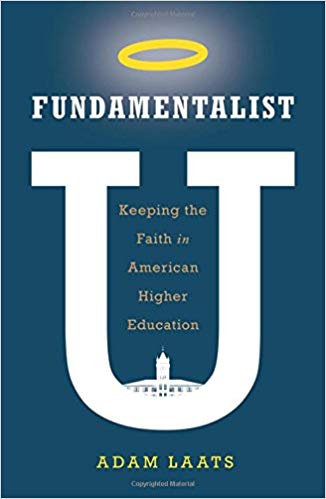
As I found in the research for Fundamentalist U, evangelical higher ed has always been ferociously divided about this approach to faith formation. Lots of administrators, families, and faculty members have always shared this vision. They have agreed that young Christians need to be open about their doubt, just as they are about their faith. The goal of evangelical higher education—in this vision—has been to be there for students when they doubt, guiding them lovingly and Christian-ly through this predictable crisis.

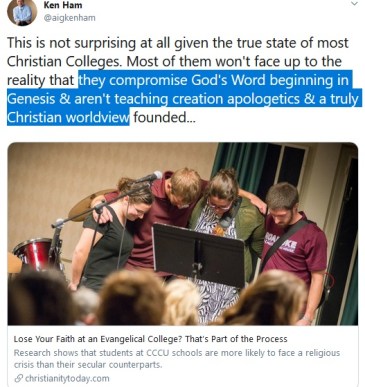
But not everyone has agreed. As fundamentalist creationist Ken Ham recently charged, Christian colleges who don’t protect their students from doubt don’t deserve to call themselves Christian at all. As Ham accused, colleges that help their students struggle with doubt

compromise God’s Word beginning in Genesis & aren’t teaching creation apologetics & a truly Christian worldview.

The right way to protect faith, Ham argues, is not by challenging it. Instead, evangelical students should be taught how to “stand against the secular attacks of the day,” not how to doubt and question. For parents who agree, Ham offers his list of “Creation Colleges,” staunch conservative schools that promise not to challenge faith.

So why don’t more evangelical colleges brag about their approach to faith formation? Because the world of conservative evangelical higher education has always been divided about it. Not just between more conservative schools and less, but even within many schools themselves.

At less-conservative schools like the ones Silliman talked about, I’ll bet dollars to donuts some faculty members and some trustees hope for a less-wishy-washy approach to student doubt. And at more-conservative schools like the ones Ken Ham praises, I bet there are faculty members and students who yearn to be in an environment in which they can talk more openly about their doubt and struggle.

I Love You but You Didn’t Do the Reading

Back to school; back to … losing our religion? Christian colleges that challenge faith, secular colleges that challenge ideas, Rosa Parks Barbie and, of course, Professor Matthew McConaughey all made this week’s list of must-read stories from around the interwebs:

So…now there’s a Rosa Parks Barbie. A triumph for Civil Rights history? Not exactly, at HNN.

The problem is that the more in-depth narrative that historians have worked hard to reconstruct is continually lost in public consumption.

rosa parks barbieHow does Barbie tie in to Newt Gingrich, Bertie Forbes, and the history of racism in the US? The ILYBYGTH take.

How can colleges foster true intellectual diversity? At NYT.

Is the point of a university education simply to provide students a forum in which they can air their political views, no matter how poorly informed? Of course not — and one reason that some students are reluctant to speak in class is because they are confronted, for the first time, by information that undermines their pre-existing assumptions. So how can professors keep exposing students to uncomfortable facts — because that’s our job — while encouraging them to speak their minds and hear out arguments they find outrageous?

Losing your faith at an evangelical college? Don’t worry; it’s always been part of the process. At CT.

At some evangelical schools, religious crisis is provoked by design. Nyack College in New York City offers a slate of first-year classes coordinated with chapel talks meant to challenge students’ beliefs.

“It’s almost that we have to deconstruct their faith, but in a nice way,” said Wanda Walborn, associate professor of spiritual formation at Nyack. “We have to carefully and lovingly get you back to Jesus, get you back to the grace of God, outside of performance.”

Mayor Pete Buttigieg on Queen Betsy DeVost at EdWeek:

There are no shortage of cabinet appointees to take issue with. But I think there’s something particularly egregious with what’s happening with Betsy DeVos in the Department of Education because it’s not just somebody who’s taking the department in a direction I disagree with. She’s somebody who, in my view, is actively undermining the very purpose of the department.

Recruiting top faculty:

From the Big Surprise file: Turns out better pay can attract more teachers. At FP.

Alumni sue NY Jewish school for sexual abuse, at CNN.

The lawsuit accuses former principal George Finkelstein of targeting the children of Holocaust survivors and then imploring them “to not add to their parents’ suffering by telling them about his assaults.”

She’s not racist, but…this Michigan city council candidate wanted to keep her community white. Because the Bible. At FA.

Why do 55% of teachers hope their kids won’t become teachers? At Curmudgucation. The issues are

tied together with the single thread of distrust and disrespect for teachers. . . . we’ve had decades of federal and state programs meant to force teachers to do a better job. In the classroom, much of these “reforms” have sounded like “You can’t do a good job unless you are threatened, micromanaged, and stripped of your autonomy.” There is a special kind of stress that comes from working for someone who says, in effect, “You have a big important job to do, and we do not trust you to do it.”

Teachers do not experience disrespect only on a national level. Talk to individual teachers about their own work circumstances and you will often hear about district and building administrators who treat teachers like children.

“Gifted & Talented” program is out in NYC. What comes next? At Chalkbeat.

“The label is something that people really crave,” said James Borland, a Teachers College professor who studies “gifted” education. “The fact that the curriculum is very weak in lots of gifted programs — or the fact that it’s not that different — it’s a problematic situation,” he added.

What’s it like to be a progressive Christian in a conservative state? A review of American Heretics at R&P.

we hear Walke describe something of a conversion narrative. She transformed from a Southern Baptist in the pews of a church whose pastor was teaching that Hurricane Katrina was God’s punishment for sin into a different sort of Christian—one who now leads in the charge of Mayflower UCC’s vote to denounce racism and become a sanctuary church.

The most touching moment in the film gives us a glimpse of the toll of Walke’s conversion. We sit in the passenger seat of her truck as she drives away from her grandmother’s home, where we’ve just seen the two women reflecting awkwardly (but with great compassion) on their connection as Christians, despite their current theological and political divide. The two women sang together an old-time hymn about heaven. But the voices in unison could not cover up the palpable tension, as her grandma, Novella Lore, appeared to struggle to find something to say about her granddaughter’s making headlines in the local paper for public LGBTQ advocacy. In the truck afterward, Walke confides that Lore is worried about her granddaughter’s eternal salvation. “I just want to know one thing. Are you going to go to heaven when you die?” she says Lore asked her.

Liberty U.’s president gives another big $$$ gift to an attractive young man, at Reuters.

“The concern is whether the university’s president wanted to do his personal trainer a favor and used Liberty assets to do it,” said Douglas Anderson, a governance specialist and former internal audit chief at Dow Chemical Co, who reviewed both the transaction and Liberty’s explanation of it at Reuters’ request. That would be bad governance, he said. “At a minimum, the terms suggest the buyer got a great deal and Liberty got very little.”

Hellfire in the Amazon: fires split Brazilian evangelicals from other faiths, at RNS.

“Due to their alliance with Bolsonaro, the evangelicals started to oppose the protection of the environment. They assimilated the idea that environmentalism is a disguise for communists and for international leaders who want to take the Amazon from Brazil,” said Renan William dos Santos, a researcher at the University of São Paulo who investigates the relations of Christians with environmentalism.

amazon fire

Evangelicals…support it?

Christian colleges watch SCOTUS nervously about LGBTQ cases, at DN.

“Student housing standards would face new pressure. Affiliated clinics and hospitals could be compelled to provide religiously objectionable medical procedures. A religious university’s tax-exempt status could be challenged or revoked,” the brief explains.

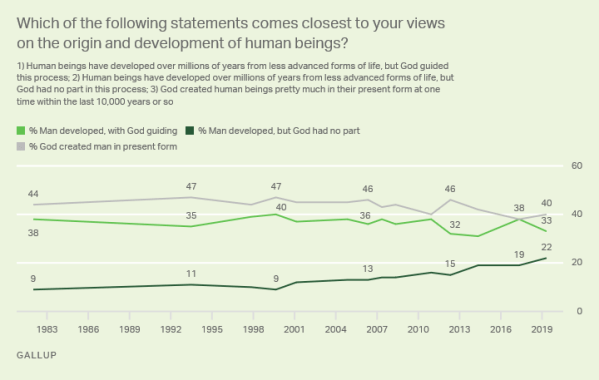
The new Gallup poll on creationism is out. The upshot: Lots more people seem okay with evolution this year.

gallup creationism 2019

The problem with ed reform at EdNext:

Why am I able to anticipate these failures in education reform initiatives, while the people devoting fortunes to these efforts and their staff have such a hard time avoiding strategies that result in failure? I’m not that smart and they aren’t that dumb. I suspect the answer is that foundations have organizational interests and cultures that tend to draw them to a mistaken theory about education policy. In its essence, that theory holds that there are policy interventions that could improve outcomes for large numbers of students if only we could discover them and get policymakers and practitioners to adopt them at scale.

I begin with a different theory. I suspect that there are relatively few educational practices that would produce uniformly positive results. Instead, I’m inclined to think of education as similar to parenting, in which the correct approaches are highly context-specific.

Christian College Apocalypse: October 8, 2019

The leaders of America’s conservative evangelical colleges are freaking out, and I don’t blame them.  An upcoming SCOTUS case threatens to upend the entire premise of evangelical higher ed.

A little background: In October, SCOTUS is slated to hear a trio of cases about LGBTQ rights. At issue is whether or not LGBTQ sexual and gender identity deserve the same legal protections as other factors such as male/female gender, race, and religion. Not surprisingly, conservative evangelical colleges are alarmed.  An anti-discrimination ruling could have a serious impact on the way they house students, hire faculty, and earn accreditation. (To be clear here, I don’t agree with most evangelical colleges on LGBTQ issues. I would love to see LGBTQ protections deepened and extended. I DO agree with evangelical leaders that this SCOTUS decision is a big deal.)

If SCOTUS decides that LGBTQ people are covered under Title VII and Title IX, for example, universities that don’t recognize transgender identities could be forced to do so, or give up their federal student funds. That would hurt, but it wouldn’t necessary be deadly. As I examined in Fundamentalist U, conservative evangelical institutions have withstood similar shocks in the past. Bob Jones University famously gave up its tax-exempt status back in the 1980s over racial segregation. BJU took a big financial hit, but it didn’t wither and die. BJU might even have benefited in the long run.

In this case, however, the core premise and promise of conservative-evangelical higher education might be disrupted. Since their foundings in the 1920s, colleges in the fundamentalist (and later conservative-evangelical) movement have promised students something other colleges couldn’t. Namely, institutions such as Wheaton College and Bob Jones University promised that all of their faculty members would reliably agree to a “pure” evangelical statement of faith.

This promise about “safe” and “pure” teachers has always been at the core of the conservative-evangelical college appeal. Back in the 1920s, for instance, Bob Jones Sr. could promise,

Fathers and mothers who place their sons and daughters in our institution can go to sleep at night with no haunting fear that some skeptical teachers will steal the faith of their precious children.

And even in the twenty-first century, as the case of Larycia Hawkins at Wheaton shows, evangelical colleges insist that their faculty members endorse a “safe,” “pure” sort of evangelical faith. At least when anyone is listening.

What does any of this have to do with the SCOTUS LGBTQ case? As evangelical colleges and their allies have accurately protested to SCOTUS in an amicus brief, if they lose their ability to be very selective about their faculty, they lose their entire raison d’etre. As they write in their brief,

A religious university identifies itself and its community by religious teachings that ‘cover the gamut from moral conduct to metaphysical truth.’ Hosanna-Tabor, 565 U.S. at 201 (Alito, J., concurring). Because ‘the content and credibility of a religion’s message depend vitally on the character and conduct of its teachers,’ a religious university’s ‘right to self-governance must include the ability to select, and to be selective about’ its employees. Id. For  many religious universities, ‘the messenger matters,’ id.—as do tenets of faith and standards of conduct, see Obergefell v. Hodges, 135 S. Ct. 2584, 2625 (2015) (Roberts, C.J., dissenting).

In plain English, evangelical colleges complain that they must be able to discriminate when they hire their faculty. If they can no longer promise that their teachers will embody parents’ vision of proper evangelical faith—which for a lot of parents has no room for LGTBQ Christians—they will no longer have any unique appeal for the conservative evangelical public. They will no longer be able to fill the unique role they laid out in the 1920s: An entire college filled only with professors who agree on key matters of evangelical faith.

The worst case scenario is troubling indeed, from the perspective of evangelical higher ed. If they lose their ability to insist on the beliefs of their faculty, they lose everything. If they can no longer force faculty to sign their annual statements of faith, they can no longer promise students and parents a “pure” or “safe” evangelical college experience.

I Love You but You Didn’t Do the Reading

A professor fired for threatening Christians. Christians fired up about Trump the Blasphemer. Christian colleges on the rocks. And, yes, racist organic farmers in Indiana. All these stories and more made our list this week:

How can a professor get fired in Iowa? By saying, “It’s not pretty, and I’m not proud, but seeing what Evangelical Christians are doing to this country and its people fills me with rage, and a desire to exact revenge.” At IHE.

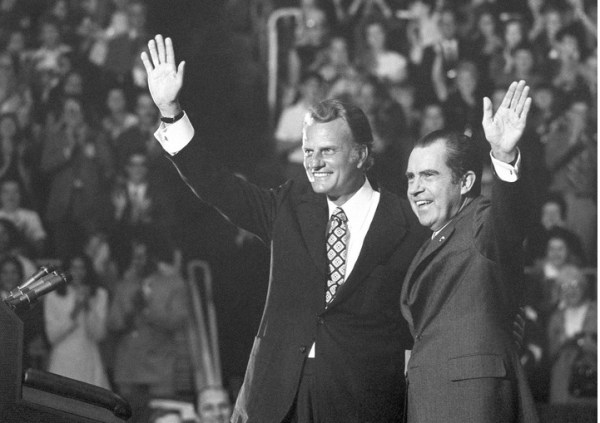
White evangelicals once changed their minds about lovin a president. Will Trump be next? At WaPo.

“Whether we like it or not, a major problem we face as evangelical Christians today is the identification in the popular mind of the religious position we represent with the Nixon administration and its actions. We are ‘middle America,’ the group sector that gave President Nixon his ‘mandate.’ We are the war party, the white backlash (if not racist) party, the Watergate scandal party.”

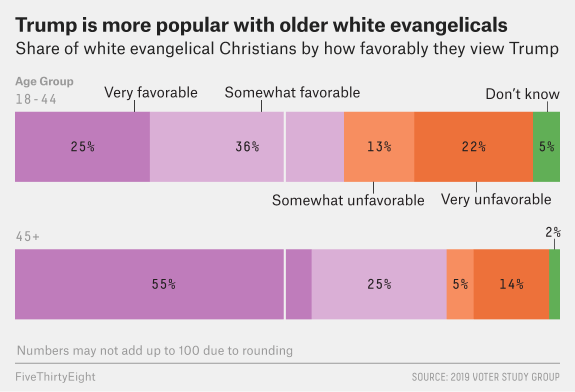
nixon graham wapoSome evidence that younger white evangelicals are already giving up on Trumpism, at 538.

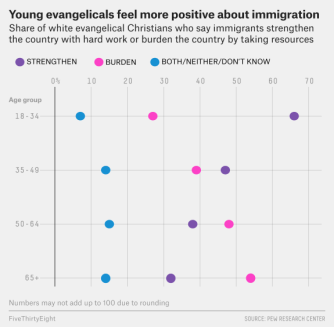
But there are increasing signs of a generational rift: Younger white evangelicals have not fully bought into Trump’s politics and are less receptive to Trump’s message of cultural decline. The age gap among white evangelicals in some ways just mirrors the age gap among the public overall with regards to Trump, but in conversations with a number of younger white evangelical Christians, many said they are reexamining the way their faith informs their politics and whether the two have become too tightly intertwined. . . . Two-thirds (66 percent) of young white evangelical Christians (age 18 to 34) say that immigrants coming to the U.S. strengthen the country because of their hard work and talents, a view shared by only 32 percent of white evangelical seniors (age 65+). A majority (54 percent) of older white evangelical Christians believe that immigrants are a burden on American society.

evangelical youth and trump 538

…still a lot of Trump-ism in there.

…or maybe all the blasphemy will drive evangelicals away? At WaPo.

Trump is neither the “Second Coming of God” nor the “Messiah.”. . . .

I am a conservative evangelical who cast my vote for Trump for the very same reason many other evangelicals did: his conservative stance on issues concerning abortion and religious freedom. I visited Washington last October for a briefing at which faith leaders listened to White House officials address many policy issues. . . .

We must . . . vocally denounce [Trump’s] blatantly egregious actions, including not only Wednesday’s tweets but also his consistently negative interactions and dialogue with people of different races, genders and ethnicities.

Christian mom vs. teacher-led school prayer, at Christianity Today.

Though I understand it’s pleasant for some to hearken back to a day when a tight-bunned teacher led children through a crisp Pledge and a Prayer (no matter what her heart, mind or soul actually believed) as somehow holier, better, safer, they weren’t. Schools with teacher-led prayer refused to admit black children. Schools with teacher-led prayer burnt to the ground. Students were still bullied. They still had sex, got abortions, and got high. Homes were still broken. Kids were still confused and frightened by their sexuality. Even back then. Even with all that prayer.

Yoga: Banned in Alabama, at CBS42.

“I don’t know if it is the school system or if it is a polarized subject, like abortion or common core,” Gray said. “It’s one of those things that people think is bad.”

Another good time not to be the mayor of Bloomington, Indiana. What are they supposed to do with racist organic farmers at their farmers’ market? At NYT.

Bloomington has declined to remove Schooner Creek from the market. Mayor John Hamilton said the farmers had First Amendment rights to their personal views as participants in a city-run market, and said the farm did not appear to be breaking any written rules about how vendors should behave at the market.

While some in Bloomington want Schooner Creek to leave, others said they wished protesters would drop their cause. In late July, an associate professor at Indiana University was arrested as she held up a paper sign in front of the Schooner Creek stand. Protesters yelled “Shame, shame!” as police officers escorted her away from the market.

racist farmers NYTTough times for evangelical colleges, at WORLD.

Nyack College, a Christian and Missionary Alliance (CMA) school in the New York City area, received an independent audit in 2017 with an opinion any institution dreads: “substantial doubt about its ability to continue as a going concern.”

What will the future hold for LGBTQ exemptions? Will evangelical institutions be forced to comply? At The Atlantic.

For religious groups and institutions that teach that homosexuality is a sin, and that men and women were created as such by God, the prospect of this kind of legislation is worrying. “It would be years of litigation—that’s what we would look forward to under the Equality Act as currently drafted,” Shirley Hoogstra, the president of the Council for Christian Colleges and Universities (CCCU), told me. For the nearly 140 Christian institutions that are members of her organization, she said, the bill “would put federal funding, it would put accreditation, it would put hiring rights, it would put campus student-life policies all at risk.” Fundamentally, these kinds of groups want to be able to preserve what they see as religious integrity in their own spaces—and they object when that is described as bigotry. “The Equality Act as currently drafted has caused Christian institutions to really wonder about whether their particular educational contribution is valued in America,” Hoogstra said.

Send in the clowns: A historical review of clownish leaders at HNN.

Making fun of those who have power over us is a small blow against authority. But the clown princes go further. What could be more anti-elitist than to take politics to the polar opposite extreme? Elitists read books, use evidence to make arguments, rely on science, demand proof; the clown prince needs no such intellectual crutches; they rely on passion, emotion, feelings. Lashing out is their feel-good option.

Women, transgender women, and sports. What is the fair solution? At Arc.

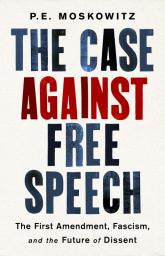
Free speech on campus: A new book argues that conservative gripes are bogus, at IHE.moskowitz IHE

Is denying someone admission to a college a threat to that person’s free speech? Is failing someone in a class a threat to their free speech? Is a student not being able to disrupt a class whenever they want a threat to free speech? We take these limits as a given, and even a positive in colleges, yet when it comes to students requesting or demanding that colleges not allow professors or students to say racist, transphobic and other offensive language without punishment, that becomes a step too far for administrators. So I would question whether they’re really afraid of limiting speech (which, as I said, they do all the time), or whether they’re afraid of confronting just how common and ingrained transphobia, racism and other forms of oppression are on their campuses.


Will Fundamentalist U Crush Trumpism?

Don’t be fooled by the noises coming out of Lynchburg. Though Jerry Falwell Jr. of Liberty University might be shameless (and just kind of weird) in his white-evangelical support for Trump, the overall landscape of evangelical higher education might be driving younger white evangelicals off the Trump train. We have to ask: Did the efforts of evangelical school administrators in the twentieth century lay the foundation for Trump’s political demise?

white evangelical youth immigration

Did ‘Fundamentalist U’ teach young evangelicals to value immigration?

Here’s what we know: Recent surveys show that younger white evangelicals don’t share their elders’ anxieties about immigration. As Daniel Cox wrote recently at 538:

Two-thirds (66 percent) of young white evangelical Christians (age 18 to 34) say that immigrants coming to the U.S. strengthen the country because of their hard work and talents, a view shared by only 32 percent of white evangelical seniors (age 65+). A majority (54 percent) of older white evangelical Christians believe that immigrants are a burden on American society.

That’s bad news for Trumpism. If younger white evangelicals don’t dislike immigration, they might waver in their support Trump. It might just crack his electoral base.

How does any of this relate to evangelical higher education?

As I found in the research for Fundamentalist U, many evangelical universities had a long and shameful racist history, just like most of the rest of American higher education. Starting in the 1950s, though, white evangelicals participated—and often took the lead—in promoting anti-racist attitudes among white Americans.

Institutions such as Wheaton College often floundered, but in the end they added new curriculum about African and African-American history and culture. They recruited more non-white faculty and students. They did not succeed as well as we might hope, but evangelical faculty members and administrators at many colleges worked hard to fight against white racism at their institutions.

What’s the upshot? In some cases, such as at storied Nyack College, the racial climate on campus has been utterly transformed. Nyack might be drowning in debt, but it has succeeded in attracting and retaining non-white evangelical students. When a white evangelical student attends a school like Nyack these days, she gets a very different sense of what it means to be a “good Christian” than her grandmother would have.

It’s not only Nyack or Wheaton. These days, evangelical colleges are far more racially diverse than they were in the past. As Cox notes,

On Christian college campuses, which have seen enrollment gains in recent years, young white evangelical Christians are part of an increasingly diverse student body. White students account for 62 percent of the student body on the roughly 140 campuses affiliated with the Council for Christian Colleges and Universities, down from 82 percent in 1999.

Younger white evangelicals, in other words, are experiencing life as part of a new kind of America, one in which white evangelicals no longer assume that they have a special role to play as the ‘real’ Americans, one in which Making America Great Again is not such a compelling battle cry. In large part, evangelical colleges and universities helped teach each new generation that diversity and immigration are not dangers, but strengths.

And because white evangelicals play such a large role in supporting Trump, today’s evangelical colleges could be spreading a message that will spell the end of Trumpism.

Fundamentalist U Review

It is nerve-wracking waiting to hear what the experts have to say. The latest academic review of Fundamentalist U is in and I’ll be taking the rest of the day off to celebrate.

Gloege Guaranteed Pure

The experts weigh in…

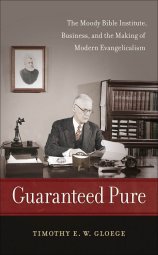
Tim Gloege was the reviewer. Dr. Gloege is author of the terrific book Guaranteed Pure: The Moody Bible Institute, Business, and the Making of Modern Evangelicalism. He knows all there is to know about the history of evangelicalism and evangelical higher education. Naturally, I was dying to hear what he had to say about Fundamentalist U.

The good news: Not only did he conclude that Fundamentalist U is “essential reading for anyone interested in the history of modern evangelicalism,” he claimed that the book succeeded in making three contributions to the history of American evangelicalism. Namely,

Fundamentalist U . . . challenges three persistent myths that have also been targets of the new evangelical historiography. First, it demonstrates evangelical “orthodoxy” was an aspiration, a dream—and a fleeting one at that. . . . Second, Fundamentalist U challenges the myth of fundamentalist “withdrawal from culture” between 1920 and 1970. . . .Finally, Laats demonstrates the utility of defining evangelicalism as a social network anchored by educational institutions. . . . Fundamentalist higher education may be an oxymoron to many outsiders, but Laats has convincingly demonstrated it has been central to American evangelicalism.”

Thank you, Dr. Gloege, for this generous and meaty review! Almost makes me want to read the book.

The Weirdest Good News for Fundamentalist U

It has never been easy to run a mission-driven evangelical college. These days, though, it seems like it might be harder than ever, with storied institutions like Gordon and Nyack Colleges forced to make harsh budget cuts. Even worse, evangelical colleges—like all colleges—are plunged into a facilities “arms-race” that no one can win. For small liberal-arts universities, it feels as if any bit of institutional bad news might just make the wheels come off. A new study of higher-ed scandals, however, might give evangelical administrators a bitter ray of hope.

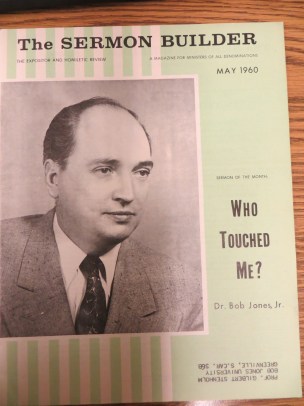
bj jr who touched me

There will always be scandal in the world of evangelical higher ed…

Turns out, when universities endure high-profile scandals, their fund-raising efforts can actually improve. According to the Chronicle of Higher Education, the recent blow-ups at Baylor, Michigan State, and Penn State did not close alumni wallets, but the opposite. As they put it,

While headline-grabbing scandals involving rogue administrators and structural failures often generate steep legal fees, criminal charges, and public outrage, high-profile universities have seen donations — and sometimes enrollment — rise in the aftermath.

One fund-raiser at Penn State, for example, found that some alumni, though not all, became MORE generous after the ugly scandal.

One donor called in the months after the scandal broke and offered a million-dollar donation — “a birthday gift to myself,” [Penn State fund-raiser] Kirsch recalled him saying. Others were symbolic gestures, he remembered. . . . Those kinds of donations make psychological sense, said Dennis Kramer. . . . He said high-profile athletics scandals could, in a convoluted way, encourage alumni to show financial support.

What does this mean for evangelical colleges? As I found in Fundamentalist U, the top-down institutional structures of schools such as Bob Jones University, Pensacola Christian College, and Liberty University gives them some advantages, but it leaves them prone to wave after wave of scandal.

The twenty-first-century scandals at Bob Jones, for instance, in which administrators were found to have been cruelly ignorant of sexual-abuse laws, were only the latest. Throughout the twentieth century, Bob Jones University endured schisms and scandals such as the Ted Mercer affair of the 1950s or the Dorothy Seah episode of the 1930s.

In tough financial times, it might seem as if those scandals would spell the end of conservative colleges, but they never have. As one expert told the Chronicle of Higher Education,

when there’s a scandal, or when there’s something that causes us to question the viability of something we hold dear, we may respond with supporting that entity more.

That sort of circle-the-wagons support has been evident throughout the history of evangelical higher education. Especially for the more conservative fundamentalist schools, such as Bob Jones, every scandal tended to divide the university community, driving some people away but leaving supporters more firmly entrenched than ever before.

Would it make sense for evangelical college administrators to provoke a scandal, then? To intentionally cultivate the scorn and contumely of outsiders? Not really. As CHE concludes, scandals can be dangerous, too.

[T]here’s one instance in which that changes: if a scandal exacerbates or publicizes an already-existing institutional problem — an institution known for lax academics that becomes embroiled in a cheating scandal, for example.

Said [institutional strategist David] Strauss, “If it’s reinforcing of a problem the school already has, watch out.”

Why Are Evangelical Colleges Struggling? Don’t Forget These Two Things

Kudos to Sarah Eekhoff Zylstra at The Gospel Coalition for peeling apart the complicated causes for declining enrollments at evangelical colleges and universities. She goes beyond the obvious, yet her article still leaves out two important factors, two unique trends in evangelical higher ed that were already becoming evident during the twentieth century.

fundamentalist U cover

How did we end up here…?

As Zylstra writes, all colleges these days are charging higher tuition than they had in the past. Moreover, there are more students than ever attending higher education. Seems as if these should be boom times for all universities, but they are not. Revenues are down, enrollments are threatened, and administrators are facing difficult cost-cutting choices. Just ask Alaska.

What gives? As Zylstra notes, we shouldn’t be fooled by high tuition rates. In practice, colleges have to discount that rate for most of their students, and evangelical colleges might be getting only about 50% of their sticker price. Plus, competition with public universities has become even more intense, with many publics adopting the aggressive recruitment models of private schools. Finally, to keep up, evangelical colleges have had to pony up for new kinds of campus accoutrements that families have come to expect, such as high-end dining, climbing walls, and more.

As Zylstra relates,

“It’s an arms race,” [one administrator] said. “We all had to do what we needed to compete.” Colleges upgraded their technology and built new dorms, classrooms, and gyms. . . . “Now we hit a price point, and a lot of parents won’t pay.”. . .  schools are bringing in less money due to discounted tuition while at the same time spending more on upgrades.

In addition to these important reminders, evangelical colleges in particular have their own unique strengths and challenges. First, the good news for evangelical higher ed: These days, small colleges and universities are all struggling to come up with something that evangelical institutions have gobs of. Namely, a niche. In Wisconsin, for example, the hapless Stevens Point campus tried to recreate itself as a “professions” campus, focusing on teaching and health care. It didn’t work.

For a century already, evangelical colleges and universities have had their niche. In this case, conservative evangelical colleges can claim to do something that state schools and secular private schools don’t—they guarantee the faithfulness of their faculty and they promise to shape students’ faith in their own tradition. For a lot of college-shoppers, that’s huge.

But it comes at a big cost. Ever since the 1950s, as I uncovered in the research for Fundamentalist U, evangelical institutions faced a unique sort of intra-evangelical competition. Biola looked anxiously at the success of Azusa Pacific. Wheaton fretted about the successes of Bob Jones. And Bob Jones got nervous about the growth of Liberty.

For evangelical parents and families, the marketplace of evangelical institutions gives them a choice, and that choice tends to push schools to become more and more conservative. From Bryan College to Cedarville, all across the country, evangelical colleges are tightening down on their political and religious distinctives. Why? Because if they want to enjoy the enrollment boosts that come with their religious niche, they need to offer something truly different than mainstream schools. They need to sell themselves to students and families as something other than a public university with mandatory chapel attendance. So they tend to squeeze students and faculty members with more and more conservative requirements.

Does it spell doom for evangelical higher ed? Not at all. But as a perspicacious alumna of Westmont College recently noted in these pages,

The crisis of higher education is felt across the board, and evangelical colleges are no different. At Westmont, enrollment has been down significantly in recent years, making the role of donors even more prominent. By now I recognize that all colleges and universities are beholden to donors to some extent, but Christian colleges especially are due to their generally smaller size and “niche market.” . . . How will these trends impact Christian higher education? I believe there’s already a significant rift between progressive members of Christian colleges (including mostly faculty and some students) and conservative members (donors, administrations, and some other students). If the conservative element continues to control the purse strings, the progressive element will feel increasingly alienated, perhaps contributing to an even greater decline in enrollment.

Is THIS Why White Evangelicals Love Trump?

Why? Why? Why? That’s what nerds have been asking for the past few years. Why, that is, do so many white evangelical voters seem to (still) love Trump? Sometimes even more now than in 2016? Reporter Julie Zauzmer recently examined some interviews to offer a new explanation. To me, it seems like there is still something missing. It’s big and it’s obvious, but it’s not the first thing white evangelicals like to talk about.

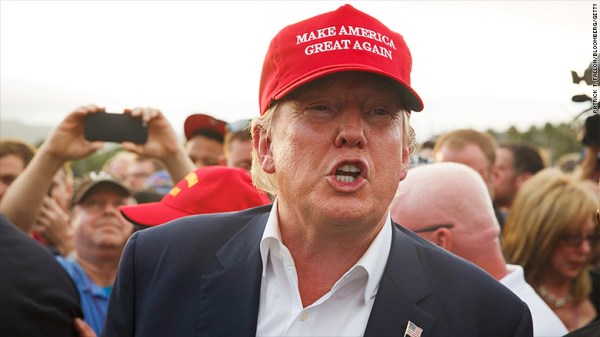
Trump make america great again

It’s the hat, stupid.

When asked, a group of white evangelicals explained that they like Trump because they think he is fighting for them. Finally. As Zauzmer explained,

Interviews with 50 evangelical Christians in three battleground states — Florida, Pennsylvania and Wisconsin — help explain why. In conversation, evangelical voters paint the portrait of the Trump they see: a president who acts like a bully but is fighting for them. A president who sees America like they do, a menacing place where white Christians feel mocked and threatened for their beliefs. A president who’s against abortion and gay rights and who has the economy humming to boot.

“You’ve just got to accept the bad with the good,” Halbert [a white evangelical from Florida] said.

Makes sense. But there’s an important element missing from this explanation. Yes, many white evangelicals feel that America is a “menacing place,” but more important, with a bitter nostalgia they see mainstream America as a menacing place that used to be better. They see a mainstream America that has been warped and perverted, not just an America that isn’t the way they like it. Most important, many white evangelicals see America as a place that has been stolen from them. As I found in the research for Fundamentalist U, white evangelicals have long felt that America has not only declined passively; they feel America has been usurped.

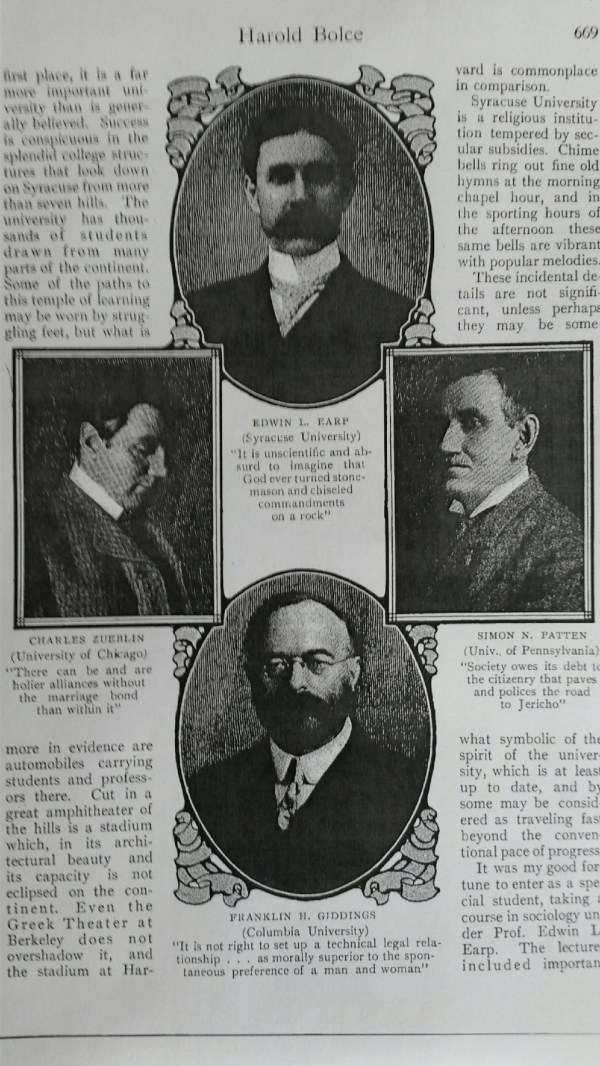
bolce page image

Watch out, white evangelicals–mainstream institutions have been usurped!

It is a hugely important distinction and it’s one that Trump stumbled across with his MAGA approach to the 2016 elections. Consider just a few 20th-century examples of the kind of nostalgism that has driven white evangelical politics for so long. Way back in 1909, for example, journalist Harold Bolce reported in the pages of Cosmopolitan magazine that mainstream colleges had gone to the dogs. Instead of inculcating youth with revered values of God, home, and family, elite colleges taught students a devilish stew of skepticism and “science.”

By way of example, Bolce interviewed Syracuse sociologist Edwin L. Earp. As Bolce told anxious readers,

“Do you not believe, Professor,” I asked, “that Moses got the ten commandments in the way the Scriptures tell?”

The professor smiled. “I do not,” said he. “It is unscientific and absurd to imagine that God ever turned stone-mason and chiseled commandments on a rock.”

For white evangelicals at the time, the message was clear. Something terrible had happened. They could no longer trust mainstream institutions. The feeling lasted throughout the twentieth century and got stronger with time. By 1979, fundamentalist school founder A.A. “Buzz” Baker could warn readers,

It may come as a surprise to some that the very first public and private schools in our country had a traditional approach or philosophy of education.  Harvard, Yale, Andover Newton [sic]—to name but a few—used to be ‘our’ schools.

For white evangelicals in the 1970s, the notion that Harvard used to be a conservative-evangelical stronghold often came as a shock and a revelation. It fit with the sense of angry nostalgia that has driven white evangelical politics for so long. Not only did America use to be great, many white evangelicals feel, but America used to be OURS.

Why did so many white evangelicals vote Trump in 2016? And why do so many like him even better now, in spite of everything? Yes, they see Trump as a fighter in their corner on issues like abortion rights and LGBTQ rights. But even more important, they hear Trump repeating their mantra: America used to be great. America used to be OURS. It has taken some hits, but together we can Make America Great Again.

Fundamentalist U & Me: Kelsey Lahr at Westmont

Welcome to the latest edition of Fundamentalist U & Me, our occasional series of memory and reflection from people who attended evangelical colleges and universities. [Click here to see all the entries.] The history I recounted in Fundamentalist U only told one part of the complicated story of evangelical higher education. Depending on the person, the school, and the decade, going to an evangelical college has been very different for different people.

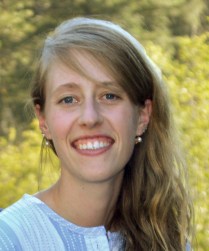
This time, we are talking with Kelsey Lahr. Kelsey had the experience of returning to her alma mater to teach, when she saw her school in a very different light. Today Kelsey is a writer and communication studies professor. In the summer, she works as a park ranger in Yosemite National Park. You can find links to her writing here.

If you attended an evangelical college or university and you’re willing to share your story, please contact Adam at the ILYBYGTH International offices at alaats@binghamton.edu.
wed4 (2018_12_14 05_13_56 UTC) (2)

Kelsey Lahr today.

ILYBYGTH: When did you attend your evangelical institution? What school did you attend?

I attended Westmont College from 2007-2011. I returned to teach there as an adjunct professor for two years, from 2017-2019.

ILYBYGTH: How did you decide on that school? What were your other options? Did your family pressure you to go to an evangelical college?

I was looking for a Christian college because I was interested in the possibility of pursuing vocational ministry as a career path. I looked at a number of evangelical colleges across the country, but was most familiar with Westmont and most drawn to it. My mom and older sister had both attended Westmont, although my family never pressured me to attend a Christian college. Ultimately I decided on Wesmont because I had such positive experiences visiting my sister there. The small class sizes and close-knit student community seemed like a good fit for me. I think my parents were actually a little surprised that I opted for a small, Christian school only an hour and a half from my hometown, but they were supportive, and would have been no matter kind of college I might have chosen.

ILYBYGTH: Do you think your college experience deepened your faith? Do you still feel connected to your alma mater? What was the most powerful religious part of your college experience?

I do think Westmont deepened my faith in some ways. I’m not a person for whom faith comes easily, and I spent my whole life questioning everything I was ever taught, including my family’s faith commitments. At Westmont, I encountered brilliant, open-minded faculty members, many of whom were politically liberal. They showed me that I could think deeply, hold progressive political ideas, ask questions, and still be a Christian. Without this experience, I think I would have become bitter about the Christian church and all its hypocrisy. In those moments of disgust with the Church when I was fresh out of college, when I was ready to give up on it, I often thought back on the great examples of thoughtful, progressive Christians I had encountered at Westmont. I think this is what kept me from leaving my faith behind.

One particularly powerful religious element of my Westmont experience was a study-abroad program I took to South Africa and Northern Ireland. On this trip, we studied racial, political, and religious conflict and reconciliation. I was deeply fortunate to witness the work that Christians and other people of faith were doing to help heal divided societies, and to develop a faith-based framework for social and political engagement. This experience continues to influence me today.

All that said, I do not feel particularly connected to Westmont now. Shortly after I graduated, there was something of a mass exodus of faculty members of color because Westmont was not a hospitable work environment for them. The most influential professor I had at Westmont left during this time because it had become so difficult to exist in that space as a faculty member of color. When I went back to work at Westmont as an adjunct, it was truly a disillusioning experience. Some of the wonderful faculty I had there as a student were still around, but now I got to see up close how the administration functioned. I saw how beholden they were to conservative donors. I had been insulated from this icky reality when I was a student, but as faculty, it was like watching the sausage get made. I knew it wouldn’t be a long-term career fit for me for that reason.

ILYBYGTH: Can you give an example of the tension between donors and faculty? Between the progressive sentiment on campus and the more conservative impulse?

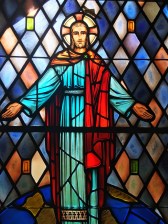
At the center of the college’s spiritual life is a prayer chapel in the middle of campus. The chapel is always open, and is the only overtly “religious” building on the campus. At the front of the chapel is a stained-glass window that depicts Jesus as white, standing on a globe that is positioned so that he is right on top of North America. In the past couple of years, students have begun to recognize this depiction as problematic, colonial, and inappropriately conflating Christianity with whiteness. Many students of color expressed that the centrality of this depiction on campus made them feel even more marginalized than they otherwise would in a school where white students and faculty far outnumber students and faculty of color.  A group of students started a petition last semester, asking the administration to take the window out of the prayer chapel and put it somewhere less visible and less central to the community’s spiritual life. As a faculty member, it was my impression that most students either supported this proposal or didn’t really care about the window one way or the other. Yet the administration balked, and their responses always revolved around the importance of the window to Westmont’s history. (The chapel and the window were both installed in the 1970s as a memorial to the daughter of the college’s president at the time, who died in a car accident as a young woman.) The prioritization of “history” over the concerns of current students of color seems typical of the administration. And of course, older donors are the ones who care about that particular phase of Westmont’s history.  You can read more about the window issue here.
Westmont-Jesus

Westmont’s “White Jesus”–stay or go?

ILYBYGTH: Would you/did you send your kids to an evangelical college? If so, why, and if not, why not?

I don’t have kids, so I guess I’m off the hook! But if I did have children, I suppose it would depend on the college. Not all evangelical colleges are the same. Many of my high school church friends ended up at a very conservative Baptist college, and thankfully my parents discouraged me from applying there. I would likely do the same for my own kids. Westmont was a mixed experience for me, but I think ultimately it allowed me the freedom to question my faith within a supportive context, and I would welcome that for my children as well. On the other hand, in the years since I’ve been a student, Westmont’s faculty has become a lot less diverse, which is a huge detriment to the college. If that trend continued, I would probably discourage my kids from attending. Learning from a diverse faculty was one of the major reasons Westmont was mostly positive for me, so I might instead encourage my children to go someplace where more diversity is offered–and unfortunately, that’s not likely to be an evangelical college.

ILYBYGTH: Do you still support your alma mater, financially or otherwise? If so, how and why, and if not, why not?

I donated what I could when I was a young alum. But when my favorite professor of color left Westmont and told me what was going on, I stopped donating. Knowing what I know now about Westmont’s unfortunate tendency to pander to conservative donors and alums, even to the detriment of students and faculty, I would not donate.

ILYBYGTH: If you’ve had experience in both evangelical and non-evangelical institutions of higher education, what have you found to be the biggest differences? The biggest similarities?

I have attended and taught at both public and evangelical institutions. I was surprised to find that Westmont was by far the most academically rigorous. Maybe because it’s so small (only 1300 students), my students were intensely engaged, and truly a delight to teach. That was an unexpected and welcome difference, although I doubt that Westmont’s evangelical identity is the major cause for that. I don’t really know the major cause for that level of rigor. Perhaps the high cost of tuition selected for a particularly privileged group of students who happened to have been given all the resources they ever needed to be successful academically.

A surprising similarity was the level of closed-mindedness I experienced both at Westmont and at the public university where I attended grad school. Although this closed-mindedness was shown in different ways and toward different people, it was still quite prevalent in both places. By definition, religious colleges will require certain behaviors and encourage certain beliefs. But I also found this to be the case in grad school, although in a different way. Evangelicals were openly mocked all the time by my cohort. I no longer identified as evangelical (by then I considered myself to be simply Protestant), and I could understand why evangelicals seemed so hateable, but it was still uncomfortable. Political conservatism was also verboten. I had been a progressive my entire adult life, so I wasn’t personally affected, but I kept thinking that my grad program and Westmont were both pretty intolerant of beliefs that fell outside the mainstream of the majority.

ILYBYGTH: If you studied science at your evangelical college, did you feel like it was particularly “Christian?” How so? Did you wonder at the time if it was similar to what you might learn at a non-evangelical college? Have you wondered since?

I only took one science class at Westmont, which was a basic biology class, the only one that didn’t require a lab. It was Christian to the degree that all my classes at Westmont were Christian, in that we were encouraged us to undertake our learning with the goal of pursuing God’s truth. The material itself was probably no different from what I would have learned elsewhere. The professor went to great lengths to teach mainstream evolution, but respectfully engaged with students who were offended by having their young-earth creationism challenged. In fact, I doubt many Westmont professors held a literal understanding of Genesis. Even in my Christian doctrine course, the professor spent a lot of time trying to give us a framework for reading the creation story as more metaphorical than literal, and most of my fellow students embraced this, along with standard evolutionary theory. I think this is one major factor that sets Westmont apart from other evangelical colleges. Although Westmont describes itself as evangelical, most faculty reject a strictly literal interpretation of the Bible, which puts the college at odds with one major tenet of evangelicalism. This was most apparent to me in my biology class, but also in many other classes, including theology and Bible classes.

ILYBYGTH: Was your social life at your evangelical college similar to the college stereotype (partying, “hooking up,” drinking, etc.) we see in mainstream media? If not, how was it different? Do you think your social experience would have been much different if you went to a secular institution?

My social life was nothing like the college stereotype. Westmont requires all students and faculty to sign a “Community Life Statement,” which forbids underage drinking and drinking to excess, sex outside of marriage, drug use, etc. For me, both as a student and a faculty member,  it was a matter of integrity to adhere to this agreement, since I had signed it, although I didn’t necessarily agree with every element of it. So I didn’t party at all while I was in college, and once I turned 21 right before my senior year, I drank in moderation (which was allowed by the agreement). Many (but not all) students also adhered to the Community Life Statement, so for us socializing often meant movie nights, wandering the downtown area, or going to the beach. Other students did choose to party, and did so off campus. Being in Santa Barbara, not far from UCSB, those students who did want to party didn’t have any trouble finding that scene. But it happened off campus, and you had to seek it out pretty intentionally.

For me personally, I doubt my social experience would have been that different if I had attended a secular institution. Partying was never my thing. In the summers, I worked in Yosemite for the National Park Service, which was a totally secular environment and offered many opportunities to party, but I never did. Instead, I spent time socializing with other people who were happy to sit on the porch in the evenings and sip moderate amounts of wine. I probably would have gravitated to similar kinds of people at a secular college.

ILYBYGTH: In your experience, was the “Christian” part of your college experience a prominent part? In other words, would someone from a secular college notice differences right away if she or he visited your school?

The “Christian” part of my Westmont experience was certainly prominent, and anyone visiting would definitely notice. Chapel happens three times a week and is required for all students. Faculty intentionally integrate faith and learning; as a new faculty member, my department chair worked with me on this specifically. Courses in the religious studies department are also required for all students. Old Testament, New Testament, and Christian Doctrine were all required when I was a student, and still are. Faculty are also required to sign a statement of faith, although students are not. This statement of faith is not so detailed that it would exclude, say, Catholics, and many denominations are represented on the faculty, but it does ensure that all professors are practicing Christians. This means that religion is discussed openly and often, both in the classroom and in the dorms.

ILYBYGTH: Did you feel political pressure at school? That is, did you feel like the school environment tipped in a politically conservative direction? Did you feel free to form your own opinions about the news? Were you encouraged or discouraged from doing so?

I was a registered Democrat before I enrolled at Westmont, and I never felt any pressure to move right. In fact, my impression as a student was that most faculty members were at least as progressive as I was (perhaps with the exception of the economics and business department, which is probably conservative at most institutions). As a faculty member, I interacted with a greater variety of other professors than I had as a student, and my impression now is that it’s a fairly even mix of liberal and conservative, perhaps tending slightly toward the left. The student body was and is generally conservative, coming from mostly evangelical homes. But like college students everywhere, many of them move left over the course of their time at Westmont. As a student, I definitely felt free to form my own opinions about the news, and in fact I got the impression that faculty were trying to challenge students’ conservative assumptions by exposing them to a greater variety of perspectives. I saw this as a huge benefit, but then again, I was liberal to start with.Westmont_College_logo
I also didn’t feel any political pressure as a faculty member. I openly taught from a progressive standpoint, and felt total freedom to do so. Critical theories were central to my teaching, and I spent a lot of time with my students examining the ways that race, class, and gender influence communication. I also incorporated a number of environmentally-focused readings into my course and assigned works by feminist scholars. A couple of students noted this in their end-of-semester course evaluations, writing that I was “extremely feminist” (this was meant negatively). Although both the provost and my department chair saw these evaluations, no one ever brought it up, which reinforced my sense of academic freedom.

ILYBYGTH: What do you think the future holds for evangelical higher education? What are the main problems looming for evangelical schools? What advantages do they have over other types of colleges?

The crisis of higher education is felt across the board, and evangelical colleges are no different. At Westmont, enrollment has been down significantly in recent years, making the role of donors even more prominent. By now I recognize that all colleges and universities are beholden to donors to some extent, but Christian colleges especially are due to their generally smaller size and “niche market.” And that market is getting even more niche–young Americans are leaving the Protestant church in record numbers.[1] The reasons for this are complicated, but the trend is at least partially explained by the increasingly conservative identity associated with evangelicalism.[2] How will these trends impact Christian higher education? I believe there’s already a significant rift between progressive members of Christian colleges (including mostly faculty and some students) and conservative members (donors, administrations, and some other students). If the conservative element continues to control the purse strings, the progressive element will feel increasingly alienated, perhaps contributing to an even greater decline in enrollment. I saw this tension up close while I was teaching at Westmont, because I was the faculty adviser to the student newspaper, which is both a voice for students and is also sent to alums and donors, placing the paper right in the center of these competing constituencies. I often felt the tension between student free speech (which I prioritized) and pleasing donors (which I did not believe was my job). On one occasion I was called into the provost’s office for a stern warning when the paper published a piece of very mild satire poking fun at white privilege. It turns out that a couple of conservative alums had been offended by the piece, and the student editor in chief ended up having to issue an apology. This incident was one example of several that made It seem to me that the administration cared more about avoiding controversy and pleasing conservative donors than allowing students the opportunity to have difficult conversations in a forum that exists to foster those very discussions, especially when those conversations have to do with “liberal” issues like race, gender, and sexual orientation.

By contrast, increased political polarization might work to the advantage of some evangelical institutions that are more conservative than Westmont. Places like Liberty University will likely continue to market themselves as “safe spaces” for young conservatives, and I suspect those places will continue to draw the same faculty and students they always have. Evangelical colleges that are less overtly connected to the world of politics, like Westmont, might find themselves between a rock and a hard place as donors shape policies in a conservative direction, while students and faculty feel increasingly out of place.

[1] Cooper, B., Cox, D., Lienesch, R., & Jones, R. P. (2016, September 22). Exodus: Why Americans are Leaving Religion—and Why They’re Unlikely to Come Back. Retrieved August 9, 2019, from Public Religion Research Institute website: https://www.prri.org/research/prri-rns-poll-nones-atheist-leaving-religion/

[2] Riess, J. (2018, July 16). Why millennials are really leaving religion (it’s not just politics, folks). Retrieved August 9, 2019, from PBS website: https://www.pbs.org/wnet/religionandethics/2018/07/16/millennials-really-leaving-religion-not-just-politics-folks/34880/