Join ILYBYGTH for the Debate

You know you’re going to watch the debate tomorrow between young-earth creationist Ken Ham and science popularizer Bill Nye.  So why not join us as we live-blog throughout the event?

It will be streamed live at 7 PM New York time and will be found at debatelive.org.

We will offer live commentary and invite readers’ comments as the debate moves along.

We’ll be especially interested to see what sorts of arguments each speaker will bring out.  As we’ve discussed before, this debate might have the effect of imposing a limited definition on the meanings of “creationism.”  But will it?  Watch it with us and let’s see.

Creation Debate Update: Squeezing Out the Middle

Forget the Super Bowl.  Next Tuesday, February 4th, at 7 PM New York time, we’ll all be watching the debate between young-earth creationist Ken Ham and science popularizer Bill Nye.  It looks as if Nye and Ham agree on their goals: squeezing out the middle.  Both debaters want to draw attention to young-earth creationism, and their agreement threatens to exacerbate the divide between evolution and creationism.

The debate host, Answers In Genesis’ Creation Museum, will be streaming the action live for all of us to see.

Ken Ham has suggested that the debate might be a perfect learning opportunity for teachers and students in public school science classes.  From Ham’s point of view, this debate might be a chance to reach students who might not otherwise be aware that mainstream evolutionary science is full of holes.

Bill Nye, too, has explained his reasons for engaging in this debate.  In these pages and elsewhere, evolution-education mavens have wondered if this debate only legitimizes the dead science of the young-earth creationists.  As “The Science Guy” explained, “I don’t think I’m going to win Mr. Ham over.”

So why debate?  Nye says, “I want to show people that this belief is still among us. . . . It finds its way onto school boards in the United States. . . . I’m not going in as a scientist as such . . . I’m going in as a reasonable man.”

So it seems both debaters have the same goal.  Both men want to make people aware of the claims of young-earth creationism.  From Ham’s perspective, such awareness will help keep smart young Christians from leaving the faith.  From Nye’s point of view, if people know what creationism is, they will help fight against it politically.

With such agreement, it seems likely both debaters might succeed.  This debate might elevate the profile of young-earth creationism.  One casualty, it seems, will be other visions of creationism.  Ken Ham’s brand of young-earth creationism, after all, is only one extreme form.  Many religious people believe that humans and life were created at some point by God.  But they do not believe that they must discard the findings of modern science.  The folks at BioLogos, for example, insist that fervent Biblical Christianity can go hand-in-hand with mainstream evolutionary science.  And “old-earth” creationists such as Hugh Ross agree that God did it all, but they don’t insist that he did it only 6,000 years ago.

If this debate succeeds—at least according to the goals of both Ken Ham and Bill Nye—those “other” creationist belief systems will likely get squeezed even further out of the conversation.  That’s a shame.  Too many observers already equate “creationism” with young-earth creationism.  It may make for more lively debates, but it makes for less productive and civil conversations.


What Should The Science Guy Say?

It’s coming up. 

In just a few short weeks, Bill Nye “The Science Guy” will debate the scientific premise of creationism with Ken Ham at Answers In Genesis’ Creation  Museum.

What should Nye say?

Science writer Greg Laden offered this morning a short list of points he’d like Nye to make.  In general, Laden suggests that Nye focus on the unscientific nature of creationism.  The debate over divinity was real and important in the history of science, Laden points out, but that debate has come and gone.  Laden doesn’t use the phrase, but his argument is reminiscent of philosopher Philip Kitcher’s definition of creationism as “dead science.”  In this vision, it makes no sense to debate the science of creationism, since creationism is not even bad science.  Creationism, rather, represents an understanding of science that has been thoroughly and completely discredited.    

Laden’s debate prep brings up two important questions.  First, what would people advise Ken Ham to say?  And second, do we agree with Laden’s advice to Nye?

First things first: What do you think Ken Ham should say?  For those of us who live mental lives outside the boundaries of religious creationism, is there anything he could say that would convince us that his creation science should be taken seriously?  For me, the answer is no.  I’ve defended Ham in the past and taken heat for it from ardent anti-creationists.  But in this case, I’ll be flummoxed if Ham uses any arguments beyond his scriptural stock-in-trade.  That is, I don’t guess Ham will try to convince people like me who are not moved by references to Biblical passages. 

I’m thinking Ham will likely harp on the scientific merits of young-earth creationism, when in fact his argument would be much stronger if he tried a different approach.  To people like me, at least, Ham’s scientific credentials have no leg to stand on.  But as religious dissenters young-earth creationists can claim much more wiggle room in education and culture.  If Ham wanted to reach out to people beyond the ranks of his current religious supporters, he should argue for creationists’ rights as aggrieved minorities, as a religious group, not as a contender for scientific legitimacy. 

But Ken Ham is not likely to take this approach, since he has built his career on the promise that young-earth creationism is better science than mainstream science.  He will likely trot out his compelling but ultimately vacuous arguments about observational science vs. historic science.  He will likely ask Bill Nye some variant of his ultimately senseless question: “Were you there?”  If Ken Ham hopes to maintain his role as the charismatic leader of the young-earth creationist movement, he can’t really do anything else. 

Question two: What should Nye say?  I don’t think Laden’s advice is the first best answer.  IMHO, the most effective answer to young-earth creationists such as Ken Ham is a theological one, not a pop-science one.  As do the folks at BioLogos, I think the most effective message young-earth creationists need to hear is that Biblical faith does not require faith in a young earth.  As science pundits tend to agree, young-earth creationism is not really science, it is something else.  It is an outgrowth of a particular religious understanding.  Therefore, the strongest arguments against it are religious, not scientific. 

Also, I don’t think Nye should use his precious exposure to creationists to blast the dead-science nature of young-earth creationism.  Many creationists will expect a hostile attack on their belief system.  They will not be moved by it.  They will not be convinced by it, since they will not credit its source.  I think it will be more effective for The Science Guy to do what he does best: explain what science is.  Young-earth creationism is based on a very different way of defining knowledge.  If Bill Nye can explain what real science is—instead of attacking the reasons why young-earth creationism doesn’t meet that definition—he can expose some of the creationists in the debate audience to a very different way of understanding the entire debate. 


To Debate or Not to Debate

Bill Nye and Ken Ham will be going a few rhetorical rounds next month.

The mega-popular science educator will broach the creationist lion’s den of the Creation Museum on February 4th.  The topic: “Is creation a viable model of origins in today’s modern scientific era?”

Image Source: Answers In Genesis

Image Source: Answers In Genesis

Are these debates worthwhile?  In the past they had decisive impact on the formation of American creationism and fundamentalism.  But these days such debates are a different animal.

Science pundits don’t like it.  Jerry Coyne warned that Bill Nye will only be putting money and legitimacy in Ham’s deep pocketsPZ Myers wisely concludes that each side will likely only speak past the other.

I agree.  The audience at this debate will likely not be moved by either man’s arguments.  No matter how scientifically accurate or biblically flawless, logical arguments tend not to be the deciding factor in determining one’s beliefs about human origins.

As David Long’s ethnography demonstrated so powerfully, creationists can thrive in mainstream scientific environments without abandoning their religious ideas.  Many creationists have simply been taught to regard mainstream scientists as deeply flawed and bumbling fools.  It is easy to dismiss plausible-sounding talk from someone we have already deemed unreliable.

It’s hard to imagine Ham’s Cincinnati audience won’t be prepared to dismiss Nye’s mainstream science talk out of hand.  I assume Nye is hoping that he may still plant a few seeds of science doubt in the minds of those who hear him.  Not much reason to offer Ham such a plum chance to look like a reputable scientific authority.

At the start of America’s public evolution/creation battles, this legacy of public debating functioned much more powerfully, since creationists had not yet set up alternative institutions.  As I describe in my 1920s book, some of the most influential creationists of the 1920s received humiliating public trouncings in popular debates.

At a talk on the campus of the University of Minnesota, for example, fundamentalist leader William Bell Riley found himself surprised by a student prank.  Someone lowered a monkey onto the stage as Riley tried to convince his audience that creationism was reputable science.  “Every time I hear the argument that this is a controversy between experts on the one hand, and, as someone has said, ‘organized ignorance,’ on the other, I smile,” Riley told the St. Paul Pioneer Press in 1927.  “This is not a debate between the educated and the uneducated.”

Similarly, in London, creationist godfather George McCready Price found himself hooted off the stage in the days following the 1925 Scopes Trial.  He had tried to tell the merciless audience that the theory of evolution was doomed as mainstream science.  Such flawed science, Price insisted, may have worked fine

for the times of comparative ignorance of the real facts of heredity and variation and of the facts of geology which prevailed during the latter part of the nineteenth century; but that this theory is now entirely out of date, and hopelessly inadequate for us. . . .  We are making scientific history very fast these days; and the specialist in some corner of science who keeps on humming a little tune to himself, quietly ignoring all this modern evidence against Evolution, is simply living in a fools’ paradise.  He will soon be so far behind that he will wake up some fine morning and find that he needs an introduction to the modern scientific world.

The audience didn’t buy it.  Price found himself heckled so mercilessly that he could not complete his presentation.  That London debacle was Price’s last public debate.  After that experience he focused his considerable energy on founding alternative scientific institutions to prevent future creationists from needing to convert mainstream scientists.

Back in those days, creationists and fundamentalist scientists still attempted to tell audiences that they represented the true mainstream of scientific discovery.  Such early creationists eagerly debated in a variety of settings in hope of convincing middle-of-the-road audiences that evolutionary science was not real science.

In that context, public debates held promise for both sides.  Creationists hoped to prove that they had better science.  Evolutionary scientists hoped to demonstrate the scientific vapidity of creationism.

These days, both sides have hardened.  Creationists these days are not unaware of the fact that their science does not represent the scientific mainstream.  Evolutionary scientists are not hoping to relieve creationists of their naïve ignorance.

Rather, both sides in these debates enter and exit with the same set ideas.  Each side knows who to trust on that stage and who to ignore.  No matter how persuasive Ken Ham can be, he doesn’t really hope to change Bill Nye’s mind.  Rather, this exercise merely serves to give each charismatic speaker the chance to gain a sliver of legitimacy and respectability in the opposite camp.


Teaching Evolution to Christians

Young Christians don’t know much about evolution.  As a result, they are either turning away from the faith or embracing a distorted hellfire theology.

That’s the diagnosis, anyway, from two academics at Bryan College.  Brian Eisenback and Ken Turner describe the problem of teaching evolution to young people who have spent their youth in Christian schools, nervous public schools, or Christian homeschools.  Eisenback, an entomologist, and Turner, an Old-Testament scholar, offer a new curriculum that promises to teach real evolutionary science without pushing students away from the faith or into bad theology.

As the authors describe, too many of their Christian students have faulty understandings of evolution.  As they put it,

If they were taught anything about evolution, students were often told that evolution is a component of an atheistic philosophy that aims to disprove God and undermine the authority of Scripture. For many, evolution was not a substantial component of their education; instead, more time and effort was spent on anti-evolution arguments. When these students are confronted with the evidence for evolution from multiple scientific disciplines, they are often shocked by the scope of evidence and react by wondering if their faith is still legitimate. They have often been taught that a Christian who holds a high view of Scripture rejects evolution, and Christians are obligated to interpret Genesis in a particular way. When they learn about evolution in a college biology classroom, they may feel their faith threatened or called in to question.

As a result, Eisenback and Turner explain, students often reject their home faith in toto or they hold their faith tighter and learn to feel suspicious toward mainstream science.  Whether they go to school in Christian schools that use curricula such as the Apologia series, or they go to pusillanimous public schools that tend to downplay evolutionary science, too many Christian students get only a distorted echo of real science, Eisenback and Turner point out.

Their solution?  A BioLogos-funded curriculum that will teach evolutionary science thoroughly and respectfully, yet do so in a profoundly Christian context.  Their curriculum will begin not with a primordial soup, but with the Old Testament.  It will include a broad range of ideas about life’s origins.  As Eisenback and Turner put it, they hope students will recognize the false dichotomy too often given between “atheistic evolution and young earth creationism.”

Will it work?  Will this curriculum help overcome the decades-long tension between evolution education and conservative evangelical belief?  Will students at Christian schools learn evolution better?  Will their faith be more durable when they encounter the compelling claims of mainstream science?

I wish Eisenback and Turner all the best.  As someone who hopes to see more and better evolution education in all kinds of schools, I strongly support efforts to bring good science into households that have, IMHO, been misled into believing that their faith won’t allow them to trust mainstream science.  But I can’t help but raise a couple of issues.

First, as many ILYBYGTH readers have taught me, there are intellectual and logical stumbling blocks to this approach.  In this as in many contentious issues, it ends up being simply dishonest at some point to mumble through some central concepts in the hope that “we can all just get along.”  For many evangelical Protestants, one such stumbling block is apparently the historicity of Adam & Eve.  Science demands a large genetic pool of original ancestors.  Many readings of the Bible demand an historical first pair.  Without that first pair and a real historical original sin, there is no need for salvation from Jesus, I’m told.  More than the age of the earth or the historicity of a global flood, this issue of sin and salvation are non-negotiable for many religious people.  How will this curriculum handle this stubborn intellectual conflict?

Second, though I do not know much about evangelical theology or genetics, I do know a thing or two about classroom teaching.  As an historian, I have seen, time after time, laments that America’s young people are not learning X or Y.  In most cases, the jeremiads about the state of student knowledge are followed up with grandiose plans to fix standards or textbooks.  Today’s huffapaloo about the Common Core Learning Standards, for instance, is based on deeply held assumptions that those standards are the most important way to fix or wound schooling, depending on one’s perspective.  But standards, textbooks, and curricula are not the most important determinant of learning.

As a teacher, I’ve learned to be skeptical about curricular panaceas.  I taught middle school and high school for ten years.  I’ve taught in a state university now for almost seven.  In all these teaching contexts, I’ve seen students go through identical curricula with wildly different results.  In other words, curricula/textbooks/syllabi/standards can be great, or they can be terrible, but either way, they will not determine student learning.  Don’t get me wrong: all other things being equal, good textbooks/standards/curricula are better than bad ones.  But good teachers, devoted parents, interested and engaged students…these are the things that make learning go on.  Without them, the best curricula are not going to produce great learning.  With them, bad curricula won’t get in the way.

Finally, we must also ask the $64,000 question: What about students in public schools?  They make up a vast majority of students.  Eisenback’s and Turner’s frankly theological curriculum could never be used in public schools without making a joke of the US Constitution.  But can there be a way to reach public-school students with evolutionary science when they live in communities that look askance at such things?

I’ll say it again: I hope Eisenback’s and Turner’s curriculum project takes off.  I hope students in Christian schools and Christian homeschools use their materials to see that questions of evolution are more complex than a stark choice between Darwin & hell on one side, and Jesus & bad science on the other.  But as Eisenback and Turner themselves would likely be the first to agree, these ambitions come with important roadblocks that must be overcome.


 

The Missionary Supposition

Is evolution a religion?  Are its teachers missionaries?

That has long been the accusation by some conservative religious folks.  The godfather of today’s young-earth creationist movement, Henry Morris, insists that it is.

Given that history, it is with trepidation and full humility that I’ve argued recently in the pages of the Reports of the National Center for Science Education that evolution educators might learn something from religious missionaries.

I want to be as clear as I can about this: I do not think that evolution is a religion.  I do not think evolution educators should consider it their job to “convert” young people to an evolutionary worldview.

But I do think evolution educators have been plagued historically by an attitude that creationism is simply an absence of something, a lack of knowledge about evolution.  To be sure, thoughtful evolution educators have long avoided that trap.  The folks at the National Center for Science Education, for instance, have made a strong case that we need to understand creationism if we want better evolution education. 

The attitude of many evolution educators throughout history, however, has been that creationists must simply not know enough about evolution.  Once creationists hear the truth, according to this line of thinking, they will hop on board the evolution train.

Ironically, that understanding of creationism and evolution teeters perilously close to the attitude among many early religious missionaries.  The Bible, many Protestant missionaries believed, contained such powerful, supernatural power that it would be instantly embraced by heathens worldwide.  All missionaries had to do was spread the Word.  Indeed, this faith in the transformative power of Gospel text remains strong among groups such as the Gideons and the American Bible Society.

But most religious missionaries these days understand that conversion needs more than just the Gospel.  Many conservative Protestant missionaries insist that the home cultures of local groups must be studied thoroughly and lovingly by would-be Bible missionaries.  Without that sort of preparation, real missionaries insist, evangelization is a waste of time, and may even be what one missionary writer called “evangelical toxic waste.”

What do I suggest?  I argue in my RNCSE essay that evolution educators need to spend more time understanding creationism.  If we really want to teach evolution in the United States, we need to do more than just spread the word.  We need to spend time learning about the cultures that refuse to believe evolutionary theory.

We need to study history, anthropology, and religion in addition to biology, geology, and genetics.  Awkward as it might be to admit, one “-ology” that evolution educators have ignored to their peril is missiology.


Can Evolution Match This?

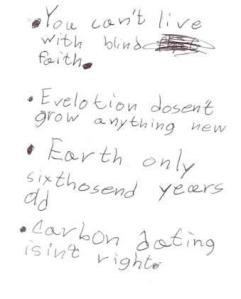
So clear and compelling a seven-year-old can understand it.  That’s the boast of young-earth creationist leader Ken Ham.  As proof, he published the lecture notes of one of his young audience members.

Image Source: Answers In Genesis

Image Source: Answers In Genesis

Image Source: Answers In Genesis

Image Source: Answers In Genesis

Image Source: Answers In Genesis

Image Source: Answers In Genesis

For those of us hoping to improve evolution education in the United States, Ham’s revelation raises a serious question: Can evolution hope to match the gut-level appeal of creationism?

Science pundits have long noticed this yawning gap between the popular acceptability of mainstream science and that of creation science.  The most clear-headed writers have admitted that creationism has better stories.

As Richard Dawkins put it in his 1996 book The Blind Watchmaker,

It is almost as if the human brain were specifically designed to misunderstand Darwinism, and to find it hard to believe.

The creation stories of young-earth creationists, on the other hand, are appealing to all age levels.  There’s a garden, there’s love, there’s disobedience, there’s punishment.  All of these are powerful themes that resonate with young and old alike.

And, lest we evolution-embracers smugly conclude that this stark advantage of creationism will fade as audiences get more intelligent and more sophisticated, let’s remember that creationism’s advantage also pulls in the intellectually sophisticated.

ILYBYGTH readers may remember the postmodern plea of journalist Virginia Heffernan.  A few months back, Heffernan declared her affinity for creationism over evolution.  Why?  In her words,

I was amused and moved, but considerably less amused and moved by the character-free Big Bang story (“something exploded”) than by the twisted and picturesque misadventures of Eve and Adam and Cain and Abel and Abraham.

Obviously, something doesn’t need a compelling narrative in order to be true.  But in the stubborn culture wars over evolution and creationism, popular appeal matters.  Evolution’s biggest selling point is that it does a better job of explaining and predicting than does creationism.  Maybe the winning narratives won’t be the detailed natural-selection classic tales starring finches and moths, but rather the far more stirring story of enlightenment triumphing over dunderheaded fogeys.

That’s a good story.  At least it worked for Kevin Bacon in Footloose.


Allmon at EVoS

Clear your calendars!

Next week Professor Warren Douglas Allmon will be traveling down scenic Route 96 from Ithaca to talk about creationism.

Allmon’s talk, “Creationism in 2013: Not in the Headlines but Never Far Away,” will be on Monday, November 18, at 5:00 in room AG008 on the beautiful campus of Binghamton University in sunny Binghamton, NY.  The talk will be free and open to the public; no registration is required.

It will be part of the continuing series of Monday seminar talks hosted by the Evolutionary Studies program here on campus.

Allmon is the Hunter R. Rawlings III Professor of Paleontology at Cornell.  He also runs Ithaca’s Museum of the Earth.

I’m excited to hear what Professor Allmon has to say.  A couple years back, Allmon argued in the pages of Evolution: Education and Outreach that evolution educators must begin by understanding the reasons for resistance, not just riding roughshod over it.  As he put it,

This multiplicity of causes [for rejecting evolution] is not sufficiently appreciated by many scientists, educators, and journalists, and the widespread rejection of evolution is a much more complicated problem than many of these front-line practitioners think it is.

Hear hear!  If you want to hear what Allmon has to say, come on down.  Hope to see you there.

Help! My Teacher’s a Girl Now!

Do young children need to be protected from transgender teachers?

Ryan T. Anderson thinks so.  And in his argument, he joins a long conservative tradition of insisting on special culture-war protections for children.

Anderson, a prominent voice in the anti-gay-marriage coalition, argued recently in the pages of the National Review that transgender teachers would force young people to wrestle prematurely with issues of sexuality and gender identity.

His argument came in the context of his opposition to the Employment Non-Discrimination Act (ENDA), a bill that would make it illegal for some employers to discriminate against gay or transgender people.

In Anderson’s opinion, this is not the latest civil-rights bill.  Sexual identity and gender identity, Anderson argues, are self-identified and self-defined, unlike race.

Perhaps most compelling, Anderson thinks, this bill might force elementary schools to employ men who used to be women, or women who used to be men.  It would force children, Anderson says, to know too much too soon.

As he put it,

Issues of sex and gender identity are psychologically, morally, and politically fraught. But we all ought to agree that young children should be protected from having to sort through such questions before an age-appropriate introduction. ENDA, however, would prevent employers from protecting children from adult debates about sex and gender identity by barring employers from making certain decisions about transgendered employees.

Although ENDA includes some exemptions for religious education, it provides no protection for students in other schools who could be prematurely exposed to questions about sex and gender if, for example, a male teacher returned to school identifying as a woman.

Anderson’s argument about age-exemptions for culture-war issues echoes a traditional theme among educational conservatives.  On the issue of evolution, for example, many conservative intellectuals of the first generation of fundamentalists argued that evolution could fairly be taught, but only at the college level.

As I argued in my 1920s book, this seemingly moderate view was held by some of the most vituperative anti-evolutionists.

William Jennings Bryan, for example, the Bible-believing man-of-the-people who stood up for the Bible at the Scopes Trial, repeatedly insisted that evolution should be taught, but with proper regard for the intellectual maturity of students.  In colleges, it should be taught as an influential theory about the origins of life.  But in primary grades, students must not be taught that evolution was the simple and only truth.

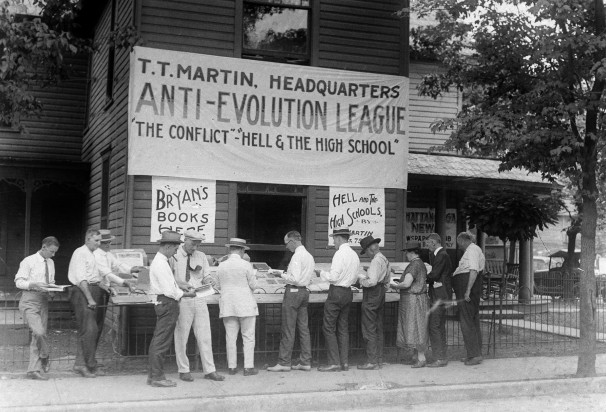
Even the hot-headed polemicist T. T. Martin, author of the relentless Hell and the High Schools, didn’t insist that evolution must be utterly banned from all schools.  In a 1923 speech, Martin suggested a new set of “graded books, from primary to university.”  These books could introduce evolutionary ideas gradually, until at last for the most mature students the books would present “fairly and honestly both sides of the Evolution issue.”

Martin's Booth at the Scopes Trial, 1925

As Anderson’s recent argument about transgender teachers makes clear, the notion that young people in school must enjoy special protection from threatening ideas still has punch in today’s culture-war debates.  Conservatives have long insisted that children must be protected from premature exposure to issues of sex and origins.


Take a Trip to a Creation Museum

How do creationists do it?

How, that is, do creationists manage to maintain a belief in a 6,000-year-old earth and a real global flood?  How do they get their children to believe that all of humanity sprang from two people in Mesopotamia a few thousand years ago?

To outsiders like me, such beliefs seem so far outside the mainstream that I have a hard time understanding how creationists manage to stay convinced.

One thing that must help is an array of institutions to support young-earth creationist ideas.  It is easy enough for a family to raise children in that tradition, attending schools, reading books, and going to museums all safely within the intellectual boundaries of young earth-ism.

Science-education guru Randy Moore took a trip to a creation museum to describe one way this can work.  In the just-released issue of Reports of the National Center for Science Education, Moore describes his trip to the Creation and Earth History Museum, just outside of San Diego.

Image Source: Creation and Earth History Museum

Image Source: Creation and Earth History Museum

The museum was founded in 1992 by the Institute for Creation Research.  It has since been sold, but its new owners continue to operate it according to ICR beliefs.  Don’t confuse it, by the way, with the much larger and more lavish Creation Museum just outside of Cincinnati.  The young-earth beliefs of the two may be very similar, but Answers In Genesis’ Cincinnati museum looks and feels much more like mainstream science museums.

Still, for those who can’t make it all the way to Cincinnati, this San Diego attraction might achieve many of the same goals.

Moore walks readers through those beliefs in an even-handed and explanatory way.  Moore does not try to critique the science or religion on display.  Instead, he offers a much more useful blow-by-blow description of the kinds of ideas museum-goers will encounter.

What does this group of young-earth creationists believe?  The museum demonstrates the unreliability of radiometric dating and the voluminous evidence for a real catastrophic global flood.  Believers might find reassurance that the best scientific evidence supports their beliefs, regardless of rumors they may have heard to the contrary.

If you’re looking for mockery and witty barbs about the bad science on display, you’ll need to go elsewhere.  Moore has a different aim: to inform other science educators of the kinds of information young-earth creationists might be exposed to.

As always, Moore’s approach is the right one.  Mainstream science educators don’t need to hear another attack on the scientific demerits of young-earth creationism.  What evolution educators do need to receive, in massive doses, are unbiased glimpses of the worlds outside of mainstream science.

Without understanding creationism and creationists, mainstream science and mainstream science education will make little headway.  For those who can’t afford a trip to a creation museum themselves, Moore’s travelogue will be a handy introduction.