Election Coverage: Evolution Skeptic Wins Seat on Texas State School Board

Education-watchers have long focused on the politics of education in the Lone Star State.  From The Revisionaries to Rod Paige’s skewed statistics, Texas education often serves as a harbinger of education trends nationwide.

Nowhere is this more true than in the touchy issues of education culture wars.

Yesterday’s election put one more conservative voice on Texas’ 15-member State Board of Education.

Marty Fowler of Amarillo won a resounding victory over Steven Schafersman.  The politics of the two candidates demonstrate what Texas voters in district 15 want out of their public schools.

Schafersman went down to defeat with his pro-mainstream science, pro-sex ed platform.  According to mywesttexas.com, Schafersman, “a practicing scientist in the petroleum industry with 23 years of college  teaching experience, said he ran for the board because he wants students to have  unbiased, factual and scientific textbooks and increase[d] knowledge about  contraception.”

Schafersman won a measly 20% of the vote with these positions.  Earlier this year, Fowler explained his support for teaching multiple scientific approaches–intelligent design along with evolution–in Texas’ public schools.  As Fowler put it in an interview with an Amarillo newspaper:

“Evolutionists would say that we progressed to this point through a series of unplanned, random circumstances and random events.  I don’t believe that tells the whole story. I think there is more to our creation that indicates an intelligent being that has played a significant role.”

Beyond the issue of evolution/creation, Rowley won support as the more consistently conservative candidate, with opinions on issues from standardized testing to vocational education that more closely matched the conservative district.

As fence-sitting observers like me have pointed out, this is the real crux of the issue in educational culture wars.  Schools prohibit sex ed and teach creationism not because teachers are ignorant, not because administrators are prudes, but rather because those educational policies are often the clear mandate from large electoral majorities.

Much as it pains me to admit it, Marty Rowley would be acting in an irresponsible fashion if he did not go to work to promote multiple scientific theories in Texas textbooks and schools.  That, after all, is what the voters seem to be demanding.

Creationists Excel in Science

What’s wrong with teaching creationism?  Some folks say creationism will block America’s students from learning science.  I oppose the teaching of creationism as science in public schools, but this argument does not hold up.  As uncomfortable as it might be for non-creationists like me, we need to abandon the false argument that creationism is incompatible with learning science.

We see it now and again.  For instance, in a recent editorial in Church & State, Americans United for the Separation of Church and State insisted that creationism “leaves youngsters woefully unprepared for the demanding science courses many of them will encounter in college.”

Similarly, in his recent Youtube video against creationism, Bill Nye “The Science Guy” insisted that creationism would cripple science education.  “I say to the [creationist] grownups,” Nye announced,

“if you want to deny evolution and live in your world, in your world that’s completely inconsistent with everything we observe in the universe, that’s fine, but don’t make your kids do it because we need them. We need scientifically literate voters and taxpayers for the future. We need people that can—we need engineers that can build stuff, solve problems.”

This is a powerful argument.  We must teach science well and thoroughly, otherwise young people will not be able to understand the world.  Young people robbed of scientific education will not be able to contribute to society.

Unfortunately for those of us who want to promote more comprehensive evolution education, this argument does not hold up when we examine it closely.  Turns out creationist students can do just fine with science.  We need to grapple with this inconvenient truth.  It seems that—somehow—creationists do fine with science.

Consider a few examples.

From the recent headlines, US Representative Paul Broun received a lot of criticism for his comments that evolution, along with embryology and the Big Bang, were “lies from the pit of hell.”  Many of Broun’s critics insisted that Broun was utterly ignorant of science.  Now, I don’t agree with Broun’s ideas about evolution or astrophysics.  But we non-creationists have to acknowledge that Broun, an MD with a bachelor’s degree in chemistry, is not really utterly ignorant of science.  He certainly understands it differently, but it is a false refuge to conclude that he is simply ignorant.  He has been educated in science.  It appears he somehow chooses creationism in spite of this education.

Or take one of the most famous creationists of the twentieth century, Henry Morris.  In spite of Bill Nye’s lament that creationism will block the flow of “engineers that can build stuff,” Morris held a PhD in hydraulic engineering from the University of Minnesota.  At the same time, Morris led the way for a new sort of creationism with his books and institutional leadership.

There are other leading creationists with scientific credentials.  Kurt Wise, for instance, earned his PhD in geology at Harvard.

But we non-creationists could take some solace from the notion that exceptions are always possible.  We could tell ourselves that a few outliers do not prove that creationism is somehow compatible with scientific education.  Like the folks at Project Steve, we could take comfort from the fact that overwhelming numbers of scientists DO embrace evolution.

However, those who have looked closely at the broader picture suggest that creationists often do just fine with mainstream science education.

Political scientists Michael Berkman and Eric Plutzer, for instance, found in their large-sample survey of high-school biology teachers that many self-professed creationists had completed lots of college-level science classes.  Of the teachers who professed a belief in young-earth creationism, 32% had completed a full-semester course in evolutionary science.  More than one in ten (13%) held a graduate degree in science.  Almost half (49%) had earned forty or more college credits in biology.

These creationists managed to do fine in what Americans United called “the demanding science courses” in college.  The creationist teachers, to evolutionists’ chagrin, must be acknowledged to be among Bill Nye’s “scientifically literate voters.”

Clearly, something else is going on here.  For those of us outside the circle of creationist thinking, it is difficult to understand how creationists can combine the utterly unscientific notions of a young earth with such widespread success in the highest levels of academic science.  How do they do it?

David Long’s ethnography provides at least one clue.  Long studied creationist students enrolled in a secular biology program at a large public university.  The results suggest some disturbing lessons for those of us who want a more thorough evolutionary education.  As one of his informants described, doing well in college science classes was a snap.  “I take those really big classes,” this student informed Long,

“because it’s really easy to excel in those huge classes.  I mean, I got like a hundred on every test.  You have to be an idiot pretty much not to.  If you just sit, and you listen to what they’re saying, and you know how to take tests, it’s very easy to do well in those classes.”

Long’s ethnographic study can’t tell us how common this experience is among creationist students.  But it suggests a far more complicated educational reality than the black-and-white schemes suggest by Bill Nye and Americans United.  In a nutshell, creationists do fine in college science classes.  They do fine in science-related careers such as engineering, teaching, and medicine.

If we really want to improve evolution education in the United States, we need to wrestle with this perplexing fact: Creationists excel in science.

Required Reading: Moran’s American Genesis

From time to time people ask me for a place to start.  For those who don’t want to dedicate their entire lives to understanding the creation/evolution controversies, they ask, what is one smart, short book that offers a useful introduction?

I am very happy to suggest a new book by Jeffrey Moran of the University of Kansas: American Genesis: The Evolution Controversies from Scopes to Creation Science.  In the newest edition of the Reports of the National Center for Science Education, I offer a brief review of this terrific book.

Moran was already the author of two essential books on my shelf, Teaching Sex and The Scopes Trial.  In American Genesis Moran does more than just hash over the history of controversy.  As I write in my NCSE review,

“Moran examines the history of antievolutionism as more than just religion, more than just science. As Moran explains, ideas about evolution offer a unique “mirror, however distorted, of [American] culture itself” (p 24). The most intriguing sections of American Genesis, accordingly, offer readers more than just a clear and compelling brief history of the American antievolution “impulse” (p x). Moran demonstrates the ways that anti-evolutionism has been both a bellwether and an influence on broader trends in American culture. In the first three chapters, Moran’s book approaches antievolutionism as a question not only of religion and science, but also of gender, region, and race.”

In just under 200 pages Moran crafts an argument that connects anti-evolutionism to the bigger pictures of American history and culture.  His book is consistently readable and wonderfully worthwhile for both experts and the general public.

Those interested in creation/evolution will find other items of interest in the most recent Reports of the NCSE.  The editors include a review of David Long’s ethnographic study of creationism among college students and Jason Rosenhouse’s Among the Creationists.

Worth checking out!


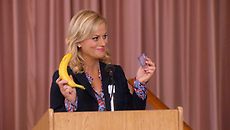
Condoms on Bananas, or, Why Culture Warriors Aren’t Funny

Parks and Rec’s Leslie Knope Sheaths the Banana

I disagree with Russell Moore on many things.  But I do agree with the heart of Moore’s recent argument in the pages of Christianity Today.

Moore commented on a recent episode of the sitcom Parks and Recreation.  I didn’t see the show.  But according to Moore, the plotline concerned an outbreak of sexually transmitted infections among residents at a small-town nursing home.  Moore argued that the show engaged in the worst kind of smug culture-war preaching.

Moore’s accusations ring true.  Many self-professed “liberals” engage in the kind of liberal fundamentalism that Moore describes on the show.  In Moore’s words,

“the show intended to reinforce a view already held by the people to whom they were talking. Those who already deride abstinence education could nod their heads in affirmation, ridicule the morons who oppose good common sense, and feel much better about their moral and intellectual superiority to the Neanderthals out there.”

I support comprehensive sex education in public schools.  But as Moore points out, lots of people disagree.  And lots of those people are smart, caring, informed, and engaged.  At best, the kind of self-satisfied mockery that he describes on Parks and Rec sounds ineffective.  As Moore charges, “few people are going to have minds changed by seeing their viewpoints caricatured.”  At worst, this kind of preaching to the choir deepens our culture-war divisions and leaves us all more bitter, angry, and, in the end, ignorant about the real conflict.

As we battle over issues such as sex ed, prayer in schools, and creationism, we need to keep in mind that those with whom we disagree may have legitimate reasons for their positions.  Moore takes conservative evangelicals to task for often forgetting this message.  As Moore argues,

“Sexual liberation ideology is deadly, but we aren’t preaching to those in bondage to it if we simply repeat slogans. In order to see the true wickedness of sexual liberation, we must ask why it’s appealing, and why deceptive arguments can seem plausible. Only when we speak to the conscience can we get to where people are, as we all once were, hiding from God.

“Darwinism can’t explain the meaning and purpose of the universe or of humanity. But when we simply laugh and say, “My grandpa wasn’t a chimpanzee,” we aren’t taking seriously the claims of our opponents. In fact, we’re not speaking to them at all, just to ourselves.

“When unbelievers hear a canned, caricatured argument, they recognize exactly what I recognized when I listened to the moralizing of the Parks and Rec script: They’re not trying to convince me, or even to talk to me. They just want to soothe the psychologies of their partisans.”

Moore’s central point remains powerful even if we don’t agree about the nature of Darwinism or sex ed.  When we talk about the cultural truths at the heart of our education system, we need to remember that those with whom we disagree deserve respect.  True liberalism is not the pat preachiness of Leslie Knope.  Rather, it requires a much more difficult cultural argument that disagrees without deriding its opponents.

Darwin Denounced as “Jew” in Turkish Textbooks

Every now and again we hear from evolution educators that creationism is somehow unique to the United States.  In his recent popular video denouncing creationism, for instance, Bill Nye “The Science Guy” said exactly that.

Not so fast!  As scholars such as Ronald Numbers have documented, creationism has long been an international affair.  In places such as Australia and Turkey, for instance, creationism has strong and apparently growing support.

And, thanks to the Sensuous Curmudgeon, we come across a story from the international edition of the Financial Times demonstrating the durability of Turkish anti-evolution education.

The FT story demonstrates both the similarities and differences of creationism across national and cultural boundaries.  In some senses, the story could come straight out of the USA.  Other parts seem uniquely Turkish.

For instance, the story describes a controversy over the use of anti-evolution textbooks in Turkish schools.  A teachers’ union has taken legal action to block schools in Istanbul from using anti-evolution textbooks.  Just as in the USA, the Turkish government has made moves to loosen Turkey’s traditional government secularism in a strongly religious nation.  The government, according to the FT article, has allowed more schools to favor religious themes.

All of this sounds like it could have come directly from the evolution/creation controversies in the USA.

But other parts of the story have a uniquely Turkish twist.  The schoolbooks, for example, denounce Darwin as Jewish.  According to the FT, the textbooks warn students that Darwin “had two problems:  first he was a Jew; second, he hated his prominent forehead, big nose and  misshapen teeth.” The books mock Darwin’s lack of formal education, noting strangely that he preferred to spend his time with monkeys in the zoo.

Such anti-Semitic attacks do not usually appear in America’s evolution/creation controversies.  More common would be attacks on Darwin’s atheism.  For the record, Darwin was not Jewish.  However, a creationist attempt to discredit Darwin by “accusing” him of Jewishness makes some sense in a Turkish context.

Clearly, context matters.  Students in Louisiana’s publicly funded schools might read textbooks promoting creationism and evangelical Protestantism.  Students in Istanbul’s publicly funded schools had read that Darwin could not be trusted because he was Jewish.

Adam Laats on Evos & You

Many thanks to DJ SupplyGuy for hosting a talk yesterday on his radio show “EVoS & You.”  DJSG presented some interesting questions and our short half-hour talk ranged from pen-dropping to ham-and-cheese sandwiches.

Some of the questions we wrestled with:

  • Why do so many Americans doubt evolution?
  • Why do smart evolutionary scientists seem so dumb about creationism?
  • How can evolution education do a better job?

Check out the show: Evos and You~2012_10_16_17_00_08.

Required Reading: Evolution, Creationism, and the Battle to Control America’s Classrooms

For those who care about creationism, evolution, and America’s schools, stop reading this shine-ola and go get your hands on a copy of Michael Berkman’s and Eric Plutzer’s Evolution, Creationism, and the Battle to Control America’s Classrooms (New York: Cambridge Univ Press, 2010).  Not only is this the best “street-level” analysis about the way real teachers teach evolution and creationism, but the authors’ approach sheds light on schooling and culture far beyond the bounds of biology instruction.

Image source: Cambridge University Press

The same authors released some of their survey data in an article in Science in January 2011.  That National Science Foundation-funded survey of 926 high-school biology teachers from across the United States offered dramatic results.  A full 13% of respondents taught creationism or intelligent design in their public-school biology classrooms.  Twenty-eight percent taught recognizably evolutionary biology.  The rest, roughly 60%, muddled through in the middle, teaching neither or both evolution and creationism.  This book is built around the same survey responses, but it contains much more.

The authors argue compellingly that the evolution/creation deadlock involves three moving parts.  Berkman and Plutzer label these the procedural issues, the substantive issues, and the issues concerning the autonomy of teachers.  In other words, the tangle of evolution includes issues of who decides what gets taught, the science and religion involved, and the final decisions of teachers themselves.

Not surprisingly, these political scientists conclude that the real question here is political.  More than simply science, more than just religion, the contest is at heart “a political struggle over who decides, a question central to democratic politics” (31).

Perhaps the most attention-grabbing part of the authors’ Science article in January 2011 was the sheer volume of anti-evolution education that went on in American public-school biology classes.  As they argue in the pages of the book, their 13% number as a mark for the number of teachers who actively teach creationism or intelligent design is actually a lowball.  The real number may surge more toward 21% (138).

For those like me who want more evolution taught in America’s schools, Berkman and Plutzer’s findings may be profoundly disheartening.  For instance, in addition to the very high numbers of teachers who omit evolution, teach both ideas, or teach explicit creationism, the authors conclude that teachers don’t care too much about changing state standards in science (160).  Thus, while evolution promoters may work hard to improve those standards, the authors here suggest that actual classroom practice will likely not be much affected.

The most important factor in teachers’ choices about evolution education, Berkman and Plutzer conclude, remains teachers’ personal opinions.   Although some factors, such as a full-semester college course devoted to evolutionary biology, may tend to improve the quality and amount of evolution education offered by teachers, such changes pale in significance compared to teachers’ beliefs.  Dwarfing every other factor, if teachers don’t believe evolution, they don’t teach it (186).

Another powerful contribution of the book is the authors’ application of the notion that teachers function as what political scientists call “street-level bureaucrats” (149).  Like other such functionaries, teachers often teach what their communities want them to teach.  In the United States, despite the chagrin this causes among evolutionary scientists, large majorities want their public schools to teach both evolution and creationism, or even creationism alone (49).  This is true even among those American adults who agree that mainstream scientists have agreed on the veracity of evolution.  Berkman and Plutzer analyze a fistful of polls and surveys to conclude that, even among the 52% of adults who agree that mainstream science has embraced evolution, only 20% want only evolution taught in their local public schools.  You read that right.  Even when Americans acknowledge the scientific consensus in favor of evolution, they still favor teaching both evolution and creationism, or even creationism alone.

As “street-level bureaucrats,” teachers tend to fit in with their local communities.  Among the 926 teachers who responded to Berkman and Plutzer’s survey, most agree with the attitudes in their area.  For instance, among the 136 “most cosmopolitan” school districts, only 4% of teachers taught young-earth creationism.  On the flip side, among the 139 “most traditional” school districts, a whopping 37% of teachers taught young-earth creationism (198).

The book contains chapter after chapter of survey analyses like these.  If you’re like me, you’ll want to buy a copy to keep on your desk as a reference for all the different surveys and multivariate regression charts the authors include.  But the survey and polling data are not the only strength of the book.  Also extremely helpful is the authors’ sketch of the structure of the durable evolution/creation controversy.  As they point out, we will never make heads or tails of it if we understand it as mainly a scientific or religious dispute.  Those “substantive” issues are very important, but they are not the whole problem.  This is why, for instance, many mainstream scientists will insist that there is no controversy over the teaching of evolution.  They mean, of course, that the scientific community does not dispute whether or not evolution should be taught.  If we end there, however, we will remain hopelessly flummoxed over the nature of the continuing controversy.  Because, of course, there is a controversy.

The authors suggest two other important dimensions.  First, we need to get our heads around the “procedural” elements at play.  Where do decisions about teaching get made?  By courts, to protect minorities?  By legislatures, to represent majorities?  By professional bodies such as the American Academy for the Advancement of Science, to ensure superior expertise?  If we ignore these crucial questions we’ll never understand the nature of the impasse.

Also, Berkman and Plutzer inject a new element into these discussions.  Unlike the generations of historians, scientists, theologians, and political scientists that have preceded them, the authors emphasize the critical importance of the “autonomy of teachers” (29).  Teachers can and do consistently make daily decisions about the kind of instruction that goes on in America’s public schools.  Without looking at the impact of those decisions, we will never be able to wrap our heads around the true contours of this culture-war debate.

The authors conclude that these questions remain, at root, a fundamental “political struggle over who decides” (31).  This insight alone makes a significant contribution to stale discussions over the nature of evolution/creation.  Some of our brightest minds have foundered over this simple truth.  In a recent book, for instance, philosopher Philip Kitcher implies that the conflict has lasted so long primarily because the two sides have not adequately understood one another.  In Living with Darwin (2007), Kitcher writes, “detailed replies” to creationist challenges have calmed the controversy temporarily (3).  Yet, due to lack of understanding by creationists, Kitcher suggests “we shall not escape the cycle of controversy until it is completely clear what lies at the bottom of it all” (xi).  Clearly, Kitcher knows the science involved.  He knows the theology involved.  But his implication that a clear enough explanation will somehow clear the air ignores Berkman and Plutzer’s convincing point: this is not about understanding, this is about power.

No matter how brilliant and erudite Kitcher’s explanations of evolution, no matter how clear and cogent his arguments, Kitcher and his ilk will ultimately have little effect on the course of the creation/evolution debates.  Of the teachers who teach creationism in Berkman and Plutzer’s survey, 32% had completed a college-level semester-long course devoted entirely to evolutionary science, 55% held a bachelor’s degree in science, 13% held a graduate degree in science, and 49% had earned 40 or more college credits in biology courses.  It is not that teachers of creationism don’t know the evidence for evolution.  They simply reject it (186).  After all, how clear and convincing would an argument based on the Old and New Testament have to be to convince Kitcher of the truths of creationism?

For all its explanatory power, Evolution, Creationism, and the Battle to Control America’s Classrooms includes a few minor hiccups.  First of all, the authors insightfully note that the essence of the evolution/creation struggle has been a struggle for control of educational decisions.  But among the groups involved–“Federal judges, scientists, education policy makers, and teachers” (13)—the authors curiously omit parents as direct curricular decision-makers.  Since at least the 1920s, activists have insisted on the rights of parents to control the curriculum for their own children.  Recently, in places such as New Hampshire and Missouri, as I’ve argued in these pages and in the Washington Post’s Answer Sheet, state laws have changed the playing field.  These new laws have finally introduced what Berkman and Plutzer might call direct curricular democracy.  Not only can judges, scientists, policy makers, and teachers take part in this durable battle, but parents can and have successfully exerted their significant political influence.  The authors’ failure to include parents as interested and influential parties is a puzzling omission.

In addition, as political scientists, the authors overlook some simple historical errors.  They date the end of the American Civil War, for instance, to 1869 (66).  In a similar slip, they refer to the leading creationist Seventh-day Adventist Church as the Seventh Adventist Church (91).

But such minor quibbles do not detract from the overall argument.

The authors will likely continue to attract the most attention for their original survey data of biology teachers.  And those data are indeed compelling.  But far more important to understanding the nature of the creation/evolution debates are the authors’ arguments about the inherently political and deeply local nature of those debates.  They are not decided in state houses, but in school houses.  They are not decided in courtrooms, but in classrooms.


Required Reading: Assemblies of God on Faith/Science

Can Pentecostals embrace science?  Can they find a way to love both God and Gould?

For those of us trying to understand the conservative vision of education from the outside, the newest edition of the Assemblies of God’s Enrichment Journal is a treasure trove.  This edition offers a series of articles for the denomination’s readers about the proper relationship between faith and science.  As General Superintendent George O. Wood explains, the dangers for young people in the church are stark.  He quotes “Mike,” who declared, “I knew from church that I couldn’t believe in both science and God, so that was it.  I didn’t believe in God anymore.”  Wood hopes that this volume will help Assemblies of God members negotiate a more profound and religious relationship between science and faith.

For those unaware of the distinctions among conservative Bible-based Protestant groups, the Assemblies of God, very briefly, is the largest denomination of Pentecostal believers, claiming 65 million members worldwide.  Pentecostalism, also very briefly, is a form of conservative evangelical Protestant belief that came into existence in the early 20th century.  It combines conservative Bible-based theology with an emphasis on baptism by the Holy Spirit.  Pentecostal services are typically vibrant, dramatic events that can include speaking in tongues and divine healing.  As historian Grant Wacker argued in Heaven Below (2001), the attraction of early Pentecostal churches derived from their combination of a powerful “primitivist” theology with a comfortable cultural “pragmatism.”

In an opening piece, Amos Yong of Regent University encourages Pentecostal readers to “work to overcome the history and culture of anti-intellectualism that persists in some segments of the Pentecostal church.”

Perhaps the most interesting section of this issue for those of us outside the conservative tradition is its forum on the variety of evangelical positions for the age of the earth.  Kurt P. Wise makes the case for a young earth, Hugh Ross for six long ages, and Davis A. Young for an old earth.

With each article, we see the very different intellectual playing field for evangelical intellectuals.  Among mainstream scientists, the first question is usually whether any new approach offers better insight into the natural world.  Among evangelical thinkers, the first question is whether any scientific approach offers better insight into the natural world while allowing Christians to maintain an authentic faith.

As Kurt Wise argues in his pitch for a young earth, “believers” enjoy a more promising guide to the natural world.  Wise insists, “We should look at the eyewitness account from God before we begin inferring the meaning of circumstantial evidence.”

Everyone interested in the creation/evolution debate will be well served by reading through these articles.  Some of the most fervent young-earth creationists such as Answers in Genesis’ Ken Ham have condemned such forums.  Any consideration of an old earth, Ham blasted in a blog post, results in a “dogmatic, intolerant stand against those who take the position we do at AiG.”

But for those of us outside of evangelical circles, an understanding of both the different evangelical views of science and the ways evangelicals construct their scientific arguments will go a long way to decoding the stubborn controversy over evolution and creationism.


Required Reading: David Long and an Ethnography of Creationism

Gallup polls are what they are.  The numbers can be misleading from time to time.  As Homer Simpson scornfully concluded, “Facts!. . . pffft.  Facts can be used to prove anything that’s even remotely true.”

Image source: Dead Homer Society

But when polls keep saying the same thing, it makes sense to listen.  According to Gallup, from the mid-1980s through today, nearly half of American adults agree that the earth was created in “pretty much its present form within the last ten thousand years or so.”

Evolutionists like me tend to be shocked by this number.  How is this possible?

As David E. Long argues in his book Evolution and Religion in American Education: An Ethnography (Springer, 2011), the old evolutionists’ answers don’t hold up anymore.  Some evolutionists tend to assume that creationism, especially young-earth creationism, is similar to a public-health problem.  As soon as enough people are exposed to the saving truth of evolution, this argument goes, creationists will quickly realize the errors of their ways.  This assumption doesn’t match the historical facts, but it still has its share of true believers.  As we noted here recently, Bill Nye “The Science Guy” attracted a lot of attention when he endorsed this sort of fallacy.

Another problem, Long argues, is an implicit “deficiency model” among evolution educators.  These educators, Long asserts, would not be likely to blame students from households without a lot of books for being somewhat behind in their reading skills.  Yet they do blame students from creationist households for resisting evolution.

Long hopes to challenge these approaches to understanding creationism in America.  As he puts it, too many educators act as if learning evolution were a simple matter of “being shown discrete points of Truth and adding these bits to our respective Truth-piles” (14, emphasis in original).  If this were the case, Long argues, “there simply would be no societal issue over evolution.”  Obviously the deadlock over such issues as evolution, scientific creationism, and intelligent design proves that much more is going on here.

Long’s study joins others in offering a new approach.  As did Michael Berkman and Eric Plutzer in their study of biology education, Long hopes to get inside the heads of those who are somehow avoiding evolution education.  Berkman and Plutzer found that anti-evolutionists had not necessarily been isolated from the truths of evolution.  Instead, many anti-evolutionists “choose to ignore scientific arguments demonstrating evolution.”[*]  Knowledge of evolution, according to their large study funded by the National Science Foundation, is often relatively high among those who dispute it most fervently.  This does not match the fantasies of science fans such as Bill Nye.  Long’s study, like that of Berkman and Plutzer, promises to unravel this apparent mystery.

Instead of asking, even implicitly, “what’s wrong with these creationist students?”, Long wants to ask, “what in fact do Creationists have that makes the study of evolution troublesome or even dangerous?” (15, emphasis in original.)

Long himself grew up in a conservative Protestant family.  He remembers his mother telling him sadly that he was going to hell (11).  But this book is neither an apology for creationism nor an attack on creationists.  Instead, Long offers an ethnography of creationism in action.  He conducted interviews with thirty-one students at a state university along the Ohio River.  The results make for arresting reading.

One student, a non-traditional student who grew up as a child of missionaries, reported that she had not learned any evolution before she got to college.  Sitting in the large lecture halls, she told Long that a professor made her feel distinctly inferior.  She remembered the lecturer’s attitude:  “If you believe in God creating the earth, then pretty much you’re an idiot.  And he obviously didn’t use those words, but that’s pretty much what he said.  And I remember thinking . . . What is he talking about?. . . like, he should just go around and ask people to raise their hands ‘who believes in this and who doesn’t’!” (36).

This student, “Esther,” told Long that she had no problem with the academic challenge of evolution.  In her words, “I take those really big classes, because it’s really easy to excel in those huge classes.  I mean, I got like a hundred on every test.  You have to be an idiot pretty much not to.  If you just sit, and you listen to what they’re saying, and you know how to take tests, it’s very easy to do well in those classes” (36).  Long wrestles with the important questions this sort of testimony evokes.  For students like Esther, what does it mean to “know” evolution?  What does it mean to feel belittled for one’s background, even if it is done unintentionally?

Another thoughtful creationist interviewee told Long that accepting the truth of evolution would mean “a lot of work for me to change my worldview, a lot of time, a lot of alienation from friends” (41).  Long asked what it would mean if somehow this student—who had been homeschooled into his creationist views—what it would mean if somehow this student found out that humans had really evolved.  The student replied, “It would be a complete crisis.  It would be really tough” (41).  As Long notes, this is more than a scientific situation.  This is an entire life wrapped up in creationism.

Long argues that evolution educators have not sufficiently wrestled with the existential anxiety at stake for some creationist students.  Accepting the truth of evolution, for some, would be more than simply changing one’s mind.  It would be a radical change, and more often, the “positive, commonsensical, and affirmed” path is to simply reject evolution (47).

In most cases, Long concludes that no amount of education really threatens to change students’ worldviews.  Of his batch, only three experienced any sort of profound change, including in their attitudes toward evolution.  These three cases form the basis of Long’s fifth chapter, a chapter that’s worth the price of admission all by itself.  Long describes the case of “Cindy,” a student from a staunchly anti-evolution small town.  Cindy ended up open to the notion of human evolution, but only because she challenged her entire upbringing.  It was not the eye-opening scientific evidence for evolution that convinced her.  Rather, Cindy got pregnant and had an abortion in high school.  The gossipy and cruel reaction of her church drove her away from that worldview.  The entire experience left Cindy open to the idea of human evolution.

Equally fascinating is the case of Renee.  Renee came from a non-religious family, sort of.  She was a biology major with plans on graduate work in pharmacology.  Her non-religious worldview was shattered not by the saving words of Jesus, but rather by pair of bitter divorces.  Renee herself divorced her husband, and her father divorced her mother.  Partly as a result, Renee’s father embraced the creationist-centered conservative Protestantism of his youth.  Though Renee’s mother continued to insist on the family’s atheism, Renee embraced creationist Christianity during a trip with her father to the Creation Museum outside of Cincinnati.

These brief summaries can’t do justice to the fascinating case studies Long explores in this book.  The book itself is a must-read for any outsiders who really want to understand the evolution/creation stalemate in America.  Long’s interviews and analyses offer unmatched insight into the reasons why evolution and creation both create such durable and impermeable worldviews.

Unfortunately, unless and until a paperback edition comes out, Long’s publisher has priced this out of range for most non-institutional buyers.  At $140, it is targeted more at university libraries than interested lay readers.  Hopefully, that will not restrict the number of readers this book attracts.  Joining other nuanced studies like Berkman’s and Plutzer’s, Long’s book promises to make an end run around some of the conceptual difficulties that have stymied so many efforts to understand the durability of creationism in the United States.


[*] Michael Berkman and Eric Plutzer, Evolution, Creationism, and the Battle to Control America’s Classrooms (Cambridge: Cambridge University Press, 2010), 78.  Emphasis in original.

What Do Missourians REALLY Want?

Everyone interested in what we’re calling Fundamentalist America should be following Missouri’s Amendment 2.  The debate about the nature of religion in public schools and institutions gets right to the heart of many culture-war controversies.  But it appears that the amendment might pack a much heavier culture-war punch than it seems to.

There are plenty of places to go to catch up on the story.  ILYBYGTH has introduced the upcoming vote, discussed the results, and noted Catholic Bishops’ support for Amendment 2.  The St. Louis Post-Dispatch offered a very helpful introduction in late July.  For anyone interested in the viewpoint of amendment supporters, a Baptist congregation in Odessa published an hour-long video of Representative Mike McGhee explaining his vision for the amendment, frankly and openly.

For those who don’t like clicking on stuff, here’s the story in a nutshell:  On August 7, 2012, Missouri voters overwhelmingly (83%) approved an amendment to their state constitution.  The amendment was promoted as a school-prayer amendment.  Supporters such as legislative sponsor Mike McGhee called it a clarification of the rights of religious people to pray in public, so long as their prayers did not disturb others.  McGhee claimed that such rights are often disrespected.   Opponents such as Americans United for Separation of Church and State insisted it was at best unnecessary, since such rights are already protected in the US Constitution.  At worst, opponents insist, this amendment threatens to undermine the barrier between church and state.

Given a closer look, however, this amendment does much more than clarify students’ rights to pray in public schools.  It does that, but the amended Constitution now includes two other rights for students.  These new rights go far, far beyond protecting the rights of public schoolchildren to pray quietly.  The new rights satisfy the long-standing desires of important constituencies in Fundamentalist America.  For all parents who have worried that their children might be taught unwholesome moral, sexual, or religious lessons in public schools, the Missouri Constitution now offers an easy escape route.

The first added phrase, “students may express their beliefs about religion in written and oral assignments free from discrimination based on the religious content of their work,” opens the door for conservative families to include their beliefs in all parts of the school curriculum.  For example, creationist parents and students could now use their beliefs to answer questions about evolution.  This has long been a sticking point for creationists.  Consider the words of Avis Hill, a pastor from Kanawha County, West Virginia.  Hill rose to national prominence in 1974 when assumed a leadership role in a controversy over adopted textbooks.

From Trey Kay, “The Great Textbook War”

Hill told interviewers that his daughter was given a failing grade for her report on evolution.  According to the Reverend Hill, the young Miss Hill, fifth grader, told her teacher, “‘Mrs. So-and-So’—whose name I’ll not use—‘I’ll not give that report, and I’ll not read that book in class.’  She said, ‘I have a book I will read,’ and she opened her Bible—and I did not coach her because it didn’t bother me that much at that time—she opened her Bible, and she began in Genesis 1, ‘In the beginning God—‘ and the teacher failed her.” [Interviewed by James Moffett, included in Moffett’s Storm in the Mountains (Southern Illinois University Press, 1988), pg. 90].

This sentiment echoes throughout Fundamentalist America.  Fear that students will be forced to learn evolution, or about the use of condoms, or about the moral ambiguities of modern life have long dominated conservative rhetoric about public education.  Missouri’s new Constitution fixes that perceived problem.

The second telling phrase in the new Constitution underlines the point.  “No student,” the amendment reads, “shall be compelled to perform or participate in academic assignments or educational presentations that violate his or her religious beliefs.”  The implications are clear.  Sex ed, evolution ed, “situation ethics,” all have loomed large in the imagination of Fundamentalist America for generations.  This amendment guarantees that no student shall be forced to learn about such things.

Missouri’s amendment is not the only place to find this sentiment in political action.  New Hampshire’s state legislature recently passed a very similar law.  As I argue in my 1920s book,  conservatives have struggled to protect conservative religious students from public-school curricula since the 1920s.  In the last generation, the fight in Hawkins County, Tennessee, might have generated the most attention.   In that case, conservative religious parents ultimately lost their lawsuit against the school board.  Parents had claimed that anti-religious messages in school textbooks forced their children to learn messages inimical to their religious beliefs.  In 1987, the US Court of Appeals for the Sixth Circuit disagreed.

Lawmakers in New Hampshire and now voters in Missouri found a way around this legal precedent.  However, it is not clear that Missouri voters knew just what they were voting for.  Consider the wording of the ballot measure:

“Shall the Missouri Constitution be amended to ensure:

“That the right of Missouri citizens to express their religious beliefs shall not be infringed;

“That school children have the right to pray and acknowledge God voluntarily in their schools; and

“That all public schools shall display the Bill of Rights of the United States Constitution.

“It is estimated this proposal will result in little or no costs or savings for state and local governmental entities.

“Fair Ballot Language:

“A “yes” vote will amend the Missouri Constitution to provide that neither the state nor political subdivisions shall establish any official religion. The amendment further provides that a citizen’s right to express their religious beliefs regardless of their religion shall not be infringed and that the right to worship includes prayer in private or public settings, on government premises, on public property, and in all public schools. The amendment also requires public schools to display the Bill of Rights of the United States Constitution.

“A “no” vote will not change the current constitutional provisions protecting freedom of religion.

“If passed, this measure will have no impact on taxes.”

No mention of creationism, sex ed, condoms in schools, or other implications.  Nothing about guaranteeing students the right to opt out of any instruction they deem pernicious.  The ballot measure emphasized the amendment as a clarification of students’ rights to pray.  Yet the amendment itself makes the other meanings crystal clear.

Missouri voters approved the amendment by overwhelming margins.  But it appears that the implications of that ‘yes’ vote might not have been entirely apparent.  So what DO Missouri voters want?