Will I Go to Hell for Learning Science?

Those of us who want to get more and better evolution education into our public schools have our work cut out for us. Evidence keeps piling up that Americans still get nervous when it comes to mainstream science.

As my co-author Harvey Siegel and I argue in our upcoming book about creationism and evolution education, public schools don’t have a credible option. They must teach real evolutionary science—and ONLY evolutionary science—in their science classes. Anything else does a grave disservice to students.

Even creationist students. Those creationists, though, should not be forced to mouth vaguely religious platitudes as they learn about evolution. Rather, public school teachers must make their goal to teach students to know and understand evolutionary theory. If they choose not to believe it, that is their fundamental right.will i go to hell for learning science

As SAGLRROILYBYGTH know, my humble blog has wrestled with these issues of creationism and evolution education for years. Every once in a while, we get a glimmer of the harsh reality out there: People really don’t like evolution.

In the editor’s board of the blog, I can read some of the search terms that brought people to the blog. In the past, we’ve seen plaintive requests such as “Can a creationist and evolutionist be in love?”

Today we get another humdinger. In the search terms today we see, “Will I Go to Hell for Learning Science?” As David Long and other scholars have argued, learning evolution is profoundly disconcerting for some students. For those like this searcher, it is more than just a lack of knowledge that is the problem. Many students have deep worries that science these days is nothing but a lure of the devil.

What I Did on my Summer Vacation

By Adam L.

I hope you choke on your sunscreen. While you are out and about doing summer fun stuff, I’ll be in the office putting together the index for my upcoming book.

Okay, okay, I’m being a little melodramatic. I actually enjoy the process of writing an index. It helps me get into the manuscript in a detailed way. It helps me think over what the main points are. And it helps me imagine what future readers might be looking for.

If you poke your head out the window and crane your neck, you still can't see the beach from here...

If you poke your head out the window and crane your neck, you still can’t see the beach from here…

Not to mention the fact that writing an index has its own share of intellectual challenges. For example, I’m wondering which subheading to use under “Darwinism.” Should I list anti-evolution protests as “Darwinism: equated with atheism, 7, 14—15”? Or should it be more general: “Darwinism: critiqued by anti-evolutionists, 7, 14—15”?

In any case, enjoy your dog days at the beach, or the mountains, or wherever it is that normal people spend their summer time. I’ll be festering in air-conditioned office comfort. When the snow flies in January, this book should be ready to share.

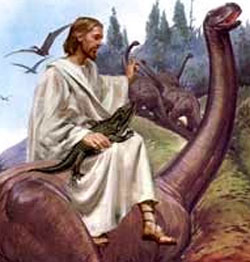
So Jesus WAS on a Dinosaur…?

We just don’t know what we’re talking about.

Could've happened...?

Could’ve happened…?

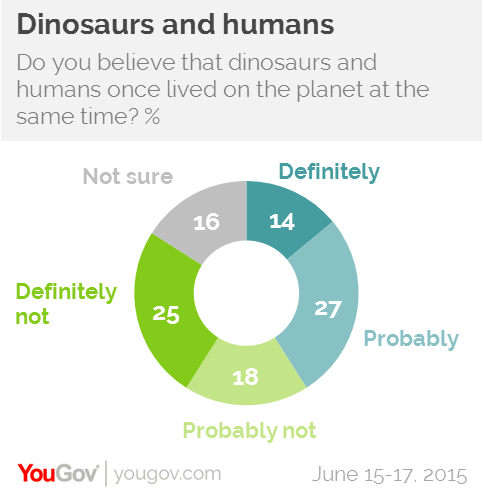
A new poll inspired by the hit movie Jurassic World suggests that Americans don’t know much about much. Thanks to the ever-watchful folks at the National Center for Science Education, we see some startling responses to a simple question: Did humans and dinosaurs live at the same time?

As YouGov explained,

YouGov’s latest research shows that 41% of Americans think that dinosaurs and humans either ‘definitely’ (14%) or ‘probably’ (27%) once lived on the planet at the same time. 43% think that this is either ‘definitely’ (25%) or ‘probably’ (18%) not true while 16% aren’t sure. In reality the earliest ancestors of humans have only been on the planet for 6 million years, while the last dinosaurs died out 65 million years ago.

Ouch.

For evangelicals, the numbers are even more skewed. A clear majority (56%) of evangelical Protestants think humans and dinosaurs co-existed. Only 22% of evangelicals thought that dinosaurs and humans did not.

...doh!

…doh!

As the National Center for Science Education points out, there are a couple of possible wrinkles in this poll. Most scientists these days consider birds to be dinosaurs. Is that what the respondents meant? The NCSE charitably suspends judgment, but it seems obvious to your humble editor that most of us just don’t know what we’re talking about.

Good Seats Still Available!

The 2015-2016 lineup at Binghamton University is looking like another winner. Dan Kahan of Yale Law School has just agreed to come up in the spring for a talk about his work with science communication.

We had a very exciting year last year, too. Michael Berkman visited from Penn State. Professor Berkman gave a great talk to our Evolution Studies program about his work with evolution education. Then in May, Jonathan Zimmerman from New York University delivered our annual Couper Lecture. Professor Zimmerman blew our minds with some of the most provocative ideas from his new book, Too Hot to Handle.

Are you a Kentucky Farmer?

Are you a Kentucky Farmer?

Folks who spend a lot of time with science, creationism, and public perceptions will be familiar with Professor Kahan’s work. His Cultural Cognition Project has explored exciting new directions in the tricky field of science communication. As Professor Kahan will tell you, we’re all Pakistani doctors; we’re all Kentucky farmers.

Details of Professor Kahan’s talk to follow. It will likely be a Monday evening in the early months of 2016. As always, the seminars hosted by Binghamton’s stellar Evolution Studies Program are free and open to the public.

Can’t wait.

Dissenters, Not Ignoramuses

[Editor’s Note: As SAGLRROILYBYGTH are well aware, I’ve just completed work on a new book about creationism and evolution education in the United States.  Based on that effort, the education editor of Anthropology Now invited me to contribute some thoughts about the implications of the creation/evolution controversy.  Below I’m reprinting that essay in its entirety, with the permission of Anthropology Now.  You can also find the essay in its original form in the April 2015 edition of that magazine. Thanks to Zoe Burkholder and Maria Vesperi of AN.]

Physical anthropologists have long been on the front lines of debates over evolution. In the Texas textbook tumult over the past decade, for example, Ronald Wetherington of Southern Methodist University has gone head-to-head with creationists over the content of science textbooks. There is no debate over the science, Wetherington has argued. There is simply no way humanity’s origins can be traced to two bashful ancestors in an idyllic garden, 6,000 years ago.[1]

Image courtesy of Scott Thurman, The Revisionaries

Wetherington thinking it over. Image courtesy of Scott Thurman, The Revisionaries

Yet the fight goes on. Creationists insist on including their religious beliefs in public-school science classes. Mainstream scientists protest. All too often, the debate has forced folks such as Wetherington to attack the scientific pretensions of creationism. How would it be possible, mainstream scientists insist, for the earth to only have a short history? For humanity to trace its lineage from the Garden of Eden? The genetics just don’t line up. The fossils don’t line up. Nothing fits.

This sort of back-and-forth about the possibilities of science goes nowhere. More false debates pitting mainstream scientists against creationist scientists in a choreographed and predictable non-dialogue about the proper nature of science are not needed. One side calls the other a bunch of ignoramuses. Creationists retort that they are the only real scientists in the room.

Creationists may or may not be ignorant about evolutionary theory, but there is a better way to understand creationism, as primarily a form of religious dissent. Of course, notions of religion and religious dissent have always played a part in creation/evolution debates. Court decisions, especially, have tended to reject creationists’ claims on the basis that they represent a religious viewpoint, not a scientific one. Even those decisions, however, have pushed creationists to insist on their status as scientific dissenters above all. For everyone’s sake, including that of creationists themselves, creationism should be viewed first and foremost within the tradition of religious dissent in the United States.

This approach offers hope for moving the long debates over creation and evolution in a more productive direction. In the end, centering the debate on religious dissent rather than on scientific truth could offer two promising new policy goals. First, it would require both sides to agree on different goals for evolution education. Public schools would be tasked with clarifying their expectations and demands. While students from every background must be helped to understand evolution, their beliefs about that knowledge are their own business. As religious dissenters, creationists have the right to preserve their religious beliefs. Second, for public-school teachers to teach dissenting students, teachers themselves must be taught some basic principles about cultural difference and inclusion. Here is where anthropologists can get involved. Teachers should study not only biology and geology, but also ethnography and principles of cultural anthropology. Science teachers must understand the cultural beliefs of religious dissenters in order to welcome those dissenters into science classes. And teachers should be trained to understand their own cultural perspectives, to see the dissent of their students as a cultural strength, not a deficit to be corrected or an ignorance to be attacked.

Anthropologists can be helped by historians. As every historian is well aware, the US educational system has a long, spotty record of handling religious dissent. All too often, public schools have crammed hegemonic notions of proper culture and theology down the throats of minority students and families. In the 19th century, as historian Carl Kaestle has argued, Protestant school leaders often pooh-poohed the objections of Catholic dissenters. In the 1830s, Protestant school leaders in cities such as Boston, New York, and Philadelphia dismissed Catholic complaints about textbooks that ridiculed the Pope and described Catholics as inquisitors and anti-Christians.[2] Even into the 20th century, as David Wallace Adams has shown, minority groups felt the heavy hand of the dominant culture. At Native American Indian boarding schools, Adams found, non-native teachers made it their mission to squash the religion of their native charges. School founder Richard Henry Pratt wanted to “kill the Indian and save the man.”[3]

As the 20th century progressed, religious dissenters scored some successes in major court cases. Perhaps most influential, the US Supreme Court ruled in Abington School District v. Schempp (1963) that students had the right to dissent from religious practices in public-school classrooms. Even if families were allowed to opt out of prayers and Bible readings, the Court decided, such religious practices involved the government too closely in private religious beliefs.[4] Other federal courts have underlined the rights of religious dissenters in public schools. One Tennessee district court ruling in 1979 spelled it out: “if that which is taught seeks either to disparage or to encourage a commitment to a set of religious beliefs, it is constitutionally impermissible in a public school setting.”[5] It is not enough anymore for public schools to allow minorities to attend. It is not enough to permit dissenters to share in parts of the public-school culture. Public schools, rather, must welcome dissenters and minorities as equal members.

That new consensus can be applied to the status of creationist dissenters. Their beliefs should not be mocked or dismissed out of hand. But while dissenting religious beliefs must be respected, religion should never inform the public-school curriculum. Students of all backgrounds, dissenting or not, must be exposed to the very best knowledge on offer. They should be helped to understand that knowledge, even if it contradicts their home religions. At the same time, they must not be forced to believe anything that they find theologically repugnant.

Although creationists and mainstream scientists have disagreed bitterly for generations, they have often agreed on one fundamental—but mistaken—notion. Both sides have repeatedly defined the struggle as a scientific one, rather than a religious one. Many creationists insist that their religiously motivated understanding of the origins of humanity represents a scientific vision. And many mainstream scientists engage on just this issue: Which model represents the better scientific explanation? These debates—fascinating but ultimately pointless and unproductive—roiled in the 20th century and continue into the 21st.

Monkeys and Modernity

The first generation of evolution/creation debates in the 1920s set the tone for those that followed. One of the leading anti-evolution voices of that generation, William Jennings Bryan, insisted that evolution was first and foremost bad science. Bryan proudly and pointedly maintained his membership in the American Association for the Advancement of Science. In the pages of the New York Times in 1922, Bryan insisted that his anti-evolution position represented a deep love of true science. “We do not ask,” Bryan told readers, “for the exclusion of any scientific truth, but we do protest against an atheist teacher being allowed to blow his guesses in the face of the student.”[6] Those who insisted on forcing such false ideas on America’s students, Bryan mocked, were nothing but irresponsible “pseudo-scientists.”[7]

"Are you know or have you ever been...an ignoramus?"

“Are you know or have you ever been…an ignoramus?”

Mainstream scientists met Bryan on the field of science. They often insisted that his was not real science, yet allowed the discussion to focus too often on such definitions. One of Bryan’s primary public antagonists in the 1920s was Princeton biologist Edwin Conklin. Conklin called Bryan a “non-scientific person,” someone utterly unqualified to assert the boundaries of scientific knowledge.[8] Conklin poured out a good deal of time, sweat and ink in his attempt to prove that creationism did not count as real science. Real science, he wrote, was the “freedom to seek and to find truth. . . . confident that even unwelcome truth is better than cherished error.”[9] Real scientists never shied away from uncomfortable conclusions, while Bryan’s sort—scientific usurpers—began with false conclusion and worked backwards.

Perhaps the defining moment of these battles over evolution and creationism came in the summer of 1925. The Scopes Trial in July of that year focused the world’s attention on the question of evolution and creationism, religion and science. Bryan battled famous atheist Clarence Darrow in the sweltering heat of Dayton, Tennessee. The trial brought public attention to the question, but did not do much to resolve the issues. Too often, debates still focused on questions of science.

For example, in the months following the trial, the first celebrity creation scientist from the United States debated the issue with journalist Joseph McCabe. In this debate, held in London in September 1925, leading creationist George McCready Price pilloried evolution as a scientific travesty. The theory made sense, Price told the assembled crowd, “for the times of comparative ignorance of the real facts of heredity and variation and of the facts of geology which prevailed during the latter part of the nineteenth century.” To real scientists, though, Price insisted that evolution could not hold water. Any believer in evolution, Price concluded, would “wake up some fine morning and find that he needs an introduction to the modern scientific world.”[10]

Price never mentioned the need to protect the rights of religious minorities. He did not argue in 1925 that evolutionary theory might outrage the religious sensibilities of dissenters such as himself. Yet it is without doubt that Price’s scientific vision emerged from his religious faith. Price was a member of the Seventh-day Adventist church, a denomination founded in the aftermath of William Miller’s failed 1844 apocalyptic visions. The prophetess of the denomination, Ellen G. White, founded the group largely on her visions of the beginning and end of time. In the beginning, White attested, God created the universe in six literal days. For orthodox Seventh-day Adventists such as Price, faith demanded a young Earth, a worldwide flood and a six-day special creation by God.[11]

Such debates at the start of the modern culture-war controversies over the teaching of evolution defined the issue mainly as one of science and science education. Not that activists did not also discuss the religious aspect of these debates—Conklin, for example, accused Bryan of pushing for “medieval theology” in place of real science—but too often the debates implied that the central questions were scientific ones.[12]

The More Things Change…

Contemporary debates feature similar definitions and boundaries. In February, 2014, for instance, today’s leading young-Earth creationist Ken Ham debated the prominent science-educator Bill Nye, “The Science Guy.” In that debate, Ham insisted that mainstream science had lost its way. Creationists such as himself, Ham told the crowd, had a better grasp of the impossibility of “historic” science. Real science, Ham informed Nye and the world, did not make leaps of illogic about past events. Mainstream scientists made a fundamental error when they limited themselves to the echo-chamber of flawed evolutionary reasoning.

Bill Nye played along. The simplest facts of real science, Nye insisted, proved the utter baselessness of young-Earth creationism. Nye referred to the local Kentucky limestone as just one example of the many that made the case. “We are standing,” Nye said, “on millions of layers of ancient life. How could those animals have lived their entire lives in just four thousand years?” The briefest introduction to the principles of geology or biology proved the power of evolutionary theory beyond any reasonable doubt.[13]

Even in the 21st century, creationists insist that their religious beliefs are better science  and mainstream scientists (and “Science Guys”) agree to define the fight as one about the proper boundaries of science. For their part, creationists these days are in a strategic pickle. Courts have ruled against teaching religious views in science classes. Most significantly, the US Supreme Court’s 1987 decision in the case of Edwards v. Aguillard specified that creationism could not be taught in public schools. Such beliefs, the court ruled in a 7-2 decision, represented religion, not science. However, the majority decision stipulated that dissenting visions of science could be taught if they represented better science instead of simply better religion.[14] Thus creationists can hope to include creationism in public-school science classes only if they can demonstrate that their science is better than mainstream teachings. Mainstream scientists, too, still hesitate to dispute creationism on religious grounds. After all, it is easier to attack the scientific pretensions of what philosopher Philip Kitcher has called “dead science” than it is to critique an opponent’s religious beliefs.[15]

While courts have repeatedly concluded that creationism is primarily a religious belief, both creationists and mainstream scientists have continued their endless rounds of debate. But embracing the definition of creationism as a form of religious dissent instead can reveal new approaches to the controversies. Dissenters in public schools have a contentious but clearly defined tradition of rights and responsibilities. They must be treated respectfully and knowledgeably, but their beliefs do not grant them the right to dictate curriculum for the entire school. Dissenters must be allowed to specify why they find curricular material offensive, but simply calling something offensive does not automatically guarantee that it should be excluded from public education.

Two general rules of thumb will help public schools walk this fine line, teaching evolution to everyone, yet respecting the beliefs of those who dissent for religious reasons. First, teachers should make their goals clear. When it comes to evolution education—or any other form of public education, for that matter—the goal should be for students to understand the material, not to adopt any sort of belief about it. In the case of evolution, all students from all backgrounds would be expected to learn the outlines of evolutionary theory. But teachers would be required to avoid implying that students should believe anything in particular about human origins or the age of the universe. And again, teachers would need to know more about the home cultures of dissenting students. Educating teachers about creationism in its cultural context would help smooth away unnecessary conflict between evolution educators and dissenting creationist students.

Creationists Get On the Bus

Along with their arguments about the superiority of their science, some creationists have long argued for their rights as religious dissenters. Most famously, in 1978, creationist scholar Wendell Bird argued for the rights of creationists as a minority in the pages of the Yale Law Review. “Exclusive public school instruction in the general theory of evolution,” Bird insisted, “abridges free exercise of religion.”[16] Other creationist activists and writers have similarly insisted on their rights as beleaguered minorities. In the mid-1980s, for instance, creationist Jerry Bergman complained that he had been denied tenure at Bowling Green State University due to his creationist beliefs. “A similar case might be,” Bergman claimed, “if a black were fired on the suspicion that he had ‘talked to students about being black,’ or a woman being fired for having ‘talked to students about women’s issues.’”[17] Speaking in the mid-1990s, creationist activist Duane Gish took a similar stance. When he learned he was one of only two creationists invited to a scientific dialogue, Gish erupted, “I will proceed to take one of the two seats on the back of the bus reserved for the creationists in this meeting.”[18] No one believed more strongly in the definition of creationists as put-upon minorities than these creationists themselves. If the benefits of that position can be made clear, perhaps other creationists would embrace a definition as religious dissenters.

Even if they do, however, it remains a question whether it be possible for creationist students to learn about evolution without embracing it as a belief. Can students be asked to understand something if they are not asked to believe it? Some scattered evidence suggests this is already happening. Anthropologist David Long, for example, studied a small group of about 30 undergraduate biology students at a large public university. Many of them came from creationist backgrounds. Those students reported no trouble in learning and understanding evolution without changing their religious beliefs. One student told Long:

I take those really big classes, because it’s really easy to excel in those huge classes. I mean, I got like a hundred on every test. You have to be an idiot pretty much not to. If you just sit, and you listen to what they’re saying, and you know how to take tests, it’s very easy to do well in those classes.[19]

Of the students from creationist backgrounds in Long’s sample, only one abandoned her creationist beliefs while studying biology at a public university. And that student had already begun to abandon her faith before she left high school.[20] Learning evolutionary science, Long found, did not lead to religious conversions.

Similar results occur in high schools. One study of roughly one hundred public-school biology students found that a three-week unit on evolution did not force creationist students to abandon their beliefs. Indeed, though students in this study learned a good deal about evolution, many of them became more firmly convinced of their creationism by learning about evolution. After the unit on evolution, for instance, students improved their performance on a test about basic evolutionary principles. More of these same students, however, agreed or agreed strongly—after studying evolution—with the statement, “Genesis is the best account of how the Earth was created and populated with life.”[21]

Americans in general already seem to separate knowledge from belief when it comes to evolution. In 2012, the National Science Board (NSB), which is part of the National Science Foundation, experimented with the wording of its questions about general science knowledge. Only 48 percent of respondents agreed with the statement, “human beings, as we know them today, developed from earlier species of animals.” But when the NSB prefaced that statement with the phrase, “According to scientists,” 72 percent of respondents agreed.[22] In short, significant numbers of Americans know what the science says about evolution. They simply choose not to agree that it is true.

Finally, students learn better when they feel some connection to their teachers. Teachers who can connect culturally with their students will have an easier time teaching anything, from evolution to arithmetic. As education scholar Gloria Ladson-Billings has argued, “Teachers who practice culturally relevant methods. . . . see themselves as part of the community and they see teaching as giving back to the community. They help students make connections between their local, national, racial, cultural, and global identities.”[23]

For teachers who come from non-creationist backgrounds, the effect of a short course in cultural anthropology could be profound. For one thing, it would introduce teachers to the idea that the world of creationism includes a vast kaleidoscopic array of beliefs and cultures. It would be useful to know how a Baptist creationist student might differ from a Seventh-day Adventist or from a Gulenist. More important, an introduction to the foundational principles of cultural anthropology can help science teachers understand that difference is not deficit. Simply because creationist students do not accept evolution, they are not necessarily naively ignorant about evolution. Indeed, as David Long has noted, many students from creationist backgrounds perceive any discussion of evolution as “troublesome or even dangerous.”[24] Good teachers want to help students, not terrify them. A primer on the principles of cultural anthropology can help teachers connect with creationist students more productively.

None of this will make creation/evolution controversies go away. There is no magic wand here. But by placing the educational discussion more squarely on the rights and responsibilities of religious dissent, we may drain some of the venom from our achingly repetitive school battles.  

Notes

[1] See Scott Thurman’s documentary, The Revisionaries (2012).

[2] Carl F. Kaestle, Pillars of the Republic: Common Schools and American Society, 1780-1860 (New York: Macmillan, 1983).

[3] David Wallace Adams, Education for Extinction: American Indians and the Boarding School Experience, 1875-1928 (Lawrence: University Press of Kansas, 1995), 52.

[4] Abington School District v. Schempp, 374 U.S. 203 (1963).  (accessed January 11, 2015).

[5] Wiley v. Franklin 474 F. Supp. 525 [E.D. Tenn. 1979] at 531.(accessed January 11, 2015).

[6] William Jennings Bryan, “God and Evolution,” New York Times, February 26, 1922, 11.

[7] William Jennings Bryan, In His Image (New York: Fleming Revell, 1922), 69.

[8] Edwin Grant Conklin, “Bryan and Evolution,” New York Times, March 5, 1922, 1.

[9] Edwin Grant Conklin, The Direction of Human Evolution (New York: Scribner’s, 1921), v–vi.

[10] George McCready Price, “Is Evolution True?” in Ronald L. Numbers, ed., Creation-Evolution Debates (New York: Garland Publishing, 1995), 160.

[11] See Ronald L. Numbers, The Creationists: From Scientific Creationism to Intelligent Design, expanded edition (Cambridge, MA: Harvard University Press, 2006), 91-93.

[12] Conklin, “Bryan and Evolution,” 1.

[13] Video of the debate from February 4, 2014 is still available at http://debatelive.org/ . See the author’s commentary and discussion at “Time for Ham on Nye!” I Love You but You’re Going to Hell, February 4, 2014,  (accessed June 2, 2014).

[14] Edwards v. Aguillard, 482 US 578 (1987)  (accessed April 14, 2014).

[15] Philip Kitcher, Living with Darwin: Evolution, Design, and the Future of Faith (New York: Oxford University Press, 2007), 8.

[16] Wendell R. Bird, “Freedom of Religion and Science Instruction in Public Schools,” The Yale Law Journal 87 (January, 1978): 518.

[17] Jerry Bergman, The Criterion: Religious Discrimination in America (Richfield, MN: Onesimus Press, 1984), 43.

[18] Duane T. Gish, “The Scientific Case for Creation,” in Frank Awbrey and William Thwaites, eds., Evolutionists Confront Creationists: Proceedings of the 63rd Annual Meeting of the Pacific Division, American Association for the Advancement of Science, Vol. I, Part 3 (San Francisco: Pacific Division, American Association for the Advancement of Science, 1984), 26.

[19] David E. Long, Evolution and Religion in American Education: An Ethnography (New York: Springer, 2011), 36.

[20] Ibid., 75.

[21] Anton E. Lawson and William A. Worsnop, “Learning about Evolution and Rejecting a Belief in Special Creation: Effects of Reflective Reasoning Skill, Prior Knowledge, Prior Belief and Religious Commitment,” Journal of Research in Science Teaching 29:2 (February 1992): 143-166.

[22] National Science Board, Science and Engineering Indicators 2014, “Chapter 7: Science and Technology: Public Attitudes and Understanding,” National Science Foundation, February 2014  (accessed January 11, 2015). See also “Evolution in Science and Engineering Indicators 2014,” National Center for Science Education Blog, February 18, 2014  (accessed January 11, 2015).

[23] Gloria Ladson-Billings, The Dreamkeepers: Successful Teachers of African American Children (New York: Wiley, 1997), 25.

[24] Long, Evolution and Religion in American Education, 15.

Can It Work?

Is it possible for conservative religious people to know and understand evolution without believing it? And, if it is possible, what does it look like? What does it mean? At the ever-challenging Cultural Cognition blog, Dan Kahan challenges the notion of “cognitive apartheid.” Do Professor Kahan’s ideas match real experience?

As the sophisticated and good-looking regular readers of I Love You but You’re Going to Hell (SAGLRROILYBYGTH) are aware, I’ve written a new book with philosopher Harvey Siegel suggesting a different approach for evolution education. Too often, the implicit goal of evolution education is to encourage student belief in evolution. Students from families who dissent are sometimes made to feel unwelcome in public schools, as if their dissent disqualifies them as science students. Instead, we argue, the goal of evolution education must be to foster knowledge and understanding of evolution. If students choose not to believe it, that is their right.

But is it possible? It seems difficult to know something and not believe it. Do I really know that 2 + 2 = 4 if I don’t believe it, like some sort of Orwellian thought-victim?

Studies of real students have shown that it is not only possible, but a relatively common practice. In 1996, W.W. Cobern suggested that resistant students commonly practice what he called “cognitive apartheid.”[1] Students who don’t want to believe the philosophical or religious implications of evolutionary theory, Cobern thought, could segregate out those ideas for use only in specific situations. When they needed to pass a science test, for example, students could pull up their knowledge of evolutionary theory, but in other contexts, they could keep those ideas separate from the rest of their thinking.

In a 2012 study, Ronald S. Hermann looked at the ways this apartheid worked in practice. Hermann located students who did well on tests of evolutionary ideas. Then he talked to two of them who knew and understood evolutionary theory very well, yet refused to believe it. “Krista” and “Aidan” both described the ways this process worked for them.

For those of us from secular or liberal religious backgrounds, these interviews provide fascinating insights into the ways conservative religious people justify their seemingly conflicted knowledge and belief. Hermann argues that the mental processes involved are “unclear and ambiguous in nature.”

For Aidan, his thorough knowledge of evolutionary science jostled along uncomfortably with his religious beliefs. As he tried to explain to Hermann,

I don’t know enough to make a real good judgment. I just try and take the Bible as its literal interpretation, and kind of leave the science stuff alone.

Krista had an even more complex relationship to evolutionary knowledge. As Dan Kahan points out, she did not simply wall off her knowledge in one segregated part of her brain. That is, she did not simply memorize a list of facts for use on rare occasions such as tests. Rather, she served as a tutor in Hermann’s class and planned a career as a veterinarian. She was able to teach evolutionary concepts to other people. And she planned to use basic evolutionary ideas in her future career. Yet she says she does not believe them.

From the snippets of her interview provided by Hermann, Krista does not seem to wall off evolutionary knowledge in her mind. Rather, she seems to be able to switch back and forth from knowing it and using it in some situations, to disbelieving it in others. Or, more precisely, she seems to know evolution in a different way. She tells the interviewer at one point, “I don’t think I, like, put my emotion into it.”

Professor Kahan wants to call this something other than “cognitive apartheid.” A better description, he suggests, is “cognitive dualism.” Some people, from Pakistan to Kentucky, seem to believe mainstream science at work, but disbelieve it at home.

In K-12 public schools, too, I think we see similar effects. Students tend to believe all sorts of things at school, then switch to a different set of beliefs at home. This is not only about controversial ideas in science, literature, or history. Rather, students do this constantly with their social identities. They might be one kind of person at school, with peers and teachers, then present a very different persona to their families at home.

As usual, I don’t have much personal experience with this kind of cognitive struggle, whether it be “apartheid” or “dualism.” Have you experienced such struggles in your life? Do you remember maintaining a dual belief system in your youth, only to move more firmly in one or another direction as you grew older?

[1] Cobern, W.W. Worldview theory and conceptual change in science education. Science Education 80, 579-610 (1996).

The Biggest Creationists in the World

Is Christianity the most creationist religion?  Islam?  A new study from Europe, Africa, and the Middle East suggests some surprising conclusions about the relationship between religion and creationism.

The study by Pierre Clément of the Université de Lyon used a questionnaire distributed to teachers throughout Europe, Africa, and the Middle East.  Fifteen of the questions had something to do with evolution.

Creationist hotspot, whatever your religion...

Creationist hotspot, whatever your religion…

Perhaps not surprising, in countries where teachers tended to be more religious, they also tended to be more creationist.  In Algeria, for example, 91.9% of respondents identified as Muslim.  Only 1.3% called themselves atheists or agnostic.  And over 90% of those Algerian teachers thought that “Only God” was responsible for the origin of humanity.

Compare that to France, where just over half of teachers identified as atheist/agnostic, 38.1% called themselves Catholic, and 1.5% said they were Muslims.  Only about 2% of French teachers thought that “Only God” was responsible for the creation of humanity.

The authors had wondered if Islam tended to push teachers harder toward creationism than did Christianity.  That is, do Muslims tend to be more creationist than Christians?  Their conclusion: Not in these countries, it seems.  As Clément put it,

There is not a specific effect on the Muslim religion itself on the teachers’ conceptions of evolution, but a more general effect of their degree of belief in God, whatever their religion.

In creationist-heavy countries, that is, Christians and Muslims agree.  On creationism at least.

Do You APPRECIATE Evolution?

HT: MM

I don’t often wish I went to Yale. To my provincial mind, Yale = The Bad Guy from Back to School. Me, I’m more of a Thornton Melon type. But Professor Dan Kahan’s class on the science of science communication at Yale has me wishing I was there.

Indubitably...

Indubitably…

Happily, Professor Kahan is sharing his current syllabus and reading list on his Cultural Cognition blog. This week, he asks probing questions about the relationship between “knowing,” “understanding,” “accepting,” and “believing” evolution. I’m starting to wonder if we need to add a new word to this list: “appreciating” evolution.

As the sophisticated and good-looking regular readers of I Love You but You’re Going to Hell (SAGLRROILYBYGTH) are painfully aware, I’ve got a new book on the subject coming out soon. In Teaching Evolution in a Creation Nation, my co-author Harvey Siegel and I argue that science teachers need to be aware of Professor Kahan’s questions. Specifically, teachers need to be aware that there can be an important difference between “knowing/understanding” evolution and “believing” evolution.

Come and see me some time when you have no class…

Come and see me some time when you have no class…

In a nutshell, we argue that teachers must insist on student knowledge and understanding, but remain intentionally and explicitly neutral on the question of student belief. As sharp critics have pointed out, this might be an impossibly delicate task for classroom teachers who have their hands full with more prosaic questions. As a colleague of mine put it, the most common question most real-world teachers ask is not “Am I crossing a line into ‘belief’ when I should be more concerned with ‘understanding’?” Rather, most real-world teachers are asking questions like, “Is Bob sleeping back there?” and “How can I make this more accessible to students?”

Professor Kahan’s blog reminds us of another difficulty with these distinctions. The belief/understanding split has one meaning among mainstream scientists, but it has a very different meaning among the regular joes in K-12 science classes.

Time and again, smart science types have pointed out that NO ONE ought to “believe” in evolution. That’s not how science works. As FrankL commented on Professor Kahan’s recent post (scroll down to the first comment):

I think it’s entirely possible to understand evolution without believing in it. Asking me “do you believe in evolution?” is, in my mind, like asking me “do you believe in your hammer?” or “do you believe in your computer?”. The answer is no, they are just tools. If they work, I keep them, if they do not, I try to fix them, if they are unfixable, I throw them out. The theory of evolution is just a tool, it should not be deified or demonized or “believed in” or not. Part of understanding evolution is understanding its domain of usefulness. I don’t use my computer to hammer nails, and I don’t ask my hammer for my email. That doesn’t mean they are broke, it means that my tools have limited domains of usefulness. Using the theory of evolution to establish or deny the existence of God, or to determine who is “smarter” is so absurdly far from its domain of usefulness that it would be laughable if it were not so sad, because that’s the approach that the partisans take.

FrankL is not alone in pointing out the central undesirability of “belief” in evolution, even among evolution’s most fervent supporters. A few months back, Keith Blanchard offered a similarly smart argument in the pages of The Week:

So if someone asks, “Do you believe in evolution,” they are framing it wrong. That’s like asking, “Do you believe in blue?”

Evolution is nothing more than a fairly simple way of understanding what is unquestionably happening. You don’t believe in it — you either understand it or you don’t.

To my mind, Blanchard and FrankL have offered wonderfully clear articulations of the difficulties of “belief” from the perspective of mainstream scientists. But that is not the perspective in which we are really interested. What we really care about are the resistant students who fill America’s K-12 public-school science classrooms.

What do we want from those students? We agree with Blanchard and FrankL that no one wants to push “belief” in evolution. But we mean it in a different sense. We are concerned about students for whom the central ideas of modern evolutionary theory have an intensely religious meaning. For those students, to “understand” evolution in the Blanchard/FrankL sense would roughly equate to “believing” it. That is, if creationist students “accept” that evolution is simply the truth about what is unquestionably happening, they must wrestle with a theological crisis.

We hope instead to allow students for whom evolution presents a religious problem to sidestep questions of belief.  Or, to be more precise, we want to move those questions of belief out of public schools and into homes and churches. We want students to “understand” what FrankL and Blanchard are saying. We want them to “know” why evolution has become the intellectual coin of the realm in modern science. But we also want to protect their right in public schools to dissent, to say to themselves, “But it’s not really the truth of existence.”

And perhaps for that we need a different word. A recent lecture by a colleague about the history of literary appreciation got me thinking. Maybe we want to push for student “appreciation” of evolutionary theory. The word “appreciation” might be closer to our educational goal for K-12.

After all, we want something more than for students to just parrot back, “Scientists say that species evolved from a common ancestor. [But only because scientists are deluded.]” We want them to “know” why scientists embrace evolution. We want them to be able to “understand” the idea of evolution well enough to see why it has come to dominate modern thinking in biology.

Do you "understand" this?  Do you "appreciate" it?

Do you “understand” this? Do you “appreciate” it?

When my co-author Harvey Siegel uses the term “understand,” it includes these meanings. Professor Siegel does not argue that students should be encouraged to skate by with a surface knowledge of evolution—one that is enough to pass any state test, but does not properly engage with the idea. Rather, for Professor Siegel, “understanding” evolution must mean grasping the deeper implications of evolution as well.

Perhaps “appreciation” would be a better match for the way most people think of these things. After all, we can all “appreciate” a painting, even if we don’t like it. We can understand where it’s coming from, understand why it has become a famous work of art. We can do all those things—get a profound understanding of the painting—and then say equally truthfully, “I don’t think it’s good.”

Isn’t that what we mean when we say we want students to “know” and “understand” evolution, but not (necessarily) to “believe” it?

Hoosiers, Hate, and Homosexuality

When Charles Barclay, Miley Cyrus, Hillary Clinton, and Apple all attack Indiana, you know something big is going down. Many liberals have condemned Indiana’s new religious liberty law as a thinly veiled attack on LGBT rights. Not so fast, says Boston University’s Stephen Prothero. He raises a key question for all of us interested in culture-war issues. Who gets to define what is and what isn’t a religious act?

Defending liberty?  Or spreading hate?

Defending liberty? Or spreading hate?

Indiana’s new Religious Freedom Restoration Act has been reviled as a sneaky way to impose a kind of cultural segregation on gay couples. If a baker does not want to bake a cake for a gay wedding, for example, or if a photographer refuses to shoot the pictures, this law gives them some legal protection to do so.

With these intentions, it certainly seems like an intolerant stab at the rights and dignity of LGBT people.

Yet liberal scholar Stephen Prothero defends the law. He is a supporter of full equality and rights for LGBT citizens, but he thinks conservative religious types have every right to refuse service to religious ceremonies of which they disapprove.  Not to refuse service in secular affairs, but to refuse service to religious ceremonies.  As he puts it,

There is no excuse for refusing to serve a lesbian couple at a restaurant and to my knowledge no state RFRA has ever been used to justify such discrimination. But if we favor liberty for all Americans (and not just for those who agree with us), we should be wary of using the coercive powers of government to compel our fellow citizens to participate in rites that violate their religious beliefs. We would not force a Jewish baker to make sacramental bread for a Catholic Mass. Why would we force a fundamentalist baker to make a cake for a gay wedding?

Full disclosure: I’m a big fan of Professor Prothero’s work. I’m looking forward to his upcoming book, Why Liberals Win. In this op-ed, Prothero raises a key question that ranges far beyond the narrow issue of Indiana’s RFRA and discrimination against LGBT couples.

Namely, who decides when and if something is a religious act? If a lesbian couple gets married in a secular ceremony, is that a religious act? Or, to be specific, is it fair for a religious person to define such a ceremony as a religious act, even if the people involved don’t see it as one?

Here’s another real-world example: Is the teaching of evolution a religious act, even if the teacher does not see it as such? That is, if such teaching has religious meaning to a religious student, does that make it a religious act?  Obviously, public-school teachers have no business committing religious acts in their classrooms.  But what if they don’t think it is a religious act?  Who decides?

These cumbersome distinctions matter. As Professor Prothero points out, no one wants to force a Jewish baker to do anything to affirm a Catholic ceremony. But traditionally, legally, and historically, it has been acceptable to force a Jewish baker to do things that are perceived as non-religious, such as following health codes or serving customers of all races.

Defining the boundaries of religious activity thus takes on enormous political heft. If your actions are religious to me, even if they do not feel religious to you, who gets to decide?

In the checkered history of America’s public schools, time and again these disputes have been resolved against the claims of religious minorities. As I argue in my upcoming evolution book with philosopher Harvey Siegel, in the nineteenth century Catholic activists were told by Protestant school leaders that their complaints lacked merit, since the Protestant Bible could never be objectionable. Similarly, in the early twentieth century, Native American students had their religions suppressed in government boarding schools, since their religious objections were not seen by school founders as legitimate. In light of this history, shouldn’t religious minority groups, including creationists, be allowed to define for themselves if certain topics count as religious?

So far, conservative religious folks have not had too much luck in arguing in favor of their rights to discriminate. Perhaps most famously, Bob Jones University lost its Supreme Court case against the Internal Revenue Service. BJU had had its racial segregation challenged. BJU insisted its stance was religious. BJU lost.

If Indiana’s law is intended to protect conservatives’ right to discriminate, will it go the way of racial segregation? Do conservatives have the right to define the nature of religion, even if other people disagree? Is it fair for conservatives (or anyone) to insist that something is a religious act, even if the people engaged in that act don’t think so?

Briefing from the Evolution Mission Field

HT: BM

There is apparently more going on at the University of Kentucky than basketball.* Professor James J. Krupa has offered a description of his trials and travails as he tries to cram evolution down the throats of creationist students on that historic culture-war battlefield.

Teaching or preaching evolution?

Teaching or preaching evolution?

I’m all for evolution education. But Professor Krupa’s missive shows some of the dangers of an old-school attitude among some mainstream scientists, what I’ve called the “missionary supposition.”

First, though, let me acknowledge that I don’t have any street cred when it comes to science education. I’m a mild-mannered historian. My only experience teaching science came during one short year in which I taught middle-school science, along with reading, history, math, swimming, and camping. So when I critique Prof. Krupa’s approach, I have to do it with the full knowledge that I don’t really know what I’m talking about.

Professor Krupa shares what he calls his “relentless efforts” to teach introductory biology classes to non-majors at the University of Kentucky. As he notes, the university has had a long history as a front-line institution in the fight over evolution education. Back in the 1920s, Kentucky’s state legislature barely defeated an anti-evolution law. Prof. Krupa explains that the leaders of his school led the fight for evolution. He doesn’t seem aware of how much they gave away in that fight. The only reason Kentucky’s anti-evolution lawmakers agreed to let their bill die, as I related in my 1920s book, was because they received a solemn promise that evolution would not be taught in the state’s schools, even without the anti-evolution law.

That tradition lingers in Kentucky’s K-12 schools. Professor Krupa is quite right in his assertion that few of his students these days have had much evolution education. He shares his experiences with hostile students. Across the course of a semester, the door of his lecture hall often bangs shut as protesting students storm out.

Though I imagine he’d deny it, Krupa seems to derive some satisfaction from these creationist protests. He writes off the large section of his students whose

minds are already sealed shut to the possibility that evolution exists, but need to take my class to fulfill a college requirement.

More interesting to Krupa are students on the fence, students who are “open-minded” about evolution. If he can just explain evolution in all its power and beauty, Krupa implies, he can win those students for real science.

Krupa carefully avoids describing his mission as one to get students to “believe” evolution. Among many scientists, such language is frowned upon. After all, we don’t try to get people to “believe” in gravity or germs. Rather, since these things are inarguably true, the attitude goes, we only want students to “accept” and “understand” them.

This is just as it should be, sort of. As philosopher Harvey Siegel and I argue in our upcoming book, teachers too often seek to change students’ beliefs about life and divinity. It seems to make sense, at first, that if students understand evolution, they will come to believe that it is the best way to understand the origins of diverse species. But students’ beliefs should be beyond the purview of science teachers. The goal for evolution education should be for students to know and understand evolution. What they believe about it is their own business.

Professor Krupa nods to this distinction. At the end of his semester, he writes, he discusses the notion that evolution need not conflict with religious belief. Many Christians accept evolution. There is no need to assume that evolution somehow implies atheism, or leads to atheism.

So far, so good. But Prof. Krupa suffers in two ways from the missionary supposition among mainstream scientists. First, he takes it as his mission to preach the truths of evolution. As he puts it,

I’m occasionally told my life would be easier if I backed off from my relentless efforts to advance evolution education. Maybe so. But to shy away from emphasizing evolutionary biology is to fail as a biology teacher. I continue to teach biology as I do, because biology makes sense only in the light of evolution.

Krupa took the job, he explains, inspired by the mission laid out by biologist EO Wilson. These introductory classes, Krupa believes, might be “the last chance to convey to [students] an appreciation for biology and science.” And in spite of setbacks, Krupa maintains the clear-eyed self-assurance of every missionary. As have all sorts of missionaries, Krupa assumes that the truth of his message is so powerful that simply hearing it will blast away all resistance, at least among the “open-minded.” As he explains,

After a semester filled with evidence of evolution, one might expect that every last student would understand it and accept it as fact. Sadly, this is not the case.

Such a result should not be surprising to anyone who knows the history of missionary work. Too often, old-school Bible-toting missionaries plopped down among local populations and set to work enlightening them. The truth of the Bible, many felt, was so compelling that non-Christians only needed to have it explained clearly in order to convert.

Like these old-school missionaries, Prof. Krupa is well-intentioned but surprisingly naïve. He repeatedly notes his hostility toward creationism, yet he complains that creationist students and community members seem hostile back. He describes creationists as having their “minds sealed shut.” He notes that they “take offense very easily.” The explanations creationist students offer are mind-blowingly ignorant and laughably simplistic.

What does Professor Krupa want? In spite of his careful insistence that he is not trying to change students’ beliefs, he clearly hopes to do more than simply help students to know and understand what evolutionary theory says. He wants his students to get “an appreciation” for evolution, not just an understanding.  In some cases, he relates, his evolutionary lectures are “a message that . . . gets through.” One evangelical student came back to visit after taking Krupa’s class. Though this Christian student had resisted, he eventually thanked Krupa for “turning his world upside down.”

To Krupa, such moments savored of sweet success. Missionaries, after all, have the ambitious goal of changing worlds, of “opening . . . eyes,” and of blowing minds.

With those goals, it is no wonder that Professor Krupa has had a difficult time of it. He has suffered from more than just inadequate K-12 teaching. He has suffered, it seems, from his own missionary supposition.

Don’t get me wrong: I’m not saying we shouldn’t teach evolution to creationists. We should. But it does not help if we assume that creationists are idiots. Instead, we should endeavor to learn all we can about the creationists in our classes. As with all students, we should treat them respectfully and even lovingly.

Many of the sophisticated and good-looking regular readers of I Love You but You’re Going to Hell (SAGLRROILYBYGTH) have real experience teaching science at the college level. Am I off base here? To get students to understand science and evolution, do teachers need to share Krupa’s missionary supposition?

________________________________________________________________________________

*For you nerdwads out there, that is a humorous reference to a popular sporting event going on right now, the NCAA men’s basketball championship. Kentucky has a historic winning streak going on.