Creationism in the Land of the Bible

Quick: When I say “creationist,” whom do you picture? Ken Ham, the Australian-American creationist impresario of Kentucky? Or Arye Dary of Israel’s Shas Party?

Is THIS the face of creationism?

Is THIS the face of creationism?

As Josh Rosenau of the National Center for Science Education pointed out recently, the question of Palestinian statehood received the lion’s share of attention after the last round of elections in Israel. But those elections could also have significant impact on the teaching of evolution in Israel’s schools.

In a nutshell, the new government will likely be dominated by conservative parties. In Israel, that means a significant political presence for the more conservative religious factions. Many of those groups oppose the teaching of evolution.

...or is THIS?

…or is THIS?

As Rosenau relates, the topic of evolution only recently became a required part of the middle-school curriculum in secular Israeli public schools. Arye Dary of the Shas Party, a likely government partner, made no bones about his opposition to evolution education. “As an ultra-orthodox party,” Dary explained,

that believes that our forefathers were Adam and Eve, Abraham, Isaac and Jacob, and that our holy matriarchs were Sarah, Rebecca, Rachel and Leah, we refuse to teach our children that they originated from apes.

For those few who continue to believe that creationism is uniquely American, or peculiar to conservative Protestantism, this serves as a healthy reminder of the truth.  Creationism as a political and educational impulse is strong worldwide.  Conservatives of many backgrounds in many countries insist that there is more to “truth” than can be divined by human scrabblings.

Christian School Causes Student to Abandon Creationism

How can parents make sure their children don’t lose their faiths? Enrolling them in religious school is not enough. As a recent story from the BioLogos Forum makes clear, education ranges far beyond schooling. Too many hasty critics, religious and secular alike, have assumed that we can control education by controlling schooling. It’s just not that simple.

This Christian learned to embrace evolution, but not in school...

This Christian learned to embrace evolution, but not in school…

In the pages of the BioLogos Forum, college sophomore Garrett Crawford shared his educational story. Crawford was raised in a conservative evangelical household. He went to a Christian school, one that presumably hoped to shield Crawford’s faith from secularism. While at that school, Crawford relates, he grew curious about the scientific evidence for evolution. After a lot of reading and study, Crawford concluded that he could no longer believe in young-earth creationism. After a lot more reading and study, Crawford concluded that Christian faith does not require a belief in a young earth. It is entirely theologically legitimate, he decided, to accept the science of evolution.

In Crawford’s case, his education took him in directions his school never intended.

Such stories shouldn’t surprise us. After all, with just a moment or two of reflection, we can all think of ways that our “education” has differed from our “schooling.” Yet in all of our tumultuous educational culture wars, pundits rush to make sweeping claims about education based on scanty evidence from schools.

We’ve seen this recently in the pages of the New York Times, when philosopher Justin McBrayer declared–based on data that was not just slim, but positively anorexic–that Our Schools Were Training Amoral Monsters.

Among conservative Christians, too, this tradition of school-bashing has a long history.  In the 1970s, for example, fundamentalist school leader A.A. “Buzz” Baker decried the tendency of many conservative Christians to rush into school-founding for the wrong reasons. In his book The Successful Christian School (1979) Baker warned that too many parents and pastors rushed to open new schools because they thought

Public education has failed! It is failing to provide a good academic education while exposing our children to a godless, secular-humanistic approach to life.

Leading young-earth creationists have long assumed that the best way to protect their children’s faith is by attending creationism-friendly schools. Ken Ham, for example, argued that Christian colleges and universities can lead students astray from true faith when they abandon young-earth thinking. As he put it,

the real issue concerns Christian colleges, universities, and seminaries that break away from the authority of Scripture in Genesis—held to by the majority of scholars up through the Reformation—and teach students that God’s Word doesn’t mean what it says. That’s what makes students doubt the truthfulness of the Bible as a whole, and can be a major reason many of them walk away from the Christian (not “creationist”) faith, as we see happening in our culture today.

From the other side, many secular or liberal critics insist that fundamentalist schools are nothing but indoctrination factories. As friend of ILYBYGTH (FOILYBYGTH) Jonny Scaramanga told the BBC, his fundamentalist schooling experiences were nothing short of “horrendous.” During his sojourn in a fundamentalist school, Scaramanga remembers, he did nothing but recite back theological nostrums. The school was so socially crippling, Scaramanga relates, for the rest of his life he was “always playing catch up.”

Scaramanga’s own case, however, shows that schooling of any sort is only one part of a person’s education. Scaramanga himself has now become a leading voice in the anti-fundamentalist education scene. Like Garrett Crawford, Scaramanga’s education took him in directions that his schooling never intended.

The take-away? Of course we should all care about the way schools operate. Better schools will help produce better educations for all students. At the same time, though, we all need to remind ourselves that formal schooling makes up only one slice—sometimes a small slice—of a person’s education.

How many of us, after all, can say that we came out the way our schools intended?

“Enablers of Doubt:” What Do Science Teachers Learn about Teaching Evolution?

Creationists have an easy task. They don’t need to disprove evolutionary science. All they really need to do in public schools is create a reasonable doubt in students’ minds that evolution is the best available scientific explanation. That’s the argument, anyway, made in a recent article by political scientists Michael Berkman and Eric Plutzer. More interesting, from their point of view, are the ways science teachers learn to create that kind of reasonable doubt.*

You may remember Berkman and Plutzer from their terrific book, Evolution, Creationism, and the Battle to Control America’s Classrooms. You may also remember that Professor Berkman will be making a trip up to scenic Binghamton University next month to address our Evolution Studies Program. He’ll be talking about the new research from his new article.

For those who can’t make it up to Binghamton on March 30, you can check out the argument in the pages of The Annals. In evolution education, B&P argue that anti-evolution forces have acted similarly to tobacco companies or climate-change denialists. In each case, they write,

determined political actors have been able to force a stalemate—or even achieve a victory—on an issue by calling into question scientific consensus.

In other words, creationists these days can win merely by playing strategic defense.

Not teaching the controversy, avoiding the controversy

Not teaching the controversy, avoiding the controversy

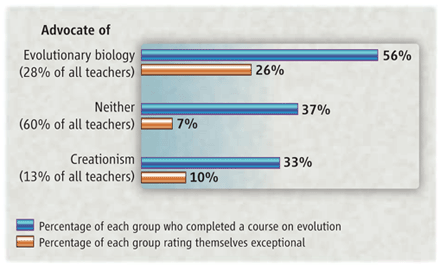
In their earlier survey work, B&P discovered that a large minority of high-school science teachers (28%) teach evolution as the only science game in town. A smaller minority, around 13%, teach creationism as science. The big middle group tended to teach a mish-mash of watered-down evolutionary science mixed with creationism-friendly ideas.

Using a new batch of focus-group data, B&P asked new questions:

How is it possible that young people who major in a scientific field and desire to be science educators lack confidence in their understanding of a central principle of modern biology? Where do teachers develop their belief that they are obligated to be “fair” to nonscientific accounts of creation? And how critical is personal faith in the development of the pedagogical choices that they will make over many years in the classroom?

To find out, B&P conducted focus-group interviews at four different sorts of colleges in Pennsylvania. They interviewed groups of students who planned careers as science teachers.

Significantly, B&P found that pre-service teachers had a shaky hold on evolutionary science, even though they often majored in biology. When the teachers looked ahead to possible future controversies in their own classrooms, an overwhelming majority of pre-service teachers expressed confidence that they could handle any controversy by using better classroom management techniques, not better science. As B&P put it,

The impression we got is that classroom management techniques and skills to negotiate controversy were aspects of professional capital that students felt they needed to absorb, internalize, and have at the ready. They understood that the content of science was also critical in any encounter with a skeptical parent or community member, but they did not feel they needed to own the content in the same way that they needed to become masters of management techniques.

Even when they knew the science and wanted to teach it, many of the pre-service teachers B&P interviewed seemed nervous about provoking any sort of controversy. As student teachers and then new teachers, their main goal was often to avoid attracting negative attention.

If a controversy did arise, pre-service teachers imagined they could take shelter behind their state’s standards or their district’s curricula. Without exception, the teachers-to-be insisted they did not want to become culture warriors in their classrooms. As B&P put it,

their primary identification as educators rather than scientists suggests that they are relatively passive recipients of arguments and political communication from elites and groups trying to shape popular opinion.

In short, teachers are people. As B&P argued in their 2010 book, teachers’ values tend to reflect the consensus values of their school communities. If they teach in a town in which large numbers of people are favorable to creationism, teachers will also be favorable to creationism.

Perhaps more important, teachers are people with very public jobs. Contrary to culture-war presumptions that teachers are somehow trying to undermine or subvert students in one way or another, most teachers are concerned with avoiding controversy.

As Professors Berkman & Plutzer conclude in this article, we are stuck too often in a “feedback loop” of evolution education. Student teachers didn’t learn much evolution in school, because teachers tended to avoid controversial issues. They don’t wrestle with issues of faith and doubt at public universities, since such issues are largely seen as religious, not scientific. As pre-service teachers, students are more concerned with studying nuts-and-bolts classroom issues, not basic science. And when they do their student teaching, they don’t often see classroom teachers wrestle with evolution in their classrooms.

Teachers become “enablers of doubt,” in other words, because anything else might stir up a hornet’s nest of controversy.  And almost all teachers are more interested in getting along with students and parents than in provoking controversy.

*The article requires a subscription to read the whole thing. If you don’t have access to a university library, ask your local public librarian to scour their databases. Many public libraries these days subscribe to pretty broad academic journal databases. Here’s the full citation to look up: Michael B. Berkman and Eric Plutzer, “Enablers of Doubt: How Future Teachers Learn to Negotiate the Evolution Wars in their Classrooms,” The ANNALS of the American Academy of Political and Social Science, March 2015, vol. 658 no. 1: 253-270.

Do Teachers Have the Right to Be Wrong?

How do we draw the line? How do we know when to punish a teacher for being wrong and when to insist that teachers have a right to express their views on controversial topics? A new bill in Montana again insists that creationist teachers should have legal protection to teach their views. Nor is this simply a Montana question. From its headquarters in Seattle, the Discovery Institute has proposed a model bill for legislatures nationwide. From Alabama to Colorado, Florida to South Dakota, lawmakers have offered similar bills.

The basic argument is the same: Teachers must be allowed to teach the full range of ideas about evolution and the origins of life. Should they? And if they shouldn’t, why not?

These are not easy questions, though they might seem so at first. Opponents of these sorts of creationist “academic freedom” laws scoff that no teacher has the right to tell students things that aren’t true. Supporters, on the other hand, might insist that this is a simple question of teachers’ rights to academic freedom.

Neither of those positions captures the complexity of the situation, though. For those of us who oppose these bills, it seems obvious that teachers must not be allowed to tell students things that are not true. As Glenn Branch of the National Center for Science Education put it, Montana teachers do not have the right to teach “bunk.”

The hard question, though, is who decides on the definition of bunk, and how. Historically, we’ve seen teachers persecuted for unpopular political beliefs. As historian Clarence Taylor has described, in the early 1950s eight New York teachers were fired for their leftist sympathies.

Throughout the twentieth century, as I argued in my new book, progressive teachers and school administrators struggled to protect their rights to their political opinions. These educators insisted on their right to hold controversial opinions. More pertinent, they insisted on their right to teach students about these ideas.

In hindsight, it’s clear that the rights of these teachers were egregiously violated. What’s worse, the climate of public education as a whole was degraded by these educational witch-hunts. Only a few teachers were actually purged, but a climate of fear pushed teachers and students to hew more closely to the patriotic party line. That’s not good education.

So creationists ask: Aren’t these bills protecting the same right? Don’t creationist teachers have the right to present all sides of scientific questions about origins?

Yes and no. As philosopher Harvey Siegel and I argue in our upcoming book, creationist teachers and students DO have enormous rights in public-school classrooms. Too often, evolution mavens get too wrapped up in winning culture-war battles to admit it. Far too often, science teachers imply that students need to believe evolution; earnest teachers want students to acknowledge the fact that real knowing means abjuring supernatural explanations of events. Creationist students have every right to dissent from such beliefs. If students want to believe that the earth is 6,000 years old, or that the earth is a floating turtle, or any other sort of thing, they have every right to do so.

Public schools must welcome a plurality of religious beliefs. Creationists—teachers and students alike—must be defended in their quest to protect their faith from assault, even if that assault is only implied or suggested.

By that same token, however, these sorts of academic bills fail on two counts. First, students in public schools have the right to be protected from religious indoctrination. No teacher may preach religious doctrine. Though creationists might howl in protest, even the most intelligently designed creationist bills have religious goals. Instead of protecting teachers’ rights to teach controversial subjects, in effect these sorts of academic freedom bills protect a non-existent right to preach a certain religion-friendly doctrine in public-school classrooms.

Second, students in public schools have the right to learn the best ideas available. When issues are truly controversial, students must be exposed to those controversies. But when ideas are not controversial, students must not be forced to mull false ideas as co-equal to truer ones.

This is not only an evolution/creation idea. In history classes, for example, students should not learn that the South won the Civil War. Or that most enslaved people preferred bondage to freedom. These ideas are held by lots of people, but that doesn’t make them just as true as other historical ideas.

Teach the controversy?

Teach the controversy?

In science classes, the sorts of dissent that people such as Montana legislator Clayton Fiscus wants to protect are not equally scientifically valid. True academic freedom does not include the right to offer worse scientific ideas as equal to better ones. True academic freedom does not include the right to preach religious ideas as facts.

So do teachers have the right to be wrong? Yes, indeed. But they do not have a right to encourage students to believe any particular sort of religious belief. Nor do they have the right to pretend two sets of ideas are equally valid when they are not.

Teaching Evolution in a Creation Nation

What do we want out of America’s schoolchildren? . . . out of America’s creationists? I’m tickled pink to announce that my co-author Harvey Siegel and I have just sent in our final manuscript for our new book, Teaching Evolution in a Creation Nation. In this volume, we tackle these difficult questions head-on.

As we’ve explored in these pages, Harvey and I review the historical and philosophical issues involved in America’s long culture-war battle over evolution and creationism. Historically, I argue, creationism (in most of its religiously inspired variants) has worked like other forms of religious and cultural dissent. Philosophically, Harvey reviews the tricky definition of science, as well as the most common objections to evolution education.

In essence, we argue that the best way to understand creationism is as a form of educational dissent. By defining creationism that way, we can see some directions in which classroom policy should go.Jack chick Evolution

Most important, we argue that the proper aims of public-school evolution education should be to inculcate a knowledge and understanding of evolution. No creationist-friendly variants should be allowed in science classes as science. But dissenting students must be allowed and even encouraged to maintain their dissent. We can’t insist that students believe this or that about evolution. Not in public schools, anyway. We must insist, however, that students know and understand that evolution is the best scientific explanation of the ways life came to be on this planet.

Among the tricky questions raised by our book are these:

  1. Is “belief” an inherent part of good evolution education? That is, should children in public schools be encouraged not only to know and understand certain facts about evolution, but to believe that evolution is really the best way to understand the roots of our species’ existence?
  2. Does it water down evolution education to allow dissenters to maintain their dissent, even in the face of overwhelming scientific evidence?
  3. From creationists’ perspectives, is it too much to agree that mainstream evolution science really is the best science? Will creationists agree that their ideas are more religiously inspired belief than legitimate scientific dissent?
  4. Can teachers in the real world walk this line between teaching facts about evolution and teaching belief in evolution?

There’s one important question that is less difficult: When will this baby hit the bookstores? Our editor at the University of Chicago Press tells us our baby will be like a real baby: it needs to gestate for at least nine months before it’s ready to get slapped around.

And I’m confident it will attract plenty of slappers.

The Creationist Dream, Part II

What should public-school biology classes look like? A couple days ago, I shared an article from an evangelical magazine, c. 1967. It told a story of a creationist high-schooler who bravely stood up to her evolutionist teacher. As a result, the class put biology aside and had a spontaneous prayer meeting.

As one astute reader noted, it sounded like a fifty-year preview to the new film God’s Not Dead.

Whatever your beliefs about creationism and evolution, there was something dead wrong in the story. Something that just didn’t fit with the ways the creation/evolution battle really works. And this something was besides the hokey language and the Leave-It-To-Beaver creationism.

What was wrong? Was it

  1. No teacher really feels that gung-ho about teaching evolution?
  2. No student really cares that much about creationism?
  3. No parents would encourage their kid to publicly preach that way in a public school?
  4. There would never be that sort of religious revival in a public school? or
  5. A teacher would not likely be that clueless about the religious beliefs of her students?

Let’s take them one by one. In the story, the teacher was a mean-eyed evolutionist. She ridiculed creationist belief, while being stupidly ignorant of the fact that most of her students shared those beliefs. Could a teacher really feel that gung-ho about teaching evolutionism? Well, clearly the character was an utter caricature, but I think it is certainly possible for teachers in 1967 or 2014 to feel a passion for enlightening students with the truth of evolution. I would say that most teachers don’t feel this sort of mission, but some do.

What about number 2? Do any students really feel so intensely devoted to their creationist beliefs that they would risk public humiliation to express them in class? Just as with number 1, I think this would be unusual in the real world, but by no means impossible.

Would parents really encourage their kids to preach in a public school? Some would. Again, not likely in the same Richie-Cunningham tone presented in this story, but I don’t find it beyond belief that parents might want their children to stick up for their beliefs in public schools. Some parents likely encourage their kids to see their public schools as a sort of mission field. And there is a literature out there helping parents help their kids to evangelize properly in their public schools.

Could it work? As number 4 suggests, is this sort of religious revival beyond the possibility for a public school? Not at all. These days, for instance, public-school children are encouraged to meet at the flagpole of their schools one day in September. Just like in the story, this strategy promises “amazing transformations” of students and school culture.See you at the pole

So I agree with the sharp commenters who voted for number 5. It is possible, of course, that a teacher might have no idea that her students shared fervent creationist beliefs. But in general, that doesn’t happen much. As Michael Berkman and Eric Plutzer argued in their book Evolution, Creationism, and the Battle to Control America’s Classrooms, teachers tend to fit in with their communities. As they put it, “traditional districts and cosmopolitan districts tend to hire teachers whose training, beliefs, and teaching practices serve to reinforce or harmonize with the prevailing local culture.”

Take a Trip to a Science Museum with a Creationist

“See, fossils!  That’s science.”  So says Megan Fox, self-identified creationist homeschool mom, Tea Partyer, blogger, and Latest YouTube Sensation.

We’ve taken plenty of museum trips here at ILBYGTH: to the Institute for Creation Research’s museum in San Diego, to the big Creation Museum in Kentucky, and even to a medley of creation and mainstream science museums.  Now there is a new option: Take a trip to Chicago’s Field Museum with Megan Fox.  In this half-hour video, Fox explains all the problems with mainstream science.

Plenty of commentators have blitzed Mrs. Fox with insults.  More interesting will be an attempt for those of us outside the creationist community to find out what this creationist thinks about mainstream science.

https://www.youtube.com/watch?v=32mxZxv3dYM

I’m no creationist-basher, but Mrs. Fox does seem to have an unpleasantly loud and in-my-face personality.  Predictably, bloggers have teed off on her “expose” of mainstream science at the Field Museum. Atheist PZ Myers called Fox “Smug and Stupid.” At Dangerous Minds, she was called a “blithering idiot,” and worse.

I would imagine that many of the intelligent creationists out there wouldn’t have chosen Fox as their ideal spokesperson. But what if we watch her museum tour as a chance to learn more about her creationist vision of science? Historians have worked hard—maybe too hard—to explain the philosophical underpinnings of creationist and Protestant fundamentalist science.

Many agree with George Marsden, who has argued that at heart, fundamentalist science hearkens back to the scientific principles laid down in the 1600s by Francis Bacon. As Marsden wrote in Fundamentalism and American Culture (2006 edition, pg. 59):

the role of the interpreter, according to the same Baconian assumptions, was not to impose hypotheses or theories, but to reach conclusions on the basis of careful classification and generalization alone.

Other historians have agreed. Mark Noll, for example, argued in The Scandal of the Evangelical Mind (pg. 197),

Creationists regularly reaffirm the principles of Baconian science: no speculation without direct empirical proof, no deductions from speculative principles, no science without extensive empirical evidence.

Perhaps the most careful student of conservative Protestant encounters with mainstream science, Jon Roberts, argued similarly in his 1988 book Darwinism and the Divine in America (pp. 41-42 of that first edition from the University of Wisconsin Press),

Nonscientists were also enamored of the Baconian method, for they believed that it was the surest route to the certainty they associated with science. Asa Mahan, a prominent philosopher who served as the first president of Oberlin College, presented in 1872 a typical statement of the prevailing view within the American Protestant intellectual community: ‘Science is knowledge systematized. Into a scientific process, nothing but what is absolutely known can enter.’

Is this what Megan Fox is doing? More interestingly, which term fits Fox better: “blithering idiot” or “Baconian loudmouth”?

I think a better term for Fox’s scientific vision is one used by historian Ted Davis. Though the roots of Fox’s attitude toward proper science may have originated in Baconian principles, it seems misleading to suggest that Fox selected a Baconian framework out of thin air. Like most of us, Fox’s ideas of proper science seem to come from a mix of sources, some of them only dimly understood.

So, instead of calling Fox “Baconian,” I think we should use Davis’s label of “folk science.” As Davis explains, the term came from Jerome Ravetz, Scientific Knowledge and Its Social Problems (1971).

Of course, it is not only creationists who practice “folk science.” As Dan Kahan argues, there is not much daylight between creationists and non-creationists when it comes to actual knowledge about evolution. Most of us have only the vaguest grasp on the real meanings and implications of mainstream science. Unlike Mrs. Fox, however, most of us are willing to learn mainstream science when we go to the Field Museum, not try to pit our folk-ish understandings against the efforts of mainstream science educators.

HT: GB

Is Sex Ed Religious Persecution? Is Evolution?

Am I persecuted if my kid is taught sex ed that goes against my religious beliefs?  That’s the question coming out of Arizona this morning.

And it has echoes far beyond the questions of contraception and sex ed.  If kids have a constitutional right to protection from ideas that challenge their religions, it will change the ways we teach evolution, history, literature…really, everything.  But so far, courts have generally not recognized conservatives’ claims of religious persecution. The good news is that there is a simple solution, though it’s one that everyone might hate.

But that doesn’t stop conservatives from making their cases.  As the New York Times reports, a new sex-ed textbook controversy is roiling school politics in Arizona.  Back in 2012, conservatives pushed through a state law mandating that adoption be given preferential treatment in schools.  That is, children in Arizona public schools have to be nudged toward thinking of adoption as a more moral choice than abortion.  An alert parent noticed that a commonly used biology textbook discussed contraception, including the drug mefipristone. According to the NYT, mefipristone can be used to terminate a pregnancy.

A pro-choice lemur...

A pro-choice lemur…

In Gilbert, Arizona, a suburb of Phoenix, the school board voted narrowly that the information violated the 2012 law. What to do? The Gilbert school board ruled that two textbook pages must be removed, somehow.

So far, so ho-hum.  In school controversies, textbooks have been snipped, blacked-out, removed, even burned.  What’s more, the narrative told by conservative school board member Julie Smith seems almost like pages from a tired old script. As I note in my upcoming book about educational conservatism in the twentieth century, nearly every conservative activist has told a similar story. From the 1920s to the 1970s, conservatives have insisted that they were floored by the salacious, socialist, or heretical material their kids brought home from school.

Mrs. Smith brings this tradition into 2014. As she told the New York Times, when her son told her what he was learning about contraception, “I almost drove off the road.”

But Mrs. Smith did not stop with this old chestnut. She also insisted that including this material in textbooks represented an unconstitutional abuse of her religious freedom. As she told the NYT, by having her son read about contraception, the schools “have violated my religious rights.”

Is Smith right? Do religious conservatives have a constitutional right to free exercise of religion in public schools? Is that right violated when public schools force students to learn ideas that contradict their religions?

This question received the most thorough examination in the tortuous path traced by the case of Hawkins County, Tennessee, in the late 1980s. Parents complained that textbooks promoted a bevy of anti-Christian ideas, including secular humanism and occultism. These conservative parents wanted to have their children exempted from reading such anti-religious material.
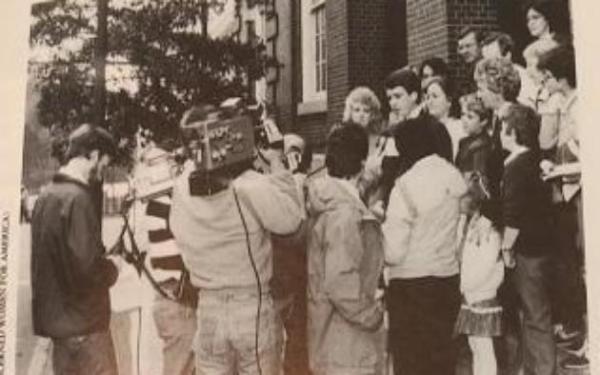
Mozert makes his case...

Mozert makes his case…

The conservative parents had some initial success in court, but eventually the 6th circuit court ruled against them. In the opinion of that court, the children did not have the right to protection from exposure to mainstream ideas. If the children had been forced to perform religious acts, the court ruled, the parents would have had a better case. But public schools have a duty, not just a right, to expose children to the best current knowledge about every subject, including presumably sex ed.

It’s not for me to tell conservatives what to do, but in this case, it seems Julie Smith is pursuing a losing strategy. Claiming to be religiously persecuted because children are exposed to mainstream ideas is not going to work. If, instead, conservatives could claim that their children were being forced to perform religious acts, conservatives would have a better case.

And, IMHO, contraception is not the right issue for conservatives to pursue with this strategy. Public schools don’t FORCE students to use contraception. Schools simply give students information about contraception.

Conservatives might have a better shot with evolution. Folks like me want to give every person in the United States more information about evolution. There is nothing religious about this goal. For me and other evolution mavens, evolution simply represents the best current science, and students must be exposed to the best current knowledge in every field.

The way I see it, exposing students to knowledge does not violate anyone’s religious rights. But here’s the kicker: The fact that I have a secular purpose in teaching evolution does not mean that evolution does not have religious meanings for others. Again, I don’t want to dictate political strategy to conservatives, but it seems to me creationists could have some success if they claimed that their children have a constitutional right to a certain sort of protection from evolutionary ideas in public schools. Not a right to be protected from hearing or reading those ideas. That would count as simple exposure.

But creationist kids WOULD have a right to be protected from performing religious acts in public schools. For some religious groups, saying that humans evolved from other animals is a religious act. For some religious groups, saying that the earth is billions of years old is a religious act.

In other words, IMHO, public schools have a right and a duty to expose all children to the best current knowledge in all fields. In biology, that means human evolution without any supernatural guidance. In geology, that means an ancient earth and cosmos. At the same time, however, creationist kids have a right to freely practice their religions. And they have a right to insist that the government does not push religious actions upon them. If their religion forbids them from saying that the earth is ancient, kids have a right not to be coerced into saying such things.

This may seem like an unsolvable situation, but there is a simple solution. Public schools and public school teachers have a simple two-word answer to all these conundrums. Instead of pushing students to say that the earth is ancient and that humans have evolved, teachers need only to help students to understand that scientists think these things to be true.

By letting kids say “Scientists say” humans evolved; by letting kids say “Scientists say” the earth is ancient, public schools protect themselves from charges of religious indoctrination. And at the same time, creationists get schools that will not be hostile to their faiths.

The bad news for Julie Smith from Gilbert, Arizona is that she cannot claim any similar sort of constitutional protection. Even if the fact that her son is learning about contraception causes her to drive her car off the road, the public school is not persecuting her by teaching such things.

A Brazillion Creationists Out There

How powerful is creationism worldwide? Some pundits have suggested that creationism is unique to the USA. But recent news from Brazil indicates that global creationism may be gaining steam.

The latest report from Brazil comes to us from the National Center for Science Education. Proposed legislation in that country would introduce US-style creationism to Brazilian public schools. My Portuguese is no good, but according to the NCSE report, this bill insists that schools include creationist science, including “the ideas that life has its origin in God, the supreme creator of the whole universe and of all things that compose it.”

Why? Because, in the words of the bill’s sponsor, “the creationist doctrine is prevalent throughout our country.”

Is it? Some science pundits, such as Bill Nye, contend that this sort of creationism is “unique” to the United States.

In this case, The Science Guy is flat-out wrong. Creationism—even if we limit it to just the Christian kind—is a global phenomenon. And the reasons for that globalism matter.

Pundits like Bill Nye might assume that creationism thrives in those corners of the globe that have not yet been incorporated into the global conversation. In some isolated regions, this theory goes, the obvious truths of evolution have not yet penetrated.

But that explanation gets it backward. The reason for thriving creationism in Brazil is not due to ineffective science education. It is due, rather, to explosively effective religious education. That is, Brazilian creationists are not simply religious primitives who have been isolated from the gospel of evolution. Instead, they are religious innovators who have been connected to a global gospel of creationism.

As usual, historian Ron Numbers—my grad-school mentor—put it best. In his book The Creationists, Ron captures this experience with a pithy chapter title: “Creation Science Floods the World.”

A growing force in Brazilian politics...

A growing force in Brazilian politics…

Throughout the twentieth century, conservative evangelical Protestants have successfully spread their religion throughout Latin America, finding a particularly congenial home in Brazil.

As a recent study from the Pew Research Center for Religion & Public Life makes clear, US-style evangelicalism has aggressively moved into Brazil, courting the country’s Catholics and converting them in large numbers.

For a hundred years, evangelical groups have spread via missionary organizations into Brazil. As Andrew Chestnut of Virginia Commonwealth University explains, groups such as the Assemblies of God have been particularly successful in Brazil. With this Pentecostal denomination, at least, Brazilian locals have taken over and made it their own. And they are now asserting their power politically.

For instance, the author of the recent creationist legislation, Marco Feliciano, is an Assemblies of God pastor. And he insists that Brazilians are on his side. Poll numbers back him up. According to the NCSE report, fully 89% of Brazilian respondents think creationism should be taught in Brazil’s public schools. Nearly that many, 75%, think ONLY creationism should be taught.

I’ve argued in the past that evolution educators often have a missionary zeal to spread the truth about evolution. This news from Brazil suggests that evolution’s missionaries are just not as good as the creationist types.

Forget the Intelligent Designer: What about Creationist Graphic Designers?

[Thanks to JS for PACE materials.]

Ken Ham is right again.  I’m no creationist, much less a young-earth type, but Mr. Ham’s Answers In Genesis organization has done it again.  As they did with their museum, AIG has managed to overcome the traditional stylistic weirdnesses of creationist outreach.

Weird science, but good-looking graphics...

Weird science, but good-looking graphics…

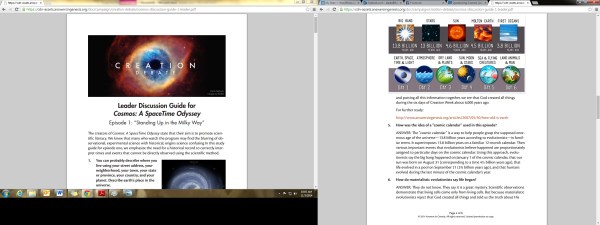
Ham has bragged recently about the high-class materials his group has cranked out.  In answer to the new version of Cosmos, Answers In Genesis has produced classroom materials to rebut the claims of the popular science show.  As Ham put it,

The AiG graphics department and publications team did a great job designing Questioning Cosmos. Its full-color glossy pages are packed with illustrations, questions for discussion, and detailed answers and explanations to help parents, teachers, and youth group leaders teach young people (and adults!) how to discern what observational science is presented in the Cosmos series and what material is best described as an evolutionary infomercial.

Even those of us who want more evolution taught in public schools must admit that Mr. Ham is right.  The anti-Cosmos materials don’t look any different than mainstream school texts.  Just as Answers In Genesis has done with its museum, this outreach effort has erased some of the obvious outward signs of the non-mainstream nature of creationist science.

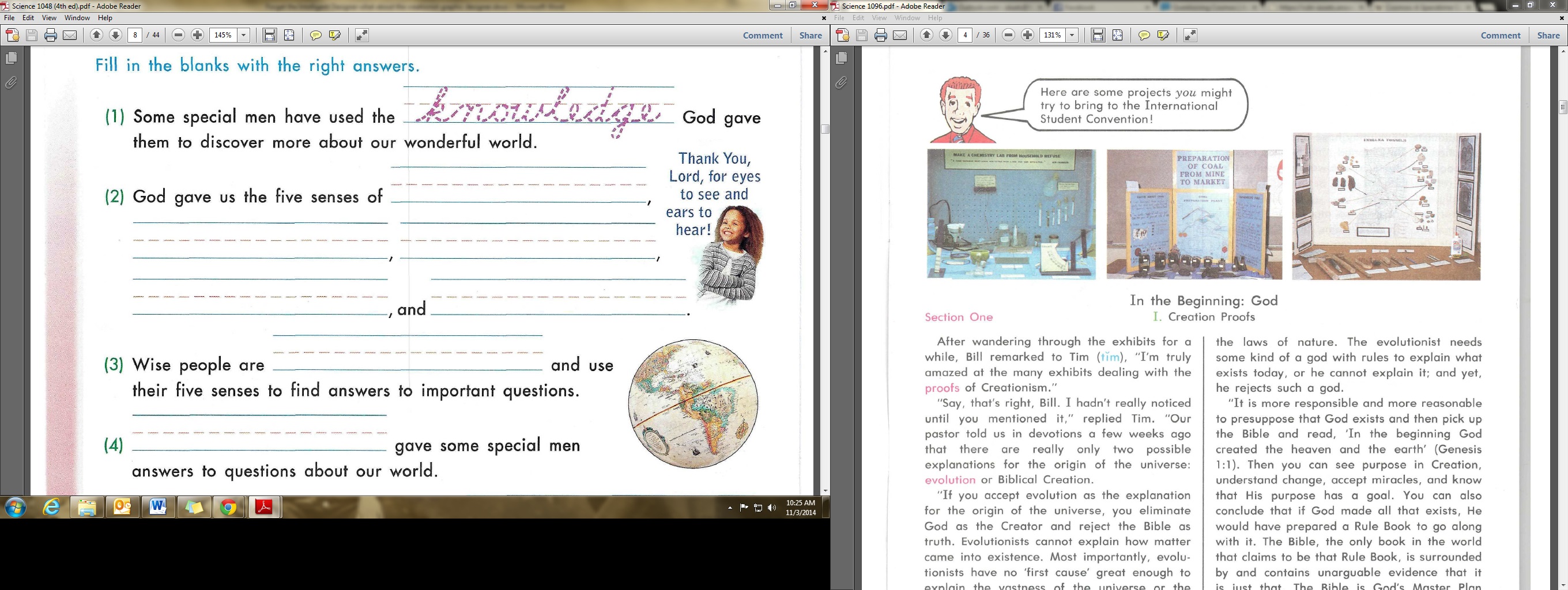
It used to be easy.  Creationists used to produce school materials that looked hokey, weird, old-fashioned.  Consider just a few samples from Accelerated Christian Education.  As these pictures show, not only is the science much different from mainstream science, but the workbooks themselves seem obviously out of date.  The graphics are weird, the comics are jerky, and the lettering looks homemade.

Creation science used to look as if it were created in six days...

Creation science used to look as if it were created in six days…

Creation science books used to LOOK different...

Gee whillikers!

That’s just not the case with AIG’s anti-Cosmos materials.  The graphic design is very similar to the production values we’d expect from mainstream school materials.  And that matters more than we might think.  Parents, school administrators, and, most important, children tend to judge books by their covers.  The shoddy production values of cheap creationist pamphlets used to make them less attractive.

In the case of Answers In Genesis, mainstream science-ed materials can no longer count on such weak and ugly competition.