Charter Schools Teach Fundamentalism

Can fundamentalist Protestant educators change their packaging and call their new schools charters?

Leaving Fundamentalism’s Jonny Scaramanga argued recently in the pages of Salon that some fundamentalist leaders are doing just that.

As we’ve seen, publicly funded charter schools elsewhere have been accused of simply re-branding religious schools and siphoning off public money.

Scaramanga, a product of the fundamentalist Accelerated Christian Education curriculum and now its fiercest critic, uncovered Texas charter schools in which ACE’s rigid fundamentalist materials are paid for with taxpayer dollars.

Check out the full article.  Scaramanga describes ACE-derived textbooks that promote skepticism toward mainstream evolutionary science.  He found evidence that ACE-influenced charter schools guided students by the Ten Commandments but called them non-religious “success principle[s].”  Most headline-grabbing, the ACE-ish books blamed evolution for the rise of Hitler.

Scaramanga even cites yours truly as a source, so you know his article’s gotta be good.


What Color Are Your Fundamentalists?

Who are the “fundamentalists” who hope to keep America’s public schools religious?

Some of us may picture a Saddleback-type white suburban evangelical, driving around in a Biblically-sized SUV, worrying in equal measure about sin and soccer.

New!  School Prayer Barbie!

New! School Prayer Barbie!

But as Peter Berger reminds us this morning on The American Interest, that image of conservative evangelicalism might represent the past more than the future.

Berger notes the dramatic effects of immigration on the nature of American Christianity.  New immigrants tend to be Christian, and their Christianity tends to lean conservative.  As Berger concludes,

Both in their theology and religious practice, non-Western Christians are more conservative. Their worldview is strongly supernaturalist: The spiritual world, both benign and sinister, is very close—the Holy Spirit, the Virgin and the saints, miracles of healing—but also the devil and other malevolent spirits. This supernaturalism is strongest in the Pentecostal and charismatic movements, but it is also very visible in Catholic and mainline Protestant churches. But non-Western Christians are also more conservative in their moral convictions—very little sympathy here for the feminism, let alone the agenda of the gay movement, that has become so prominent in mainline Protestantism in America—and, I suspect, would be more prominent in American Catholicism, were it not for surveillance and intervention from Rome.

The implication of all this is simple and exceedingly important: Immigration will strengthen the conservative forces in American Christianity.

In the future, the fight over religion in America’s public schools may have a very different tone.  Instead of a ring of white conservative suburbs around every ethnically diverse urban core, we may see a shift to immigrant-led demands for more vibrant religion in schools.  Instead of whitebread traditionalism resisting a multicultural liberalism, we might have an ethnically diverse group of conservatives battling to keep morals pure in public education.

Faith & Physics, Part I

ILYBYGTH is happy to welcome a new series of guest posts from Anna.  Anna blogs about her experiences leaving the fundamentalist subculture at Signs You Are a Sheltered Evangelical.  She holds an M.Sc. degree in Astroparticle Physics and currently lives in Virginia with her fiance Chelsey and a cat named Cat.

As a scientist, it’s a bit awkward for me to confess that I used to be a science denier.  I would never have classified myself as such at the time.  I would have called myself an intelligent, well-educated, critically thinking, aspiring physicist.  Yet I was a fervent believer in 6-day Biblical creation, I staunchly disbelieved global warming, I thought homosexuality was a conscious decision to rebel against God, and I was deeply skeptical of any sort of environmental preservation initiatives, even though I was a devoted nature-lover.  Yep, I was about as bad of a science-denier as they come.

Despite all of this, I cannot think too ill of my younger self for my ignorant beliefs.  Admitting them is uncomfortable, of course, but largely because of misunderstandings in the secular and science communities regarding these sorts of beliefs and the people who hold them.  The prevailing opinion is that science-deniers are stupid, uneducated, unable to think critically, and usually just too stubborn to admit they are wrong.  I certainly am not going to excuse my former beliefs, but  I also do not believe they were a result of stupidity, stubbornness or even a lack of research or study.  The truth behind them is much deeper and more complex than most of my peers realize.  This is why I am writing; I want to chronicle my transition from science-denier to scientist, hopefully helping others understand the anti-science mindset, the actions and attitudes that contribute to it, and the attitudes from my more science-savvy peers that made my transition either easier or harder.

If you are going to follow me on this journey, you will need to know who I am.  My name is Anna.  I am a mathematics instructor at a local career college and I also tutor students privately in higher-level math and physical sciences.  I currently hold a Masters Degree in Astroparticle Physics from Jacobs University.  I earned my Bachelors Degree in Physics from New Mexico Tech (where most of my transition occurred) and before then, I was homeschooled.

From kindergarten through 12th grade, I was taught at home with Christian-based curricula, and socialized in a staunchly fundamentalist Christian sub-culture.  TV and video games were off-limits in my home, secular music was all-but banned until I was 17 or so, and my internet useage was strictly monitored.  My world experience, therefore, was quite limited.  I often laugh among friends that I grew up in the 1800’s, not just because I had to wear ankle-length skirts and waist-length hair for much of my young life, but because community isolation like this was very common 100 years ago.  Indeed, being ignorant or skeptical of competing opinions and viewpoints would not have been considered closed-minded in an age before radio broadcasts, television, internet, cellphones, and national and international travel.  It would have been normal.  Human.  That is how it was for me.

That is not to say that I was unaware of differing opinions or viewpoints.  Rather, my sources for this information were almost exclusively biased.  If I brought home a book from the library that mentioned the Big Bang, my parents would sit me down and explain how the book was wrong.  If I saw an advertisement on a billboard that had a scantily clad woman posed on it, I would be told that it was a sign of the downfall of our nation and that it was wrong.  If I read an article in the newspaper that held a left-leaning political viewpoint, a discussion would be opened about how this viewpoint was wrong.  Without fail, ideas that fell outside of the realm of accepted ideas were dismantled, disproven, argued, or shown in a negative light.  A negative reaction to such ideas then became instinctual.  I lived in a never-silent echo-chamber of my subculture’s worldview.

And yet, through all of this, I was taught to think critically.  Most of my peers were as well.  The ability to rationalize, to argue and debate, to pursue knowledge, and to question authority was considered the peak of achievement and intelligence.  Public speaking and debate were cornerstones of Christian homeschooling culture.  “Never believe everything you read” was often on my mother’s lips.  “Always question.  Find things out for yourself.  Never take someone else’s word for anything.  Learn, grow, challenge.”  That was my mandate… a mandate that eventually led me to rejecting the views that my culture espoused.

Many of my secular peers begin to disbelieve my story at this point, which I find very frustrating.  The stereotypes about science-deniers, fundamentalists, and creationists run so deep that I have been called into question on my own life story.  Some people don’t want to hear that people like me, like my family, like my community can be intelligent.  They don’t want to hear that they encourage critical thinking and discussion.  They want to call into question my family’s motives.  “Obviously, they were just saying things like ‘question everything’ to make themselves feel better.  All they wanted was a mindless drone and a copy of themselves.  They were just lying to you.”

These comments are hard to swallow, because on one hand, I partially agree.  My parents and community leaders certainly did not intend for me to turn out the way I did.  And yet, I assert that they truly believed their motives were honest.  They WANTED me to think, to learn, to question.  They just honestly believed that all of that thinking, learning and questioning would inevitably lead me to validate their opinions.  And unfortunately for them, they were wrong.

And so, before I delve more deeply into the culture of fundamentalist education, before I discuss my studies on creationism, my meetings with Ken Ham, my awkward debates with my college peers, and my sloooooow deconversion from science-denialism, I have a request to make: please listen.  Please believe.  Please be open to seeing me and the people I knew outside of the ignorant-hateful-redneck stereotype.  My experiences and motivations were real, and much more complex than many people outside of that subculture realize.  I am telling my story because I am tired of others (on both sides) thinking they can tell it for me.  So, please respect me in that regard.  Thank you, and I hope you enjoy the ride!

Kicking Out the Christians: Duck Dynasty and “Facial Profiling”

Christians are a persecuted minority!

That’s the claim we hear over and over again from conservative religious folks.

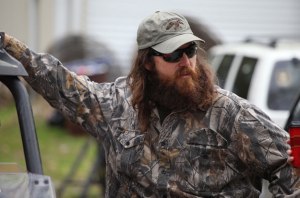
Today we get some surprising evidence that bearded holy men of the Christian faith really are punished unfairly.  Duck Dynasty star Jase Robertson was apparently kicked out of the Trump Hotel in New York City when an employee assumed he was homeless.

jase-robertson4

Robertson. Image Source: A&E

As the Christian Post reports, Robertson didn’t take the incident too seriously.  He called the episode a case of “facial profiling.”

It was not Robertson’s Christian faith, but rather his appearance, that apparently led to this embarrassing incident.  The big reality-show star didn’t make a fuss.  But other conservative Christians like the Robertson family have consistently complained that they are treated like despised minorities in American culture.

In 1980, for example, evangelical superstar Jerry Falwell called conservative Fundamentalists “the largest minority bloc in the United States.”[*]

These feelings among conservative Protestants have been especially strong in debates over public education.  Since the 1920s, conservative evangelical Protestants have complained that their rights have not been respected.  To cite just one example, in 1965 evangelical editor John R. Rice lamented the fact that conservative Christians were not only a minority, but a minority that had been consistently singled out for unique persecution.  “Why not have freedom in America as much for one minority as another?” Rice asked.  “Why not observe the rights of Bible believers as well as the rights of the infidels in the churches and infidels in courts or schools?”[†]

We have seen despised-minority rhetoric again and again in conservative calls to include creationism in public-school science classes.  In the early 1980s, creationists pushed laws that would include both evolution and creationism, in order to protect the constitutional rights of minority creationist students.  Laws such as Arkansas’ Arkansas’ Act 590 of 1981, for example, emphasized that such rules would “protect academic freedom . . . [and] freedom of religious exercise.”[‡]

Creationists have also often complained that their views are ignored out of an anti-scientific zeal to punish minority dissent.  In 1984, for example, creationist Jerry Bergman published his expose of anti-creationist persecution in American higher education.  Bergman himself claimed to have been denied tenure at Bowling Green State University solely for his religious beliefs.  “Several universities,” Bergman lamented,

state it was their ‘right’ to protect students from creationists and, in one case, from ‘fundamentalist Christians.’ . . . This is all plainly illegal, but it is extremely difficult to bring redress against these common, gross injustices.  This is due to the verbal ‘smoke-screen’ thrown up around the issue.  But, a similar case might be if a black were fired on the suspicion that he had ‘talked to students about being black,’ or a woman being fired for having ‘talked to students about women’s issues.’[§]

Kicking out a bearded Christian holy man from a fancy New York hotel won’t offer much clarity to this old dispute.  Jase Robertson himself did not seem at all offended that a hotel employee took him outside to a park when Robertson asked for directions to a bathroom.

Other conservative evangelical Protestants, however, have not laughed off this kind of thing so lightly.  In controversies about the nature of America’s public square, including its public schools, conservative Christians have consistently insisted that they had been treated like persecuted minorities.

It makes me wonder if Jerry Falwell was ever kicked out of a fancy hotel.


[*] George Vecsey, “Militant Television Preachers Try to Weld Fundamentalist Christians’ Political Power,” New York Times, January 21, 1980, A21.


[†] John R. Rice, “White Minorities Have Rights, Too,” Sword of the Lord 31 (3 September 1965): 1.


[‡] “Act 590 of 1981: General Acts, 73rd General Assembly, State of Arkansas,” in in Marcel C. LaFollette, ed., Creationism, Science and the Law: The Arkansas Case (Cambridge: MIT Press, 1983), 15.


[§] Jerry Bergman, The Criterion: Religious Discrimination in America (Richfield, MN: Onesimus Press, 1984), 43.

“I Hope You Rot in Hell:” Greetings from a Liberal Fundamentalist

Are there “fundamentalists” of every political and cultural persuasion?  That is, do some people cling to such extreme and unbending worldviews—from the political and cultural left as well as the right—that they lash out at any dissent?  People—religious or not—who cannot tolerate any deviation from the Truth As They Know It?

It seems we have an example of such a thing from the cornfields of Iowa today.

The Sioux City Journal reported recently on a simmering conflict between an evangelical pastor and a gay politician.

Pastor Cary Gordon of Cornerstone World Outreach complained that Human Rights Commissioner Scott Raasch had made hateful and threatening comments a few years back.  At issue, apparently, was The Reverend Gordon’s opposition to Iowa Supreme Court judges who had supported gay marriage.

A few years ago, according to the Sioux City Journal, their disagreement degraded into the following Facebook exchange:

In one comment, Raasch wrote: “You are haters and bigots and you will get what’s coming to you sooner or later. I hope you rot in hell.”

Gordon replied, “I hope you repent of your sins and accept Jesus as your Lord and Savior. I wouldn’t want you or anyone else to go to hell.”

Raasch wrote, “I know Christ and don’t need a snake oil salesman like you to tell me about him. I guess that’s the difference between us because I think there are many people that deserve to burn in hell … including you and your entire family.”

Ouch.

The Reverend Gordon called for Raasch’s removal from the Human Rights Commission.  Someone with such extreme views, Gordon argued, should not be in charge of making rulings on discrimination cases that involve religious issues, as well as issues of race, creed, gender, and sexual orientation.

Raasch has admitted that he made the comments, and apologized for any stress caused.

Is this an example of what we might call “liberal fundamentalism?”  A case where someone feels so morally assured of his own righteousness that he lashes out at dissenters in such an angry way?


Fear and Loathing in Fundamentalist America

Who hates whom?  Do “fundamentalists” hate the rest of us?

A new article about the hate-centric Westboro Baptist Church confirms what many of my secular, liberal friends and colleagues believe: fundamentalists hate.  Hate seems to be at the core of their fundamentalist identity.

But hate is a tricky thing.  Is it okay to hate the Westboro Church and its horrific tactics?  How about other fundamentalist groups?

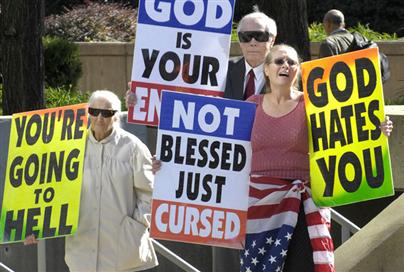
Image Source: Top Ten Unbelievable Westboro Baptist Church Protests

Image Source: Top Ten Unbelievable Westboro Baptist Church Protests

The hatefulness of the Westboro sect is hard to deny.  Writing in the Los Angeles Times, Jenny Deam offers a portrait of Westboro refugee Libby Phelps-Alvarez.  Phelps-Alvarez, granddaughter of Westboro founder Fred Phelps, shares a story of cultish indoctrination into the Phelps family business.  You’ve seen the images: soldiers’ funerals picketed by Westboro members holding up signs saying, “God Hates Fags” and the like.

As Deams’ story relates, Libby grew up with the family church.  She began picketing at age 12.  By her late teens, though, according to Deams, “Libby began to wonder: ‘Am I doing the right thing? Should I be telling people they are going to hell?’”

Eventually, Libby left her church and family.  But she seems strangely ambivalent about it. As Deams concludes, “Libby isn’t sure what she believes anymore. She no longer hates homosexuality, but her journey is far from complete: ‘Everyone thinks when you leave you do this 180. It doesn’t work that way.’”

Many other ex-fundamentalists take a much angrier tone.  For some, hating the haters has freed them to engage in their own brand of hatefulness.

Ken Ham has complained recently of vicious verbal attacks on him and his young-earth creationist ministry by groups of atheists.  Ham planned to speak at a Texas homeschooling conference, and Texas freethinkers posted their discussion about their planned response.

Most of their planning revolved around intelligent protests and information-sharing.  Vic Wang of the Houston Humanists made the intelligent point that their protests should not be against religion.  Rather, Wang argued, they should paint Ham as a specific sort of “extremist,” a “crackpot.”

Other speakers took an angrier tone.  “Sister Shayrah” equated creationism and conservative religion with child abuse.    She insisted that religious parents were free to teach their children their beliefs, but that no parent, in any sort of school, could be allowed to use religion as an “excuse for damaging or hurting or indoctrinating your child.”

Shayrah and other participants, such as Neely Fluke, noted that they had been brought up in the world of young-earth creationism and fundamentalist Protestantism.  That has left them angry.

I can’t claim to know what it is like to grow up in the world of fundamentalism.  Many of those who grew up that way, such as Jonny Scaramanga or “Forged Imagination,” have offered compelling insights into their feelings and transformations.

But whatever personal anguish or turmoil these folks may have experienced, it does not make sense in the cold light of cultural politics to use angry, confrontational language.  It doesn’t help.

Indeed, the beneficiary of this sort of anger seems to be Ken Ham himself. He has promoted this anti-Ham video on his blog and website.  As he says to his creationist readers,

Everyone needs to experience this video chat for themselves to get an understanding of the increasing intolerance and aggressiveness of many atheists against biblical Christianity. . . .

And let’s get churches in Texas aware of this intolerance by atheists and publically get out the word, including alerting the Christian media. Pastors should speak out about the increasing intolerance of atheists to their congregations. In fact, these video excerpts should be used by pastors across this nation to warn their flocks about the growing intolerance being directed at Christians and then equip their people to stand against these secular attacks. . . .

So, let’s use this video chat by atheists as a tool to offer some practical teaching about those people who oppose the Bible’s messages.

I can’t claim to know what it was like to be taught the doctrines of young-earth creationism or Protestant fundamentalism.  I understand that I might be angry if I had.  But like any political movement, venting too much spleen against our opponents only fuels the other side.  Hate may feel good sometimes.  It may feel righteous.  But it only digs deeper the culture-war trenches that have divided our country.


Required Reading: Meet Tim LaHaye

Do you know Tim LaHaye?

LaHaye

LaHaye

If you’re interested in conservative educational thinking in the United States, you should.

Steve Fouse at AliveReligion recently offered a helpful introduction to LaHaye’s enormous influence among conservative and fundamentalist circles.

As Fouse points out, arguments about conservatism that seek to explain away its popularity miss the boat on LaHaye.  Fouse takes Thomas Frank to task for making such oversimplistic assumptions.  Fouse prefers the explanations of historians such as Darren Dochuk.  Dochuk’s more complex perspective fits better the career of a fundamentalist Renaissance Man like LaHaye.

Fouse notes LaHaye’s wide-ranging interests, from LaHaye’s role in the Institute for Creation Research, to his best-selling apocalyptic novels, to his evangelical sex guides.

Fouse mentions LaHaye’s central interest in educational issues, from sex ed to creationism.  If anything, Fouse downplays the influence LaHaye has had in late twentieth-century educational conservatism.

Fouse could have mentioned, for instance, LaHaye’s role in arguing for increased phonics instruction.  In his 1983 book The Battle for the Public Schools, LaHaye argued that abandoning phonics could be part of a massive conspiracy to “reduce the standard of living in our country so that someday the citizens of America will voluntarily merge with the Soviet Union and other countries in a one-world socialist state”   (46).   Disappearing phonics instruction showed the extent to which Christian America had been undermined.  It served as a canary in the secular coalmine.  “Some modern educators,” LaHaye insisted, “use look-and-say instead of phonics because the material enables them to secularize our once God-conscious school system” (50).

Similarly, Fouse did not mention LaHaye’s ardent activism in favor of more traditionalism in US History instruction.  In LaHaye’s 1987 Faith of Our Founding Fathers, LaHaye argued that the nation had endured a “Deliberate Rape of History” (5). Between 1954 and 1976, LaHaye insisted, a generation of “left-wing scholars for hire” worked for secularizing organizations such as the Carnegie Foundation (6).  Such authors systematically distorted the truth of America’s Christian heritage.  Thus, in order to find the true history of America’s founding, readers needed to look to older books, written by those “closest to the events they describe” (6). LaHaye insisted on the Christian beliefs of the Founding Fathers, demonstrating that “most were deeply religious, all had a great respect for the Christian traditions of the colonies, and all were significantly influenced in their thinking by the Bible, moral values, and their church” (30).

Thanks to Steve for offering his post about this important figure.  All of us who hope to understand conservatism in American education should check it out.


You Might Be a Fundamentalist If…

What does it mean to be a “fundamentalist” in America? And what does “fundamentalism” mean for American education?

Theologian Roger E. Olson offers a great introduction to the intricate theological and cultural boundaries of American fundamentalism.

As with any theological tendency, the definition of “fundamentalism” has long been fraught with bitter disputation.  As I learned in my study of 1920s American fundamentalism, there will be exceptions to every rule and protestations of every boundary.

Olson offers outsiders like me a convenient double list.  First, he gives his carefully hedged list of theological determinants.  In the context of American Christianity, someone is likely a fundamentalist if he or she agrees with some or all of the following list:

  • Embrace of traditional conservative Christian doctrine, such as divinity of Christ, the trinity, inspiration of Scripture, salvation by grace through faith, and so on;
  • Refusal to fellowship with those who are not similarly theologically aligned;
  • Refusal to fellowship with those who fellowship with those who are not similarly theologically aligned;
  • Embrace of Biblical inerrancy—the notion that the original autographs of the Bible are without error;
  • Belief that the King James Version is the proper English translation;
  • Belief that young earth creationism and premillennial eschatology are central to true Christian faith;
  • Belief that America is “God’s Nation;”
  • An insistence that good education must be Bible-based;
  • Belief that Catholics are not real Christians.

Does Professor Olson insist on this list as the ultimate definition?  No.  As he warns, “These are not absolute litmus tests. It’s theoretically possible that a person might hold most of these beliefs and, for some unforeseen reason (a fluke) not be a fundamentalist.”

Most helpful of all, Professor Olson notes that the label “fundamentalist” is often used in looser ways.  The list above describes a certain tradition among American Protestantism.  But “fundamentalism,” as Olson argues, has long been used to describe other phenomena as well.

Olson gives us four of these other traditional uses of “fundamentalism.”

First, there’s a sense that “anyone considered religiously conservative and fanatical” is a fundamentalist.  Second, some people use “fundamentalism” to describe any sort of religiously motivated anti-modernism.  Third, some folks call anyone they don’t like a fundamentalist.  If you are conniving, or manipulative in your dealings with other church folk, even if you are theologically liberal, you might be called a fundamentalist.  Finally, Olson offers his “historical-theological meaning:” “militant defense of conservative Protestantism against liberal theology and higher biblical criticism.”

Many thanks to the good professor for offering this nuanced public definition.  My summary here doesn’t do justice, and I suggest reading the article in its entirety.  Outsiders to the world of conservative American Christianity like me often have a very difficult time decoding the dense layers of meaning attached to such labels.  Yet for many within the porous boundaries of “fundamentalism,” many of the distinctions remain more inherited and implied than intellectually understood.

Olson relates one anecdote that reveals some of these implicit meanings, the sort of meanings that might often be lost on outsiders.

“About fifteen years ago I noticed that a seminary historically noted for being fundamentalist (in the historical-theological sense) had set up a table in the evangelical college where I then taught to recruit undergraduates. I approached the recruiter, a relatively young (early middle aged) employee of the seminary. I told him I would have difficulty recommending that any of my students attend his seminary. He asked why. I told him that the seminary had a reputation for being fundamentalist. He said ‘No, we’re changing. We’re evangelical now.’ So I asked him this question: ‘If Billy Graham volunteered to preach in your seminary’s chapel free of charge, no honorarium expected, would your president allow it?’ His slightly red-faced response was ‘We’re moving in that direction.’ Enough said.”

Before I started my academic research into American religion, I wouldn’t have made much sense of this encounter.  For insiders, though, it is just obvious, even humorous, that some seminaries just would not have Graham.  And some might claim to be “evangelical” while everyone knows they are still “fundamentalist.”

Before we move on, let’s consider some of the implications of this definition of fundamentalism for American education.  If, as Olson argues, his list includes broad and widely shared tendencies among conservative Protestants, we can see why such folks have long been so keenly interested in educational issues.  Some of the connections are obvious.  Professor Olson suggests that young-earth creationism is considered a “crucial Christian belief…” among many fundamentalists.  Supporters of creationist school policies, then, would have ardent supporters from the fundamentalist community.  Second, Olson’s fundamentalists often believe “the Bible ought to be the basis of an entire educational curriculum, including studies of science, philosophy, psychology, etc.”  Again, the educational implications are obvious.

But beyond creationism and Bible, elements of Olson’s definition offer insights into the intersection between American fundamentalism and American education.  For instance, the notion of “secondary separation” should deflate some of the ever-present suspicion of a vast fundamentalist educational conspiracy.  As Olson describes, many fundamentalist types refuse to work with those with whom they disagree.  More than that, fundamentalists often refuse to associate with those who fellowship with those with whom they disagree.  That is, a fundamentalist must be very careful to associate only with those who are free of any connection to any organization or church that has any sort of suspect connection.

In educational politics, this sort of rigid separationism can have important consequences.  Many fundamentalists might sternly oppose policies, for instance, that promote teaching intelligent design in public schools.  Or fundamentalists might (and have) fought against prayers in public schools, when those prayers become broad and ecumenical.

Finally, the rigid separationist tradition has led to a long history of separate educational institutions.  From Bob Jones University and Dallas Theological Seminary in the 1920s, through a host of new colleges and schools throughout the twentieth century, fundamentalists have often been keen to found their own schools.  After all, if education must be based on the Bible, and young people must be taught to avoid the dangers of less-strict separationism, then many fundamentalists would insist on their own schools, their own textbooks, their own teachers, and so on.

As with any theological or cultural definition, Professor Olson’s attempt to give a brief and readable account can be disputed endlessly.  But for those of us outsiders trying to understand the complicated landscape of conservatism in American education, Olson’s article is a good place to begin.


Strange Bedfellows: Creationists and the “Cults”

Here’s a stumper: Why do proudly orthodox Protestant young-earth creationists embrace non-orthodox writers?

If anyone were to be touchy about the theological bona fides of their friends, it would seem to be the YECs, the defiantly literalist readers of Genesis.

But for generations, creationists have enthusiastically promoted the work of anti-evolution writers from outside the world of conservative Protestantism.

These days, the best example is the work of Jonathan Wells.  Wells’ 2000 Icons of Evolution received an enthusiastic reception even among the fiercest and most combative young-earth creationists.

Wells has credentials to back up his frontal assault on the scientific establishment.  In addition to his PhD in theology from Yale, Wells earned a doctorate in molecular and cell biology from Berkeley.  He currently holds a fellowship at the intelligent-design mothership Discovery Institute.

It’s not surprising that the big-tent anti-evolutionists of the Discovery Institute would welcome Wells.  But it may come as a shock to see him embraced by the fiercer separatists at the young-earth Answers in Genesis.  Yet, in its review of Wells’ Icons, AiG only describes Wells as follows:

“Wells is a man with indisputable intellectual gifts who does not bow to intimidation. Having been opposed to serving with the American armed forces in Vietnam, he chose jail rather than compromise his convictions. He then went on to earn a Doctorate in Theology (Yale) and a second Doctorate in Molecular and Cell biology (Berkeley).”

Fair enough.  But conspicuously unmentioned is Wells’ leadership role in Rev. Moon’s Unification Church, the once-booming religion often called “the Moonies” by outsiders.

Wells himself makes no secret of his Unification belief.

At best, most conservative evangelical Protestants would likely agree that the Unification Church lies somewhere outside the borders of true Christianity.  One evangelical theologian defined the Unification Church as “a pseudo-Christian cult.”  Less prominent evangelical bloggers have called the Unification Church “the anti-Christ,” and a dangerous, greedy, opportunistic organization peddling “wacky theology.”

Most intriguing, this orthodox embrace of the non-orthodox is nothing new.

As I argued in my 1920s book, the first generation of Protestant fundamentalists eagerly snapped up the anti-evolution writings of authors from far outside the pale of acceptable theology.  Most prominently, early American fundamentalists read the work of Catholic authors such as Alfred McCann.  McCann’s God or Gorilla earned him an invitation from William Jennings Bryan to come to the 1925 Scopes Trial as an anti-evolution expert.

Though Bryan himself had a tetchy relationship with fundamentalism, Bryan saw no reason not to publicly embrace the Catholic McCann.  McCann, however, did not want to play along.  He told Bryan privately in June, 1925 that a big public trial would not solve the problem.  Likely, McCann did not feel comfortable on the side of the prosecution.  In that era, Protestant fundamentalists regularly denounced the Pope as the anti-Christ, and Catholicism as a deadly soul-crushing abomination.

For those like me outside the intellectual world of conservative religion, it might make perfect sense for anti-evolutionists to ally with anyone who fights evolutionary theory.  After all, the enemy of my enemy is my friend.

But when we get inside theological logic, such pragmatism is often denounced as moral compromise and sinful truckling.  Consider, for instance, Answers in Genesis’ recent denunciation of conservative Protestant leader Pat Robertson.  Over the course of his career, Robertson has proven himself to be a staunchly conservative, thoroughly dedicated evangelical Protestant.  Yet when he repudiated the notion of a young earth, the young-earth creationists pounced on him.  In the words of AiG pundit Tommy Mitchell, “It is compromisers like Robertson who actually lead our children astray.”  If creationists accept an ancient earth due to the mainstream scientific evidence, Mitchell asked,

“Why not adopt the views of the secular world about abortion, about marriage, about homosexual behavior, about premarital sex, about child-rearing, and about morality? After all, if the secular world is wise enough to tell us how to interpret our Bibles, it must be wise enough to guide us in other areas, too.”

To my mind, this is the puzzle: Among some young-earth creationists, a thoroughly heterodox Jonathan Wells can be lauded as an exemplar of correct thought.  But a deeply conservative Protestant leader like Robertson can be denounced as leading children into abortion and homosexuality by insisting that Biblical belief does not mandate belief in a young earth.

How are we outsiders to make sense of this?

The first obvious answer is not satisfying.  We might say that young-earth creationists care only about protecting their “brand,” the notion of a young earth.  Any evidence from any source that confirms this will be lauded; any argument from any source that denies it will be attacked.  To believe this, however, we would have to deny that young-earth creationists have a theological reason for insisting on a young earth.  We’d have to think that YECs don’t really care about the wider theological implications of an ancient earth.  That doesn’t fit the evidence.  Leading YECs often argue that only a young-earth allows for true orthodox belief.  Only a literal reading of Genesis, they insist, solves the problem of death before the introduction of sin into the world.  Only a literal reading of Genesis solves the problem of Jesus’ vouching for the veracity of the Genesis account.  The arguments for a young earth consistently point toward the promotion of orthodox Christian belief.  If we think that YECs don’t care about such broader issues of Biblical orthodoxy, we don’t really understand YEC belief.

The second obvious answer also does not work.  Some outsiders might glibly conclude that YECs don’t know about the non-orthodox nature of Jonathan Wells’ Unification Church.  Maybe some don’t, but leading YEC intellectuals are trained to sniff out heresy.  The notion that someone with a proud public history of leading the Unification Church might sneak past YEC heterodoxy detectors doesn’t make sense.

So what is it?  I don’t believe for a minute that many Protestant YECs accept the theological legitimacy of the Unification Church.  Nor do I find the notion of a conspiratorial political pragmatism among YEC leaders plausible.

So why is it okay to follow the Reverend Sun Myung Moon, but not the Reverend Pat Robertson?


The King’s College and Christian Higher Education

Can a firmly conservative Christian college save America?  Or should it focus on saving souls?  This is a question conservative evangelicals have been asking themselves for almost a century.  As I detail in my 1920s book, the first generation of Protestant fundamentalists hoped a new clutch of truly Christian colleges could heal America’s benighted culture.

The recent dust-up at The King’s College over the personal life of celebrity president Dinesh D’Souza illustrates this inevitable tension.

According to a recent article by Melissa Steffan in Christianity Today, The King’s College has moved itself away from the hurly-burly of D’Souza’s brand of cultural politics.  When asked if the college would keep D’Souza’s trademark political obstreperousness while finding new leadership, interim president Andy Mills replied, “[TKC] is a Christian college.  Period.”

According to Steffan, TKC has changed its self-description:

“In the presidential search that led to D’Souza’s hiring, TKC published a list of ‘”true ideas” that distinguish King’s within … higher education,’ including ‘biblical competition’ and the right to ‘seek prosperity and risk bankruptcy.’ TKC no longer lists these on its website.”

Even more intriguing, Steffan points to similar changes at similar schools:

“Gene Edward Veith, provost at Patrick Henry College, says his school’s conservatism has become ‘more sophisticated’ since its founding in 1998. What he described as a ‘meltdown’ in conflict between faculty and administrators six years ago ‘was mainly a matter of the institution maturing and going through some disillusionment struggles,’ he said. ‘I see that happening across the board. Christian activists who get involved with politics soon find that things are not so simple as getting Christians elected.’”

What direction for Patrick Henry and The King’s College?  Without their distinguishing dedication to ferociously conservative politics, do they become quiescent Christian colleges?  In the case of TKC, the question is whether they return to a long previous life avoiding headlines instead of chasing them.