Dynasties and Christian Colleges

Why do conservative Christian colleges pass from father to son?  That’s the question asked recently by Mark Oppenheimer in the New York Times.  He looks at the dynastic succession of school presidents at schools such as Liberty and Bob Jones.  But does Oppenheimer give short shrift to the history of the question?

It’s an intriguing line of inquiry.  Leading schools such as Liberty University, Oral Roberts, and Bob Jones University all have histories of passing leadership from father to son.  Sometimes this has worked well, Oppenheimer points out, but sometimes it has not.

Why have conservative schools constructed these sorts of dynasties?  Oppenheimer explains it as a sort of sectarian necessity.  Colleges such as Liberty and BJU started as outgrowths of the founders’ evangelistic efforts.  Those efforts included the creation of a sub-cultural identity.  Only a limited circle of true believers could be trusted to carry on the legacy.  As a result, Oppenheimer argues,

It would thus be a small band of insiders, versed in the particulars of the founder’s message, who would even be eligible to carry it into the future. That may be why, for example, the presidential search committee at Bob Jones University, while not seeking another Jones descendant, has stated “a preference for a B.J.U. graduate.”

Oppenheimer wisely consulted scholars such as Matthew Sutton and D. Michael Lindsay.  Lindsay warned not to read too much into this dynastic tradition at evangelical schools.  After all, the cases Oppenheimer cites make up only a handful, among hundreds of colleges.  And they are only at the “newer colleges.”

I have the greatest respect for President Lindsay as a scholar, school leader, and all-around nice guy.  [Full disclosure: Lindsay and I served together as postdoctoral fellows with the National Academy of Education.]  But in this case, Lindsay whitewashes the connection between legacy and Christian colleges.  And unfortunately, Oppenheimer lacks either the word count or the historical knowledge to push Lindsay on the issue.  It’s a shame.

After all, in contrast to Lindsay’s assertion, dynasties in evangelical colleges go way back.  And there seems to be some tentative connections we could suggest between the drive for orthodoxy and the family connections.  For example, the flagship evangelical school, Wheaton College, passed from father to son in 1882.  And though this might make today’s evangelicals uncomfortable, Charles Blanchard, son of founder Jonathan Blanchard, originally took the school in an explicitly fundamentalist direction.  To be fair, as I argue in my 1920s book, the meanings of “fundamentalism” as Blanchard the Younger understood them in the 1920s were significantly different than they became after Blanchard’s death.

There can be no mistake, however, in Charles Blanchard’s intention.  He wanted to align Wheaton College with fundamentalism, with orthodoxy, with the fight against modernism.

The question we still need to ask, though, is how much this drive for orthodoxy resulted from the dynastic structure of the college.  Did Charles Blanchard feel pressure to maintain his father’s orthodox legacy?  Did Bob Jones Jr.?  Jerry Falwell Jr.?

Oppenheimer asks a good question in this article.  But we wish he had the space and the background to push it a little further.

Liberalism Leads to Campus Rape

Well-intentioned liberal rules—plus “binge drinking”—led us to an epidemic of campus sexual assaults.  That is the equation offered recently by conservative intellectual Patrick Deneen.  Deneen argues that the abdication of control by universities in the 1960s, meant to liberate students, has pushed the federal government to step in.

In recent days, we at ILYBYGTH have wondered about the connection between conservative Christianity and campus sexual assault.  Do overzealous reporters try to use uniformed bluster about “fundamentalism” to smear conservative religious peopleOr does there seem to be something peculiarly dangerous about authoritarian institutions such as fundamentalist colleges?

Professor Deneen has different concerns.  He notes the recent announcement by the federal government that it is investigating fifty-five universities for their handling of sexual-assault cases.  When universities and colleges fail to maintain the safety and security of their students, the Office of Civil Rights will step in.

As Deneen points out, this responsibility for the sexual morality of students used to be the responsibility of the universities themselves.  College graduates of a certain age may remember the elaborate rules that enveloped college-student social lives before the 1960s.  Female students at mainstream colleges—even at public institutions—often had to check in with “dorm mothers” at nine o’clock.  In every aspect of student life, the college took on the role of the parent.  In every way, the college acted in loco parentis—in place of the parent.

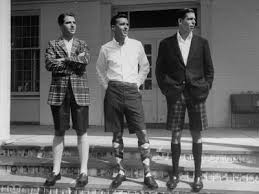
Of course, in the 1960s campuses in the US and around the world became hotbeds of political and cultural upheaval.  Students demanded more freedom, and they got it.  At many schools, in loco parentis rules were scrapped.  In many schools, indeed, core curricula were also scrapped in the name of freedom.  For instance, at my own beloved school, Binghamton University, students staged the “Bermuda Revolution.”  Not quite up to the office occupations and shotgun-wielding demands that rocked our neighbors at Columbia University or Cornell, but Bearcats managed to come together to protest strict student rules.  At Binghamton, the Bermuda Revolution brought students out to our Peace Quad clad in Bermuda shorts.  At the time, this was against the stern, traditional dress code that required shirts and ties for men and skirts and blouses for women.  As a result, the university changed those rules, giving students more freedom over their own lives.

Campus Revolutionaries, Binghamton Style

Campus Revolutionaries, Binghamton Style

One unintended consequence of this freedom is that more young people on college campuses have been exposed to sexual violence.  When students have more opportunity to drink alcohol and stay out late, more students find themselves in situations that lead to sexual assault.  As a result, the federal government has stepped in to investigate the way universities respond to charges of rape and sexual assault.

Professor Deneen argues that this tale of freedom gone awry can be seen as the history of liberalism in a nutshell.  As he puts it,

Longstanding local rules and cultures that governed behavior through education and cultivation of certain kinds of norms, manners, and morals, came to be regarded as an oppressive limitation upon the liberty of individuals. Those forms of control were lifted in the name of liberation, leading to regularized abuse of those liberties. In the name of redressing the injustices of those abuses, the federal government was seen as the only legitimate authority for redress and thereby exercised powers (ones that often require creative interpretations of federal law to reach down into private institutions) to re-regulate the liberated behaviors. However, now there is no longer a set of “norms” that seek to cultivate forms of self-rule, since this would constitute an unjust limitation of our freedom. Now there can only be punitive threats that occur after the fact. One cannot seek to limit the exercise of freedom before the fact (presumably by using at one’s disposal education in character and virtue); one can only punish after the fact when one body has harmed another body.

Conservative Christian colleges may have a unique set of challenges when dealing with the issue of sexual assault.  But Professor Deneen argues that sexual assault on other campuses has been a result of liberalism, not traditionalism.  Loose rules and permissive attitudes, Deneen notes, have led to an anything-goes culture.  The resulting “sexual anarchy” has left victims vulnerable to attack, with little recourse after the fact.


Was I Fair to Ken Ham?

Ken Ham complains that I was not precise enough.  I think I was.

Here’s the issue: On his blog today, leading young-earth creationist Ken Ham chided yours truly for saying “Ken Ham” when I really meant something like “conservative Christians.”  Ham was reacting to a recent post of mine in which I asked about Ham’s inordinate influence over some conservative Protestant colleges.  In that post, I noted Ham’s recent pronouncements about leading evangelical schools such as Calvin College and Bryan College.  I wondered if conservative schools had to bend over backwards to satisfy Christian critics like Ham.  Did schools like Bryan College have to toe the Ham line in order to maintain their support base among conservative evangelical Protestants?

Be More Precise, Please

Be More Precise, Please

Ham said I needed to be “more precise.”  Ham made the fair point that Science Guy Bill Nye often used the unfair rhetorical strategy of reducing all creationism to simply Ken Ham.  Of talking about creationism as if it were just a one-man crusade to bilk taxpayers and fool schoolchildren.

When it comes to Bill Nye’s language, I agree with Ham.  Bill Nye–with whom I generally agree–does not always seem to understand creationism.  In a recent post, for instance, I agreed with Mr. Ham that Bill Nye “Misse[d] the Boat on Creationism.”  I have also agreed with Mr. Ham that Mr. Nye’s use of phrases such as “Ham’s followers” is sneaky and unfair.

But in this case, I was not doing any such thing.  In my essay about Mr. Ham’s influence on conservative Christian colleges, I was talking precisely about the work of Mr. Ham and Answers In Genesis.  If I was incorrect about the influence of Ham in the recent controversy at Bryan College, I’ll apologize.  But I won’t apologize for mistakes I didn’t make.

Ham also notes that I expand my questions to include the state of conservative evangelical colleges and sexual assault.  As ILYBYGTH readers know, this is a question that has been bandied about here recently.  Those who are new to the blog will not be aware that we do not simply attack “fundamentalist” schools as rape havens.  Indeed, our recent string of commentary began with questions about a journalist’s unschooled presumptions about the nature of fundamentalism.  We do not assume that sexual assault is somehow unique to conservative religious colleges, but it does seem that there is a connection between the opaque authoritarian cultures of many conservative colleges and a culture that blames the victims of sexual assault.

The central point of interest to me, though, then and now, is whether and how Mr. Ham has come to wield such authority over conservative evangelical colleges.  In the case of Bryan College, at least, Ham’s worries led to changes at the school.  I can’t help but wonder if Ham’s say-so is of enormous influence at similar colleges and universities.  This is not a question about conservatism in general.  This is not a question about creationism in general.  This is a specific question about the influence of Mr. Ham’s Answers In Genesis ministry.


Required Reading: Wal-Mart and Fundamentalist U

A recent exposé in the New York Times attacked Wal-Mart’s funding of charter schools. Conservative pundits defended Wal-Mart. But neither side took notice of a more profound tradition of educational activism by the leaders of the mega-retailer.

Historian Bethany Moreton, in her not-so-recent-anymore book To Serve God and Wal-Mart, describes a different sort of educational work by the founders and leaders of Wal-Mart. In addition to funding charter schools, the Waltons and Wal-Mart developed a network of fundamentalist colleges and universities that may have had far more long-term impact on American society and culture than any charter school.

How did capitalism, Christianity, and college combine?

How did capitalism, Christianity, and college combine?

The 2009 book garnered plenty of rave reviews from academic historians. I won’t try to offer a full review here, but if you’re interested, you can check out this one in Church History, or this one in the American Historical Review. Instead, I’ll sketch a few of Moreton’s points about the links between the Wal-Mart fortune and a network of evangelical colleges in the Ozark region. As I move into the research for my next academic book, a twentieth-century history of conservative evangelical colleges and universities, it seems clearer and clearer to me that these colleges have played a huge role in determining some of the basic culture-war landscape of recent United States history.

As Moreton describes, Wal-Mart and Walton money helped support some schools that desperately needed financial help. Especially close to Wal-Mart were the University of the Ozarks, John Brown University, and Harding University. Each of these schools embraced a Wal-Mart friendly combination of evangelical Protestantism and free-marketeering. And each benefited from substantial financial support from the Wal-Mart empire. Indeed, as Moreton relates, University of the Ozarks students joked that they should just change the name of their school to “Wal-Mart U” (pg. 144).

In the mid-1980s, as Moreton tells the story, with help from the Waltons, the faculty of the University of Ozarks spelled out the connections between traditional evangelical higher education and an intellectual embrace of the values of capitalism. In 1983, Mrs. Walton launched a series of “Free Enterprise Symposia” to trumpet the achievements—both moral and economic—of capitalism (pg. 154). A few years later, the faculty agreed that a new student concentration in entrepreneurship would include traditional courses in Old and New Testament, government, and liberal-arts electives. But the focus would be on business and the moral triumph of capitalism over “socialism/marxism” (pg. 155).

Students at these capitalist/Christian colleges embodied a very different sort of student identity from those of the hippies and leftists dominating headlines at other schools. For instance, Moreton describes one example of student activism at the University of the Ozarks in the late 1970s. Students joined with downtown merchants to encourage Christmas shopping. Students combined patriotic displays of red, white, and blue with traditional Santas to connect Jesus, America, and consumerism (pg. 143).

Wal-Mart also supported student organizations such as Students In Free Enterprise (SIFE). These pro-Christian, pro-capitalism student groups claimed to enroll 40,000 college students at 150 campuses nationwide. Together, SIFE bragged that it reached 100,000,000 people with its message of Christian free enterprise. Moreton described one example of that sort of student outreach by the SIFE chapter at Harding. Harding students tromped about the region with a student in a giant pencil costume. They spoke at schools, club meetings, and any other venue that would have them. Their message? Following the work of pundit Leonard Read, the students explained that worldwide capitalism managed to produce goods and services for all without central guidance. The humble pencil, for example, took materials and know-how from all around the world, bringing profit and uplift to all involved. Yet the invisible hand of the market accomplished this incredibly complex task without oversight from bumbling and greedy governments (pp. 193-197).

Leonard Read's Free-Enterprise Tale

Leonard Read’s Free-Enterprise Tale

As Moreton tells it, Wal-Mart’s college activism did not limit itself to the borders of the United States. In the late 1980s, the Waltons funded scholarships for students from Central America to study at colleges such as Harding, John Brown, and the University of the Ozarks. The goal was to train managers and workers in the pro-business, pro-Christian approach to big-block retailing and worldwide supply chains (pp. 222-247).

Moreton rightly emphasizes the centrality of higher-educational activism by conservatives such as the Waltons. Throughout the twentieth century, as I argue in both my 1920s book and my upcoming book on educational conservatism more broadly, the nature and purpose of higher education remained a central focus of American conservatism. As Moreton’s study reveals, the brains behind the Wal-Mart phenomenon took an active part in sponsoring the sorts of college and university “experience” that they thought would promote proper, traditional Americanism.

If I were to quibble with this book, I’d note that Moreton sometimes seems unaware of the longer, broader connections between pro-business groups and educational institutions. She describes what she calls the “national context of business colonization of education generally” (pg. 151) in the 1970s, but she doesn’t adequately note that the roots of that colonization go back into the 1930s, at least. Groups such as the National Association of Manufacturers, for example, actively conducted the same sorts of pro-business educational outreach that Moreton describes. A quick consult with Jon Zimmerman’s Whose America? would have helped Moreton flesh out the longer history.

But this sort of historian’s quibble does not detract from the importance of Moreton’s book. As the recent New York Times attack makes clear, conservative activism in K-12 education will always get plenty of attention. But the more profound cultural work of changing higher education may have much bigger impact on the nature of America’s culture wars. Who teaches the many conservative teachers in K-12 schools, for instance? Where do Christian executives learn to combine Jesus with Milton Friedman? Moreton’s look at the connections between Wal-Mart and higher education help illuminate the core intellectual premises of Christian capitalism.


What Mormons Want Evangelicals to Learn in College

College is about fulfilling God’s mission.

That’s what Glenn Beck told the crowd at Liberty University the other day.  As Jonathan Merritt notes in Religious News Service, it is remarkable historically that Beck, a member of the Church of Jesus Christ of Latter-Day Saints—the Mormons—was invited to preach to the evangelical community of Liberty University.  Traditionally, as we saw in the presidential candidacy of LDS member Mitt Romney, evangelicals have looked askance at Mormonism.

As Merritt reports, Beck did not hide his LDS beliefs.  Rather, he flouted them, displaying Mormon relics such as Joseph Smith’s watch.

But that was not the only remarkable part of Beck’s talk.  Beck offered Liberty students a vision of the purpose of higher education.  You may have come here to help you get a job, Beck told the college crowd, but that’s not really what your education is for.  “You are at this university for a reason,” Beck reported.  What is God’s reason for higher education?  God did not say, Beck insisted, “I’m gonna send you down because you need to be . . . an accountant.”  [26:56]

The purpose of a university education, Beck told the audience, was not merely professional.  “You came to this university thinking, maybe,

I have to have an education to get a job.  You need this education from Liberty University because of your only true job.  The purpose that you were sent here for.  To magnify Him.  To bring Him to others.  To do what it is that you’re supposed to do.  To preserve liberty, the liberty of all mankind.

According to Beck, that sort of education is the true aim of education, whether students are LDS, Baptists, Mennonites, or whatever.  Life is a mission from God.  Higher education is simply further training for that mission.

Of course, Liberty University itself has a more ecumenical attitude toward the true purpose of education.  On Liberty’s website this morning, for instance, the casual reader is quickly reassured that Liberty certainly wants to train “Champions for Christ.”  But another of the four circulating mottos declares that Liberty “helps students and alumni find the right job or internship.”

Glenn Beck may be confident about the real purpose of Christian higher education.  But evangelical college students seem to want their college to walk both sides of the line.


Charles Murray, Extremist?

No one doubts that scholar Charles Murray is controversial.  Best known for his book The Bell Curve, Murray ruffled feathers by asserting that some sorts of people are naturally less intelligent than others.  Though he denies every accusation of racism, Murray’s reputation has caused the administration of Asuza Pacific University to abruptly cancel Murray’s upcoming campus talk.

Has Murray’s reputation as a racist caused him to be seen as too extreme even by administrators at conservative Christian colleges?  The leaders of APU, for example, worried that Murray’s talk might be hurtful to “our faculty and students of color.”

Scholar?  Or Racist?  Can He Be Both?

Scholar? Or Racist? Can He Be Both?

After all, Murray has been labeled as a “white nationalist” by the Southern Poverty Law Center.  Murray, the SPCL charged, uses

racist pseudoscience and misleading statistics to argue that social inequality is caused by the genetic inferiority of the black and Latino communities, women and the poor.

For his part, Murray accuses Asuza Pacific of pusillanimity and closed-mindedness.  In an open letter to APU’s students, Murray challenged them to think for themselves.  Murray invited students to explore his website and read some of his publications.  The more you know about me, Murray suggested, the harder it will be for you to take these accusations of extremism seriously.  “The task of the scholar,” Murray told APU students,

is to present a case for his or her position based on evidence and logic. Another task of the scholar is to do so in a way that invites everybody into the discussion rather than demonize those who disagree. Try to find anything under my name that is not written in that spirit. Try to find even a paragraph that is written in anger, takes a cheap shot, or attacks women, African Americans, Latinos, Asians, or anyone else.

There is no reason, Murray concludes, why students should not listen to talks by “earnest and nerdy old guys” like Murray.

This cancellation of Murray’s talk raises key questions.

First of all, does the goal of intellectual diversity on college campuses include the inclusion of unpopular conservative ideas?  We’ve seen recently examples of speakers protested against at Montana Tech for their support of creationism, pro-life student groups at Yale being refused fellowship in a social-justice club, and Steven Hayward’s lonely life as a token conservative campus intellectual at Colorado.

Second, what does it mean that this cancellation comes from a relatively “conservative” campus?  APU is one of the oldest evangelical universities in the country.  No one could safely accuse the leadership of APU of pandering to the traditional secularist campus leftism run amok.  Yet this school’s leadership saw fit to cancel Murray’s speaking appointment due to worries about Murray’s reputation.

Finally, who decides which ideas are extreme?  By any measure, Charles Murray’s work has been part of recent mainstream American conversations about race, class, and society.  His 2012 book, Coming Apart, for example, was prominently reviewed by such leading publications as the New York Times, Wall Street Journal, and the New York Review of Books.  It does not make sense to suggest that Murray has only some sort of fringe status as a scholar.  Yet in this case, even a conservative Christian school saw Murray as too controversial to speak on campus.


Conservative Politicians Need an Education

If you want to be President, go to college.  Eventually.

Wisconsin Governor Scott Walker has announced his intention to return to college to finish his bachelor’s degree.  The conservative Walker dropped out of Marquette University as a senior and never looked back.  Until now.

With presidential aspirations on the table, Governor Walker has decided to complete his undergraduate education.  He’ll use a program for working adults at the University of Wisconsin.

Makes us wonder: Would his opponents have used Walker’s incomplete college education against him?  Called him just another ignorant conservative?  As I’ve argued in the pages of the Chronicle of Higher Education and elsewhere, “ignorance” is one of the go-to accusations made against conservatives.

Doesn’t seem like good politics, with the vast majority of adults in a similar boat.  Only about one in five adults in the United States has a college degree.  Nevertheless, Governor Walker seems to think it’s not worth the risk.  These days, part of the resume for POTUS must include higher education.  But don’t tell that to G-Wash and Honest Abe.


Ken Ham Is My Guidance Counselor

Why does Ken Ham care where you go to college? Where you send your kids?   Because “college” is more than just a collection of classes and academics. For religious conservatives as for everybody else, “college” represents a formative experience. The ideas one will encounter, the personal connections one will make, and the changes in one’s outlook and worldview all make the college years some of the most transformative in our lives.

In recent years, Ham, America’s (and Australia’s) leading voice for young-earth creationism, has established himself as the arbiter of creationist orthodoxy in college attendance. And his word carries weight in the world of evangelical higher education.

Recently, for instance, Ham warned readers at Answers In Genesis about the dangers of attending Calvin College. Students at that storied Christian school, Ham explained, were “being influenced . . . to undermine the authority of Scripture in many ways.” When faculty engage in evolutionary research and teaching that might turn away from Ham’s strict attitudes about knowledge and creation, Ham warns, students will too often abandon their creationist faith.

As a precaution, Ham offers readers a list of schools that adhere to the young-earth creationism taught by Ham’s Answers In Genesis ministry. To be safe, Ham warns, parents and students ought to stick with schools that have proven their fidelity to these ideas.

Ham’s anxiety over the crumbling orthodoxy in Christian higher education is nothing new. As I argue in my 1920s book, many of today’s evangelical schools had their origins in the founding decade of American fundamentalism. Back in the 1920s, religious schools often faced a choice between fundamentalist orthodoxy and modernist adaptation. Most chose modernism. The University of Chicago, for example, founded as a Baptist beacon of learning, became the leading voice for theological modernism, employing such folks as Shailer Mathews and Shirley Jackson Case. In contrast, a few Christian schools, most famously Wheaton College, sided with the fundamentalist movement.

Leading fundamentalists in the 1920s also founded a spate of new schools to embody their theological and cultural conservatism. Perhaps most prominently, evangelist Bob Jones Sr. opened Bob Jones College (now Bob Jones University) in 1926. The goal of this school was to form the fundamentalist character of young people while educating them in the best traditions of arts and sciences. In order to reassure parents that the school would never slide toward theological modernism or cultural liberalism, Jones and his allies established a rock-ribbed charter. This charter hoped to guarantee the continuing orthodoxy of the school. The charter’s second paragraph outlined that orthodoxy:

The general nature and object of the corporation shall be to conduct an institution of learning for the general education of youth in the essentials of culture and in the arts and sciences, giving special emphasis to the Christian religion and the ethics revealed in the Holy Scriptures, combating all atheistic, agnostic, pagan and so-called scientific adulterations of the Gospel, unqualifiedly affirming and teaching the inspiration of the Bible (both Old and New Testaments); the creation of man by the direct act of God; the incarnation and virgin birth of our Lord and Saviour, Jesus Christ; His identification as the Son of God; His vicarious atonement for the sins of mankind by the shedding of His blood on the Cross; the resurrection of His body from the tomb; His power to save me from sin; the new birth through the regeneration by the Holy Spirit; and the gift of eternal life by the grace of God.

Perhaps most notably, the next line specified that this charter “shall never be amended, modified, altered, or changed as to the provisions hereinbefore set forth.” Also remarkable, according to a 1960 reminiscence by Bob Jones Sr., at its founding BJU decreed that every graduating senior would pledge to monitor the school’s continuing fundamentalism. “Should the policy and conduct of the University ever, in my lifetime, deviate, in the slightest particular, from the letter or spirit of this Creed,” seniors would promise,

I hereby pledge myself to exert all my influence to affect a change in conditions; failing which, I will resort to such legal measures as the courts may offer to the end that the institution may be kept true to the University Creed and the original intentions of the founder.

Most evangelical colleges established similar creeds and many promised never to amend them. Not many others, to my knowledge, required such strict supervision by their alumni.

These days, Ken Ham has taken over the role of orthodoxy’s gadfly. In addition to his warnings about waverings from his definition of creationism at Calvin College, Ham has warned that other evangelical schools might be threatening the faith of their students. And Ham’s warnings carry weight.

In one recent episode at Bryan College, for example, Ham’s public worries about faculty orthodoxy led the school’s leadership to instigate a new sort of creationist orthodoxy pledge for faculty. From now on, faculty must publicly avow their belief in a real, historic Adam and Eve. As I argued at the time, the fallout from Bryan College’s policy shift might lead to a shake-up of faculty. More directly relevant, the furor at Bryan seems to testify to Ham’s influence. Worried that creationist parents might not send their students and their tuition dollars, Bryan’s leaders acted to shore up their image as a home of young-earth creationist orthodoxy.

Also intriguing, I must ask again if the drive to protect their reputations as safe theological and cultural havens has led some conservative evangelical schools to cover up incidents of sexual assault. Of course, these are very serious allegations, and I do not ask these questions lightly. I am certainly not accusing Ken Ham or the leadership of these schools of condoning sexual assault. But the drive to present a public face as a uniquely safe environment for fundamentalist students certainly puts undue pressure on college leaders. It is not unfair to wonder if such pressure might lead schools to downplay any cases that might threaten those reputations.

Outside the world of conservative evangelical Protestantism, colleges spend an inordinate amount of time and treasure to attract students. Flashy dorm rooms, high-visibility sports programs, celebrity faculty, and lavish campus lifestyles all hope to convince families to send their kids and their money to certain schools. The pressure on recruiters is intense.

There is a similar pressure on evangelical colleges. Influential voices such as that of Ken Ham are able to exert outsized influence by warning creationist families toward or away from certain schools. Without Ham’s imprimatur, conservative schools may lose the loyalty of students and families.

 

Florida, Football, and Fundamentalism

Is football a religion? Do the high priests of college football act like the leaders of the nation’s most conservative fundamentalist colleges? In some ways, when it comes to responding to accusations of rape and sexual assault, the similarities seem creepily prominent.

News emerged today that the case of football star Jameis Winston at Florida State will undergo a new round of scrutiny. Back in December, Winston evaded charges about an alleged sexual assault. At the time, pundits accused FSU of coddling Winston because of Winston’s star power.

As we’ve seen in these pages, conservative evangelical Protestant colleges–“fundamentalist” schools–have weathered similar charges of stonewalling and covering up charges of sexual assault on their campus.

Are these cases similar? Does football function like fundamentalism? That is, does the culture of big-name, big-money football create an environment in which everything else takes a back seat to success on the gridiron? Where any questioning of the football team becomes similar to questioning basic tenets of orthodox religious belief?

Let’s take a look at some of the similarities and differences.

At least according to some accusers, fundamentalist schools actively target victims of sexual assault. Both men and women, students and administrators, are steeped in a “purity culture” that encourages all involved to see female victims as sexual temptresses. When accusations of rape emerge, victims are attacked by students and administrators. The threat of making such accusations intimidates many other victims into a scarred silence.

Similar hostility emerges with college football. The alleged victim of the FSU rape, for instance, eventually dropped out of school and moved out of town due to constant harassment and death threats.

Also, it seems both football and fundamentalism push college administrators to worry first about the school, and only secondly about the complaints of victims. With football, the stars must be protected. No one can win a Heisman Trophy or a national championship from a jail cell. And with fundamentalism, schools must protect their reputations as uniquely safe environments. Publicity about sexual assault would certainly threaten that reputation.

But there are also significant differences. First of all, non-fundamentalist schools are almost all subject to review by federal guidelines. In the case of FSU, for example, the case has come back into the headlines because of accusations that the FSU administration might have violated provisions of Title IX in its handling of the case. Most fundamentalist schools refuse all federal funding, so they can operate without such oversight or federal review.

More profoundly, cases at fundamentalist schools are about more than just administrative cover-ups. Some pundits insist that the culture at fundamentalist schools operates as a hyper-charged version of broader cultures that blame women victims. More than at pluralist public schools such as FSU, critics allege, fundamentalist schools promote both sexual assault and victim-blaming by insisting on a “purity culture” standard. Women involved in sex of any kind often find themselves accused of instigating sinful acts.

Victory we have heard on high

Victory we have heard on high

There’s no doubt that big-time college sports look like religions, in lots of ways. They have weekly rituals, with ceremonial outfits and traditional musical accompaniment. They have high priests and acolytes who huddle to make important decisions. And, at least in the eyes of many fans and players, they involve the community in a staged fight of the powers of good versus the powers of evil.

But does this quasi-religious adoration of college sports bleed over into the treatment of accusations of rape as well?


Conservatives Blast the “Myth” of Rape Culture

Why do some conservative thinkers insist that anti-rape-culture activism is a fraud? That “rape culture” itself is a myth?

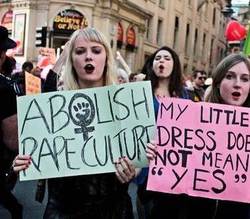
As we’ve seen in these pages, talk about rape culture is often tied to the atmosphere of colleges and universities. And it is understandably an incredibly sensitive subject. Even asking about the nature of rape culture can be seen as truckling to rapists and those who hope to explain rape away.

Full disclosure: I am one of those who thinks that denying this problem is part of the problem. I agree that colleges and universities need actively to confront cultures that encourage sexual assault. For too long, college administrators have winked at the “boys will be boys” attitudes that lie at the heart of rape culture. In these pages, I have asked whether this is worse at conservative Christian colleges. I have wondered if non-denominational Christian schools, “fundamentalist” schools such as Bob Jones University, Patrick Henry College, and Pensacola Christian College have a harder or easier time dealing with these issues. In those cases, I was accused of apologizing for sexual assault myself.

And watch: I won’t be surprised if I am accused of supporting rape culture for writing these words as well.

But I’m going to do it anyway. Because there’s a new question that stumps me. Why do some conservative intellectuals attack the very notion of rape culture? What is “conservative” about dismissing the existence of rape culture on college campuses?

Minding the Campus Blasts Rape-Culture Activism

Minding the Campus Blasts Rape-Culture Activism

This past week, we’ve seen Caroline Kitchens of the American Enterprise Institute denouncing the “hysteria” over rape culture in the pages of Time Magazine. Kitchens asserted that there is no rape culture. There is no culture, that is, in which rape is apologized for and excused. America as a whole loathes rape and despises rapists, Kitchens points out. “Rape culture” only exists in the imaginations of over privileged college students and their tame faculty. Colleges such as Boston University and Wellesley ban pop songs and harmless statues as an overblown response to such rape-culture myths, Kitchens writes.

Kitchens claims the support of the Rape, Abuse, & Incest National Network (RAINN). She cites a recent RAINN letter to a White House Task Force. In order to help victims of sexual assault on college campuses, this RAINN letter asserts, administrators should understand that these are the acts of criminal individuals, not the result of a nebulous cultural trend.

It is rape-culture stereotypes themselves that absolve abusers of responsibility, Kitchens argues. “By blaming so-called rape culture,” she concludes, “we implicate all men in a social atrocity, trivialize the experiences of survivors, and deflect blame from the rapists truly responsible for sexual violence.”

Kitchens is not alone. In the pages of the conservative higher-ed watchdog Minding the Campus, KC Johnson has agreed recently that “rape culture” is a “delusion,” the product of overheated leftist imaginations. Johnson, a high-profile historian from Brooklyn College, worries that campuses from Dartmouth to Occidental to Duke suffer from an overabundance of intellectual cowardice and groupthink. “Fawning” media coverage has allowed for “transparently absurd allegations,” Johnson writes. Plus, harping on “rape culture,” Johnson argues, allows “activists to shift the narrative away from uncomfortable questions about due process and false accusations against innocent male students, and toward a cultural critique in which the facts of specific cases can be deemed irrelevant.” Finally, the blunt instrument of “rape-culture” accusations provides activists with “a weapon to advance a particular type of gender-based agenda.”

Such claims are intensely controversial. But before we examine the legitimacy of these arguments, we need to ask a more basic question: Why do conservative intellectuals make them? Now, I understand Johnson is no conservative himself. But it is telling that conservative organizations such as the American Enterprise Institute and Minding the Campus are the ones hosting these anti-rape-culture accusations.

Is there something “conservative” about disputing the existence of rape culture? Is “rape culture” a leftist ploy to assert (more) control over college campuses? To tighten the screws of the academic thought police? Or is something more profound at work? Do these conservative voices dispute the existence of rape culture in order to perpetuate traditional gender roles?