Stomp on Jesus at College

Conservative thinkers and activists have long worried that the faith of young people would be threatened by the dangerous skepticism they learned in college.

A recent flap at Florida Atlantic University demonstrates the continuing worry over the anti-faith teaching on offer in American higher education.

In this story, student Ryan Rotela protested when instructor Deandre Poole told students to write the word “Jesus” on a piece of paper, then stomp on it.  According to reports, Rotela claimed to have been suspended from class for his unwillingness to complete the assignment.  The university later apologized.

The flurry of interest in this story among conservatives tells us something about their attitudes toward higher education.

Paul Kengor, for example, executive director of the Center for Vision and Values at Grove City College, told Fox News’ Todd Starnes this sort of Jesus-bashing was typical of today’s higher education.  This sort of lesson “reflects the rising confidence and aggression of the new secularists and atheists, especially at our sick and surreal modern universities,” Kengor said.

This anxiety over the goings-on at “modern” universities has a long lineage.

In 1922, for example, William Jennings Bryan warned that even among rich and powerful families, college threatened students’ faith.  One of Bryan’s acquaintances, a US Congressman, told Bryan that his daughter had returned from college only to inform him that “nobody believed in the Bible stories now.”  Nor was this an isolated case, Bryan argued.  Other Congressmen and prominent clergy had shared similar stories.  Children had gone off to school, only to return with a set of values and ideas abhorrent to their parents.    [See William Jennings Bryan, In His Image (New York: Fleming H. Revell, 1922), 120.]

Patriotic conservative activists in the 1930s shared these worries about the nature of “modern” schools.  In 1935, for instance, New York Congressman Hamilton Fish denounced the socialism and communism that had corrupted leading schools such as Columbia, New York University, City College of New York, the University of Chicago, Wisconsin, Penn, and North Carolina.  Such schools, Fish charged, had become “honeycombed with Socialists, near Communists and Communists.”

Conservatives have long worried about what goes on once America’s children go off to college.  What will students be asked to do at college?  What will they be forced to learn?  Will they be punished if they refuse to stomp on Jesus?

**UPDATES:  Juan Williams has offered a defense of the Jesus-stomp lesson at Fox News.  And the Texas Freedom Network Insider has reported that the instructor of the controversial lesson is a leader in his Biblical-Christian church, Lighthouse Worship Center Church of God in Christ.  Does that matter?

Colorado’s Conservative: Conservatives Weigh In

Was the recent hiring of conservative Steven Hayward by the University of Colorado a good thing for conservatism?

Minding the Campus offers a helpful collection of opinions from a variety of higher-education thinkers about the meanings of CU’s move.

As we might expect, the collection demonstrates a wide variety of conclusions.  Many of the contributors, though, condemn the move as an example of illiberal liberalism.  That is, hiring one exemplary conservative simply exacerbates the problem.  Higher education, some argue, has already degraded into a mere culture-war shouting match.  This wrong-headed move only adds one more shouter to the arena.


Colorado Finds Its Conservative

What would it take to foster true intellectual diversity at a public university?

Some have argued for affirmative action.  The University of Colorado decided to bring in a Visiting Scholar in Conservative Thought and Policy.

For the first year of the three-year program, CU hired Steven Hayward.

Hayward has served as the F. K. Weyerhaeuser Fellow at the American Enterprise Institute.  He is currently Thomas W. Smith distinguished fellow at Ashbrook Center at Ashland University in Ohio.

Hayward will teach classes in environmental conservatism and constitutional law.  As Hayward told ColoradoDaily.com, “I’m not going to pick any fights or start any gratuitous controversies.”

But Hayward’s one-year position has already raised some controversies.  The program was pressed on CU from outside political pressure.  Some Coloradans apparently felt the university unfairly tipped to the left.  They originally wanted to fund a full chair in conservative thought, but the rigmarole of politics reduced the line to three one-year visiting positions.

How was Hayward selected?  Two other finalists visited the Boulder campus, Linda Chavez of the Center for Equal Opportunity and Fox News, and Ron Haskins of the Brookings Institution.

As far as I can tell, this selection process seemed to reinforce the negative stereotype of affirmative action.  Unlike other academics hired to teach political science classes, Hayward does not have a PhD in political science.  His degree comes from Claremont Graduate University in the field of American Studies.  Chavez does not seem to hold a PhD in any field, and Haskins’ PhD was in Developmental Psychology.

The university itself declared that Hayward “brings an impressive breadth of knowledge to this position.”

I don’t doubt it.  But the fact remains that this entire process has encouraged a very different hiring process than usual, and a very different outcome.  The hiring committee itself included five faculty members and five community members, including conservative radio host Mike Rosen.

Will this process encourage CU to embrace Hayward—and future visiting conservative scholars—as part of their intellectual community?  It doesn’t look that way.

Given Hayward’s–and Chavez’s, and Haskins’–very different qualifications, and the different process used to bring them to campus, I wonder if this position will end up confirming the worst fears of some Colorado conservatives.  As John Andrews told the Colorado Observer recently, “this almost plays into the hands of the overwhelmingly left-liberal domination of CU, because it treats conservative thought as sort of an oddity, a zoo exhibit, or the focus of an anthropological field trip.”

Despite Hayward’s and the university’s assurances to the contrary, this experiment seems certain to degenerate into the most fruitless sort of culture-war grandstanding.


Liberty and Intellectual Diversity

Can the faculty at a fundamentalist university embody a true intellectual diversity?  In some senses, of course they can.  Depending on the school, faculty at conservative Protestant schools may disagree vehemently on important issues such as the age of the earth, the best tax system, or the proper way to structure an election.  But fundamentalist schools still face a narrower list of potential faculty members than do less strictly defined colleges.  At many conservative schools, prospective faculty members must agree to an institutional creed.  This has the desired effect of cutting out a wide range of dissenting intellectual perspectives.

Journalist Michael McDonald brought up these issues of perennial interest this morning in a Bloomberg.com article about Jerry Falwell’s Liberty University.

McDonald’s main interest was in the financial aspect and prospect of Liberty’s enormous and lucrative on-line branch.  As McDonald notes, the deeply conservative evangelical Protestant school is now the largest private non-profit university in the country.  For a school dedicated to a sternly fundamentalist theology, that is a remarkable achievement.

In his research for the article, Mr. McDonald asked me if I thought Liberty’s success could mean that it will become a model for mainstream universities.  As McDonald quoted in his piece,

“This dream of turning it into Notre Dame won’t work for Liberty,” said Adam Laats, an assistant professor in education and history at Binghamton University in Binghamton, New York. “Liberty University faculty will always be more constrained in the breadth of intellectual diversity they can welcome.”

It’s true: most colleges and universities do not require faculty to sign a strict creed.  If Notre Dame could only hire Catholics, or if my alma mater Northwestern University could only hire Methodists, they might be in a similar situation.

But Liberty’s potential faculty will have to agree with the school’s strict evangelical Protestantism, and this will always set it apart from more pluralistic colleges.

Of course, I’m not the first person to note this, by any means.  Leading evangelical historians such as Mark Noll and George Marsden have long argued that evangelical institutions differ in important ways from pluralist ones, due largely to this tradition of faculty and institutional creeds.

But already I have heard some intelligent objections.  Dan Richardson contacted me to object to my premise in the Bloomberg article.  As Mr. Richardson wrote,

“I read your comments with interest on Bloomberg concerning Liberty University. As a graduate myself of the Virginia Public University system, I found essentially zero tolerance or professors willing to even consider or give any credence/discussion to any philosophy other than relativistic, humanistic,  at best agnostic culture on campus today. There are countless examples of ‘conservative’ speakers, hassled, disinvited, shouted down at many public universities. If you truly care about the breadth of intellectual diversity, start with thyself.”

Richardson makes an important point.  Simply because the faculty of fundamentalist colleges lack some of the inherent intellectual diversity of pluralist schools, this does not mean that pluralist schools do a perfect job of encouraging true diversity themselves.

As historian Jonathan Zimmerman has asked, what would it take to get real intellectual diversity on pluralist campuses?  Do we need an affirmative action program for conservative intellectual faculty?

Sometimes the creeds in place at pluralist universities are implicit.  Sometimes they are more aggressively spelled out.  The recent flap over the funding of a Christian student group at Tufts University, for example, demonstrates the way pluralist universities’ dedication to pluralism often has confounding and unpredictable results.

Nevertheless, I stand by my statement in Mr. McDonald’s article.  Mainstream universities will have different challenges from Liberty University when it comes to welcoming a variety of intellectual perspectives.  Liberty’s dramatic financial success with on-line education does not change that.

Creation Colleges

Where did you go to school?  Did you learn about evolution?  WHAT did you learn about it?

Non-creationists like me are often dumbfounded by the notion that so many educated Americans believe in a young human species.  But a quick look at the large number of young-earth-creationist colleges shows us how easy it is to earn a college degree without leaving the intellectual boundaries of young-earth creationism.

As recent Gallup polls consistently demonstrate, almost half of American adults agree that humanity was formed in “pretty much its present form” within the past 10,000 years or so.  And of those young-earth creationist adults, the same proportion went to college as non-creationist adults.  That is, believers in a newish human species are just as likely to have a college degree as believers in a long history for the species.

As always, it’s vitally important for outsiders like me to recognize the many different sorts of creationist belief.  Young-earth creationism, the notion that the earth has only been in existence for about as long as is described in the Bible’s Book of Genesis, is only one version.  Intelligent design theorists, like those of the Discovery Institute, or evolutionary creationists, like those of Biologos, also oppose mainstream evolutionary science, but without insisting on a young earth.

And, to be fair, this Gallup question only asks about the age of the human species, not the age of the earth.

Nevertheless, the notion that such large percentages of educated Americans agree that humanity is so new, and so un-evolved, always makes me wonder what kind of education Americans are receiving.

The leading young-earth creationist organization Answers in Genesis provides a handy guide.  To be fair, the map of creationist colleges provided by AiG makes no claims to be an exhaustive guide to all creationist institutions of higher education.  Rather, this map only includes those schools whose presidents have signed AiG’s statement of faith.

A quick glance at the map shows how easy it will be for most college-bound young people to find a college that affirms young-earth beliefs.  Even in my neighborhood of sunny Binghamton, NY, two schools made the AiG map, Davis College and Baptist Bible College.

The sponsoring schools include such fundamentalist heavy-weights as Bob Jones UniversityLiberty University, and Pensacola Christian Colleges.  Other sponsors include smaller schools such as Jackson Hole Bible College and Ohio Christian University.

For those of us trying to understand creationism from the outside, this thriving culture of creationist higher education provides a crucial clue.  We can’t know what all the students, or even all the professors at these schools believe, but the schools themselves devote themselves to promulgating the notion of a young human earth and divine creation by fiat, as described in Genesis.

Persecution and the Conservative Academic

Do conservative academics suffer persecution?

NYU professor of history and education Jonathan Zimmerman recently called for affirmative action for conservative college professors, even though, Zimmerman insisted, such professors hadn’t suffered from historic discrimination.

That hit a nerve.

Writing in the higher-education blog Minding the Campus, a publication of the conservative Manhattan Institute, Ronald Radosh called foul.

Radosh took exception to Zimmerman’s insistence that liberal professors like himself were not the “wild-eyed Marxists” many conservative pundits had accused them of being.

Radosh disagreed.  “NYU,” Radosh wrote, “is most egregiously guilty of precisely such a bias. Their own history department is dominated by precisely those types, and some of the institutes and centers they have established have gone out of their way to make that crystal clear.”

Radosh complained that his career had suffered for purely political reasons.  At George Washington University, for instance, Radosh claimed that he had been subjected to questions mainly “about my politics, and not about my approach to history or how it should be taught.”  At another school, Radosh said he was buffeted in a job interview with a series of “hostile questions” about his views on Cold-War spies Ethel and Julius Rosenberg.

In the end, Radosh concluded that most history professors discriminate actively and self-consciously against conservative academics.  As Radosh wrote,

“The reason such professors will not hire conservatives is precisely because they do not want ‘other right-leading students’ to ‘follow them, into the academic profession,’ as Prof. Zimmerman hopes they will once conservative professors are hired. Does he really think people like Marilyn Young and Linda Gordon at NYU want anyone to challenge the ideological hegemony they now hold over molding students’ minds?”

Other sorts of conservative academics have long claimed to suffer from similar persecution.

The case of Teresa Wagner, for instance, still bubbles along.  Wagner had applied for jobs at the University of Iowa’s law school.  She was one of five finalists, but was passed over for the most desirable tenure-track job.  Was it due to prejudice against Wagner’s loud-and-proud conservative activism?  Wagner had made no secret of her pro-life and traditional-marriage stances.

One unique element of Wagner’s case was the existence of a smoking gun.  Unlike most hiring-discrimination cases, Wagner was able to produce a document that seemed to make her case.  Associate Dean John Carlson had written in an internal email, “Frankly, one thing that worries me is that some people may be opposed to Teresa serving in any role in part at least because they so despise her politics (and especially her activism about it). I hate to think that is the case, and I don’t actually think that, but I’m worried that I may be missing something.”

That email made Wagner’s case complicated.  A group of jurors agreed that Wagner had been treated unfairly.

These conservative claims of academic persecution are nothing new.

Creationist Jerry Bergman collected cases of such discrimination in his 1984 book The Criterion.  Bergman, who claimed to have been denied tenure at Bowling Green State University in the early 1980s due to his creationist beliefs, described the stories of academics such as Clifford Burdick.  Burdick was allegedly refused his PhD at the University of Arizona in 1960 for including a consideration of divine creation as an explanation for discrepancies in the fossil record.  Bergman argued that such attitudes had no place in a university setting.  Firing a creationist for speaking to students about his or her beliefs, Bergman argued, would be like “if a black were fired on the suspicion that he had ‘talked to students about being black,’ or a woman being fired for having ‘talked to students about women’s issues.’”

Even further back, anti-evolution leader T. T. Martin complained in 1923 that the universities had been taken over.  “We sent our young men to the great German universities,” Martin lamented, “and, when they came back, saturated with Evolution, we made them Presidents and head-professors of our colleges and great universities.”

Of course, the academic politics of evolution are much different than the politics of communism, which are different from the politics of abortion.  I think it is safe to say that a mainstream school will be more open about its discrimination against a creationist than against a neo-conservative anti-communist or a traditional-marriage supporting legal scholar.

However, Professor Zimmerman’s claim that conservatives have not been the subject of historic discrimination still rankles among conservative academics of various backgrounds.  One of the most closely treasured beliefs among conservative intellectuals, after all, is that American universities have been largely captured by a totalitarian and essentially anti-liberal left.


Do Diverse Campuses Need More Christ?

Jonathan Zimmerman recently called for an affirmative action program for conservative college professors.  But what about for conservative students?  Do diverse campuses need to welcome groups with conservative, discriminatory policies?

A Christianity Today piece by Greg Jao, National Field Director for Intervarsity Christian Fellowship, argues that true diversity, true learning, will only take place once universities welcome a “principled pluralism” to their campuses.  This means welcoming not only groups from a variety of racial or ethnic backgrounds, but also Christian groups like Intervarsity.  Campuses must remain, in Jao’s words, “communities with conflicting narratives and ideologies.”

Jao’s argument, like the broader conflict over the presence of conservative religious groups on college campuses, highlights the tension between tolerance and pluralism, between inclusiveness and exclusiveness.

Jao’s comments come largely in response to a continuing controversy over Intervarsity’s presence at Tufts University.

A couple of months ago, Tufts decided to “de-recognize” Intervarsity.  That meant the group would no longer receive university funding.  It could no longer use the Tufts name.  The reason for the decision was Intervarsity’s restriction on its leadership.  Only those who subscribe to the group’s Bible-based Christian theology could become leaders.  University policy at Tufts, as at many schools, requires student groups to welcome all comers, regardless of race, sexuality, religion, or other factors.

As the controversy wends its way through a cycle of appeals and counterappeals, activists on both sides have framed their position as the best chance for schools to achieve a healthily diverse campus.

One student argued in the pages of Tufts’ student newspaper that the Intervarsity group must be de-funded in order to combat bigotry.  As this student argued in September,

“Since when was freedom of religion a ‘Get Out of Jail Free’ card that excused bigotry? Since when was an organization like IVCF given the permission to speak for evangelical Christians such as myself? . . .  it is long past time to tolerate – that word the intolerant hate so much – self-righteous pontificating that says: ‘Yes, we will use your buildings and your money, and we will not treat you as an equal. Because we are religious.’”

Greg Jao’s more recent argument turns this on its head.  Jao insists, “A truly inclusive university should reject anti-discrimination policies which flatten differences and reduce true diversity.”

So which is it?  Must universities tolerate groups that discriminate?  Or, since many groups discriminate—such as an all-male a capella group or an all-engineering student fraternity—are only certain types of discrimination acceptable?  If so, who makes such decisions and on what grounds?

Zimmerman: Give Us Affirmative Action for Conservative Professors

Jonathan Zimmerman of NYU has offered a bold proposal: Let’s have affirmative action for hiring conservative college professors.  Writing in the Christian Science Monitor, Zimmerman suggested such a program would go a long way to increasing the intellectual diversity of college life.  Zimmerman argues as a liberal Democrat, but one interested in promoting true liberal diversity.

As Zimmerman points out, one US Supreme Court justice’s argument in favor of traditional racial affirmative action,

“included the observations of a Princeton graduate student, who stated that ‘people do not learn very much when they are surrounded only by the likes of themselves.’

“That’s exactly right. And it’s also why we need more right-leaning professors, who would accelerate the intellectual variation that Bakke imagined. Race-based affirmative action has made our universities much more interesting and truly educational places, adding a range of voices and experiences that hadn’t been heard before. Hiring more conservative faculty would do the same thing.” 

Zimmerman makes a compelling argument.  I’m all for authentic intellectual diversity, especially on a university campus.

But there are a couple of points that must be added.  First of all, as we’ve noted, at least one prominent public university has initiated a program to bring high-profile conservatives to its famously liberal campus.  As critics have pointed out, that program has some of the worst elements of tokenism and political engineering of intellectual life.

More important, the heavy tilt toward political liberalism Zimmerman denounces may not be so heavy at non-elite campuses.  Zimmerman notes the profound bias in favor of Democratic election donations among faculty at Columbia, Brown, and Wisconsin.  He notes that none of his NYU colleagues seem to tilt Republican.  But what about at the schools that actually teach most of the country’s college students?  David Long’s provocative ethnography of creationism at a large public university suggests that a substantial proportion of faculty at those schools embrace deeply conservative religious values.

So let’s get a little more specific: What we really need is something beyond a few token conservative faculty.  Just as with racial affirmative action, we need to create intellectual and institutional spaces where conservative scholars can thrive, not just survive.  And we need this specifically at the nation’s top schools, places that can set the trend for other colleges and universities.  Like Professor Zimmerman, I don’t speak as a partisan.  I’m no conservative.  But I do agree that a truly diverse environment is a compelling goal of higher education.  In order to learn about the world, students must be surrounded with people who come from different backgrounds, with different ideas.  Hiring faculty with a wide diversity of ideologies would promote that goal.

The King’s College and Christian Higher Education

Can a firmly conservative Christian college save America?  Or should it focus on saving souls?  This is a question conservative evangelicals have been asking themselves for almost a century.  As I detail in my 1920s book, the first generation of Protestant fundamentalists hoped a new clutch of truly Christian colleges could heal America’s benighted culture.

The recent dust-up at The King’s College over the personal life of celebrity president Dinesh D’Souza illustrates this inevitable tension.

According to a recent article by Melissa Steffan in Christianity Today, The King’s College has moved itself away from the hurly-burly of D’Souza’s brand of cultural politics.  When asked if the college would keep D’Souza’s trademark political obstreperousness while finding new leadership, interim president Andy Mills replied, “[TKC] is a Christian college.  Period.”

According to Steffan, TKC has changed its self-description:

“In the presidential search that led to D’Souza’s hiring, TKC published a list of ‘”true ideas” that distinguish King’s within … higher education,’ including ‘biblical competition’ and the right to ‘seek prosperity and risk bankruptcy.’ TKC no longer lists these on its website.”

Even more intriguing, Steffan points to similar changes at similar schools:

“Gene Edward Veith, provost at Patrick Henry College, says his school’s conservatism has become ‘more sophisticated’ since its founding in 1998. What he described as a ‘meltdown’ in conflict between faculty and administrators six years ago ‘was mainly a matter of the institution maturing and going through some disillusionment struggles,’ he said. ‘I see that happening across the board. Christian activists who get involved with politics soon find that things are not so simple as getting Christians elected.’”

What direction for Patrick Henry and The King’s College?  Without their distinguishing dedication to ferociously conservative politics, do they become quiescent Christian colleges?  In the case of TKC, the question is whether they return to a long previous life avoiding headlines instead of chasing them.

Marxists and Creationists: Peas in a Pod?

Are Marxists and Creationists sharing carrel space at American universities?

A query by Kurt Newman at the ever-interesting US Intellectual History blog generated a lively discussion of the question: How many Marxist historians are out there?

Reading the discussions led me to wonder a different question: Are academic Marxists and creationists flip sides of the same coin?

Darwin. Image Source: Humanist Life

Full disclosure: I’ve got thoroughly Marxist intellectual roots myself.  As an undergraduate, I found Marxism and its derivatives intensely interesting; those years remain profoundly influential in my thinking.  On the other hand, I’ve never been a creationist, though recently I’ve been accused of being one.  My intellectual world in my formative years had absolutely nothing to do with religion, the Bible, or creationism.

I’m not trying to promote one or the other, but the similarities between the two traditions jumped out at me.  Allow me to list a few of the obvious parallels:

  • Both Marxists and creationists remain surprisingly common on mainstream college campuses.  As David Long discovered when he began his ethnographic study of creationism on secular campuses, creationists are far more common than one might think.  The same result for Marxists becomes starkly clear when we read the responses to Newman’s query at USIH.
  • Both Marxists and creationists could make some claim to being persecuted.  Certainly, many mainstream scientists would not want to have creationist faculty in their departments.  And, as Newman points out in one of his comments, Marxist professors have a long history of institutional controversy.  Newman astutely mentioned in one aside, “(This is to say nothing of the apoplexy that would be induced in large swaths of the political class upon learning that any state-funded school was offering Marxist classes under the guise of US history, which might also say something about the stakes of doing Marxist research in 2012).”
  • Both Marxists and creationists could be accused of clinging obdurately to an intellectual tradition whose heyday has come and gone.
  • Both Marxist and creationist intellectuals and academics have always been famously and ferociously sectarian.  Gramsci-ites might not speak with Trotskyites, who might look down their noses at Bernsteinians, etc.  The same is true with today’s creationist galaxy of “evolutionary creationism,” “young-earth,” pre-Adamics, post-Adamics, day-agers, gap theorists, etc. etc. etc.

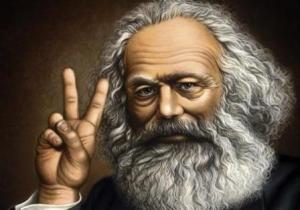
Marx. Image Source: Georgia Spears

Of course, some obvious differences jump out at us.  Here are a couple:

  • Marxism is profoundly secular, though some have called it a religion.  Creationism is profoundly religious, though some have insisted on its secular merits.
  • The two groups have enormous sociological differences.  Creationism does not thrive at elite schools, while Marxism seems to. The background of each group of scholars likely differs immensely.
  • Marxism seems to be losing influence outside the academy, while creationism has been steadily gaining strength in politics and popular culture for the past century.

So, are these flip sides of the same phenomenon?  Intellectuals who pride themselves on their superior insight into the workings of humanity and history?  Folks who take encouragement from the cultural slings and arrows directed their way?

Just askin…