Hello, Wheaton!

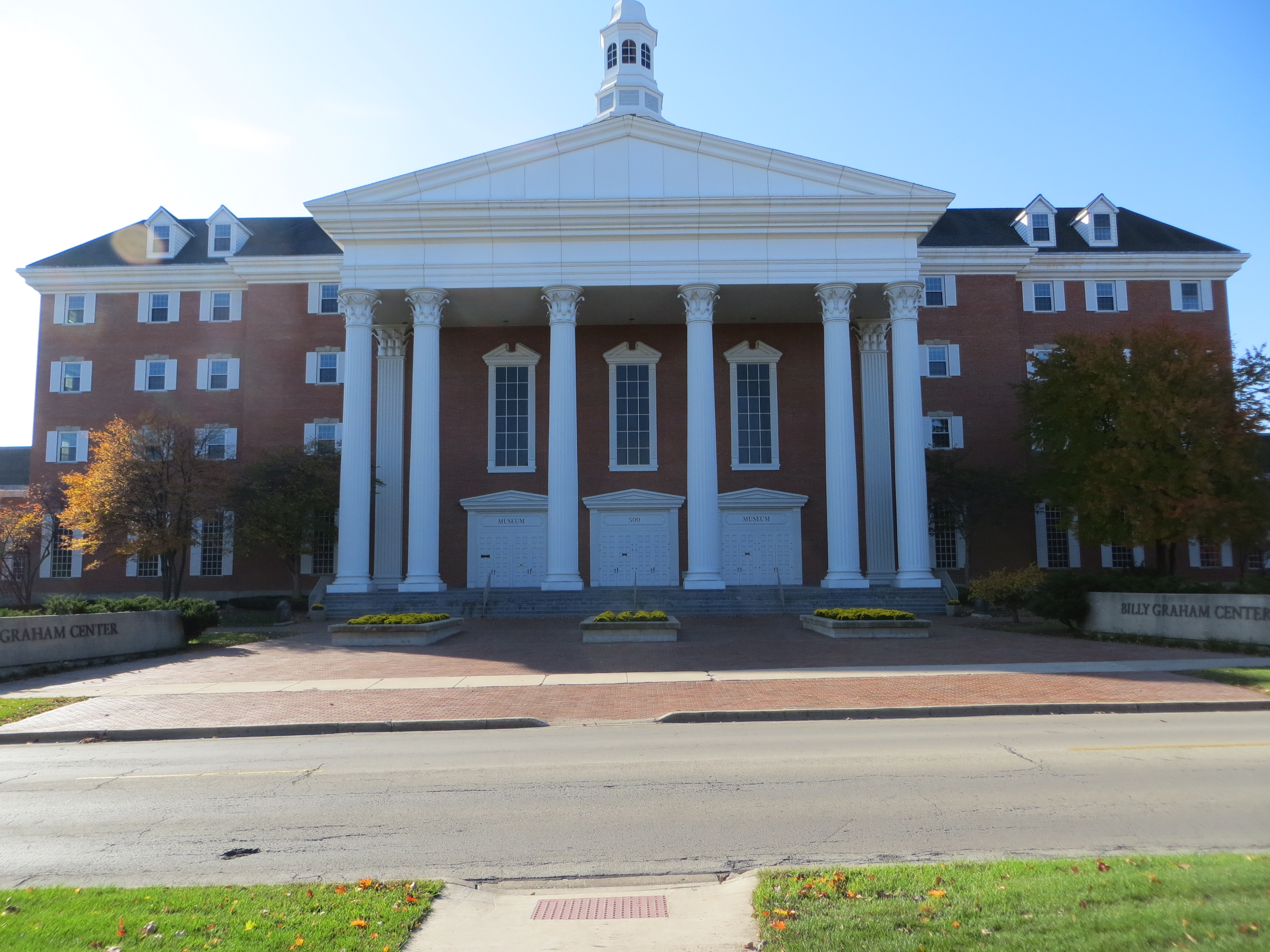
Rolled into sunny Wheaton, Illinois last night to start my research at the fabled Billy Graham Center Archives. Located on the campus of Wheaton College, this archive is like nerd Disneyland. The collections are beautifully organized and intimidatingly expansive.

I'll be here all week...

I’ll be here all week…

What am I doing here? It’s the natural first stop for anyone interested in the history of conservative evangelical colleges. The collections offer two great things. First, Wheaton College itself has been a leading fundamentalist/ evangelical college since the 1920s. It enjoys a unique and uniquely influential history as a leader in the network of conservative colleges. As leading historian Joel Carpenter put it, in the 1920s

There was only one college of thoroughly fundamentalist pedigree . . . that was neither just half-evolved from Bible school origins nor still waiting for the ink to dry on its charter.

That school, of course, was Wheaton. For my current research, I’ll need to dive deep into the history of Wheaton itself. What was life like for students in different decades? For faculty? I also have some specific questions about interesting episodes. For instance, why did Wheaton kick out its fundamentalist president in 1939? Why did the board of trustees add in 1961 a line to the statement of faith that Adam and Eve were real, historical people? What did Wheaton’s version of the “free-speech” movement look like in 1964?

But these archives offer more than just a look at the history of Wheaton itself. Since the school was such an influential leader in the field of evangelical higher ed, its leaders kept in constant contact with other school leaders. In their correspondence, I’ll be digging to discover the issues that motivated school leaders across the entire network of conservative evangelical colleges. This will include prosaic issues such as admissions and accreditation, but also uniquely evangelical issues such as determining which schools remained orthodox and which threatened to slide into liberalism and modernism.

Best of all, decades of work by the archivists at the Billy Graham Center has created an invaluable collection of oral history interviews. Some of these are available online and I’ve been reading them during the past weeks. But many more are only here at Wheaton. In these interviews, alumni of Wheaton and the rest of the conservative evangelical college network remember what life was like at these schools in the 1920s, 1930s, 1940s, and more recently. Why did they decide to go to Wheaton? Or the Moody Bible Institute? Or John Brown College? Or a ‘secular’ public university? Many of these interview subjects offer unique perspectives on what college life was like.

With such a vast collection, I need to pace myself. There’s no way to take it all in during one short visit. Instead, I’ll see what I can discover and make plans to come back soon.


Evangelicals and Homosexuality on the College Campus

Maybe President Lindsay feels better knowing that only high pressure can create diamonds. Because the leader of evangelical Gordon College is feeling intense pressure from two sides right now. On one hand, the school’s accrediting agency has threatened to take away its accreditation if Gordon does not revise its policy on homosexuality. On the other, the school’s conservative supporters insist the policy must stay in place. If history is any guide, it appears one group might make the crucial difference in this case.
Are all welcome?  MUST all be welcome?

Are all welcome? MUST all be welcome?

This Gordon-ian knot is one that all conservative evangelical colleges have tried to pick apart. Schools such as these are in a pickle: they need to remain intellectually respectable and financially viable, yet a decision either way threatens both intellectual consistency and the bottom line.

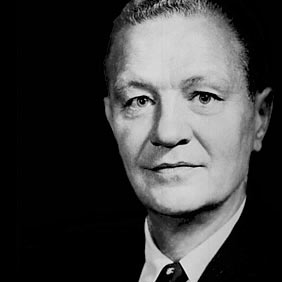
As I’m finding as I research my new book, similar schools have had a difficult time walking this line. In the 1930s, for example, Wheaton College leaders moved fast to bring Wheaton up to accreditors’ standards. As historian Michael Hamilton argued, the president at the time, Oliver Buswell, viewed accreditation as more than just a piece of paper. To Buswell, accreditation was the “one of the best ways to earn intellectual respect for fundamentalist Christianity.”

But college leaders such as Buswell were also under intense pressure to maintain both the appearance and the reality of theological steadfastness. Leaders needed to maintain the confidence of the evangelical community that their schools were not slipping into secularism. In 1929, for instance, Buswell withdrew from publication a controversial book he had written. Why? As he explained to a colleague, above all Buswell felt the need to keep “the confidence of fundamentalist leaders . . . in the administration of Wheaton College.”

Losing either accreditation or the respect of the “fundamentalist” community could mean a wasting death for an evangelical college. And the two have often pushed in opposite directions.
WWBD?

WWBD?

Much has changed since then, but President Lindsay at Gordon College finds himself coming under similar pressure from both sides. [Full disclosure: I worked with Michael Lindsay in the Spencer Foundation/National Academy of Education Postdoctoral Fellows program. I consider him a friend and colleague.]

For those who are just joining us, this story began back in July, when President Lindsay signed an open letter to President Obama about religious exemptions to an anti-discrimination law. Now, the question has become whether Gordon’s Statement on Life and Conduct violates the rules of its accrediting agency.

At issue is the Gordon ban on “homosexual practice.” The New England Association of Schools and Colleges has collaborated with Gordon in setting up a “discernment” group to examine the policy.  (As an aside, we could ask why only this part of the policy has come under investigation. After all, the Gordon policy also bans “blasphemy” and “profanity,” not to mention heterosexual sex outside of marriage. Doesn’t this impinge upon the free speech rights of potential students?)

For a host of reasons, the accrediting agency doesn’t care about blasphemy. But it is threatening to withdraw accreditation over the ban on “homosexual practice.” For Gordon College, loss of accreditation would have serious consequences. Its graduates would not necessarily be considered qualified for graduate school. Nor could they receive student loans backed by the federal government. Perhaps most important, though, loss of accreditation would be a symbolic slap in the face. Gordon would face the challenge of proving its continued intellectual respectability.

But that is not the only pressure facing Gordon right now. Just as President Buswell at Wheaton worried about both mainstream intellectual respectability and credibility within the world of conservative evangelicalism, so President Lindsay faces a double-sided threat.

Beyond accreditation pressure, Lindsay must consider the opinions of the far-flung community of conservative evangelicals. As one conservative pundit wrote recently in the pages of the Christian Post,

To Michael Lindsay, the gifted president of Gordon, and to the board of trustees, I remind you: Many eyes are watching you, knowing that the decisions you make could either strengthen or dishearten many other schools that will soon be put under similar pressure.

As this conservative writer worried, Gordon might be willing to “sell its soul” to maintain accreditation.  If it did, conservative students and parents might take their tuition dollars elsewhere.  But if it doesn’t it might lose accreditation.  Without that sort of mainstream credibility, students and parents might take their tuition dollars elsewhere.

So what is a conservative school leader to do? How can President Lindsay balance the pressure to reform with the pressure to hold fast to the faith once delivered to the saints?

In this case, there is a new wrinkle. Traditionally, alumni are one of the groups most likely to push school leaders to maintain conservative positions. Today, though, some Gordon alumni are hoping to convince Gordon to change its ways. A group of two dozen alums have published a letter encouraging Lindsay to remove any hint of anti-gay discrimination from Gordon’s policies.

In the past alumni have been one of the most vocal groups fighting any change at evangelical colleges. Conservative evangelical colleges have long been keenly aware of the pressures to modernize and secularize. Traditionally, alumni of these schools have been staunch foes of any perceived change, since any change could lead to an utter loss of the school’s steadfast character. Historian Michael Hamilton described this alumni attitude this way:

colleges, more than any other type of institution, are highly susceptible to change, and that change can only move in one direction—from orthodoxy toward apostasy. . . . The very process of change, no matter how slow and benign it may seem at first, will always move the college in a secular direction, inevitably gathering momentum and becoming unstoppable, ending only when secularization is complete.

In Gordon’s case, however, alumni—at least some of them—are pushing in the other direction. It is impossible to predict what will happen at Gordon. The board of trustees may decide this policy needs updating. Or they may not. And President Lindsay might decide that this language is a central part of the school’s evangelical character. Or he may not.

This case highlights the double pressure faced by conservative evangelical colleges. In a sense, they must serve two masters: the pressure to maintain a vague and shifting “respectability” with mainstream institutions; and the pressure to remain bastions of orthodoxy in a world hurtling headlong into secular mayhem.

No Free Speech for Conservative Students

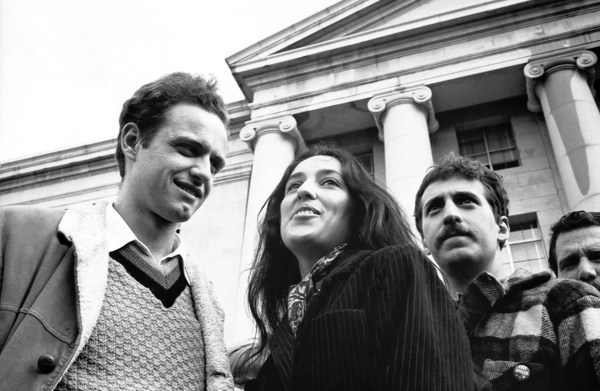
In less than a week, we’ll see the official fiftieth anniversary of the Berkeley Free Speech Movement. And some conservatives worry that college campuses will celebrate that milestone by cracking down particularly on the free speech of conservative students.

What Free Speech looked like fifty years ago...

What Free Speech looked like fifty years ago…

Some found it ironic that Berkeley Chancellor Nicholas Dirks began the commemoration season with an equivocal email. Dirks encouraged the Berkeley community to remember to temper its yen for free speech with an esteem for the value of civility.

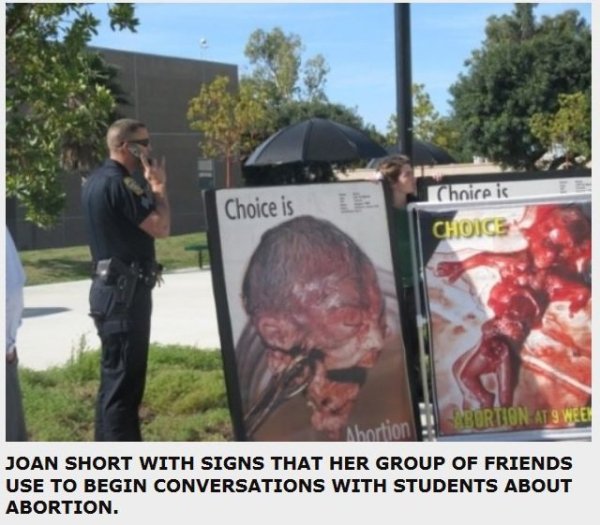
Over the past year, too, campuses nationwide have wrestled with their policies of establishing limited “free-speech zones.” In some cases, conservative students have come under special pressure, either for preaching conservative evangelical religion or for protesting against abortion.

This week in the Wall Street Journal, education scholar and historian Sol Stern lambastes the current climate of campus free speech. As he recalls, as a twenty-seven-year-old graduate student, he stood up for free-speech rights at Berkeley fifty years ago. But nowadays, he laments the trajectory of campus politics. “Though the movement promised greater intellectual and political freedom on campus,” Stern argues,

the result has been the opposite. The great irony is that while Berkeley now honors the memory of the Free Speech Movement, it exercises more thought control over students than the hated institution that we rose up against half a century ago.

Why do today’s campus activists face a more restrictive environment? Stern blames the new dominance of academia by closed-minded leftist autocrats. “Unlike our old liberal professors,” Stern writes,

who dealt respectfully with the ideas advanced by my generation of New Left students, today’s radical professors insist on ideological conformity and don’t take kindly to dissent by conservative students. Visits by speakers who might not toe the liberal line—recently including former Secretary of State Condoleezza Rice and Islamism critic Aayan Hirsi Ali —spark protests and letter-writing campaigns by students in tandem with their professors until the speaker withdraws or the invitation is canceled.

There seem to be two questions on the table. First, do campuses need to restrict student speech in order to maintain order? And, second, as Stern and other conservative commentators argue, do conservative students sustain the brunt of these anti-free-speech attacks?

Is this what free-speech looks like today?

Is this what free-speech looks like today?

From the Archives: Campus Rape in the 1930s

Do fundamentalist colleges encourage sexual assault?  It’s a terrible and difficult thing to talk about.  As we’ve seen in these pages, some alumni insist that fundamentalist schools force victims of sexual assault to blame themselves.  But we’ve also seen that sexual assault is not at all unique to religious schools.  As I continue the research for my new book about the history of evangelical colleges and universities, I’ve stumbled across a story that might shed light on these tricky questions.

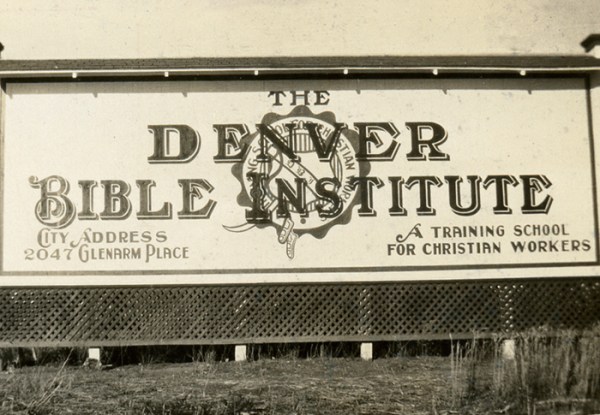
Despot in Denver

Despot in Denver

The way we word the questions themselves is controversial: Are fundamentalist schools cults that pander to the lusts of authoritarian leaders?  Or do the strict sexual ethics of conservative evangelicalism help protect young women and men from predatory teachers and authority figures?

Critics of conservative evangelical colleges warn that that the pervasive “purity culture” of these schools leads directly to rape.  Bloggers such as Samantha Fields have accused fundamentalist colleges of blaming victims of sexual assault.  Journalists have blasted schools such as Patrick Henry College for fostering a rape-friendly environment.  Prominent evangelicals have suggested that the problem is not one of theology, but of an authoritarian institutional culture.  For example, Boz Tchividjian famously suggested that abuse can happen “in any culture, elevating leaders beyond accountability, leaving victims’ rights to their whim, and sidelining critics who challenge their rule.”

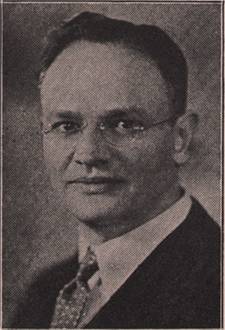
I’ve stumbled across a story from the 1930s that might illuminate the longer history here.  In 1936, a high-powered panel of fundamentalist leaders convened to investigate Denver Bible Institute (now part of Colorado Christian University).  At the time, DBI was led by charismatic founder Clifton L. Fowler.  Fowler wanted to join the Evangelical Teacher Training Association, and to do so ETTA demanded that rumors be cleared up.

Unfortunately for Fowler, an extremely disturbing picture emerged.  Fowler, the investigators concluded, ran DBI like a sex-crazed despot.  Students and faculty were pressured to declare lifelong commitments to the schools.  Married faculty members were pushed into pledging “continence.”  (I’m not sure what was meant by “continence” in this context.  Any suggestions?)  Students were encouraged to separate from parents and home churches.  Community members felt pressure to offer Fowler detailed confessions of their sexual sins.  And, yes, Fowler apparently routinely engaged in sexual activities with male students.

From one perspective, this historical episode might seem to confirm the dangers of authoritarian fundamentalist schools.  For as long as there have been fundamentalist schools, we might conclude, leaders have felt free to engage in predatory sexual practices.  Community members felt constrained by their own admitted sexual sinfulness from criticizing the dictatorial leadership.

On the other hand, as Michael Hamilton argued in his excellent 1994 dissertation, Fowler did not have a free hand to do as he pleased.  The accusations against Fowler forced DBI out of decent fundamentalist company.  Local fundamentalist churches cut off DBI.  The Evangelical Teacher Training Association would not let DBI join.  Fowler, in other words, was restrained in his behavior because of the network of fundamentalist schools and churches in which he worked.

As usual, history does not offer any pat solutions.  But this episode does demonstrate the long lifespan of these questions at fundamentalist schools.  It shows that school founders have always been accused of sexual predation.  But it also shows that fundamentalist leaders and communities worked hard to police their own ranks.

In this case, at least, both national leaders and local community members refused to look the other way.

College Christians Strike Back

Do evangelical Protestants need to boycott pluralist universities? That’s the plan this morning from Joe Carter at the Acton Institute.  To those aware of the longer history of conservative Christianity and higher education, this sounds like déjà vu all over again.

Carter is reacting to the latest round of de-recognition of Intervarsity Christian Fellowship. This time, the campuses of the California State University system will no longer accept IVCF as a full member of their communities.  At issue is the system’s newly enforced policy of non-discrimination.  No student organization will be allowed if it does not open its leadership ranks to all comers.  For IVCF, that’s a no go.  The organization insists that leaders must agree with its evangelical statement of faith.

This higher-education controversy has been going on for a while. Most prominently, as we noted in these pages, Tufts University de-recognized its campus IVCF chapter.  Other schools have followed suit.

De-recognition has consequences, but it doesn’t mean the organization is banned. Rather, a de-recognized group is not allowed free use of campus facilities for its meetings.  It is not allowed to take part in campus-wide recruitment fairs.  Perhaps most significantly, de-recognition sends a symbolic message that an organization is no longer part of a campus community.

How should evangelicals react? Joe Carter says they should go their own way.  As Carter puts it,

Colleges and universities are businesses that exist in a competitive educational market. A free market solution is to refuse to support the business’ “product.” In other words, Christians should refuse to attend schools in which their beliefs are “derecognized.” Similarly, alumni should refuse to provide donations to support a college or university that considers our faith not welcome on the campus.

We’ve seen this argument before. As I argued in my 1920s book, the first generation of fundamentalist leaders worried about the state of higher education.  At both pluralist and religious schools, fundamentalists charged, anti-Christian teaching and attitudes threatened the faith of young Christians.

Some leaders insisted that the only answer lay in the boycott. Evangelist Bob Jones Sr., for instance, opened his own college in order to offer fundamentalist parents an alternative.  As Jones remembered decades later in a private letter,

Going about over America in my evangelistic work, I ran into so many people who had lost their faith in schools, some of which were supposed to be Christian schools and that had at least been built with Christian money but that had compromised and brought religious liberals into the school; and young people had lost their faith. I kept one fellow from committing suicide because of what happened to him in a certain school that had been built with sacrificial gifts of Christian people but an institution that had gone modernistic.  I made up my mind there ought to be a certain type school somewhere in America, but I did not want to build it.  I was at the height of my evangelistic career and had open doors all over the world. . . . I went on to tell [his wife] that there is an idea going around that if you have old-time religion you have to have a greasy nose, dirty fingernails, baggy pants, and you must not shine your shoes.  And I told her that religious liberals were putting that over.  I said, ‘I want to build a school that will have high cultural and academic standards and at the same time a school that will keep in use an old-time, country, mourner’s bench where folks can get right with God.’

As a result, conservatives who agree with Joe Carter have a place to go. A network of evangelical colleges and universities offer alternatives to schools that might de-recognize Christian student groups.  Whatever one’s theology and preferences, from fundamentalist Bob Jones University deep in the heart of Dixie to evangelical Wheaton College just outside of Chicago; from Manhattan’s aggressive The King’s College to LA’s laid back academic Biola vibe.

If evangelicals really feel a need to boycott pluralist campuses, they have no shortage of Christian options.

College Helps Christianity

Watch out, Christians!  Sending your kids to college may mean sending them to hell.  That has been the standard wisdom since the 1920s.  One sociologist now suggests that this is no longer true.

The notion that college might lead children to abandon their faiths has been a staple of conservative thinking for a long time.  In the 1920s, conservative leader William Jennings Bryan warned of the dangers of mainstream higher education.  Bryan drew on the work of scholar James H. Leuba.  Leuba’s 1916 book The Belief in God and Immortality suggested that eighty-five percent of college freshmen described themselves as believers.  Only fifty-five percent of graduates did.  The conclusion, Bryan warned, was clear.  College was turning children away from God.

As usual, fundamentalist firebrand T.T. Martin expressed the idea more colorfully.  In a 1923 book, Martin quoted one former college student’s complaint: “My soul is a starving skeleton; my heart a petrified rock; my mind is poisoned. . . . I wish I had never been to college.”

As I argued in my 1920s book, this sort of anxiety about the results of mainstream higher education led fundamentalists to open their own network of colleges, universities, and seminaries.  My current research looks at the twentieth-century history of these schools.  How did they hope to give students a “college experience” different from the kind on tap at Harvard, Yale, and State U?  How did they hope to educate students who were conservative about the Bible, about evolution, and about gender roles?  Certainly, since the 1920s, these concerns have remained central to conservative evangelical Protestants.  Such folks have continued to hope that righteous colleges can crank out righteous Christians.

But according to a story in Religion News Service, one recent sociological study suggests that the college trend may have turned.  Sociologist Philip Schwadel has argued that people born between 1965 and 1980, “Generation X,” no longer have a correlation between college education and abandoning faith.  Because so many more people are going to college, Schwadel argues, there is no longer a correlation between higher education and personal secularization.

In other words, college no longer seems to be turning people away from their faiths.  For people born in the 1970s, those WITHOUT a college degree were more likely to abandon their faiths.  That’s right: for folks born in the 1970s, having a college degree made them more likely to retain their youthful religion.

Of course, as with any academic study, Schwadel’s is carefully wrapped in layers of caveats.  This study does not say anything about people born in the 1980s or later.  They simply haven’t had enough time to form their adult identities.  Nor does it claim that it has firmly proven the fact that college no longer moves people away from their childhood faiths.

But the correlation is fascinating.  Schwadel offers a few suggestions about why this change may have taken place.  First of all, more and more people in this age cohort went to college.  That means there is less and less elitism associated with a college degree.  Also, there is more religion on college campuses, Schwadel writes.  People can combine their “educated” adult identities with a “religious” identity firmed up in religious student groups.  Finally, as more and more college-educated people attend church, those without college degrees might feel socially unconnected.  Beyond theology, that sort of mundane social-connection may contribute to people leaving their churches.


Fundamentalist Parents Can’t Relax

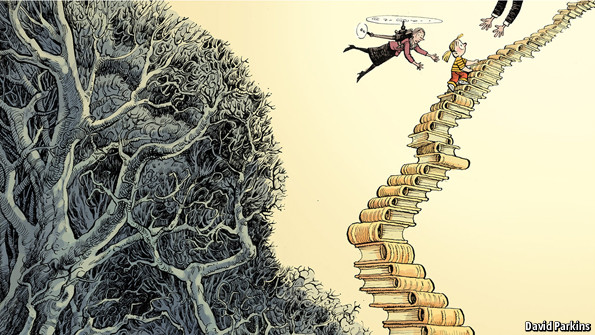
Rich parents can relax.  At least according to an article in this week’s Economist.  But fundamentalist parents never can.  They have to worry about more than their kids’ careers.  They have to fret about eternal damnation.  And they have to worry that Satan lurks in every textbook, every TV show, and every mainstream school.

The Economist article is worth reading in its entirety.  As it explains,

Well-to-do parents fear two things: that their children will die in a freak accident, and that they will not get into Harvard.

Getting into Harvard might be harder than getting into heaven...

Getting into Harvard might be harder than getting into heaven…

Both fears lead to exaggerated and ultimately counterproductive lifestyles.  In terms of safety, the article notes, an American child under five years of age in 1950 was five times as likely to die of disease or accident as that same kid would be today.  And though it is difficult to get into Harvard, most kids of affluent families will have fine careers without an Ivy-League transcript.

But fundamentalist parents have more to worry about.  Since the birth of American fundamentalism in the 1920s, conservative evangelicals have fretted about the influence of mainstream culture on their offspring.  Even if their kids don’t get polio, and even if their kids do get into Harvard, fundamentalist parents have to worry that success in life will lead to terrible punishment after death.  For fundamentalists, even Harvard itself can be more of a threat than an achievement.

As historian Randall Balmer put it in his blockbuster book Mine Eyes Have Seen the Glory,

the greatest fear that haunts evangelical parents is that their children will not follow in their footsteps, that they will not sustain the same level of piety as their parents—stated baldly, that they are headed for hell rather than heaven.

As I argued in my 1920s book, historically this fear for the children has fueled fundamentalism’s public campaigns.  Fundamentalist leaders and parents worried that no level of affluence and economic privilege could protect their children from a culture sliding nonchalantly straight to hell.

As conservative leader William Jennings Bryan explained in 1922, even the rich and powerful had lost the ability to protect the faith of their children.  As a former Secretary of State, Bryan knew many of these families personally.  He wrote about one acquaintance, a US Congressman, whose daughter came home from college only to tell the family that “nobody believed in the Bible stories now.”

It was not only conservative Congressmen who worried.  Fundamentalist evangelist Bob Jones Sr. liked to tell the story of a less powerful family who had a similar experience.  This family, Jones explained in one of his most popular 1920s sermons, scrimped and saved to send their precious daughter to

a certain college.  At the end of nine months she came home with her faith shattered.  She laughed at God and the old time religion.  She broke the hearts of her mother and father.  They wept over her.  They prayed over her. It availed nothing.  At last they chided her.  She rushed upstairs, stood in front of a mirror, took a gun and blew out her brains.

Even when fundamentalist families did not experience that sort of cataclysm, we must keep their anxiety in mind when we try to understand fundamentalism from the outside.  Why do conservative evangelicals fight against evolution?  Why do they insist on school prayer?  Why do they worry about rights for homosexuals?

In all these cases, conservative evangelicals’ public activism is made more desperate by their intense worry about their children.  In this, there is no difference between conservative evangelicals and mainstream Americans of any background.  As the Economist article points out, almost all parents love their children and make sacrifices for them.  In the case of mainstream affluent parents, it might even help if they relaxed a little bit.  As Bryan Caplan of George Mason University argues,

Middle-class parents should relax a bit, cancel a violin class or two and let their kids play outside.

Easy enough.  But fundamentalists face a very different situation.  If we want to understand the mind of fundamentalists, we can try a mental experiment.  Non-fundamentalist parents have a hard enough time relaxing about their kids, even though they feel at home in mainstream culture.  Non-fundamentalist parents fret too much about their kids’ futures, even if they don’t feel alienated by their local public schools and elite universities.

Let’s try to translate the anxiety experienced by fundamentalist parents into mainstream terms.  Imagine, for example, the sorts of public outcry there would be if public schools began promoting ideas or practices that affluent secular parents found dangerous.  For instance, what do you think would happen if a public school somewhere began promoting smoking as a fun and healthy activity?


Fundamentalist Colleges Have the Last Laugh

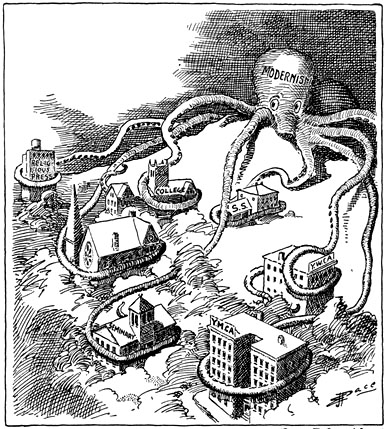
In this cartoon from the 1920s, cartoonist E.J. Pace shows the ways the "modernists" took over every institution, including colleges.

In this cartoon from the 1920s, cartoonist E.J. Pace shows the ways the “modernists” took over every institution, including colleges.

What are the best colleges in America?  A trenchant new argument by Ivy-League insider William Deresiewicz suggests that conservative religious folks may yet have their revenge when it comes to higher education.

Since the 1920s, conservative Christians have complained that “their” colleges had been taken over by a secularizing elite.  As I argued in my 1920s book, there was a great deal of truth to these claims.  Elite schools such as Harvard and the University of Chicago really had been founded by conservative Protestants.  Their original missions were explicitly religious.  And, by the 1920s, those schools really had been transformed.  Instead of their traditional goal to train each new generation of “Christian gentlemen,” elite colleges became places where students learned to question religious verities.

As a result, conservative evangelicals faced a difficult situation.  Some schools, such as Wheaton College, allied themselves with the “fundamentalist” side of the growing divide among Protestants.  Most other elite schools, though, moved toward the new vision of higher education.  Some 1920s fundamentalists responded by opening schools of their own, such as Bob Jones University and Dallas Theological Seminary.  In my current research, I’m looking at the twentieth-century history of this alternative network of colleges and universities.

Deresiewicz argues that this alternative network of schools does a better job of educating young people than do the mainstream elite schools.  Religious colleges have often avoided the elite trap of ever-increasing expectations and the soul-crushing spiral of success.  At elite mainstream colleges, Deresiewicz writes, students become “anxious, timid, and lost, with little intellectual curiosity and a stunted sense of purpose.” Without the same relentless pressure, religious colleges have remained true to their purpose of encouraging true thoughtfulness and intellectual risk-taking. As he puts it, “Religious colleges—even obscure, regional schools that no one has ever heard of on the coasts—often do a much better job in that respect.”

Is Deresiewicz right? Do elite colleges turn smart kids into zombies? In some ways, his is not a new argument. Sociologist James Coleman argued in his 1961 book The Adolescent Society that schools did not work the way we thought they did. It was not the most talented students, the brainiest students, who did the best on school tasks. Rather, the nature of the tasks demanded in most high schools led the smartest students to opt out. They focused on success elsewhere, such as sports or social activities. As a result, the best academic records were compiled by a “sub-group” of students who agreed to buy into the school’s irrational demands.

In other words, for generations now, our educational system has encouraged a weird sub-class of hyper-successful students. These students are not turned into zombies in college. Rather, they have been zombies all along. To excel in school—not just college but the whole way through—students have to be bright enough to do well at school tasks but not quite bright enough to realize that school is just a shell game.

If Deresiewicz is correct, religious colleges may have the last laugh. Conservative Christians complained that elite schools had been stolen from them. As a result, they opened their own schools, built their own network of colleges and universities. Getting pushed out of the academic rat race may have been the best thing that ever happened to conservative evangelicals.


Are Christians Too Bigoted to Work With?

You may have seen the headline by now: Christian College Discriminates Against Homosexuals.  And the follow-up: City Cuts Off Christian College.  But isn’t it weirdly ironic that non-religious governments now seem to be repeating the separatist struggles of fundamentalists?  Doesn’t it seem odd that the drive for tolerance pushes pluralists to act like the more extreme religious separatists?

In this case, it was the public decision of Gordon College President D. Michael Lindsay to sign a letter to President Obama that sparked the furor.  [Full disclosure: Lindsay and I worked together as 2009 Spencer/National Academy of Education postdoctoral fellows, and I admire Lindsay personally and consider him a friend and colleague.]  Along with a host of other prominent evangelical leaders and intellectuals, Lindsay asked President Obama for a religious exemption to a planned executive order banning workplace discrimination against homosexuals.

Lindsay’s participation caused a furious reaction.  Gordon alumni and students petitioned Lindsay to retract.  Gordon College’s accrediting agency promised to investigate.  And most notably, the nearby city of Salem, Massachusetts canceled its partnering contract with Gordon to operate an historic city building.

Let me be clear about a couple of points.  First, I personally agree that institutions should not discriminate against homosexuals.  Public governments, especially, have a duty to include all members of society, not only passively, but actively.  IHMO.  Also, I do not wish to argue whether Lindsay’s position is or is not “anti-gay,” since he has publicly insisted that Gordon College does not discriminate against homosexuals.  And though I find it curious, I don’t want to ask why President Lindsay has become the center of this controversy, even though the letter was signed by many other evangelical leaders as well.  Even on my humble little blog, for example, I’ve experienced a surge of search terms such as “D. Michael Lindsay bigot” and “Gordon College Anti Gay.”  Why has Lindsay become the focus in this case?  Why not all the other signatories?

Though interesting, we have to leave such questions aside for now.  From an historical point of view, there is a more interesting aspect to this case.  It seems that those who support tolerance and diversity have, in some ways, adopted the position of the traditionally conservative fundamentalists.

Here’s what I mean: In the twentieth century, conservative Christian colleges carried on a furious and often angry internecine debate about the propriety of partnering with non-Christian institutions.  Schools such as Gordon and Wheaton College earned the vicious denunciation of more conservative schools such as Bob Jones University.  Among the many accusations, more conservative, “fundamentalist” schools often insisted that the more open, “evangelical” schools had tainted themselves by their open association with non-Christian ideas.  Separatist fundamentalists often cited the Bible passage 2 Corinthians, chapter 6, verse 14:

Be ye not unequally yoked together with unbelievers: for what fellowship hath righteousness with unrighteousness? and what communion hath light with darkness?

In order to be truly Christian, separatists argued, believers could not allow themselves to be joined with those who did not share their belief.  So, for instance, when fundamentalist megastar Jerry Falwell worked with conservative Catholics and Jews in the Moral Majority, fundamentalist leaders at Bob Jones University denounced Falwell as the “most dangerous man in America.”

This rigid separatism, indeed, has been one of the hallmarks of American fundamentalism.  Some fundamentalists have insisted that they must practice even a “secondary separation,” not sharing Christian fellowship with other Christians if those other Christians share fellowship with questionable folks.

Now, it seems the city of Salem feels it must practice a strangely similar form of separatism.  As Salem Mayor Kimberly Driscoll informed Gordon College in a recent letter, the city must separate itself from the college.  Why?  Because, Driscoll wrote, Lindsay’s position implied open discrimination against the LGBT community.  The college had every right to do so, Driscoll believed, but the city could no longer be affiliated with such things.  The city’s non-discrimination law, Driscoll informed Lindsay, “prohibits our municipality from contracting with entities that maintain discriminatory practices.”

This is not the only time when the beliefs of liberals and fundamentalists have neatly swapped sides.  In the creation-evolution debates, for example, creationists took over evolutionists’ positions.  As historian Ronald Numbers has pointed out, by the 1990s creationists began appropriating the language of 1920s liberals.  In the 1920s, evolution supporters insisted that teaching only one theory was bigotry.  By the 1990s, creationists started saying the same thing.

In this case, we see a weird and clearly unintentional echo.  Mayor Driscoll feels compelled to separate her government from any entity that practices discrimination against homosexuals.  It is not enough, morally, for her government itself to avoid such discrimination.  The principle of separation seems to have migrated from fundamentalists to their supposedly tolerant opponents.


I Hart Lyle Spencer

I want to shout it from the rooftops. I love this man!

Mr. Spencer, I Love You.

Mr. Spencer, I Love You.

Thanks to his Spencer Foundation, I’ll be able to spend the next year traveling to archives to research my new book. My grant from the Spencer Foundation will fund my trips to a variety of evangelical colleges. I’m looking forward to diving into the world-class collection at the Billy Graham Center Archives, for example.

My goal in this book is to explore the history of evangelical higher education in the twentieth century. What did schools such as Wheaton College, Bob Jones University, Biola University, Bryan College, John Brown University, and a host of others hope to teach their students? Most interesting, since the emergence of “fundamentalism” in the 1920s, how did these colleges try to teach their students what it meant to be an evangelical Christian in a rapidly secularizing America?

Naturally, these questions changed over time. In the 1920s, for example, the first decade of “fundamentalism,” evangelists and evangelical intellectuals struggled to define what it meant to be a “fundamentalist.” For Bob Jones, it meant eschewing many of the outward trappings of modern life as well as cultivating a Bible-first way of knowledge. For President Blanchard of Wheaton College, it meant more of a theological steadfastness.

By the late 1940s, the world of conservative evangelicalism had changed radically. I want to explore the ways these changes emerged on evangelical campuses. What would it mean for a family in 1950 to choose to send their sons or daughters to “evangelical” Wheaton instead of “fundamentalist” Bob Jones? Or to Biola instead of one of the growing crop of non-religious colleges, including my own beloved Binghamton University (founded 1948)?

Each new generation offers new topics. Moving into the late 1960s, conservative colleges experienced a very different “Sixties.” I’m interested in exploring the ways evangelical students and faculty developed a counter-counter-culture. And in the late 1970s, the emergence of a “New Christian Right” in mainstream American politics was both fueled and influenced by developments in evangelical higher education.

Central to all these investigations will be the experience of students and faculty at evangelical colleges. Luckily, the archives of all these schools have rich collections of their own students’ experiences. At the Billy Graham Center Archives, a host of oral history interviews also tracks the school memories of evangelicals from across the decades.

Thanks to the Spencer Foundation, I’ll be able to devote the next year to full-time research. For readers who are unaware of the Foundation, it is the best thing going in education research. I’m not saying that only because of my generous grant. Every academic knows about the Spencer Foundation’s programs, including its dissertation fellowship and its postdoctoral fellowship. In my case, a postdoc from the Spencer Foundation and National Academy of Education allowed me to complete two books, my 1920s book and my upcoming one about educational conservatism in the twentieth century.

So I say it with unabashed enthusiasm: I Love Lyle!