School Is Not the Place for Education

What does it mean to be educated?  This morning at The Imaginative Conservative, Steven Jonathan Rummelsburg blasts public schools for punting on this central question.

Rummelsburg relates his long quest to dig into the basic philosophy of public education.  No one he’s asked, he tells us, is able to answer the simple question: What is an education?

Rummelsburg, a veteran public-school teacher himself, asked public-school teachers, students, and administrators.  Most of the respondents, according to Rummelsburg, hemmed and hawed with answers about mastering standards and earning a diploma.  One math teacher, he tells us, paraphrased Steve Forbes.  What is an education?  This teacher answered, “Replacing an empty mind with an open one.”

When he asked his county superintendent’s office, he got a list of four points:

  1. You will get as many definitions of education as the number of people you ask.

  2. To be educated means to have learned enough language and math to be a good citizen.

  3. It is not about the subject being taught, but what the teacher does with her audience. It is all about the student teacher relationship and what she can get them to do.

  4. That is the answer today, the answer tomorrow will be different.

[I assume this was Rummelsburg interpretation of the superintendent’s office’s answers.  The language sounds a little too frank to come from a public official.]

What should the answer have been?  Rummelsburg wants teachers and schools to hew closer to GK Chesterton’s definition of education.  Education must not be thought of as a simple thing, but as a “method.”  It should be a transmission of all that is best in our culture.  The only way to do that properly, Rummelsburg concludes, is to separate out the unfairly conjoined notions of “school” and “education.”

As he concludes,

It is a terrible crime to hand the formation of our children over to an enormous class of uneducated teachers, yet that is what we have done. As it stands, there is nothing redeemable about the public schools or the lies they instil in our children. . . . Let us take our children back and assume our responsibility as their first teachers and teach them as they ought to be taught.

Certainly, Rummelsburg’s argument that today’s public schools have utterly lost their way resonates with intellectuals on both the cultural right and left. And I have a deep sympathy for his insider’s critique of public education. I work with many public-school teachers and administrators, and nothing makes me more pessimistic about our public schools than the number of teachers who choose to homeschool their own children.

But is Rummelsburg’s method sensible? If we can’t get an adequate philosophical definition of education from teachers and school administrators, does that mean that schools are not educating students?

Would this work for other institutions? For example, if I asked everyone who worked in my local supermarket to explain “the market,” would I get a coherent answer? An answer that captured the essence of social and economic exchange? Probably not. But does that mean that my supermarket is not functioning as a market?


Is This Child Abuse?

Is it a crime to keep young people isolated from the wider community?  To teach them nothing that will allow them to thrive as independent adults?

From Frimet Goldberger in the Jewish Daily Forward we hear accusations that Hasidic communities in Ontario perpetrate educational crimes on their own children.  She shared a disturbing video in which a journalist asked young men basic questions.  Do you know the name of the Prime Minister?  The names of Canadian provinces?  Do you know anything about Canadian history?  The parts of the body?

The students, all apparently members of the Lev Tahor community—a group of about 40 families—did not seem to understand much about what they were being asked.  Most of the difficulty seemed related to their lack of English language skills.  But the boys did not seem able to answer in Hebrew, either.  One student, for example, asked to explain what he had learned about biology, explained haltingly that it is not healthy to jump too much right after eating.

The Lev Tahor community faces more serious challenges, too.  Some of the members are on the run from Canadian police, facing charges of child neglect and abuse.  Goldberger asks the question we want to hear: Does failing to teach children English or French count as abuse?  As Goldberger puts it, “These boys are lacking the basic language tools to take one step out of the community, to communicate with anyone outside their community.”

The United States has long wrestled with these questions, too.  Most notably, the US Supreme Court ruled unanimously in 1971’s Wisconsin v. Yoder that dissenting parents had the right to remove their children from public school.  These days, accusations of abuse in the growing homeschooling community have prompted calls for more government oversight.

Does a dissenting community have the right to restrict their children’s future?  If so, how can the wider society make any claims to regulate religious schooling?  And if not, who gets to decide what knowledge (or lack of knowledge) constitutes a limit?  Is young-earth creationism a limit on children’s futures?  Is a belief in faith healing?

Homeschool: Latest Frontier for the Fabulous

Why do parents homeschool?  At least one mother has told us recently that homeschooling has become yet another perk for the fabulously fabulous.

As anyone who follows historian Milton Gaither’s blog knows, the world of homeschooling in the United States is fabulously complex.  There is no simple answer to the question of why some parents choose to homeschool.

For some readers and contributors to this blog (see, for instance, the experiences of Anna), homeschooling has resembled nothing so much as a horrific theocratic prison, similar to the recent expose in the pages of American Prospect.  For these families, homeschooling has functioned as a way to bind up their children’s minds in the over-tight wrappings of fundamentalist theology.

Yet for many other conservative religious folks, homeschooling has included equal parts theology, culture, and pedagogy.  Some non-conservative readers out there might be as surprised as I was to discover the number of conservative evangelical Protestants who homeschool for very progressive-sounding reasons.  Or even the number of conservative creationist homeschoolers who want to teach their children about evolution responsibly and accurately.

But homeschooling is not only for conservative religious folks.  At least since the early 1970s, progressive educators and hippies have been attracted to the allure of “unschooling.”  And homeschooling has long been a traditional option for students who cannot attend school due to health problems or even due to pregnancy.

A recent piece in the New York Times offers another rationale for homeschooling: it’s the only lifestyle that can be fabulous enough for those who have already maxed out on their fabulous-ness.  Jennifer Kulynych’s self-outing as a fabulous homeschool mom took as a pretext her difficulty in admitting to her homeschool practice.  At work, Kulynych explains, she has trouble telling colleagues that she homeschools her daughter.  Too many people, she writes, make too many assumptions about homeschooling.

At its core, though, Kulynych’s self-outing seems like nothing so much as a brag about homeschooling as the last frontier for the fabulous.  Kulynych explains that she began homeschooling her daughter when their public school failed to challenge her daughter intellectually.  Since Kulynych’s daughter was too smart for school, and their family couldn’t afford ritzy private schools, Kulynych chose to homeschool.  Plus, Kulynych explains, she was not willing to see her daughter raised by nannies and tutors.  Instead, Kulynych chose to keep her job as a lawyer, while still arranging a perfect intellectual environment for her perfect intellectual offspring.  The fabulous experiment has not been without cost, Kulynych explains.  She goes without spare time in order to keep up the fabulous pace of her fabulous homeschooling lifestyle.  She enjoys spending time learning with her daughter, as she explains, as “co-conspirators in a counterculture adventure, eating our academic dessert first whenever we like.”

Don’t get me wrong: I’m not knocking Kulynych for homeschooling.  I’m all for parents who sacrifice for the good of their children.  But I do wonder if Kulynych’s self-aggrandizement will mark a new normal in the kaleidoscopic world of American homeschooling.  Homeschooling has always been counter-cultural.  The traditional countercultures, though, have been those of the left or right.  For Kulynych, at least, the “counter” in counterculture seems to rely mainly on being simply too cool for school.


Faith & Physics, Part II

ILYBYGTH is happy to continue our series of guest posts from Anna.  In her first post, Anna described her shift from creation science to mainstream science.  Today she tells us a little bit about the way she learned her creationist science as a kid.  Anna blogs about her experiences leaving the fundamentalist subculture at Signs You Are a Sheltered Evangelical.  She holds an M.Sc. degree in Astroparticle Physics and currently lives in Virginia with her fiance Chelsey and a cat named Cat.

Creationist Curriculum

I am a conservative, anti-government-educator’s dream.  Because I was homeschooled, my family had the unique opportunity to control every aspect of my education completely.  Part of this included being taught with a Christian science curriculum that supported Biblical 6-day creation, denied Evolution, described scientific evidence for a global flood, and opposed modern environmental policies.  When I tell my secular peers this, the reactions of shock, horror, and amazement are often rather comical.  Very often, I am told that I must be remarkably resilient or intelligent to be able to make a successful science career for myself after being handicapped by my early education.  As much as I’d love to accept the accolades, I simply don’t see it that way.  My seemingly-bizarre education did not hamper me much at all, and in some ways, I must credit it for inspiring me to become a scientist in the first place.  Although I cannot defend the inaccuracies in the curriculum, I still have fond memories of it, and I can highlight both the shortcomings and successes of the book series.

My formal science education, I believe, started around age 10 or 11 (since I was homeschooled, I did not progress through formal grades, so it is sometimes very difficult for me to track the passage of time without these milestones to help.)  I was started on an A-beka book, which I remember little of besides loathing.  It was spiral bound with wire and the pages were made of cheap paper, meaning that they were constantly tearing out, scattering across the floor, and getting lost.  Besides that, the text itself was dry, the pages were cluttered with illustrations that illustrated nothing, and the quizzes (aptly named “brain drains”) never seemed to pertain to the actual text and would often quiz you in facts only found in the illustration captions.

For the rest of my pre-college education, I used Apologia‘s Christian-centered curriculum by Dr. Wile, and I loved it.  Over the years, I worked through Exploring Creation with General Science, Exploring Creation with Physical ScienceExploring Creation with Biology, Exploring Creation with Chemistry, Exploring Creation with Physics, and Advanced Physics in Creation.  I wish that I had a copy of some of these books still with me… especially the 1st edition of General Science and Physical Science (if anyone feels like getting me an early Christmas present… I won’t say no) because I recall those two books having the most absurdities in them.  Obviously, I cannot cover all of the curriculum in detail, but I can shed some light on the divergences from science that I recall.
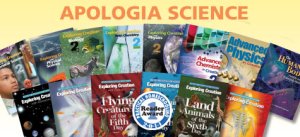
Image Source: Apologia

Image Source: Apologia

I have to laugh now recalling that one of the books (General Science, I think) had an entire chapter devoted to attempting to validate the Bible as an accurate scientific and historical record.  This would seem grossly out of place in any standard science text.  For a creationist, however, it is perfectly reasonable and, indeed, necessary to discuss this in depth.  I recall in my early years of college, seeing my peers and professors laugh at the absurdity of creationism.  “Scientists start with evidence and draw a conclusion from it.  Creationists start with a conclusion and draw evidence for it,” was posted on my professor’s office door.  I felt a little defensive.  “We all tend to accept conclusions that come from reputable, repeatedly-tested sources,” I thought.  “If the Bible were not reputable and repeatedly-tested, then obviously accepting claims from it would be absurd, but that is not the case.”  Much of my conviction on the validity of the Bible originated from the early Apologia texts.  It’s important to remember that Creationists do not see themselves as anti-science… they want to find compelling evidence for their claims.  As a result, I waded through a chapter discussing the accuracy of Bible translations, similarities between different Biblical manuscripts, refutations of Biblical contradictions, etc.  The purpose of this was to prove that the Bible could be reliably used as a basis for scientific theory.  To exclude this chapter would be grossly negligent if claims in the Bible are indeed the basis of your theory.  Even so, the whole conversation bored me; I wanted to learn science.

The Physical Science textbook spent an inordinate amount of time condemning modern environmental policies as fraudulent.  I recall the book passionately opposing the ban on CFC’s, claiming that the ozone hole was a scare tactic used by politicians to promote a hysterical agenda, and predicting that people would suffer from increased rates of infection now that medical tools could no longer be sterilized by the chemical.  These political discussions now irritate me more than any of the other inaccuracies in the books.  I had been raised when I was young in a very rural area and had developed a great love of nature.  I was fiercely protective of the environment, and all of the flora and fauna in it.  I wrote an article to my local newspaper about reducing litter when I was 11 years old or so which I was very proud to see published.  As such, it angers me in retrospect that I was taught so many lies about proper stewardship of the environment and that I believed them for so long.  I have never fully understood why Christian Fundamentalism is so opposed to environmental protection, and yet it seems to be a common theme.  Apologia science chose to start kids on that path early.

The Biology text book focused on disproving Evolution.  Of course.  In all honesty, as silly as 6-day-creation seems to me now, my Bible-based text book really did not deprive me of a decent education on evolutionary biology.  Because of the sheer amount of information I was provided with to refute Evolution I came away with a pretty darned good understanding of it.  I disbelieved it, of course, but once I came around to accepting true science, I was no further behind in understanding than any of my secular peers.  This is why the shock-and-horror response to my anti-evolution education makes me chuckle a little.  If one truly wants to argue effectively against an opponent, one must know his position at least as well as he does.  Thus, I truly believe that my anti-evolution text served me surprisingly well.

Now that I’ve discussed all of these lies, distortions, and absurdities, you might wonder how I can have a favorable memory of Apologia at all.  Well, for one, the books were very well written.  Their style was conversational, without sacrificing content.  The illustrations were meaningful and placed sparingly to complement the text, rather than cluttering the book.  Learning felt like learning… like you were truly on a road to discovery, rather than simply memorizing information for a test.  And, perhaps most awesome of all, if you emailed the author, he would email you back within 24 hours.  If I ever found myself confused by a concept or curious about some theory, I would write to him and eagerly await his response.  He was always friendly and informative with his replies.  Perhaps my enthusiasm over this simple email contact seems exaggerated but, remember, I was homeschooled.  I was almost entirely in charge of my own education by the time I reached higher sciences.  My mother did not have the education to help me in science or math, and none of the other homeschooling moms in my group were any better.  Whenever I was uncertain about something, I would have to figure it out myself.  Thus, having an authority figure to direct my questions to was amazing.  I felt like I was talking to a celebrity.  My childish enthusiasm aside, I think that it also highlights Dr. Wile’s admirable dedication to education.  It meant a lot to me at the time, and I still think back on it fondly.

Dr. Wile was one of my inspirations to become a scientist.  I loved his enthusiasm for the subject, I loved his dedication to the students using his books, and I wanted to emulate that.  Honestly, I still do.  As an instructor, I strive to let my enthusiasm show, to infect others with it, and to always make myself available to my students for questions and assistance.  But what about the science-denial?  It is still a bit difficult for me to look back on authority figures and members of my community that I looked up to and respected and wonder: are they just ignorant, or are they purposely deceptive?  How can a scientist be completely honest with him- or herself and still make the claim that ALL evidence points to a 6-day creation, without question or doubt?  I give myself a lot of grace for my early ignorance because I was young and had little access to any information outside of the pre-approved worldview that I was being fed.  But creationists like Ken Ham, Dr. Wile, and others have no such excuse.  So, without being able to see inside their minds, can I offer them the grace of assuming that they are truly honest in their seeking and have just been misled?  I think the answer is both yes and no, and it is greatly complicated by a wide array of cultural factors involved in the creation/evolution debate.  In order to begin to tackle this, I need to first discuss the factors and pressures that surround a creationist belief in the first place.  For that, however, you will have to wait for the next installment.


Faith & Physics, Part I

ILYBYGTH is happy to welcome a new series of guest posts from Anna.  Anna blogs about her experiences leaving the fundamentalist subculture at Signs You Are a Sheltered Evangelical.  She holds an M.Sc. degree in Astroparticle Physics and currently lives in Virginia with her fiance Chelsey and a cat named Cat.

As a scientist, it’s a bit awkward for me to confess that I used to be a science denier.  I would never have classified myself as such at the time.  I would have called myself an intelligent, well-educated, critically thinking, aspiring physicist.  Yet I was a fervent believer in 6-day Biblical creation, I staunchly disbelieved global warming, I thought homosexuality was a conscious decision to rebel against God, and I was deeply skeptical of any sort of environmental preservation initiatives, even though I was a devoted nature-lover.  Yep, I was about as bad of a science-denier as they come.

Despite all of this, I cannot think too ill of my younger self for my ignorant beliefs.  Admitting them is uncomfortable, of course, but largely because of misunderstandings in the secular and science communities regarding these sorts of beliefs and the people who hold them.  The prevailing opinion is that science-deniers are stupid, uneducated, unable to think critically, and usually just too stubborn to admit they are wrong.  I certainly am not going to excuse my former beliefs, but  I also do not believe they were a result of stupidity, stubbornness or even a lack of research or study.  The truth behind them is much deeper and more complex than most of my peers realize.  This is why I am writing; I want to chronicle my transition from science-denier to scientist, hopefully helping others understand the anti-science mindset, the actions and attitudes that contribute to it, and the attitudes from my more science-savvy peers that made my transition either easier or harder.

If you are going to follow me on this journey, you will need to know who I am.  My name is Anna.  I am a mathematics instructor at a local career college and I also tutor students privately in higher-level math and physical sciences.  I currently hold a Masters Degree in Astroparticle Physics from Jacobs University.  I earned my Bachelors Degree in Physics from New Mexico Tech (where most of my transition occurred) and before then, I was homeschooled.

From kindergarten through 12th grade, I was taught at home with Christian-based curricula, and socialized in a staunchly fundamentalist Christian sub-culture.  TV and video games were off-limits in my home, secular music was all-but banned until I was 17 or so, and my internet useage was strictly monitored.  My world experience, therefore, was quite limited.  I often laugh among friends that I grew up in the 1800’s, not just because I had to wear ankle-length skirts and waist-length hair for much of my young life, but because community isolation like this was very common 100 years ago.  Indeed, being ignorant or skeptical of competing opinions and viewpoints would not have been considered closed-minded in an age before radio broadcasts, television, internet, cellphones, and national and international travel.  It would have been normal.  Human.  That is how it was for me.

That is not to say that I was unaware of differing opinions or viewpoints.  Rather, my sources for this information were almost exclusively biased.  If I brought home a book from the library that mentioned the Big Bang, my parents would sit me down and explain how the book was wrong.  If I saw an advertisement on a billboard that had a scantily clad woman posed on it, I would be told that it was a sign of the downfall of our nation and that it was wrong.  If I read an article in the newspaper that held a left-leaning political viewpoint, a discussion would be opened about how this viewpoint was wrong.  Without fail, ideas that fell outside of the realm of accepted ideas were dismantled, disproven, argued, or shown in a negative light.  A negative reaction to such ideas then became instinctual.  I lived in a never-silent echo-chamber of my subculture’s worldview.

And yet, through all of this, I was taught to think critically.  Most of my peers were as well.  The ability to rationalize, to argue and debate, to pursue knowledge, and to question authority was considered the peak of achievement and intelligence.  Public speaking and debate were cornerstones of Christian homeschooling culture.  “Never believe everything you read” was often on my mother’s lips.  “Always question.  Find things out for yourself.  Never take someone else’s word for anything.  Learn, grow, challenge.”  That was my mandate… a mandate that eventually led me to rejecting the views that my culture espoused.

Many of my secular peers begin to disbelieve my story at this point, which I find very frustrating.  The stereotypes about science-deniers, fundamentalists, and creationists run so deep that I have been called into question on my own life story.  Some people don’t want to hear that people like me, like my family, like my community can be intelligent.  They don’t want to hear that they encourage critical thinking and discussion.  They want to call into question my family’s motives.  “Obviously, they were just saying things like ‘question everything’ to make themselves feel better.  All they wanted was a mindless drone and a copy of themselves.  They were just lying to you.”

These comments are hard to swallow, because on one hand, I partially agree.  My parents and community leaders certainly did not intend for me to turn out the way I did.  And yet, I assert that they truly believed their motives were honest.  They WANTED me to think, to learn, to question.  They just honestly believed that all of that thinking, learning and questioning would inevitably lead me to validate their opinions.  And unfortunately for them, they were wrong.

And so, before I delve more deeply into the culture of fundamentalist education, before I discuss my studies on creationism, my meetings with Ken Ham, my awkward debates with my college peers, and my sloooooow deconversion from science-denialism, I have a request to make: please listen.  Please believe.  Please be open to seeing me and the people I knew outside of the ignorant-hateful-redneck stereotype.  My experiences and motivations were real, and much more complex than many people outside of that subculture realize.  I am telling my story because I am tired of others (on both sides) thinking they can tell it for me.  So, please respect me in that regard.  Thank you, and I hope you enjoy the ride!

They’re Coming for your Children

Beware!  The State is coming for your children.

That is the reminder recently from some conservative Christian commentators.

As we’ve noted here at ILYBYGTH, the struggle for control over children between parents and the state has a long and bitter history.

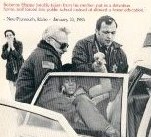
The cover of Sam Blumenfeld's 1981 Is Public Education Necessary depicted a teen being forcibly abducted from his home by agents of the State.  His crime?  Learning outside of government schools.

The cover of Sam Blumenfeld’s 1981 Is Public Education Necessary depicted a teen being forcibly abducted from his home by agents of the State. His crime? Learning outside of government schools.

Recent warnings have come from Elizabeth Mitchell of Answers in Genesis and Roger Kiska of the evangelical Alliance Defending Freedom.

The lesson from Germany is stark, both insist.  In that country, homeschooling parents have had their children taken away by the government.

Mitchell tells the story of the Wunderlich family.  By German law, the four children of this homeschooling family were arrested for violating a school-truancy law.  Mitchell warns that such threats are not limited to Germany.  “Those of us,” she insists,

who maintain that the Word of the Creator of the universe can be trusted from the very first verse work to provide answers to equip children and adults to understand science as well as the suffering in the world in the light of God’s Word. At the same time, we as Bible-believing Christians must not take for granted our freedom to speak the truth. . . .  we need to remain vigilant to guard against encroachments that chisel away at the freedoms we have in our own country.

Writing for the Alliance Defending Freedom, Kiska similarly warns, “today, the suppression of parental rights to teach and influence their own children isn’t restricted to overtly fascist regimes.”  In Sweden and Germany, “a land once shrouded under the Nazi flag,” homeschooling families have been attacked by government forces.  Such threats are not limited to Europe, Kiska insists.  He asks,

So, could Europe’s degree of intolerance and crackdown on homeschooling reach American shores anytime soon? It all depends on how vigilant we are in opposing decisions like the one in New Hampshire—and it’s precisely why ADF is fighting to protect parental rights in that case and abroad so that a very nasty cancer is not allowed to grow.

For outsiders like me, this anti-state rhetoric can seem strangely hyperbolic, even a “paranoid style.”  But dismissing these fears as mere social neurosis misses the point.  For many Americans of a conservative bent, the dangers of government aggression are of primary concern.  So, for instance, when pundits such as Allison Benedikt make an aggressive case for public education, many conservative writers express alarm.

This is more than just a paranoid style.  This is a thorough-going distrust of government power.  This distrust lies at the heart of conservative thinking in the United States.  Many conservatives still relish the pithy expression of this central idea by Ronald Reagan.  As Reagan put it, the most terrifying words in the English language are these: “I’m from the government and I’m here to help.”

For some conservatives, that government “help” might include the forcible abduction of children.  Folks like me might scoff at the extreme paranoia of such ideas, but we will be wise to understand that such warnings resonate with large numbers of Americans.


Jesus, Measles, and the Fight against Science

Does Jesus want your children to get measles?

A recent outbreak at a Texas mega-church highlights the tangled connections between faith, schooling, and science.

The fight against evolution gets all the headlines, but as this story shows, the connections between religion, education, and science can get a lot more convoluted.

As journalist Liz Szabo reported in Religion News Service, Eagle Mountain International Church in Newark, Texas, seems to be ground zero for a recent measles outbreak.  Twenty-five people in all have been sickened, fifteen of whom have direct connections to the church.

A visitor to the church from an unnamed country in which measles are common seems to have sparked the mini-demic.  Pastor Terri Parsons has warned of the connections between vaccinations and autism, a connection mainstream scientists have decisively pooh-poohed.  However, Pastor Parsons has also now encouraged members of the EMIC community to get vaccinated against measles.

According to the RNS story, the infected young people are all home-schooled and apparently unvaccinated.

So does Jesus want children to get measles?  Of course not.

But skepticism runs deep among conservative Christians.  In this case, conservatives did not trust mainstream science’s claims that immunizations were a good idea.  Nor did they trust the state board of education enough to agree that all children of a certain age must get the measles vaccine.


Fundamentalists Go to School

Homeschool, fundamentalist colleges, mainstream law school.

That’s the educational career described movingly this morning by “Georgia” at Defeating the Dragons.

Georgia describes her parents’ decision to pull her out of public schools.  Though her parents were indeed staunchly conservative religious folks, the decision, as she remembered, was more about academic rigor than about Jesus.

When it came time for college, she first attended Pensacola Christian College.  As I’ve written elsewhere, the founders of this school chastised the leaders of Bob Jones University for not being strict enough.

From there, she moved to the relatively liberal Liberty University, “relatively” being the key word here.  With that degree under her belt, she attended Vanderbilt University Law School.

For those of us outsiders who are trying to understand conservative thinking about education, her story can tell us a great deal about one family’s attitudes.  As she remembers it, there was (and is) a good deal of bitterness and disagreement within her own family about the contours of proper education for conservative Christians.


“Home-school Freak:” A Portrait of American Christian Homeschooling?

What is the world of conservative Christian homeschooling like?

A recent memoir in Salon painted a picture of cultic isolation and criminal parental negligence.

Author Leslie Patrick described a youth spent watching TV with her sister while her overworked mother slept.  They were told to stay away from windows so that the happy public-school children across the street wouldn’t witness their truancy.  They had some schoolbooks, but without parental guidance, Patrick and her sister spent their days curled up in front of the television instead.

The result?  No surprise.  When Patrick finally enrolled in a Christian school in tenth grade, she could not begin to keep up with the academic work.  Her natural shyness added to her “freak”-ish separation from the current fashions of teenagers in her school.  With good luck, Patrick reports, she somehow managed to survive her religious education and emerge “normal.”

Is this what Christian homeschooling is like?  As Patrick notes,

I realize that many of the nearly 2 million home-school students in the United States don’t have experiences like mine. They get sparkling educations, and come through the relative isolation with their social skills intact.

If this is the case, why do we find articles about religious-educational freakishness so compelling?

I wonder if a number of us liberals harbor deluded stereotypes about the world of Christian education.  The “secret” world of such intensely religious schools becomes an object of morbid fascination, a theological, cultural, and personal trainwreck from which we self-satisfied liberals cannot turn away.  This is why, perhaps, occasional glimpses like that of the recent “Bible dinosaur” quiz become such objects of fascination.  This is why, perhaps, the editors at Salon agreed to publish Patrick’s idiosyncratic expose.

My hunch is that the everyday world of the average Christian homeschooler is far too boringly mundane to ever rival the headline-grabbing allure of the “home-school freak.”  Nevertheless, in spite of Patrick’s belated acknowledgement of the real experience of “many” Christian homeschoolers, readers of her sad memoir are likely to come away with a skewed and misleading vision of conservative education.


A Visit to a Creationist Homeschool Science Fair

What would a creationist homeschool science fair look like?

Greg Laden at ScienceBlogs described his recent trip to one in Minneapolis-St. Paul.

Laden offered more than just a snarky blanket condemnation of the creationism and science on display.  Some of the exhibits, Laden wrote, were actually pretty good.  In one exhibit, students created and explained plant tissue batteries, for instance.

Some students, though, conducted experiments that disappointed the mainstream scientists.  One student, for instance, made salt stalactites to prove that they could form more quickly than some mainstream scientists believed.  According to Laden, mainstream science already knew that even limestone stalactites could form fairly quickly.  Another student retreated from science to explain animal behavior.  Faced with a question he or she could not answer, one student told Laden that “a certain problem would be solved because ‘God put something in the animal to make that happen.'”

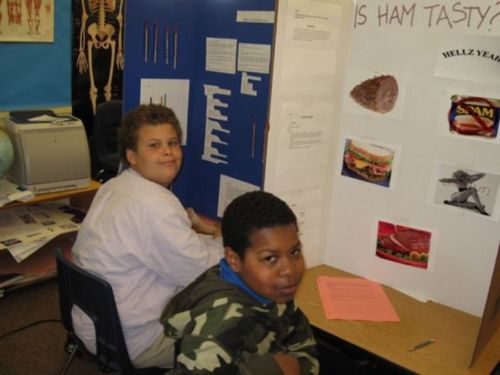
Non-creationist science fair...

Non-creationist science fair: “Is Ham Tasty? Hellz Yeah”

Best of all, IMHO, Laden recognized that some of the weaknesses of student presentations were not due to religious belief, but rather due to the age of the presenters.  As Laden put it, “many of the limitations and shortfalls of the less than stellar posters were typical of small scale school science fairs in general, not peculiar to these students.”

This point is clearly one that could use more study.  We observers of creationism and evolution education often lament the fact that relatively few students learn any real evolutionary science.  But we must remember the broader point: relatively few students learn any real anything in too many of America’s schools.  It is not fair to assume that students’ generally weak grasp of evolutionary concepts is necessarily due to religious dissent.  Rather, we should measure the successful teaching of evolutionary concepts alongside other basic concepts such as the appreciation of literature, the history of the founding of the country, or algebra.  My hunch is that the “shocking” weakness of most American adults in mastering the basic concepts of evolutionary theory might not look so shocking compared to the weakness of American adults in mastering other basic concepts.