Do Georgians Hate Gay Kids?

About a week ago, an article in the New York Times drew attention to a report about anti-gay discrimination in tax-funded private schools in Georgia.  Though liberal groups such as Americans United for Separation of Church and State have publicized the findings, responses from conservative America seem more muted.  I wonder if this lack of indignant defenses from conservatives results from the implicit connection between this issue and racial discrimination.

The report from the Southern Education Foundation warned that of the 400+ Georgia private schools that receive tax-funded scholarship money, 115 schools discriminate openly and explicitly against homosexuality.

The report included policy statements from several such schools.  For instance, according to the report, the parent/student handbook at Shiloh Hill Christian School in Kennesaw warned that any student who said, “I am gay,” “I am a homosexual,” or a male saying, “I like boys,” could be expelled.  Another school statement quoted in the report warned,

“In accordance with the Statement of Faith and in recognition of Biblical principles, no ‘immoral act’ or ‘identifying statements’ concerning fornication, adultery, homosexuality, lesbianism, bisexuality, or pornography, will be tolerated.  Such behavior will constitute grounds for expulsion. . .”

These schools all receive funding from student scholarship organizations (SSOs).  SSOs, active in eleven states, according to the New York Times, allow taxpayers to divert taxes dollar-for-dollar to these scholarship organization.  Instead of paying their money in taxes, in other words, taxpayers can pay for students to attend private schools.

How have conservatives defended the program?  Fairly quietly, it seems to me.  Perhaps my antennae are simply not sensitive enough, but I have not read many endorsements of the Georgia program.  This is surprising, since other school-funding options such as charter schools and school vouchers usually draw vociferous defenses from conservatives.

There have been some arguments in defense of Georgia’s policies.

In a post on First Things’ First Thoughts blog, for example, Joseph Knippenberg made a religious-liberty defense of the Georgia program.  First, Knippenberg argued, taxpayers ought to have control over their tax dollars, to some extent.  Until their money enters the public treasury, it is still private, Knippenberg pointed out.  Therefore, choosing to donate to certain schools must be considered in the same category as choosing to donate to certain churches, or hospitals, or advocacy organizations.

Second, Knippenberg extended this argument to people’s right to practice their religions freely.  “To deny people the opportunity to make a contribution to the faith of their choice,” Knippenberg wrote, “is to deny their religious freedom.”

It seems there are other arguments conservatives could make.  As one commenter on a Christianity Today blurb noted,

“Sexual preference or orientation is not a person. It is not unjust discrimination to discriminate between acts, including sexual acts that respect the personal and relational essence of the human person and are thus acts of authentic Love, and acts, including sexual acts, that do not respect the personal and relational essence of the human person and are thus demeaning.”

These comments from “Kathleen” articulate a deeper possible defense of Georgia’s policies.  Though I personally agree that Georgia’s tax money ought not fund schools that discriminate against homosexual students, let me try to spell out this possible argument a little bit.

Here goes:

The argument against Georgia’s tax-funding scheme implicitly uses the history of racial school discrimination to discredit the current policy of religious school discrimination.  It fudges the difference.  This implied analogy does not hold water.

All schools, all people, all organizations discriminate.  Any school that admits some people and does not admit others discriminates.  In some cases, private schools discriminate openly against people who can’t or won’t pay their tuition.  And this sort of discrimination raises no objections.

The issue, then, is which sorts of discrimination are legitimate.  On the whole, Americans agree that discrimination by race is not legitimate.  Of course, there are plenty of white- and black-supremacist holdouts.  In general, however, in terms of constitutional law and explicit policy practice, America has abjured its white-supremacist past of schools segregated legally by race.

To imply that all school discrimination belongs in the same moral, legal, and Constitutional category as racial discrimination unfairly smears religious dissenters as bigots.

Again, just to ward off misunderstanding, let me be clear: I’m playing devil’s advocate here.  In this case, I personally believe that public money should not fund private schools that discriminate against homosexuality.

But intelligent scholars have pointed out the flaw in the “bigotry” analogy.

In an essay on Public Discourse a few months back, Princeton’s Robert George assailed the tendency to label all forms of discrimination “bigotry.”  Speaking in regard to the definition of marriage, George argued,

“Thus, advocates of redefinition [of marriage] are increasingly open in saying that they do not see these disputes about sex and marriage as honest disagreements among reasonable people of goodwill. They are, rather, battles between the forces of reason, enlightenment, and equality—those who would ‘expand the circle of inclusion’—on one side, and those of ignorance, bigotry, and discrimination—those who would exclude people out of ‘animus’—on the other. The ‘excluders’ are to be treated just as racists are treated—since they are the equivalent of racists. Of course, we (in the United States, at least) don’t put racists in jail for expressing their opinions—we respect the First Amendment; but we don’t hesitate to stigmatize them and impose various forms of social and even civil disability upon them and their institutions. In the name of ‘marriage equality’ and ‘non-discrimination,’ liberty—especially religious liberty and the liberty of conscience—and genuine equality are undermined.”

Similarly, Peter Berger noted the increasing tendency of homosexual-rights advocates to frame their arguments as matters of rights.  As Berger wrote in The American Interest,

“At the time [the 1950s] homosexual rights were advocated by a discourse of individual freedom, basically freedom to choose one’s values and way of life. In other words, the discourse was in terms of the first amendment to the US constitution. The discourse now is very different: Homosexuality is not a choice, but a destiny—an individual does not, cannot choose to be gay—one is born gay—and society should acknowledge and respect this congenital fate. I think it is very clear why this change in discourse occurred: If homosexuality is destined not chosen, it is analogous to race—and thus the movement for homosexual rights can wrap itself in the mantle of the Civil Rights movement. Let me reiterate: I have identified all along with the insistence on the rights of homosexuals, and I think I understand the rhetorical logic of the changed discourse. Is it based on good scientific evidence? I don’t know.”

In other words, if conservatives hope to maintain schools—even private schools, even religious schools—that discriminate against homosexual students, it will be imperative for conservatives to reframe this issue.  If Americans see Georgia’s funding of anti-homosexual schools as a fair analogy to public funding of anti-African American schools, the writing is on the wall.  Such racial discrimination no longer musters any public support.

Arguing that this is an issue of religious freedom will not be enough.  Conservatives must do more than just argue that discrimination against certain lifestyle choices is a legitimate part of their religious freedom and expression.  After all, religious freedom has been abridged in the quest for racially desegregated schools.  Conservatives, it seems to me, must do what Professor George advocates: break the intellectual connection between discrimination on the basis of race and discrimination on other bases.  Only if discrimination against homosexuals is seen as a legitimate option—even by those who do not agree—will religious institutions manage to maintain such policies.
Lesbians and Libraries: We’re All Victims Now

The recent fuss over Patricia Polacco’s In Our Mothers’ House has followed a familiar pattern.  First, a mother from conservative Davis County, just north of Salt Lake City, complained when her daughter brought the book home from her school’s library.  The book celebrates a family with two mothers and three children.  Next, the school district decided to keep the book, but put it behind the library counter.  Students would need a parent’s permission to check out the book.  Finally, the American Civil Liberties Union sued, claiming the book must be freely available for all students.

In this case as in so many others, both sides rushed to insist on their own victimhood.

Both sides make the customary arguments.  The ACLU fights for First Amendment freedom.  In the words of one ACLU blogger,

“Removing library books because they ‘normalize a lifestyle that parents don’t agree with’ or contain positive portrayals of LGBT protagonists violates the First Amendment rights of all students to access ideas in a school library on a viewpoint-neutral basis.” 

Conservative Christians claim the books are part of a widespread conspiracy—the “homosexual agenda”—to teach children in public schools that all sexual lifestyles are equally valid.  In this case, opponents of the book cite Utah law, which they say forbids school curricula that promote homosexual lifestyles.

Just as predictably, both sides depicted themselves as the victims.  Consider the author’s defense.  Polacco, writing on the ACLU’s blog, told the story of the book’s origins:

“One year I was visiting a fourth grade class and the teacher had arranged for me to hear essays that her students had written entitled: ‘My Family.’ . . . one little girl stood up and began to read. She was immediately asked to take her seat by an aide. The aide said scornfully, ‘No dear…you don’t come from a real family…sit down!’

“This child came from a family of two mothers and two adopted siblings. I was so appalled and insulted on that child’s behalf that I immediately, after school that day, went back to my hotel room and wrote, In Our Mothers’ House.”

From the other side, one commenter on a conservative Christian website asked, “Does the ACLU also require that Bibles be on the shelves!”  Another lamented, “Law suit by law suit [the ACLU] are coarsening the moral fabric of America, and our children are the victims!”  A third chimed in, “I don’t hate these people [i.e. homosexuals] & if they want to live this way that’s their business but don’t try to push it on the rest of us!! God help them!!”

Clearly both sides in this school-library dispute focus on their own victimhood.  The ACLU insists that hiding such books behind library desks hurts families.  Polacco argues that treating some families as illegitimate hurts children.  Conservative Christians, for their part, worry about the creeping influence of the ACLU.  Conservatives fret that they have no voice in public institutions.  Their books, most notably the Bible, have been “kicked out,” while books that denigrate traditional lifestyles and morals are promoted.

Neither side publicly notices their own strengths.  We will not hear conservative Christians gloating over the Christian-friendly policies of this Utah school district.  Nor will we hear ACLU types celebrating the power and influence of their national watchdog presence.

Does the rush to victimhood matter?  Only in the sense that a cornered animal fights the fiercest.  By reassuring ourselves that we are the true victims, we condone any escalation in culture-war rhetoric or strategy as a matter of simple self-defense.  If we are all victims, we all have the moral high ground; we all have license to fight dirty.

Mormonism and the Paradox of Modern Homosexuality

There is a deep paradox at the heart of American culture when it comes to homosexuality.  On one hand, Americans seem more accepting than ever.  We have openly gay couples at high school proms, gay characters on primetime sitcoms, and plenty of pop songs insisting that homosexuals are “Born This Way.”

Yet on the other hand, many Americans–not just conservatives or Fundamentalists–display a new anxiety about being perceived as gay.  Male behaviors that might not have raised eyebrows in pre-Stonewall days–think Honest Abe sharing a bed with a male pal–now seem obviously “gay.”

If we outsiders hope to understand Fundamentalist America’s hostility to homosexuality, we need to chip away at this seeming paradox.  In a fascinating essay this morning on Religion & Politics, Kristine Haglund explores the way this modern dilemma plays out in LDS (Mormon) communities.  For male LDS members, Haglund argues, an intensely masculine identity is balanced with a soft gentleness.  Male church members have an intense patriarchal privilege.  Yet they are also tied to a sexual chastity that forbids homosexual sexual conquest as a way to establish hetero bona fides.  Men are required to spend their late-teen years in an intimate partnership with another young missionary male.  And in community, men are encouraged to display stereotypically feminine gentleness and emotionality.  These things lead, Haglund writes, to an exaggerated display of masculinity, in traditions such as “church ball.”  Yet LDS members such as Haglund herself are accustomed to seeing men act in gentle, emotional ways in public.  Haglund notes,

“Paradoxically, these behaviors, which might be pejoratively coded ‘gay’ or effeminate in other contexts, are key components of Mormon masculinity. A look at this fraught masculinity may offer a glimpse into what drives the LDS Church, and Mormon politicians like Mitt Romney, to insist on the defense of traditional gender roles in the family. The unique contours of Mormon masculinity can also help answer the question: Why are (many) Mormons so vehemently opposed to gay marriage and any other overt expression of homosexuality?

“The short answer to that question is that the unique mix of ritualized homosociality and patriarchal authority—the bedrocks of Mormon masculinity—means that many Mormon men are nervous about permitting even the idea that there might be more than a platonic ‘bromance’ in the post-Church Ball game sweaty hug.”

What is true for LDS men might be extended to American men as a whole.  As the notion of homosexuality becomes more of an everyday reality in American culture, some males struggle to establish their heterosexuality beyond reproach.  Does this fuel the hostility in Fundamentalist America to the notion of homosexuality as simply another way to be a sexual person?  In other words, as men become more keenly aware of homosexuality as a real phenomenon, does it push them to a sterner insistence on heterosexual supremacy and traditional family norms?

I’m nervous about the dangers of psychologizing such a broad cultural tendency.  It is a tried-and-true culture-war tactic to dismiss any opposition as somehow psychologically maladjusted.  We don’t want to insist that traditionalist opposition to homosexuality can only come from ignorance, fear, and Freudian neuroses.  But Haglund’s observations about the  “performance of Mormon masculinity [as] a difficult balancing act, a tightrope walk between poles established by a brutish, hyper-masculine ‘natural man’ and an effeminate gay man” seem equally applicable outside the LDS temple walls.  For many American men, increasing awareness that homosexuality is everywhere may lead to a desire to project a more firmly anti-homosexual identity.

Tradition and Homosexuality

Why do some people care that other people are gay?  If we hope to understand Fundamentalist America, we need to wrestle with this question.  To begin, we should acknowledge that opposition to homosexuality is a deep tradition in our culture.  Some of the foundational thinkers of our civilization considered homosexuality to be a horrible thing.  For those like me who consider homosexuality simply another way to be a sexual person, this hostility toward homosexuality is difficult to understand.

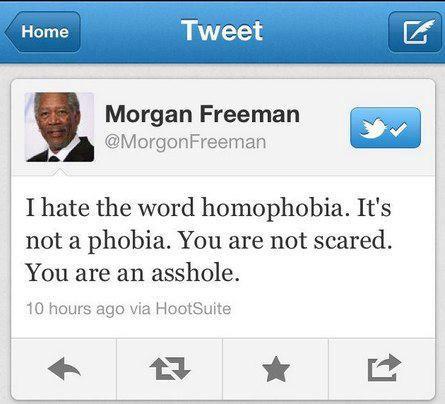
Part of the difficulty must result from the infinitely complicated nature of anti-homosexual feeling in America.  Even those like me sympathetic to what we’re calling Fundamentalist America must acknowledge that some anti-homosexual feeling must result from old-fashioned ignorance and bigotry.  Some, but not necessarily all.  Many of my secular and liberal friends, colleagues, and acquaintances seem to lump all opposition to homosexuality to mere hatred.  They assume, like Morgan Freeman, that any anti-homosexual thinking results from small-minded intolerance of those who are different.

Image source: The Obamacrat.com

To really understand Fundamentalist America, we need to avoid Freeman’s sort of partisan sniping.  It may be briefly satisfying, but it doesn’t help us understand.  Those who simply hate all homosexuals are likely assholes.  But while we can’t forget that component of anti-homosexual culture in today’s America, we need to also acknowledge that many of the best minds of our past have also denounced all homosexuality.

PLATO

Plato denounced homosexuality in the harshest terms.  He repeatedly called it unnatural. (e.g. Laws, VIII, 836Laws, I, 636c.)  Plato’s suggestion for rooting out this unnatural practice was simple and shocking to the modern ear.  Simply convince people that homosexuality belonged in the same class as incest, and the “problem” would disappear. (Laws VIII, 838.)

The goal, according to Plato, must be to ban homosexuality entirely.  (Laws, VIII, 837).

LEVITICUS

Americans may be more familiar with the Biblical tradition on homosexuality.  After all, as we have explored in the pages of ILYBYGTH, American culture has been and remains profoundly influenced by the Bible.  In twenty-first century culture wars, the rules of Leviticus are often raised as evidence for an anti-homosexual attitude.  The book is clear: homosexuality must be viewed as an abomination.  See for example, the following snippets:

Lev. 18.22: “Do not lie with a man as one lies with a woman; that is detestable.”

Lev. 20.13: “If a man lies with a man as one lies with a woman, both of them have done what is detestable.  They must be put to death; their blood will be on their own heads.”

Those who believe the Bible to be a good moral guide must at least wrestle with these commandments.

AUGUSTINE

In his Confessions, Augustine articulates a vision of human sexuality that denounces all non-procreative sex as counter to the will of God.  In Book III, chapter VIII, Augustine called the “sin of Sodom . . . abominable.”  Such acts, the Bishop of Hippo charged, “deserve punishment wherever and whenever they are committed.”  God’s purpose, Augustine argued, was not for humans to “use each other in this way.”

What do these ancient denunciations of homosexuality mean for twenty-first century America?  For one thing, it does not seem fair to interpret these ideas away.  Though some fancy intellectual footwork could likely dispute the meanings of each of these individual quotations, the overall tone of the ancient sources above seems clear: Each condemns homosexuality as unnatural, against God’s plan.  But this leaves us with one obvious question: What does it matter if these ancient sources condemn homosexual practice?  Do the attitudes of the ancients need to influence our thinking?

After all, it does seem as if Plato was an asshole.  In addition to denouncing all homosexuality, he also had complicated ideas about the permissibility of poetry, for instance.  And the lifestyle commandments in Leviticus certainly seem motivated by a small-minded legalism.  For example, we are told in Lev. 19.19 we must not wear clothes made of both linen and wool.   Is it fair to use Leviticus as a reason for opposition to homosexuality, but not use it to fight against textile abuse?  Can Fundamentalist America cite Plato’s opposition to homosexuality, but not insist—as Plato would—that children be taken away from their biological parents and raised by the state?   Such arguments seem like attempts simply to use the Bible or Plato to enforce modern prejudices.  But even if that is the case, we outsiders to Fundamentalist America must acknowledge the deep cultural roots of opposition to homosexuality.

Even more difficult, we need to wrestle with Augustine’s more nuanced understanding of human sexuality.  Homosexuality, for Augustine, was simply a variant of humanity’s depraved understanding of itself.  In an Augustinian framework, the notion of a “sexual orientation” itself reflects a flawed and dangerous understanding of the nature of humanity.  The orientation of humans ought not be sexual, but rather divine.  To live properly, Augustine argued, our minds should be on God, not sex.  This is not bigotry against homosexuals as such, but an argument about the nature of humanity profoundly at odds with our notion that any suppression of sexual feelings is a dangerous affair.

Morgan Freeman probably would not impressed by the deep tradition of anti-homosexual thought in Western culture.  Anyone who starts by dismissing all those with whom he disagrees as simple assholes does not likely desire a more profound understanding of his opponents.

But we do.  Here at ILYBYGTH, we hope to understand conservative opposition to homosexuality.  In addition to strains of bigotry and ignorant intolerance, we must also recognize the foundational element of anti-homosexuality in our shared culture.  This may be a bitter pill for folks like me to swallow, but it is true: Those who dislike homosexuality can claim a long and distinguished intellectual heritage.

Is Gay Okay? Not in Utah…

Image source: Business Insider

I’ll admit it.  I find Glee offensive.  Not because of any teen-steam sexuality or anything, but just because everyone keeps singing and dancing all the time.

Now it appears a new show by one of the creators of Glee will not be aired by a Utah NBC affiliate.  According to an article by Scott Pierce in the Salt Lake Tribune, TV station KSL will not show The New Normal in the usual NBC timeslot.  Why not?  The show depicts the lives and times of a gay couple and their quest for a surrogate-carried baby.

For the culture-war-tuned antennae of ILYBYGTH, the interesting part of this story is the language each side uses to explain its position.  According to Jeff Simpson, CEO of KSL’s parent company, the show was banned because, “The dialogue might be excessively rude and crude. The scenes may be too explicit or the characterizations might seem offensive.”

Voices from Fundamentalist America support this decision.  The activist group One Million Moms has opposed the show.  According to the group’s website,

“NBC is using public airwaves to continue to subject families to the decay of morals and values, and the sanctity of marriage in attempting to redefine marriage. These things are harmful to our society, and this program is damaging to our culture. . . .

“Millions of Americans strongly believe that marriage should be between one man and one woman. NBC’s “The New Normal” is attempting to desensitize America and our children. It is the opposite of how families are designed and created. You cannot recreate the biological wheel.”

In these short paragraphs, One Million Moms sums up (sum up?) the reasons some conservatives give for opposing homosexual marriage and homosexuality in general.  In coming weeks, we at ILYBYGTH will be exploring these arguments in more detail.

In the meantime, the defense of the show demonstrates one of the most popular arguments made in favor of gay marriage.  As Glee and New Normal producer Ryan Murphy argued, “It’s 2012.  I don’t think this is anything so outrageous.”


Required Reading: The “Gospel Homosexual”

Just like all people, many Fundamentalist Americans can be a lot of things at the same time.  At Religion Dispatches, Douglas Harrison interviews Anthony Heilbut about people who live with seemingly irreconcilable contradictions: African American, conservative Christian, and homosexual, all at once.  And often without feeling the conflict.  How do they do it?

Heilbut describes his recent book, The Fan Who Knew Too Much: Aretha Franklin, the Rise of the Soap Opera, Children of the Gospel Church, and Other Meditations.  One of his themes is the persistent tradition of “gospel homosexuals.”  Heilbut says in this tradition, homosexuals have long had an influential role.  Often called “the children,” they experienced an intensely ambiguous role as singers, musicians, and fans.

On the one hand, “the children” endured or even participated in an increasingly rabid anti-homosexual theology and culture in the black church.  On the other, they pushed for acceptance–albeit in a very different way than many other post-Stonewall gay-rights activists.

Heilbut wants to crack the anti-gay code, both to prevent more ruined lives and to promote better music.  As he told Harrison,

“What I want to say to all of these people from all denominations—and we know that homophobia is allowed in all the churches—is: where would religious art be without gay men? You wouldn’t have the Sistine Chapel. You wouldn’t have The Last Supper. You wouldn’t have “Ave Maria.” Most likely you wouldn’t have the “Hallelujah Chorus,” because we seem to think Handel was gay.”   

The story, as Heilbut tells it, is not a happy one.  His gospel homosexuals lived tortured, even persecuted lives.  “You must remember,” he concludes,

 “that I’m really very angry. I really want to be literate and literary, but I’m really furious. Probably the most daring thing I say in the book is when I compare [the gospel church to] the Taliban, and then I say, thinking of all the ruined gay lives, this really is the number that no man can number.”

It would be hard to imagine a group of people more exposed to the destructions of America’s culture wars than this.  Forced to negotiate between seemingly irreconcilable cultural identities, some members of this contested group made some of the greatest contributions to gospel music.  More than that, Heilbut implies that other gay African Americans, such as James Baldwin and George Washington Carver, found themselves propelled by these ambiguities to excel in literature or science, too.

The Bible in America: Proof-Texting and the Cultural Divide

Quick: What does the Bible have to say about vegetarianism?  …about the war in Iraq?  …about Catholicism?

I don’t know the answers to these questions.  And, without meaning any disrespect, I can honestly say I don’t care.  I don’t think my ignorance on these issues makes me “ignorant.”  I don’t think it makes me uneducated.  I just don’t think the Bible’s opinions on these issues are important.  Don’t get me wrong: I’m not anti-Bible.  In fact, I’m confident I’d be better off if I had spent my youth memorizing the Psalms instead of the lyrics to the Gilligan’s Island theme song.  But I didn’t.  And I don’t feel the loss.

Just sit right back and you’ll hear a tale…

However, many citizens of Fundamentalist America would consider my ignorance deeply embarrassing.  For many conservative religious folks, especially among the Protestant denominations, the ability to cite Scriptural chapter and verse is one sign of an adequate spiritual education. 

This divide fuels America’s culture wars.  Many non- or anti-fundamentalists doubt that fundamentalists are even capable of rational, logical intellectualism.  (Consider a few examples: here, here, here, here, and here.)  The more ardently conservatives dig into their Bibles to prove their points, the more confident anti-fundamentalists become that conservatives have lost all claim to intellectual coherence.    

And many fundamentalists don’t seem to understand that their compilations of Biblical proof-texts carry very little weight outside the borders of Fundamentalist America.  They build arguments against homosexuality  or same-sex marriage based on collections of chapter and verse.  But such arguments are only compelling—or even comprehensible—if we accept the premise of the Bible proof-text in the first place.  As a result, different sides do not speak to one another.  They speak—or yell—past one another, scoring points that only the people on their own side can recognize.    

If we outsiders are to understand Fundamentalist America, we need to understand the proof-text tradition.  Why do religious conservatives care so much what Leviticus has to say about whether or not people should have sex with animals?   Why is it so important that evidence for a young earth can be found not only in Genesis, but also in Mark 10:6, 1 Corinthians 15:26, and Matthew 19:4,5? 

It is not a stretch to say that this style of proof-text argument had been, until the late 1800s or early 1900s, the standard style of theological disputation among Protestants.  In the nineteenth century, European scholars began to look at the Bible in a new way.  By the turn of the twentieth century, leading American Protestant theologians disputed the intellectual usefulness of the Scriptural proof-text.  In 1907, for instance, William Newton Clarke lambasted his more conservative colleagues for their continued reliance on this method.  “Even if,” Clarke argued, “a proof-text method were a good method in itself, it could not be successfully employed now, since the texts of the Bible have suffered such serious though unintended distortion.”  Since liberal theologians had come to disagree with the notion of an inerrant Bible, the method of proving an argument by assembling an overwhelming dose of chapter and verse no longer seemed compelling.

During the twentieth century, however, among Bible-centered Protestants—including self-styled fundamentalists, neo-evangelicals, Pentecostal groups, conservative Lutherans, and others—the proof-text tradition continued.  For those groups who maintained a faith in the Bible as inerrant, it remained convincing to prove every point with an assembly of relevant texts. 

Consider the following doctrinal statement from David Cloud’s Way of Life Ministries.  Each point is proven with an array of relevant texts. 

STATEMENT OF FAITH

Way of Life Literature
P.O. Box 610368, Port Huron, MI 48061
866-295-4143 (toll free), fbns@wayoflife.org
http://www.wayoflife.org


THE SCRIPTURES

The Bible, with its 66 books, is the very Word of God. The Bible is verbally and plenarily inspired as originally given and it is divinely preserved in the Hebrew Masoretic Text and the Greek Received Text. The Bible is our sole authority in all matters of faith and practice. The King James Version in English is an example of an accurate translation of the preserved Hebrew and Greek texts; we believe it can be used with confidence. We reject modern textual criticism and the modern versions that this pseudo-science has produced, such as the American Standard Version, the New American Standard Version, the Revised Standard Version, and the New International Version). We also reject the dynamic equivalency method of Bible translation which results in a careless version that only contains the general ideas rather than the very words of God. Examples of dynamic equivalency versions are the Today’s English Version, the Living Bible, and The Message.

2 Samuel 23:2; Psalm 12:6-7; Proverbs 30:5-6; Matthew 5:18; 24:35; John 17:17; Acts 1:16; 3:21; 1 Corinthians 2:7-16; 2 Timothy 3:15- 17; 2 Peter 1:19-21; Revelation 22:18-19

THE CREATION

We believe in the Genesis account of Creation and that it is to be accepted literally and not figuratively; that the world was made in six 24-hour days; that man was created directly in God’s own image and did not evolve from any lower form of life; that all animal and vegetable life was made directly and made subject to God’s law that they bring forth only “after their kind.”

Genesis 1; Nehemiah 9:6; Job 38:4-41; Ps. 104:24-30; Jn. 1:1-3; Acts 14:15; 17:24-26; Rom. 1:18-21; Col. 1:15-17; Hebrews 1:1-3; 11:3

THE WAY OF SALVATION (THE GOSPEL)

Salvation is by the grace of God alone, which means that it is a free gift that is neither merited nor secured in whole or in part by any virtue or work of man or by any religious duty or sacrament. The gift of God’s grace was purchased by Jesus Christ alone, by His blood and death on Calvary. The sinner receives God’s salvation by repentance toward God and faith in the Lord Jesus Christ. Though salvation is by God’s grace alone through faith, it results in a changed life; salvation is not by works but it is unto works. The faith for salvation comes by hearing God’s Word. Men must hear the gospel in order to be saved. The Gospel is defined in 1 Corinthians 15:1-4.

John 1:11-13; 3:16-18, 36; 5:24; 14:6; Acts 4:12; 15:11; 20:21; Romans 10:9-10,13, 17; Ephesians 1:7; 1:12-14; 2:8-10; Titus 3:3-8; Hebrews 1:3; 1 Peter 1:18-19; 1 John 4:10

CIVIL GOVERNMENT AND RELIGIOUS LIBERTY

We believe that civil government is of divine appointment for the interests and good order of human society; that magistrates are to be prayed for (1 Tim. 2:1-4), conscientiously honored and obeyed (Mat. 22:21; Rom. 13:1-7; Titus 3:1; 1 Pet. 2:13-14), except only in the things opposed to the will of God (Acts 4:18-20; 5:29); that church and state should be separate, as we see in Scripture; the state owing the church protection and full freedom, no ecclesiastical group or denomination being preferred above another. A free church in a free state is the Christian ideal.

We can see the proof-text tradition in David Cloud’s sermons as well. 

The way Cloud and Way of Life use proof-texts is just one example from a galaxy of possible examples out there.  Especially among Bible-based conservative evangelical Protestant groups, the proof-text is the method by which truth is established.  The Bible is the inerrant authority.  In order to make any point, about any subject, the name of the game is proof-texting.  Of course, among many conservative Protestants, the term “proof-text” has taken on negative connotations.  It should not mean that one simply has to slap a bunch of Bible citations together to prove a point.  In this continuing intellectual tradition, the cogency of the argument is based on the proper selection of texts.  How well do the selected texts establish the point at hand?  Does the author use each text in a way that respects the context and original meaning of the selected passage?  Does the author consider relevant passages that might disagree with this interpretation?  Or does a poorly educated pastor merely assume an air of false erudition by throwing Scriptural citations around willy-nilly

To be sure, it is an intellectual tradition that no longer carries weight in mainstream religion and culture.  Though large majorities of Americans might believe that the Bible contains the answers to all of life’s questions, those same majorities do not necessarily agree that the Bible should be the main intellectual authority in all matters.  Indeed, especially galling to many non- and anti-fundamentalists is proof-texters’ assumption that their particular religious tradition should be considered binding in matters of public policy.  In other words, it may be fine for Way of Life to demonstrate the validity of its creed through proof-texts.  But that does not mean that proof-texts can be used to demonstrate the need to teach religious doctrine in science classes. 

These are important arguments.  Proof-texters need to understand that their intellectual tradition does not carry weight outside the borders of Fundamentalist America.  But that is a much different thing than admitting to being non-intellectual or anti-intellectual.  If we outsiders can better understand the tradition of proof-texting, we will be better able to speak intelligently, reasonably, calmly, and even productively with Fundamentalist America.     

FURTHER READING: William Newton Clarke, The Use of the Scriptures in Theology (Edinburgh: T. & T. Clark, 1907); Timothy P. Weber, “The Two-Edged Sword: The Fundamentalist Use of the Bible,” Nathan O. Hatch and Mark A. Noll, eds., The Bible in America: Essays in Cultural History (New York: Oxford University Press, 1982), 101-120.

In the News: “Gay” Is not Slander in NY

In a story from my new hometown, a New York appellate court ruled recently that it no longer counted as slander to falsely accuse someone of being homosexual.  In this case, a woman spread a rumor that Mark Yonaty was gay in order to get his girlfriend to break up with him.  Yonaty sued and lost.  As the New York Times reported, the appeals court threw out earlier rulings in Yonaty’s favor, saying they were “based on a false premise that it is shameful and disgraceful to be described as lesbian, gay or bisexual.”

What does this mean for Fundamentalist America?  On one hand, it could mean that FA will find itself more marginalized if it maintains its opposition to homosexual sex and relationships.  Some conservative groups, for instance James Dobson’s Focus on the Family, emphasize love and care for those engaging in homosexual behavior or identifying as homosexuals, even while condemning all sex outside of marriage, especially including gay sex. 

Other FA voices keep up harder-edged language against homosexuality.  A recent article by Bryan Fischer, for instance, on Rightly Concerned, affiliated with the American Family Association, notes that America must discriminate against homosexuals not out of hate but out of love.  However, Fischer also compares healthy anti-homosexual discrimination to other healthy forms of discrimination:

We discriminate against adults, even priests, who have sex with children. We discriminate against teachers who have affairs with students. We discriminate against teachers who moonlight in the porn industry. We discriminate against students who engage in sexting. We discriminate against rapists. We discriminate against those who expose sexual partners unknowingly to the AIDS virus. We discriminate against those adults who commit statutory rape against minors.

If the recent ruling from Albany is a bellwether for the direction of mainstream American culture–and that’s a big if–then Fischer’s type of argument is swimming upstream.  If it is no longer an insult to call someone ‘gay,’ then it will make no sense legally, politically, or culturally to discriminate against homosexuality. 

There’s another lesson we can draw from this article.  At least one gay-rights activist has warned that this decision must not be taken as the end of discrimination against homosexuality.  As the UK’s Daily Mail reported, New York activist Jay Blotcher insisted that being identified as gay could still summon up “something akin to a lynching mob” in parts of the country.  “It’s still a thorny issue,” Blotcher said. “Bottom line, just because you have gay characters on television that make everybody laugh doesn’t mean that the entire country embraces gay people as equal citizens yet.”

Blotcher’s comments illuminate one of the most puzzling aspects of these kinds of “culture-war” debates.  Instead of celebrating the achievement of mainstream acceptability for homosexuality, Blotcher emphasizes the continuing persecution of homosexuals.  Like Blotcher, many voices from FA insist on their own status as beleaguered cultural minorities.  This tradition among American Protestantism has long roots, back to the seventeenth-century persecution of “Pilgrims” and “Puritans” that led in part to the founding of New England.  In the twentieth century, fundamentalist activists have often used Blotcher’s language of continuing discrimination to defend the borders of Fundamentalist America.     

To cite just one example, in 1965 in the wake of the US Supreme Court rulings against school-sponsored religious devotions in public schools, fundamentalist editor and publisher John R. Rice insisted that “White Minorities Have Rights, Too.”  In the pages of his Sword of the Lord magazine (volume 31, September 3, 1965, page 1), Rice asked,

“If Christian people do not have a right to have the Bible taught in the schools, then infidels have no right to teach infidelity in the schools . . . . Why not have freedom in America as much for one minority as another?  Why not observe the rights of white people as well as the rights of Negroes?  Why not observe the rights of nonunion workers as much as the rights of union workers?  Why not observe the rights of Bible believers as well as the rights of the infidels in the churches and infidels in courts or schools?” 

Just as Jay Blotcher warned not to remove homosexuality from the category of defended minorities, so fundamentalists such as Rice insisted that they be allowed to claim minority status.  One of the quirks of America’s culture wars is that both sides often claim the rights and privileges of both majority AND minority status.  If we hope to understand Fundamentalist America, we need to understand the continuing propensity of fundamentalists to do both at the same time.    


TRADITIONALIST EDUCATION Part II: VALUES…of what?

Formal education must include moral values.  In some subjects that fact is overwhelmingly obvious.  History and literature, for instance.  At the most basic level, the selection of literature reveals an entire worldview.  What counts as a good book?  Is it Holden Caulfield trying to pick his way through the field of phonies to discover an authentic life?  Or is it Abraham pulling Isaac up to the top of the mountain to fulfill God’s cruel command?

But such moral values are embedded in every subject, even those that seem to be mere delivery of information.  Some people might suggest that schools should simply teach students academic skills: reading, writing, arithmetic.  But what would such a value-free classroom look like?  Will women and girls be allowed to participate?  Will there be tuition?  Will there be an authoritative teacher at the front of the room dispensing knowledge, keeping order, and evaluating student work?  Or will it be a collective effort, each student responsible for his own learning?  Will students vote to decide policy?  The classroom and school structure dictate a comprehensive set of values, even when the subject matter is limited to such seemingly neutral subjects as geometry and plane mechanics.

Schooling these days is in a woefully chaotic moral condition.  Officially, most public schools are meant to be ruled by a value system of pluralism.  Not verging into the choppy waters of cultural relativism, in which all cultural values are deemed equal, pluralism hopes to insist on a moral code of tolerance and acceptance.  Every type of culture and belief will be celebrated.  Diversity will be embraced as the new path to moral relevance.

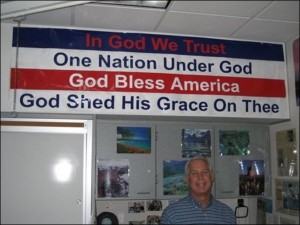
All well and good.  From the traditionalist perspective, however, pluralism has the crippling internal flaw of claiming to welcome all cultures, while in fact it often belittles or even criminalizes traditionalist beliefs.  Just recently, a spate of legal cases involving teachers’ religious views has illustrated this trend.  First, from the San Diego area, Bradley Johnson was ordered to remove large signs from his math classroom containing such slogans as “In God We Trust,” “One Nation Under God,” “God Bless America,” and “God Shed His Grace On Thee.”  The California Ninth Circuit Court of Appeals ruled that Johnson did not have free-speech rights to keep such signs in his classroom.  The Court reasonably concluded that such slogans, though they came from well-known songs or foundational historical documents such as the Declaration of Independence, created an atmosphere that unacceptably breached the wall of separation between church and state.  They implied that the school endorsed Judeo-Christian belief.

It seems as if that was exactly Johnson’s intent.  Johnson was not merely a patriotic teacher with a yen for big banners.  He was also the faculty leader of the school’s Christian Club.  When the school offered to replace his banners with reproductions of documents such as the Declaration of Independence, Johnson refused.  When another teacher suggested that his signs could shock students from other religious backgrounds and make them feel unwelcome, Johnson allegedly replied, “Sometimes, that’s necessary.” 

Johnson wanted to make the point that although his traditional religious message was prohibited, the district allowed other teachers to display messages from a wide array of other religions and value systems.  He conducted visits to the four other high schools in the district and found a wide array of displays to confirm his charge, including a Tibetan prayer flag, a John Lennon poster with the lyrics from “Imagine,” a poster of Malcolm X, and posters of Mahatma Gandhi and the Dalai Lama.

Johnson provoked this court case to make his point.  Schools, in his opinion, promoted every value system except that of traditional Christian patriotism.  Another recent teacher controversy came about more accidentally.  In Union Township, New Jersey, special education teacher Viki Knox came under fire for criticizing the school’s support of Lesbian, Gay, Bisexual, and Transgender History month.  The school had put up displays that celebrated prominent homosexuals.  Knox complained on her Facebook page that, although she loved those who were gay, her religious beliefs taught her that homosexuality was “against the nature and character of God.”  Furthermore, Knox argued that a public high school was “not the setting to promote, encourage, support and foster homosexuality.”

Now her job is on the line.  Not technically for her religious beliefs.  But she is accused of being unable to perform her duties—duties that include defending every student from bullying and harassment—because she does not agree with the moral values of the school.

Time will tell what lies in store for Ms. Knox.  But the story illustrates the cluster of values that public schools actively promote.  The large banner that offended Knox promoted the notion that all people have equal value.  It attacked the idea that homosexuals could or should be discriminated against.  For the record, I agree with those notions.  I think people have equal value and sexual orientation must not be used as grounds for discrimination.  The important point here, however, is that those values themselves discriminate against certain religious traditions.  They would make students from fundamentalist churches and families feel just as excluded as Bradley Johnson’s banners would make atheist students feel excluded.

Supporters of such pro-homosexuality values in public schools might argue that such students ought to feel excluded.  Students who do not embrace the equal rights and status of all fellow students, regardless of race, creed, or sexual orientation, must be forced to change their beliefs.  That is a tricky perspective.  Especially if, as did Knox and as do many other conservative Christians, religious students advocate love for homosexual students, but not for homosexual behavior.  Such religious folks do not suggest violence or even ostracism for homosexuals.  But they also do not recognize their sexual orientation as legitimate.  Can public schools force such traditionalists to change their religious beliefs?  Doesn’t that violate the wall of separation between church and state?

Finally, consider another recent court case that illustrates this bias of public schools and courts against traditional religion.  As I noted in a recent post,  we don’t have to merely imagine that anti-Christian statements by teachers might be treated with less severity than pro-Christian statements.  The California Ninth Circuit Court of Appeals, the same Court that ruled against Bradley Johnson, decided that James Corbett could not be held to account for statements that belittled traditional Christian belief.  In his Advanced Placement European History class, Corbett had created a hostile atmosphere for any student who might have believed in a young earth or in the special creation of humanity by God.  Corbett repeatedly ridiculed such belief.  Like the New Jersey posters supporting the notion that homosexuality must be celebrated, such an environment breaches the wall of separation of church and state, by attacking one set of beliefs.

Yet the Court let Corbett off the hook.  Corbett, they decided, could claim “qualified immunity” for offending religious students.

The wider picture is clear: Public schools do promote a certain set of moral values.  Most of those values are hard to argue with.  Who could deny the value of teaching young people that every person deserves equal respect, regardless of race, creed, gender, or sexual orientation?  Who could deny that students should learn to question their own belief systems; that schools must force students to learn to think deeply about such notions?  But we must also recognize that religious notions are embedded in those laudable values.  Students and teachers from traditionalist Christian backgrounds will feel excluded.  They will feel that public schools are hostile environments.

Public schools and school law have a very difficult time wrestling with these moral conundrums.  Their value system of pluralism and acceptance does not recognize itself as one system among others.  It claims, rather, to embrace and celebrate all cultures.  It is incapable, though, of embracing and celebrating any value system that insists on a set of immutable, transcendent values.  In America, that excludes a very large number of families.  It creates a hostile religious environment for all those who believe in the foundational truth of Biblical teachings.  Even worse, it does so while claiming to be opposed to the creation of a hostile religious environment for anyone.  Since it claims to be a neutral arbiter of moral values, it is incapable of easily recognizing its role as a moral agent.