From the Archives: Conservatives, Historical Knowledge, and the Political Process

Guest Post by Kevin B. Johnson

How could American History bother conservatives?

Most people probably believe that sex education and evolutionary biology are the most contentious subjects taught in school.

But conservative activists have also targeted American history.  Why?  Because as historians such as Jon Zimmerman and David Blight have argued, America teeters on a culture-war divide in its understanding of its own history; a culture-war divide no less contentious than questions about sex and God.

Nowhere has this battle over the nation’s history been more bitter or grueling than in Mississippi.

A look at the record of conservative activism in the Magnolia State may shed some light on the continuing battle over the nature of history.  It also demonstrates the ways conservatives have scored their greatest successes.  In Mississippi, at least, conservatives managed to win by promoting one central idea: historical knowledge, properly understood, is static and unchanging.

As the Cold War split nations into the Free, Unfree, and Third Worlds, Americans began scrutinizing their communities in search of suspected communists and subversives. In Mississippi, these searches involved the content in state-approved social studies textbooks. Civic-patriotic organizations such as the American Legion, the Sons of the American Revolution (SAR), the Daughters of the American Revolution (DAR), and the Mississippi Farm Bureau Federation led the charge in exposing objectionable historical knowledge presented in social studies texts.

The civic organizations were not alone in controlling textbook content. In the 1940s Mississippi began providing students with schoolbooks; lawmakers also set up the State Textbook Purchasing Board charged with governing the screening and selection of all texts. In the Cold War context, however, many civic organization leaders believed the state’s education professionals were ill-suited for this job and challenged their role in screening school materials.

A few key figures spearheaded the effort to guard historical knowledge. Mississippi State College education professor Cyril E. Cain, for example, found reading and “doing” history to be a mystical-spiritual experience. In 1949, Cain learned about the California SAR calling for removal from that state’s schools the Building America textbook series. America and its democratic system was not part of a process, the SAR argued. Rather, American democracy had been built and perfected in comparison to rival governments.

Through the Mississippi Patriotic Education Committee, Cain called upon other conservatives guard against the historical knowledge contained in schoolbooks. He wrote to the state regent of the Mississippi DAR—Edna Whitfield Alexander, asking for collaboration between their two organizations “for the common cause of defending America” from textbook authors who espoused “alien ideologies.”

For the next twenty years, Alexander became the South’s preeminent textbook activist. She developed her organizational skills through the Mississippi DAR, which held significant power in the 1950s and 1960s. Many DAR members’ husbands served in state government or were the state’s business leaders; the DAR owned numerous radio stations throughout Mississippi. A segregationist society like other civic clubs, its members naturally opposed perceived egalitarian messages in textbook treatments of history, civics, and economics. History was the DAR’s domain and it held what they believed was magnificent power to order present-day society.

Gaining the attention of Mississippi’s leaders, especially Mississippi House Speaker Walter Sillers, Jr, by 1958, Alexander and DAR activists officially recorded their objection to the content in dozens of state-approved books.

The following are just a few examples:

“Laconic treatment of the South…did not mention Fielding Wright as Vice-Presidential nominee of the States Right party…praises Federal aid to education…Booker T. Washington picture is much later than Thomas Jefferson [sic]” –review of United States History, American Book Company, 1955 reprint.

“This slanted-against-the-South book makes no mention of the fact that Russia offered to help the North [during the American Civil War]” –review of The Making of Modern America, Houghton-Mifflin, 1953.

“…records a good bit of history—some of which we are not too proud, and conspicuously omits some of which we are very proud like religious freedom!” –review of Your Country and the World, Ginn & Company, 1955.

“…advocates creation of a state of social equality…” –review of Economic Problems of Today, Lyons and Carnahan, 1955.

“Formerly history was largely concerned with kings, monarchies, laws, diplomacy, and wars…Today history deals with the entire life of a people. So now were are told that history must change along with this changing world and George Washington, Valley Forge, and the U.S. Constitution are no longer worthy of recognition to be ignored so far as our children’s history books are concerned.” – wrote a DAR reviewer of The Record of Mankind, published by D. C. Heath, 1952.

The DAR, in addition, opposed books citing renowned scholars such as Henry Steele Commager, Charles Beard, Allen Nevins, Gunnar Myrdal, Arthur Schlesinger, John Hersey, in addition to Mississippi writers like Hodding Carter, Ida B. Wells, and William Faulkner.

These comments sent to Sillers demonstrate the DAR’s view of History.  In the DAR vision, History should be dominated by pro-South, segregationist, and patriotic biases. The reason for teaching history in the Cold War context, the DAR and others agreed, was to instill in school children loyalty to state and country.

The DAR, under Alexander’s leadership, began a concerted lobbying effort. In 1959, Alexander informed the Mississippi Superintendent of Education and head of the State Textbook Purchasing Board, Jackson McWhirter “Jack” Tubb, that “youth must be taught Americanism in its purest form if this Republic is to survive.”

The American Legion and the Mississippi Farm Bureau Federation became important DAR allies. These civic clubs conducted official studies of Mississippi’s approved books and found that many “cater to alien ideologies contrary to the Mississippi way of life.” Boswell Stevens, a Legionnaire and president of the state’s Farm Bureau, believed social studies curricula should cultivate among students adoration of quintessential American values like Jeffersonian individualism, capitalism, and patriotism.

During state elections in 1959, the lobbyist coalition collaborated by staging exhibits of objectionable texts in the lobby of the Robert E. Lee hotel in Jackson. After Sillers intervened the DAR moved the exhibit to the lobby of the state capitol in time for the 1960 legislative session.

Lawmaker-members of American Legion and the Farm Bureau dominated the Legislature, passing amendments to state laws pertaining to textbook screening and adoption. The amendment gave the governor, recently elected Ross Barnett, appointment power over the state’s education professionals on these important textbook screening committees.

These conservative victories were not unopposed, however.  Newspapers editorials considered the DAR efforts as a “witch-hunt” and the state’s teachers association believed that textbook reviews were best left to education professionals.

But politics—in this case, staunchly conservative politics—trumped the claims of journalists and teachers.  Conservative activists also managed to stymie complaints from academic historians. In 1975, for example, James W. Loewen and several co-authors of the history text Mississippi: Conflict and Change had to file a federal lawsuit against Mississippi for adoption of their revolutionary new textbook. Loewen even commented at the time that most of the state-approved books were merely “didactic chronologies.”

Loewen’s lawsuit demonstrated the deeply entrenched nature of conservative visions of History in Mississippi.  For decades, conservative activists had succeeded in establishing state sanction for their vision of History: a static, unchanging field of facts, uniquely useful for promoting patriotism and instilling a love for traditional Americanism.


Kevin Boland Johnson is a doctoral candidate in American history at Mississippi State University and a dissertation fellow with the Spencer Foundation. His dissertation, “The Guardians of Historical Knowledge: Textbook Politics, Conservative Activism, and School Reform in Mississippi, 1928-1988,” explores numerous education reform efforts designed either to constrain or improve public school social studies curricula. You can reach Kevin at kbj41@msstate.edu.


CSCOPE and the Dustbin of History

CSCOPE is dead.

Anyone who hopes to understand the sort of conservative crusade that killed CSCOPE should draw two lessons from the news.

First: Historians should be invited to more dinner parties.

Second: The question is not why CSCOPE was suddenly targeted, but rather why so many Americans are so deeply suspicious of educational experts.

But before we talk about such things, an update: As reported by the Houston Chronicle and Texas Freedom Network Insider, leading Texas politicians announced a few weeks back that the suddenly controversial curriculum management system would no longer be offering lesson plans for Texas school districts.

CSCOPE had come under attack from conservatives in Texas and around the country as promoting a witches’ brew of “progressive,” “Marxist,” “pro-Islam” ideas for Texas schools.  Liberals such as those at the Texas Freedom Network complained in exasperated tones about an irrational “witch hunt” against lessons that had been used without controversy for years.

What does any of this have to do with the loneliness of historians?  The book I’m now finishing looks at the 20th-century history of this sort of school controversy.  Again and again, conservatives discover that the teaching in their schools has been infiltrated by nefarious ideas such as evolution, socialism, progressivism, or filthy sex and violence.  In each case, once a set of textbooks or curricular program gained attention as an example of such ideas, it was quickly tossed out by conservative activists.

I hate to quote myself, but in this case an historian’s perspective makes this outcome seem predictable. As I noted a few weeks back, “CSCOPE might offer an ideologically balanced, pedagogically efficient way for Texas school districts to streamline their teaching systems.  But once it has acquired the reputation for leftist indoctrination, the writing is on the wall.”

This is why historians should be invited to more parties.  Especially if there is food.  Not because historians can predict the future.  Every case is different. But an historical perspective eliminates much of the surprise of unfolding events.  For those who know the 20th-century history of conservative activism in America’s schools, the anti-CSCOPE crusade seems remarkably predictable.

Another important lesson should be drawn from the premature death of CSCOPE.  The career of CSCOPE illustrates the profound cultural divide at the heart of America’s continuing educational culture wars.   Personally, I sympathize with the liberal critics of the Texas Freedom Network, who noted that many of the attacks against CSCOPE seemed “bizarre” or “paranoid.”  As a parent and citizen, I worry about the exaggerated attacks made on this curricular program.

Such attacks, however, must be understood as an irruption of a profound suspicion among Americans about what any outside interference in public school curricula.  Like other commentators, I am deeply skeptical about claims that CSCOPE was a vast conspiracy to subvert patriotic Christian values in Texas public schools.  But the important question is not why this particular program was targeted for attack after years of controversy-free use in schools. The question, rather, is why so many Texans jumped so quickly to join the anti-CSCOPE bandwagon.

This has been the case with every curriculum controversy in the past.  As historians Charles Dorn[1] and Jonathan Zimmerman[2] pointed out about the Rugg textbook controversy in the 1940s, though the Rugg textbooks were banished, similar books continued to be used widely.

In the Kanawha County blow-up of the 1970s, the same sentiment surfaced.  What had seemed like a humdrum approval process for a new set of reading textbooks became a violent struggle over the content of the curriculum.  In that case as in this, many observers scratched their heads and wondered why these particular books had suddenly become such lightning rods.

The depressing truth is that most Americans are deeply skeptical about the intentions of the people who write the books and lesson plans for our public schools.  With curricular materials such as CSCOPE, the Rugg textbooks, or the Interaction series adopted in Kanawha County, as soon as materials were accused of subversion, many Americans believed it.  As conservative leader Elmer Fike explained about the Kanawha County books, “You don’t have to read the textbooks.  If you’ve read anything that the radicals have been putting out in the last few years, that was what was in the textbooks.”[3]

The sudden outrage against CSCOPE shows us this same dynamic at work.  In Texas as in the rest of our nation, a politically powerful plurality are willing to believe outlandish accusations against relatively bland curricular materials.  Though the books and lessons themselves may be moderate in tone, a significant number of parents and politicians are quick to believe they have set out to destroy America.

Why did CSCOPE meet such a sudden and violent premature death?  Because for generations, a significant proportion of Americans have looked with grave suspicion at the intentions of “experts” who write such classroom materials.  Parents are not surprised to hear that textbooks contain hateful language and shocking subversion.  Such accusations confirm what too many parents already believe.

We will not understand the CSCOPE story, nor the similar stories sure to come in future years, unless we grapple with the fact that many parents maintain an awkward ambivalence toward public education.  Many parents may approve of their local schools, but they feel a need to defend those schools from the control of grasping autocrats at far-flung universities and think-tanks.  At the bitter heart of the CSCOPE saga lodges the uncomfortable truth that Americans do not trust educational experts.


[1] Charles Dorn, “‘Treason in the Textbooks:’ Reinterpreting the Harold Rugg Textbook Controversy in the Context of Wartime Schooling,” Paedagogica Historica 44:4 (August 2008): 477.

[2] Jonathan Zimmerman, Whose America? Culture Wars in the Public Schools (Cambridge: Harvard University Press, 2002), 79.

[3] Quoted in James Moffett, Storm in the Mountains: A Case Study of Censorship, Conflict, and Consciousness (Carbondale, IL: Southern Illinois University Press, 1988), 70.

Liberty and Intellectual Diversity

Can the faculty at a fundamentalist university embody a true intellectual diversity?  In some senses, of course they can.  Depending on the school, faculty at conservative Protestant schools may disagree vehemently on important issues such as the age of the earth, the best tax system, or the proper way to structure an election.  But fundamentalist schools still face a narrower list of potential faculty members than do less strictly defined colleges.  At many conservative schools, prospective faculty members must agree to an institutional creed.  This has the desired effect of cutting out a wide range of dissenting intellectual perspectives.

Journalist Michael McDonald brought up these issues of perennial interest this morning in a Bloomberg.com article about Jerry Falwell’s Liberty University.

McDonald’s main interest was in the financial aspect and prospect of Liberty’s enormous and lucrative on-line branch.  As McDonald notes, the deeply conservative evangelical Protestant school is now the largest private non-profit university in the country.  For a school dedicated to a sternly fundamentalist theology, that is a remarkable achievement.

In his research for the article, Mr. McDonald asked me if I thought Liberty’s success could mean that it will become a model for mainstream universities.  As McDonald quoted in his piece,

“This dream of turning it into Notre Dame won’t work for Liberty,” said Adam Laats, an assistant professor in education and history at Binghamton University in Binghamton, New York. “Liberty University faculty will always be more constrained in the breadth of intellectual diversity they can welcome.”

It’s true: most colleges and universities do not require faculty to sign a strict creed.  If Notre Dame could only hire Catholics, or if my alma mater Northwestern University could only hire Methodists, they might be in a similar situation.

But Liberty’s potential faculty will have to agree with the school’s strict evangelical Protestantism, and this will always set it apart from more pluralistic colleges.

Of course, I’m not the first person to note this, by any means.  Leading evangelical historians such as Mark Noll and George Marsden have long argued that evangelical institutions differ in important ways from pluralist ones, due largely to this tradition of faculty and institutional creeds.

But already I have heard some intelligent objections.  Dan Richardson contacted me to object to my premise in the Bloomberg article.  As Mr. Richardson wrote,

“I read your comments with interest on Bloomberg concerning Liberty University. As a graduate myself of the Virginia Public University system, I found essentially zero tolerance or professors willing to even consider or give any credence/discussion to any philosophy other than relativistic, humanistic,  at best agnostic culture on campus today. There are countless examples of ‘conservative’ speakers, hassled, disinvited, shouted down at many public universities. If you truly care about the breadth of intellectual diversity, start with thyself.”

Richardson makes an important point.  Simply because the faculty of fundamentalist colleges lack some of the inherent intellectual diversity of pluralist schools, this does not mean that pluralist schools do a perfect job of encouraging true diversity themselves.

As historian Jonathan Zimmerman has asked, what would it take to get real intellectual diversity on pluralist campuses?  Do we need an affirmative action program for conservative intellectual faculty?

Sometimes the creeds in place at pluralist universities are implicit.  Sometimes they are more aggressively spelled out.  The recent flap over the funding of a Christian student group at Tufts University, for example, demonstrates the way pluralist universities’ dedication to pluralism often has confounding and unpredictable results.

Nevertheless, I stand by my statement in Mr. McDonald’s article.  Mainstream universities will have different challenges from Liberty University when it comes to welcoming a variety of intellectual perspectives.  Liberty’s dramatic financial success with on-line education does not change that.

Teaching the Culture Wars

Isn’t it nice to be included?

Andrew Hartman of Illinois State University, author of Education and the Cold War, has announced his reading list for a graduate seminar in America’s culture wars.

fundy and education scopes era coverI am tickled pink to see my 1920s book on the list (now available in paperback!).

It is an honor to be included with books that shaped my intellectual development, including Jonathan Zimmerman’s Whose America, James Davison Hunter’s Culture Wars, and many other wonderful titles.

Makes me want to join the seminar…

Persecution and the Conservative Academic

Do conservative academics suffer persecution?

NYU professor of history and education Jonathan Zimmerman recently called for affirmative action for conservative college professors, even though, Zimmerman insisted, such professors hadn’t suffered from historic discrimination.

That hit a nerve.

Writing in the higher-education blog Minding the Campus, a publication of the conservative Manhattan Institute, Ronald Radosh called foul.

Radosh took exception to Zimmerman’s insistence that liberal professors like himself were not the “wild-eyed Marxists” many conservative pundits had accused them of being.

Radosh disagreed.  “NYU,” Radosh wrote, “is most egregiously guilty of precisely such a bias. Their own history department is dominated by precisely those types, and some of the institutes and centers they have established have gone out of their way to make that crystal clear.”

Radosh complained that his career had suffered for purely political reasons.  At George Washington University, for instance, Radosh claimed that he had been subjected to questions mainly “about my politics, and not about my approach to history or how it should be taught.”  At another school, Radosh said he was buffeted in a job interview with a series of “hostile questions” about his views on Cold-War spies Ethel and Julius Rosenberg.

In the end, Radosh concluded that most history professors discriminate actively and self-consciously against conservative academics.  As Radosh wrote,

“The reason such professors will not hire conservatives is precisely because they do not want ‘other right-leading students’ to ‘follow them, into the academic profession,’ as Prof. Zimmerman hopes they will once conservative professors are hired. Does he really think people like Marilyn Young and Linda Gordon at NYU want anyone to challenge the ideological hegemony they now hold over molding students’ minds?”

Other sorts of conservative academics have long claimed to suffer from similar persecution.

The case of Teresa Wagner, for instance, still bubbles along.  Wagner had applied for jobs at the University of Iowa’s law school.  She was one of five finalists, but was passed over for the most desirable tenure-track job.  Was it due to prejudice against Wagner’s loud-and-proud conservative activism?  Wagner had made no secret of her pro-life and traditional-marriage stances.

One unique element of Wagner’s case was the existence of a smoking gun.  Unlike most hiring-discrimination cases, Wagner was able to produce a document that seemed to make her case.  Associate Dean John Carlson had written in an internal email, “Frankly, one thing that worries me is that some people may be opposed to Teresa serving in any role in part at least because they so despise her politics (and especially her activism about it). I hate to think that is the case, and I don’t actually think that, but I’m worried that I may be missing something.”

That email made Wagner’s case complicated.  A group of jurors agreed that Wagner had been treated unfairly.

These conservative claims of academic persecution are nothing new.

Creationist Jerry Bergman collected cases of such discrimination in his 1984 book The Criterion.  Bergman, who claimed to have been denied tenure at Bowling Green State University in the early 1980s due to his creationist beliefs, described the stories of academics such as Clifford Burdick.  Burdick was allegedly refused his PhD at the University of Arizona in 1960 for including a consideration of divine creation as an explanation for discrepancies in the fossil record.  Bergman argued that such attitudes had no place in a university setting.  Firing a creationist for speaking to students about his or her beliefs, Bergman argued, would be like “if a black were fired on the suspicion that he had ‘talked to students about being black,’ or a woman being fired for having ‘talked to students about women’s issues.’”

Even further back, anti-evolution leader T. T. Martin complained in 1923 that the universities had been taken over.  “We sent our young men to the great German universities,” Martin lamented, “and, when they came back, saturated with Evolution, we made them Presidents and head-professors of our colleges and great universities.”

Of course, the academic politics of evolution are much different than the politics of communism, which are different from the politics of abortion.  I think it is safe to say that a mainstream school will be more open about its discrimination against a creationist than against a neo-conservative anti-communist or a traditional-marriage supporting legal scholar.

However, Professor Zimmerman’s claim that conservatives have not been the subject of historic discrimination still rankles among conservative academics of various backgrounds.  One of the most closely treasured beliefs among conservative intellectuals, after all, is that American universities have been largely captured by a totalitarian and essentially anti-liberal left.


Zimmerman: Give Us Affirmative Action for Conservative Professors

Jonathan Zimmerman of NYU has offered a bold proposal: Let’s have affirmative action for hiring conservative college professors.  Writing in the Christian Science Monitor, Zimmerman suggested such a program would go a long way to increasing the intellectual diversity of college life.  Zimmerman argues as a liberal Democrat, but one interested in promoting true liberal diversity.

As Zimmerman points out, one US Supreme Court justice’s argument in favor of traditional racial affirmative action,

“included the observations of a Princeton graduate student, who stated that ‘people do not learn very much when they are surrounded only by the likes of themselves.’

“That’s exactly right. And it’s also why we need more right-leaning professors, who would accelerate the intellectual variation that Bakke imagined. Race-based affirmative action has made our universities much more interesting and truly educational places, adding a range of voices and experiences that hadn’t been heard before. Hiring more conservative faculty would do the same thing.” 

Zimmerman makes a compelling argument.  I’m all for authentic intellectual diversity, especially on a university campus.

But there are a couple of points that must be added.  First of all, as we’ve noted, at least one prominent public university has initiated a program to bring high-profile conservatives to its famously liberal campus.  As critics have pointed out, that program has some of the worst elements of tokenism and political engineering of intellectual life.

More important, the heavy tilt toward political liberalism Zimmerman denounces may not be so heavy at non-elite campuses.  Zimmerman notes the profound bias in favor of Democratic election donations among faculty at Columbia, Brown, and Wisconsin.  He notes that none of his NYU colleagues seem to tilt Republican.  But what about at the schools that actually teach most of the country’s college students?  David Long’s provocative ethnography of creationism at a large public university suggests that a substantial proportion of faculty at those schools embrace deeply conservative religious values.

So let’s get a little more specific: What we really need is something beyond a few token conservative faculty.  Just as with racial affirmative action, we need to create intellectual and institutional spaces where conservative scholars can thrive, not just survive.  And we need this specifically at the nation’s top schools, places that can set the trend for other colleges and universities.  Like Professor Zimmerman, I don’t speak as a partisan.  I’m no conservative.  But I do agree that a truly diverse environment is a compelling goal of higher education.  In order to learn about the world, students must be surrounded with people who come from different backgrounds, with different ideas.  Hiring faculty with a wide diversity of ideologies would promote that goal.

Zimmerman on School T-Shirt Politics

Jonathan Zimmerman wants students in public schools to be able to wear any kind of t-shirt they want.

He asks a pointed question in this morning’s Inquirer about the Romney t-shirt controversy: What if Sam Pawlucy’s shirt had not supported Romney, but supported an anti-homosexual position?  In a similar case in 2007, a student was prohibited from wearing a shirt that proclaimed, ‘Homosexuality is shameful.’

I’m a big fan of Zimmerman, the reigning Pooh-Bah of American educational historians and the author of the best book out there on culture wars in public schools.  As he has argued for years, in this morning’s op-ed Zimmerman wants students to be given freer range to offend.  He asks in his Inquirer piece,

“Why should we assume that some people need special protection from distasteful speech? In the guise of defending minorities, these restrictions actually patronize them. And they make a mockery of Tinker, which emphasized the rights of students to exercise free speech, not to be shielded from it.”

As Our Man in Scotland commented yesterday about the Philadelphia t-shirt controversy, Sam Pawlucy would not likely have received such enthusiastic support if her shirt had not supported GOP candidate Romney.  Zimmerman agrees.  The point of free speech, Zimmerman argues, is not to protect speech with which we agree.  The point of free speech is to protect all forms of speech, even and especially those phrases that are offensive or controversial.

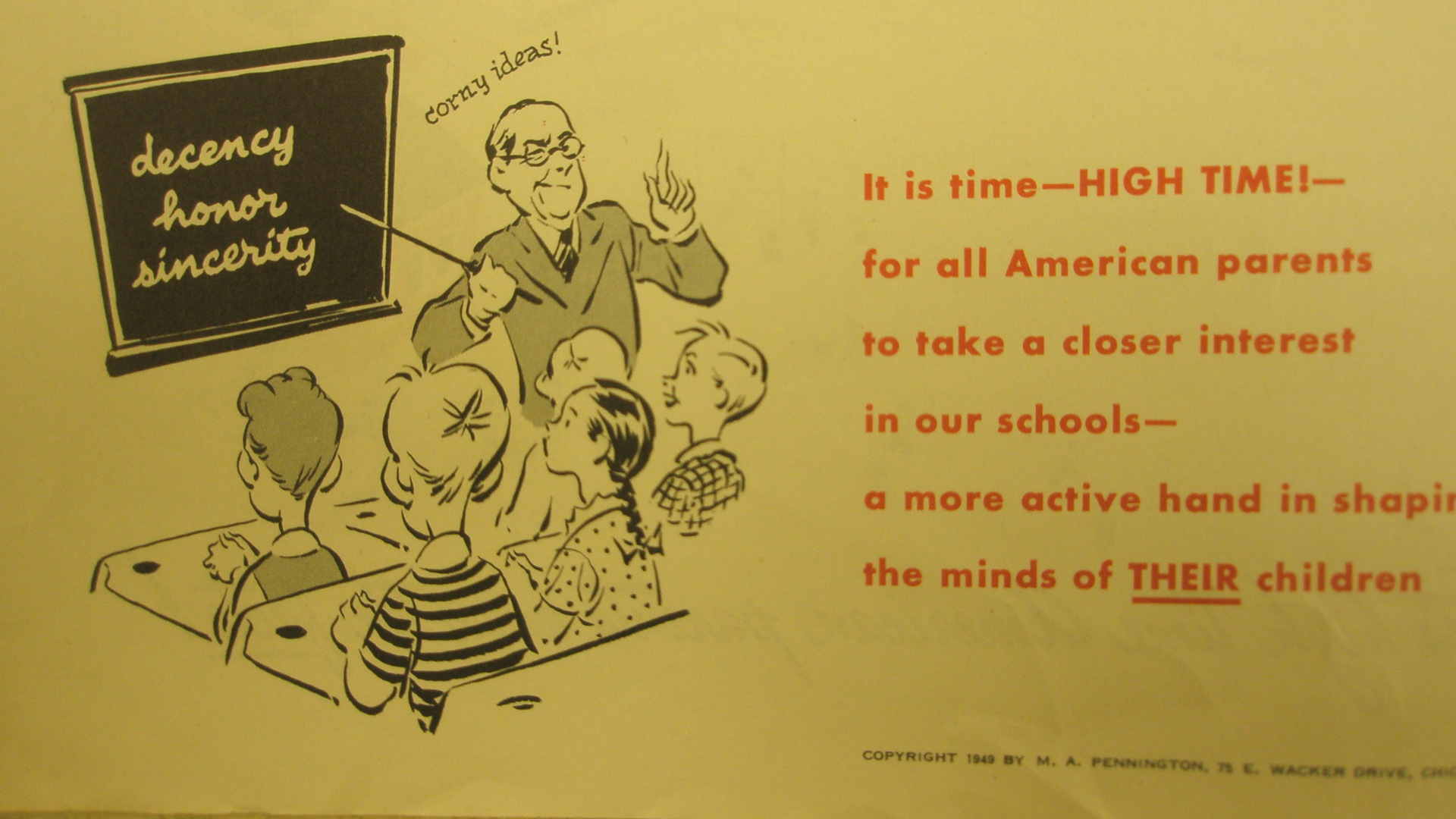
FROM THE ARCHIVES: Fundamentalism vs. Communism, c. 1949

In the twenty-first century, it can be difficult to remember the menace once posed to Fundamentalist America by communism.  Of course, it was not only Fundamentalist Americans, but most Americans, who shared a strong anti-communism, at least since the 1930s.  As historian Ellen Schrecker has argued, anti-communism WAS Americanism.

It is too easy to limit our understanding of anti-communism to a narrow campaign against one political group.  In Fundamentalist America, the fight against communism took on a broad array of meanings.  “Communism” itself came to include a vast spectrum of purportedly anti-American ideas, including anti-theism, progressive education, declining manners, anti-capitalism, disrespect for tradition, and so on.  Not surprisingly, the fight against communism came to include such notions as support for more public religion.  It often included support for traditional families and social relationships.  It also included a fight for more traditional teaching, both in content and in method.

To cite just one example, as President General Anne Minor of the staunchly anti-communist Daughters of the American Revolution insisted in 1923, Americans “want no teachers who say there are two sides to every question.”  Teachers must teach a strict patriotic traditionalism.  They must tell their students the correct answer, with the correct social values, every time.  Those “progressive” teachers who waffle and squirm, who infect their students with a crippling moral relativism, would eventually create a generation of insipid, unpatriotic Americans unable to defend against the menace of communism.

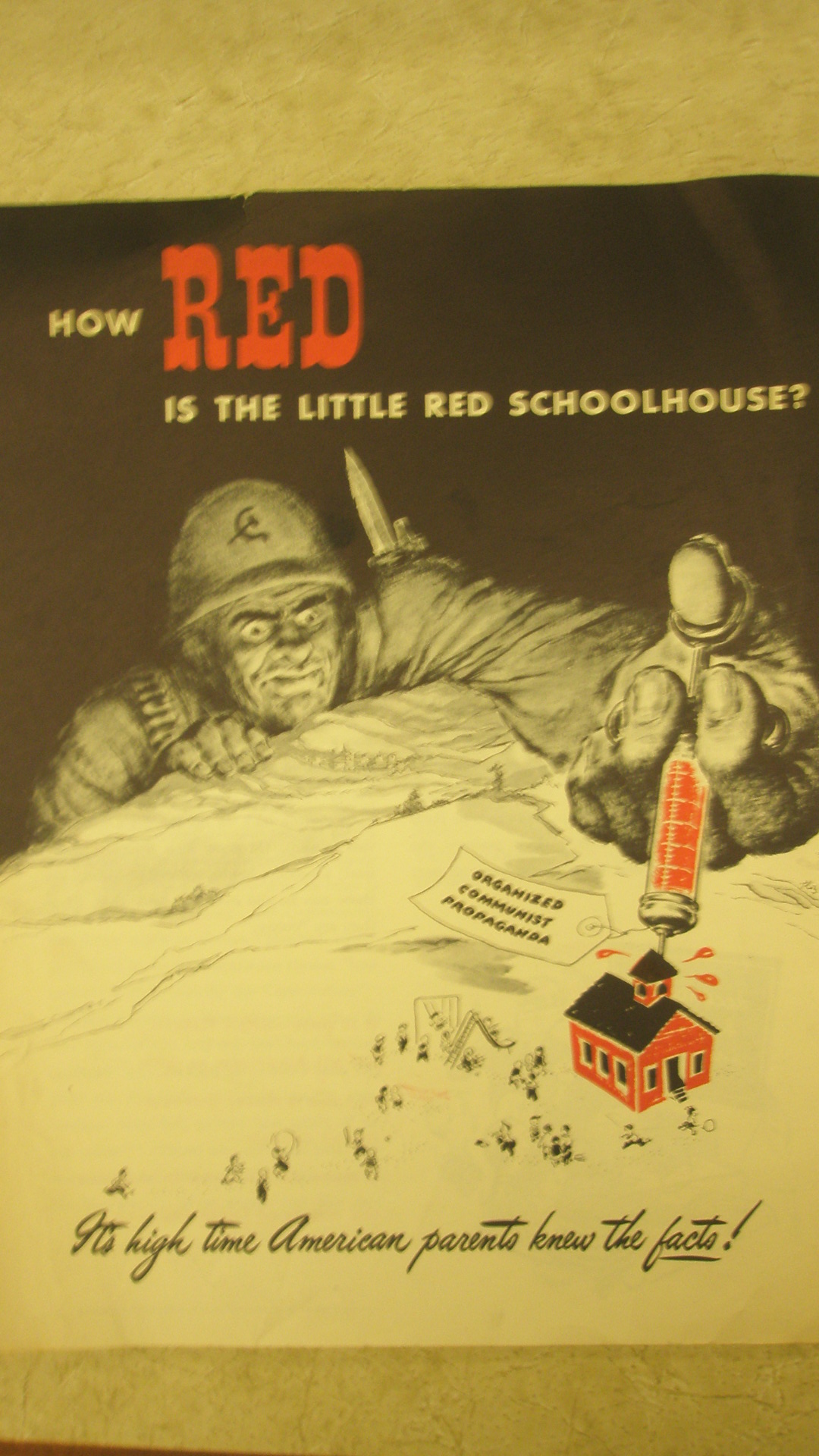
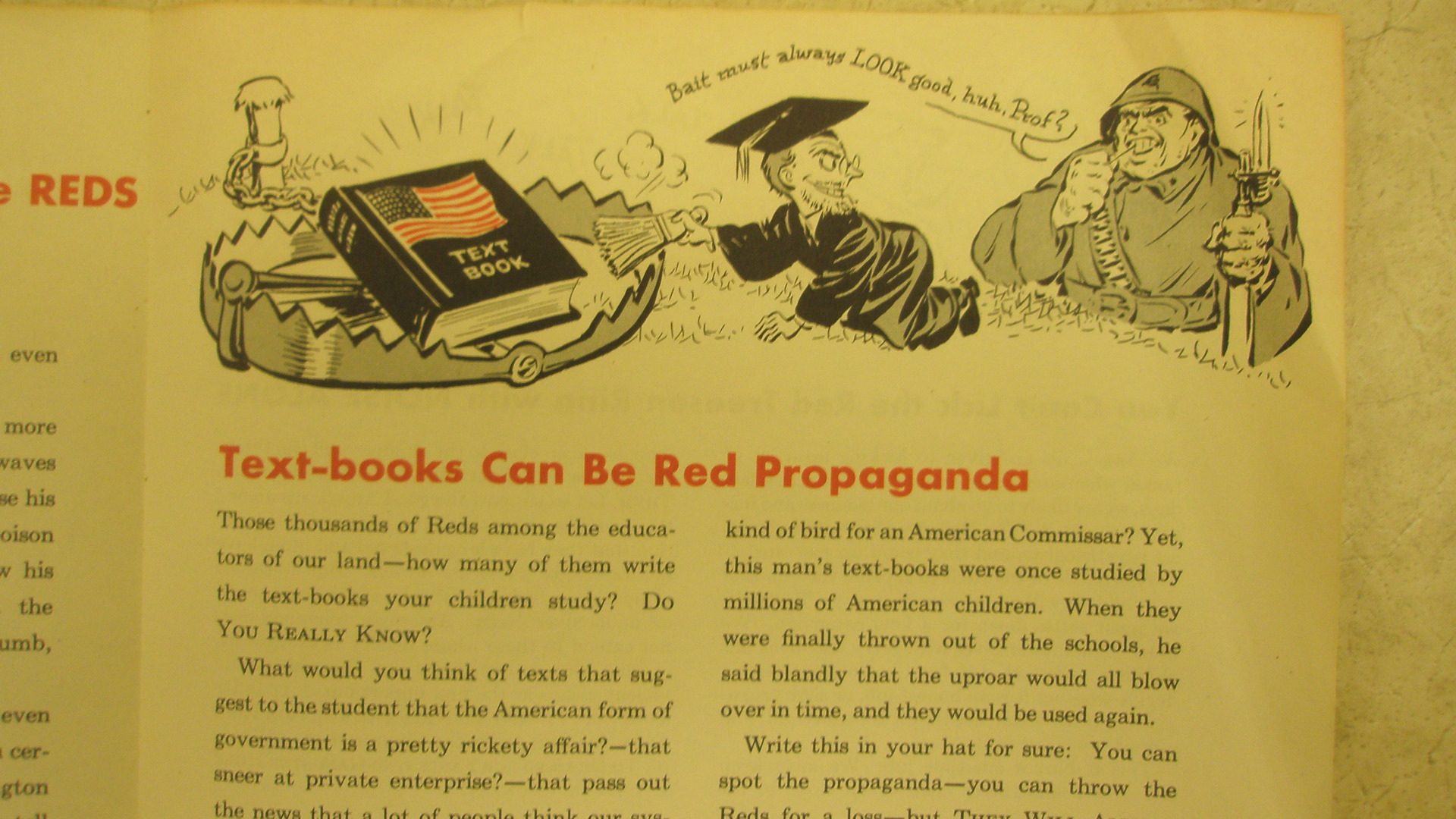
As always, a picture is worth a thousand words.  In this case, I’ll share some cartoons from an anti-communist pamphlet from 1949.  These cartoons demonstrate one common ideological thread in Cold War Fundamentalist America.  At the time, activists like the one who published this brochure felt that Communism threatened a two-pronged attack.  The danger included a military menace from Soviet Russia.  But it also meant internal subversion by dupes who did the work of the Red Army.  Intentionally or not, such subversive activity helped to weaken the resolve of America, making a communist takeover that much easier.

Further Reading: Ellen Schrecker, Many Are the Crimes: McCarthyism in America (Princeton: Princeton University Press, 1998); Jonathan Zimmerman, Small Wonder: The Little Red Schoolhouse in History and Memory (New Haven: Yale University Press, 2009).

This one shows the vast sweep of cultural ideology folded into the fight against communism. Not only must patriots fight communism, they must also fight to uphold traditional values.

Parents squeezing the “Red” out of textbooks.

As historian Jonathan Zimmerman has argued, the image of the “Little Red Schoolhouse” has long been a potent political symbol. In this cover image, the cartoonist makes a connection common in Cold-War anti-communism. “Reds” worked hard to subvert the Red Schoolhouse.

The scheming, bearded academic has long been an object of suspicion in Fundamentalist America. Here, he does the work of the Red Army.