Will Creationists Take Half a Loaf?

Okay, so here’s a deal: If science educators in public schools agree to remain neutral about creationists’ beliefs, will creationists allow teachers to teach their kids evolution?

I don’t rule the world, but if I did, that would be my cure for our creation/evolution battles.  Let me try to spell it out in a little more detail:

I’m working on a short book with philosopher Harvey Siegel, tentatively titled Teaching Evolution in a Creation Nation: Historical and Philosophical Perspectives.  Why would we attempt such a thing?  It wasn’t our idea.  Our little book will be part of a series cooked up by historian Jon Zimmerman and philosopher Randy Curren.  What if, they asked, what if we could get philosophers and historians talking to one another about educational issues?

This past weekend, the authors of these books gathered for a workshop at New York University.  Harvey and I made our case.  The high-caliber intellectual firepower gathered around the table asked lots of difficult questions.  Hardest of all, IMHO, was the one above: Will Creationists Take Half a Loaf?

In essence, given the long history of cultural battles over the teaching of evolution and creationism, Harvey and I make the following argument:

  • Creationism may or may not be science, but it’s not the best science out there.  Students in public schools must be taught the best science available.  At this point in history, that means the modern Darwinian synthesis.  (Bear with me for a minute here.  I know we can argue about what we mean by this, or whether or not that is the best name for mainstream evolutionary theory.  But for the moment, for the sake of argument, let’s proceed.)
  • Too many scientists and science teachers take this to mean that creationism must be purged from students’ minds.  If we consider creationism to be a form of religious dissent, that sort of attitude among mainstream scientists seems both cruel and pedagogically ineffective.
  • Teachers in public schools, therefore, must teach evolution.  Real evolution, not watered down with bogus religiously inspired alternatives.
  • But teachers must not make any claims on the religious beliefs of their students.  If students acquire a reasonable knowledge of evolutionary theory, their teachers will have succeeded.  Full Stop.  Public schools should tell students nothing about what religious beliefs they should hold.
  • In short, the goal of evolution education should be for students to understand or know evolutionary theory, but not (necessarily) to believe it.

One of the big issues that came up in our weekend workshop was whether or not students and teachers could really walk this line between understanding and belief.  How practical is it to ask students to “know” something they don’t “believe?”  But let’s leave that aside for a moment.  The question I’d like to ask this morning is different.

Assuming teachers could embrace this goal of “understanding-not-belief,” do you think young-earth creationists would go for it?  That is, would creationists who hold ideas that differ radically from the mainstream scientific consensus agree to allow their kids to learn evolution, IF the public schools agreed not to meddle with their children’s religious beliefs about evolution?

Smart people are skeptical.  With good reason.  At the recent blockbuster debate between young-earth creationist Ken Ham and science popularizer Bill Nye, for example, Ham did not take the role of a religious dissident, but rather insisted that creationism meant superior science.  Creationists have always insisted that their beliefs are better science, not just a religious dissent from good science.

So I ask again: Will creationists accept public education that teaches real evolution—and only real evolution—in science classes, IF that education remains stubbornly neutral about related religious beliefs?

Creation, Evolution, and College Marketing

Bryan College is having a rough time.  The school is experiencing angst as it wrestles with a new policy about the origins of humanity.  The leadership is insisting that members of the school community must adhere to a newly rigid position on origins.  All members of the college community, it seems, will be asked to sign off on a doctrinal statement recognizing that Adam & Eve represented the real, historical ancestors of all humanity.  Traditionally, faculty and students had been encouraged, or at least permitted, to embrace a relatively wide scope of Biblical opinions about the age of the earth and the historicity of Adam & Eve.

Some commentators have argued that this represents a false dilemma for Christians, or even that Bryan’s misery proves the failure of religion in the modern world.  But there is a simpler explanation.

Those familiar with the history of Bryan College can’t help but note the ironies here.  As I point out in my 1920s book, the founding of Bryan College was stymied by William Jennings Bryan’s unorthodox brand of conservative evangelical Protestantism.  Not only did the original Bryan not embrace the notion of a young earth, but Bryan was loud and proud about his postmillennial interpretation of Scripture.  For the growing fundamentalist movement in the 1920s, Bryan’s old-earth position was not remarkable or problematic.  Many leading fundamentalist thinkers in the 1920s had “liberal” positions about the age of the earth.  But Bryan’s postmillennial beliefs caused some worry.  Could “fundamentalists” be postmillennialists?  Such debates threatened to derail the funding of the new university in the 1920s.

Such arguments based on the history of Bryan College are relevant in today’s disputes.  The current leadership of the school insists that their new statement of faith is really only a clarification of their traditional creed.  Indeed, it would have to be, since part of that original charter stipulated that the creed could never be altered.

Faculty members at Bryan differ, however.  As we’ve noted in these pages, faculty members such as Bryan Eisenback have crafted innovative school curricula that hope to teach evolution to Christians in a Christian way.  As described in a recent article in Chattanooga’s Times Free Press, Eisenback has been accused of teaching both evolution and creationism.  As Eisenback described to the TFP,

In my view, God gave us science to learn about the physical world.  When people embrace that, science is our way of understanding God’s handiwork, so to speak, then science isn’t threatening. It becomes exciting.

As usual, Josh Rosenau of the National Center for Science Education offered a sensible argument in the pages of the TFP.  Bryan’s leadership, Rosenau noted, seemed to be staking out a hard-line position unnecessarily.  “The evangelical position,” Rosenau argued, “doesn’t have to be an outright rejection of human evolution. There are ways to be a Bible-believing literalist without being at odds with science.”

Less convincing was the cackling triumphalism of science pundit Jerry Coyne.  In the pages of The New Republic, Coyne argued that the mess at Bryan College resulted from a necessary clash between advancing science and retreating religion.  “Bryan is fighting a losing battle,” Coyne crowed,

but it will be a long battle. These vestiges of superstition, and of blind adherence to it, will eventually disappear as America becomes more secular. There will always be Biblical literalism, but I’m confident it will slowly wane. But it will wane not with the changing of minds, but over the corpses of its adherents, as the older generation dies off and the younger, exposed to secularism and doubt on the internet, begins to ask questions.

I’m an avid reader of Coyne’s blog, but I don’t see how his argument makes sense.  The “older generation” he refers to is many generations derived from the founders of Bryan College.  A pile of the corpses of adherents to Bryan College’s conservative theology would be too high for any young people to climb over!

Corpse imagery aside, there’s a more important point to be made here.  College presidents want most of all to see their institutions thrive.  As the Chattanooga TFP article makes clear, the problem at Bryan College started when prominent young-earth creationist Ken Ham accused the college of falling away from Biblical orthodoxy.  The leadership of Bryan College faces a worrying prospect.  What if conservative evangelical parents no longer trust the orthodoxy on tap at Bryan?  What if they no longer agree to send their children and their tuition dollars to the school?

More than nuances in Biblical scholarship or evolutionary theory, college presidents must consider such things.  The dangers to the bottom line from the condemnation of Ken Ham are real and substantial.  Unless the leadership acted to shore up the impression of orthodoxy, they must have worried that their institution would become just another failed small religious college.

Let me be clear: I have no inside knowledge of the goings-on at Bryan College.  But it seems as if the simplest explanation here is probably the right one.  Beyond keeping the faith true, college presidents must worry about keeping the lights on.  In today’s climate, a bad review from the likes of Ken Ham could easily spell the end of any conservative evangelical school.


How Richard Dawkins Begat Ken Ham

Why is there creationism?  Marc Barnes at Bad Catholic makes the argument that today’s young-earth creationist movement is nothing more nor less than a theistic outgrowth of Richard Dawkins-style materialism.

Today’s sort of Ken-Ham-style creationism, Barnes correctly observes, is an entirely modern phenomenon.  Barnes doesn’t make the point, though he could have, that ignorant partisan anti-creationist hack jobs like that of Mark Stern in Slate miss the boat entirely when they accuse creationism of being “medieval.”  Nonsense.  Today’s creationism is a thoroughly modern affair.  Even the briefest familiarity with the history of the movement makes that point abundantly clear.

Today’s creationism, Barnes argues, is not a wholesale repudiation of the materialist viewpoint, though it falsely claims to be.  Materialism, after all, in this sense, means the assumption that life and everything has purely material origins.  Primordial soup somehow got a transformative spark, perhaps from undersea volcanic vents.  Life came from non-life due to purely material causes.  Similarly, life itself, though it may feel like it has transcendent spiritual meaning, is nothing more than biochemistry.  When the switch goes off, the magic ends.  Back to carbon.

Such a view of life separates God out entirely, Barnes points out.  And Ken-Ham-style creationists make the woeful mistake of simply plugging God back in, from the outside.  In other words, Barnes argues, young-earth creationists stupidly think that by insisting on a God who popped into time, created life and the universe, inspired a Bible, and sent his kid in to fix things, they have refuted materialist assumptions.  Not so, Barnes contends.  That sort of outsider God, a God who creates, judges, and saves, all from somewhere outside of, beyond the creation itself, actually endorses the materialist vision of life.  Instead of electricity as the prime mover, though, Ken Ham’s style of creationism plugs in a Bearded-Guy-in-a-Throne sort of God.

God, in this YEC vision, is a mere competitor with electricity for the role of life’s spark.  God, in this YEC vision, is simply the materialist understanding of life with a quick substitution of God for an unintelligent spark.

Instead of falling for this materialist presumption, instead of simply rebutting one part of materialist assumptions about life, real creationism needs to posit an entirely different relationship between the world and its Creator, Barnes argues.  As he puts it,

God is not simply the Creator of the material order, and the theistic tradition has never made such laughable claims. The concept of God as Creator has always been the source of existence as such. This means that God does not just answer the material question of “Where came this rock, that plant, or the entire conglomerate of material thingmabobs we call the universe?” He answers the ontological question: “Why is there something rather than nothing?”


Evolutionists Roast Ham

HT: AS

Thanks to the brilliant Matt Stopera, we also have a series of 22 questions evolution-believers would like to ask Ken Ham.

[If you’re just joining us, you can catch up on the details of the Ham-on-Nye debate here; some analysis here; and some of Stopera’s creationist questions here.]

As a preamble, let me remind readers that I am a “self-identified evolutionist” myself, so my comments here will be more along the lines of family disagreements than were my comments about the creationists’ questions.

I cringe the most when I see the snark inherent in some of these questions.  Worst of all, one questioner asked about the Flintstones.  This kind of question just poisons the well.  If I were a young-earth creationist reading this, it would reassure me that everything I believed about mainstream intellectual/scientific culture is correct. First, this kind of question demonstrates a determinedly hostile attitude toward creationist belief.  Second, it implies that creationists believe things they don’t really believe.  Third, it doesn’t demonstrate any knowledge about evolution or science, only a knowledge of kitschy old TV cartoons.  Finally, it proves that only creationists are willing to talk politely and civilly to those with whom they disagree.  As Ken Ham tried to prove in the debate itself, many creationists believe that evolution believers are “indoctrinated” into believing evolution by fake science that has “hijacked” the name science for its own anti-God purposes.  Closed-minded burns like this Flintstones question demonstrate first and foremost–to any intelligent creationist–that Ham was right.  Evolution, this question implies, is something we’re not even willing to talk about.  All we can do is make fun of those with whom we disagree.  A shameful repudiation of liberal civil values.

Also sad, some questioners chose to make only assertions.  One woman wrote happily, “Science rules!”  Not exactly a proud demonstration of the clear intellectual superiority of the modern evolutionary synthesis.

Happily, other evolutionists asked better questions.  The best point Nye made during the debate, IMHO, was the irrefutability of the fossil record.  Find a single exception, Nye repeated, and you’ll convince me.  The evidence is clear.  Several questioners challenged Ham to address that issue more clearly and directly.

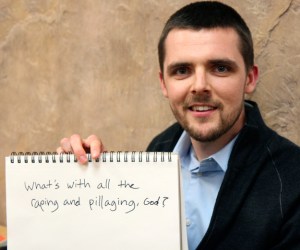
Other evolutionists, surprisingly, focused on religious themes.  As one guy put it, “What’s with all the raping and pillaging, God?”  Now, this doesn’t have anything to do with evolution directly, but I think religious questions are the proper field of discussion here, not scientific ones.  It makes the most sense to me for evolutionists to challenge creationists–especially Ham’s brand of young-earth creationist–on the theological and logical problems with the religious attitudes at the heart of YEC.  Why should we believe in a six-day creation, in other words, and not the rest of the Old Testament?  Of course, intelligent YECs have answers to those questions, but by asking religious questions, IMHO, we keep this discussion where it properly belongs.

Stoperas HamOther questions seem less well thought out.  One person asked, for example, how one could doubt evolution, since there were entire disciplines devoted to it?  That seems like an ignorant question to me.  Why would anyone assume that something that gets studied a great deal must be true?  The history of science can give us plenty of examples of radically untrue notions that attracted lots of academic attention: quantity of angels on pins, phlogiston, phrenology…the list could go on and on.

Some smart questions demonstrated a more understandable ignorance.  One person, for instance, asked, “How can you deny microevolution?”  A good question, but one that shows a lack of knowledge about today’s young-earth creationism.  Creationist scientists these days are actually some of the most ardent advocates of the distinction between “micro-” and “macro-” evolution.  Creationists eagerly agree that microevolution occurred.  In the debate, Ham referred to this as the changing of God’s original “kinds.”

Finally, several of the questions asked about educational issues, the questions near and dear to our hearts here at ILYBYGTH.  Some were silly, such as one who said he required his textbooks to be newer than 4,000 years old.  This is not only silly in the obvious sense that creationists use lots of new textbooks, but in the deeper sense that YECs would call the Bible a “textbook” only in a unique sense.  The Bible to many YECs is indeed a storehouse of knowledge, but it is much more than that.  As Ham argued in the debate proper, the Bible has a unique status, something much more than a textbook.

Another made the great argument, “Keep religion out of my science classes!”  Even better would be if this person added, “Keep YOUR religion out of my science classes.”  This is indeed a strong point.  Whatever one may say about it, even Ken Ham agrees that YEC is a belief based in religion.  Indeed, he goes through verbal (and mental) gymnastics in his efforts to prove that evolution is also a religion.  Both sides agree, though, that science classes in public schools ought not teach religion.  And intelligent YECs admit that their evolutionary beliefs are frankly religious.

OK, nuf sed.  Three cheers for Matt Stopera.  This 22-vs-22 has been at least as illuminating as the debate itself.


Creationists Grill Nye

HT: NBR

What did creationists want to ask Bill Nye?  In Tuesday’s big debate, we heard a series of audience questions, but there must have been many audience members who still wanted to ask more.

Journalist Matt Stopera was there, and he asked self-identified creationists what they would wanted to have asked Nye.  Whatever your analysis of the debate, these questions help us understand what creationists thought of Mr. Nye and his presentation of the evolutionary worldview.

Some of the questions demonstrate ignorance of mainstream evolutionary science.  One respondent, for example, wondered why there were still monkeys if we came from monkeys.  That’s not what evolution says.  This is the sort of simple, naïve ignorance that too many non-creationists think makes up all of creationism.  A couple of other questions asked similarly naïve questions.  How can there be a sunset without God, one asked.  Another asserted that since the world was “amazing,” there must be a God.  It doesn’t take a Bill Nye to poke scientific holes in that sort of naïve creationism.

But that’s not all there is to the intellectual fabric of American creationism.  The other questions show the diversity among creationists.  One question asked simply, “What about noetics?”  Another woman wondered how we can understand salvation if we believed in evolution.  Another challenged Nye: “Are you scared of a divine creator?”  Two people asked about the Lucy fossils.  Some asked what caused the Big Bang.  When this came up in the debate itself, Bill Nye frankly and enthusiastically responded that he did not know, but that non-knowledge and the excitement of discovery lay squarely at the heart of real science.

stopera nye

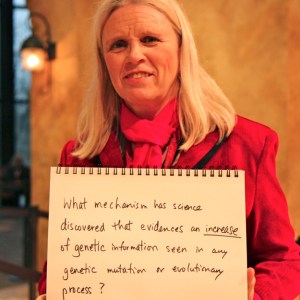
Some of the questions showed that creationists have learned science, but a very different science.  For instance, one woman wanted to know how evolution could account for an increase in genetic information.  This is a question mainstream science can answer, but it is often presented by creationist scientists as a decisive disproof of mainstream evolutionary science.  What does it matter?  It shows that some creationists are not simply unaware of mainstream science.  Rather, their knowledge about evolution has been occluded by a compelling–if not scientifically accurate–counter-knowledge.  This is different from people who just don’t know about evolution.

Several questioners wanted to ask Nye about schools.  “Are you influencing children in a positive way?” one asked.  Why not teach more than one “theory” of origins, a couple more wanted to know.

Thanks to Stopera for sharing this fascinating gallery of creationist conundrums.


Debate Analysis

So, the Ham-on-Nye has come and gone.  For those of you who missed it, you can still watch the debate for a couple of days.  Or you can follow our comments and discussion from last night.

I’m very curious to hear people’s reactions.  For me, as someone convinced that humanity had its roots long ages ago in a process that did not need (or receive) any divine guidance, I certainly did not hear anything from Ken Ham to make me question my beliefs.  Though I did find Mr. Ham to be engaging and warm.  Speaking from the “evolutionist” side, I thought Nye did a good job, though I wished several times that he had taken different approaches.  For example, I think it is a bad strategy to focus on the unlikelihood of Noah’s Ark.  As Steve Carrell can tell you, such questions can all be answered with a steadfast belief in the power of the supernatural.  They do not need to make naturalistic sense.

As I describe in my upcoming book, William James Bryan handled this “village atheist” objection nearly a century ago.  When arch-skeptic Clarence Darrow put Bryan on the stand at the 1925 Scopes Trial, Darrow pressed Bryan on the believability of the Bible.  How could Joshua have told the sun to stand still?  Didn’t Bryan know that such a feat would cause the Earth to melt?  Bryan’s reply shut down Darrow’s attack, IMHO.  As Bryan put it, to cheers from the audience, if Darrow had trouble believing in miracles, the problem lay not with the miracles, but with the man.  It does not seem as if Nye understands this fundamental epistemological attitude among many religious people, not only young-earth creationists.

How about you?  Did any creationist readers find Mr. Nye’s arguments new or worth consideration? 

Were there any other parts of the debate that you found surprising or intriguing?

Personally, I thought the best part of the evening were the last section, when both speakers took audience questions.  Questions two and four were the best.  Each asked Nye to explain a fundamental mystery of origins, to which Nye replied in each case, “Don’t know.  It’s a remarkable mystery.”  Then, in each case, Ham rebutted that it was not really a mystery at all.  It was explained in the Bible.  It was a humorous exchange, and illuminated the difference between mainstream science and Biblical knowledge.

Time for Ham on Nye!

Getting ready to watch the debate.  For those who are just emerging from their winter hibernations, I’m talking about the debate at the Creation Museum between young-earth creationist Ken Ham and “The Science Guy” Bill Nye.  You can watch live via debatelive.org.

I’ll update this post throughout the evening if anything comes to mind.  All are encouraged to put in their two cents in the comments column.

Here are some of the things I’ll be looking for:

  • Will Ham harp on the “observational” vs. “historic” science argument?  If so, will Nye call him out on the non-scientific nature of that argument?
  • Will everyone keep smiling?  If not, who will crack, and how?
  • Along those lines, will the Creation-Museum crowd give Ham an enormous home-field advantage?
  • Will Nye make the bad argument that creationism somehow prevents people from learning mainstream science and engineering?
  • Will Nye demonstrate his lamentable ignorance about the culture and history of American creationism?
  • What will either side say about other sorts of creationism, such as intelligent design, evolutionary creationism, or old-earth creationism?  I’m guessing neither will even mention them.

OK, nuf sed!  I’m going to go eat a taco and open a beer.  See you when the debate gets started.

_____________________________________________________________________________

6:30: While we’re waiting, I encourage everyone to consider looking into the history of creation/evolution debates.  As usual, the best source for these things is with my grad-school mentor Ron Numbers.  Ron’s blockbuster book The Creationists includes great source material about the long tradition of public debate about evolution.  Even more nerdily compelling, Ron edited a collection of debates themselves.  The volume is harder to find, but anyone with a decent-sized university library nearby should be able to find it or request it via inter-library loan.  For all with an interest in the history of these debates, it’s vital reading.

_____________________________________________________________________________

6:30: I gotta give the Creation Museum credit.  The other day when I tried to register to watch, I was a little skeptical that they would have it working properly.  But now they’ve got a nice set up with the format listed along the right side and an exciting countdown clock going.

_____________________________________________________________________________

6:45: We’ve got music!  And a visual of the Nye-Ham weigh-in…  I like the titles: Ken Ham, AIG CEO; Bill Nye “The Science Guy”

_____________________________________________________________________________

6:53: Ugh…whoever wins this debate, it won’t be the person who picked this elevator music…

_____________________________________________________________________________

7:00: Here we go! What’s going on?  A Ken Ham cartoon?  Kids come free–an ad for the Creation Museum.  We’ve been welcomed!  “Hundreds of thousands watching online.”  That’s us!

_____________________________________________________________________________

7:02: Who knew the moderator could make jokes?  Where did we come from?  He came from DC on a plane! Yuk yuk.  And a coin flip?  Perfect for a Broadway Joe Superbowl joke…

______________________________________________________________________________

7:04: Did Ken Ham just say, “I’m a Nazi?”  Oh… “I’m an Aussie…”

Ham’s lead-off: evolutionists have “hijacked” the name of science to squeeze out creationism.

And he’s got experts: Stuart Burgess.  I’m not familiar with Burgess.  Anyone else?

______________________________________________________________________________

7:07: Sure enough, Ham is leading with his main argument: “observational” vs. “historical” science.  Not the best approach.  But a better argument: we don’t need evolution to be good technologists.  A middle path: forcing evolution on school children is actually a religious argument.

______________________________________________________________________________

7:09: Nye’s turn at bat: He leads with a joke about bowties.  And a long anecdote for a guy with only five minutes to talk.  Grandpa and his bowtie.  Maybe that will be a good way to make “evolutionists” seem less terrifying.

Oooh.  Nye is changing the question.  His new version: Does Ken Ham’s creation model hold up?  Looks as if he’s taking on Ham’s observational/historical distinction.  Wow!  Nye is great.

If CSI can tell about the past from clues, then so can scientists.  All of them use the SAME science.

Uh Oh, Nye is breaking out his less-powerful argument that creationists can’t be good technologists or engineers.  That one just doesn’t hold up!

______________________________________________________________________________

7:16: Raymond Demadian.  A young-earth creationist and inventor of the MRI.  Now Danny Faulkner, AIG astronomer with PhD.  This is what worries me about Nye’s argument that creationists BY DEFINITION can’t do science or technology.  It is easy to find people who can poke holes in that assertion.

This bit drives mainstream science bonkers.  This is why the NCSE does its Project Steve.

7:20: Ham’s “We weren’t there” argument just doesn’t do much.  I think Nye’s CSI intro was a great way to predict this and defang it in advance.

NOW A GOOD ONE: a challenge for Nye–can Nye name a single technology that couldn’t be designed by creationists?

And snappy graphics: cartoon Nye vs. cartoon Ham.  The same evidence, interpreted differently.

7:25: Ham spends some time explaining the fact that evolution occurs, but only within biblical “kinds.”  That is, two ur-dogs on Noah’s ark created wolves, foxes, dogs, etc.

7:29: Whoops! Ham insists that public-school science teaches religion, since they teach evolution that has no basis in observational science.  Based on belief, not on observations.

Is it just me, or does Ken Ham seem nervous?  I’m surprised, since he is such a polished performer and public speaker.

7:32: Smart tactic, Mr. Ham.  He takes on Darwin as a racist thinker.  Biblical creationism, in contrast, insists that there can be no real racial differences.  Of course, he doesn’t explore the notion that today’s evolutionary scientists no longer argue that evolution proves the differences between races.  Nevertheless, as a political tactic, this makes good sense for Mr. Ham to focus on.

7:35: not as powerful: Ham keeps insisting (as we thought he would) on the intellectual paucity of “historical science.”  It would be a stronger argument to non-creationists like me if Ham kept it simpler–asked mainstream science to admit that there is SOME belief implicit in mainstream science.  But that belief does not inhere in mainstream science’s use of “historical science.”

7:37: Now Ken Ham enters into the theological roots of his belief system.  “We make no apology” for our religious roots.

7:40: Looking at Texas textbook battles.  Ham says the news slants the coverage, pitting “creationists” against “academics.”  Says that Kathy Miller of the Texas Freedom Network is really the one imposing religion on public school students.  By insisting on evolution, kids are indoctrinated in a belief system instead of discovering truth on their own.

7:42: More preaching to the choir.  Evolution leads to more abortion.

And, what’s the real point?  According to Ken Ham, young people must learn first and foremost that God loves them.

______________________________________________________________________________

7:45: Now it’s time for Nye’s longer presentation.  Starting with limestone.  “We are standing on millions of layers of ancient life.  How could those animals have lived their entire lives in just four thousand years?”

7:48: As an “evolutionist” who reads creationist literature, I can hear the voices of creationist disputing Nye’s anti-flood, anti-young-earth examples–though there might be ancient trees and ancient rock layers.  But that does not refute the central argument of Ham and other YECs that such things are not observed, but assumed.

Oh, wait!  This fossil stuff is great.  There is NO EXAMPLE OF FOSSILS THAT CHANGE THE ORDER OF EVOLUTIONARY THEORY.  A flood would have produced much more turbulence.  Will this convince any YECs in the audience?

7:52: here’s another good one: If animals were all on the Ark, where are the kangaroo fossils on the way from Mt. Ararat to Australia?

How could one family have built an ark so big?  That doesn’t make sense.  Other great shipbuilders could not build a wooden ship that lasted in seas.  How could eight people have built a sea-worthy wooden ship?  Of course, the YEC answer here is easy: God can make anything happen.  I’m worried Nye here is not reaching any listeners.  Same with other arguments that Nye is not making: How could Jonah survive for days in a fish?  Etc.?  The answer is easy, and was the argument made by William Jennings Bryan in the 1925 Scopes Trial: Miracles are easy to believe if one has faith.

Plus, if all 16,000,000 species evolved in the last 4,000 years from the 7,000 “kinds” that went on the ark, that would mean we’d be seeing 11 new species every day.  Where are they?

I wonder if these mind-blowers will cause any creationists in the audience to reconsider their beliefs.  Or will they just dismiss them as bitter ravings from a confused non-Christian.

8:02: Nye overuses the word “remarkable.”  He uses it both in the usual sense, and as a veiled criticism of Ham’s scientific model.

Also, I wonder if Nye’s repetition of his sex argument (he’s making the point that some animals get genetic benefits from reproducing sexually, even in some fish species that are capable of asexual reproduction) will make some YECs uncomfortable.  Implies that Nye is a little too comfortable with sex.

8:13: good call, Mr. Nye.  The US Constitution says we should promote science.  But don’t specify this is only an issue for Kentucky, Texas, and Tennessee!

______________________________________________________________________________

8:14: Time for rebuttals.  Ken Ham first.  How does he rebut radioactive dating?  Dates done by this method produce inconsistent results.  Stuff in the same layers show very different dates.  Plus, dating methods assume constant rates.  How do we know this?

And watch out for Christians who believe in an ancient earth.  Death cannot have happened before Adam’s fall.

______________________________________________________________________________

8:20: Nye’s rebuttal.  Dating methods ARE reliable.  Why is the translated Bible a better source.  To Nye, that reliance on the Bible is “unsettling, troubling.”  But, again, why should it convince YECs if Nye is unsettled?

Nye condemns Ham’s argument as “magical.”  How will that convince someone who agrees wholeheartedly that it is miraculous?

If we use the Bible as a science text, what does that mean?  That Mr. Ham’s words are somehow to be more respected than what people can observe themselves.

Also, evolutionary theory is not racist.  Rather a simple matter of historic ethnocentrism.

______________________________________________________________________________

8:25: Ken Ham counter-rebuttal.  Bears are vegetarian.  But they have savage teeth.  Fruit-bats, too.  That does not prove that lions might not have been vegetarians before the flood.  And why couldn’t Noah have built a better ark than we could later?  Don’t assume that people in the past were not as smart as modern people.

______________________________________________________________________________

8:30: Nye counter-rebuttal.  Says Mr. Ham did not come close to addressing the huge problems with the numbers raised by the idea of a young earth.  Where did all the species come from?  There just isn’t enough time.  Nye says it is not “reasonable” to think Noah and 7 helpers could have built an ark.

What’s the central issue?  Ham says we can’t make assumptions about the past.  Nye says these are legitimate, not just made up.  Why should we accept Ham’s word for it that natural law changed completely four thousand years ago, without leaving any record?

And what about all the billions of religious people who disagree with Ham’s vision of the origins of life?

Whoops!  Says Ham’s model is based on the Old Testament, not the New.  That seems like another reach for Nye.  Those are questions YECs and others have debated for a looooooong time.

Great point: real scientists welcome proof.  If there is proof of a very different fossil record, no one wants to see that more than real scientists.

______________________________________________________________________________

8:35: Q&A from the audience.

Question 1: for Ham: How does creationism account for the celestial bodies . . . moving further apart?

Ham: That’s in the Bible.  God says he is stretching out the heavens.

Nye: Where did we come from?  We all ask it.  Astronomy is a science devoted to this question.  They are not satisfied with an answer from the Bible.

Question 2: For Nye: How did the atoms that created the Big Bang get there?

Nye: We don’t know.  Scientists engage in what we call science in order to find answers.  We do not take anyone’s word for it.  Nor even The Word for it.  This is the heart of real science.  This is the problem with Ham’s approach.

Ham: There is a book that tells us the answer.  “That’s the only thing that makes sense.”  How else would there be matter?  It could only come from “intelligence.”

Question 3: Scientists produce evidence for evolution.  Besides the Bible, what evidence can you produce?

Ham: Don’t make an argument based on what the majority of scientists believe.  We can see from history the danger of relying on the majority of scientific opinion.  When it comes to the past, we can’t know scientifically, we can only know through belief.  We’re honest, mainstream scientists are not.

Nye: If any scientist makes a big discovery, that scientist will be embraced.  Science progresses by seeing what works and by always challenging its own assumptions.  It is not true (totally) that science is dictated by majority belief.

Question 4: for Nye: How did consciousness come from matter?

Nye: “Don’t know. This is a great mystery.”  Science is all about the joy of discovery.  We want to find out the answer to this question.  Something about dogs?  And self-doubt?  We must encourage young people to investigate the question of consciousness.

Ham: Goes for the laugh!  There is an answer, Bill.  It’s all in the Bible.  It is not a mystery.  And if it’s all about discovery, what about life after death?

Question 5: for Ham: What if anything would ever change your mind?

Ham: pause….”I’m a Christian.” As such, he goes by God’s guidance.  The Bible is the Word of God.  You can make predictions based on that.  I can’t prove that to you, but I can say, try it.  See if God will reveal Himself to you if you ask Him.  “No one’s ever gonna convince me that the Word of God is not true.”  But that doesn’t mean they don’t keep learning and asking and inquiring.  Would Bill Nye ever change his mind?

Nye: All I’d need is one piece of evidence.  One fossil in a different layer.  One piece of evidence that stars appear to be far away, but they’re not.  Says he would change his mind immediately.  GREAT ANSWER.

Question 6: for Nye: Is there evidence for the age of the earth besides radiometric evidence?

Nye: Deposition rates, seen by Lyell so many years ago.  Plus, radiometric evidence is very strong.  The weight of the evidence is so strong that creationists need to find a way to disprove it somehow.

Ham: The age of the earth came from studies of meteorites, not earth rocks.  Every dating method is faulty.  But most dating methods say the earth is much younger.

Question 7: For Ham: Can you reconcile the change in the rate continents are now drifting, to the rate they would have had to have traveled 6,000 years ago?

Ham: This also proves my point about historical vs. observational science.  Our researchers look at this often.  Plate movements today don’t necessarily equal the rates in the past.  That is an unwarranted assumption.  We believe in catastrophic plate tectonics.  A big shift at one point in time.

Nye: The evidence for sea-floor spreading is clear.  It leaves a record in the rocks.  We can measure rates of continental drift.

Question 8: for both: favorite color?

Nye: Green.

Ham: Blue.

Question 9: for Nye: How do you balance the law of evolution with the second law of thermodynamics?

Nye: Energy is always lost to heat.  Entropy increases.  Here’s the kicker: the earth is not a closed system.  The sun is always delivering energy.  Day and night.  Ha ha.

Ham: Energy or matter will never produce life.  God imposed information.  Matter could never do it alone.

Question 10: for Ham: Could evidence of an ancient earth make you change your belief in God and Jesus?

Ham: Science could never prove such a thing.  It would be “historical” science and therefore based on possibly faulty assumptions.  Therefore, the question doesn’t make sense.  I believe in a young universe because the Bible says it.  Frankly and openly.  But there is nothing in real science to contradict that.  There is nothing that will make me change my belief.

Nye: You CAN prove the age of the earth using observations.  Ham thinks everyone should take his word for it.  His vision of a book translated into English.  How does he know that life cannot come from something that is not alive?

Question 11: For Nye: Is there room for God in science?

Nye: Billions of people are religious and yet embrace science.  Does anyone here not have a phone?  Anyone here who doesn’t use medicine?  Anyone who doesn’t eat?  Science makes life possible.  That has nothing to do with religion.  People can be religious, for example Francis Collins.  Ham is the exception, not the rule, for religious people.

Ham: God is necessary for science.  I love technology.  All of that has to do only with “observational” science.  God makes science possible, since God created logic and natural processes.  The Bible and science go hand in hand.

Question 12: for Ham: Should the entire Bible be taken literally?

Ham: “Literally” has many different interpretations.  I take the Bible “naturally,” i.e., in the sense in which it was intended.  One can’t insist on Old Testament rules as laws today.

Nye: Only certain parts of the Bible are to be taken literally?  Others are assumed to be just poetry?

Question 13: for Nye: Have you ever believed that evolution was accomplished through way of a higher power?

Nye: The idea of a higher power can’t be proven or disproven.  We can’t know some things.  But intelligent design is a different matter.  ID has a “fundamental misunderstanding of the nature of nature.”  The watchmaker analogy doesn’t hold.  Nature adds complexity through natural selections.  Better designs survive.

Ham: Are there any examples of new functions that arose from genetic material that was present?  It doesn’t happen.  The information has to have been already present.  Information is not created.  Just switched on or off.

Question 14: for Ham: Name one institution. . . other than a church . . . that uses . . . creationism to produce its product.

Ham: Any scientist uses creationism.  They all use the laws of logic, which only make sense in a God-created universe.  Otherwise, how can we count on natural law if we don’t assume an all-powerful creator?  This is the only way to raise a generation of innovative youth.  Teach them to trust natural laws created by God.  Plus, creationist scientists publish in secular peer-reviewed journals.

Nye: Creationism does NOT have a predictive quality.  A Biblical worldview is only shared by a few people. What about everyone else?  Were they condemned?

Question 15: for Nye: If evolution says that humans are getting smarter, what about smart people in the past?

Nye: Wait: that is not evolution.  It does not mean that people are getting smarter.  Natural selection does not mean the best.  It means those that fit in the best.  The right germ could kill millions.  No matter how smart.  Those who are resistant will survive, not those that are smartest.

Ham: Evolution says that some fish will lose their sight.  That’s not an improvement.  Evolution never provides new information, new function.

Question 16: LAST QUESTION: for both: What is the one thing. . . upon which you base your belief?

Ham: Easy.  The Bible.  Salvation relies upon it.  Test it for yourself.  Look at the evidence.  It all proves what the Bible says.  God can prove it to you, too, if you seek after Him.

Nye: I believe in the process we call science.  It is always a process of discovery.  It is a process of always seeking new answers.  We can all do it.  We are all seekers after knowledge.  Closing point: if we abandon science, we will lose out to other countries.  The USA must embrace science education.

______________________________________________________________________________

You can see the whole thing at debatelive.org for several days.

I’m going to bed.  Emotionally exhausted.  I’ll offer some thoughts soon on this debate.  In the meantime, thanks to all for playing along.  Please let us know what you thought.

  • Did one side come out on top?
  • Did anything surprise you?
  • If you started the debate strongly on one side or the other, what was the strongest argument you heard from the other side?  What drove you bonkers?


Join ILYBYGTH for the Debate

You know you’re going to watch the debate tomorrow between young-earth creationist Ken Ham and science popularizer Bill Nye.  So why not join us as we live-blog throughout the event?

It will be streamed live at 7 PM New York time and will be found at debatelive.org.

We will offer live commentary and invite readers’ comments as the debate moves along.

We’ll be especially interested to see what sorts of arguments each speaker will bring out.  As we’ve discussed before, this debate might have the effect of imposing a limited definition on the meanings of “creationism.”  But will it?  Watch it with us and let’s see.

Creation Debate Update: Squeezing Out the Middle

Forget the Super Bowl.  Next Tuesday, February 4th, at 7 PM New York time, we’ll all be watching the debate between young-earth creationist Ken Ham and science popularizer Bill Nye.  It looks as if Nye and Ham agree on their goals: squeezing out the middle.  Both debaters want to draw attention to young-earth creationism, and their agreement threatens to exacerbate the divide between evolution and creationism.

The debate host, Answers In Genesis’ Creation Museum, will be streaming the action live for all of us to see.

Ken Ham has suggested that the debate might be a perfect learning opportunity for teachers and students in public school science classes.  From Ham’s point of view, this debate might be a chance to reach students who might not otherwise be aware that mainstream evolutionary science is full of holes.

Bill Nye, too, has explained his reasons for engaging in this debate.  In these pages and elsewhere, evolution-education mavens have wondered if this debate only legitimizes the dead science of the young-earth creationists.  As “The Science Guy” explained, “I don’t think I’m going to win Mr. Ham over.”

So why debate?  Nye says, “I want to show people that this belief is still among us. . . . It finds its way onto school boards in the United States. . . . I’m not going in as a scientist as such . . . I’m going in as a reasonable man.”

So it seems both debaters have the same goal.  Both men want to make people aware of the claims of young-earth creationism.  From Ham’s perspective, such awareness will help keep smart young Christians from leaving the faith.  From Nye’s point of view, if people know what creationism is, they will help fight against it politically.

With such agreement, it seems likely both debaters might succeed.  This debate might elevate the profile of young-earth creationism.  One casualty, it seems, will be other visions of creationism.  Ken Ham’s brand of young-earth creationism, after all, is only one extreme form.  Many religious people believe that humans and life were created at some point by God.  But they do not believe that they must discard the findings of modern science.  The folks at BioLogos, for example, insist that fervent Biblical Christianity can go hand-in-hand with mainstream evolutionary science.  And “old-earth” creationists such as Hugh Ross agree that God did it all, but they don’t insist that he did it only 6,000 years ago.

If this debate succeeds—at least according to the goals of both Ken Ham and Bill Nye—those “other” creationist belief systems will likely get squeezed even further out of the conversation.  That’s a shame.  Too many observers already equate “creationism” with young-earth creationism.  It may make for more lively debates, but it makes for less productive and civil conversations.


What Should The Science Guy Say?

It’s coming up. 

In just a few short weeks, Bill Nye “The Science Guy” will debate the scientific premise of creationism with Ken Ham at Answers In Genesis’ Creation  Museum.

What should Nye say?

Science writer Greg Laden offered this morning a short list of points he’d like Nye to make.  In general, Laden suggests that Nye focus on the unscientific nature of creationism.  The debate over divinity was real and important in the history of science, Laden points out, but that debate has come and gone.  Laden doesn’t use the phrase, but his argument is reminiscent of philosopher Philip Kitcher’s definition of creationism as “dead science.”  In this vision, it makes no sense to debate the science of creationism, since creationism is not even bad science.  Creationism, rather, represents an understanding of science that has been thoroughly and completely discredited.    

Laden’s debate prep brings up two important questions.  First, what would people advise Ken Ham to say?  And second, do we agree with Laden’s advice to Nye?

First things first: What do you think Ken Ham should say?  For those of us who live mental lives outside the boundaries of religious creationism, is there anything he could say that would convince us that his creation science should be taken seriously?  For me, the answer is no.  I’ve defended Ham in the past and taken heat for it from ardent anti-creationists.  But in this case, I’ll be flummoxed if Ham uses any arguments beyond his scriptural stock-in-trade.  That is, I don’t guess Ham will try to convince people like me who are not moved by references to Biblical passages. 

I’m thinking Ham will likely harp on the scientific merits of young-earth creationism, when in fact his argument would be much stronger if he tried a different approach.  To people like me, at least, Ham’s scientific credentials have no leg to stand on.  But as religious dissenters young-earth creationists can claim much more wiggle room in education and culture.  If Ham wanted to reach out to people beyond the ranks of his current religious supporters, he should argue for creationists’ rights as aggrieved minorities, as a religious group, not as a contender for scientific legitimacy. 

But Ken Ham is not likely to take this approach, since he has built his career on the promise that young-earth creationism is better science than mainstream science.  He will likely trot out his compelling but ultimately vacuous arguments about observational science vs. historic science.  He will likely ask Bill Nye some variant of his ultimately senseless question: “Were you there?”  If Ken Ham hopes to maintain his role as the charismatic leader of the young-earth creationist movement, he can’t really do anything else. 

Question two: What should Nye say?  I don’t think Laden’s advice is the first best answer.  IMHO, the most effective answer to young-earth creationists such as Ken Ham is a theological one, not a pop-science one.  As do the folks at BioLogos, I think the most effective message young-earth creationists need to hear is that Biblical faith does not require faith in a young earth.  As science pundits tend to agree, young-earth creationism is not really science, it is something else.  It is an outgrowth of a particular religious understanding.  Therefore, the strongest arguments against it are religious, not scientific. 

Also, I don’t think Nye should use his precious exposure to creationists to blast the dead-science nature of young-earth creationism.  Many creationists will expect a hostile attack on their belief system.  They will not be moved by it.  They will not be convinced by it, since they will not credit its source.  I think it will be more effective for The Science Guy to do what he does best: explain what science is.  Young-earth creationism is based on a very different way of defining knowledge.  If Bill Nye can explain what real science is—instead of attacking the reasons why young-earth creationism doesn’t meet that definition—he can expose some of the creationists in the debate audience to a very different way of understanding the entire debate.